Author: Bouquets & Brickbats

Pomona

Unknown Unknown-1

03/11/15

Royal Exchange, Manchester

Something decidedly strange is happening on Pomona – the deserted concrete island that sits between Salford and Manchester in the middle of the river Irwell. In this dystopian future world, women are going missing in worrying numbers, while Gale (Rochenda Sandall) is taking extreme lengths to conceal what’s actually happening to them. Meanwhile, security guards Moe and Charlie, are charged with the task of guarding something hidden beneath the ground, something they don’t know anything about; and what does all this have to do with the ancient octopus-faced god, Cthulhu? It’s a good question and one I’m still not entirely sure I have the answer to.

Fresh from its success at the National Theatre in London, Alistair McDowall’s Pomona now makes its debut in the city where it’s actually set. It’s a labyrinthine tale, featuring seven disparate characters. The play’s themes: prostitution, sexuality and murder are probably intended to shock, but in truth these elements aren’t anything like as convincing as the ones that deal with Role Playing Games, something that seems to provide the main clue as to what’s actually going on here. The story isn’t told in a linear way – instead, it switches back and forth in time, so sometimes we know what’s going to happen to a character before he or she actually gets there.

The play begins with underwear-clad wheeler-dealer Zeppo (Guy Rhys) performing an extended monologue based around the climactic scene in Raiders of the Lost Ark for Ollie (Nadia Clifford) who is looking for her missing twin sister. Zeppo advises her not to look too hard, pointing out that a little knowledge can be a dangerous thing. But she goes looking anyway…

Individually, the ensuing scenes are mostly good, nicely acted and occasionally very funny – the ones featuring the hapless Charlie (Sam Swann) are particularly successful in this regard – and there are some nicely choreographed sections, where everything promises to fall into place, but never quite does. The fragmented nature of the work makes it feel more like a collection of short pieces in search of a story arc, so the overall play is somehow less than the sum of its parts, even if many of those parts offer much to admire.

Ultimately, I felt that Pomona was a little too pleased with itself for comfort – but the enthusiastic applause from tonight’s audience suggested that others found it captivating. One thing’s for sure. Here’s another play that will have you discussing its meaning long after you’ve headed for home.

3.8 stars

Philip Caveney

He Named Me Malala

MV5BMjQwODg2NDIyN15BMl5BanBnXkFtZTgwMTI4NDMwNjE@._V1_SY317_CR0,0,214,317_AL_

03/11/15

There are all kinds of movies for all kinds of audiences; and then there are films that are so important, you feel they should be required viewing for the entire population of every country it’s screened in. So it’s rather dispiriting to attend this advance showing of He Named Me Malala to find that only a dozen or so people have turned out to see it, while just next door, several screens are packed to bursting point for the latest Bond movie.

The Malala in question, is, of course, Malala Yousafzai, the young Pakinstani girl who in 2012 was shot in the head by Taliban soldiers for having the effrontary to campaign for something unthinkable: the right of a female to an education. They’d thought to make an example of her but against all the odds, she survived, to become something much more powerful than a martyr. She has become a figurehead for all women who long for and work towards equal opportunities. In 2014, she was awarded the Nobel Peace Prize, at which point the leaders of the Taliban must have realised that they had, almost literally, shot themselves in their collective foot.

This affecting documentary, directed by Paul Weitz, visits Malala in exile at her home in Birmingham. She is interviewed extensively as is her activist father, Zaiuddin, along with her mother and two brothers. The rest of the film is made up from newsreel footage, reenactments of some of the key scenes in her life and some eye-catching animation sequences which give an insight into the community in which she grew up. Malala is unbelievably charismatic and articulate beyond her years. It’s ironic that her name came from the folk story of a legendary young girl who led her country’s warriors into battle with the British and was shot dead in the process. We see her conversing with Presidents and Prime Ministers, we hear her speaking to the United Nations and we begin to appreciate that it’s more than just circumstance that has put her into the the world’s gaze. What she has to say is extraordinarily affecting and it’s a cold soul indeed who won’t tear up at the film’s poignant conclusion.

As a reviewer, I might argue that the cinematography could have been better, that the score might have been improved, that certain ideas were not pursued to their full extent; but given the incredible power of the subject matter, and the charisma of Malala herself, I can’t really do anything else but give this full marks and implore people to go and see it while you have the opportunity. Bond will be around for ages and sadly, based on the evidence of tonight’s screening, this lovely film may not.

5 stars

Philip Caveney

Bistrot Des Alpilles

IMG_1659bistrot-des-alpilles_54051_5d9

30/10/15

St Remy de Provençe

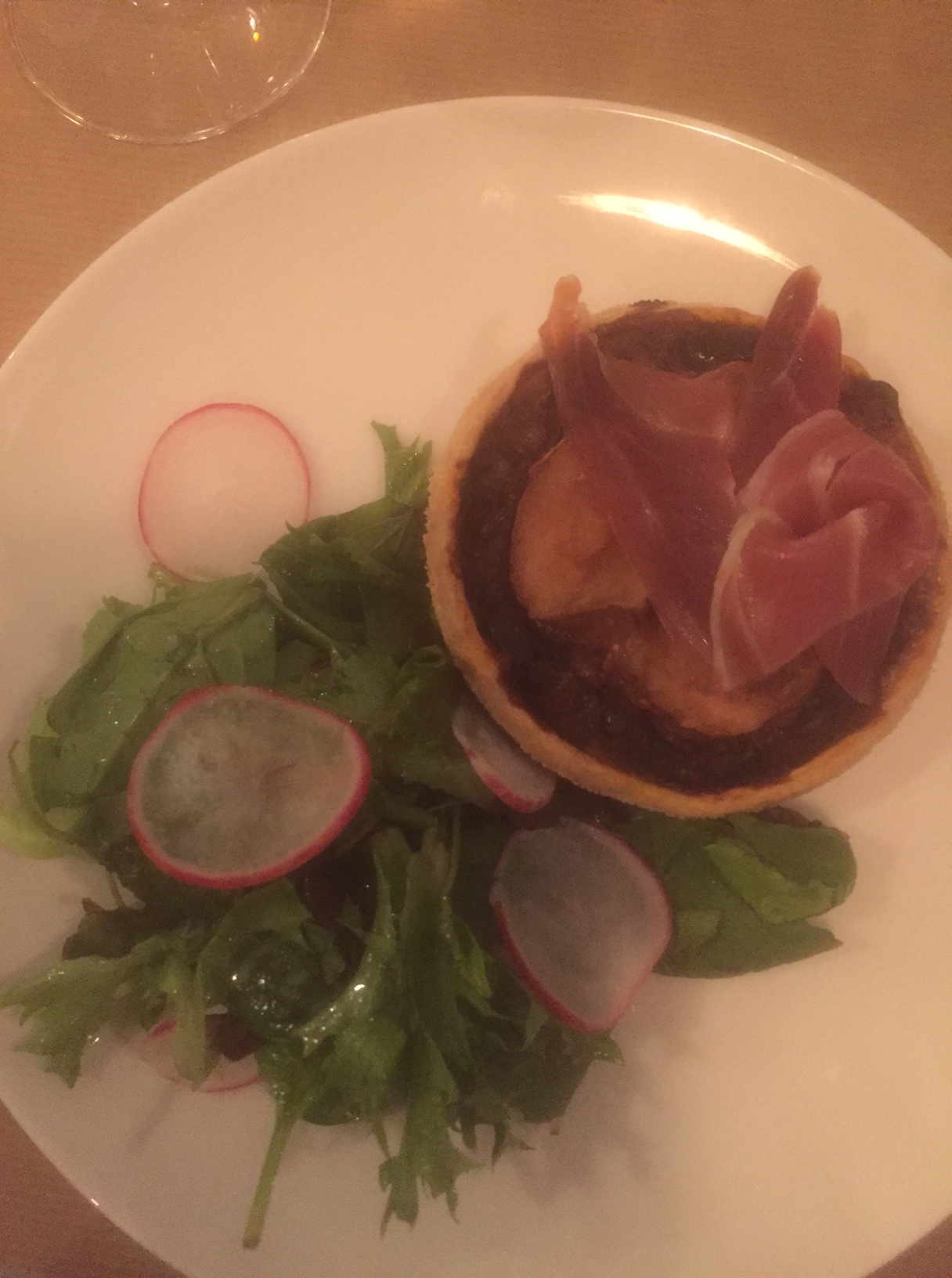
As restaurants in Provençe go, Bistrot Des Alpilles Is markedly different from the others – forget the traditional, old world settings that are generally the norm here  – this light, airy and spacious venue, with glass windows on three sides, is a stylish new build with a decidedly contemporary feel. The effect is rather like eating in a large and luxuriously appointed conservatory. We’re the first diners to arrive but are soon followed by other Friday night customers, all in search of some fine dining. The good news is, they’ve come to the right place. The service here is prompt and the staff are friendly.

There are four of us and we decide to choose from the 24 euro menu, which offers a selection of four dishes in each section. The starters include a memorable duck confit, served on a puy lentil salad. The warm fowl has a superb smokey flavour and is perfectly set off by the delightfully chewy lentils and the piquancy of the dressed salad. There’s also a charolais au boeuf served with al dente vegetables, and flavoured with pesto and parmesan; one of our party goes for an ouef joliet, a lightly boiled egg  in a brioche bun, served with porcini mushrooms. All the starters are note perfect, which bodes well for the main courses.

I opt for the mitonné de jour de boeuf (a chunky stew of ox cheeks in a succulent red wine sauce) which comes accompanied by a small dish of potatoes, mushrooms and crispy smoked bacon. The stew is delicious enough to require mopping up with chunks of freshly baked bread. Susan has the concigglionni aux moules safranées (saffron flavoured mussels on fresh pasta shells, served with slivers of smoked salmon). The pasta is clearly made in-house and its cooked to perfection. Again, there’s very little here to criticise and plenty to enjoy.

In our experience, if things are going to go wrong in France, it will be with the desserts – but I’m delighted to report that there are no problems here. There’s a fondant au chocolate, which is everything it ought to be – a deliciously light exterior which when broken into with a spoon gives up its rich, chocolate filing in an aromatic puddle. It comes with a pool of pistachio custard and a generous dollop of pecan nut ice cream. It doesn’t hang around on my plate for long. Susan’s soufflé gourmet glacé au caramel is every bit as delightful as the title suggests – perfectly set and deliciously flavoured.

As ever, we drink a bottle of the local rosé wine and after some discussion, we decide that we really can’t fault anything we’ve had here tonight. So it gets full marks. The sad thing is, we’re heading home tomorrow, but it concludes our week’s visit to Provençe in winning style.

5 stars

Philip Caveney

Les Saveurs

images images-1Unknown

28/10/15

St Remy de Provençe

Les Saveurs is a delightful little restaurant in the heart of St Remy, with space for about forty diners. We’re here on a quiet Wednesday in October, so it’s far from full, but there’s still a convivial, friendly atmosphere, and we’re ready to enjoy ourselves.

We’ve learned to order rosé wine when visiting Provençe; it’s not our preferred hue when we’re in Britain, but it’s the prevalent colour here, and tends to be better than our habitual white. We’re delighted today to see a selection from the local Mas de la Dame vineyard, which we visited earlier in the afternoon. At €21 for a bottle, it’s a fresh, crisp-tasting drink, and well worth every cent.

There’s a three-course set menu at €26, but we opt for the a la carte today; we’re not hungry enough for starters or puddings, and the main courses sound delicious.

Our companions both opt for the filet de boeuf angus, a generous slab of steak that’s cooked to perfection, soft and pink and tender throughout. There are garlicky roast vegetables to accompany it, and some skin-on chips that seal the deal: this is truly appetising fare.

I have l’agneau des Alpes, a lamb steak stuffed with sausage meat, with a lamb cutlet on top. The lamb is perfect: succulent and tasty – and served with ratatouille and crushed potatoes.

But the star is the bouillabaisse Philip chooses, a hearty bowl of intense fish stew, chock-full of crab, red mullet, dogfish, scallops, and one enormous langoustine. Served with the traditional croutons, cheese and aioli, this is a shining example, showing exactly what this dish can be.

It’s hard to fault food this good, and I’m not going to. If you’re ever in St Remy de Provençe, and looking for somewhere to eat, I’d suggest you give Les Saveurs a go.

4.8 stars

Susan Singfield

La Cassolette

IMG_1594 IMG_1600

25/10/15

St Remy de Provençe

We’re in St Remy in Provençe and no visit there would be complete without a visit to La Cassolette. This intimate and unpretentious restaurant, located on a narrow side street of the town, is an old favourite of ours, so it feels slightly odd to be reviewing it after all this time, but hey, here goes.

There are four of us to dine and the welcome at La Cassolette is always warm, the service prompt, the portions generous. We opt for the set menu at €21 per head (there is also a cheaper option at a surely unbeatable €13!). For starters, there’s a wonderfully rich and aromatic fish soup, which is served with toasted French bread, grated cheese and a bowl of thick, garlicky aioli. There’s also rillette de rougete de bassillic (potted red mullet, light and citrusy, marvellous) and a superbly flavoursome goat’s cheese salad.

On to the main courses. Two of us opt for Gardianne de Toro, a beef stew (made from the bull rather than the cow) with large melt-in-the-mouth chunks of meat flavoured with red wine and the unexpected contrast of slices of orange. This is  served with a mound of wild Carmargue rice and mopped up with slices of really fresh French bread. Delicious. Susan samples the pavé of rump steak, a meal that’s notoriously easy to get wrong, but this is an unqualified delight, mouth-watering and succulent with fat, crispy on the outside and nicely rare within. It comes with a perfectly judged potato dauphinoise and grilled tomato Provençal. One of our guests samples the sole meunière, light, fluffy and glorious in a beurre sauce, served with fresh vegetables.

If I’m honest the sweets don’t quite display the perfection of the previous courses – there’s a tart au citron that, though perfectly acceptable, is a little sweeter than I’d really like: a huge sticky rum baba that’s so shot full of rum it makes your head swim: there’s a panna cotta, which though delicious, hasn’t quite set, and there’s a trapezienne – a Genoese sponge cake swimming in creme patisserie. This is all fine, but it lacks the precision of the earlier courses.

We drink a carafe of the local rosé wine, which works out around a pound a glass and we feel we’ve enjoyed a superb meal at a great value price. If you’re lucky enough to be around St Remy and you’d like to sample traditional cuisine, this is definitely a place that’s worth a visit.

4.7 stars

Philip Caveney

The Savoy Cinema/Dark Horse

Unknown  images-1images

22/10/15

We’re at the cinema again and the film we’re here to see is Dark Horse, a charming documentary about the racehorse Dream Alliance. Bred by a consortium of working class people from a former pit village in Wales, the horse went on to become a major player on the racetrack and this is his story, told by the people of the village. It’s an absolute charmer of a film and one which I would normally award more review space to, but tonight is a little bit different, because it’s mostly all about the cinema; the recently refurbished Savoy in Heaton Moor, and frankly that’s something I never expected to be able to say.

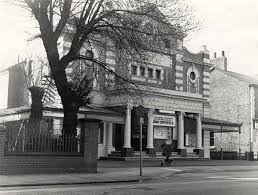
The Savoy has been in Heaton Moor since 1923 and it’s seen some changes along the way, not all of them for the better. The last time I was here was shortly before it closed down and the place was in desperate need of some TLC. Grubby, dilapidated and worn down by years of neglect, there were maybe half a dozen people in the audience. I remember joking that I wouldn’t visit again unless I’d had my malaria shots first. But what a change is here, my friends! What a change indeed.

As members of the Friends of the Savoy, we saw Dark Horse at one of the free screenings the Mundin family have set up as an introduction to the venue. On arrival, it was apparent that work wasn’t quite completed. The exterior fascia was still only partly in position and there were heaps of builder’s rubble to negotiate (this despite the team seeming to work every hour of every day to meet their deadline). Those iconic pillars were back, even though they are reproductions, the originals having been so badly damaged in the hideous 70s conversion, they had to be taken down. The place is close to looking its old self (see vintage photo above). Once through the doors though, it really was eyebrow-raising time. What was once a shabby boxlike foyer has now been opened up, with luxury seating for those who wish to quaff a quick drink before the show (people very much like us!)

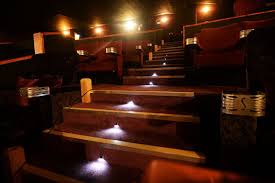
But it’s when you go into the auditorium that the transformation really hits you. Wow! Can this actually be the same place? The looks of delight on the faces of each successive person who came up the stairs told the story. The word ‘luxurious’ is the first one that springs to mind – and the design team have cleverly avoided turning the place into one of those utilitarian boxes that seem to be all the rage now, opting instead for a traditional look, all wine red velvet, soft cushions and art deco flourishes, a look that hints at the long tradition of the Savoy. The size of the place was also a shock. Around the time of my last visit, much of the back of the cinema was cordoned off and you didn’t really get the full impression of the length of the place, which now seats around 850 customers. We were lucky enough to secure one of the plush double sofas towards the back  and I can’t ever remember watching a film in such total comfort.

Oh and in case you were thinking that old and classic meant shonky equipment, don’t be fooled! The Savoy utilises the latest digital technology and crystal clear Dolby surround sound.

This is a cinema lover’s delight and Heaton Moor is incredibly lucky to have it. What’s more, the owners have compiled a programme of great films, including some live link ups for all the theatre and opera lovers in the community. There will be screenings aimed at senior citizens and screenings aimed at youngsters; seriously, they’ve put some thought into this. You’ll find their new website at savoycinemaheatonmoor.com (not to be confused with the old one, which is still lurking about out there, you be careful!)

The Savoy is something to be cherished, so please repay all that hard work by supporting the place. It’s one of only a few independent cinemas still existing in the North West. To step into that auditorium is like stepping back into a more gracious age, a time when cinema was King. The good news is, it looks as though those days are back.

Oh, and I nearly forgot. The bar does an excellent sauvignon blanc!

Dark Horse 4.5 stars

The Savoy Cinema 5 stars 

The Lobster

MV5BNDQ1NDE5NzQ1NF5BMl5BanBnXkFtZTgwNzA5OTM2NTE@._V1_SY317_CR5,0,214,317_AL_ Unknown-4

18/10/15

There’s no other way of saying it. The Lobster is weird.

This surreal blend of dark comedy and occasional violence won the Jury prize at this year’s Cannes Film Festival and it represents Greek director Yorgos Lanthimos’s first foray into the English language. It was strangely heartening to see that despite its unabashed art house ambitions, it had somehow managed to pull a decent crowd into a multiplex on a Sunday afternoon. Gratifying too, that only a few people walked out of the showing shaking their heads.

David ( a barely recognisable Colin Farrell) finds himself dumped by his wife of twelve years (well, eleven years and one month, to be exact – the film is very pedantic about things like that). In the dystopian society in which the story is set, this means that he soon finds himself whisked off to a mysterious seaside hotel, where he has just forty five days to find himself a new partner. If he fails in his quest, he will be transformed into the animal of his choice and ‘set free’. David opts to be a lobster, because he’s always been quite good at boating and water sports. Meanwhile, he and his fellow guests go out on daily hunting expeditions in the forest, shooting ‘loners’ in the nearby woods with tranquilliser guns. For every loner they bring back, their time at the hotel will be extended. On his first day there, David meets up with ‘the limping man’ (Ben Whishaw) and ‘the lisping man’ (John C. Reilly) and forms an uneasy alliance with them – in this world, people are defined by their characteristics – David, for instance, is shortsighted. The hotel is presided over by Olivia Colman and her partner, (Gary Mountaine) who can always be called upon to perform a hysterically funny version of a Gene Pitney number, when required (trust me, it works!). Indeed, the first half of the film, is often laugh-oh-loud funny. Whishaw introducing himself to the other guests is a particular delight. In the later sections, when David goes on the run in the forest and falls under the wing of a survivalist leader (Lea Seydoux), the laughs are somewhat harder to find, but the narrative still holds you in its grip, right up to the tense and decidedly unresolved ending.

Yes, you say, but what is The Lobster actually about? Good question.

For me, it’s an allegory about relationships and the immense pressure that is placed upon them by the expectations of society. It’s about the way people have to compromise with each other in order to coexist. And it’s about mankind’s inherent selfishness, the casual cruelty that people will often inflict upon one another. It’s by no means a perfect film – but in its own, unconventional way, it’s more challenging than anything else you’re likely to encounter at the cinema, these days. And one thing’s for sure. You’ll talk about it afterwards.

4 stars

Philip Caveney

Suffragette

Unknown-3 Unknown

17/10/15

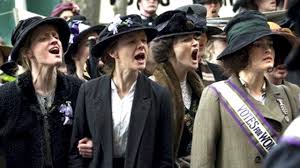
Suffragette feels like an important – and timely – film. There’s a bit of a feminist backlash going on at the moment, with cries of “feminazi” and “what about the men?” drowning out the fact that all feminists have ever really asked for is equality, which shouldn’t be too much to ask.

Suffragette brings to the screen the stories of the unknown women who fought the cause. The casting of Meryl Streep as Emmeline Pankhurst cleverly highlights this shift in focus: the most high-profile actor has a cameo role, as does the figurehead of suffrage. This film is all about the less-exalted stars of the women’s movement: working-class washerwomen like Maude and Violet (Carey Mulligan and Anne-Marie Duff) and middle-class professionals such as Edith, a pharmacist (Helena Bonham Carter). Their lives are tough and unforgiving, and they have little control over anything. Their husbands own their property, their children. No wonder they want something more, or at least the right to have a say.

But, as ever, change is difficult to effect: the beneficiaries of the status quo are reluctant to let go, and others are afraid to rock their fragile boats. Here, we see Maude vilified and reviled as she begins to speak up for herself, and the reality of what she’s lost hits home – both for the character and the audience – when we see her son adopted because her now-estranged husband, Sonny (Ben Whishaw) thinks she will corrupt the boy. Sonny is bereft too: he’s threatened and undermined by Maude’s assertion of her rights; he’s a decent man who doesn’t understand. His tragedy is real as well. Everyone’s trapped by the rigidity of societal norms: Brendan Gleeson’s Inspector Arthur Steed feels some sympathy for the women, but that doesn’t stop him locking them up or allowing them to be force-fed.

Abi Morgan’s script is well-balanced: dispassionate and informative as well as emotive and personal. It’s a truly moving tale of the past with a message for the future: as Maude says, speaking tentatively to Lloyd George, “This life… I thought there might be a better way to live it.”

4.7 stars

Susan Singfield

Crimson Peak

Unknown-2 Unknown-1

17/10/15

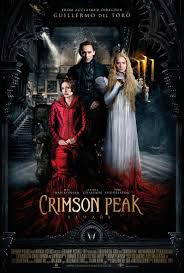
When I last reviewed a Guillermo del Toro movie, I expressed the fervent wish that he would abandon the thick-eared nonsense he was currently engaged on – in which giant robots repeatedly thumped reptilian monsters in the head – and went back to the kind of cinematic terrain he’d mined so brilliantly in Pan’s Labyrinth. While Crimson Peak isn’t exactly that, it’s about a million miles away from Pacific Rim, which is something to be extremely thankful for.

What we have here is a gothic ghost story and if we’re looking for film precedents, maybe the best of Hammer Horror, as directed by Terrence Fisher or Roger Corman’s 60s interpretations of the works of Edger Allan Poe, might be the appropriate places to look. Crimson Peak is a gorgeous piece of film making – the sumptuous look of the production, the painterly evocations of the settings are a cineaste’s delight, while the story exhibits all the conventions of the true gothic horror story – histrionic and compelling in equal measure.

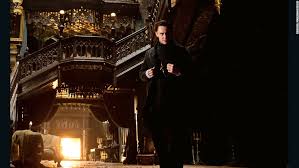
Aspiring novelist Edith Cushing (Mia Wasikowska) (note the tribute to Hammer horror actor, Peter, right there) meets up in New York with baronet and would-be inventor, Thomas Sharpe (Tom Hiddleston) and immediately falls under his spell, despite the misgivings of her rich industrialist father, Carter (Jim Beaver). Almost before we can draw breath, Carter has been brutally murdered (a typically Del Toro scene of extreme violence) and Edith is whisked away to Sharpe’s remote Cumbrian family pile, Allerdale Hall, a derelict mansion that makes the Amityville House look like a cabin in Happy Valley.  Mysterious Sister, Lucille (Jessica Chastain, struggling a bit with her English accent) goes along for the ride. The house itself is an extraordinary piece of design, as much a character as any of the human actors, and Edith soon discovers that there are secrets hidden in its shadows – secrets that are being explained by ghostly apparitions.

It’s not quite a perfect production – there are one or two lines of clunky dialogue that invoke involuntary smirks and, like so many other directors, del Toro needs to learn the basic lesson that CGI ghosts are simply not as terrifying as mere actors dressed up in rags and makeup – but this is the kind of filmmaking that hasn’t been attempted in a very long time, and mostly it pays off handsomely. Literate viewers will spot references to Jane Eyre, The Turn of the Screw and a whole collection of other literary and filmic references, but the best thing about Crimson Peak is the sumptuous look of it. Del Toro’s origins as an illustrator are writ large in every scene. Curiously though, while every imaginable trope of gothic horror is on display here – clockwork dolls, moths, mysterious labyrinths and ghastly spectres – it’s the occasional excesses of physical violence on display that scare us much more than any of the supernatural elements.

This is sterling stuff, though, and should keep del Toro’s legions of fans happy while we wait to see what he will do next.

4.8 stars

Philip Caveney
Sicario

MV5BMjA5NjM3NTk1M15BMl5BanBnXkFtZTgwMzg1MzU2NjE@._V1_SX214_AL_

16/010/15

‘Cancel that holiday in Mexico!’

That would seem to be the overriding message of Denis Villeneauve’s white-knuckle ride of a thriller in which FBI operative, Kate Macer (Emily Blunt) finds herself mixed up in the violent world of the Mexican drug cartels. Assigned to work alongside Matt Graver (Josh Brolin) and the mysterious Alejandro (Benicio Del Toro, looking increasingly like Brad Pitt’s Puerto Rican twin) she starts off with high hopes and good intentions, as the team work their way towards the Mister Big who is responsible for the murder of hundreds of innocent people; but she soon discovers that, in this shady operation, the good guys are pretty much indistinguishable from the bad ones.

Blunt, of course, cut her action chops on the seriously underrated Edge of Tomorrow and she’s on excellent form here – but it must be said, that Taylor Sheridan’s script is incredibly misogynistic. Poor Kate is beaten, throttled and crushed at every opportunity and as the one character in the film with any apparent sense of decency, the film’s bleak conclusion seems to bray the fact that women should keep their nibs out and leave the rough stuff to the big boys. And wouldn’t it be nice if, just for once, a character’s motivations weren’t based around his desire to revenge himself on the man who killed his wife and daughter?

This is a shame, because in most other respects the film works brilliantly – there are tense shootouts aplenty, gripping covert operations and a nightmarish vision of Juarez that certainly won’t make it into the holiday brochures. But when the film’s central character is a strong woman, trying to stand tall in a male-dominated environment, her eventual failure to do so  does seem suspiciously like a missed opportunity.

3.8 stars

Philip Caveney