William Shakespeare

Lear

05/06/25

Traverse Theatre, Edinburgh

It seems at first an act of incredible hubris: to take one of Shakespeare’s most accomplished works, chuck out all those pesky words and attempt to tell the story entirely through movement. But only a few minutes into Raw Material’s adaptation and I am beginning to appreciate what a clever idea this actually is – one that opens out the play’s central story to encompass a whole range of different interpretations. Anybody who has watched helplessly as an aging relative slips inexorably into the fog of dementia, for instance, will find plenty to identify with here.

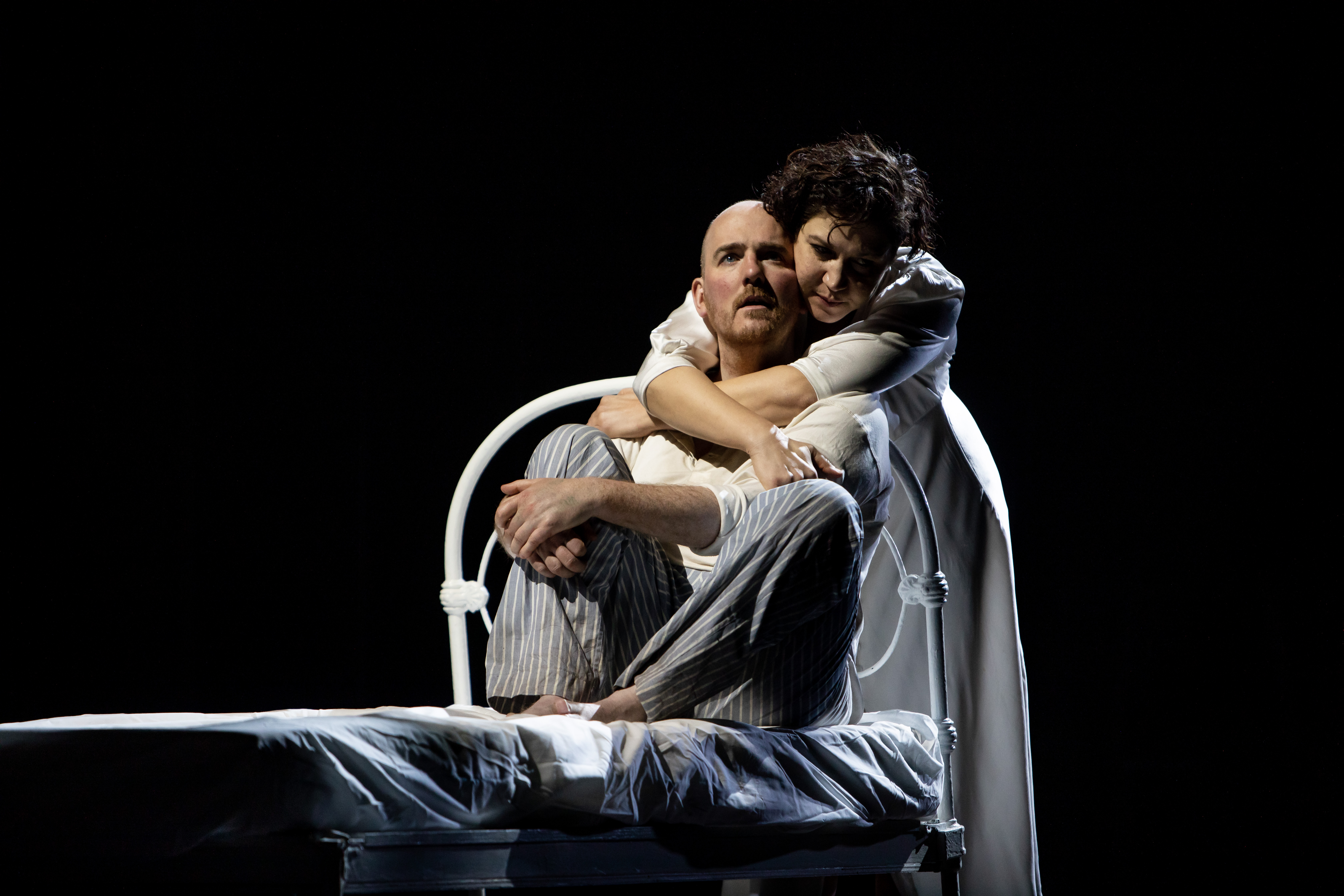
Anna Orton’s simple set comprises mostly heaps of sandbags, which we will soon discover are stuffed with what look like ashes and which, when scattered around the stage, seem to accentuate the central character’s failing grasp on reality. When Lear (Ramesh Meyyappan) first strides confidently into view, he is fearless, energetic, reenacting his past conflicts for the entertainment of his three daughters.

But we cannot fail to notice that he is already jumping at shadows, reacting to every bump and thud of David Paul Jones’s vibrant score, every flash and flicker of Derek Anderson’s vivid lighting design. Director Orla O’Loughlin keeps him centre stage while his daughters move around its periphery, cooly observing as he begins a slow but steady decline. As his grasp on the war-torn kingdom grows ever more precarious, so he goes to his daughters seeking refuge. Regan (Amy Kennedy) and Goneril (Nicole Cooper) are not the grasping, cruel sisters of the source play, but rather two concerned siblings that strive their hardest to accommodate their Father’s eccentricities. Cordelia (Draya Maria) keeps to the sidelines, always giving way to her more manipulative sisters – but her affection for her father is evident, making it clear that she will love him unconditionally.

And then the fog really begins to take hold as Lear don’s his Fool’s old hat and adopts the gurning, slapstick attitude of his former jester, Meyyappan pantomiming exquisitely as he slips effortlessly between the two characters, bicker and competing with each other for the sister’s affections. His bewildered daughters try their best to cope with their father’s mounting instability but once taken hold, these changes cannot be denied. In Lear’s latter stages, stripped to his underwear and no longer able even to wash himself, the character’s ultimate tragedy really begins to hit home.

Lear’s story is also true of so many people as they begin to slip helplessly into their twilight years – as they succumb to drug addiction – as they are weighed down by advancing depression – the transformation witnessed by their partners and their children. This daring adaptation nails such experiences with considerable skill.

Despite my initial reservations, I have to raise my hat to a fearless and thought-provoking piece of theatre.

4.2 stars

Philip Caveney

Much Ado About Nothing

06/02/25

Pleasance Theatre, Edinburgh

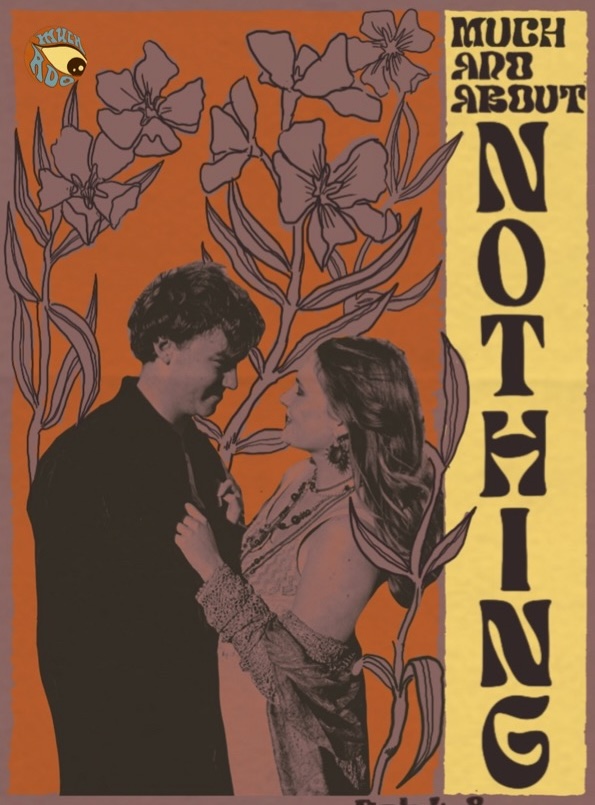
Let’s face it, judged by plot alone, Much Ado About Nothing is a bit, well… silly. Like most of Shakespeare’s comedies, the humour relies on disguise, misunderstandings and a fickle approach to romance. As an audience, we really have to suspend our disbelief. Would sworn enemies such as Benedick and Beatrice (Benedict Harrison and Verity Mann) really have an immediate change of heart thanks to some very unsubtly orchestrated eavesdropping? Both of them? It seems unlikely. Would a respected celebrant (Dylan Kaeuper) really suggest that a jilted bride should fake her death, or her father embrace the idea – agreeing that “death is the fairest cover for her shame”? Hmm. And would the groom – a mere twenty-four hours later – agree to marry his dead fiancé’s looky-likey cousin without ever setting eyes on her? I mean, that’s a no, right? Meanwhile, we’re also supposed to accept that no one in Leonato (Faolán Ingram)’s household suspects the decidedly dodgy – almost moustache-twirling – Don John (Cameron Broadly) of being a villain, despite the many outward clues. But still. It is what it is, and there’s a lot of fun to be had along the way.

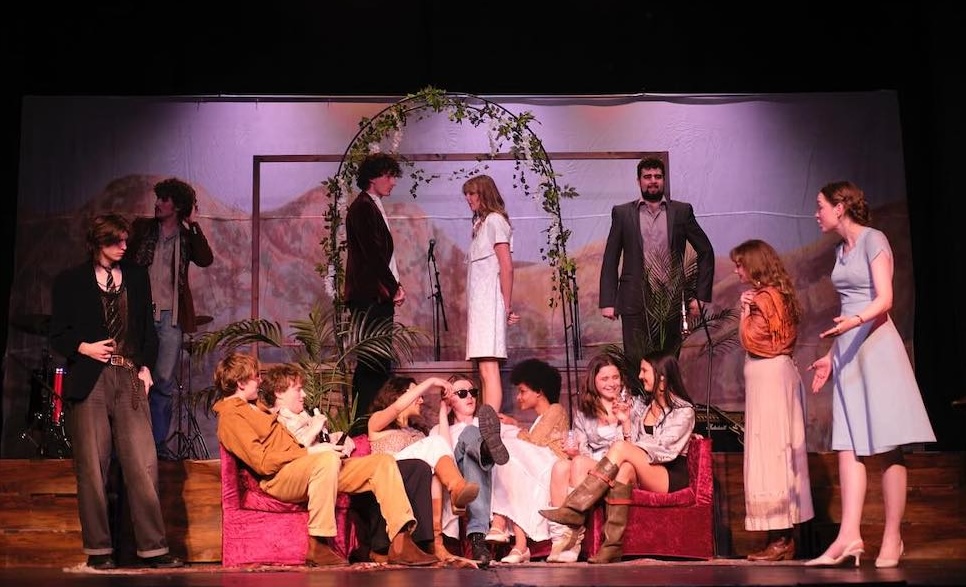
EUSC’s production of this sprawling play is sprightly and engaging. The directors (Madeleine Brown, Marina Funcasta and Anna Simurda) have chosen to emphasise the humour, eliciting larger-than-life performances from their actors rather than aiming for anything subtle – and I think this is a wise move. The action has been moved from Italy to California, from the 16th century to the 1970s but, while the period is clearly-evoked, I’m less certain about the place. There’s certainly a laid-back Summer of Love vibe, but most of the music is British (Bowie, Bolan, The Sweet, The Police) and the majority of characters speak with English accents, so it all feels a bit more Camden Town than Haight-Ashbury.

Leonato’s estate is Party Central as he and his wife, Antonia (Maria Wollgast), play host to the local socialites. What better way to make a match for their beloved daughter, Hero (Francesca Carter)? The dope is plentiful, the drinks are flowing – and love is in the air. Claudio (Rider Hartley) fancies his chances with Hero, and she’s rather keen on him as well. But “the course of true love never did run smooth” (yes, I know – wrong play), and what could go wrong with Don Pedro (Eric Parker)’s complicated plan to woo the girl on his friend’s behalf? Throw in some meddling servants, a fabulously drunken henchman (Fraser Murray), a local constable (Robbie Morris) and a veritable army of liggers – and the scene is set for some merry mayhem.

It’s a great idea to have a live band on stage, although I can’t help feeling they’re under-utilised. Still, the young cast are clearly having a ball, dressed up to the nines in flares and sequins (floppy hats off to costume designers Paloma Leigh-Stevenson, Alex Dunlop and Bea Fitz), their delivery as bold and brash as the script demands. Not everyone has a lot to do, but they all make the most of what there is, and there are some lovely moments of background detail, such as Margaret (Mia Dé)’s horrified realisation that her tryst with Borachio is being used to frame Hero. Harrison (Benedick) and Carter (Hero) are the standouts for me, but all of the actors and musicians perform with gusto, and I am thoroughly entertained.

There are just two more chances to catch this groovy rendition of Much Ado, so why not head on down to the Pleasance and hang loose with the hippies? Be sure to wear some flowers in your hair…

3.4 stars

Susan Singfield

Macbeth

05/02/25

Cineworld, Edinburgh

Macbeth is a ubiquitous play. Searching back through the B&B archive, I’m not entirely surprised to find that this is the ninth time we’ve reviewed a version of Shakespeare’s celebrated tragedy and I note too that there are three other related items that reference that infamous surname in the title. It’s easy to understand why it’s such a perennial. One of the bard’s most propulsive stories, it’s a lean, mean tale of aspiration and the overriding lust for power, which – in these troubled times – seems all too relevant. This Olivier-award winning adaptation, filmed live at London’s Donmar Warehouse, features David Tennant in the title role with Cush Jumbo as the manipulative Lady M. The screening we attend is sold out.

It’s a stripped-back production, freed from any issues with costuming or elaborate set design. The actors wear simple, monochrome outfits and the performance space is a stark white rectangular dais. It’s set in front of a transparent screened box, behind which other members of the cast occasionally gather, like a chorus of half-glimpsed ghosts, to comment on the action. Prominent among them is a young boy, who at one point hammers his fist repeatedly against the screen and also reappears in the midst of the final battle. His presence serves to remind me that the Macbeths have earlier lost a child – and that perhaps it is this loss that’s the driving force behind their callous bid to seize the throne and betray their former friends.

Tennant is extraordinary, speaking those familiar lines (often direct to camera, as though sharing confidential material) with such utter authority that I almost feel I’m hearing them for the first time. Jumbo is also compelling. She’s the only one here without a Scottish accent, which seems to emphasise her solitude and her distance from the other characters. Cal McCaninch is a stately Banquo, Nouff Ousellam smoulders powerfully as Macduff and it’s a delight to hear Benny Young’s cultured drawl delivering Duncan’s self-satisfied lines as he arrives at the castle where he is destined to die.

Ros Watt is a delightfully punky Malcolm and Jatinga Singh Randawa offers a rambunctious turn as the Porter. In the only scene that takes a wild swing away from what’s actually written on the page, the latter chats to members of the audience and displays all the symptoms of a man suffering from a raging hangover. It’s a gamble but it pays off. And the witches? In what might be the production’s bravest move, they are barely glimpsed in the first act, only heard in giggling off-stage asides as they arrive and depart with a flap of supernatural wings.

Gareth Fry’s sound design adds extra layers of suspense to the production (I note that the audience at the live performance all wear headphones for a truly immersive experience), while Alistair McCrae’s music offers jaunty reels, Celtic airs and, at one point, a spirited highland fling as a brief respite from that all-pervading air of menace. Director Max Webster brings all these disparate elements together to create a powerful and absorbing drama that dares to experiment with the source material. And, at the conclusion, designer Roanna Vize really does – magically – bring Birnam Wood to Dunsinane. 

The final confrontation doesn’t leave me wanting and the face-off between Macbeth and Macduff is unlike any version I’ve seen before. Of course, the only valid reason for doing this immortal story one more time is to offer audiences something new – an aim that this extraordinary production has clearly taken to its dark heart.

5 stars

Philip Caveney

Hamstrung

03/08/24

Pleasance Courtyard (Baby Grand), Edinburgh

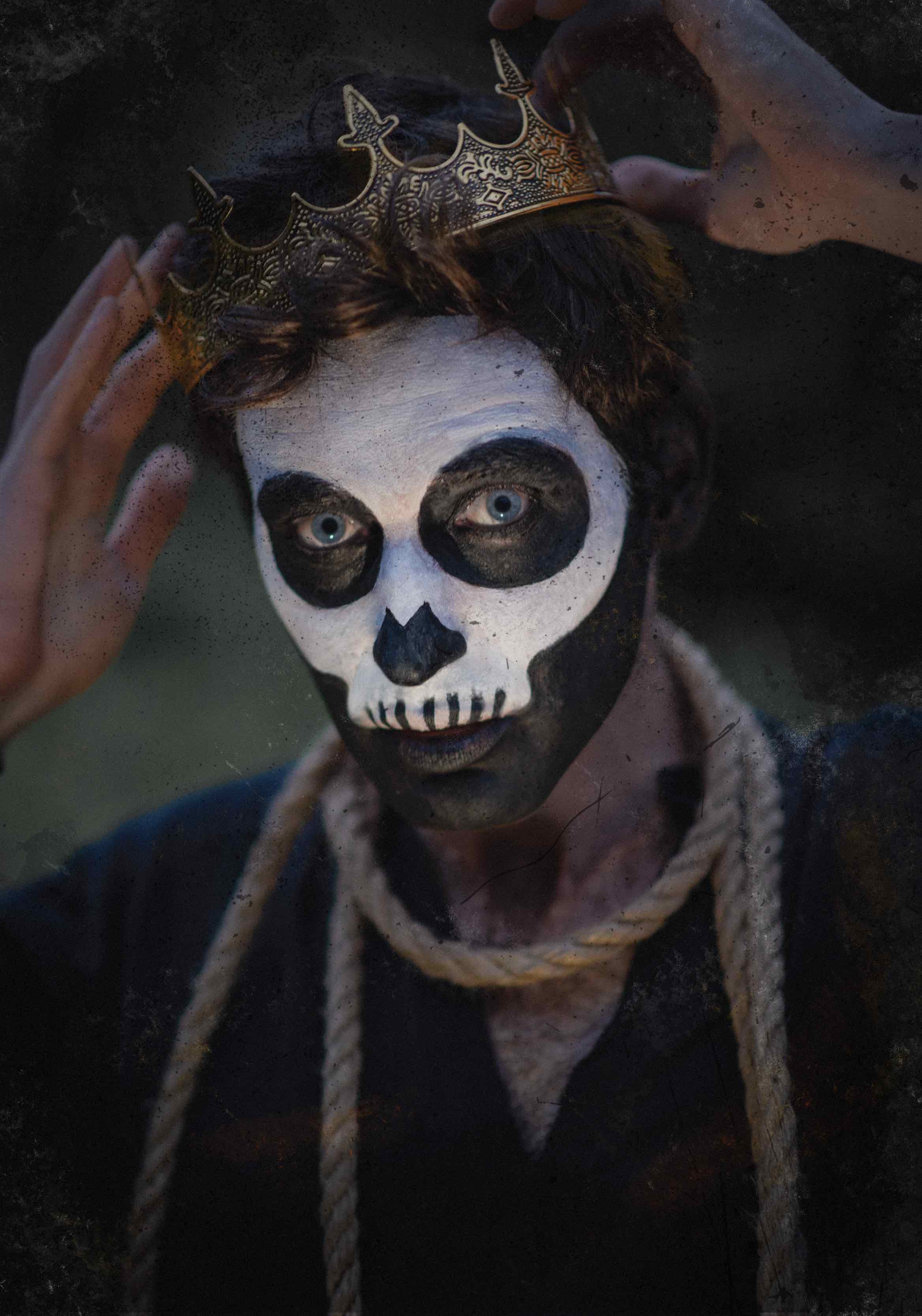
Theatre’s most famous skull, Yorick, is amply fleshed out in this playful monologue, written and performed by George Rennie. Shakespeare provides scant detail about the “fellow of infinite jest” –  we only know that he sang, danced, made people laugh and gave the young Hamlet piggybacks. But Rennie mines these few familiar lines to breathe life into a character renowned for  being er… dead. 

Rennie is an engaging actor, strutting and fretting his hour upon the stage and easily connecting with the audience. The early stretches of the play establish Yorick as a jester, keen to do his job and entertain. But his smile stretches thin as he strives to perform his routines; he’s clearly aware that something is wrong. Where is his master? Where is the King?

From here, the monologue takes a darker turn, as Yorick slowly realises that the King isn’t the only one who’s dead. There are some clever touches, including a revelation about what really happened when Hamlet thought he saw his father’s ghost. Most affecting is Yorick’s yearning for the player he loved when they were both touring performers. Being plucked from obscurity to work at court has proved both a blessing and a curse.

There are some elements that don’t work quite so well, including an extended sequence featuring two audience volunteers – in today’s show, it’s Philip and me. Although we have fun participating, the scene is long and it’s hard to see what it adds to our understanding of the character. It’s introduced as Yorick’s attempt to ‘tell his story’ but I can’t work out how it does that. (It could just be that I missed something. I was a little distracted by the fact that Philip and I were sharing one pair of reading glasses because he’d left his at home.) Structurally, I feel like this comic relief would fit better in the first half hour, as it weakens the deepening tension and unsettling atmosphere of the second act.

Still, there’s a lot here to like, including the sound design, which complements the story well, reflecting Yorick’s state of mind. Now get you to the Pleasance Courtyard; to this favour you must come; Rennie will make you laugh at that.

3.5 stars

Susan Singfield
Julius Caesar

03/03/23

Debating Hall, Teviot Row House, Edinburgh

It’s a fascinating concept – Shakespeare’s classic play reimagined as a gangster epic.

Imagine those stirring soliloquies as delivered by a young Robert De Niro or Al Pacino – the senate represented by mob mosses and wise guys, bustling around the tables of a crowded nightclub while a live band blasts out spirited jazz. That’s what we have here and, fortuitously, the baroque setting of the Teviot’s debating hall proves to be the ideal location. EUSOG have never lacked ambition and this production, directed by Devki Panchmatia, may be their most confident offering yet. There’s a powerful buzz tonight and extra seats have to be added at the last minute to accommodate an enthusiastic audience.

In this version, Francesco Davi plays the titular role as a swaggering Don, appearing to general acclaim while a fawning Mark Antony (Julia Lisa) hangs on his every word and wastes no opportunity to ingratiate himself. But Cassius (Tom Wells) is growing tired of obeying the whims of a man he perceives as a ruthless dictator. He enlists Caesar’s old friend, Brutus (Haig Lucas), as his co-conspirator. It isn’t long before they have enlisted the services of others with similar intentions and a fateful date is set: the Ides of March, where Caesar will meet with bloody retribution..,.

I’ve always felt that the play is oddly weighted, the first half culminating in one of the bard’s finest scenes (and, as performed by Julia Lisa, it’s certainly the high point of this production). The final third feels more ramshackle, condensing years of civil war into a few brief skirmishes – and there’s also the impression that some of the longer interactions could benefit from some judicious editing. I know, I know. A bit late to bring it up now!

Unfortunately, the play starts later than the advertised time and the interval stretches on for so long that the hard-earned momentum evaporates and the cast have to work really hard to recapture it. It must also be said that the decision to stick rigidly to those wise-guy accents means that it’s not always an easy matter to follow every character’s dialogue. Those audience members who know the speeches by heart will have no issue with that, but it’s a while since I last studied the play and, occasionally, I find myself struggling.

Still, there’s much here to admire. Victoria White’s costume design is impeccable and Luca Stier’s set convincingly evokes the atmosphere of a nightclub. Isabelle Hodgson offers up a sneering, duplicitous Casca, while Tom Cresswell manages to shine both as Cicero and in his brief appearance as Cinna the poet.

The strobe-lit fight scenes are effectively done, while Panchmatia manages to keep a large cast moving around the crowded stage with great efficiency. And of course, it’s always heartening to witness a young company showing total commitment to a challenging project. Here, EUSOG deliver a Julius Caesar like no other.

3.8 stars

Philip Caveney

Macbeth (An Undoing)

08/02/23

Lyceum Theatre, Edinburgh

Unlike the monarchs he wrote about, Shakespeare has reigned supreme for more than four hundred years: his plays, rich with examples of human fallibility, are endlessly relevant. But you’d think, wouldn’t you, that we’d run out of different ways to retell the same stories? I mean, the first time I ever saw Macbeth, way-back-when on a sixth-form theatre trip, it was set in a concentration camp (courtesy of Braham Murray at Manchester’s Royal Exchange). Next, I fell in love with Penny Woolcock’s 1997 film, Macbeth on the Estate, which transported the action to a maze of contemporary council flats, and I even enjoyed TV’s ShakespeaRe-Told, where chefs James McEvoy and Keeley Hawes killed off their rivals to take over a restaurant empire. More recently, Flabbergast Theatre’s wonderfully physical, visceral adaptation had me hooked, and there’s been a slew of others along the way. What I’m saying is: I know Macbeth. We all know Macbeth. It’s been done, right? What else is there to say?

And then along comes Zinnie Harris with An Undoing – and the whole thing is turned on its head.

Macbeth (An Undoing) starts from a simple premise: what happens if Macbeth and Lady Macbeth follow their natural trajectories? Because, let’s face it, although Lady M is arguably the best of Shakespeare’s female characters, she’s also the most frustrating, initially a force to be reckoned with – an interesting, complex woman – before disappearing for an age and then returning broken, for a brief goodbye, with very little to tell us why. What if, asks Harris, it’s Macbeth who crumbles? What if it’s Macbeth – whose conscience troubles him from the start – who unravels, while his wife continues unabashed, for a while at least, determined to make their plan succeed? It makes perfect sense, given their starting points.

At first, when the curtains open on a blank stage, and we’re treated to servant/witch Carlin (Liz Kettle)’s fourth-wall-breaking opening gambit, I think perhaps this will be a relatively straightforward version of the play, with just a little mischievous tinkering here and there. After all, “This story will be told, the way it has always been told. What use is it otherwise? The hags on the heath. The woman who went mad. The man who became a tyrant,” she tells us. And, for the first half, that’s sort of what we get: Macbeth at a gallop, mostly in the Bard’s own words, step-by-step through the plot. There are a few changes: we’re in the 1920s, or the early 1930s perhaps; Ladies Macbeth and Macduff (Nicole Cooper and Jade Ogugua respectively) are reimagined as sisters, and share some revelatory new scenes (An Undoing easily passes the Bechdel test); Lady Macbeth and her husband (Adam Best) don’t just want power for power’s sake – they have a meticulously-planned vision for a utopian Scotland. But, in the main, it’s as it’s always been, so that, in the interval, I find myself musing aloud, “How can there still be an hour and a bit to go? There’s not much story left…”

But then we get to the undoing…

Harris’s adaptation is bold, daring and witty. I love the idea of the witches as servants: it makes perfect sense. They’re the eyes and ears of the house, privy to the paperwork the Macbeths have drawn up, witness to intimate moments and careless asides. Invisible. Ignored. These witches are also a family – in fact, Kettle and Star Penders, along with impressive young actor Farrah Anderson Fryer, form the most functional family we see on tonight’s stage, with clear bonds uniting them. I also like the depiction of Malcolm (Penders again) as a petulant youth, patently ill-equipped for leadership and ripe for exploitation by the ruthless Macduff (Paul Tinto).

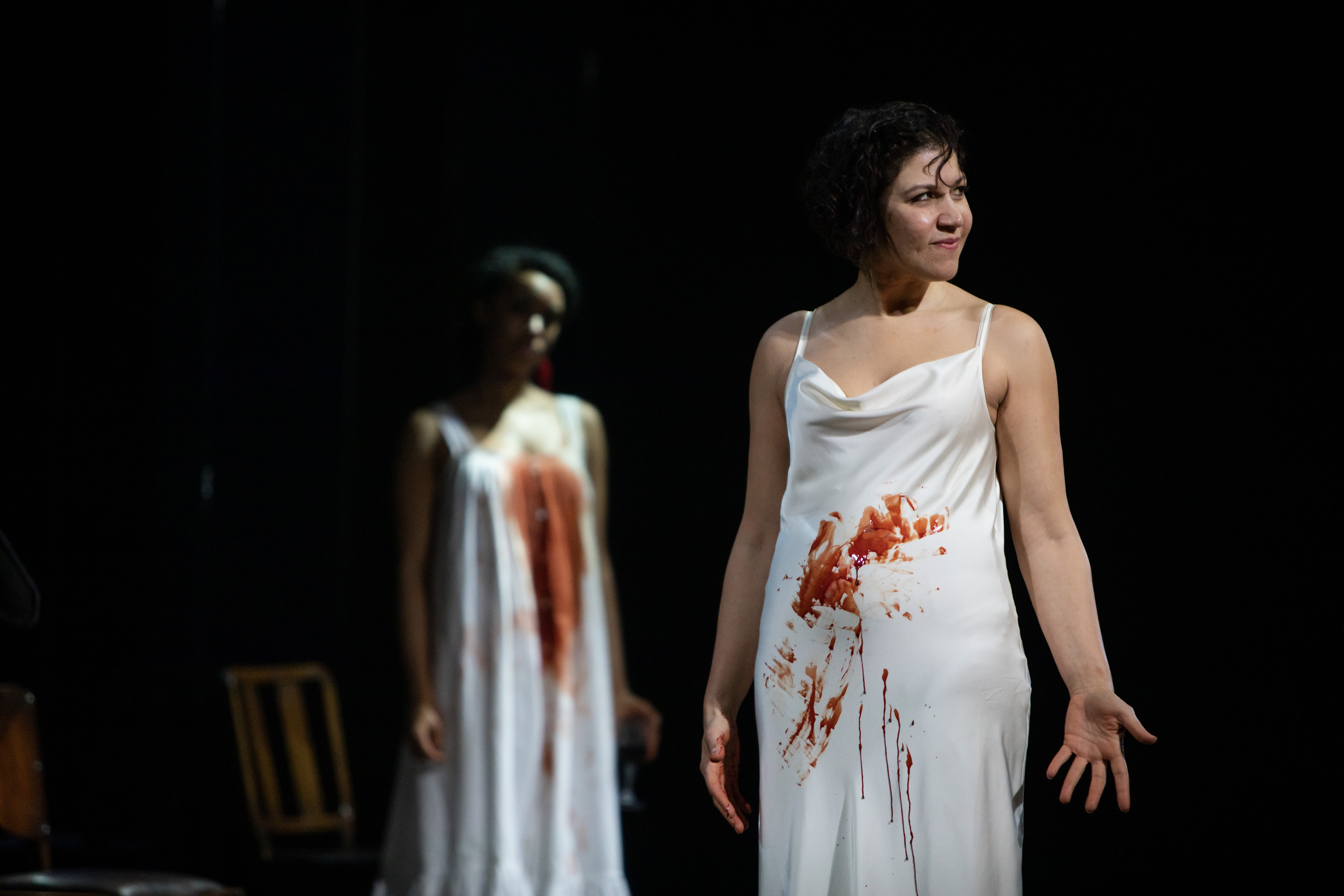
But this is, without doubt, Lady Macbeth’s play. It’s the part of a lifetime, and Cooper makes the most of it, imbuing her with strength and vitality – and just a hint of vulnerability. She’s ambitious and single-minded, but never merely cruel or heartless. We believe in her love for her husband and sister, and we believe in her idealism too. She’s angry when the lairds misgender her, referring to her as the King because they can’t conceive of a woman behaving as she does (even though, to be fair, she does ask to be ‘unsexed’). In a well-aimed swipe at other interpretations of the role, she’s also angry at being reduced to her infertility.

The set (by Tom Piper) is simple but extraordinarily effective, with warped mirrors concealing as much as they reveal, offering us multiple perspectives, and highlighting the Macbeths’ interdependence and duality. We’re there too, shimmering in the background, complicit and agog, just as Carlin accuses at the start.

The Lyceum is busy tonight – some of the boxes have even been pressed into use – and deserves to be so for the next month. You’ve probably seen Macbeth, but I doubt you’ve seen anything quite like An Undoing before.

4.7 stars

Susan Singfield

The Northman

19/04/22

Cineworld, Edinburgh

It seems suspiciously like fate. Here I am – only just returned from a week in Shetland, where I’ve been researching Vikings – and this film is waiting for me at the local cineplex. Of course I have to see it. I can’t not see it. But I have some reservations. For one thing, despite the film’s almost indecent rash of five star reviews, I haven’t been exactly enamoured by Robert Egger’s previous offerings, The Witch and (more especially) The Lighthouse, both of which felt like cases of style over content.

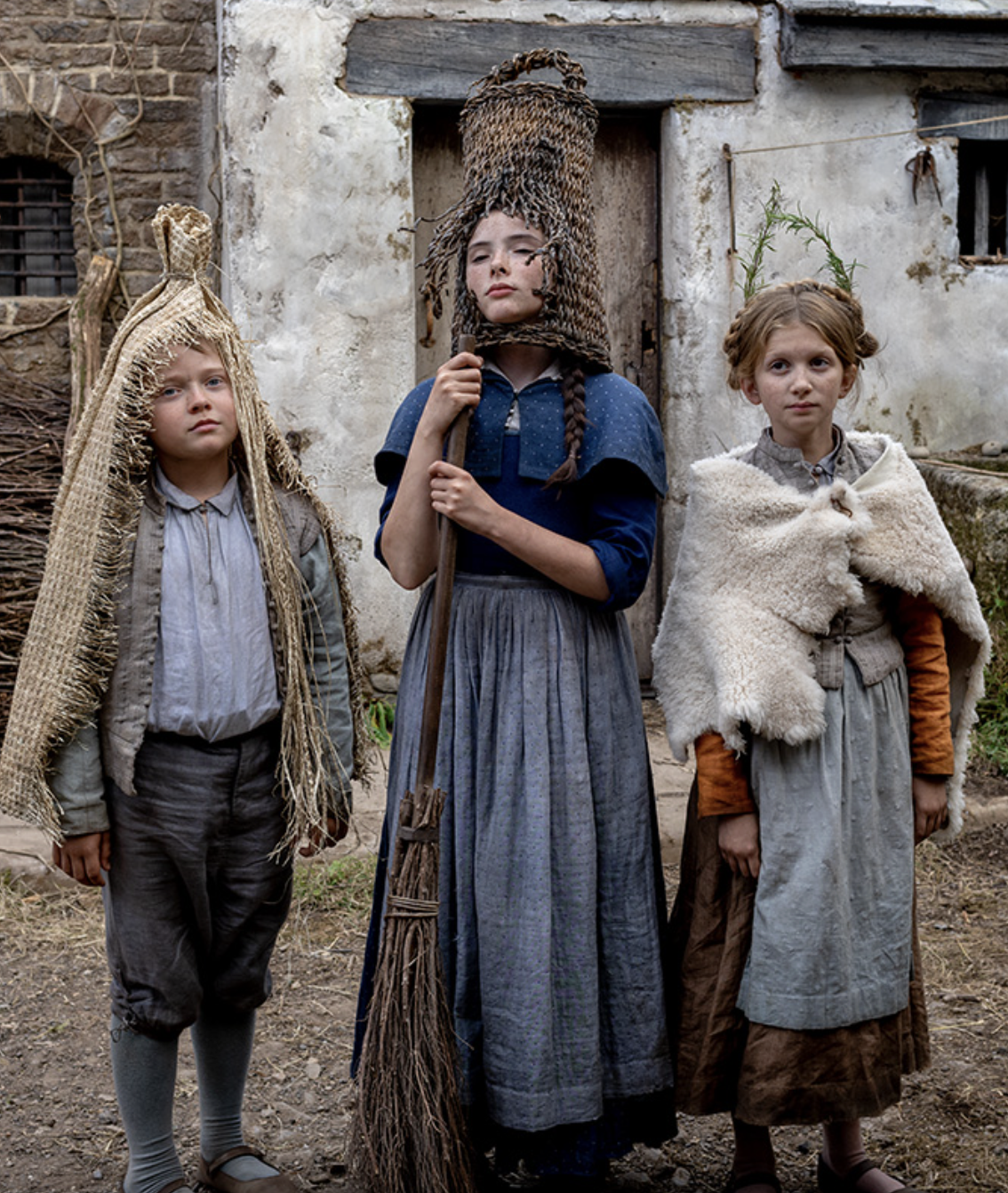
It’s clear from the get-go, that The Northman is a big step up for Eggers (who co-wrote the screenplay with Sjon). His evocation of Viking life is vividly painted in freshly-spilled viscera across a massive landscape. The world-building here is dirty, ugly and thoroughly convincing. In the opening scenes, we meet young Prince Amleth (Oscar Novak), welcoming his father, King Aurvandil (Ethan Hawke), back from his conquests. Amleth’s mother, Queen Gudrún (Nicole Kidman), is rather less welcoming and the reason for that soon becomes clear. She has secretly allied with Aurvandil’s brother, Fjölnir (Claes Bang), who is determined to kill Aurvandil and his son, and take Gudrún as his wife.

If the story seems familiar, it ought to. The ancient Scandinavian legend of Amleth is the tale that initially inspired Shakespeare to write Hamlet.

Amleth manages to escape from the bloody mutiny and, when next we meet him, he’s grown into a thoroughly buff Alexander Skarsgård, who, adopted by another tribe, has become a fully-fledged wolf warrior, a berserker. An ensuing battle sequence leaves no femur unshattered, no skull uncleft. Those viewers who wince at bloody violence may prefer to avoid this film at all costs – or spend a lot of time looking away from the screen.

Amleth learns that his uncle Fjölnir has had his stolen kingdom taken from him and has been exiled to Iceland, where he’s attempting to make a new life for himself as a sheep farmer. Gudrún has gone with him and Amleth knows that he must follow. So he disguises himself as a slave (by first branding his chest with a hot coal) and stows aboard a boat taking a consignment of workers over to Fjölnir. On the hazardous journey across the ocean, he meets up with Olga of the Birch Forest (Anya Taylor-Joy), a self-professed earth witch, and quickly falls under her spell.

But can this new love quell the thirst for vengeance that has consumed him since childhood?

The Northman is by no means perfect. It’s at its best when depicting the savage lifestyle of the Vikings and I also love the hallucinatory images that often flood the screen, particularly Amleth’s repeated visions of the legendary Tree of Yggdrasill, where family members are suspended like ripening fruit from its entwined branches. There’s also a spectacular Valkerie ride that carries me headlong to Valhalla.

Kidman, though initially underused, does get one scene that puts an entirely different spin on circumstances and makes me appreciate why she’s a director’s go-to for so many difficult roles. I would also have liked to see more of Willem Dafoe who, as Heimar the Fool, has clearly been drafted in to fill the Yorrick-shaped hole in the piece.

If I have a criticism, it’s simply that the age-old theme of revenge offers little in the way of surprise – indeed, there’s one point in the film’s later stages that seems to offer a braver and less conventional solution to Amleth’s torture, should he be man enough to take it – but, perhaps inevitably, it’s thrown aside and our rugged hero goes back to the well-worn path he’s always been destined to tread. Which makes the final fiery confrontation a little underwhelming.

Still, there’s no doubt that this is Eggers’ most assured film thus far – and I’m definitely interested to see where he goes next.

4.2 stars

Philip Caveney

The Tragedy of Macbeth

01/01/22

Filmhouse, Edinburgh

I’m not sure what to make of the writing credit for this latest adaptation of Macbeth. The wording – ‘written for the screen by Joel Coen, based on the play by William Shakespeare’ – seems a tad… hubristic. Because this is mostly Shakespeare’s work, albeit deftly sprinkled with some movie dust. Coen’s direction here is sublime, and his pared back adaptation works really well. It’s just, y’know. ‘Play by William Shakespeare; adapted for the screen by Joel Coen’ would sit better.

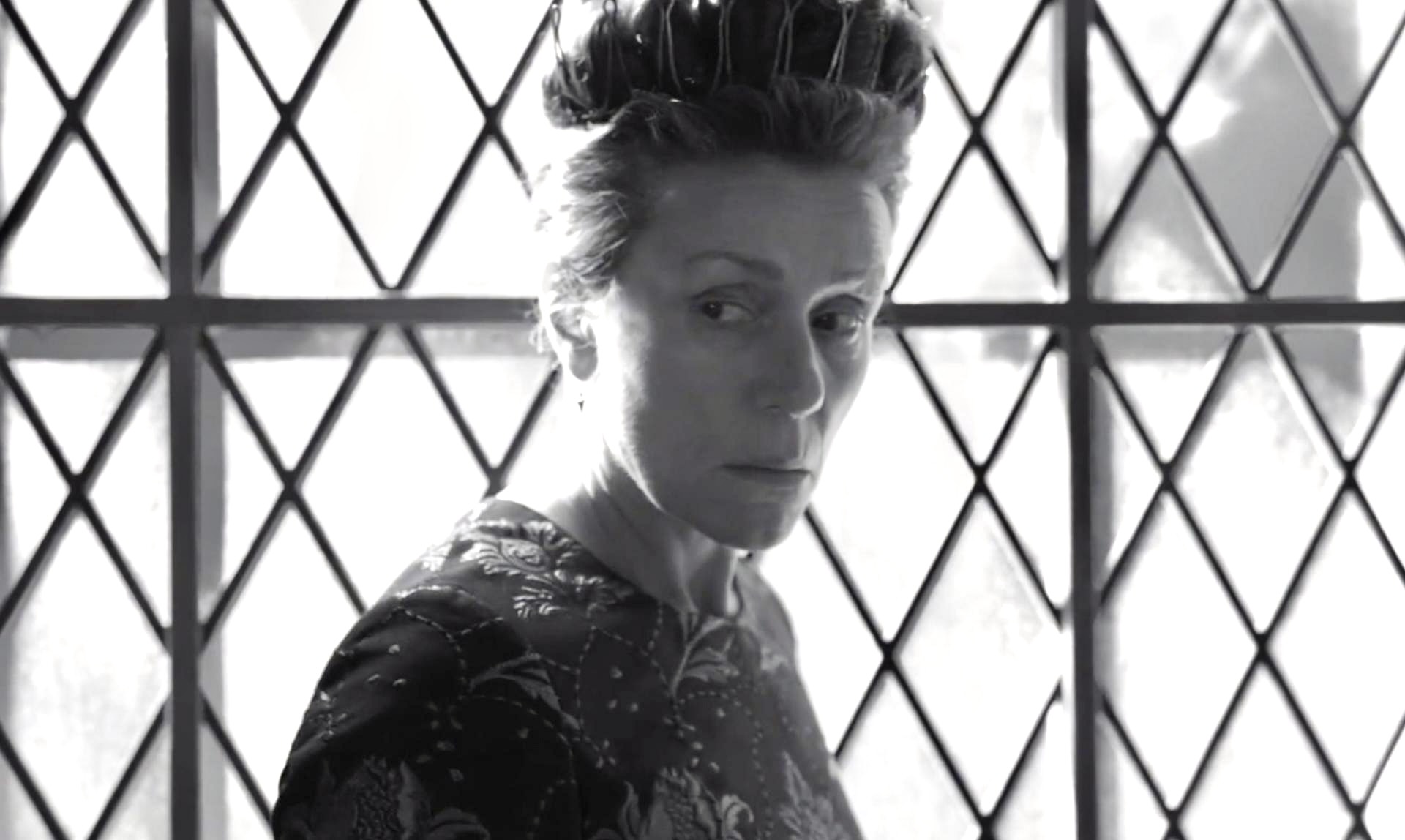
But it’s my only real gripe (if I overlook the absence of a single Scottish accent in the, ahem, Scottish play). This is the best movie version I’ve seen – and I have seen a lot. Although Shakespeare never specifies the Macbeths’ ages, I’ve tended towards the view that they ought to be young: all that swagger and ambition and impatience. When they’re portrayed as middle-aged, something seems to be lost. Here, both lord and lady are actually old: they’re in their sixties; nigh on retirement age. And it all starts to make sense again: this is a last-ditch attempt to fulfil their dreams. Time and place “have made themselves” and the Macbeths can’t resist the temptation to finally realise their desires.

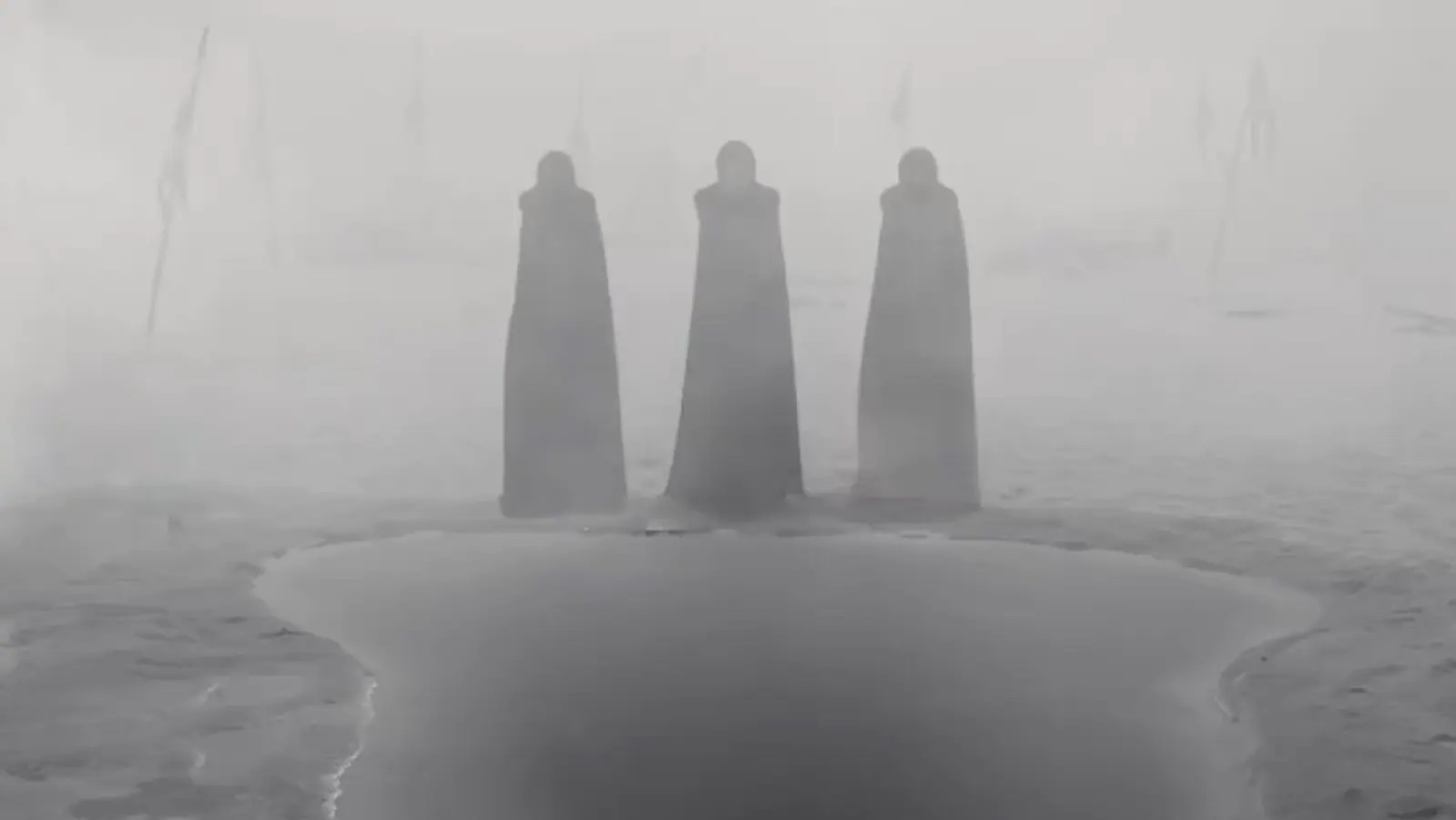
Shot in black and white, Coen’s Macbeth is a claustrophobic affair, with none of the epic battle scenes I’ve grown used to seeing in big-screen adaptations. Indeed, it feels very theatrical, the castle walls as contained and constraining as any stage could be. We rarely venture out of Macbeth’s castle; when we do, it’s into countryside so swathed in mist that very little is visible. This is a stripped back version of the play, shining a spotlight on the key elements and emotions.

Denzel Washington is magnificent as the flawed hero: this is a towering performance, at once imposing and accessible. We can believe in him as a good man corrupted by greed, unable to live with his own actions. Likewise, Frances McDormand gives us a Lady Macbeth we can understand: she’s not presented here as a temptress, leading Macbeth to his doom, but as his partner, his equal, persuading him to indulge in a shared fantasy. The consequences are as devastating to her as they are to him.

Kathryn Hunter – playing all three witches – is perhaps my favourite thing about this production. She’s a gifted physical performer, and lends the shape-shifting ‘weird sisters’ a wonderful unearthly quality. Again, Coen’s judicious employment of theatrical devices (it can’t be incidental that Hunter has worked extensively with Complicité) makes for a compelling and unusual movie; this is a successful hybrid.

Coen only deviates from Shakespeare when it comes to Ross (Alex Hassell). A minor character in the original play, he appears here as a Machiavellian schemer, sidling up to where the power is, with one eye always on what might happen next. He’s Iago; he’s Tony Soprano; he’s Dominic Cummings. The additional layer really works.

In short, this is a triumph. It lays bare the heart of Shakespeare’s play. So, proceed further in this business; be the same in thine own act and valour as thou art in desire, and get yourself to the cinema. This is too good to miss.

4.8 stars

Susan Singfield

The Legacy of William Ireland


10/08/19

PQA Venues, Riddle’s Court, Edinburgh

Ah, the unforgettable works of Shakespeare! Anthony and Cleopatra, Romeo and Juliet, Vortigern and Rowena… wait… Vortigern and Rowena? Chances are you’ve never heard of that one, mostly because it wasn’t actually written by the bard of Stratford but by a wannabe poet and playwright named William Henry Ireland, who also pursued a lucrative sideline in passing off his mediocre efforts as the work of the great man himself.

It all began modestly enough, with Ireland forging bills-of-sale bearing Will’s signature, mostly in an attempt to impress his Shakespeare-obsessed father, but – as time went on – things got somewhat out of hand…

This wittily scripted monologue by Tim Connery depicts Ireland as his deception is uncovered, understandably nervous and ready to flee for his life. Charlie Jack not only plays the fraudster with self-deprecating aplomb, but also looks uncannily like the man himself. I find myself torn between despising Ireland’s guile and feeling rather sorry for him, since the whole deception appears to be fuelled by a desperate attempt to impress the father who clearly hates him.

This is a fascinating look at a little-known historical event and, apart from a bit of dramatic licence in the final act, it sticks pretty close to the unbelievable truth.

Anyway, enough of this. I’m off to forge a new Harry Potter novel. You never know, it might just work…

4 stars

Philip Caveney


The Taming of the Shrew


13/03/19

Pleasance Theatre, Edinburgh

I’ve never seen The Taming of the Shrew. I know the play, of course (I’ve even written essays about it), and I’ve been entertained by a number of intriguing reinterpretations in various forms: Kiss Me Kate, 10 Things I Hate About You, Vinegar Girl. But I’ve never seen it staged. Maybe because it’s arguably Shakespeare’s most contentious play – although The Merchant of Venice certainly has its issues too – and difficult to reconcile with modern sensibilities.

For those readers who need a quick reminder, the ‘shrew’ of the title is Kate, a wayward young woman, whose volatility deters any would-be beaux. Her father – based on some labyrinthine reasoning – imposes a bizarre rule: her sweet-natured sister, Bianca, cannot marry before Kate. But Bianca is a popular girl, and her suitors do not want to wait. Enter Petruchio, with a plan to break the older girl’s spirit. He bullies, half starves, gaslights and manipulates her into submission. In a modern play, this would be the midway point; we’d see Kate regain her equilibrium and Petruchio punished. But here, this is the denouement. It’s most uncomfortable.

And it’s not just the gender politics that make TTOTS problematic. The plot is convoluted and over-contrived, the humour weirdly at odds with the central relationship. It’s a tough call for any theatre company, let alone one so young as the EUSC.

But, under Tilly Botsford’s direction, this is a marked success. We’re never in any doubt that Petruchio (played with chilling self-righteousness by Michael Hajiantonis) is an awful man: he treats his servants with the same foul aggression as his wife. I applaud the decision to cast women as the servants too, emphasising the power of the patriarchal structure, and underscoring the theme of domestic violence.

Sally MacAlister is marvellous as Grumio. She clearly relishes the role, and imbues the much put-upon servant with humour and brio. Nathaniel Brimmer-Beller also stands out as Vincentio: he inhabits this small role with a natural ease that is very impressive.

Of course, Anna Swinton has the hardest job: she’s Kate, and it’s a tough part to play. Perhaps, in some earlier scenes, her body language could be less languid and more combative, but this is a small point. Because her often mute response to Pertuchio’s bullying is nuanced as well as unequivocal, and – in that final moment – when she delivers her speech about why a wife should submit to her husband – the desperation of this broken woman is heartbreaking to witness.

This EUSC production shows then that it is perfectly possible to deliver this controversial play exactly as it stands, without compromising our changed values. A difficult undertaking, but most worthwhile.

4 stars

Susan Singfield