Traverse Theatre

Burning Bright

07/03/23

Traverse Theatre, Edinburgh

This latest season of A Play, A Pie and A Pint promises to be a good ‘un. Hot on the heels of last week’s sprightly Until It’s Gone comes Burning Bright, Áine King’s apocalyptic depiction of the climate crisis engulfing us. It’s no surprise to learn that this play won the 2022 David MacLennan award: it’s evocative and visual, a big story told in small fragments, as economical as poetry.

We are presented with three disparate narratives, linked by an over-arching theme of environmental collapse. Suzanne Magowan is a TV journalist desperately chasing a story about Australian wildfires, more interested in saving her career than in saving the earth. Hannah Jarrett-Scott plays a grief-stricken young woman with an eco-tourism business, taking rich adventurers on her boat, The Ice Princess, to see the polar ice caps before they’re gone. And Adam Buksh is a survivor: he’s escaped floods and tigers in his native India, and now he’s navigating racism on his Glasgow street.

The performances are all strong, the characters compellingly portrayed, and the writing is gorgeously cinematic – the image of a blazing horse, for example, is horribly mesmerising. Roxana Haines (director), Gemma Patchett and Jonny Scott (designers) achieve astonishing things with a tiny stage and a minimal set, so that it’s easy to suspend my disbelief and accept that I am, simultaneously, in the Arctic, Australia, Scotland and India, witnessing fire, floods and melting ice caps.

The conceit works to emphasise the ubiquity and urgency of climate breakdown. Even these characters, closer to the epicentres of disaster than most of us, are each only aware of one aspect of the problem. But here in the audience, we are shown the cumulative effect: their monologues are tangled and entwined, so that we see their interdependence and the extent of the catastrophe that’s looming over us. The image is there throughout, cleverly captured in the juxtaposition of the encroaching wave of plastic waste that dominates the set, and the tiny dinghy representing our precarious position.

Burning Bright is a superbly accomplished piece of theatre, skilfully illuminating why climate change is an issue we can’t afford to ignore.

4.7 stars

Susan Singfield

Until It’s Gone

28/02/23

Traverse Theatre, Edinburgh

This sprightly two-hander packs a lot into its fifty-minute running time. Until It’s Gone is the first of 2023’s A Play, a Pie and a Pint offerings, and it’s a corker: Alison Carr’s tight and cleverly-crafted script imagines a future where all of womankind have disappeared, and men are left to make the best of a world without them. In stark contrast to Charlotte Perkins-Gilman’s Herland, where women have created a female Utopia, this male-only Scotland is a dystopian mess, its citizens desperate for the women to return from their unspecified and unexplained exile.

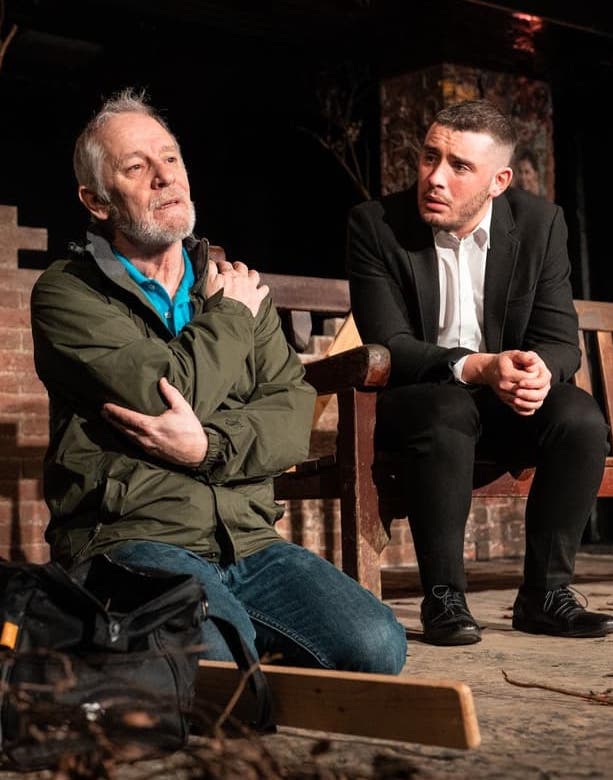
We’re offered a glimpse into this terrifying scenario through a simple park-bench, chalk-and-cheese set-up: a meeting between an eager young man of twenty-five (Sean Connor) and a gruff older one (Billy Mack). They’ve been matched by a supposedly ‘world-beating’ app, but this is not a date – or at least, not a conventional one. They are two avowedly heterosexual, cis-gendered men, following a strict government mandate to ‘connect’ – because things aren’t sustainable as they are. Through this smallest of microcosms, Carr seeds just enough information into the men’s darkly comic dialogue to allow us to envisage the bigger picture, the tortured society in which they live, where schools are closed, most interactions happen online, and everything feels wrong.

The characters are beautifully realised, played with warmth and humour by Connor and Mack, even as they expose the men’s real pain. The generational divide is deftly managed, the initial chasm between them narrowing as they talk and share confidences, slowly realising that they’re more alike than not, that their shared fate should bind them rather than pull them apart.

Under Caitlin Skinner’s assured direction, the play’s political points are clearly made without ever feeling intrusive. I like the cheeky use of tableaux and blackouts to mark the passage of time at the beginning, and the set – by Gemma Patchett and Jonny Scott – is modest but strikingly effective. I’m especially drawn to the myriad images of women adorning the tumbledown walls, and find myself wondering if they are ‘missing’ posters or simply photos, there to remind the men of what they’ve lost. 

Because, of course, you never know until it’s gone…

4.4 stars

Susan Singfield
Moonset

16/02/23

Traverse Theatre, Edinburgh

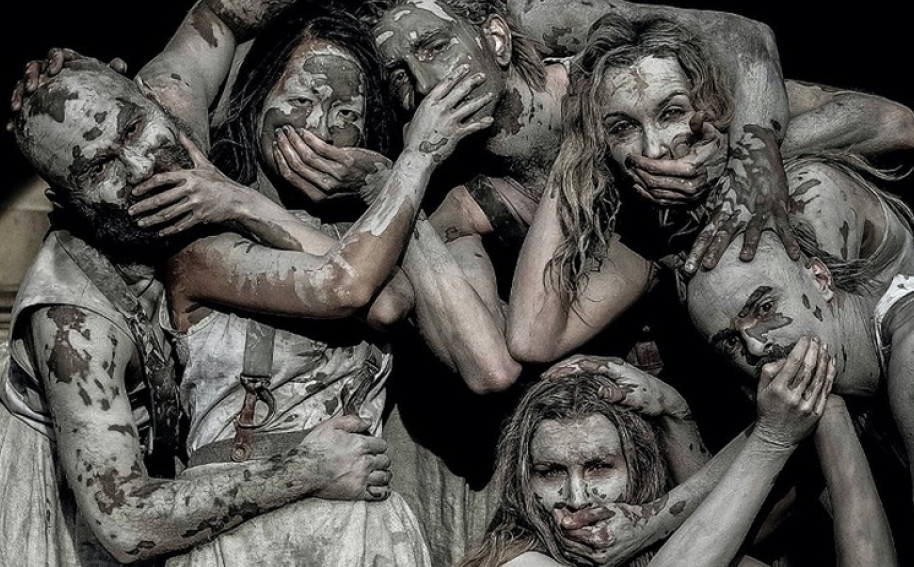
A school trip to the Paisley Witches’ Memorial proves momentous in Moonset, Maryam Hamidi’s spirited play about four teenage girls, who just need a little bit of power…

It’s a great premise. Surely the worst thing about being an adolescent is the lack of autonomy. There’s so much to deal with (exams, hormones, growing up, life), so much conflicting advice, so many rules and boundaries and exhortations to “be good”.

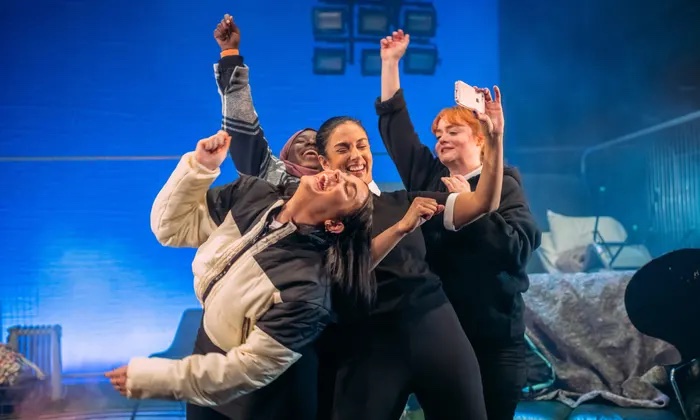
Roxy (Layla Kirk) feels like she’s on fire. Her best friend, Bushra, seems to be cooling on her, her mum (Zahra Browne) is concealing something, Nat 5s are looming – and why hasn’t she started her period yet? But Bushra (Cindy Awor) has her own problem – she has questions about her sexuality, and the answers seem scary. Meanwhile, Gina (Leah Byrne) is a ball of restless energy, bouncing from one calamity to another, and Joanne (Hannah Visocchi) isn’t sure her boyfriend, Gary, is quite the guy she’d like him to be.

They all feel powerless. And, like Abigail Williams and her friends before them, the girls seek strength in magic.

The teens’ exuberance is funny and engaging, but it doesn’t conceal the real problems they have to deal with. Hamidi’s bright, lively script grapples with dark themes – touching on coercive control, child abuse, immigration and cancer – treading this fine line with confidence. Director Joanna Bowman nimbly encapsulates the emotional turbulence of the formative years; she doesn’t hold back. We watch as the girls take terrible risks; they are as reckless and bold as only adolescents can be. And we’re on the roller-coaster with them, hoping against hope that the consequences of their actions won’t prove too appalling…

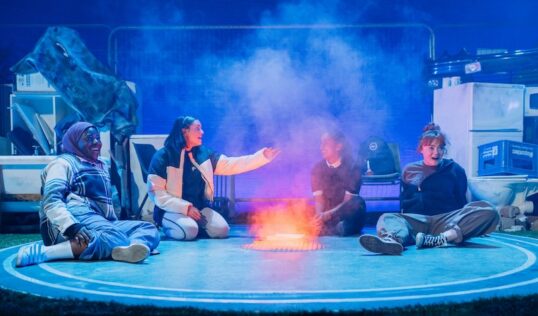
The set (by Jen McGinley) is a jumble, like the kids’ minds, with myriad items competing for attention. It works well, the empty circle in the middle representing their safe space: the junk yard, ironically, is the one place with nothing filling it, offering them room to think, to cement their friendship and ultimately find their hidden strengths. There are some pretty nifty effects too. I like the way the fire is created with smoke and light (courtesy of Simon Hayes). Movement director Vicki Manderson deserves a mention too: this is a kinetic piece and the momentum never flags, the performers interacting seamlessly with the space.

The set-up works well, leaving me scared for the girls and their futures. No spoilers here – suffice to say that, after the coup de théâtre at the end of the first act, the second provides a pay-off that is unexpected but satisfying. Although I’m crying as the lights go down, I’m also left with a feeling of hope.

4.3 stars

Susan Singfield
Love Beyond (Act of Remembrance)

11/02/23

Traverse Theatre, Edinburgh

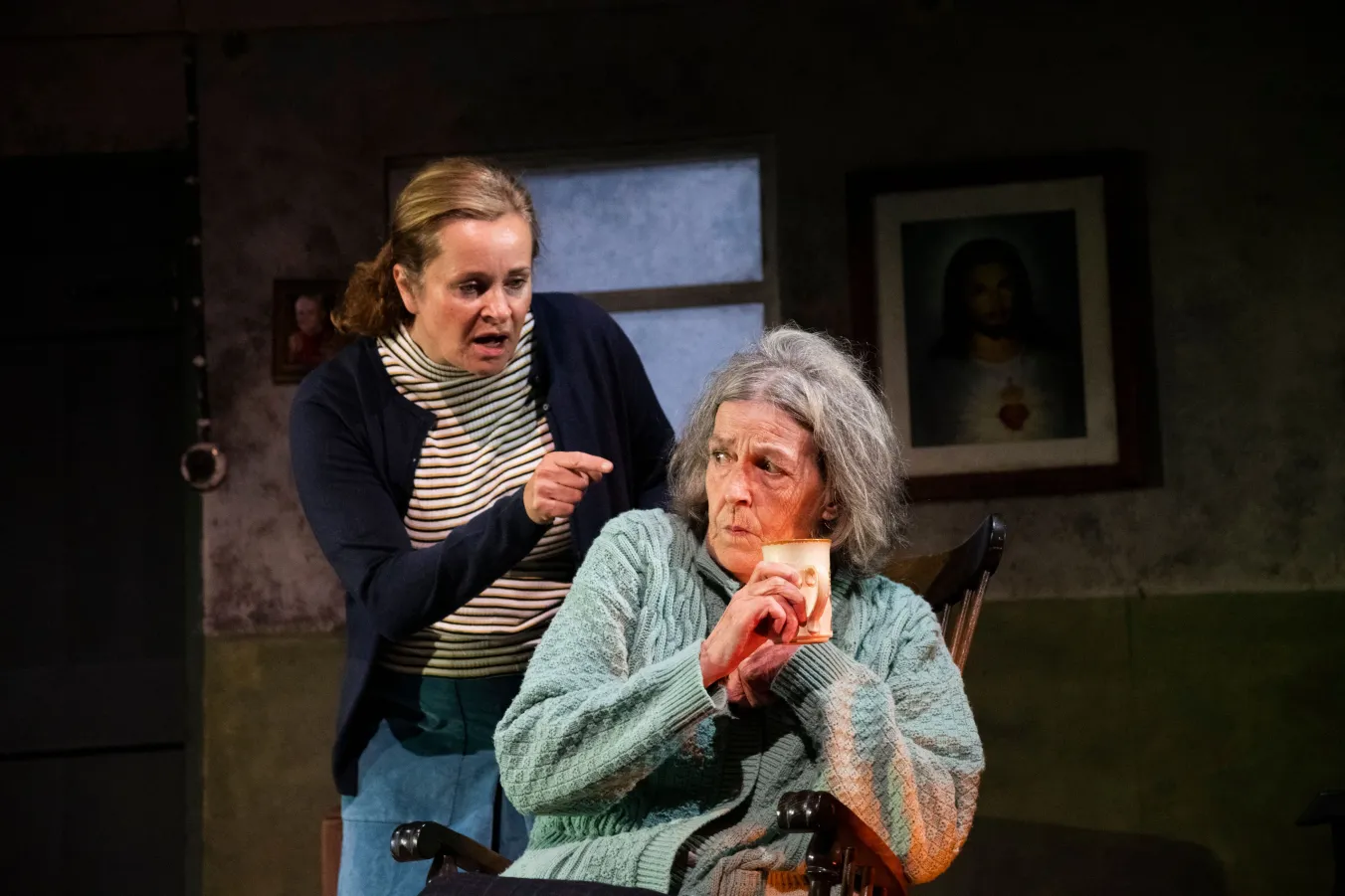
Love Beyond (Act of Remembrance) is billed as ‘a love story – but not a typical one’. And yet this play, by Ramesh Meyyappan is, like all tales of love and loss, at once unique and ubiquitous, quirky and commonplace.

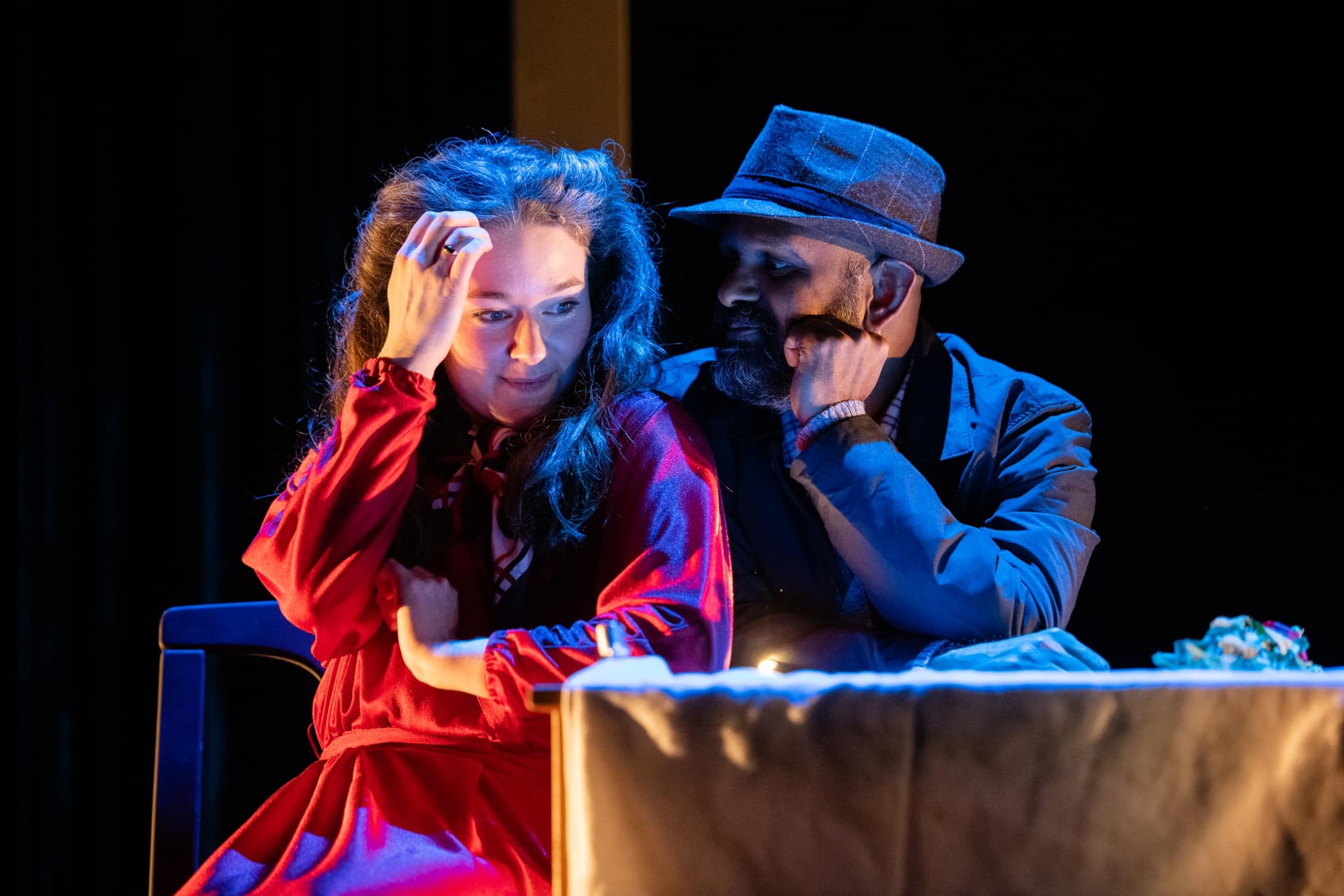
We meet Harry (Meyyappan) as he moves into a care home. He has dementia, and he’s also deaf. His new carer, May (Elicia Daly), is sweet and attentive, but she doesn’t know sign language, although she is ‘going on a course’. Naturally, Harry’s disorientation is heightened by the pair’s inability to communicate. Matthew Lenton’s skilful direction ensures the audience is drawn in, as those of us who can’t sign miss much of what Harry says, while some of those who are deaf presumably miss May’s words. It’s nicely done: we’re all given enough information to understand what’s going on, while also experiencing a little of Harry’s alienation from his new home, and May’s frustration at not being able to do her job.

The set (by Becky Minto) comprises three moveable screens. At first these are mirrors, magnifying Harry’s discomfort: the reflection of the audience staring at him adds to the sense that he no longer has a private life, or much autonomy at all. Cleverly, the screens are also transparent: lit from behind, they reveal Harry’s jumble of memories. We get to know the young Harry (Rinkoo Barpaga) and his true love, Elise (Amy Kennedy): we see them meet and fall in love; we see their joy and their sorrow, their prime and their decline. There’s something spellbinding about the way these images appear and disappear, and Harry’s yearning for Elise is palpable and heartbreaking.

The strength of this piece lies in the movement, which is precise, slow and beguiling – a realisation of the phrase ‘poetry in motion’. There is a gentle earnestness here that defies cynicism, so that a simple swimming mime becomes a thing of beauty; the act of putting on slippers becomes profound.

Composer David Paul Jones’s soundtrack is integral to the piece. The music is by turns melodic and jarring, light and intense, reflecting Harry’s inner turmoil just as clearly as the mirrors.

This year’s Manipulate Festival has thrown up some absolute gems – and this is one of them.

4.4 stars

Susan Singfield
Theatre Bouquets 2022

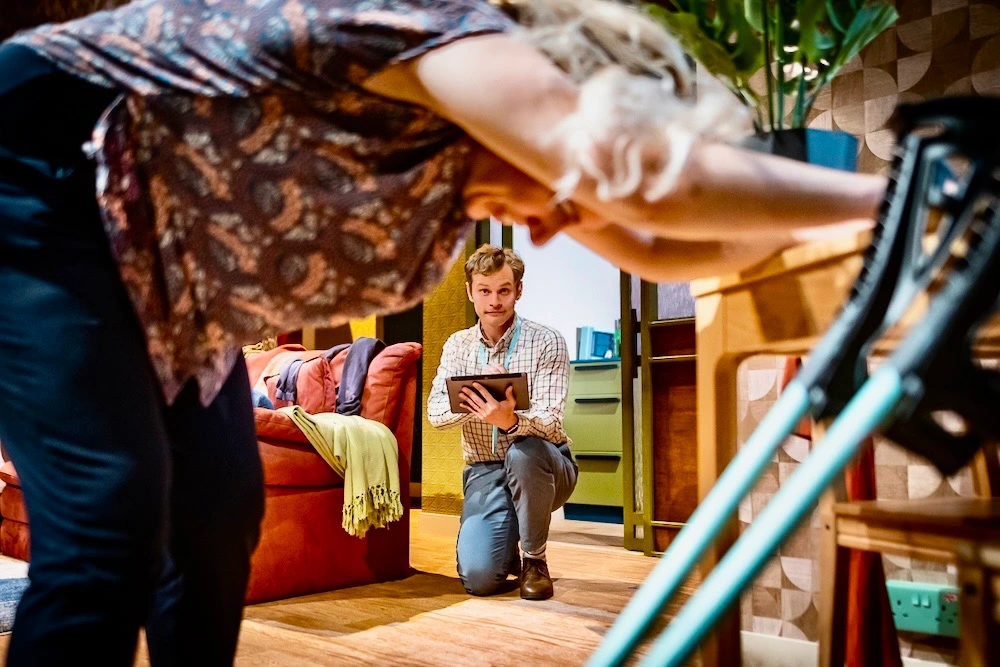
After the slim pickings of the last two years, 2022 feels like a palpable return to form: finally, emphatically, theatre is back! We’ve relished the wide range of productions we’ve seen over the year. As ever, it was difficult to choose our particular favourites, but those listed below have really resonated with us.


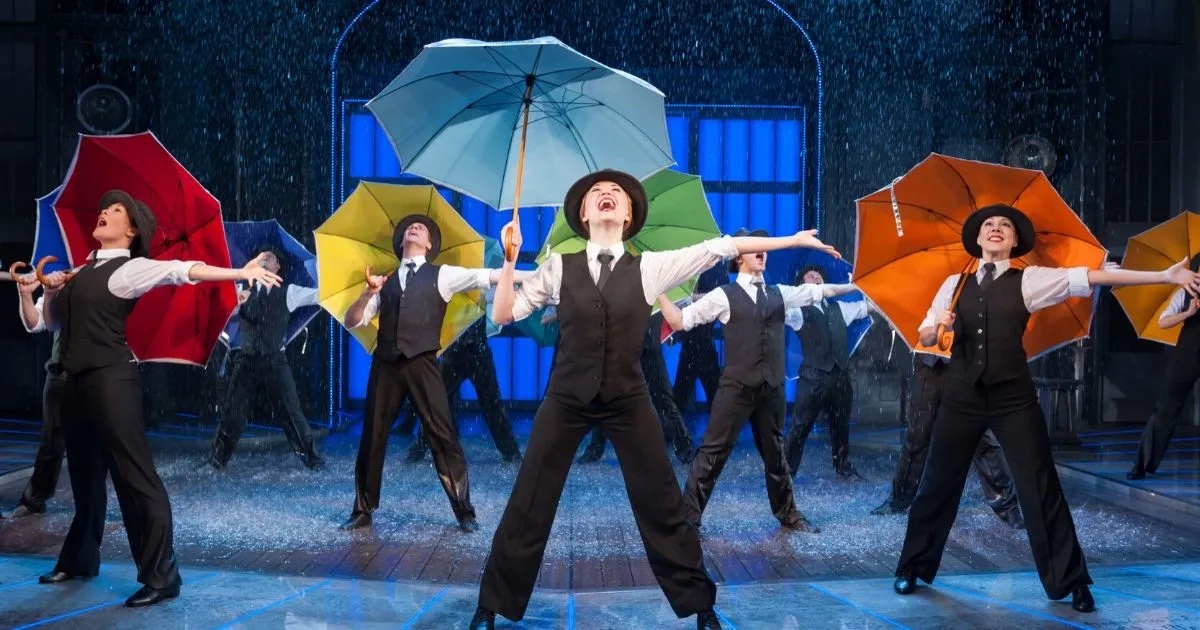
Singin’ in the Rain (Festival Theatre, Edinburgh)

Singin’ in the Rain is a delight from start to finish. It never falters, never loses pace and manages to honour the great film that inspired it. One of the most supremely entertaining shows I’ve seen in a very long time. Slick, assured, technically brilliant – it never puts a hoof wrong.

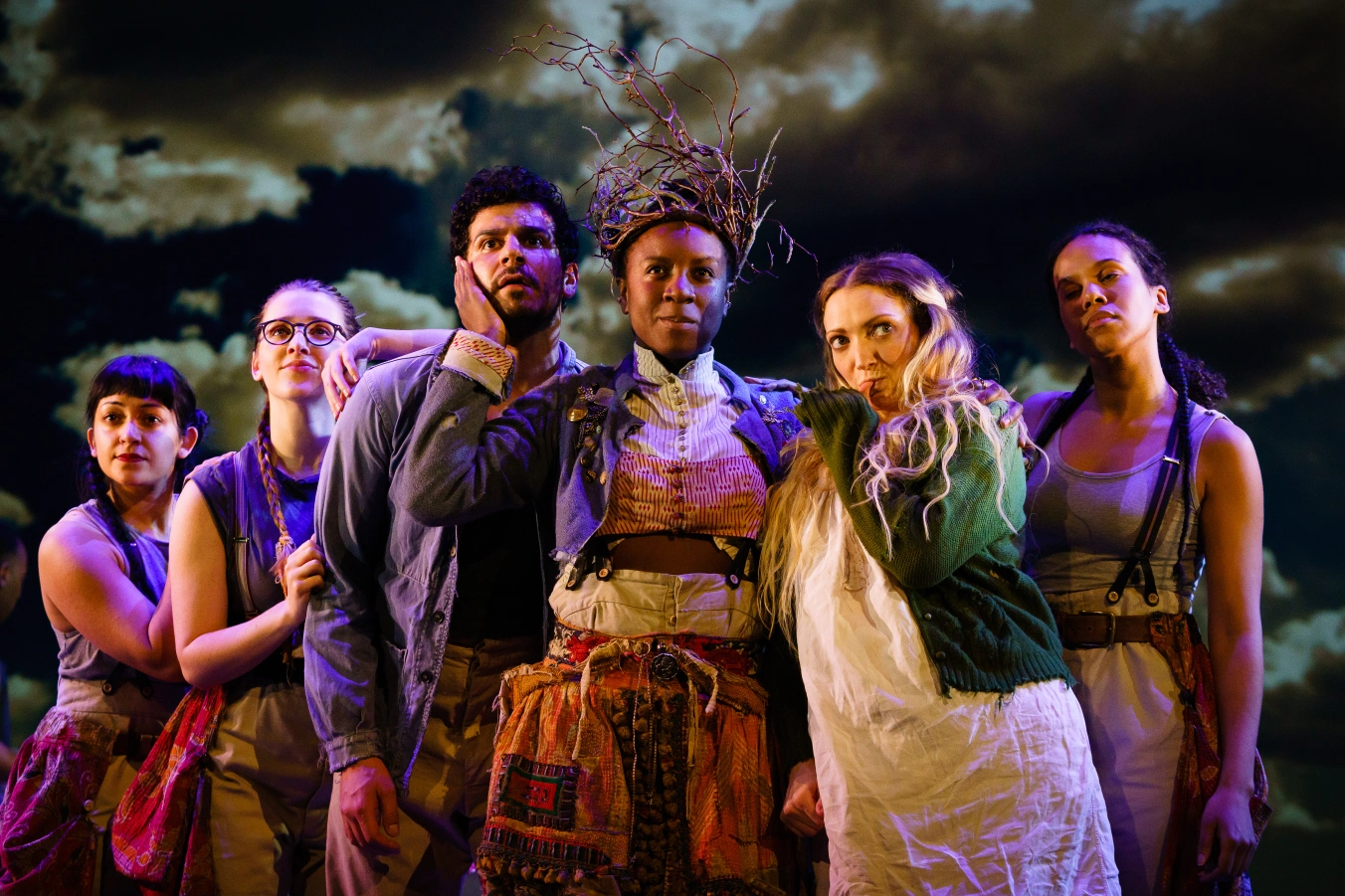
Wuthering Heights (King’s Theatre, Edinburgh)

In this Wise Children production, Emma Rice strips Wuthering Heights down to its beating heart, illuminates its essence. This is a chaotic, frenzied telling, a stage so bursting with life and energy that it’s sometimes hard to know where to look. It’s dazzling; it’s dizzying – and I adore it. 

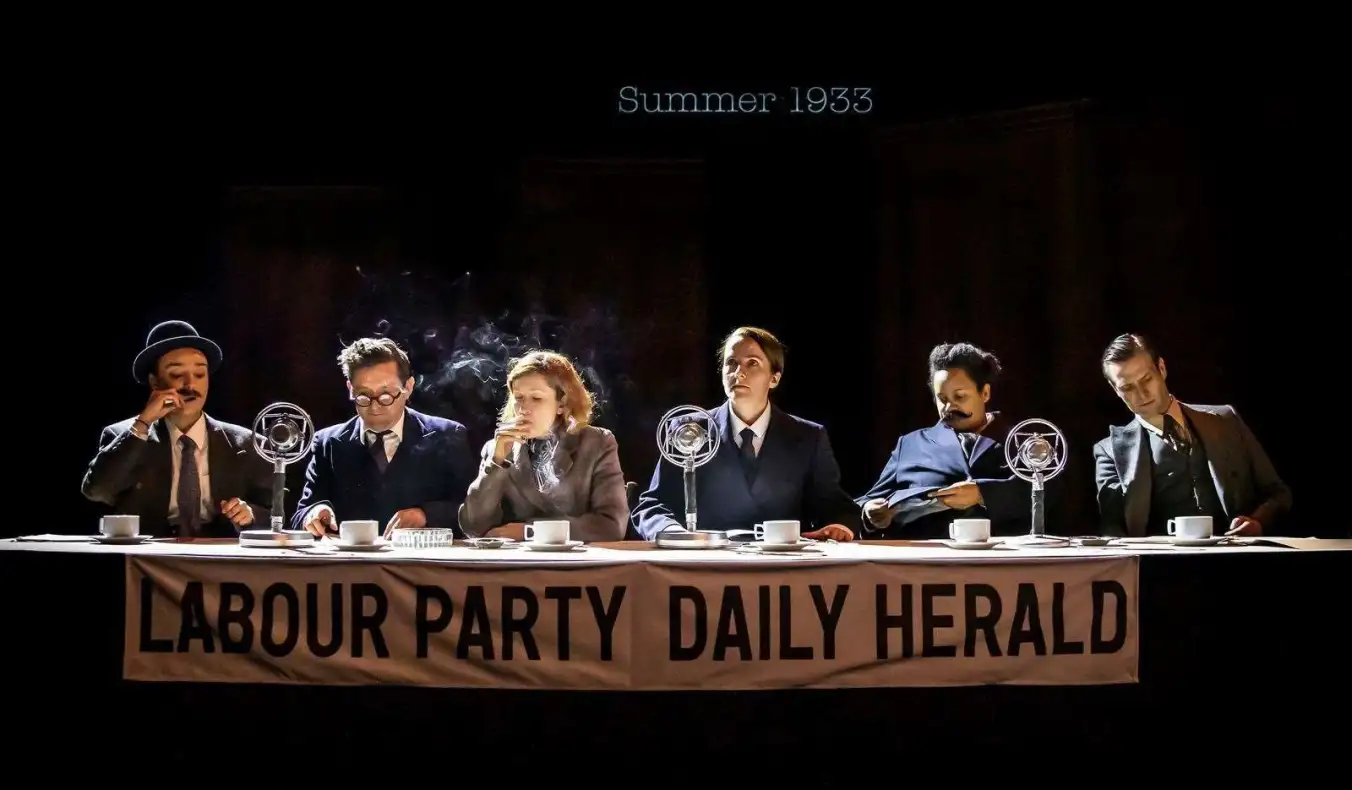
Red Ellen (Lyceum Theatre, Edinburgh)

Red Ellen is a fascinating tale, ripped from the pages of political history. Wils Wilson’s propulsive direction has Ellen hurtling from one scene to the next, which keeps the pot bubbling furiously.

Prima Facie (NT Live, The Cameo, Edinburgh)

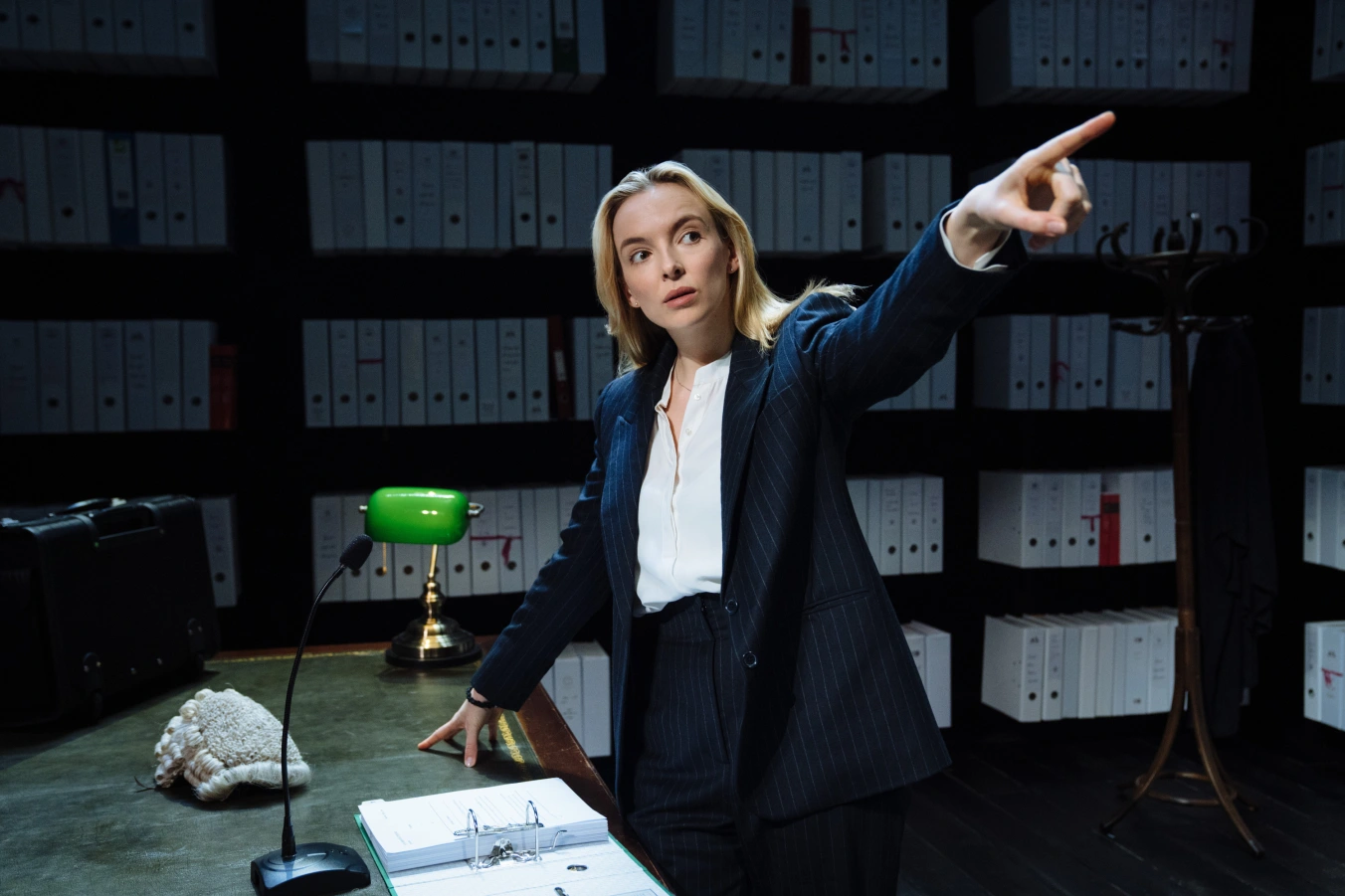
This is a call to action that walks the walk, directly supporting The Schools Consent Project, “educating and empowering young people to understand and engage with the issues surrounding consent and sexual assault”. It’s also a powerful, tear-inducing play – and Jodie Cromer is a formidable talent.

Feeling Afraid as if Something Terrible is Going to Happen (Roundabout @ Summerhall, Edinburgh)

Samuel Barnett inhabits his role completely, spitting out a constant stream of pithy one liners and wry observations with apparent ease. Marcelo Dos Santos’ script is utterly compelling and Matthew Xia’s exemplary direction ensures that the pace is never allowed to flag.

Hungry (Roundabout @ Summerhall, Edinburgh)

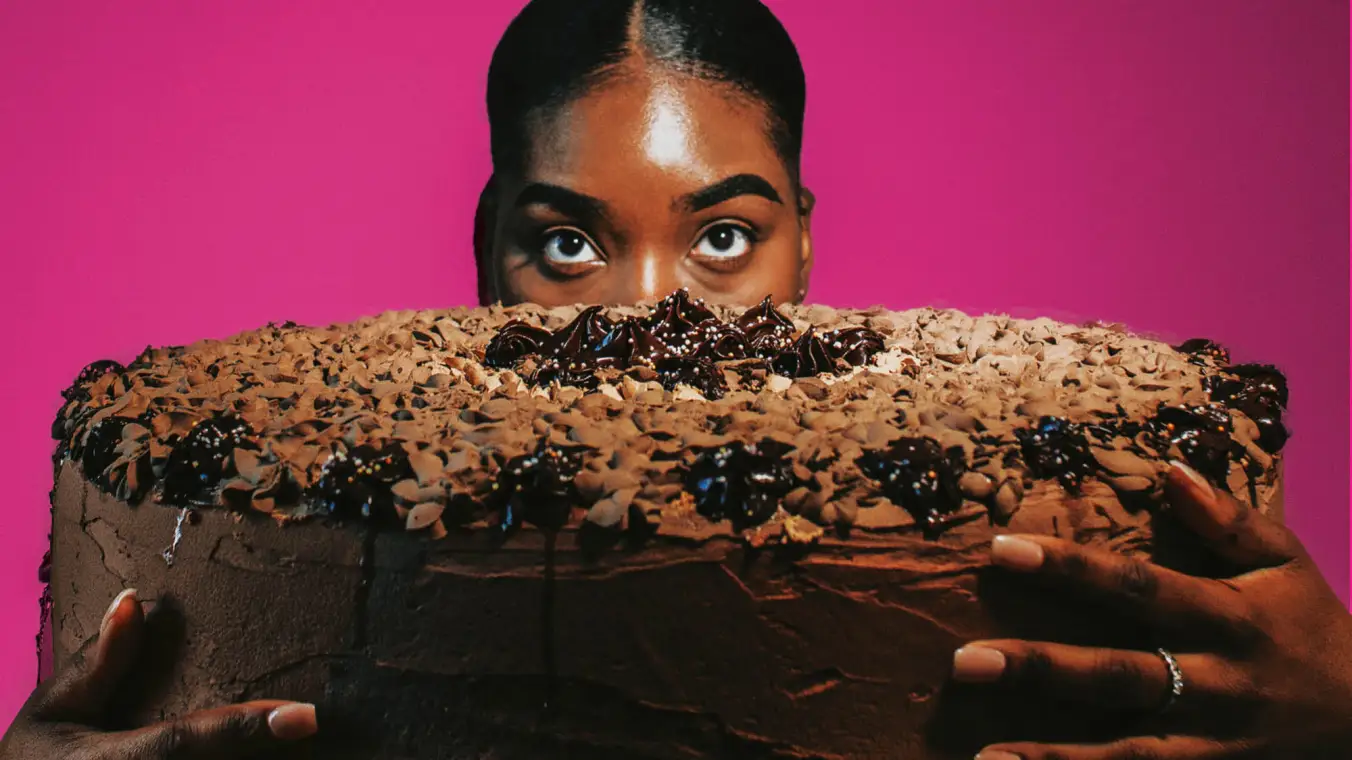
This sharply written two-hander examines the relationship between Lori (Eleanor Sutton), a chef from a relatively privileged background, and Bex (Melissa Lowe), a waitress from the local estate. This is a cleverly observed exploration of both class and race, brilliantly written and superbly acted. Hungry is a class act, so assured that, even amidst the host of treasures we saw at this year’s Roundabout, it dazzles like a precious gem.

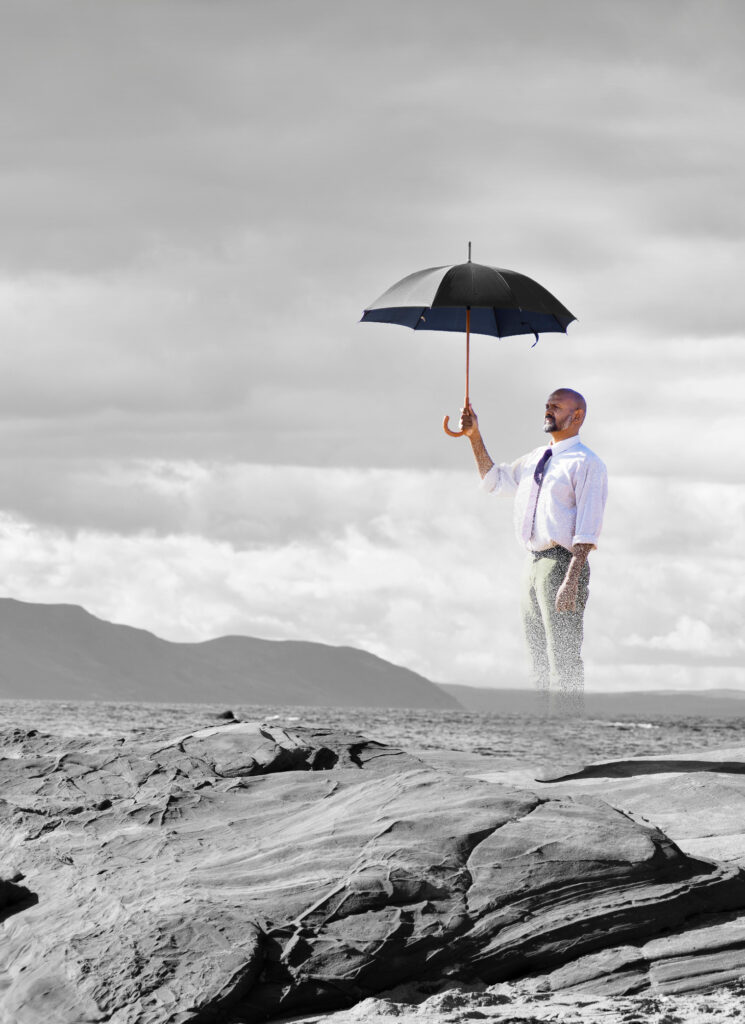
A Very Old Man With Enormous Wings (Summerhall (Main Hall), Edinburgh)

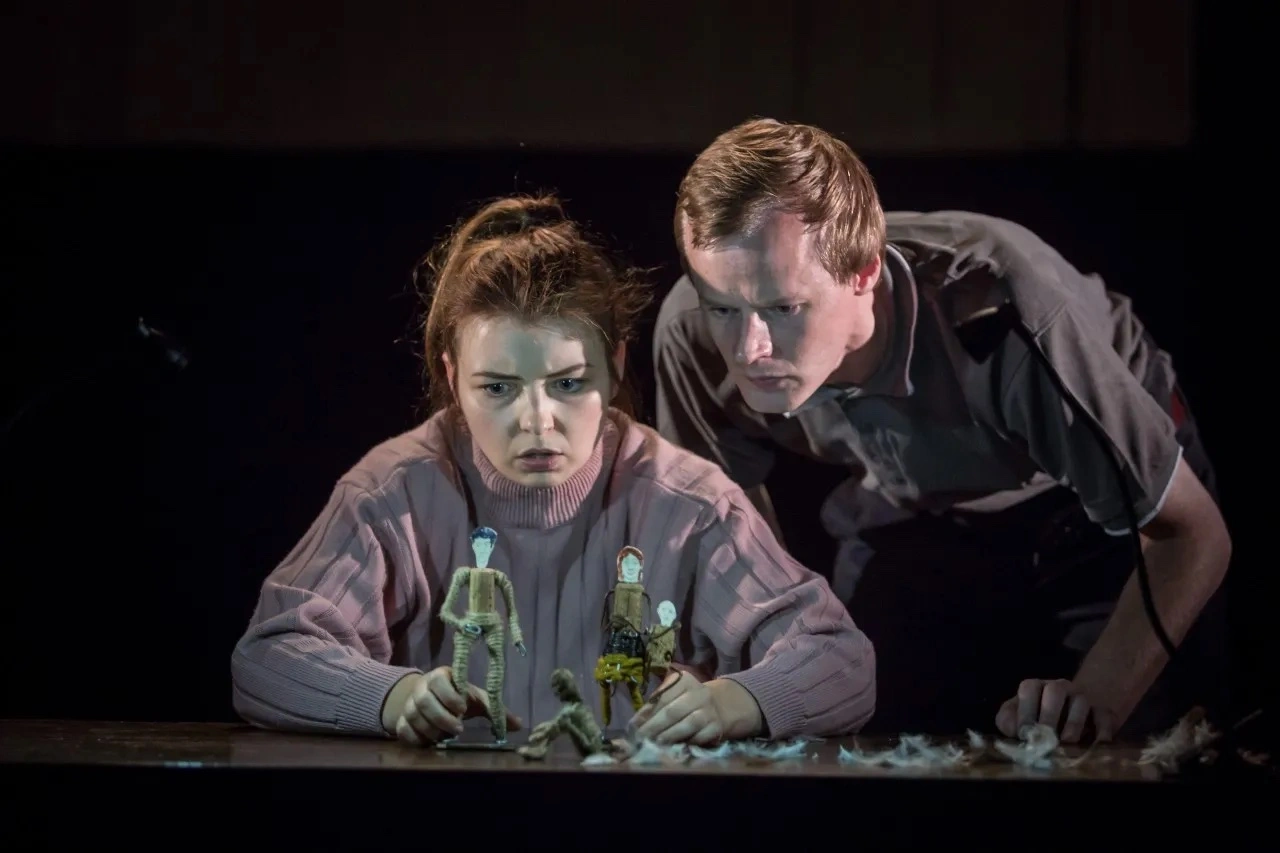
It’s hard to encapsulate what makes this such a powerful and moving experience, but that’s exactly what it is – a spellbinding slice of storytelling, so brilliantly conceived and engineered that it makes the incredible seem real. You’ll believe a man can fly.

The Tragedy of Macbeth (Assembly Roxy, Edinburgh)

Let’s face it, we’ve all seen Macbeth in its various shapes and guises – but I think it’s fairly safe to say we’ve never seen it quite like this. This raucous, visceral reimagining of the story captures the essence of the piece more eloquently than pretty much any other production I’ve seen.

The Beauty Queen of Leenane (Traverse Theatre, Edinburgh)

This was Martin McDonagh’s debut piece and, while it might not have the assuredness of his later works, it nonetheless displays all the hallmarks of an exciting new talent flexing his muscles. The influence of Harold Pinter is surely there in the awkward pauses, the repetitions, the elevation of innocuous comments to a weird form of poetry – and the performances are exemplary.

Don’t. Make. Tea. (Traverse Theatre, Edinburgh)

Don’t. Make. Tea. is a dystopian vision of an all-too credible near future, a play laced with dark humour and some genuine surprises. Cleverly crafted to be accessible to the widest possible audience, it’s an exciting slice of contemporary theatre.

Susan Singfield & Philip Caveney

Once Upon a Snowstorm

09/12/22

Traverse Theatre, Edinburgh

Described as a play for children aged 5-8 and their families, Once Upon a Snowstorm is based on the popular picture book by Richard Johnson. It tells the tale of a boy (Fay Guiffo) and his dad (Michael Sherin), who live in a woodland cottage. One day, they go out to hunt in the snow, but are separated and the boy is lost. Eventually, he ftakes shelter in a cavern and falls asleep. When he awakes, he finds himself surrounded by friendly animals, who teach him all about their ways…

It’s a charming – if slight – tale. Although Jo Timmins’ adaptation includes dialogue, it retains the quiet solemnity of Johnson’s wordless original, as well as the gentle pace. It feels true to the book, capturing its tranquil, earnest tone, and illuminating the boy’s sense of wonder. I’m especially entranced by the music (composed by David Paul Jones), and the way Guiffo’s violin is integrated seamlessly into her performance.

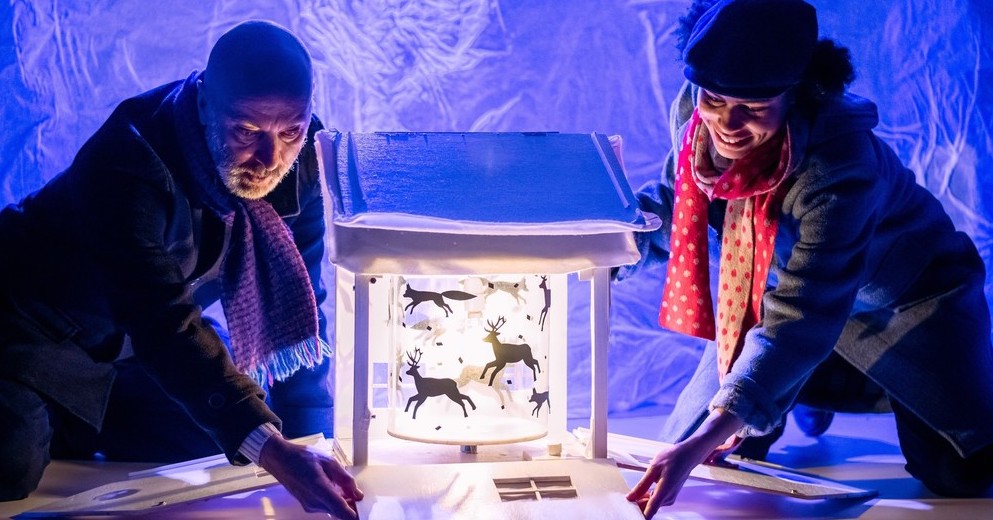
Traverse 2 has been reconfigured for this show, and it’s good to see it being used imaginatively. The acting space is tented with crumpled white sheets, and the seating comprises rows of ‘tree stumps’ (covered stools) and cushions, presumably intended for the wee ones to sit on and, at the back, a single row of adult-sized chairs. On entering, we’re asked to hang up our coats and remove our shoes, which somehow adds to the sense of occasion: something different is happening here. Largely, it works well, although there are some issues with the sight lines. There’s no one organising the smallest children to the front rows, and not enough full-sized seats for the grown-ups accompanying them. I can understand the wish to create something intimate, with no clear boundaries. But it might make sense to place the beautiful model house on a higher plinth, so that we can actually see it, and for the boy not to spend quite so much time sitting or lying on the floor.

Sherin and Guiffo embody all the different animals, and their performances are enchanting. Perhaps there’s a little too much repetition for me (the same route through the audience; three different lots of projected images), but the target audience seem to lap it up and, at forty-five minutes, there’s no time for this to flag.

Once Upon a Snowstorm is a sweet, simple tale, with some beautiful imagery.

3 stars

Philip Caveney

Cell Outs

24/11/22

Traverse Theatre, Edinburgh

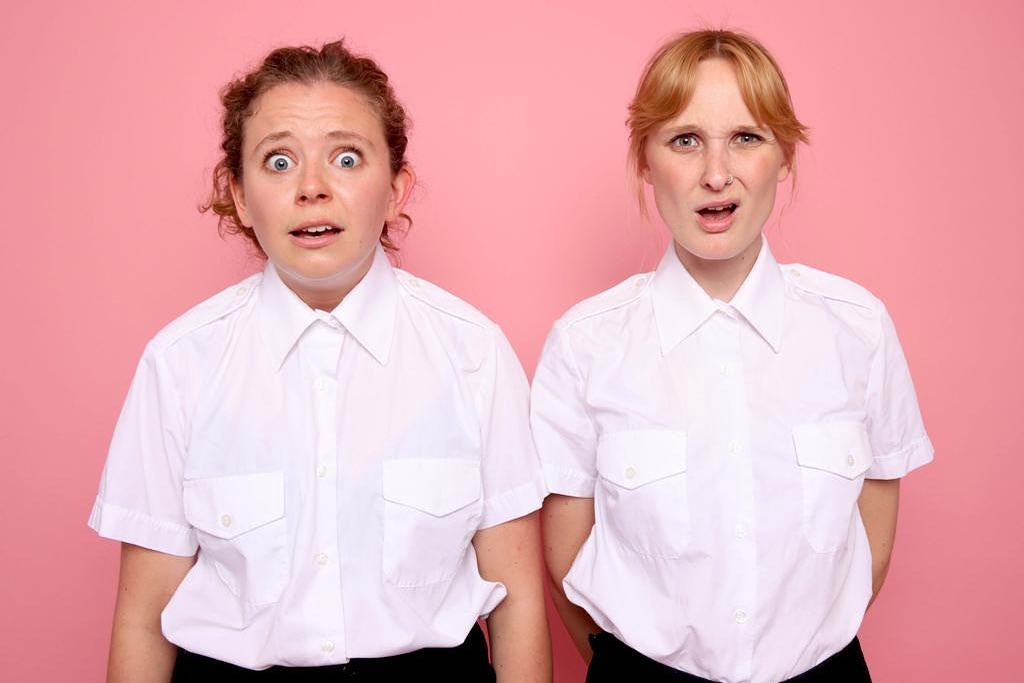
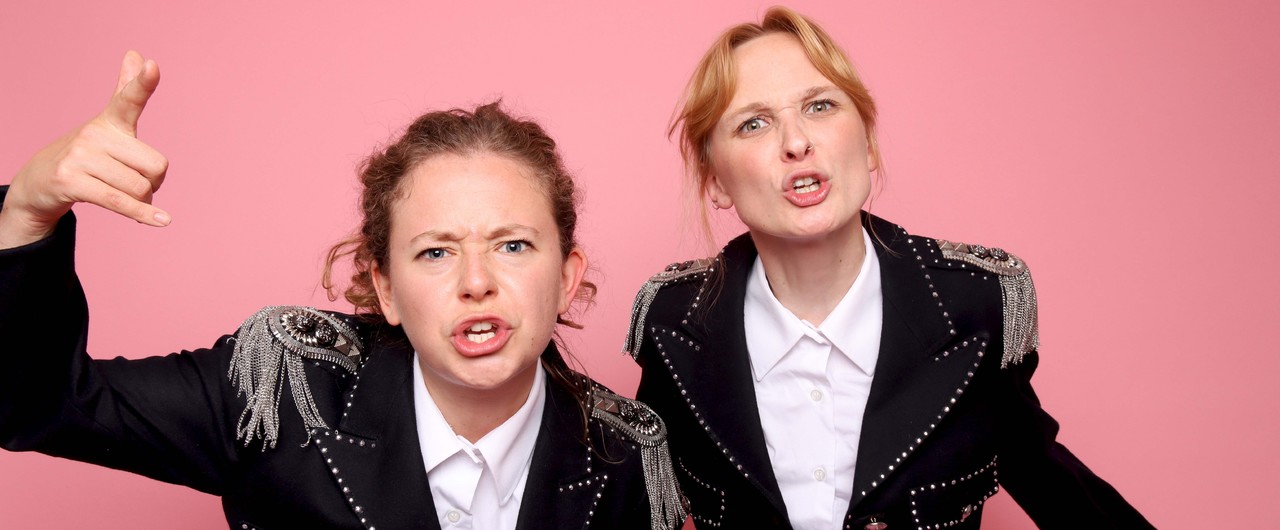
As true stories go, the plot of Cell Outs is a remarkable one. Written and performed by Harriet Troup and Ella Church and directed by Grace Church, it’s the tale of two naïve drama school graduates who enlist on a new scheme that promises to allow them to bring their social justice dreams to light in the prison system. Sounds exciting, right? They eagerly sign up and, after just six weeks of basic training, they find themselves enrolled as… prison warders, working in two adjoining gaols. Troup is based in a male prison (delicately titled HM Prick for the purposes of this drama) while Church works at the women’s prison (HM Pussy).

They quickly learn that opportunities to use their drama skills are nonexistent. Instead, they must negotiate the endless litany of drug dealing, scrapping, tongue lashings and suicides that are part and parcel of everyday prison life. At first, they’re appalled by what they witness but, as the days roll inexorably by, they become increasingly hardened to the horrors, inured to the misery around them and in serious danger of becoming everything they dislike about the system.

Troup and Church are engaging performers and they attack their roles with gusto. We are presented with a series of sketches chronicling their descent into the abyss, interspersed with voice recordings from inmates and fellow workers. They also perform occasional musical interludes, which – it must be said – vary in quality. A clever parody of ‘Doe, a Deer,’ utilising prison vernacular is a particular highlight, but some of the rap-inflected offerings feel more generic.

If there’s a major issue here, it’s the play’s story arc, which starts bleak and funny and, without really developing, soon becomes just plain bleak. Furthermore, many of the major dramatic occurrences later in the drama are told rather than shown; for the true tragedy to strike home, we need to see a climactic incident played out before our eyes, rather than just hear about it.

Cell Outs is a unique story with a powerful central message, but it’s a message that occasionally feels a little obfuscated in its delivery.

3.4 stars

Philip Caveney

Crocodile Rock

25/10/22

Traverse Theatre, Edinburgh

Seventeen-year-old Stephen McPhail feels marooned in his tiny island hometown, Millport. Sure, the mainland is only a short ferry-hop across the water, but the distance seems insurmountable. Stephen’s faither owns a pub, and his maw a B&B, and he’s expected to follow them into the family businesses. But the blokey banter at the bar leaves Stephen tongue-tied and blushing, and he dreams of something more. It’s only when handsome newcomer Henry Thomas arrives that Stephen finally figures out why he doesn’t fit in: he’s gay. The realisation brings him little comfort: Henry not only rejects him, but also makes sure he’s ostracised by his peers. Because being gay in 1997 – especially in a small town, and even more especially when you’re still at school – is a long, long way from easy. Things only improve when the annual Country and Western festival rolls into town, and a keyboard-playing drag queen offers Stephen a way out…

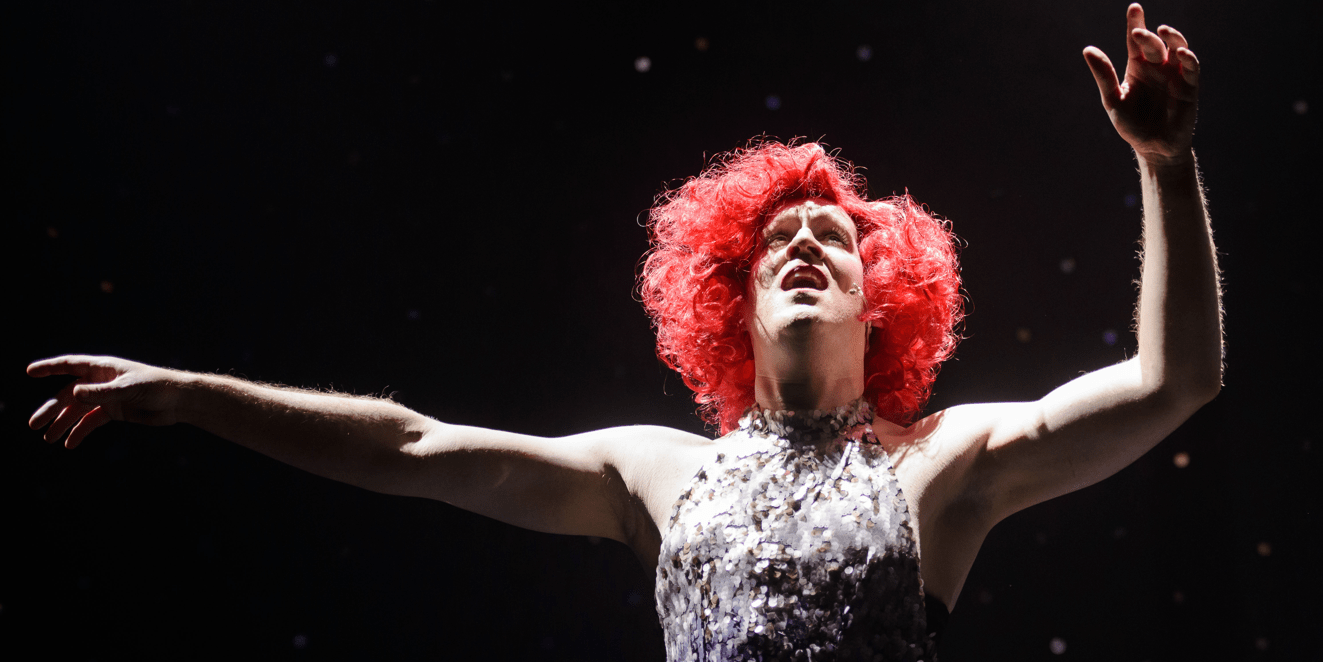
Andy McGregor’s one-man (and a band) musical is a delight. The writing nails the open homophobia still so prevalent in the late 90s; I was a teacher then, and Clause 28 was crippling. Coming-out tales are far from rare, but this one soars: the songs are bold yet nuanced, and actor Stephen Arden really brings to life the young man’s loneliness and yearning. It’s always apparent that Stephen is a caterpillar, waiting to grow his wings, and – when he does – his exuberance is catching. There’s a real sense of celebration in the final act, and we leave smiling, sharing some of Stephen’s catharsis. Arden has an impressive vocal range, and the three-piece band (Kim Shepherd and Simon Donaldson, led by musical director Andy Manning) produce an impressively full sound. Arden acknowledges their presence, interacting with them occasionally, so that they are seamlessly integrated into the play.

The set (by Kenny Miller) is simple but very effective. A large photograph of Millport’s famous but – sorry – undeniably awful Crocodile Rock serves as a background, contrasting wonderfully with the sequinned glamour Stephen eventually embraces. The photo not only hides a sliding door, but also some hinged boards that open up to show us Stephen’s cartoon-themed bedroom, reminding us of just how young he is, poised on the cusp between boy and man.

Crocodile Rock is on tour. If you haven’t seen it yet, you’ve missed your chance in Edinburgh, but you can still catch it at the Lemon Tree in Aberdeen on 4th November. It’s a real treat.

4.1 stars

Susan Singfield
Don’t. Make. Tea.

06/10/22

Traverse Theatre, Edinburgh

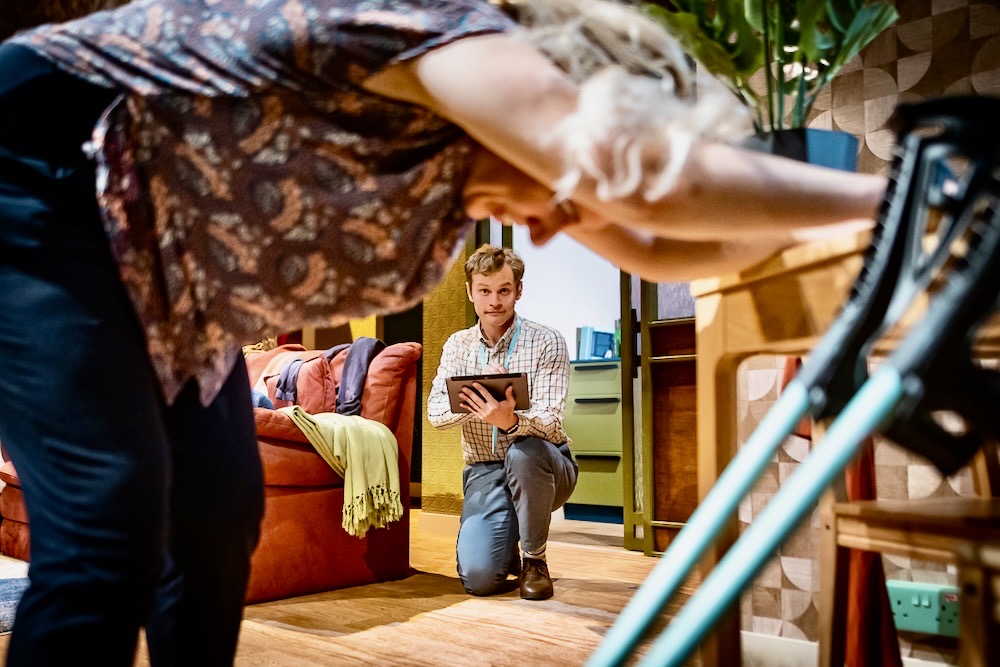
Chris (Gillian Dean) is feeling understandably nervous. It’s the year 2030 and today she’s having her assessment. Chris has OPMD, which means that she is partially sighted, has trouble walking and is in constant pain. This rare condition is degenerative, so things are only going to get worse – but, under a recently implemented system, claimants are assessed ‘positively’, i.e. on what they can do rather than on what they can’t do.

The process will be depressingly familiar to those who have been through a PIP assessment. Points are awarded throughout the frustratingly opaque interview. If Chris scores five, she will be expected to take on part-time work. Score ten and she can go full-time! All Chris knows is that she has no money in her account and her electricity supply is set to switch itself off when the meter hits zero. She’s desperate. Meanwhile, her life is supervised by ‘Able’, an Alexa-like hub that offers a commentary on everything she says and does… and may just be capable of informing on her should she ever step out of line.

Enter Ralph (Aidan Scott), the sly, smirking interrogator who will determine Chris’s future. ‘We listened,’ he keeps telling her, and then proceeds to turn her words against her. His questions are cunningly designed to trip her up and he’s on to all the received wisdom that has served her up to now (‘be you on your worst day’; ‘don’t show them you can make a cup of tea’).

This clever and prescient piece from Birds of Paradise Theatre, written by Rob Drummond and directed by Robert Softly Gale, is designed to be as accessible as possible. Able’s irksome commentary acts as a kind of audio description, while on a huge TV screen that dominates one wall, Francis (the engagingly comic Emery Hunter) helpfully translates everything into sign language. An overhead video display also offers viewers the text. I’ve rarely seen audio-visual aids so skilfully integrated; indeed, they are characters in their own right.

It’s a show of two halves. The first is essentially a taut two-hander as Chris and Ralph go through the various hoops and hurdles of the assessment. The narrative becomes increasingly adversarial and the interview builds to a frantic conclusion. As the lights go down for the interval, I ask myself where this can possibly go next.

The second act is an entirely different kind of beast, a high-powered slice of farce as new figures appear, seemingly out of nowhere. It would be wrong to give too much away but there are some wildly funny moments here, though the piece never forgets that it has an important message about disability rights to get across – something it skilfully manages without thumping me over the head.

Don’t. Make.Tea. is a dystopian vision of an all-too credible near future, a play laced with dark humour and some genuine surprises. Cleverly crafted to be accessible to the widest possible audience, it’s an exciting slice of contemporary theatre.

4.2 stars

Philip Caveney

He Who Opens the Door

04/10/22

Traverse Theatre, Edinburgh

The ‘Play Pie Pint’ season continues, and this week’s offering is a dark comedy by Ukrainian playwright, Neda Nezhdana. The morgue where Vera (Louise Stewart) works is situated in an underground bunker, originally built as a bomb shelter. For Vera, this is just a normal, boring nightshift, babysitting the dead: filling out paperwork, flicking through a magazine and half-heartedly exercising – anything to pass the time. But then Vika (Yolanda Mitchell) stumbles from the freezer into the office, still drunk from the night before. She doesn’t know where she is, or why there’s a tag on her foot. Vera faints at the sight of a walking corpse and, when she comes round, she’s confused. Is Vika alive, or is Vera dead? Suddenly, shockingly, the two women realise the doors are locked and Vera’s phone has no signal. And then the landline rings…

He Who Opens the Door has been adapted by John Faradon, and – although the setting is still Ukraine – there’s a distinctly Scottish flavour to this production. I can see what director Becky Hope-Palmer is aiming for but, for me, this muddies things somewhat. It’s a metaphorical play, “reflecting the limbo for some people in eastern Ukraine, caught between opposing forces”, but I’m not immediately aware of where I am supposed to be: the signs, flags and magazine title tell me one thing, while the tone tells me another. Likewise, the programme says ‘present day’ but that’s not quite true: the script pre-dates the Russian invasion. This adds to my confusion, as I try to piece together what it all means. Not all of the jokes land, either, although the more serious points are eloquently made. I have to confess I’m a bit uncomfortable with Vera’s anti-abortion rhetoric (in particular, the assertion that women are always damaged by the process), and I’m not sure how this particular revelation contributes to the discourse. Still, this is only one idea amid a kaleidoscope of other, more enticing hypotheses about autonomy and independence.

In truth, there’s a lot of good stuff here. Both Stewart and Mitchell deliver strong, compelling performances, and it’s a lively, engaging piece. There are echos of Beckett in the waiting and uncertainty, and of Pinter too: those enigmatic phone calls reminiscent of the notes the dumb waiter delivers to hitmen Ben and Gus. Impressively, Hope-Palmer manages to convey a sense of time passing inexorably, as the women await their fates, while simultaneously offering us a play that gallops along at pace. Amidst the existential dread, there is dancing and singing; in the darkness, there is light.

He Who Opens the Door is not an easy play, but it is a fascinating one, and I can’t think of a more fruitful way to spend a lunchtime.

3 stars

Susan Singfield