Tom Hardy

Havoc

27/04/25

Netflix

Welsh filmmaker Gareth Evans first came to prominence with his martial arts epic The Raid in 2011. An inevitable sequel (imaginatively entitled The Raid 2) followed in 2014, but his last big-screen release, The Apostle (2018), came and went with barely a ripple. So Havoc is clearly an important project for Evans. Which may explain why it feels like the very definition of the word ‘overkill.’

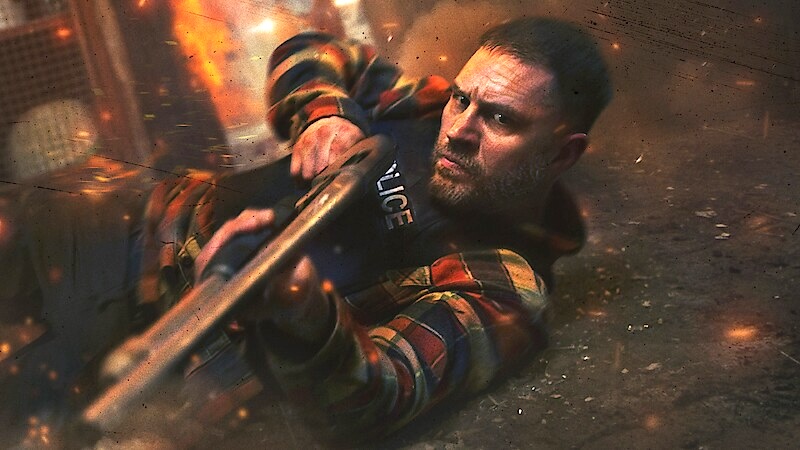
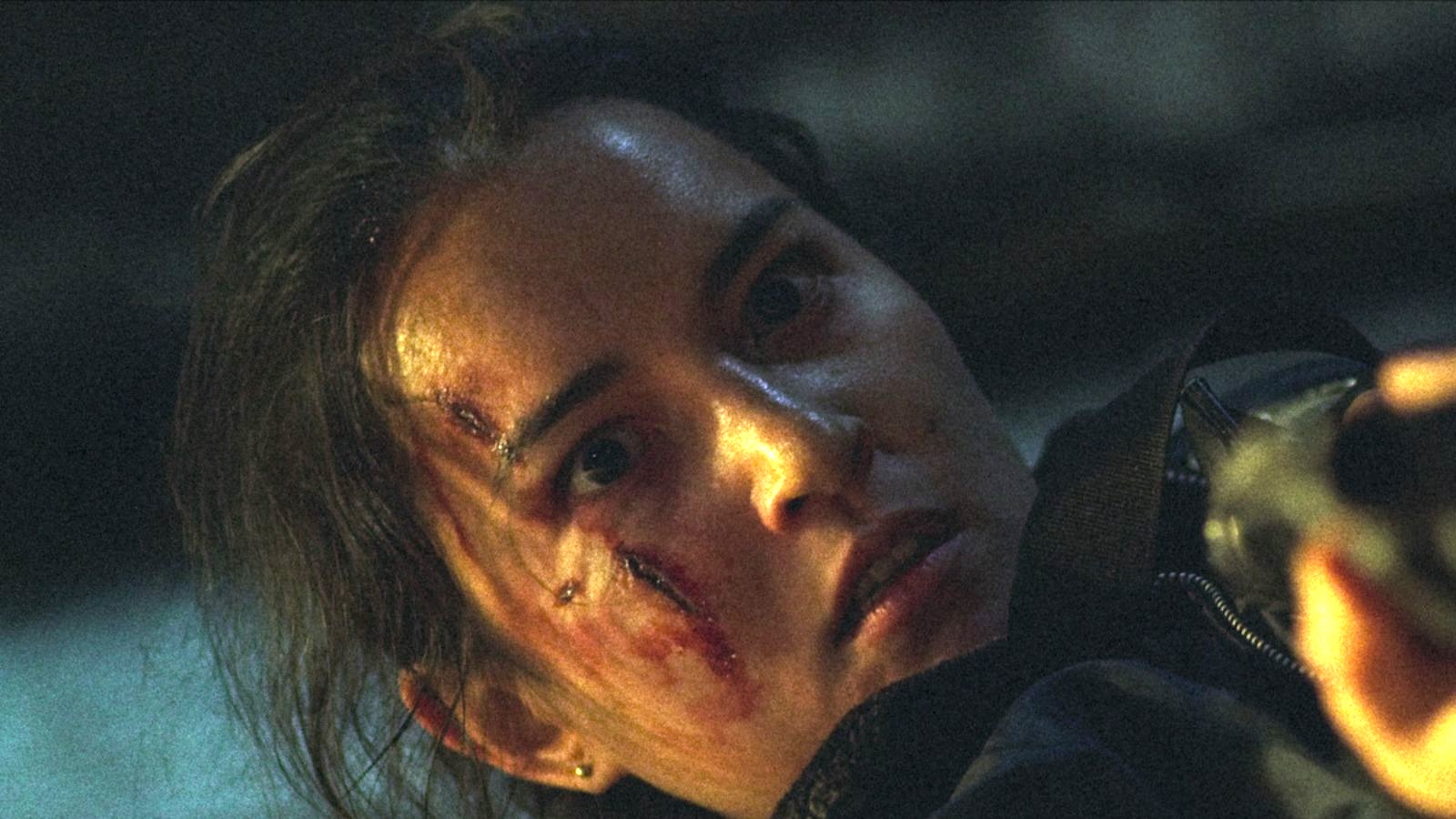
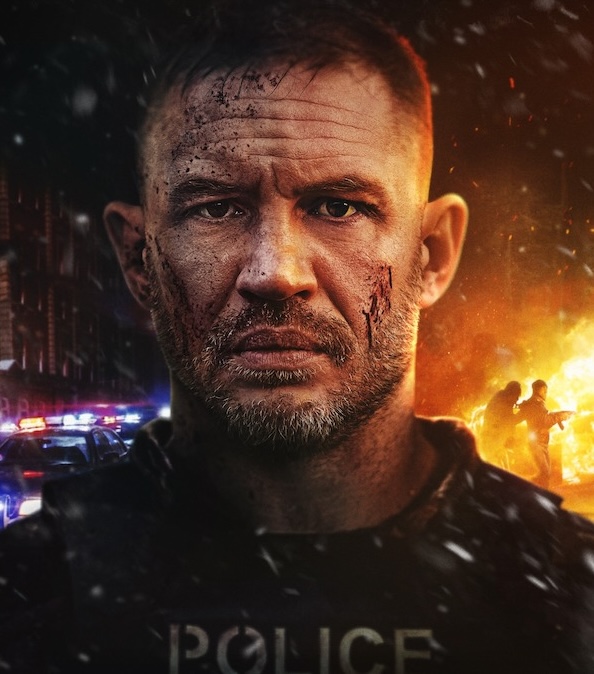
To be fair, it starts well. The action takes place in an unspecified American city – actually a heavily-CGI’d Cardiff. Grizzled cop Walker (Tom Hardy) is at an all-night garage, hastily trying to buy a Christmas gift for the twelve-year-old daughter he rarely ever sees. (Mind you, we don’t get to see much of her either.) Walker, it quickly becomes clear, is a dodgy copper, but then he’s not alone. Every member of the police force we meet in this story is on the take, apart from Ellie (Jessie Mai Li), who has only recently taken up her post as Walker’s sidekick.

After a drug deal goes wrong, Charlie (Justin Cornwell), the son of crusading politician, Lawrence Beaumont (an underused Forest Whitaker), finds himself hunted by a vengeful Chinese gang leader, who lost her own son in the resulting gunfire. Walker is ‘persuaded’ by Beaumont – yes, he’s also dodgy – to rescue Charlie, in exchange for a pardon for former crimes…

But the plot hardly matters, since Havoc – as the name might imply – is mostly an excuse to string together a series of action set-pieces. The first of them, the aforementioned ‘drug deal gone wrong’, is nicely staged, with some artfully-filmed slo-mo sequences and, what’s more, it’s relatively brief. But having dipped his bread in the old red stuff, Evans (who also wrote the screenplay) seems determined to serve up an ‘all-you-can-eat’ buffet of mayhem and murder.

The action becomes increasingly incoherent. People don’t just get shot and fall down, they dance around the screen spouting blood like human colanders. There’s a seemingly inexhaustible supply of ammunition and the Chinese drug gang employs an infinite number of human targets, all of whom appear to exist simply to run gleefully towards their own destruction. You’d need an abacus to keep a record of the body count.

For me, the main problem here is that, aside from Ellie, every character I meet is a villain of the lowest order and, while it’s not impossible to get audiences to root for bad people, you first have to know something about them in order to care what happens. But I know hardly anything about anybody and that includes Walker. Somewhere in this mess, excellent actors like Timothy Olyphant and Richard Harrington struggle to make any impression, as they are inextricably lost in a tidal wave of blood and bullets. As Havoc thunders towards its final, protracted punch-up, I’m already wistfully looking forward to the credits.

This one is clearly made for diehard action freaks and doubtless it will scare up some kind of an audience on Netflix – but for me it’s too loud, too messy and too downright unbelievable.

2.8 stars

Philip Caveney

The Bikeriders

27/06/24

Cineworld, Edinburgh

The poster for The Bikeriders might lead a viewer to expect something rather different from what this film actually is: a serious recreation of the misadventures of a motorcycle club, founded in the early 60s and initially memorialised in a 1967 book by photojournalist Danny Lyon.

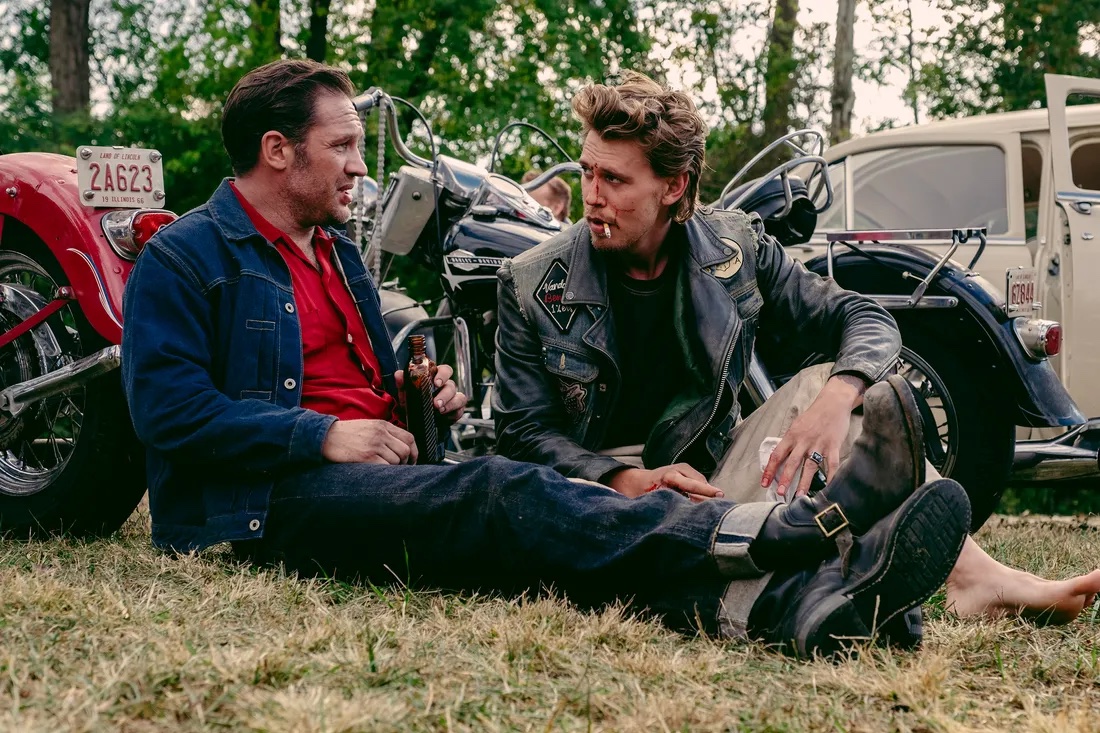
In Jeff Nichols’ film, we see Danny (Mike Faist) conducting a series of interviews with Kathy (Jodie Comer). She’s the long-term girlfriend of Benny (Austin Butler), a member of `The Vandals’, a Chicago-based group of bike enthusiasts, created and led by Johnny (Tom Hardy). In its early days, the group has a rigid code of honour that none of its members will ever ignore. Indeed, when we first encounter Benny, he’s about to be badly beaten up by a couple of rednecks when he refuses to remove his ‘colours’ in a local bar.

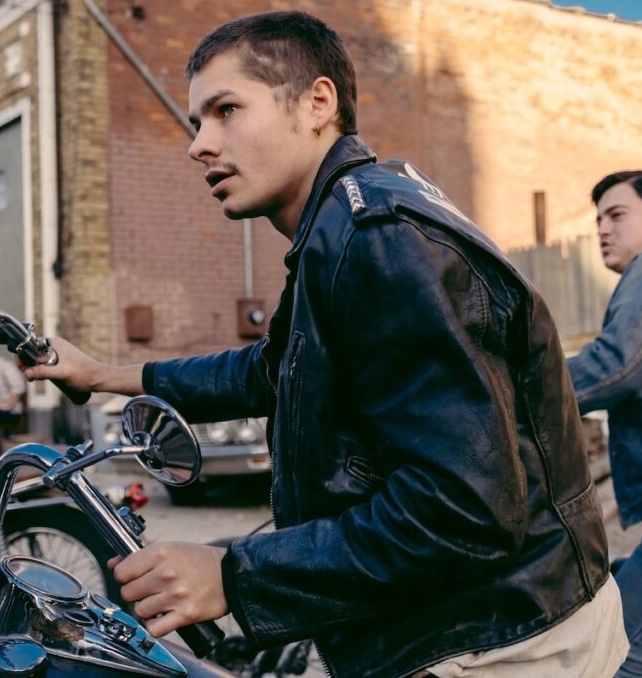
But as the years move on and the Vandals’ numbers inevitably begin to swell, that original code becomes increasingly muddied by the raft of newcomers, each with their own agenda. They include The Kid (Toby Wallace), a tough young wannabe, who has set his sights on joining up and who isn’t about to let anything stand in his path.

While The Bikeriders is light on plot, it’s loaded with characterisation. Comer is extraordinary as Kathy, who chronicles the group’s history in an eerily impressive midwestern accent; and Hardy too is eminently watchable as their leader, channeling early Marlon Brando (at one point we even see Johnny watching The Wild One and virtually taking notes). He’s somewhat mystified to discover that the Vandals are increasingly like a runaway train that, once kicked into life, proves impossible to stop. As Benny, Butler has very little in the way of dialogue, but his chain-smoking, smouldering presence makes it easy to understand why Kathy is so obsessed with him.

The other members of the gang have their own opportunities to shine. Nichols’ regular muse, Michael Shannon, is effective as the dim-witted Zipco, a man who has been repeatedly passed over by society since childhood and who has found his spiritual home amongst this gang of misfits – and Emery Cohen is also effective as Cockroach, who is destined to ride a motorcycle in the future for an entirely different reason. The 60s and 70s settings are convincingly evoked and fans of vintage motorcycles will doubtless be drooling at the sight of scores of bikes thundering in formation along the highways. But the tone of the film is essentially an elegy, a lament for the many ways in which an original idea can be twisted and debased until its original aims have all but vanished.

This won’t be for everyone. There’s no denying that it glamourises thuggery and, with a running time of nearly two hours, it could perhaps have benefitted from a tighter edit, especially around its flabby midsection. Nichols has spent the best part of twenty years putting the film together and it feels very much like a labour of love. Those looking for thrills and action might prefer to look elsewhere. But if it’s classy performances you’re after, you’ve definitely chosen the right vehicle.

3. 8 stars

Philip Caveney

Furiosa: a Mad Max Saga

25/05/24

Cineworld, Edinburgh

Furiosa is my most anticipated film of the year but to fully explain why, it’s necessary to briefly look back at the career of writer/director George Miller. I saw the first film in the Mad Max franchise way back in 1979, a modest, low-budget revenge thriller starring a young Mel Gibson. It was perfectly watchable but gave no idea of the wonders that were to follow. 

In 1983, The Road Warrior brought back the titular character with a bigger budget and an iconic look that depicted Australia in the years following a nuclear war. It was louder, more ambitious and gloriously inventive, an unstoppable thrill ride. In 1985, Beyond Thunderdome brought in Tina Turner for a guest appearance and appeared to round off the franchise in grand style. 

In normal circumstances, that would probably have been the end of it. So when Miller resurfaced nearly thirty years later with Fury Road, I had very low expectations. Tom Hardy stepped into the scuffed boots of Max and Charlize Theron played a new character, Furiosa. The film was an extraordinary, foot-to-the-metal, adrenaline-powered masterpiece, one that left me stunned at its conclusion. I saw it a second time in 3D and, two years later, was one of the first in the queue for the special Black and Chrome edition. How was Miller ever going to follow such a powerful creation?

He took his time. I was astonished to realise just the other day that it’s a full nine years since Fury Road’s release. The worst thing that could happen, I thought, would be if he tried to replicate the previous film’s simple, propulsive structure – and happily he’s gone in an entirely different direction. Of course he has. He’s George Miller.

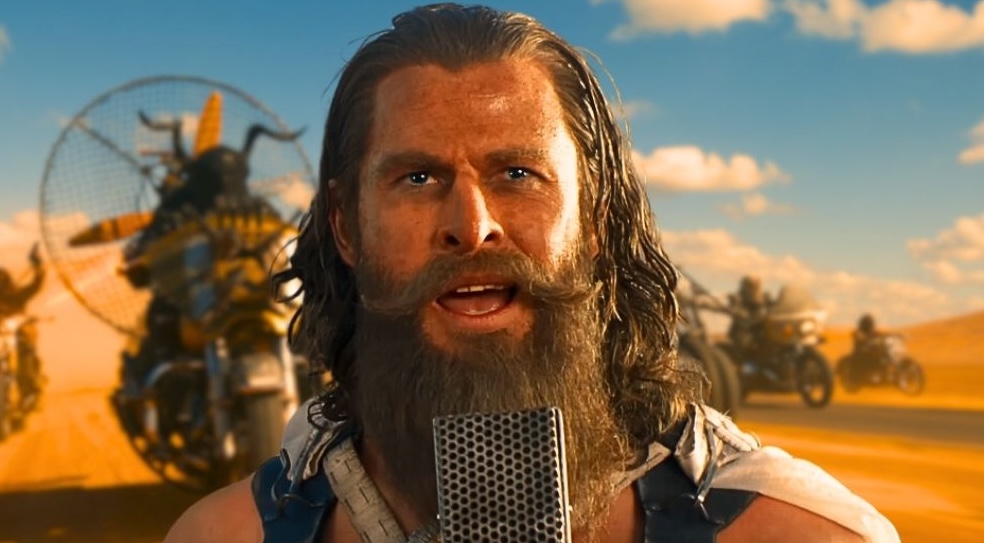
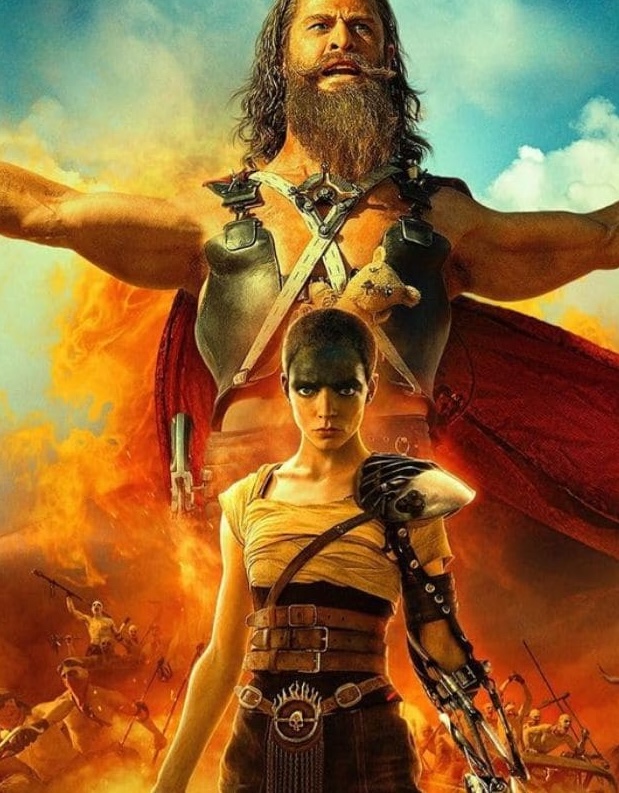
Furiosa is a prequel, a much more episodic affair than its predecessor, divided into five chapters (each with a portentous title) and, unlike Fury Road’s three and a half day timeline, this is set over something like eighteen years. We first meet the young Furiosa (Alyla Browne) in ‘The Green Place,’ the childhood home she spent most of Fury Road trying to get back to, and it’s clear at a glance why she was missing this verdant ‘place of abundance’ in the midst of a desert. But her tranquil life is rudely disrupted when she is kidnapped by a gang of bikers from the wasteland and taken to the kingdom of Dementus (Chris Hemsworth), a motor-mouthed, self-aggrandising ruler, who is used to taking whatever he wants whenever he wants it. Furiosa is merely his latest acquisition. But the girl’s mother, Mary (Charlee Fraser), follows her, intent on taking her home again at any cost…

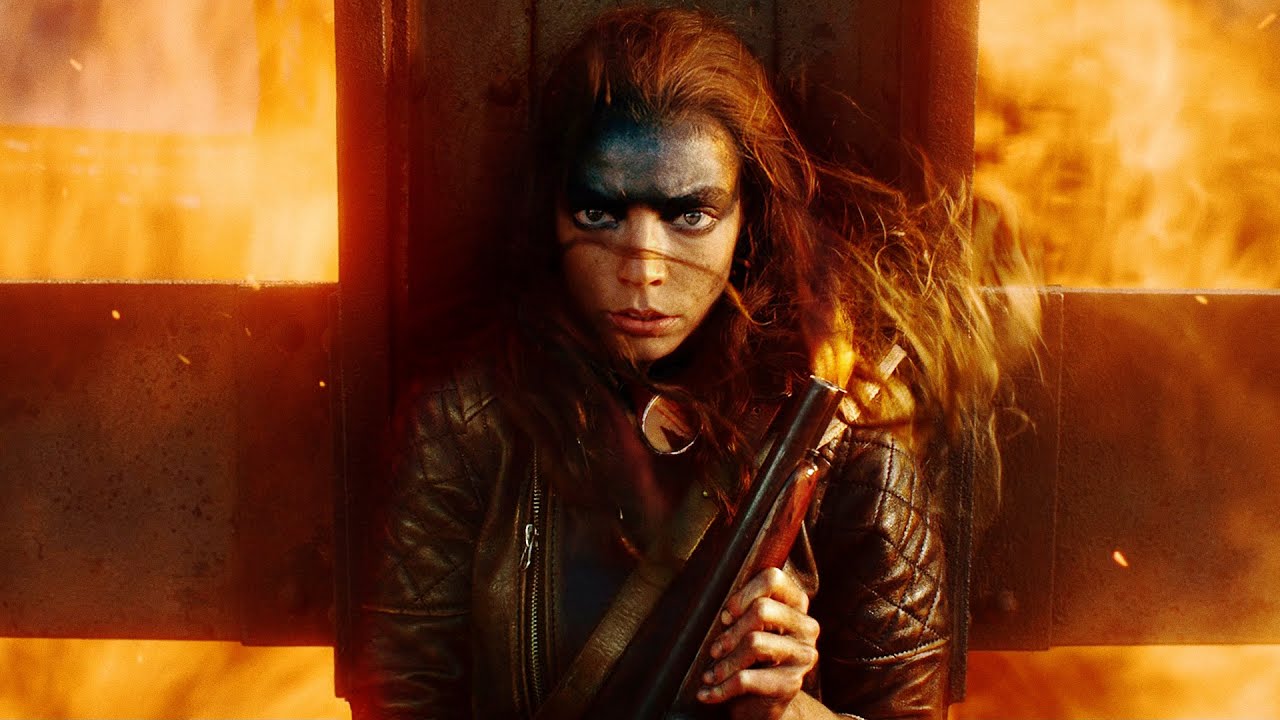
What immediately hits me about this film is the glorious world-building that’s going on. This is an eye-popping spectacle. Every shot caught by cinematographer Simon Duggan is ravishing and Jenny Beavan’s costume design is endlessly inventive. Add the powerful sound design and you have a film that literally shakes you in your seat. It’s a full hour before Alyla Browne mutates into Anya Taylor-Joy in one of the most accomplished on-screen transformations I’ve ever witnessed. Given only thirty lines of dialogue in the entire film, Taylor-Joy has to convey her character mostly using her eyes. She somehow manages to show Furiosa’s inner turmoil, only briefly finding solace in the affection of rig-driver Praetorian Jack (Tom Burke). Her most powerful motivator – a desire for revenge – is ever present and often propels her into rage. It’s fascinating to watch her. Hemsworth is also wonderful as Dementus, so much more than a cardboard cut-out villain. Here is a man with his own inner turmoil and awareness of his failings. He really should play bad guys more often.

Motor lovers shouldn’t despair because Miller’s trademark behemoth vehicles are in evidence – including a chariot pulled by three motorbikes – and there’s an extended chase sequence that pulls out all the stops, particularly in the part where Praetoran Jack’s rig is attacked by paragliders. As ever, hats off to the stunt performers who make this such a thrill ride. 

But Furiosa is more – much more – than just another action flick. It’s also about the power of mythology, the ways in which stories of epic odysseys perpetuate and endure across the centuries. It’s about the desire of humanity to survive against overwhelming odds and the ways in which religions are shaped by those who invent them. But mostly, it’s about a 79-year-old director at the height of his powers, being unleashed into the world’s biggest sandbox and invited to play. And here, Miller shows more unbridled invention than I’ve seen in a very long time. 

My advice? Get thee to the biggest IMAX screen available, buckle in and enjoy the ride. Oh, and Max? He’s there… but you’ll need to keep your eyes peeled to spot him.

5 stars

Philip Caveney

Capone

03/03/21

Netflix

Al Capone is perhaps the best known gangster in American history. He’s been the subject of many films and portrayed by a whole host of celebrated actors; perhaps most famously by Paul Muni in Scarface and by Robert De Niro in The Untouchables. But he’s never been depicted as he is in Josh Trank’s downbeat film.

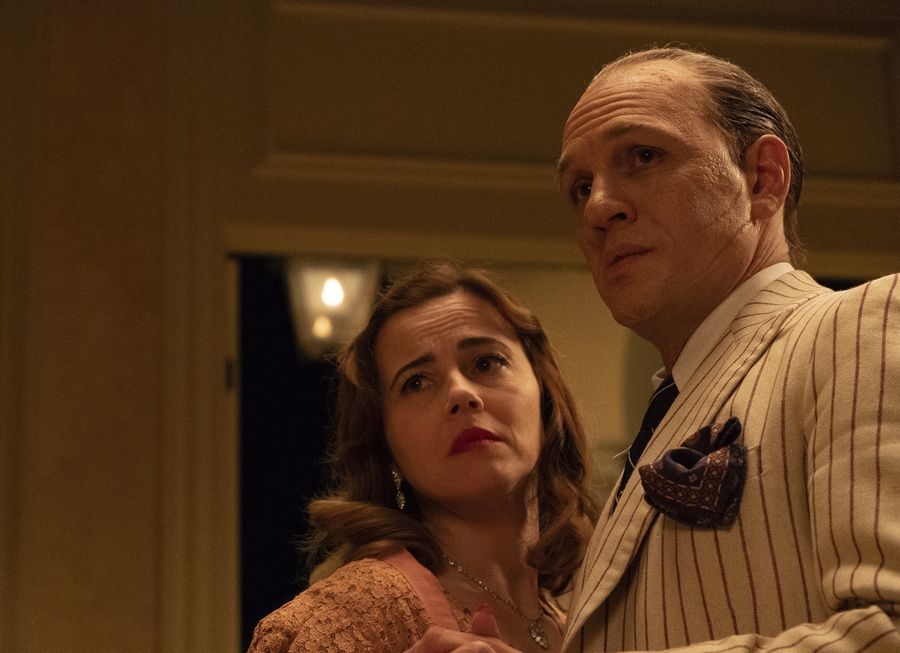
Capone is set in the dog days, towards the end of the gangster’s life. ‘Fonse’ has recently been released from prison and is suffering horribly from the neuro syphilis that has plagued him since his teens. Locked up in a palatial mansion somewhere in Florida, with devoted wife Mae (Linda Cardellini) at his side, and with regular visits from Doctor Karlock (Kyle MacLachlan), he regularly falls prey to vivid hallucinations that take him back to revisit experiences from his bloody hey day – from visits to booze-fuelled jazz clubs to crawling across heaps of bloodied bodies after a massacre he’s orchestrated.

Fonse no longer knows what is real and what is illusion and, unfortunately, this also extends to viewers of the film. While it might sound like a promising conceit on paper, it’s actually infuriating, particularly when the screenplay (also by Trank) refuses to stick to any kind of internal logic. I’m fine when I’m seeing odd happenings from Capone’s point of view, but what about when they are apparently witnessed by some of the other characters in the story? Is Capone’s old pal Johnny (Matt Dillon) actually still alive or just a vivid memory from the past? And who is the mysterious kid who keeps phoning Fonse from Cleveland? While I don’t insist that every loose end needs to be tied up, too much here is simply left hanging.

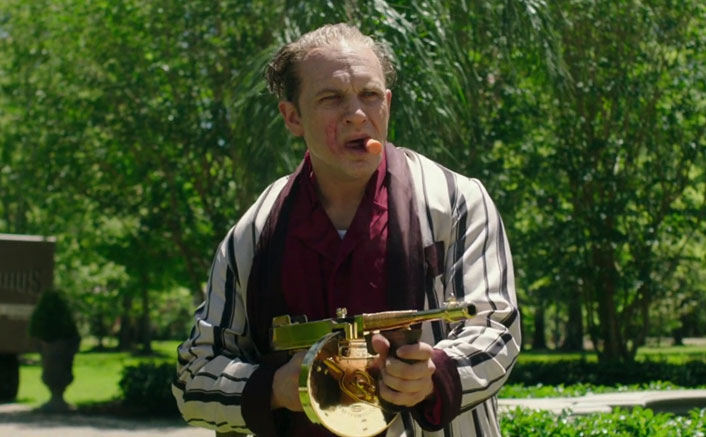
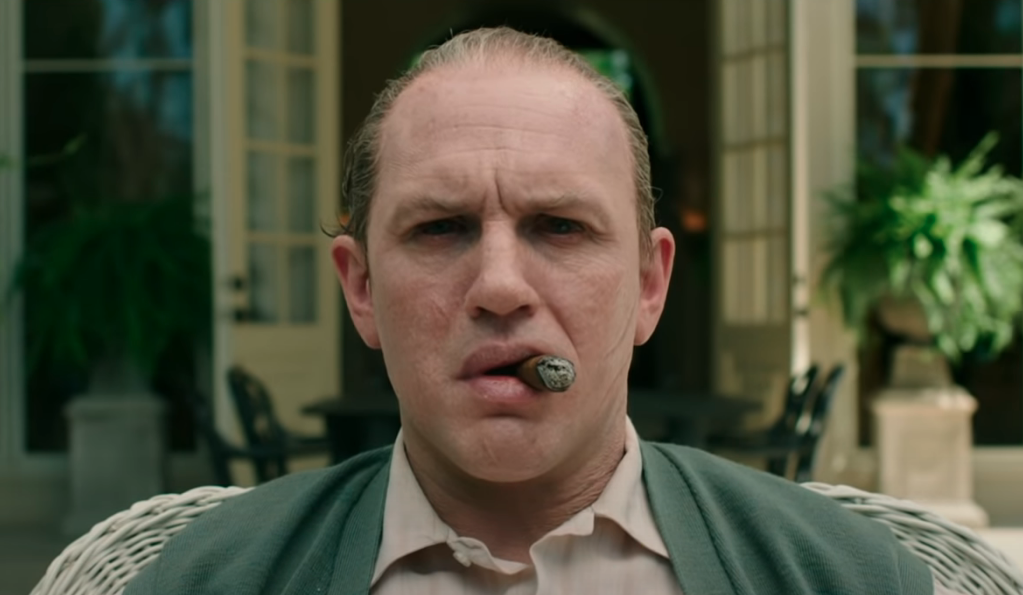
Hardy is generally a gifted performer but he’s saddled here with a thankless central role that offers him little chance to shine. Swaddled in some pretty unconvincing makeup, with a cigar (or a carrot) clenched relentlessly between his teeth, his dialogue is rarely more than a series of grunts and incoherent curses. He’s actually more eloquent when he’s noisily filling one of the oversized nappies he’s forced to wear, after suffering a few malodorous accidents in bed. Also… his constantly stoned expression makes him look a dead ringer for a grumpier version of Bernard Bresslaw from the ‘Carry On’ films.

The film’s one hour and forty-seven minutes’ duration consequently unfolds at a funereal pace, with very little in the way of progression. I feel rather like I am stuck in a traffic jam, trying to figure out what little I can see through the windscreen, and constantly wondering when I might be moving onwards again. I stick with it to the bitter end, but really have to force myself.

There’s probably a fascinating film to be made about the end of Capone’s life but, sadly, this isn’t it. Josh Trank probably had a coherent vision for his film; somehow it’s been lost in the mix.

2.5 stars

Philip Caveney

Venom

09/10/18

First, the good news. Venom isn’t quite as terrible as everybody is saying.

The bad news? It still isn’t great.

Indeed, watching this unfold, I can’t help wondering what it was about the project that tempted top drawer actors like Tom Hardy, Michelle Williams and Riz Ahmed to hop aboard for the ride. It can’t just have been the size of the pay check. Can it? I mean, surely they must have thought the end result would be… well, better than this?

Events start (as they so often do in such stories) with a spaceship crashing in East Malaysia. Billionaire scientist Carlton Drake (Ahmed) has despatched it to a remote asteroid to collect some alien life forms. In the ensuing chaos, one of the captive creatures manages to escape after latching on to a human host. (Yes, I know. So far, so dreadfully familiar.) Drake manages to salvage the other ‘symbiotes,’ as he dubs them, and has them brought to his state-of-the-art laboratory in San Francisco, where he sets about experimenting on them by unleashing them into a succession of live hosts. At first he contents himself with cuddly bunny rabbits but, despite all of his top scientists advising against it, he quickly progresses to homeless people, whom he’s duped into helping him with his ‘research programme.’ Drake, as you’ll have gathered, is not a very nice man. He’s hoping that he’ll find a perfect match, creating a human-alien hybrid, but his first attempts are… messy, to say the very least.

Meanwhile, freewheeling investigative reporter, Eddie Brock (Hardy), tries to do a filmed exposé on Drake, but soon discovers that the man has enough power to get him unceremoniously fired from his job. The problem is, Eddie has ‘borrowed’ some information from the files of his fiancé, lawyer Anne Weying (Williams), which means that she also gets the push. She is angry enough to tell Eddie to stick his engagement ring where the sun don’t shine. Eddie is understandably miffed by all this but, when one of Drake’s employees, Dr Skirth (Jenny Slate), smuggles Eddie into the laboratory, things go spectacularly wrong. He is invaded by one of the alien creatures, endowing him with a range of formidable superpowers and some very unsavoury eating habits. Chaos ensues, as Eddie and ‘Venom’ learn to co-exist. While some of this is reasonably entertaining, the greater part of it suffers from a bad case of over-familiarity.

To give Hardy his due, he does his level best to make this unpromising material work, but the fact that he’s been asked to play things for laughs may not have been the wisest decision. His Eddie Brock is a likeable slacker, who has inadvertently been thrust into very difficult circumstances, and he handles that side of things well enough. But overlong motorbike chases and CGI tweaked punch-ups are not really Hardy’s forte. Likewise, Williams is too much of a trooper not to give this her best shot, but she really isn’t given an awful lot to do and, once again, if you have an actor of such undeniable skill, maybe give her something to convey other than bewilderment?

Like most Marvel films, this eventually heads into one of those extended animated monster-battles, which – while undoubtedly expensive – just become rather tedious to behold. Director Ruben Fleischer must have been confident that this project would fly, because the first post-credit sequence sets up a sequel featuring a very well known actor in a fright wig. I can’t help feeling this is an over-optimistic move. There aren’t  many bums on seats at the viewing I attend. If however, you do feel like hanging on through the interminable credits, it’s worth staying in your seats for a sneak peek at Spiderman: Into the Spider-Verse, an upcoming animation that, in just a few minutes, manages to knock spots off everything that’s gone before. Maybe Sony Pictures decided they needed to salvage something from the wreckage. Or maybe they’re just proud of their new baby.

Venom is ultimately one for the Marvel-heads – and only the most diehard amongst them, I think. It really didn’t rock my world. Oh, and – of course – there’s a Stan Lee cameo. There’s always a Stan Lee cameo. Don’t worry, it’s mercifully brief.

2.8 stars

Philip Caveney

Dunkirk

22/07/17

Christopher Nolan must be one of the most eclectic directors currently working. From The Dark Knight to Inception – from The Prestige to Interstellar, he seems to favour no particular genre, preferring to go wherever his fancy takes him. But I would never have predicted he’d direct a classic war movie like Dunkirk… but then, of course, this coming from the same man who made Memento means that it’s actually nothing like Leslie Norman’s 1958 film of the same name. This version employs experimental time frames to tell three interlinking stories. Powered along by Hans Zimmer’s urgent soundtrack and decidedly spare in its use of dialogue, the film grips like a vice from the opening shot to the closing frame.

The first strand concerns a young soldier, appropriately enough named Tommy (Fionn Whitehead) who is desperately making his way to Dunkirk beach in the hope of finding a boat to take him to safety. Along the way he meets up with the strangely taciturn Gibson (Damien Bonnard) and with Alex (Harry Styles – relax, it turns out he can act). The three men brave the dangers of ‘The Mole,’the perilous wooden jetty that leads out into deeper water where the larger ships can dock, but finding a safe berth is not easy and they are forced to seek alternative means of escape. The soldiers’ story plays out over one week.

Next up, we encounter Mr Dawson (Mark Rylance), a quietly spoken boat-owner who answers the desperate call for help and sets off for Dunkirk from his home port in Devon, with his son, Peter (Tom Glynn-Carney) and George (Barry Keoghan), a young lad desperate to prove himself to his parents. On the way they pick up ‘the shivering soldier’ (Cillian Murphy), a man so traumatised by his recent experiences that he can barely speak and who is clearly in no great hurry to return to France. This story is enacted over the course of one day.

And finally, in the deadly skies above Dunkirk, we meet Farrier (Tom Hardy) and Collins (Jack Lowden), two spitfire pilots charged with the thankless task of taking on the might of the Luftwaffe, buying time for the fleeing army to make its escape. In what at first appears to be a perverse move, Nolan keeps Hardy’s distinctive features mostly hidden behind goggles and an oxygen mask – but then you realise that he’s doing it for a reason – to emphasise the fact that the individual pilots who took part in this conflict remain largely unknown. Their tale, dictated by the amount of fuel that a Spitfire can carry, takes only an hour.

But of course, the three strands are interwoven like an expertly braided length of rope and it’s to Nolan’s credit that the ensuing events never become confusing, even when one particular character appears to be in two places almost simultaneously. What this film does splendidly is pull you into the heart of the hurricane and hold you there in almost unbearable tension.

This is after all not a film about bloodshed – in fact we see very little of that onscreen. It’s more about the brutal realities of survival, the mental toll on the participants and the quiet heroism of those who participate in the carnage. It’s the true life story of a military miracle, pulled off against all the odds. It may not be Nolan’s finest achievement – I’d hand that accolade to The Prestige – but it’s nonetheless a superbly affecting film that justifies all the rave reviews it’s been getting.

Where will Nolan go next, I wonder? Well, I suppose he’s yet to make a teen romance. But I won’t hold my breath.

5 stars

Philip Caveney
Mad Max: Fury Road – the Black & Chrome Edition

31/04/17

Fury Road was easily my favourite movie of 2015. George Miller’s long awaited addition to the Mad Max series surpassed all my expectations – so much so, that I found myself going back for a second helping only a few days after the initial viewing (something I hardly ever do). For my money, this is the consummate action movie, a brilliant piece of world building with a visceral kinetic edge that had me on the edge of my seat, from its opening moments.

And now this: a black and white re-release! What the actual hey? But don’t jump to conclusions. What could at first seem like a mere act of vanity on Miller’s part quickly fades away when you discover that this is how he always intended the film to be shown. But his backers evidently didn’t see the wisdom in limiting its projected audience and insisted that he stick with colour. Now, after the original film’s well-deserved success, Miller finally gets to have his cake and eat it. And boy, what a glorious, delicious confection it is!

A quick resumé of the plot. Max (Tom Hardy) is captured by a war party belonging to disfigured despot, Immortan Joe (Hugh Keays-Byrne), and soon finds himself appropriated as a portable blood supply for young war-boy, Nux (Nicholas Hoult). When Imperator Furiosa (Charlize Theron) decides to abscond with several of Joe’s captive wives, a furious chase ensues… which lasts for pretty much the entire film’s duration.

From the opening shot, it’s apparent that this is going to work – big time. The razor sharp monochrome landscapes lend the film a vintage epic feel, evoking memories of John Ford’s Western vistas, while the many close ups of faces in crowds put me in mind of Sergei Eisenstein’s Battleship Potemkin. Sequences that I really didn’t think would work at all in this format are actually lent an added dimension. And in black and white, you are even more aware of Miller’s incredible attention to detail, from the costuming of his characters to the welded-together interiors of Imortan Joe’s war jalopies.

If you enjoyed the original film (and if not, why not?) you’ll relish the opportunity to view it with a fresh set of eyes – and if you hated it, well, this isn’t going to change your opinion one jot. Will there be another film in the series? Given that Miller is now in his seventies, that might not be a likely prospect, but, if the sequence does stop here, I have to say, it’s a pretty formidable, adrenalin-fueled swan song.

To paraphrase Nux: “What a film! What a wonderful film!’

5 stars

Philip Caveney
The Revenant

UnknownUnknown-1

14/01/16

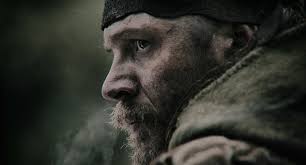
This time last year, Alejandro Gonzalez Inaritu dazzled the cinema-going public with his quirky comedy, Birdman. Now he dazzles us again, with something entirely different – a bleak, gruelling historical drama, based on a real life story, a film that pulses with bone-jarring violence offset by eerily beautiful location photography.  The Revenant looks set to dominate this year’s Oscars and it’s clearly a hard-won victory. At times, the actors look as though they’re going through as gruelling an experience as their screen counterparts. Here is the life of an 1820s fur trapper in all its grimy glory. It doesn’t look an appealing way to make a living.

The story concerns an expedition into the American wilderness in the depths of winter. Hugh Glass (Leonardo Di Caprio) is the team’s scout and he’s accompanied by his mixed-race son, Hawk (Forest Goodluck). Barely ten minutes into the action, the men are attacked by Arikara warriors and only a handful of them escape with their lives. Matters aren’t helped when, shortly afterwards, Glass is attacked by a grizzly bear (a prolonged scene of almost unwatchable savagery) and is left close to death. The team leader, Captain Andrew Henry (Domhnall Gleason) decides to strike out for their home base and leaves Glass in the care of seasoned trapper John Fitzgerald (Tom Hardy) and callow youth Jim Bridger (Will Poulter). Henry instructs Fitzgerald to give Glass a decent burial when ‘his time comes.’ But Fitzgerald is a survivalist. He murders Hawk and leaves Glass for dead, throwing him into a half dug grave and abandoning him to a slow and painful death. But Glass’s hunger for revenge somehow keeps him alive…

This is the second time the story has inspired a film. In 1971, Man In The Wilderness starring Richard Harris, used the basis of it but changed Glass’s name to Zachary Bass. Inaritu’s film actually sticks closer to the real tale and has the added advantage of Emmanuel Lubezski’s stunning cinematography, his fluid camerawork soaring and sweeping throughout the action to create an almost immersive experience. Often you’ll find yourself closer to the action than is strictly comfortable. In one scene, Glass’s breathing actually fogs the camera lens – in another, blood spatters the screen. And then there are sequences featuring Glass’s fever dreams, strange, hypnotic, almost hallucinatory. It all makes for grim but compelling viewing. Many will be repelled by the extreme violence and a scene where Glass takes refuge from the cold inside a freshly killed horse – yes, you read that right – isn’t going to sit well with any vegetarians in the audience. (Strangely, this isn’t as ridiculous as it might seem. It was an old buffalo hunter’s trick to keep warm inside the gutted carcass of a freshly killed bison. Like a fleshy electric blanket).

The Revenant is an extraordinary slice of cinema, an epic story of survival, of man against nature. If Di Caprio ends up lifting the best actor Oscar (despite speaking only a handful of lines in the entire film) I for one won’t begrudge it to him. I’d say he’s earned it, if only in the scene where he’s required to devour a live fish.

Unmissable.

5 stars

Philip Caveney
 

Legend

MV5BMjE0MjkyODQ3NF5BMl5BanBnXkFtZTgwNDM1OTk1NjE@._V1_SY317_CR0,0,214,317_AL_Unknown

11/09/15

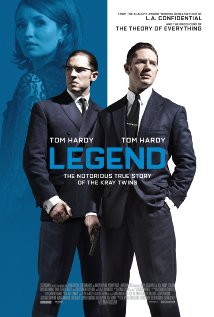
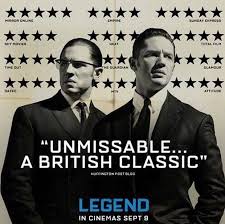
Brian Helgeland’s take on the Kray twins is a curate’s egg of a film; good in parts, but not good enough overall to deserve the welter of four star reviews it has received. Mind you, the Guardian’s two star appraisal was probably a bit harsh, though the publicity generated by the film’s publicists, who cunningly made it look like a four star on the poster surely deserves some kind of special award for chutzpah (see image). Unlike the previous attempt at filming this story (famously starring Gary and Martin Kemp) this version begins with the twins at the height of their powers in London’s East End and is narrated by Frances (Emily Browning) the troubled teenager who ends up as Reggie Kray’s long-suffering wife. Right from the beginning, this is a problem because Frances is actually a rather dull character and we really don’t learn enough about her to fully empathise with her plight, even when her misery turns to tragedy.

On the plus side, we get two Tom Hardys for the price of one. He is, of course, an extraordinary actor and he manages to portray the two very different brothers with swaggering conviction – but it has to be said that his characterisation of Ronnie Kray is largely comedic (brilliantly so in a scene where he attempts to dance to Strangers In The Night) but I felt distinctly uneasy to hear an audience laughing out loud at the utterances of an unabashed psychopath. Call me old fashioned, but that just felt wrong.

There’s a reasonable attempt here to recreate the 60s backdrop, replete with a vintage soundtrack, but the script fails to fully explore some important characters in the story. Christopher Eccleston as Nipper Read, the copper pledged with the difficult task of bringing the Krays to justice is (if you’ll forgive the pun) criminally underused and so is Tara Fitzgerald as Frances’s mother, a woman who famously wore black to her daughter’s wedding.

There are some extremely violent set pieces – a gang fight in a pub, where hammers are put to inappropriate use, and the famous murders of George Cornell and Jack ‘The Hat’ McVitie, but they are filmed with a kind of cartoonish zeal that somehow undermines their severity and inevitably, glamourises the ‘pay up or get duffed up’ world in which the Krays operated. Again, I felt conflicted by this. Surely villains should be scorned, not paraded as role models?

All-in-all then, this feels like a missed opportunity. After viewing the trailer, I’d expected to love this film, but I came away feeling that it should have (and easily could have) been so much better than it actually was.

3.2 stars

Philip Caveney
London Road

Unknown-2Unknown-1

28/06/15

London Road is an extraordinary film. Although clearly indebted to its theatrical roots, this is a truly cinematic work – and quite unlike anything I have seen before.

Centred around the infamous Ipswich murders of 2006, when five prostitutes were killed over the course of a few months, London Road tells the stories of the local residents: their discomfort at their street becoming part of the red-light district; their horror at the murders; their reactions to the revelation that the killer was Steven Wright, a neighbour of theirs. Through verbatim accounts, drawn from interviews conducted with the real life residents of the street , we learn of a community torn apart – and then, ultimately, uniting to reclaim its heart.

And it’s a musical.

Actually, it’s not really a musical, as such, but it is mostly sung – and the effect is stunning. The dialogue is faithfully reproduced, with every ‘um’ and ‘ah’ included; every hesitation, interruption, exclamation rigorously documented in the lines. The language dictates the rhythms, and the score stretches and amplifies the natural cadences of speech, creating a kind of hyper-realism that is utterly compelling. Some lines are repeated to create a kind of chorus or refrain, thus reinforcing some of the more prevalent ideas (‘He could be one of us…’).

There’s no driving narrative here, no one character whose tale defines the story. It’s exactly what you might imagine a series of interviews to amount to: a collage of disparate accounts. And yet, this collage serves to create a very clear whole picture. There are conflicting emotions, as the prostitutes move away from the area to somewhere where they feel safer, and the residents begin to take a pride in where they live again. ‘I know it’s awful,’ says Julie (Olivia Colman), as she looks around the resurgent neighbourhood, ‘but I’d like to shake his hand.’ It’s an uncomfortable truth, made more so by the brooding presence of Vicky (Kate Fleetwood) walking through the street, untouched and unobserved, clutching a balloon like a hopeful child. No one can condone the murder of these troubled women, but none of us would like them working where we live.

There are some big names attached to this film: Tom Hardy makes a fleeting appearance as a taxi driver obsessed with serial killers. But it doesn’t feel right to single anyone out: this is an ensemble performance, with all parts contributing fully to the whole.

It’s a game-changer, I think.

Go see it.

5 stars

Susan Singfield