Oscar Isaac

Frankenstein

25/10/25

Filmhouse, Edinburgh

Guillermo del Toro was always going to make his version of Frankenstein one day – the seeds were sown in his 1992 Spanish-language film, Cronos, the first of his features that I ever saw in the cinema and the one that convinced me he had a big future ahead of him. 

Now he’s finally got around to doing the job properly, courtesy of Netflix, who stumped up the $120m budget. For a while it looked as though there wouldn’t be any chance of seeing it in an actual cinema before the transfer to streaming. This would have been a crime because del Toro’s adaptation of the tale looks absolutely sumptuous on the biggest screen at Filmhouse and I’m delighted to see that the auditorium is  pretty busy for a Saturday afternoon showing.

Frankenstein is, of course, one of the most filmed books in history, but it’s probably fair to say that only a handful of the 423 movie adaptations (not to mention the 287 TV episodes – yes, I did Google it) have come anywhere close to capturing the essence of Mary Shelley’s seminal horror story. While del Toro does throw in a few original twists of his own (of course he does!), he sticks fairly close to Shelley’s narrative – indeed, he’s even credited her as his co-screenwriter. The tale is told in three distinct parts.

In the opening Prelude, we join Captain Andersen (Lars Mikkelsen) and the crew of his sailing ship, who are stranded on the ice in remote Arctic waters. There’s a sudden explosion nearby, from which the crew rescue Victor Frankenstein (Oscar Isaac), who has been pushed almost to the point of death by a monstrous assailant. After witnessing The Creature (Jacob Elordi) plunging into icy waters, they carry Victor onto the ship – but, once revived, he assures Andersen that his pursuer will not actually be dead and will surely come for him…

Before that happens, he needs to tell his story.

Victor then narrates The Creator’s Tale and we flashback back to his childhood where, under the rule of his despotic father, Leopold (Charles Dance), Young Victor (Christian Convery) first becomes obsessed with life and death. Keen-sighted viewers may spot something familiar about Victor’s barely-glimpsed mother, Claire. Something distinctly Oedipal is happening here.

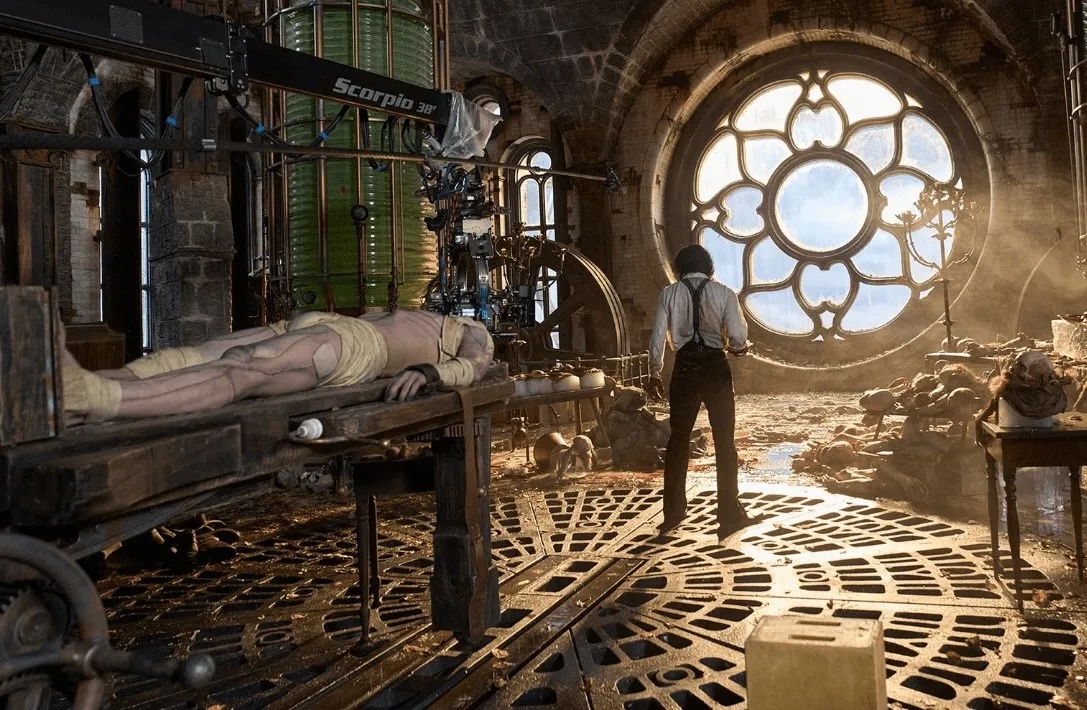
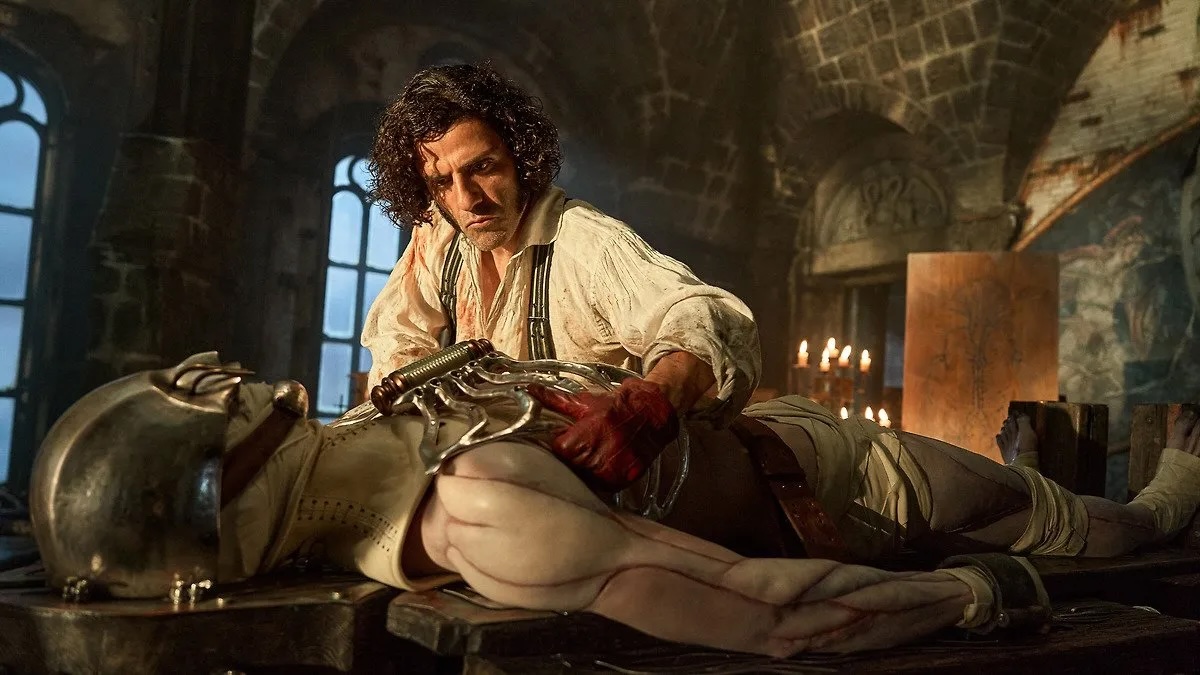
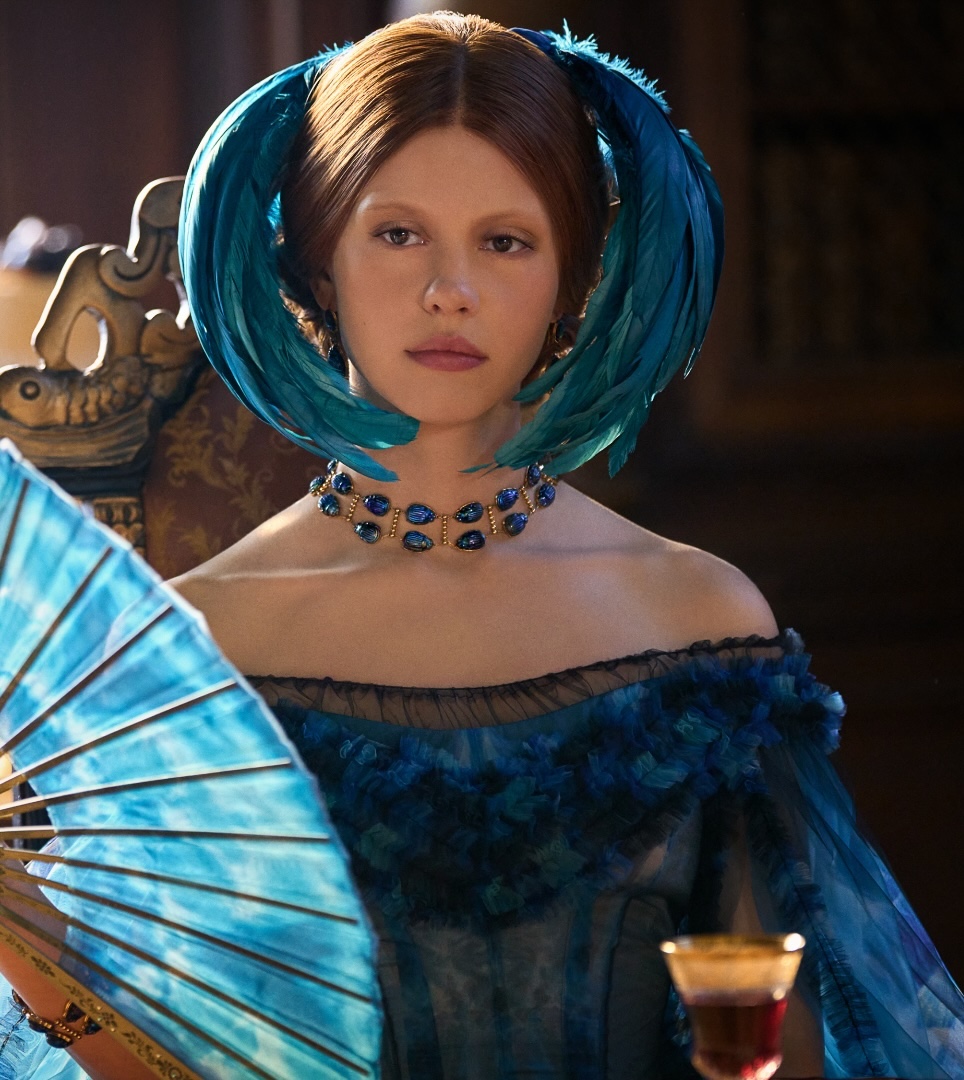
We then cut to some years later. A grown-up Victor is causing controversy at medical school in Edinburgh with the grisly experiments he’s conducting on cadavers (and I get to revisit some of the sets that were evident around my home city in September 2024). We are introduced to Victor’s younger brother, William (Felix Kammerer), and his fiancée, Elizabeth (Mia Goth). We also meet Harlander (Christophe Waltz), a character created for the film, a wealthy man who, for clandestine reasons, is perfectly happy to finance Victor’s attempts to take his experiments all the way.

But Victor’s account is later contrasted with The Creature’s Tale, where we learn of the years when the monster and his creator were apart: how The Creature lived in a barn alongside a kindly blind man (David Bradley); how he mastered the art of speaking (with a distinctly Yorkshire accent); and how he slowly began to realise how shabbily he’d been treated…

It’s not just because I’m a devout Guillermo del Toro fan that I think this film is a million times better than every other Frankenstein-generated movie I’ve watched down the decades. Isaac is a revelation in the title role, nailing both the character’s sense of privilege and his fatal short-sightedness. Elordi, meanwhile, offers a fresh take on the Creature that really brings out his innate vulnerability and his desperate need to relate to others, something that’s been attempted before with much less success. 

The film is packed with sumptuous locations and thrilling action set-pieces, that have it hurtling through its lengthy running time. Cinematographer Dan Lausten captures every scene with an almost luminous intensity, Kate Hawley’s costume designs are exquisite, and there’s a beautiful score courtesy of Alexander Desplat. If I have a minor niggle it’s that the CGI-generated wolves in one long sequence aren’t quite as convincing as they need to be – and perhaps both Mia Goth and Felix Kammerer might have been given a little more to do?

But these are nitpicks. As ever in these situations, I’m urging people not to wait for this to drop onto streaming, because this level of filmmaking deserves to be watched on the biggest, brightest screen available, one of – dare I say it? – monstrous proportions.

I’ll get my coat.

4.8 stars

Philip Caveney
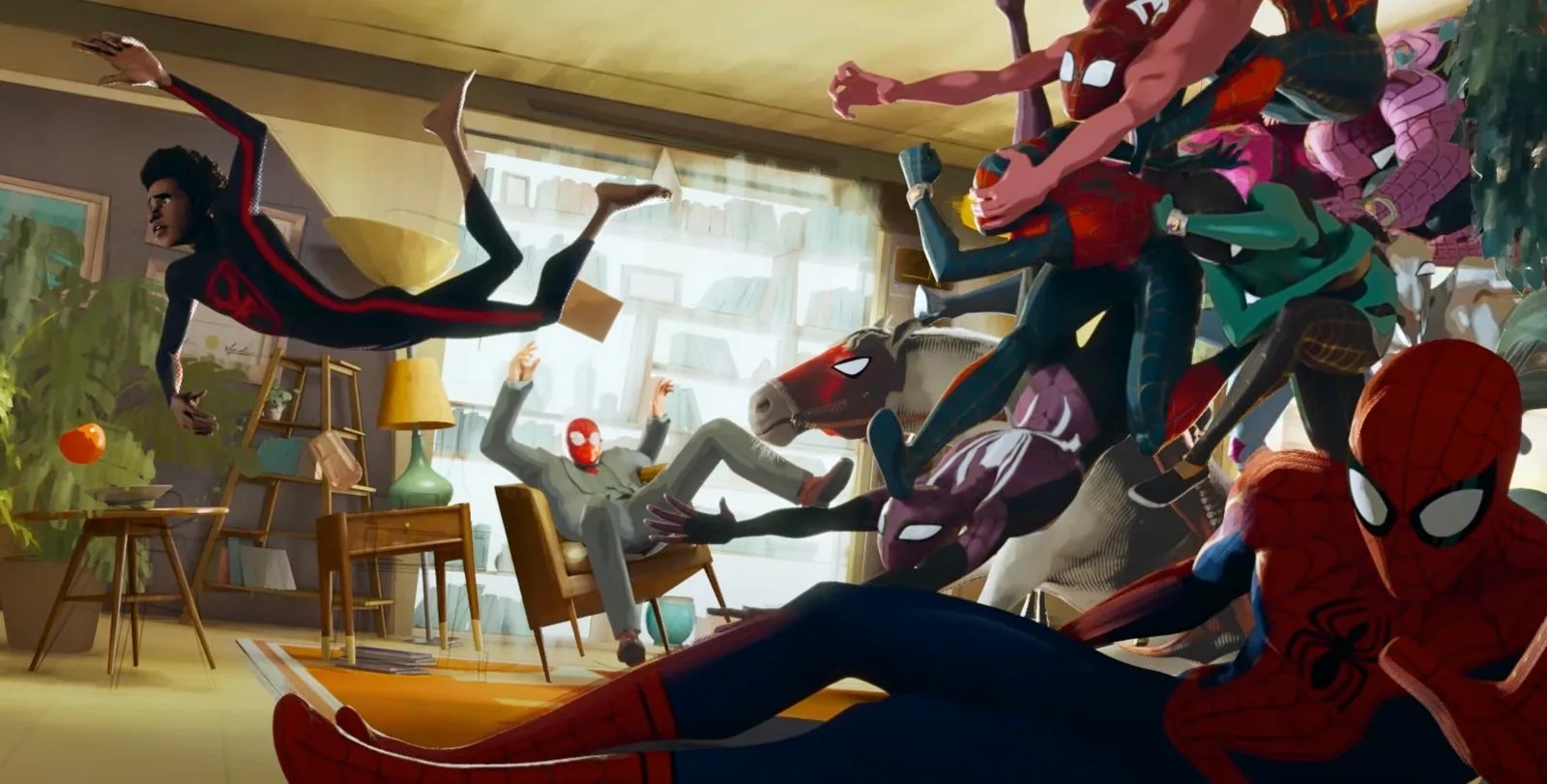
Spider-Man: Across the Spider-Verse

04/06/23

Cineworld, Edinburgh

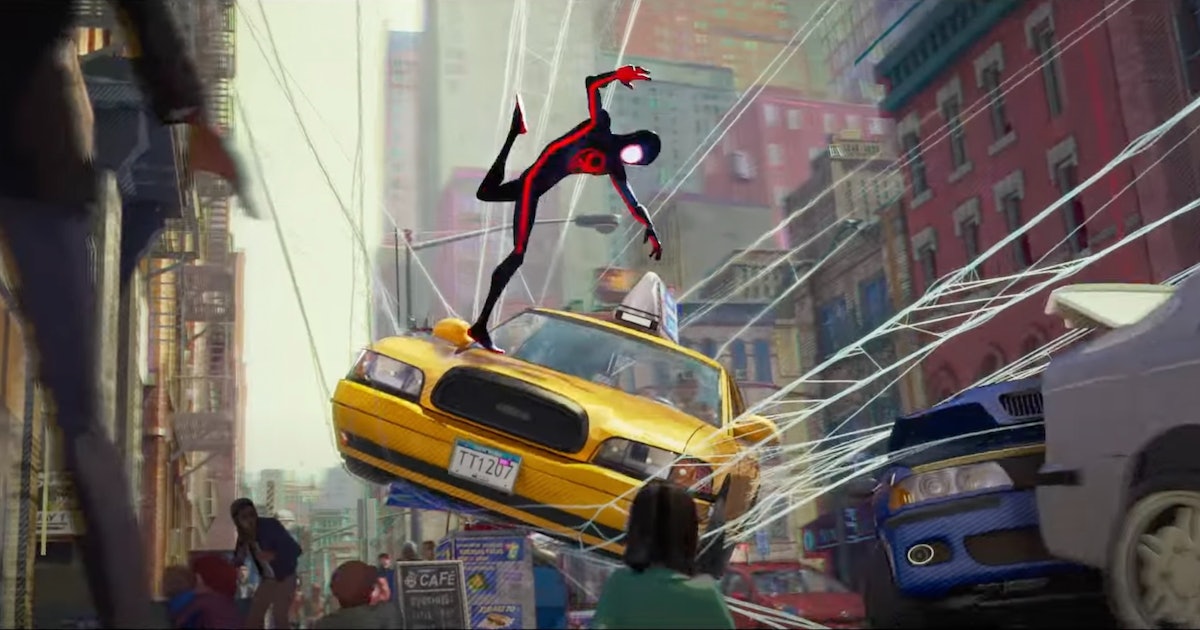
In 2018, Spider-Man: Into the Spider-Verse caught a lot of people napping. At that time, the Marvel Universe pretty much dominated the public movie-going imagination and here was something completely unexpected: Lord and Miller’s animated extravaganza – which had the temerity to take on the big guys. It was, quite literally, like nothing we’d seen before.

A lot has happened over the intervening years. Marvel are not quite the force they once were, with recent offerings (though still profitable) failing to reach the dizzy heights they’ve previously climbed to. And the weight of expectation for Across the Spider-Verse is palpable. Can this Sony Studios sequel really hope to put lightning into the bottle a second time?

Well, yes, as it turns out, it can. The credit sequence alone offers more imaginative filmmaking than we’re used to seeing in the average Marvel feature.

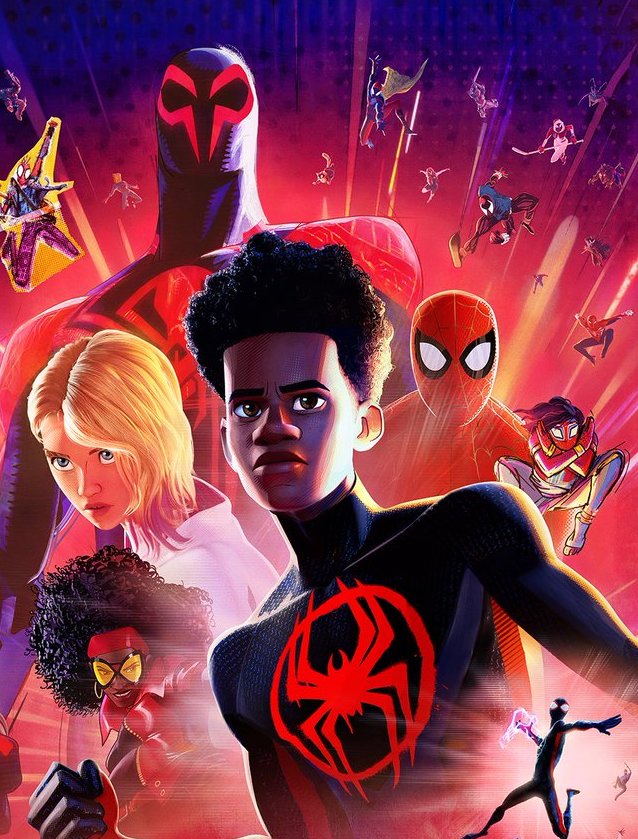
Sixteen months after the events of Into, Gwen Stacy (Hailee Steinfield) is having a hard time getting on with her life on Earth-65. After accidentally killing Peter Parker (Jake Johnson), she’s understandably depressed – and she can’t help but miss her old pal Miles Morales (Shameik Moore), who is inconveniently stranded in a completely different dimension. On Earth 1610, he’s still negotiating everyday life with his cop father, Jefferson (Brian Tyree Henry), and his nurse mother, Rio (Luna Lauren Vélez), whilst continuing his secret adventures as our friendly neighbourhood Spider-Man.

But when Gwen is visited by another couple of Spider-People, Miguel O’Hara (Oscar Isaac) and Jessica Drew (Issa Rae), they give her a handy bracelet that allows her to slip easily between dimensions. Time to give Miles a quick visit? Well, why not? Doing so couldn’t possible mess up the old twisty-turny-timey-wimey configurations… could it?

It would be pointless to try and convey more of the plot here because it’s complicated and mind-bending in the best possible sense. It’s to Lord and Miller’s credit (they wrote the script with Dave Callahan) that at no point do I feel bewildered by what’s happening onscreen. The true triumph, however, is the ever-changing beauty of the many different art techniques used to illustrate the story: from realist to impressionist; from pastel shades to psychedelia. Across the Spider-Verse is a mesmerising, eye-popping spectacle that feels like being plunged headlong into a fabulous maelstrom of sonic fury.

And it’s also more than that. The sprightly script keeps throwing snarky one-liners at me, the story counterpoints teenage angst with the minefield of parental responsibility and, with the arrival of The Spot (Jason Schwartzman), I’m offered a super-villain like none I’ve ever seen before. Best of all, I’ve rarely seen a film that feels more inclusive than this – that gleefully throws in a pregnant, afro-wearing, motorbike-riding Spider-Woman, just because it can.

My only real criticism? In a film with a running time of two hours and twenty minutes, surely the story arc could have reached some kind of standalone conclusion? When the ‘To Be Continued’ message hits the screen, I let out an audible groan. I can only hope I won’t have to wait another five years for part three, because I’d be happy to sit down and watch it right now. But hey, if my one negative comment is that I am left wanting more, that’s a good thing, surely?

Miss this one and weep. And folks, I know I say this a lot but please, please don’t wait for streaming. If ever a film was designed to be seen on the biggest screen possible, this is the one.

5 stars

Philip Caveney

Dune

21/10/21

Cineworld, Edinburgh

After the long shutdown of the pandemic and the recent Bond-led ‘resurrection’ of cinema, what we need next is an epic – one of those big, sprawling sci-fi adventures replete with stunning alien landscapes and awe-inducing special effects. So Dune really couldn’t come at a better time, but director Denis Villeneuve must be all too aware of the potential pitfalls. A previous attempt to put Frank Herbert’s source novel onto film – in 1984 – almost stopped David Lynch’s burgeoning career dead in its tracks. And while Lynch attempted to pack the entire contents of the book into one film, Villeneuve adds the extra gamble of shooting just the first half of the story, trusting to providence that the resulting movie will be successful enough to bring him sufficient revenue to make the second part.

The jury is still out on that but initial worldwide box office figures look promising.

It’s the year 10,191 and Duke Leto Atreides (Oscar Isaac) has recently been assigned – by the Emperor of the Universe, no less – to become the fief ruler of the desert planet of Arrakis (Or Dune, as it’s sometimes known). He and the rest of House Atreides will be taking over from its previous overlords, House Harkonnen, led by the corrupt Baron Vladimir (a hideously bloated Stellan Skarsgård). Arakis is the source of spice, a mysterious substance that pretty much runs the entire solar system, so of course the Harkonnens are far from pleased about being ousted from their exalted position.

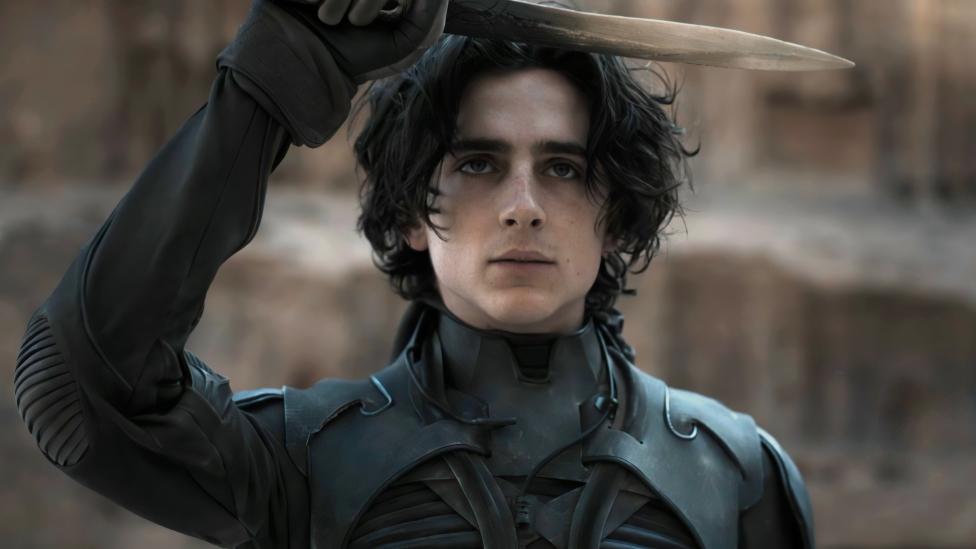
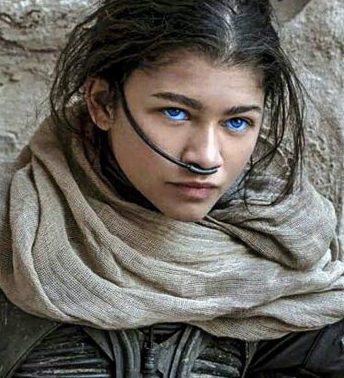
Meanwhile, Leto’s son, Paul (Timothée Chalamet), has been having recurring dreams about Arakis, or – more specifically – about a young woman who lives there, Chani (Zendaya). She is one of the indigenous Fremen, who have always endured a precarious existence under the yoke of their despotic rulers. Paul begins to think that he’s destined for something important and, when he learns his friend, Duncan Idaho (Jason Momoa), is setting off on a preliminary reconnaissance of the planet, Paul begs to be allowed to accompany him. But he’s told he must wait until Leto and the others can go with him.

So it is not until he and the rest of House Atreides set foot on the sun-blasted sands of Arakis that they discover they are venturing into a carefully laid trap….

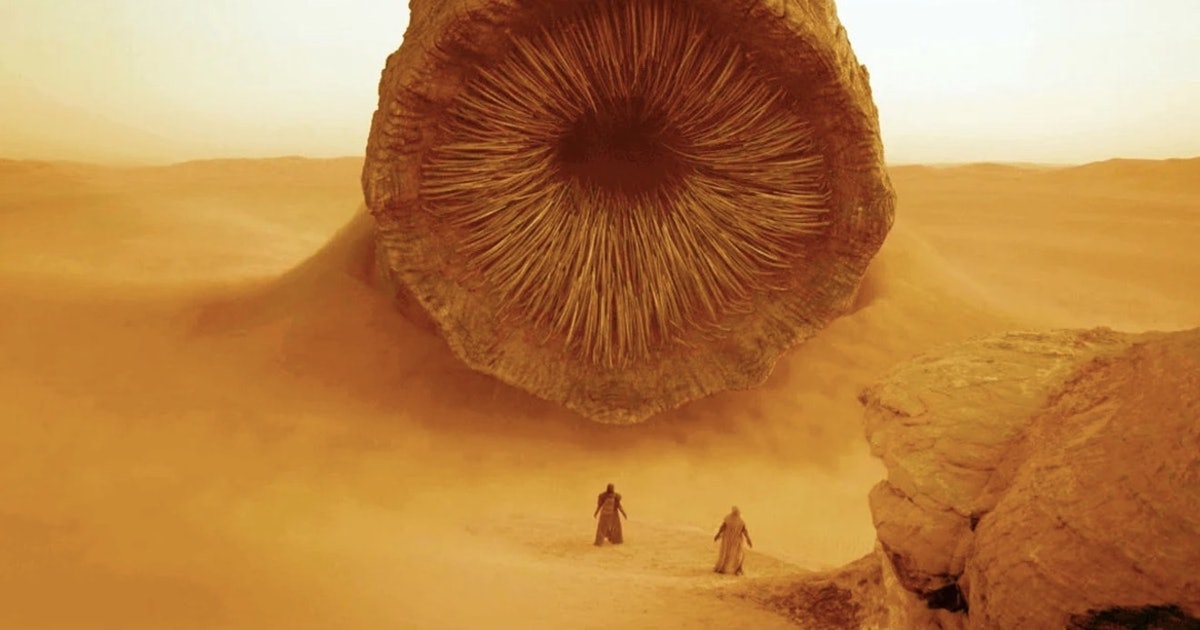
James Herbert’s novel has an almost messianic following and I imagine most of its readers will be pleased with what’s on offer here. Villeneuve’s direction, combined with the almost hallucinatory qualities of Greig Fraser’s cinematography and Hans Zimmer’s eerie score, makes for a memorable experience. The casting is impeccable, with Rebecca Ferguson excellent as Paul’s mother, Lady Jessica, and Josh Brolin a perfect choice as the dour warrior, Gurney Halleck. And then, of course, there are those infamous sandworms, one of the elements that really didn’t work in Lynch’s movie, but they certainly generate lots of tension here…

Villeneuve keeps everything bubbling along at a sedate pace, taking enough time to set out his stall. The world-building is beautifully done and the theme of colonialism convincingly explored. And if Paul Atreides is just another in a long list of Christ figures, a popular conceit in science fiction, well it hardly matters. Dune carries us along on a tidal wave of sensory overload until we dimly register that the first instalment is over and we’ll have to wait another year to see how things turn out for Paul.

Quibbles? Well, yes, and it’s one that’s becoming increasingly common. Dune has a 12A certificate, which means that some of the more violent elements of the tale have been downplayed. While I understand there’s a wish to maximise the potential audience for the film, this was never going to be another Star Wars (Dune comes from a much more po-faced universe than Obi Wan and his merry gang). So I think a 15 would be a much better fit. But I absolutely understand why it is what it is.

That said, I enjoy the film enormously and I’m sure I won’t be the only one eager for a second helping, which… all being well… will be coming to a universe near you in the not-too-distant future.

4. 6 stars

Philip Caveney

Star Wars: The Rise of Skywalker

21/12/19

In the early 70s, a young filmmaker called George Lucas had a vision. He wanted to make an epic space saga that would consist of nine episodes in total. (And one for which he would, naturally, retain all merchandising rights.) For reasons best known to himself, he decided to begin, in 1977, with episode four of what, for me, is one of the most overrated film franchises in history.

It began well enough – indeed, the first two films are great – but, from that point, it has descended into a whole series of misfires. There’s the one with the Ewoks. And those three awful prequels… oh God, those prequels!

Finally, here we are at episode nine: The Rise of Skywalker. After the bewildering cul de sac of The Last Jedi – and after the ignonimous departure of Skywalker’s original director, Colin Trevorrow – J J Abrams is back on board to bring the saga to an end. This seemed like a sensible decision when it was first announced. After all, his The Force Awakens was easily the best Star Wars movie in a very long time, a sort of lively ‘best of’ compilation. If anybody could offer a safe pair of hands, surely he was the man? So it’s sad to report that (for my money, at least) this final chapter provides a decidedly lacklustre conclusion.

The plot: a familiar voice from the past is threatening the rebel resistance, which is still being commanded by Leia Organa (the late Carrie Fisher, courtesy of some visual trickery). Rey (Daisy Ridley), Finn (John Boyega) and Poe (Oscar Isaac) head off on a quest to try to find where that pesky voice is coming from, accompanied by C3PO (Anthony Daniels) and Chewbacca (Joonas Suotamo). Meanwhile, Kylo Ren (Adam Driver) is still intent on ruling the universe. And then… ah, who cares? It’s all lumpen and – dare I say it? – dull. I find myself bored after just twenty minutes of viewing. And considering the film opens with an all-out action sequence, that’s a problem.

So what has gone wrong? Is it the unnecessarily complicated storyline that sinks it? The seemingly endless procession of people we think are dead, but aren’t any more? (Maybe even the ones who actually are dead but don’t seem to know it – and I’m not talking about Carrie Fisher here, but the fictional characters.)

Is it the series of hopelessly turgid lightsaber duels that drag it down? The fact that people talk in a series of fridge magnet quotes? Is it that characters still can’t decide if they’re good eggs or dark, demonic nasties? Or is it simply that not enough time has passed since Jedi to allow audiences to summon up enough enthusiasm for this nonsense? Whatever the reasons, by the time we hit the (ho hum) extended space battle climax, I’m looking at my watch and praying for it to be over.

I appreciate that the diehard fans will rally round to support the film, because, well, that’s what Star Wars freaks tend to do but, apart from a couple of scenes here and there, I can’t honestly say that I enjoy this. And that’s a shame because, despite the curse of diminishing returns, Star Wars has had a remarkably good run down the decades and I want it to go out on a high.

Of course, I’m not so dumb as to imagine it’s really going to end here. As long as there’s more money to be made, there will be spin-offs and prequels and homages and tie-ins.

But I seriously doubt I’ll be watching them.

2.5 stars

Philip Caveney


At Eternity’s Gate

14/11/19

Here’s one I missed at the cinema, but – as is increasingly the case these days – it’s right there on Netflix for anyone to see at the click of a button. While this would definitely benefit from the immersive qualities of a big screen, beggars can’t be choosers.

Julian Schnabel’s film of Vincent Van Gogh concentrates on his years in Arles and, later, at Auvers Sur Oise. Willem Dafoe stars in what is possibly the role he was born to play, so convincingly does he settle into the great man’s persona, and he greatly deserved his Oscar nomination.

This is far from a straightforward biopic, however. Indeed, anybody who prefers a clear narrative arc will probably have a tough time with this. There’s a lot of footage of the artist, easel strapped to his back, wandering for miles across the French countryside in search of the elusive ‘perfect light’ and the film takes its own sweet time over those sections. But there’s no doubting the power of the sumptuous cinematography of Benoit Delhomme, which really does capture the unique look of Van Gogh’s paintings.

A lot of big names pop up in cameo roles. Oscar Isaac is a suitably swashbuckling Paul Gaugin, Rupert Friend is Vincent’s endlessly patient brother, Theo, and Mads Mikkelsen gets the dubious honour of portraying the priest at an asylum, who unashamedly informs the artist that his work is ‘ugly and without merit.’ Dafoe, meanwhile, suffers for his art in utterly convincing style and generates pity for Vincent as well as anger at the horrible treatment he receives on an almost daily basis.

There’s a powerful payoff when, after his mysterious death (which is frustratingly skipped over), we witness Vincent lying in his coffin, surrounded by his paintings and we cannot help but see that the mourners are already taking more interest in his work than they ever did when he was alive.

An interesting effort, then, and – while it lacks the jaw-dropping power of Finding Vincent – it’s still essential viewing for fans of one of history’s greatest artists.

3.8 stars

Philip Caveney


Life Itself

02/01/19

There’s a lovely little movie trapped inside Life Itself. An arch, playful, beautifully acted and intriguingly populated film, with a gently emotive storyline. It’s all there: ripe and ready. Unfortunately, it’s covered in an unwelcome layer of fridge-magnet cod-philosophy, with a side helping of pomposity thrown in. Oh dear.

Things start well. We meet Will (Oscar Isaac) as he stumbles drunkenly into a coffee shop, clearly having hit hard times. His therapist (Annette Bening) encourages him to talk about his relationship with his wife, Abby (Olivia Wilde), and their back-story is revealed in a series of flashbacks. The idea of the unreliable narrator is introduced early on, and reinforced by Abby’s student thesis on the subject. Life, concludes Abby, is the ultimate unreliable narrator, more random and unpredictable than anyone cares to acknowledge. Her friends like the idea, but she fails her course, because the essay strays too far from literary criticism.

Still, as the film goes on to show: she’s right. Time and again, writer-director Dan Fogelman pulls the rug from under our feet, throwing us swerve balls and catching us unawares. The action moves, almost arbitrarily,  from Will and Abby’s New York to Javier González (Sergio Peris-Mencheta)’s Spain – where all the dialogue, naturally, is in Spanish – and back again to New York, where we meet Will and Abby’s daughter, Dylan (Olivia Cooke). All this I like. The characters are captivating, and the seemingly unrelated strands are pulled together expertly. Segmenting movies into ‘chapters’ seems to be a bit of a recent phenomenon, and it works well here. Antonio Banderas is wonderfully understated as the emotionally needy Mr Saccione, and Laia Costa, as Javier’s wife, Isabel, really lights up the screen.

So why doesn’t it work? Because that premise, of life being the ultimate unreliable narrator, is overworked. It’s not left to be played out; we’re not trusted to understand without an actual lecture, delivered in the final chapter by Elena (Lorenza Izzo), Dylan’s teenage daughter, who, we discover, has been narrating throughout. There’s not enough substance to the idea to merit this much talk; it’s a simple – dare I say banal? – concept, enough to carry a story but not to bear such scrutiny. It takes itself too seriously, accords itself too much weight. And that’s a real shame.

There’s a filmed Q and A at the end of our screening, but it reinforces rather than alleviates our concerns. The interviewer, Jenny Falconer, talks of weeping copiously as she watched, but we both feel curiously unmoved. It’s clearly a movie that wants to tap into our emotions, but the narration distances us from events, and makes that level of engagement difficult. I don’t mind this – the film is at its best when it’s witty and stylised, which it is, a lot of the time – but it feels muddled, as if the ‘message’ is getting in the way of all the good stuff that’s on offer here.

3.3 stars

Susan Singfield


Annihilation

16/03/18

Another day, and another movie goes straight to Netflix. After Mute and The Cloverfield Paradox, this is starting to feel like a trend, though in the case of Annihilation, writer/director Alex Garland has been very vocal about his displeasure in learning that his brainchild would not be receiving a theatrical release. The reason he was given by Paramount? The film was ‘too intellectual.’ More likely, perhaps, is the fact that too many big-budget science fiction movies have failed to put bums on seats over the past year.  Whatever the explanation, the film’s expensive credentials are evident and it must be said that some of the more eye-popping effects sequences really would have looked a lot more impressive on a big screen.

Soldier-turned-college-biology-lecturer, Lena (Natalie Portman), is in a bad place in the film’s early stretches. Her husband, Kane (Oscar Isaac), is a soldier, missing in action for over a year after being sent away on a secret mission – but she hasn’t quite given up hope that he will return. Then, quite unexpectedly, he does come back, acting very strangely, shortly before collapsing into a coma. On the way to the nearest hospital, the ambulance is intercepted by soldiers and Lena and Kane are rushed to a secret facility in Florida, where Kane is put on life support. Lena meets scientist Dr Ventress (Jennifer Jason Leigh), who tells her about ‘The Shimmer’ – a strange, shifting dimension that has established itself in the Everglades after a mysterious meteor strike. The Shimmer appears to be constantly expanding and Ventress tells Lena that Kane was part of a team sent in there to investigate. The other members have all disappeared without trace. Ventress explains that she is planning to lead an all-female team in there in a few days’ time and, perhaps unsurprisingly, Lena elects to go with them.

Once inside this unknown dimension, things begin to go very weird, very quickly. The team soon establish that here, species are getting their individual DNA all mixed up with others. This can be as enchanting as flowers sprouting multi coloured petals from the same stem, or growing into the shape of humans – but it can also be as sinister as a huge alligator which seems to have merged with a shark, creating a creature you most definitely do not want to spend any time with. As the team make their way closer and closer to the site of the meteor impact it begins to look as though their chances of surviving this mission are growing perilously slim…

Annihilation is a decent sci-fi movie, if not an exceptional one – and it’s nowhere near as effective as Garland’s previous effort, the criminally underrated Ex Machina. It’s refreshing though to see an action film that is predominately led by female actors, even if I really didn’t learn an awful lot about their respective characters – and there’s one particular sequence in here, featuring a mutated bear, that really did push the throttle headlong in the direction of terror. There’s an interesting conclusion too, which will doubtless prompt some discussion after the credits have rolled.

In the end, it’s hard to say whether this film would have done much business at the cinema. I actually doubt it. And, judging by what I’ve seen on social media, it’s getting plenty of  viewings on Netflix, even if most of the resulting comments are far from complimentary.

One thing’s for sure. It’s an easy matter to tune in and judge for yourselves.

4 stars

Philip Caveney

Ex Machina

06/03/17

There’s always the one that got away, isn’t there? I somehow managed to miss Ex Machina’s all-too-brief appearance on the big screen and I’ve been trying to catch up with it ever since, largely because I’d heard such good things about it. Discovering that it’s now available on Netflix was therefore great news.

Alex Garland’s 2014 movie, is a deceptively simple affair, pretty much a four-hander, laid out with cool clear linearity. Caleb (Domhnall Gleeson) discovers he has won the opportunity of a lifetime – to travel to the remote hi-tech hideaway of Nathan (Oscar Isaac) the CEO of the world’s biggest internet company and to spend a week with him, getting a sneak preview of his latest creation. This turns out to be Ava (Alicia Vikander) an AI, and one so convincing that Nathan challenges Caleb to apply the Turing Test to her – designed to examine a machine’s ability to exhibit intelligent behaviour equivalent to, or indistinguishable from, that of a human. Is she good enough to pass?

Caleb goes to work and soon establishes a powerful rapport with Ava – but, as he constantly asks himself, is she genuinely interested in him, or simply using him as a way of staying alive? Because, as Nathan makes all too clear, if she fails the test then she is destined to be replaced by a newer, better model. Nathan, meanwhile, is prone to drinking himself half to death and dancing around the apartment with his live-in housekeeper, Kyoko (Sonoya Mizuno). As the story develops it becomes apparent that nothing in this  state-of-the-art home is quite what it appears to be… and soon even Caleb is questioning his own existence.

The beauty of Ex Machina is the way in which it expertly unfolds its intriguing story, constantly pulling the rug out from under the viewer, until you don’t really know what to expect next. Vikander offers a fascinating performance in the central role, and Gleeson, Isaac and Mizono are all totally believable. If like me, you missed this film first time around, here’s your chance to catch up. It’s really rather good.

4.2 stars

Philip Caveney