Lyceum Theatre

Thon Man Molière

tumblr_o7nct3VfMA1qbch0vo10_1280

01/06/16

Royal Lyceum Theatre, Edinburgh

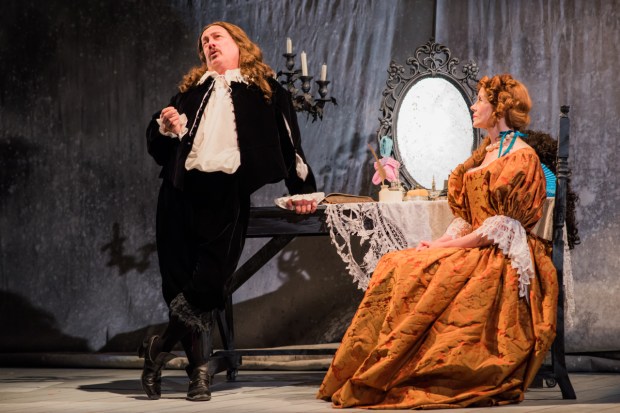
Thon Man Molière is Liz Lochhead’s witty, irreverent imagining of a particularly awkward period in the infamous French playwright’s life. Fêted by the King, and finally achieving recognition for his work, Molière seems determined to self-sabotage, persisting with his play, Tartuffe, despite warnings that its depiction of a corrupt clergyman might not sit well with the highly religious monarch on whose patronage he depends. And that’s not all: he compounds the precariousness of his position by falling in love with and marrying a young woman who, it appears, may very well be his daughter.

It’s a subject ripe for comedy, and Lochhead’s script fizzes with quips and drollery. It’s laugh-out-loud funny at times, not least when contemporary Scottish dialect is employed in response to seventeenth century mores. The performances are uniformly strong, with Jimmy Chisholm managing to tread the fine line between vulnerable and repulsive in his depiction of the egotistical Molière, so that we do actually care what happens to him, even when his misfortunes are richly deserved. Siobhan Redmond is fantastic too, imbuing Madeleine Béjart, Molière’s sometime lover, with a dignity and credibility beyond the ‘tart with a heart’ archetype.

The set, mostly backstage at a theatre, is all muted monochrome, with the unpainted backs of flats on view. The costumes, glorious peacock-confections in the main, stand out in contrast to this, conveying perfectly the tawdry glamour of the theatre, and how it shines against the pall of ordinary life.

If there’a a quibble, it’s with the dialogue. Most of the time, it’s superb: funny and acerbic and nicely paced. But, now and again, we are fed great lumps of exposition, clumsily forced into a conversation, most of which we just don’t need. There’s no real benefit, for example, in giving the audience a detailed plot summary of one of Molière’s plays; it’s unnecessary and just slows things down.

But all in all, this is a lovely play: a uniquely Scottish take on a slice of French comedy.

4 stars

Susan Singfield

The Venetian Twins

Unknown

02/05/15

Lyceum Theatre, Edinburgh

Carlo Goldoni is, of course, the playwright whose earlier work, A Servant of Two Masters was so fruitfully adapted by the National Theatre to create One Man, Two Guvnors. The Venetian Twins is cut from the same bolt of gaudy cloth (indeed, can it really be a coincidence that lead actor Grant O Rourke is a dead ringer for James Corden?) At any rate, it matters not. This is a farce majeure, beautifully played, timed to precision and rib ticklingly funny from start to finish.

The action takes place in Verona. Rich and somewhat dim country boy, Zanetto (O Rourke) comes in search of a bride, specifically the nice but equally dim Columbina (Angela Darcy) whose gold-digging father, The Provost senses an opportunity to refill the family’s depleted coffers. But Zanetto has an identical twin brother, Tonino (also played by O Rourke) from whom he was separated as a child. When Tonino flees his native Venice for Verona along with his sweetheart, prototype feminist Beatrice (Jessica Hardwick), the scene is set for a bewildering series of ‘mistaken identity’ disasters. It’s a cliche to say that much hilarity ensues but in this case, that’s exactly right.

In the wrong hands, farce can be toe-curling, but there’s not a foot put wrong here (unless you count the hilariously drunken old landlady who falls repeatedly through an open trapdoor.) This owes much to Commedia Dell Arte, but this is no ‘off-the-peg plot. Much of the wittily updated script by Tony Cownie is delivered in broad Scots accents, which work brilliantly, and there’s a wonderfully foppish performance by John Kielty as the effete (and inevitably English-accented) Florindo. There’s some wonderfully fruity innuendo, a fistful of malapropisms from Columbina and a stomach-churning scene involving a blocked toilet that modesty forbids me to describe in detail. Meanwhile, O Rourke slips effortlessly between the two roles simply by doing up the top button on his jacket and adopting a different expression. The two acts galloped by while the audience, myself included, were convulsed with laughter from start to finish. If laughter is something you relish, then you really should see this before it moves on. It’s a Venetian blinder.

5 stars

Philip Caveney

The Caucasian Chalk Circle

The-Caucasian-Chalk-Circle-at-the-Royal-Lyceum-Theatre-250x165

Lyceum Theatre, Edinburgh 17/02/15

This is one of those productions that makes me want to bottle its essence, and use it when – in my day job as a drama teacher – I am introducing a class of students to Brecht and his ideas. There’s a danger, sometimes, of presenting him as too difficult or serious (he is, of course, both – it’s the ‘too’ that’s the problem), and of the alienation effect coming to mean something quite different within the confines of the classroom.

But this production was so enchanting and funny and lively and, yes, engaging (sorry) that no one in the audience could fail to feel its impact. From the moment we entered the theatre, we were made witness to events. The stage was huge and cluttered, with all curtains removed and the wings exposed; costumes hung on rails, and actors moved around the stage, gossiping, going over lines, checking their props. After a while, a couple of actors came down into the audience and chatted. ‘D’youse know much about Brecht?’ one of them asked the woman next to me. ‘Nothing at all,’ she replied, and the actor hunched down on the floor beside her, and gave a quick précis of the ideas behind epic theatre. This deliberate negation of any notion of naturalism or realism was only made more stark by the opulent beauty of the late 19th century Lyceum theatre, with its proscenium arch and ornate boxes. This was no black box of a space, where experimental theatre is par for the course; it was a studied and deliberate clash of theatrical styles, and it worked – big time.

The production was overtly musical, with a glorious performance by Sarah Swire as the singer/narrator, acting as a kind of rock-chick Greek chorus to keep up the momentum. The pace never flagged: this was an energetic ensemble piece, whose fourteen actors contrived to create the sense that they were many more. John Kielty was another standout, in a variety of roles, but most notably as the Governer’s snobbish wife; he clearly revelled in the drag and campery. Christopher Fairbank (as Adzak, among others) also made his mark, not least for his impressive rendition of a wide variety of accents.

The direction (by Mark Thomson) was stunning. It’s hard to single out particular moments in such a seamless production, but I did love the depiction of the rickety bridge, with an enormous fan blowing a paper blizzard, while three wooden planks were moved in front of Grusha (Amy Manson), their wobbling placement creating a real sense of the crevasse she was crossing and the danger she faced. The puppet used to represent Michael was another delight, skillfully manipulated by Adam Bennett, who breathed life into the (polystyrene?) head, forcing us to confront the very real dilemmas Grusha had to resolve.

All in all, this was a fabulous and celebratory piece of theatre: dazzling, spectacular, and – above all – thought-provoking. It’s on until the 14th March. Go and see it if you can.

5 stars

Susan Singfield