Jack Nurse

Òran

13/11/25

Traverse Theatre, Edinburgh

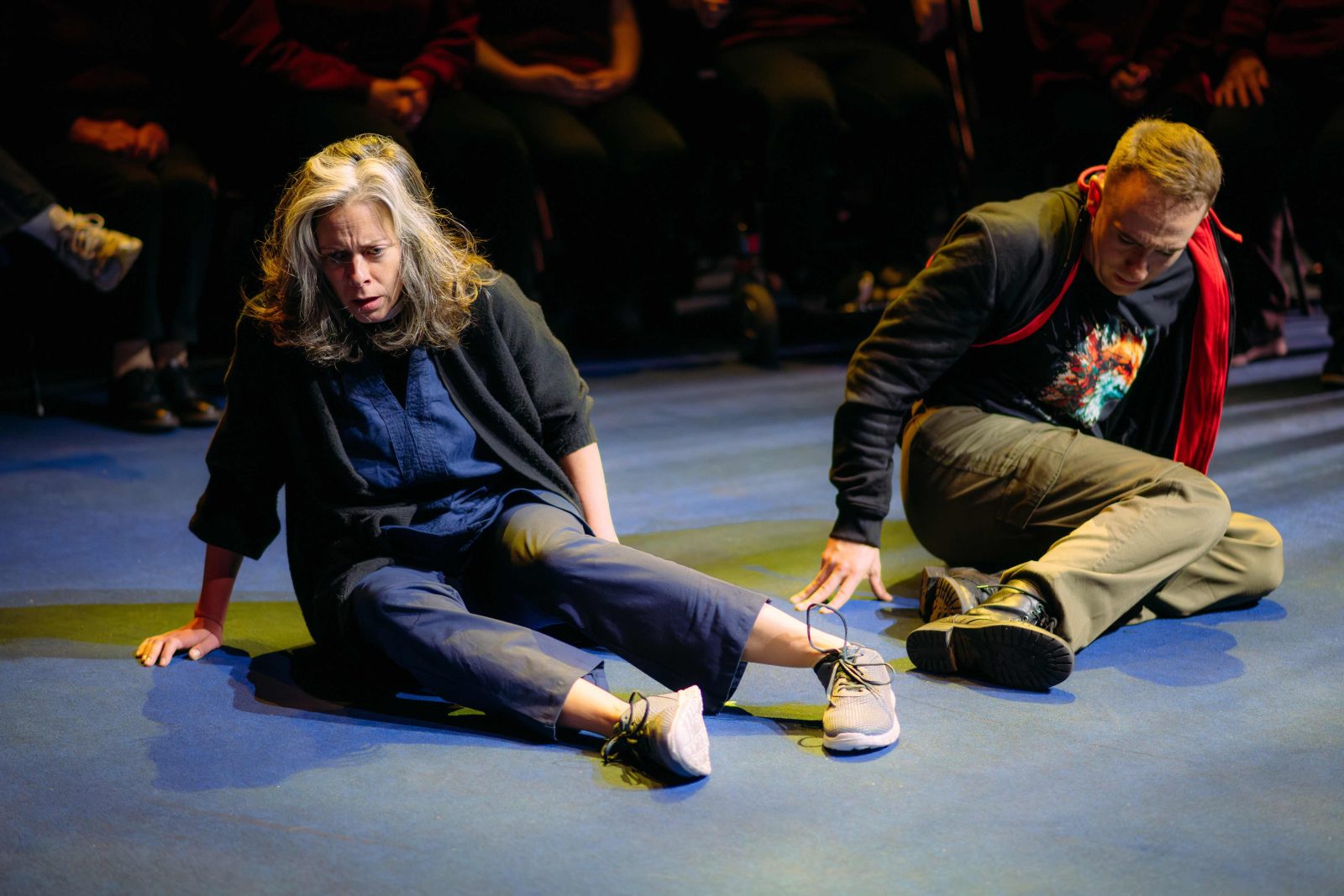
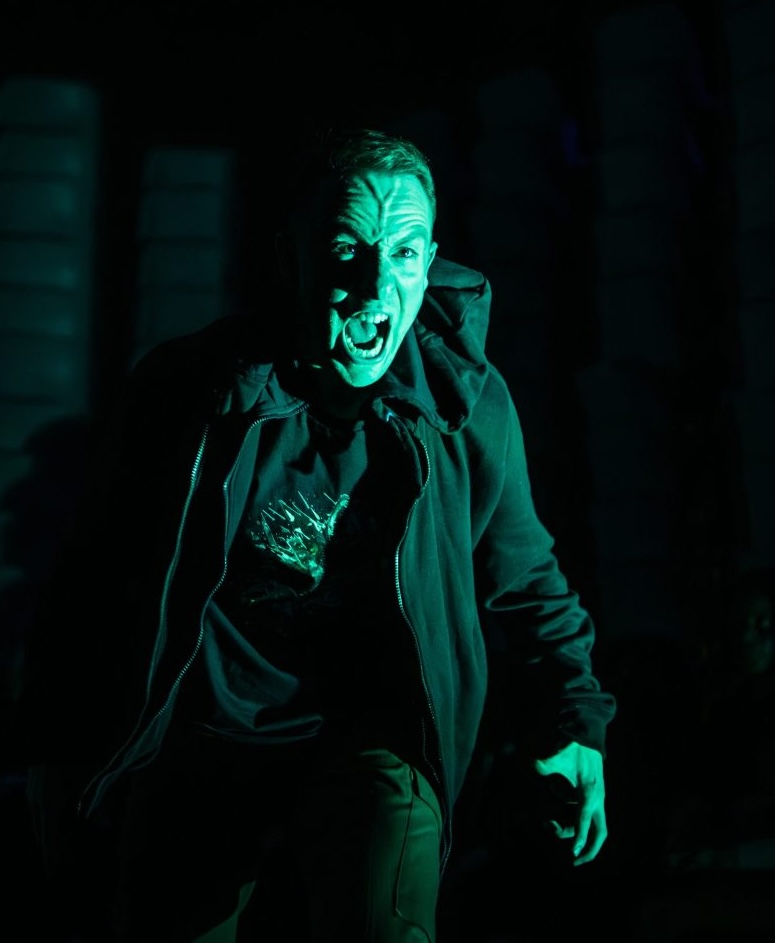
Òran is a retelling of the myth of Orpheus and Eurydice, a powerful one-man monologue written by hip-hop artist Owen Sutcliffe and performed by Robbie Gordon. The piece is centred around a pulsing, haunting soundtrack by Vanives and Ben Dean, and the story is given a contemporary makeover. Òran (Gordon) a pupil in a Scottish high school is witness to the cruel cyber-bullying of his best friend, Euan, but does nothing to help him.

Overcome with guilt, Òran feels compelled to descend into the Underworld (via a conveniently located lift) in an attempt to find Euan and pull him free from the pit of desperation into which he has disappeared.

This is a spoken-word production, with Gordon sitting either at a desk – controlling the small mixing deck which contains the labyrinthine layers of the soundtrack – or racing frantically around the stage, interacting with the audience, making us both witness to and part of the story. This is especially effective in one emotionally-charged moment when we help to create a moment of theatrical magic.

I can’t help but notice that a large group of teens sitting across from me are absolutely spellbound by this performance, staring transfixed as the story unfolds, their reactions writ large. 

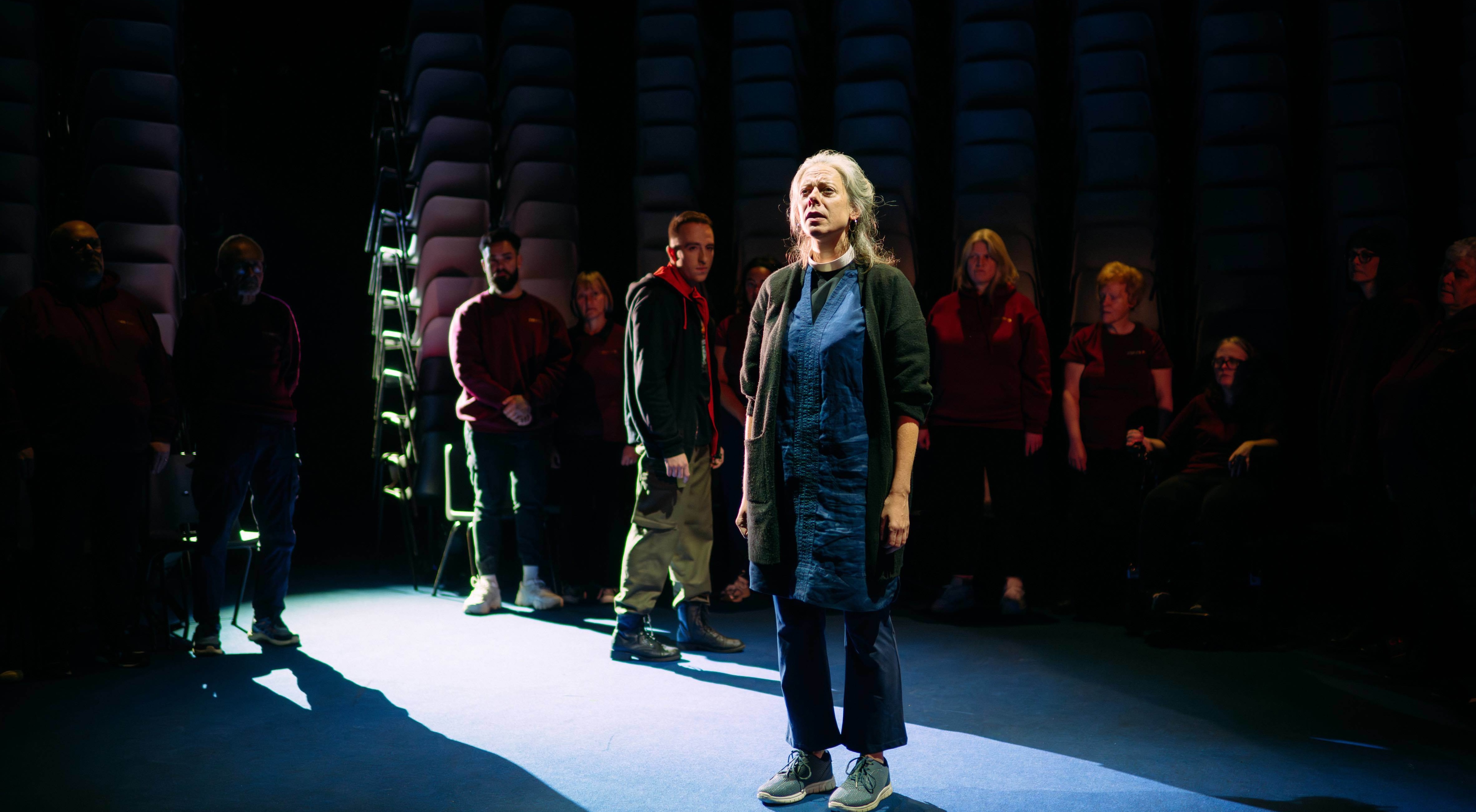
Sutcliffe’s Scots poetry alternates between the fierce and the poignant, often breaking into rap. The piece is sensitively directed by Jack Nurse and the production is also elevated by Benny Goodman’s evocative lighting design. I particularly enjoy the clever depiction of the descent into the Underworld, which is simply but effectively achieved. I also like the way that Gordon’s voice is dramatically transformed whenever he assumes the persona of Hades.

Perhaps the story’s late-stage revelation loses some of its power in the midst of what is essentially an aural assault, but that’s a quibble. Òran grabs an ancient myth by the scruff of its neck and gives it a right good shaking.

4 stars

Philip Caveney

Same Team – A Street Soccer Story

12/12/23

Traverse Theatre, Edinburgh

Street Soccer Scotland is a charity using football for positive social change, and Street 45 is its women’s programme. It makes perfect sense. Team sports promote both physical activity and social connection; they provide a sense of purpose and help build self-esteem. People experiencing poverty, homelessness or addiction; those in the care or criminal justice systems; those with mental illness or other support needs: all too often, they’re marginalised, excluded. Street Soccer Scotland aims to create a sense of hope and opportunity for them.

Same Team – A Street Soccer Story serves a similar purpose: to remove the stigma associated with certain life experiences, to celebrate the women at the centre of the tale – and to raise awareness of this most deserving charity. It’s also a cracking good play.

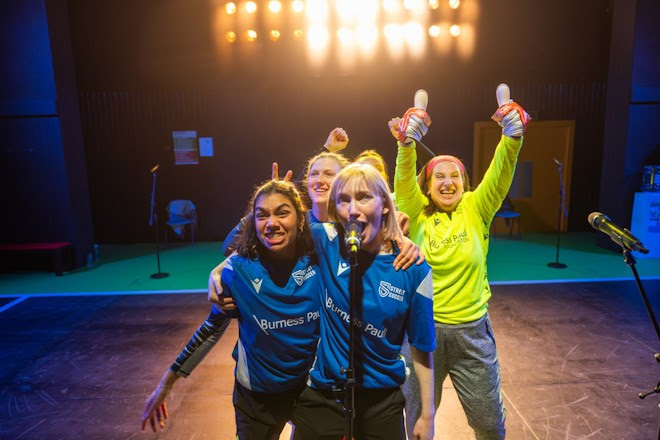
As we take our seats, five women drift onto the stage dressed in sports gear, stashing their belongings in lockers and beginning to warm-up. “Are you here for the try-outs?” they ask us. Several audience members get up and join in the running drills. (Spoiler: they don’t make the squad.)

Jo (Chloe-Ann Tylor) is chosen as captain. Of course. She’s the star player, and this is Scotland’s chance to win the Homeless World Cup. “There are five rules,” she tells her team. “Players always come first. We look to the future. We never leave anyone behind. We place others before ourselves. We keep our promises.”

The rules are not always easy to follow. The women’s lives are complicated. Single parent Sammy (Kim Allan) is facing eviction – again. Her teenage sons are hard work, and she’s not looking forward to moving back in with her disapproving mother. Middle-class Lorraine (Louise Ludgate) has been unceremoniously dumped by her husband after twenty years. She’s staying on a neighbour’s couch and fretting about her perilous finances.

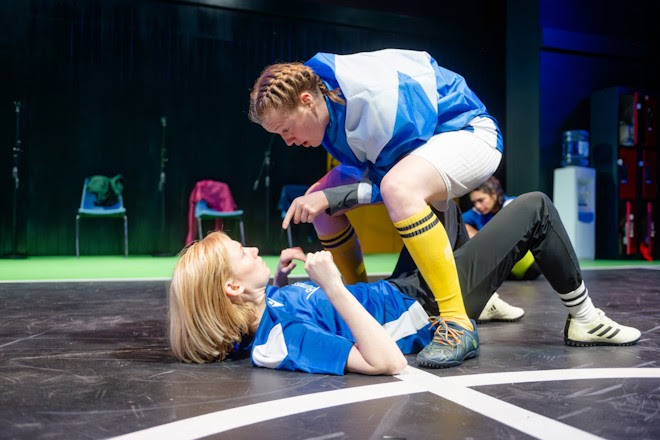
Things are even harder for teenager ‘The B’ (Hannah Jarrett-Scott), who has only just come out of prison. She’s brittle and defensive, unable to secure a job. Meanwhile, her ex-classmate Noor (Hiftu Quasem) is still at school. She lives with her grandfather – her Nana – and he’s got dementia. A chance meeting between the pair proves fortuitous, as The B tells Noor about the Change Centre. “There’s loads going on, like fitba… You were always a good player. There’s trials on for my old team. You should come along.”

And Jo. Well. Jo’s got problems of her own.

But for a few hours each week, the women leave their troubles at the edge of the pitch and focus on the game. Their commitment to the team and to each other gives them something important to feel proud of. Slowly, they let their guards down, opening up to one another and forging friendships. Their shared sense of purpose binds them together.

Written by Robbie Gordon and Jack Nurse in collaboration with the women from the Dundee Change Centre, Same Team is a heartwarming and affecting piece of drama. The narrative is clear-eyed and unsentimental, affording the characters the dignity and respect they deserve. Director Bryony Shanahan maintains the kinetic pace appropriate to the theme, with softer, sadder moments punctuated by riotous cheering or flashes of anger. The movement feels real – even though we never see a ball or an opposing team. The light and sound (by Lizzie Powell and Susan Bear respectively) are integral to the atmosphere, especially once we arrive at the World Cup in Milan. I particularly like the way the different countries’ flags appear in the floodlights.

Perhaps I don’t quite buy finicky Lorraine’s inclusion in the team; perhaps some of The B’s jokes don’t need explaining by the other characters, but this is compelling and important theatre, with five impressive performances from the ensemble cast. Jarrett-Scott is a gifted comic actor, always able to undercut even the most heart-breaking scenes at exactly the right moment. Tylor brings the emotional heft, her Jo a smouldering fuse just waiting to explode.

Same Team – A Street Soccer Story is playing at the Traverse until the 23rd December, and – although it’s not a festive tale – it embodies the spirit of the season. Grab yourself a seat in the stands and get ready to cheer.

Oh, and make sure you know the words to Flower of Scotland.

4 stars

Susan Singfield

549: Scots of the Spanish Civil War


07/06/19

Traverse Theatre, Edinburgh

549: Scots of the Spanish Civil War isn’t exactly what you’d call subtle: in a small pub in Prestonpans, the parallels between four disgruntled millennials and their 1936 counterparts are explicitly drawn.

The 2017 quartet are somewhat disaffected, ground down by austerity and disillusioned with democracy. George (Robbie Gordon), who was famed at school for being the political one, isn’t going to bother voting in the next election. What’s the point? The others disagree, but that doesn’t mean they’re of one mind. They’re angry, polarised; either silent or shouting; held together only by proximity and a shared past.

But, during a powercut, Old George (Michael Mackenzie) appears briefly and then  vanishes, leaving behind a mysterious suitcase. Bar manager Ellen (Rebekah Lumsden) seizes the opportunity to school the boys, telling them that Old George is long dead, and that his suitcase contains mementoes of his time fighting in the Spanish Civil War.

George Watters joins the legendary International Brigade in 1936, spurred on by his deeply held belief that fascism must be thwarted, no matter what the cost. He persuades his mates and his brother-in-law too: Jock (Josh Whitelaw) is keen because he wants to spread his wings, to see the world beyond East Lothian; Bill (Cristian Ortega) is an innocent, young and easily swayed, who just wants to meet some Spanish girls; Jimmy (Nicholas Ralph) is in it for the money. Their ideologies differ, but they bond over the fight.

As Ellen tells the story, the men enact it, using whatever they can find in the bar to represent the tale. Their guns are snooker cues; their barriers bar tables. The lighting (by Benny Goodman) is unusual and most effective: there are banks of brightly coloured pink and yellow spots, almost blinding at times, denoting the present day, while an atmospheric orange gloom settles over much of the past action. It’s a quirky palette, but somehow it makes perfect sense.

The physicality of the drama is excellent, with some inventive set pieces, particularly the bike ride and the battles. The small space feels crowded by soldiers; the pace never lets up, and the characters are well drawn. This is true ensemble work, and very nicely done.

And, in a testament to the power of theatre, the simple reenactment of the tale has a profound impact on the boys, shaking them out of their torpor. I know, I said it wasn’t subtle. But this isn’t the place for subtlety. Maybe, in these troubling times, as the far right rears its head again, we all need to wake up and realise what’s worth fighting for.

4.2 stars

Susan Singfield