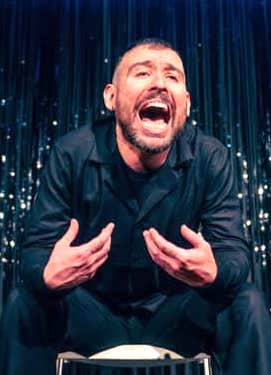
Gareth Nicholls

Black Hole Sign

08/10/25

Traverse Theatre, Edinburgh

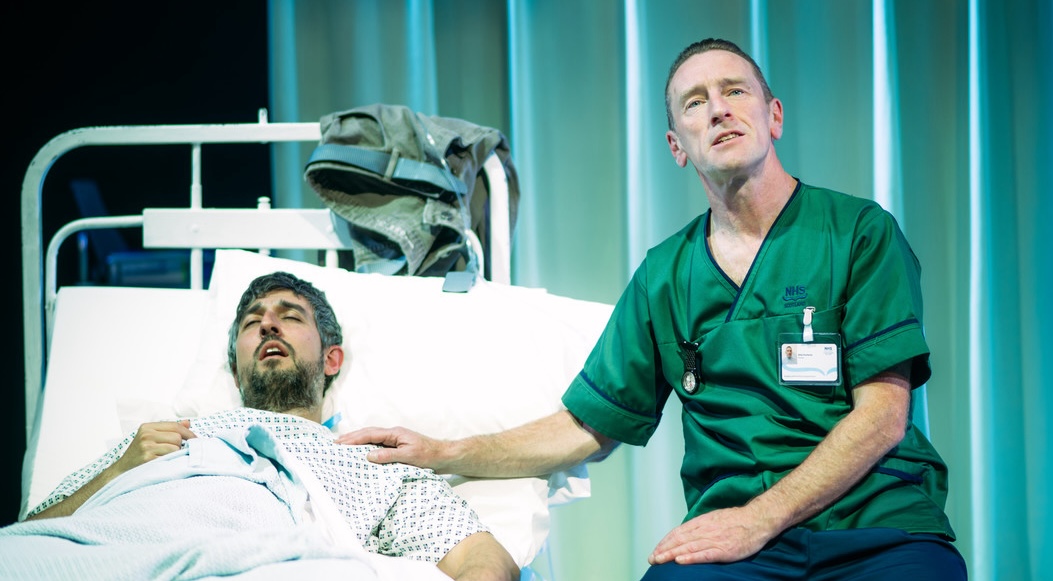
There’s a great big metaphor hanging over the unnamed hospital where this dark comedy takes place. A hole has appeared in the roof of A&E and water is dripping down onto the floor. As the story progresses, so the problem steadily worsens, the ingress ever more destructive. 

But senior charge nurse Crea (Helen Logan) and her team can only soldier on regardless, doing their best for their patients, no matter what. Crea has phoned for help about the roof only to be told (by a recorded voice) that she is number 74 in a queue. Her team include her right-hand woman, Ani (Dani Heron), currently doing a bit of soul-searching about her own future; affable porter, Tommy (Martin Docherty), who has long carriesd a torch for Crea; and Lina (Betty Valencia,) an almost cartoonishly helpless student nurse, who arrives chewing gum to ‘help her anxiety’ and who seems incapable of walking past a litter bin without knocking it over.

It’s clearly going to be a tricky night. Mr Hopper (Beruce Khan), a former alcoholic, is admitted with the fatal condition that gives the play its title, an inoperable affliction of the brain that is going to keep deteriorating and will cause his death in a matter of hours – but there’s no sign of anybody visiting him. Meanwhile, octogenarian Tersia  (Ann Louise Ross) is suffering from a urinary infection and is causing havoc as she experiences hallucinatory episodes that make her think that she is at a 1970s disco. The silver glittery shoes she’s wearing are all too real though.

At various points the play keeps cutting to an enquiry, some time later, where the members of staff have been called as witnesses and we learn that something really bad happened on that fateful night, resulting in a tragic death. It’s all too clear that somebody is going to have to pay the ultimate price for this disaster.

Playwright Uma Nada-Rajah is herself a staff nurse, who works in critical care, so it’s little wonder that, despite the sometimes slapstick levels of humour on display, the piece feels authentic, clearly inspired by events that the writer has actually experienced. It’s not the eviscerating howl of despair I came in expecting but then, such grim polemics can sometimes make for difficult viewing, so here the bitter pill has been sweetened with a shot of humour. Amidst the laughter, important points are being driven home.

It’s clear from the outset that tonight’s audience is on board with this fast-moving production, cleverly directed by Gareth Nicholls, though I must confess to being somewhat puzzled by a lengthy blackout, which – considering how little has changed when the lights come back up – seems unnecessary.

This niggle aside, the hearty applause at the play’s conclusion suggests that everyone present is in agreement with the story’s subtext. The National Health Service – one of the greatest institutions of modern times – is on its last legs and anything that forces this pressing concern into the spotlight is more than worthy of our attention.

4 stars 

Philip Caveney

So Young

04/08/24

Traverse Theatre, Edinburgh

A new play by Douglas Maxwell is always a treat. He’s an insightful playwright, able to walk that precarious tightrope between hilarity and tragedy with absolute authority. So Young is up there with his best work.

The play opens in the bedroom of married couple Liane (Lucianne McEvoy) and Davie (Andy Clark). They are in flagrante delicto and it appears to be going well – all four minutes of it. We know it’s that long because Andy has been timing it on his phone. In the afterglow, he wistfully talks about the years when their couplings could last the entire day, but there’s little time to linger on such details because the couple are already running late. They’re due to meet up with their friend, Milo (Nicholas Karimi), who they have known for years – in Andy’s case since they were best mates at school.

Liane is somewhat dismayed when Davie casually mentions that Milo is planning to introduce them to a new female friend. Both Davie and Liane are uncomfortably aware that Milo lost his wife, Helen, to COVID only three months earlier. The new friend turns out to be Greta (Yana Harris), just twenty years old and a former pupil at the school where Liane teaches. When she mentions that she and Milo are now engaged, Liane cannot help reacting badly to the news. After all, Helen was her best friend in the world and, thanks to the pandemic, there still hasn’t been a proper funeral service. 

As glasses of wine are consumed, it’s clear that there’s going to be a confrontation…

Maxwell always creates utterly believable characters. McEvoy is terrific as the caustic, fearless Liane, who has the ability to nail any target with a few well-chosen phrases and does so with abandon. She also manages to provoke a spontaneous round of applause for her discourse on the importance of female friendship. Gray, meanwhile, is brilliantly funny as the hapless Davie, at one point managing to have the entire audience convulsed with laughter, with nothing more than a series of exasperated looks and the repetition of the words, ‘Three months?’ Karimi has perhaps the trickier task of conveying Milo’s world-view, the difficulties of carrying on alone when his partner is gone. Harris is convincingly bright-eyed and resolute as Greta, fielding Liane’s dismissal of her as a child who knows nothing.

Having got his four characters into such strife, it’s left to Maxwell to conjure a conclusion that satisfies the audience and, once again – ably assisted by director Gareth Nicholls – he manages it with considerable panache. So Young is a perfectly-pitched drama that keeps me hooked throughout.

4.8 stars

Philip Caveney

Jack

27/02/24

Traverse Theatre, Edinburgh

It’s a wet and miserable February day, but we don’t care because A Play, A Pie and A Pint is back – and if I say the new season starts with a whimper, that’s no bad thing. Because the whimper belongs to Jack.

And Jack is a puppy.

At first, our protagonist (Lawrence Boothman) isn’t too enamoured with his Christmas present. He doesn’t like dogs. They smell and they piss everywhere and they require a lot of care. But he can’t say that to ‘Him’, his un-named partner, can he? That’d be ungrateful. “Aw,” he says instead. “You shouldn’t have. Thank you.”

Of course, it doesn’t take Jack long to win the protagonist over, vet bills and chewed-up espadrilles notwithstanding. And when ‘He’ is killed in a car accident, Jack is both a source of comfort and a reason to go on.

Appealingly directed by Gareth Nicholls, Jack is a witty, engaging monologue, effortlessly straddling the line between acerbic humour and devastating emotion. Boothman reels us in from the opening lines and we’re absolutely with the protagonist as he mourns his lover and struggles to cope with his grief.

Liam Moffat’s nicely-crafted script paints a convincing portrait of a man adrift. The protagonist doesn’t know how to be a widower; he’s too young; there’s no template for him to follow. Heartbroken, he rebuffs his London friends but, away from the security of his crowd, he’s startled by the homophobia that denies the importance of his relationship and excludes him from his partner’s funeral.

The set, designed by Kenny Miller, is suitably simple: a raised platform with a sparkly backdrop, a single plastic chair and a ticker tape bearing captions for each successive ‘chapter’ of the protagonist’s story. Dogs really aren’t just for Christmas, it turns out.

So Jack gets this PPP off to a flying start. No, I’m not crying. You are.

4.4 stars

Susan Singfield

The Grand Old Opera House Hotel

06/08/23

Traverse Theatre, Edinburgh

Occasionally you see a production that not only exceeds your expectations, but sends you out of the theatre exhilarated by its sheer invention. The Grand Old Opera House Hotel is one such play, a piece that fearlessly swings for the fences and hits all of its targets bang on. Part slapstick, part comic-opera, part mad-as-a-box-of-frogs spectacle, this is something you really don’t want to miss.

Aaron (Ali Watt) arrives at the titular establishment for his staff training and quickly learns that the recently rebuilt hotel is suffering from teething troubles. The electronic door numbers keep changing without warning, the lights flicker constantly and Aaron can hear people singing. A staff member tells him that, back in the day, the place was an actual opera house. It burned down sometime in the 1920s, killing the show’s cast in the process. Could Aaron be hearing their ghosts?

One of the singers he can hear is actually his opera-obsessed colleague, Amy (Karen Fishwick) – but Aaron doesn’t know that. He naturally thinks the place is haunted. If he just met up with Amy, in person, it would all be explained in an instant, but in a building with so many rooms, that’s not going to be easy…

It’s almost pointless to talk about the plot other than to say it all makes a twisted kind of sense. This delicious, sprawling extravaganza galumphs merrily through a whole gamut of different moods, characters and connections, barely stopping to draw a diaphragmatic breath. Isobel McArthur’s script is playful and exciting, while Ana Inés Jabares Pita’s set design opens up and interconnects like a Chinese puzzle box. Director Gareth Nicholls keeps his six-strong cast on their toes, moving through a whole series of lightning-fast costume changes, interacting, singing and sometimes even dancing for all they’re worth. It feels as though there are a lot more than half a dozen people on that stage. And in a way, there are.

McArthur keeps the pot simmering throughout, moving inexorably towards a tantalisingly prolonged conclusion. This is that rarest of creatures, an ambitious production that takes plenty of risks and somehow never puts a foot wrong. If you’re looking for something you’ll remember long after the final curtain, you’ve come to the right place.

5 stars

Philip Caveney

Wilf

10/12/21

Traverse Theatre, Edinburgh

James Ley’s latest offering is about as far away from a ‘Christmas play’ as it could be. In fact, there’s only one nod towards the festive season: a decorated tree in the corner of the stage. Tree aside, this is more of an antidote to Yuletide than an evocation of it. And that’s fine, because there’s plenty of the traditional stuff on offer at other venues in the city. Wilf is a December play for those who want something… else.

And it really is something else. Where to start? Calvin (Michael Dylan) is struggling. He’s bipolar – in the midst of a manic episode – and everything is going wrong. He knows he needs to leave his abusive boyfriend, Seth, but there’s no one who can help. Not his mum: she’s left for a new life in the American bible belt, and has cut him out of her life. Not his driving instructor, Thelma (Irene Allan), because – after a mere 104 lessons – Calvin has passed his test, and the ex-psychotherapist is pleased to be rid of him. So where can he turn?

The answer soon presents itself: Wilf. Wilf is an unlikely saviour, not least because he is a car. Specifically, Wilf is a beaten up old Volkswagen, so there’s more than a hint of Herbie about him – although Wilf’s antics are more colourful than his predecessor’s. And by colourful, I mean sexual. Calvin and Wilf’s relationship is intense.

To be fair, Calvin’s pretty intense all round. With his shiny new driving license and his battered old car, he finally finds the courage to break away from Seth, but he’s a long way from feeling okay. A road trip around Scotland, staying in Airbnbs and cruising graveyards for anonymous sex, seems appropriate. And, with Wilf’s help, Calvin might just make it.

This tight three-hander, directed by Gareth Nicholls, is equal parts quirky and charming. Dylan is immensely likeable as Calvin, and treads the line between comedy and tragedy with absolute precision. The soundtrack is banging – who doesn’t love a bit of Bonnie Tyler? – and the simple set (by Becky Minto) makes us feel like we’re with Calvin all the way: inside the car; inside his head.

Allan brings a powerful energy to the role of Thelma, while Neil John Gibson, as everyone else, represents a gentler, more nurturing humanity, especially in the form of Frank.

All in all, Wilf is a gloriously weird concoction, and a most welcome addition to the winter theatre scene.

4 stars

Susan Singfield

A Gambler’s Guide to Dying

26/01/21

Traverse Online

We’re a little late to this one, which is a shame because A Gambler’s Guide to Dying, written and performed by Gary McNair, is a charming and engaging monologue, a delightful way to fill a spare hour. It’s the story of the narrator’s grandfather, a hardbitten Glaswegian, who discovers a love for betting on a long shot, even when such an approach incurs the wrath of the drinkers in his local bar.

Undeterred, Granddad continues with his mission, placing an accumulator bet every day, never spending any of his winnings, and always keeping an eye on the potential millions he might one day be able to leave for his family. When he is diagnosed with a fatal illness, he even spots an opportunity to turn that into a lucrative betting proposition.

Can he somehow outlive the remaining time that his doctors have predicted for him?

This could so easily have been mawkish and overly sentimental, but McNair’s approach is too skilful to allow that to happen. The marvel here is that the narrator manages to take on several roles in this story, never relying on costume changes or make-up, but just adding subtle vocal inflexions to identify each character. Gareth Nicholls’ and Siri Rødnes’s simple but effective direction develops this, positioning the camera to establish who is who, so that I’m never in any doubt as to which of them is speaking at any given moment, even when it’s a quick-fire exchange of words between grandfather and grandson.

I also love that McNair steadfastly refuses to offer a straightforward happy ending to his tale, yet somehow manages to use the gut-punch of failure to give his story a realistic, yet satisfying conclusion. The tragedy here is that this little gem will only be available to stream for one more day.

Do try to catch it.

4.2 stars

Philip Caveney

Theatre Bouquets 2019

Bouquets&Brickbats

Bouquets&Brickbats

Bouquets&Brickbats

It’s time again to reflect on the year that has passed, and to reconsider all the wonderful (and not so wonderful) theatre we have seen. What lingers in the memory, cuts through this crowded arena even after many months? Which ideas still keep us up at night; what audacious direction still makes us smile? Here – in chronological order – are our picks of 2019.

Ulster American – Traverse Theatre, Edinburgh (writer – David Ireland; director – Gareth Nicholls

The Dark Carnival – Traverse Theatre, Edinburgh (writer/director – Matthew Lenton)

What Girls Are Made Of – Traverse Theatre, Edinburgh (writer – Cora Bissett; director Orla O’Loughlin)

Electrolyte – Traverse Theatre, Edinburgh (writer – James Meteyard; director Donnacadh O’Briain)

The Duchess (of Malfi) – Lyceum Theatre, Edinburgh (writer/director – Zinnie Harris)

Endless Second – Edinburgh Festival Fringe (Theo Toksvig-Stewart/Madeleine Gray/Camilla Gurtler/ Cut the Cord)

Who Cares? – Edinburgh Festival Fringe (Jessica Temple/Lizzie Mounter/Luke Grant/ Matt Woodhead/ LUNG & The Lowry)

Shine – Edinburgh Festival Fringe (Olivier Leclair/Tiia-Mari Mäkinen/Hippana Theatre & From Start to Finnish)

Solaris – Lyceum Theatre, Edinburgh (writer – David Greig; director – Matthew Lutton)

Clybourne Park –  Traverse Theatre, Edinburgh (writer – Bruce Norris; director – Michael Emans)

Mary Shelley’s Frankenstein – King’s Theatre, Edinburgh (writer – Rona Munro; director – Patricia Benecke)

Goldilocks and the Three Bears – King’s Theatre, Edinburgh (writers – Allan Stewart & Alan McHugh; director – Ed Curtis

Susan Singfield & Philip Caveney

The Monstrous Heart

23/10/19

Traverse Theatre, Edinburgh

Oliver Emanuel’s The Monstrous Heart takes place in a remote log cabin in the wilds of Canada, where Beth (Charlene Boyd), recently released from a long prison stretch in England, reconnects with her mother, Mag (Christine Entwhistle). It’s clear from the outset that this is not going to be a warm family reunion. The two women have unfinished business, business that relates to the little girl in the next room – and the threat of physical violence hangs heavy in the air.

There’s another protagonist in this story in the (very realistic) form of a dead grizzly bear, stretched out on the kitchen table, where it’s in the process of being stuffed by Mag, who, after an alcoholic past, has somehow rebuilt her life and now works as a respected taxidermist. The bear is a great big metaphor and its massive frame dominates the set, in some cases (perhaps deliberately?) blocking the sight-lines for some of the story’s action. Director Gareth Nicholls does his best to orchestrate the ensuing antics and, to give the actors their due, they subit powerful performances here. Boyd offers a devilish, gleefully nihilistic Beth, while Entwhistle’s Mag is a parcel of twitching uncertainty, never more compelling than when she tells her daughter exactly what she thinks of her.

But the script isn’t as assured as it needs to be and simply leaves too many unanswered questions, rendering the characters somewhat unbelievable. Around the midway point, there’s a scene that is surely intended to transform everything we’ve seen so far, as the bear does a bit more than just lie around – but sadly, it doesn’t quite come off.

Also, this is an extended riff on the plot of Frankenstein; there’s no mistaking it, as it’s  heavy-handedly referenced at one point, just to be sure we’ve got the message. Of course, it’s not this production’s fault that the last play we saw was Rona Munro’s sprightly adapation of that classic tale, but it certainly doesn’t help matters that this incarnation feels somewhat lumbering by comparison.

The Monstrous Heart is all about nature versus nurture, how creators can become as twisted and unpredictable as their creations. It certainly isn’t dull and it keeps me hooked right up to its violent conclusion.

But I am left wanting a little more substance, a little more depth.

Nice bear, though.

3 stars

Philip Caveney