David Bradley

Frankenstein

25/10/25

Filmhouse, Edinburgh

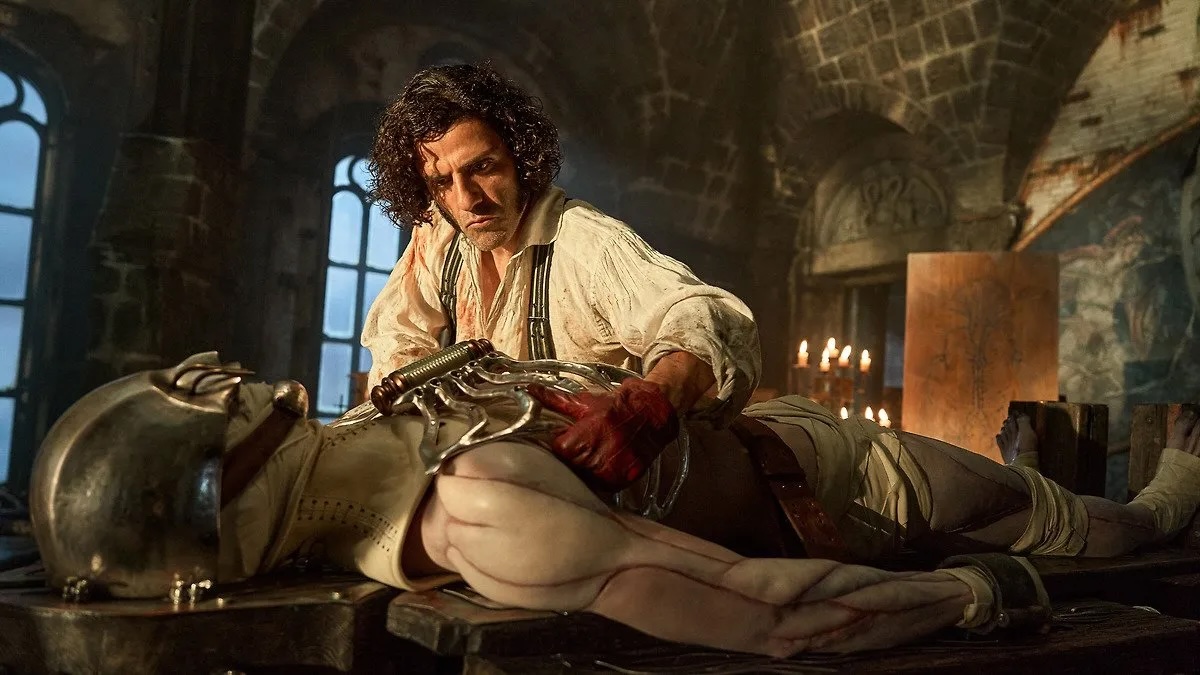
Guillermo del Toro was always going to make his version of Frankenstein one day – the seeds were sown in his 1992 Spanish-language film, Cronos, the first of his features that I ever saw in the cinema and the one that convinced me he had a big future ahead of him. 

Now he’s finally got around to doing the job properly, courtesy of Netflix, who stumped up the $120m budget. For a while it looked as though there wouldn’t be any chance of seeing it in an actual cinema before the transfer to streaming. This would have been a crime because del Toro’s adaptation of the tale looks absolutely sumptuous on the biggest screen at Filmhouse and I’m delighted to see that the auditorium is  pretty busy for a Saturday afternoon showing.

Frankenstein is, of course, one of the most filmed books in history, but it’s probably fair to say that only a handful of the 423 movie adaptations (not to mention the 287 TV episodes – yes, I did Google it) have come anywhere close to capturing the essence of Mary Shelley’s seminal horror story. While del Toro does throw in a few original twists of his own (of course he does!), he sticks fairly close to Shelley’s narrative – indeed, he’s even credited her as his co-screenwriter. The tale is told in three distinct parts.

In the opening Prelude, we join Captain Andersen (Lars Mikkelsen) and the crew of his sailing ship, who are stranded on the ice in remote Arctic waters. There’s a sudden explosion nearby, from which the crew rescue Victor Frankenstein (Oscar Isaac), who has been pushed almost to the point of death by a monstrous assailant. After witnessing The Creature (Jacob Elordi) plunging into icy waters, they carry Victor onto the ship – but, once revived, he assures Andersen that his pursuer will not actually be dead and will surely come for him…

Before that happens, he needs to tell his story.

Victor then narrates The Creator’s Tale and we flashback back to his childhood where, under the rule of his despotic father, Leopold (Charles Dance), Young Victor (Christian Convery) first becomes obsessed with life and death. Keen-sighted viewers may spot something familiar about Victor’s barely-glimpsed mother, Claire. Something distinctly Oedipal is happening here.

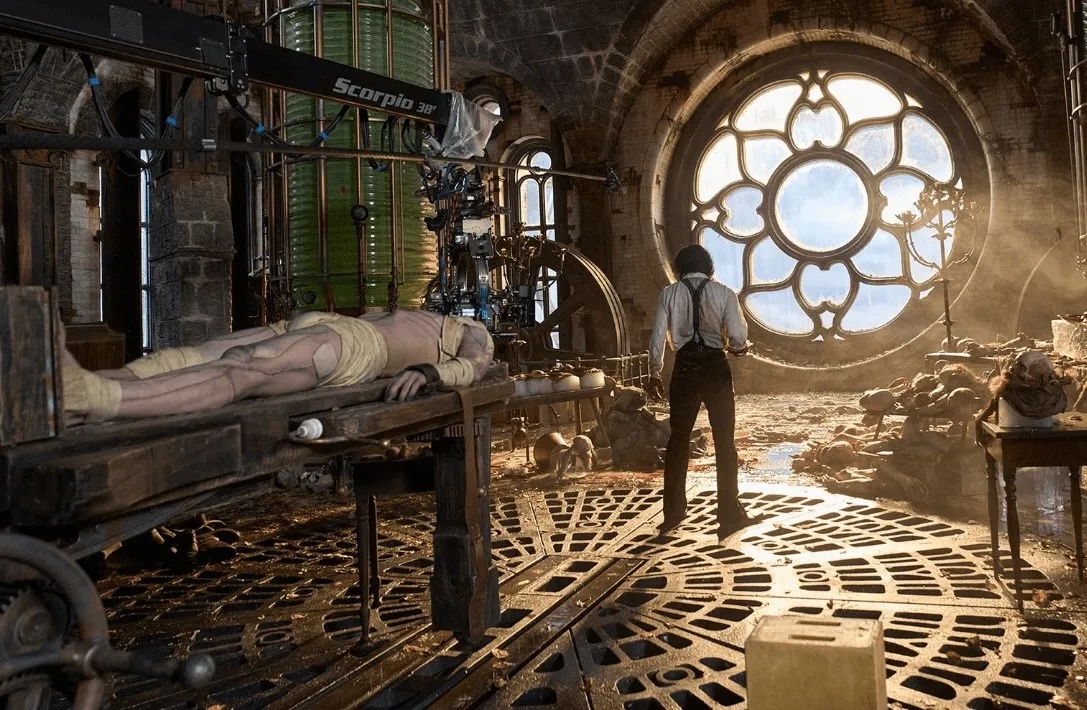
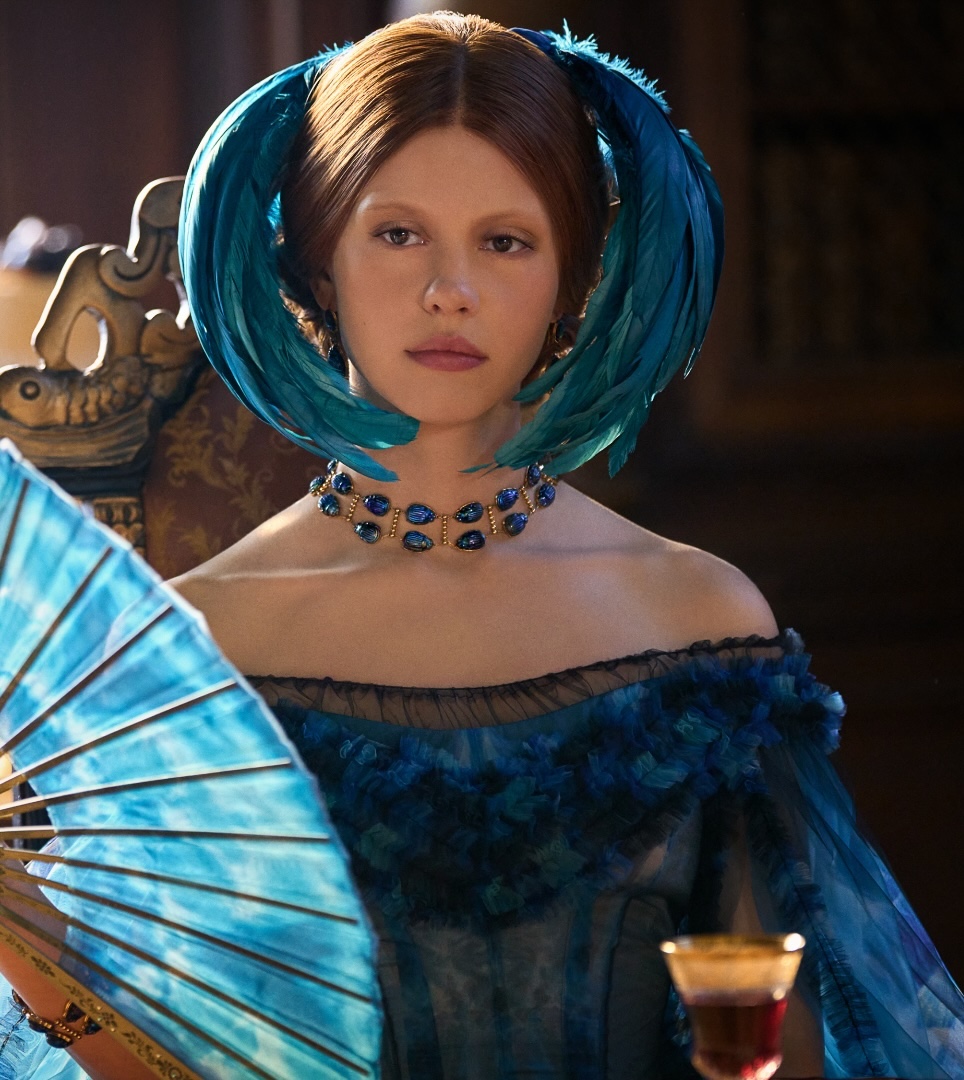
We then cut to some years later. A grown-up Victor is causing controversy at medical school in Edinburgh with the grisly experiments he’s conducting on cadavers (and I get to revisit some of the sets that were evident around my home city in September 2024). We are introduced to Victor’s younger brother, William (Felix Kammerer), and his fiancée, Elizabeth (Mia Goth). We also meet Harlander (Christophe Waltz), a character created for the film, a wealthy man who, for clandestine reasons, is perfectly happy to finance Victor’s attempts to take his experiments all the way.

But Victor’s account is later contrasted with The Creature’s Tale, where we learn of the years when the monster and his creator were apart: how The Creature lived in a barn alongside a kindly blind man (David Bradley); how he mastered the art of speaking (with a distinctly Yorkshire accent); and how he slowly began to realise how shabbily he’d been treated…

It’s not just because I’m a devout Guillermo del Toro fan that I think this film is a million times better than every other Frankenstein-generated movie I’ve watched down the decades. Isaac is a revelation in the title role, nailing both the character’s sense of privilege and his fatal short-sightedness. Elordi, meanwhile, offers a fresh take on the Creature that really brings out his innate vulnerability and his desperate need to relate to others, something that’s been attempted before with much less success. 

The film is packed with sumptuous locations and thrilling action set-pieces, that have it hurtling through its lengthy running time. Cinematographer Dan Lausten captures every scene with an almost luminous intensity, Kate Hawley’s costume designs are exquisite, and there’s a beautiful score courtesy of Alexander Desplat. If I have a minor niggle it’s that the CGI-generated wolves in one long sequence aren’t quite as convincing as they need to be – and perhaps both Mia Goth and Felix Kammerer might have been given a little more to do?

But these are nitpicks. As ever in these situations, I’m urging people not to wait for this to drop onto streaming, because this level of filmmaking deserves to be watched on the biggest, brightest screen available, one of – dare I say it? – monstrous proportions.

I’ll get my coat.

4.8 stars

Philip Caveney
Chicken Run: Dawn of the Nugget

24/12/23

Netflix

The trend for films being financed by (and galloping with indecent haste to) Netflix continues. Aardman Animations’ tardy sequel to Chicken Run is just the latest example of something that would have looked so much more impressive on a giant screen than it does on the average telly.

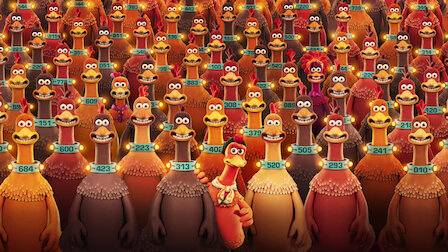
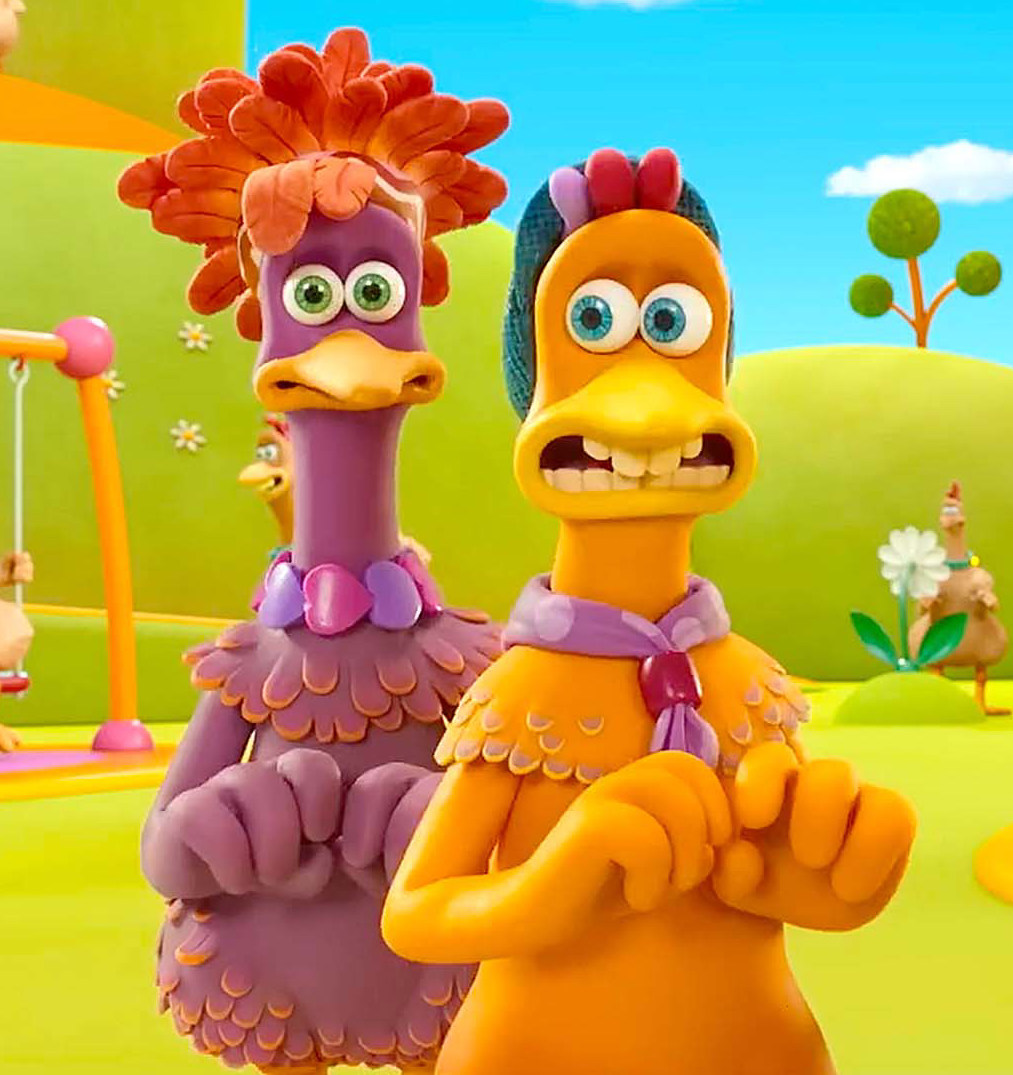
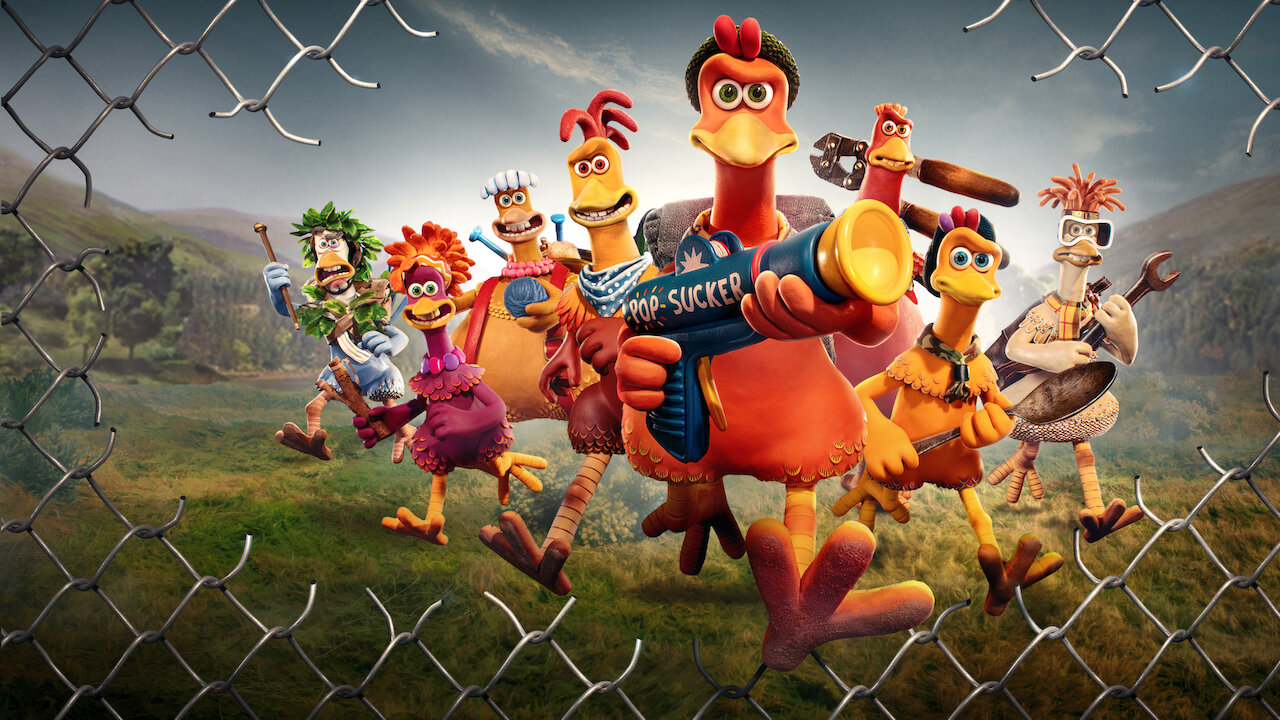
Dawn of the Nugget follows on from the first film with the escapee chickens living their best lives on a small island, where they grow their own food and work together as a team. Rocky (Zachery Levi, replacing Mel Gibson) and Ginger (Thandiwe Newton, replacing Julia Sawalha for less obvious reasons), are now the proud parents of an egg. This quickly hatches into Molly (Bella Ramsey), who has clearly inherited all her mother’s fearless qualities.

When workmen begin to clear some land on the other side of the water and new factory buildings are set up, Molly is eager to go across and investigate what’s going on, but Ginger urges her to be cautious. Of course she sets off on her own and, once on the far side, she bumps into Frizzle (Josie Sedgwick-Davies), a Scouse chicken who has heard great things about the new factory.

At first  it seems the twosome have discovered a place of refuge. But sinister happenings ensue before an old enemy reappears…

Dawn of the Nugget offers all the familiar tropes that the first film featured to such winning effect. No pun is left unspoken and several favourite characters make a welcome reappearance, including Jane Horrocks as the delightfully dim Babs and David Bradley as addled old rooster, Fowler.

The animation is beautifully handled and there are chases and spills aplenty, while the humour is innocuous enough to appeal to all age groups. But be warned, some viewers may find it hard to sit down to enjoy a chicken dinner after spending time in the company of this team of feathered lovelies. 

And if it seems a little late in the day to follow up that first film – twenty-three years to be precise – it matters not. This is great fun.

4 stars

Philip Caveney

Allelujah

17/03/23

Cineworld, Edinburgh

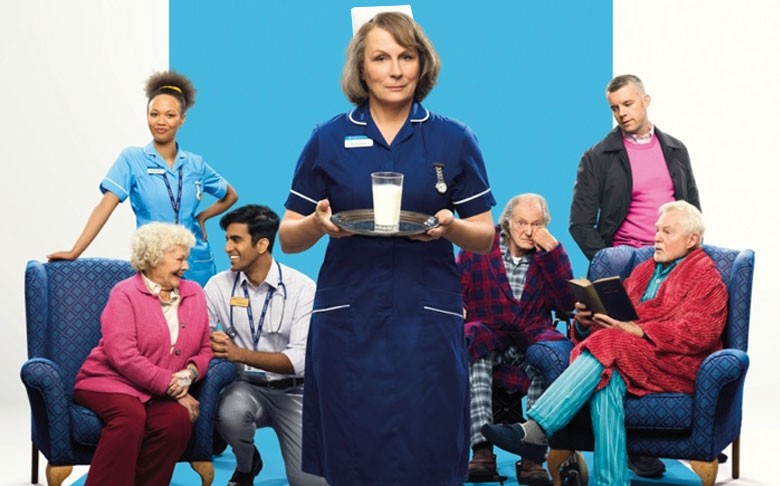
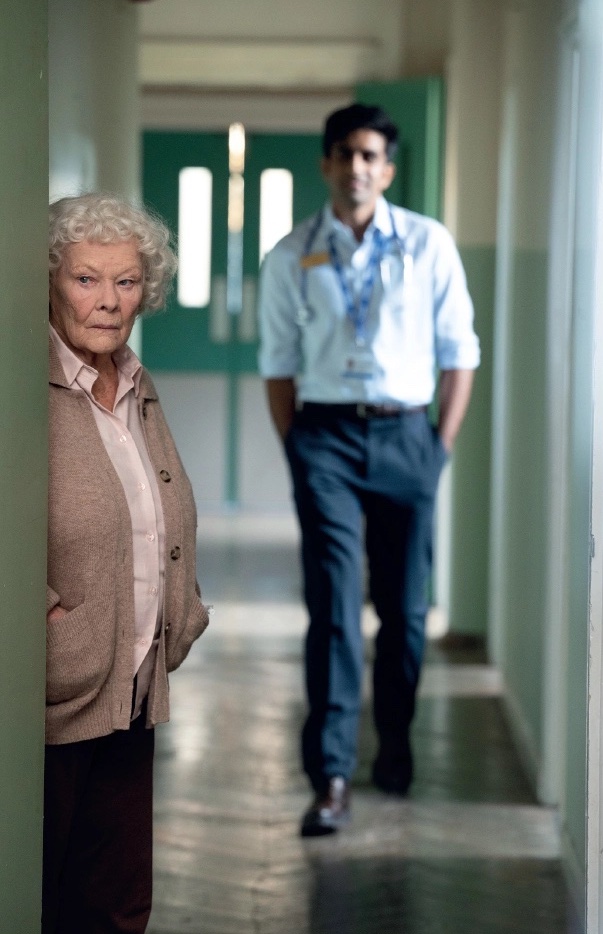
This film boasts a starry cast. Indeed, with comedy queen Jennifer Saunders in the lead role, alongside British acting legends such as Judi Dench, Julia McKenzie, Derek Jacobi and David Bradley – not to mention the brightly-hued, smiling posters – it promises to be a clever-but-gentle affair, something pleasant for a Sunday afternoon.

It’s not.

Adapted (and updated) by Heidi Thomas from Alan Bennett’s 2018 stage play, Allelujah is an ode to the NHS, as gnarly and wonderful, inspiring and infuriating as the institution itself. I feel like I’ve been lured in by the publicity, before being punched in the gut by a polemic – but I’m not complaining. This is the movie equivalent of a protest song; it’s timely and vital.

Sister Gilpin (Saunders) and Dr Valentine (Bally Gill) work at ‘the Beth’ – a small, crumbling, Yorkshire hospital, specialising in geriatric care. They’re fighting a losing battle against closure, despite the fundraising efforts of local volunteers, but they forge on anyway, doing their best for the elderly patients who need them, offering them compassion and dignity in the last stages of their lives.

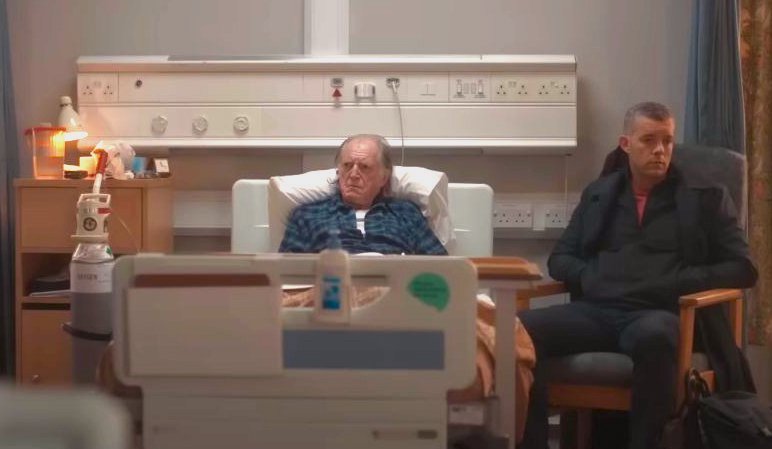
Joe (David Bradley) likes it in the Beth. He doesn’t want to go back to the Rowans, the care home where he’s miserable. But his son, Colin (Russell Tovey), is the film’s antagonist, the malevolent Tory hatchet man, who views the hospital dispassionately, from a purely numbers perspective. His relationship with his dad is thorny, but – as they soften towards one another – will he change his mind about the NHS?

Actually, it’s not as clear cut as that. Nothing here is. Under Richard Eyre’s directorship, Allelujah‘s narrative arc is awkward and jarring; it never leads where I anticipate. Instead, it keeps confounding my expectations, pulling me one way and then another, wrong-footing me. Some of the political grandstanding is a little clunky – there are speeches occasionally, in lieu of dialogue – but all of this adds up to something really impactful.

If Sister Gilpin is a microcosm of the Beth, embodying its best and worst, then the Beth is a microcosm of the NHS, encompassing its triumphs and its disasters, its shortcomings and its accomplishments. The final scenes, depicting the heroic work our doctors and nurses did during the pandemic, provide a stark reminder of why we have to fight to keep our health service. It might be troubled, but it’s glorious and it’s ours. “You dismantle it at your peril.”

As the credits roll, there’s a stunned silence in the cinema. Then someone begins to applaud. And we all join in.

5 stars

Susan Singfield

Guillermo del Toro’s Pinocchio

19/12/22

Netflix

Guillermo del Toro is one of my favourite film directors – and Disney’s Pinocchio one of the formative films of my childhood. So when I first hear the news that the Mexican director is planning to deliver his own version of Carlo Collodi’s classic tale, it’s naturally something I eagerly look forward to – for a very long time. Indeed, it turns out that del Toro has actually been working on this astonishing stop-frame animation for something like fifteen years.

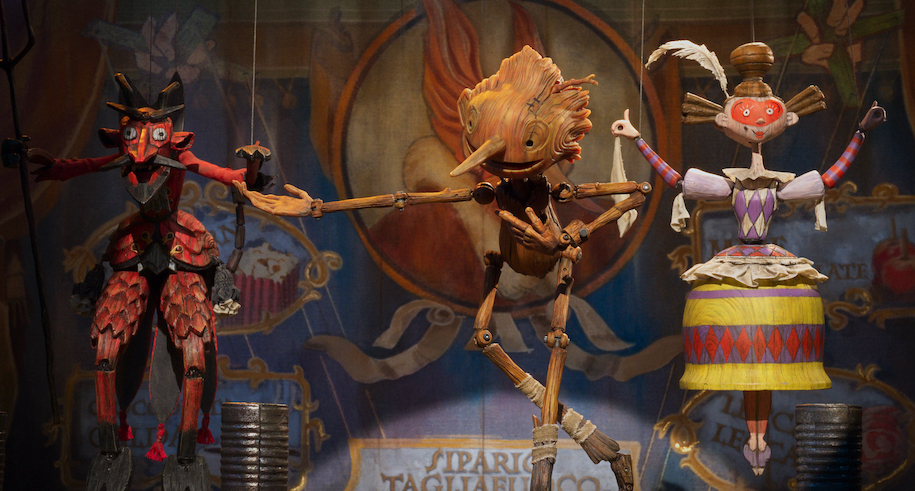
As the release date finally approaches, I look everywhere for a cinema in Edinburgh that’s planning to show del Toro’s film on the big screen, but alas, with the Filmhouse out of action, it cannot be found. So Netflix it must be. As it turns out, some visions are so powerful, so perfect, that they can blaze out of a small screen like meteors. Guillermo del Toro’s Pinocchio is an astonishing film, that has the audacity to take everything we know about the story and give it a thorough makeover. What’s more, the changes that he makes (he co-wrote the screenplay with Patrick McHale) all seem to enrich the original, making it more logical, more explicable.

Revelation number one: when we first encounter woodcarver, Geppetto (David Bradley), he has a real son, Carlo (voiced by Gregory Mann). But Carlo dies tragically when Italian air force planes unload their bombs onto the church, where Gepetto is working on a huge crucifixion. This backstory helps flesh Geppetto out and makes his subsequent actions more believable – especially when Pinocchio is forged from the very tree planted to mark Carlo’s grave.

Revelation number two: the Pinocchio that Geppetto eventually carves in a drunken rage looks nothing like a ‘real boy’. He’s a strange, spindly, half-finished marionette, generally shunned and mistrusted by the people in his home village. Contrary to the original tale, it’s the villagers who have to learn to accept Pinocchio, rather than the other way around.

Revelation number three: this version is set in Italy in the 1930s, under the rule of Benito Mussolini. Pinocchio’s adventures on the ‘Donkey Island’ are exchanged for scenes where he unwittingly becomes a poster boy for fascism. (It’s nakedly clear what del Toro is saying here. And it makes perfect sense, because to take on Disney’s most iconic scenes would be a pointless exercise. If you can’t better a scene, do something entirely different, right?)

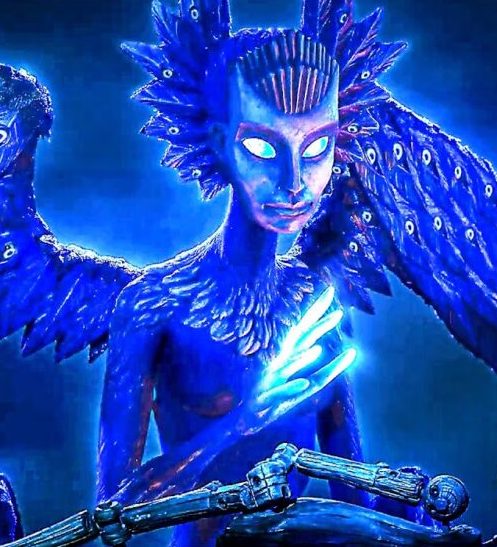
There’s more, much more, packed into the film’s two hour run. We meet Sebastian J Cricket (Ewan McGegor), an ambitious, self-aggrandising would-be author, who only agrees to take on the task of being Pinocchio’s ‘conscience’ in the hope off getting a book deal. There’s Count Volpe (Christoph Waltz), the greedy, venal owner of a travelling freak show, who spots an opportunity to make lots of money and who bullies his monkey assistant, Spazzatura (Cate Blanchett) at every opportunity. And wait till you see what the animators (and Tilda Swinton) have done with the infamous Blue Fairy, rechristened here as the Woodland Sprite. More than anything else, there are fundamental changes to the character of Pinocchio himself. He’s no longer the obnoxious, pig-headed lout of the novel, but a sweet, misguided misfit, desperately trying to be liked. A scene where he can’t understand why all the villagers hate him, but adore the other wooden figure nailed to a cross on the church wall is a stand-out.

It’s not just the levels of invention in the story that make this such a unmitigated triumph. It’s the loving attention to detail: every character, every set, every painted landscape; it all pulses and dazzles with imagination of the highest calibre. There’s so much to see here, it’s clearly going to need repeated viewings to really take it all in. And watching it makes me wish that dear old Ray Harryhausen was still alive to see where modern technology has brought the art of stop-motion animation.

Many films have the word ‘masterpiece’ attached to them, but few deserve it as thoroughly as this one. All you need to do it hit the Netflix button, so… no pressure.

5 stars

Philip Caveney

Your Christmas or Mine?

08/12/22

Amazon Prime

Christmas movies are so hard to get right, especially when it comes to pleasing a committed Scrooge like me. Much of what passes for festive fare turns out to be inane, tinsel-adorned tat, often built around some available musical output. 2019’s Last Christmas springs immediately to mind. Pitched as a tribute to the late George Michael, it is a big dollop of vacuous candy floss. So I approach this film with some trepidation, noting that it barely registered at cinemas across the UK on its recent release – but a combination of ill-health and freezing weather conditions prompt me to take a gamble on it. I’m glad I do.

Your Christmas or Mine? (terrible title) is written by comedian Tom Parry and directed by Jim O’ Hanlon. James (Asa Butterfield) and Hayley (Cora Kirk) are young drama students in the throes of a heady romance. We first meet them at a busy railway station, where they are preparing to head off to their respective family homes to spend Christmas on different sides of the North/South divide. But, at the last moment, James experiences a sudden overpowering longing to spend more time with Hayley. He jumps off his train, changes platforms and scrambles aboard her service, seconds before it leaves the station.

Unfortunately, Hayley has had the very same idea…

After a sudden snowfall, the twosome find themselves marooned in unfamiliar locations and obliged to spend Christmas with their partner’s families. Once I’ve accepted this unlikely event, things rapidly get more interesting, as James and Hayley realise that neither of them has been entirely truthful. Why does James’ dad, Humphrey (Alex Jennings) hate Christmas so much? Why is Hayley’s dad (Daniel Mays) so obsessed with turduckens? And… who the hell is Hubert?

Parry’s culture-clash comedy sparkles with delightful dialogue, manic misunderstandings and riveting revelations, while the two central characters’ escapades are pitched just on the right side of believability. There’s a poignant explanation for Humphrey’s Scrooge-like persona that unexpectedly gives my tear ducts a bit of a workout; the two leads are immensely likeable, and there are cameos by excellent character actors (Mark Heap, Harriet Walter and David Bradley, to name but three.) Best of all, there are a couple of surprises I genuinely don’t see coming.

Your Christmas or Mine? is a pleasant way to spend a couple of hours and, after witnessing some real festive stinkers in recent years, that’s something to be thankful for. If asked for a Christmas movie recommendation this year, I’m happy to go with this.

Or Die Hard. It’s a tough call.

4 stars

Philip Caveney

A Monster Calls

01/01/17

A Monster Calls is an intensely emotional movie, telling the tale of twelve-year-old Conor O’Malley (Lewis MacDougall), and his struggle to deal with the realisation that his mother (Felicity Jones) is dying of cancer. It’s made all the more poignant by the knowledge that Siobhan Dowd, who conceived the novel the film is based on, died of the same disease before she could write her book. What we have here, then, is fellow author Patrick Ness’s interpretation of Dowd’s idea – and it’s good to see he’s done her proud.

Lewis MacDougall’s performance is extraordinary. (I should perhaps note here that he’s a student at The Drama Studio in Edinburgh, where I now work; sadly I can’t claim any credit for his achievements, as he’s not in my class, I’ve never met him, and he’d filmed this before I even joined the team.) He’s a gifted young actor, perfect for the screen, with a touching vulnerability here that’s reminiscent of David Bradley’s Billy Casper in the 1969 classic, Kes. His anger, fear and frustration are all writ large, and Philip and I find ourselves crying at regular intervals.

The story is essentially a simple one, making use of the idea of ‘the monstrous other’ and exploring the concept of duality. Conor is conflicted: he loves his mother, but he can’t live with the uncertainty of not knowing when she’s going to die. And so he stumbles between quiet acquiescence and towering rage, the latter symbolised by the unleashing of the yew-tree monster – like Jekyll’s Hyde, Frankenstein’s monster, Bertha Rochester, or even Blue’s Savage in David Almond’s graphic novel. Like its literary predecessors, this monster allows Conor to release his repressed emotions. It is both his undoing and his salvation.

There’s a stellar cast at work here, with Sigourney Weaver and Toby Kebbell occupying the roles of Gran and Dad respectively, neither of whom are what Conor needs to fill the void left by his mum, although they both try hard, in their own ways. Felicity Jones’s portrayal of the dying Elizabeth is utterly heartbreaking; she’s a real chameleon, and it’s hard to think of her as the same actor I saw in Rogue One last week. And the monster’s stories are beautifully realised, with some delightful sequences featuring dazzling, stylised animation.

There are some flaws: the bullies’ dialogue, for example, is wholly unconvincing and depressingly generic, and the first fifteen minutes or so seem aimed at a much younger audience. But these are minor niggles in the face of such an affecting, tragic piece of work. It’s a lovely film, and well worth going to see.

4.2 stars

Susan Singfield