Ray Harryhausen

The Odyssey

18/07/26

Cineworld, Edinburgh

‘See it on the biggest screen possible.’

Advice we’ve often given and something we had every intention of following ourselves in the case of Sir Christopher Nolan’s latest release. But, for the first time ever, finding an empty seat in an IMAX screening in Edinburgh proves impossible – unless we’re prepared to sit in the very front row. (Done that once, never again.) This development is simultaneously annoying and wonderfully heartening. Perhaps that much-rumoured resurgence in cinema attendance, fuelled by the likes of Obsession and Backrooms, is actually gathering momentum. Or is it just Nolan’s astute handling of the movie’s advertising, coupled with the Oscar success of Oppenheimer that has led to this stampede for tickets?

Whatever the reason, we decide to book in for a standard screening. We’ll revisit in IMAX sometime in the near future. Providing it’s any good, of course. Despite widespread critical acclaim, the online vitriol poured on the film by people who haven’t actually seen it yet means that this one has much to prove. And happily, it passes every test with flying colours.

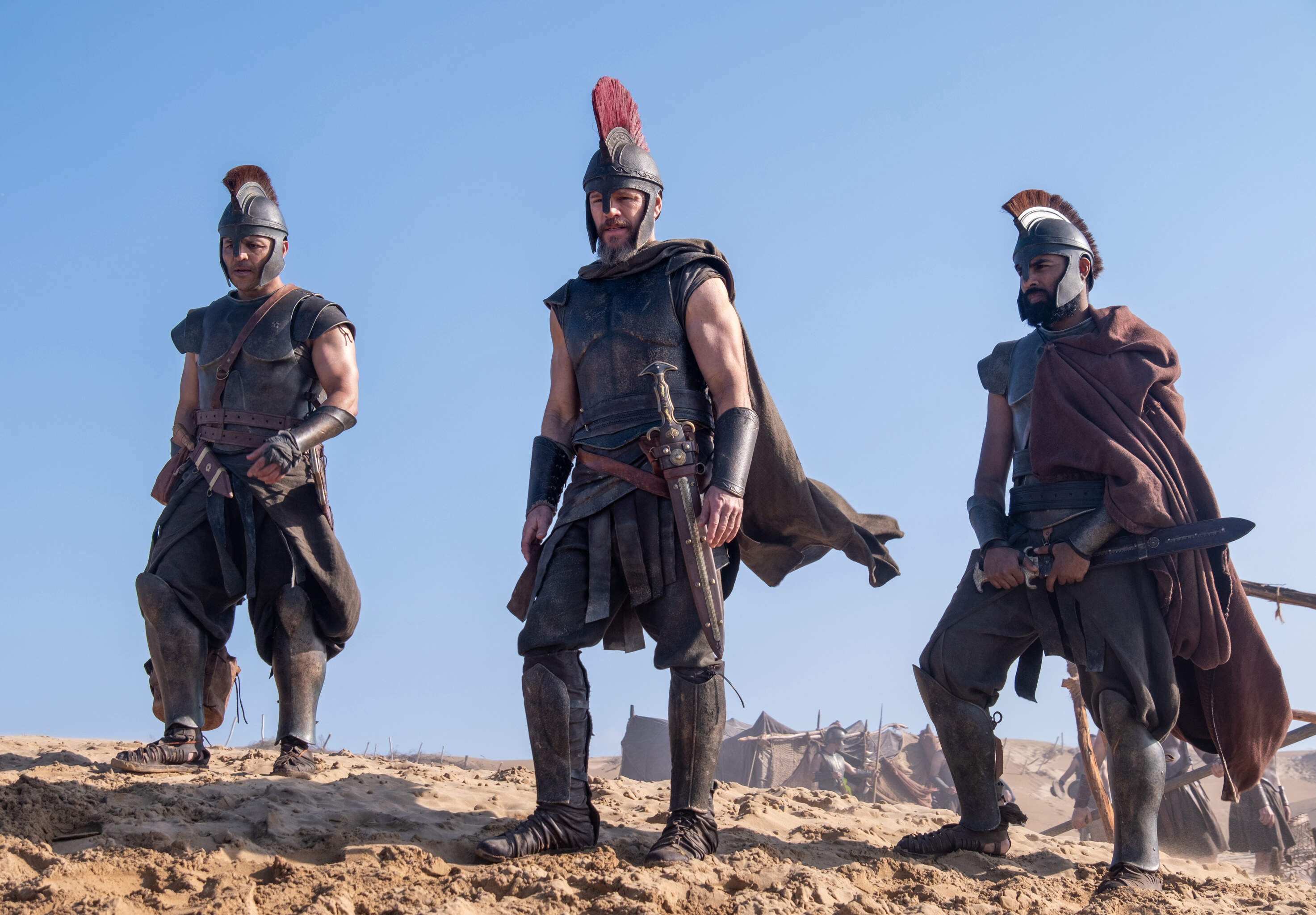
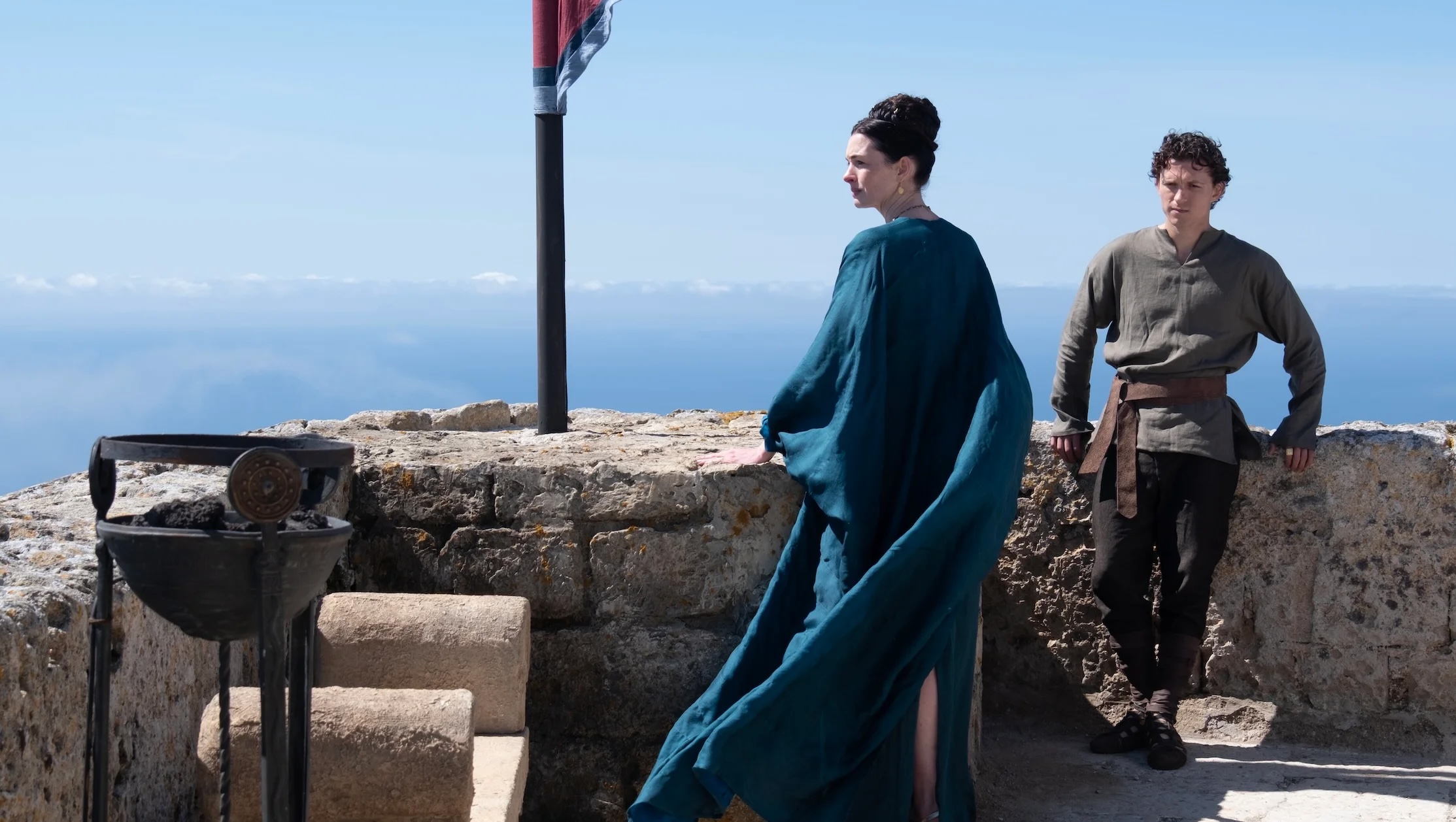
We all know The Odyssey, of course. Homer’s epic poem is still the bane of many young students’ lives as they are obliged to read their way through its meandering stanzas, which focus on the twenty year ordeal of its central character, Odysseus (played here rather wonderfully by Matt Damon). Our hero, forced for the first decade to play a key role in the siege of Troy, then has to spend the next ten trying to find his way back to Ithaca, where his faithful wife, Penelope (Anne Hathaway), and his loyal son, Telemachus (Tom Holland), still await his return.

But to get to them, Odysseus and his crew must take on all manner of obstacles: the giant cyclops, Polythemus (Bill Irwin); the powerful witch, Circe (Samantha Morton); the Lotus-dispensing Calypso (Charlize Theron); and, most egregious of all, the Ocean – which, because Odysseus has annoyed Poseidon, is determined to send them all to a watery grave.

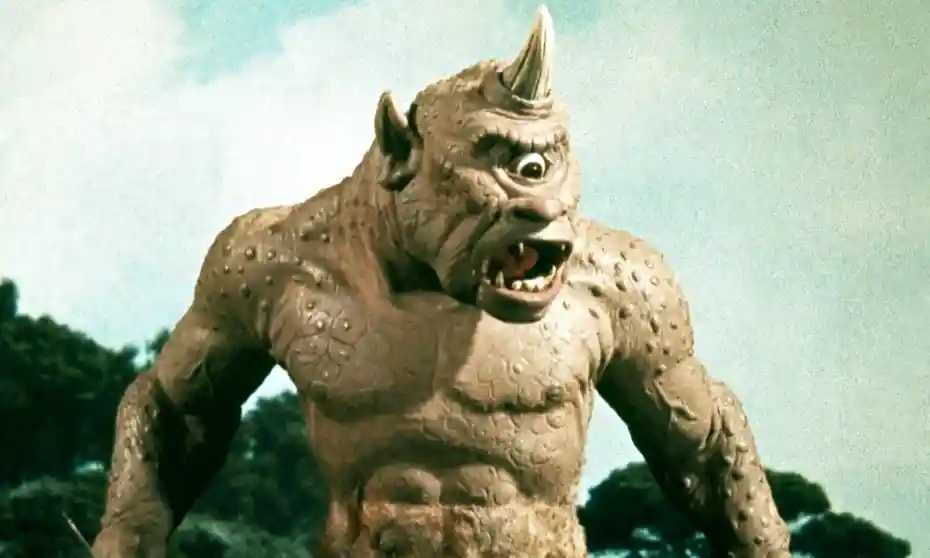
With a running time just short of three hours, this could be a ponderous affair but Nolan (who also adapted the screenplay from the original poem) employs an ingenious non-sequential approach, cutting effortlessly back and forth across the passing years to ensure that no particular sequence overstays its welcome. What’s more, even though most of the situations are familiar from earlier versions of the story (the 1954 Ulysses starring Kirk Douglas springs to mind, as do several of the films featuring the work of stop-motion genius Ray Harryhausen), Nolan always manages to put a different spin on proceedings.

Of course, a tale as packed as this one is sure to have its more memorable sections. The scene where Odysseus and his men are locked in a cave with the aforementioned Polythemus is a particular standout, as is Circe’s transformation of Odysseus’s crew into swine. She uses a hands-on approach like a potter moulding clay, the sequence employing old-school practical effects that recall the work of the legendary Rick Baker.

And if you’re a fan of an enormous climactic dust-up, well, I don’t think you’ll be left feeling short-changed.

The cast is stellar with many big names popping up in minor roles. Robert Pattinson proves once again that he is a terrific actor as the oily, scheming Antinous and all hail to John Leguizamo as the ever-faithful Eumaeous. Much has been made of the casting of Elliot Page as Sinon and Lupita Nyong’o as Helen of Troy, with incensed commentators complaining about ‘authenticity’ as though this is a historical piece rather than a slice of weird fantasy, but both actors give strong performances that more than justify their casting. Oh, and by the way, those American accents serve as a commentary on the current world order, which – when you think about it – makes a lot of sense.

Perhaps the most original addition here is the clarification of just how much two decades of havoc have taken their toll on the central character. In the film’s final section, as Odysseus recalls the cruelty and bloodshed visited upon the people of Troy, this feels increasingly like the recollections of a man suffering from PTSD, finally emerging from a lotus-induced fog and forced to confront the pain his decisions have inflicted on those who followed him.

Make no mistake, this is a superb film: assured, inventive and directed by a man at the very top of his game. I haven’t always loved Nolan’s films but this may just be his masterpiece. Buckle in and get those IMAX seats booked… if you can find them.

5 stars

Philip Caveney

Guillermo del Toro’s Pinocchio

19/12/22

Netflix

Guillermo del Toro is one of my favourite film directors – and Disney’s Pinocchio one of the formative films of my childhood. So when I first hear the news that the Mexican director is planning to deliver his own version of Carlo Collodi’s classic tale, it’s naturally something I eagerly look forward to – for a very long time. Indeed, it turns out that del Toro has actually been working on this astonishing stop-frame animation for something like fifteen years.

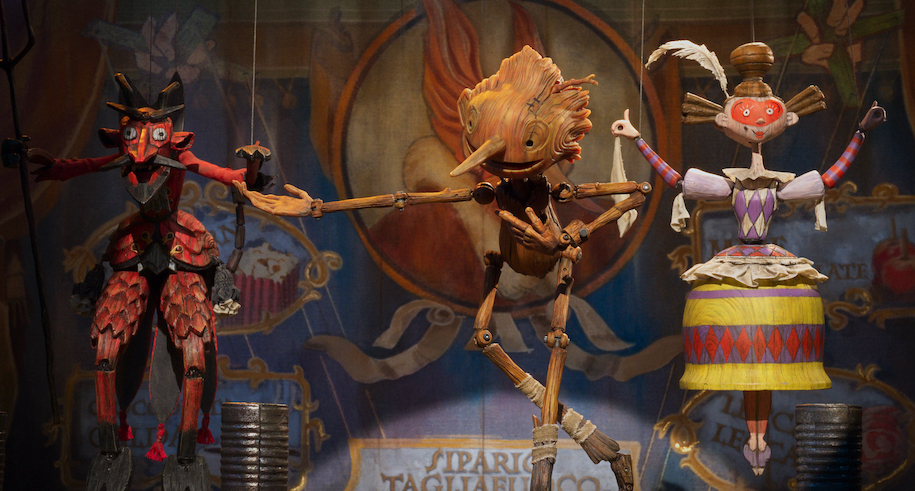
As the release date finally approaches, I look everywhere for a cinema in Edinburgh that’s planning to show del Toro’s film on the big screen, but alas, with the Filmhouse out of action, it cannot be found. So Netflix it must be. As it turns out, some visions are so powerful, so perfect, that they can blaze out of a small screen like meteors. Guillermo del Toro’s Pinocchio is an astonishing film, that has the audacity to take everything we know about the story and give it a thorough makeover. What’s more, the changes that he makes (he co-wrote the screenplay with Patrick McHale) all seem to enrich the original, making it more logical, more explicable.

Revelation number one: when we first encounter woodcarver, Geppetto (David Bradley), he has a real son, Carlo (voiced by Gregory Mann). But Carlo dies tragically when Italian air force planes unload their bombs onto the church, where Gepetto is working on a huge crucifixion. This backstory helps flesh Geppetto out and makes his subsequent actions more believable – especially when Pinocchio is forged from the very tree planted to mark Carlo’s grave.

Revelation number two: the Pinocchio that Geppetto eventually carves in a drunken rage looks nothing like a ‘real boy’. He’s a strange, spindly, half-finished marionette, generally shunned and mistrusted by the people in his home village. Contrary to the original tale, it’s the villagers who have to learn to accept Pinocchio, rather than the other way around.

Revelation number three: this version is set in Italy in the 1930s, under the rule of Benito Mussolini. Pinocchio’s adventures on the ‘Donkey Island’ are exchanged for scenes where he unwittingly becomes a poster boy for fascism. (It’s nakedly clear what del Toro is saying here. And it makes perfect sense, because to take on Disney’s most iconic scenes would be a pointless exercise. If you can’t better a scene, do something entirely different, right?)

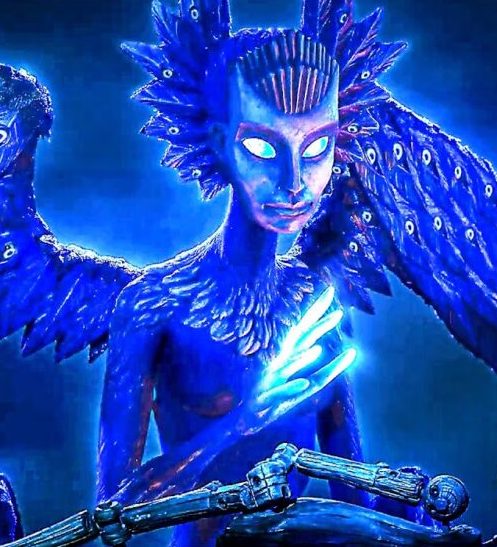
There’s more, much more, packed into the film’s two hour run. We meet Sebastian J Cricket (Ewan McGegor), an ambitious, self-aggrandising would-be author, who only agrees to take on the task of being Pinocchio’s ‘conscience’ in the hope off getting a book deal. There’s Count Volpe (Christoph Waltz), the greedy, venal owner of a travelling freak show, who spots an opportunity to make lots of money and who bullies his monkey assistant, Spazzatura (Cate Blanchett) at every opportunity. And wait till you see what the animators (and Tilda Swinton) have done with the infamous Blue Fairy, rechristened here as the Woodland Sprite. More than anything else, there are fundamental changes to the character of Pinocchio himself. He’s no longer the obnoxious, pig-headed lout of the novel, but a sweet, misguided misfit, desperately trying to be liked. A scene where he can’t understand why all the villagers hate him, but adore the other wooden figure nailed to a cross on the church wall is a stand-out.

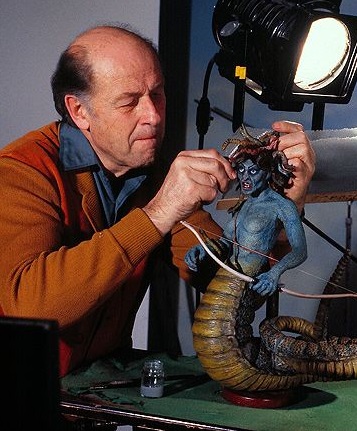
It’s not just the levels of invention in the story that make this such a unmitigated triumph. It’s the loving attention to detail: every character, every set, every painted landscape; it all pulses and dazzles with imagination of the highest calibre. There’s so much to see here, it’s clearly going to need repeated viewings to really take it all in. And watching it makes me wish that dear old Ray Harryhausen was still alive to see where modern technology has brought the art of stop-motion animation.

Many films have the word ‘masterpiece’ attached to them, but few deserve it as thoroughly as this one. All you need to do it hit the Netflix button, so… no pressure.

5 stars

Philip Caveney

Ray Harryhausen: Titan of Cinema

28/04/21

Scottish National Gallery of Modern Art

Picture this.

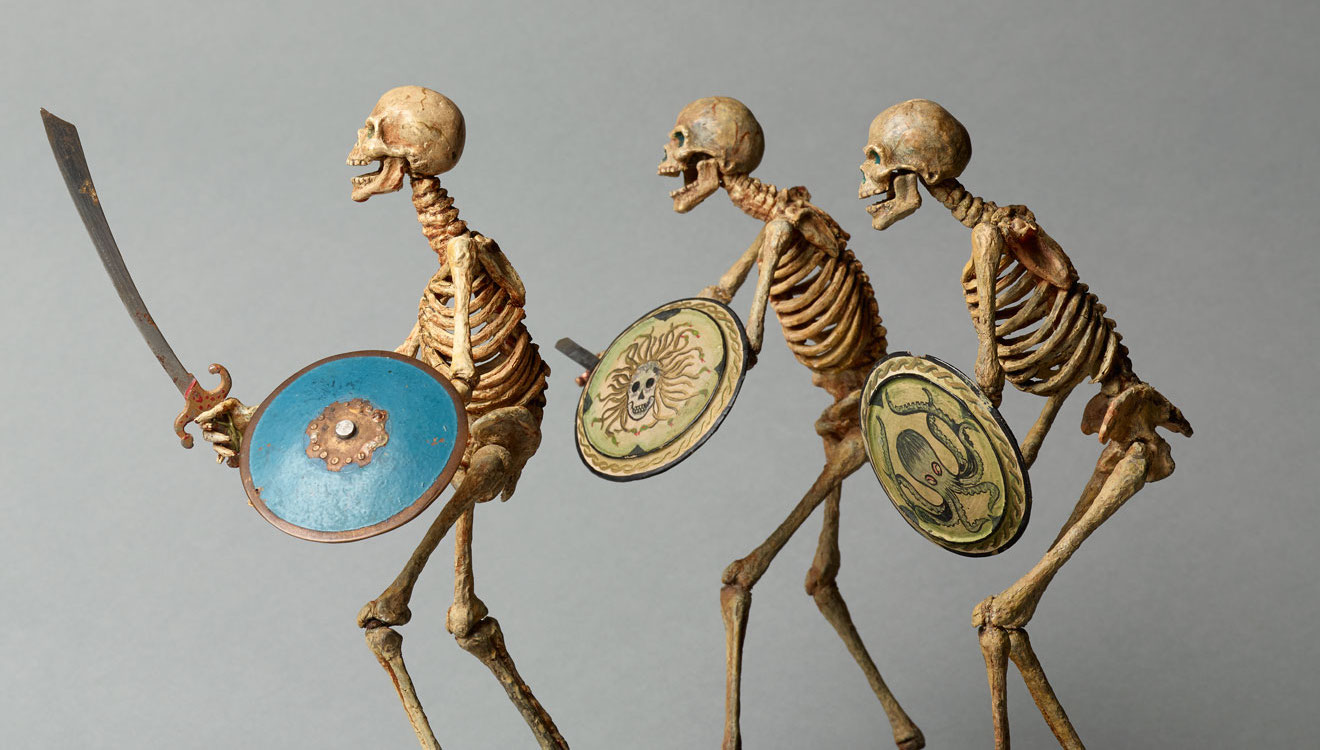
I am twelve years old and I am somewhere in darkest Lincolnshire, sitting in the front row of a cinema, gazing open-mouthed up at the big screen. It’s 1963 and the film I’m watching is Jason and the Argonauts, which I have been lured to after watching a very enticing trailer on television. As I sit there, entranced, Jason and his armoured pals are doing violent battle with a bunch of creepy-looking skeletons, brandishing swords and shields.

And the thought that’s uppermost in my mind is, How have they done this?

Thus far, my experience of movie monsters is mostly actors lurching about in shonky rubber suits… or some latex tentacles held up with lengths of (clearly visible) fishing line. But this is different. This is stop-frame animation. And yes, of course I’ve seen King Kong on the telly, and it’s been kind of explained to me how it all works, but that’s an old black and white effort while this is in technicolour and… it’s something entirely new in my experience, something so thrilling that it sets my burgeoning imagination on fire. This, it turns out, is the work of Ray Harryhausen. He is going to be an influence on my own writing in years to come, but I don’t know that yet.

Over the years, I watch all of his films – and somehow they always belong to him, rather than to whoever happens to be the director. I catch up with his earlier efforts on TV, or on video when that becomes a thing, and I watch each successive new release on the big screen, right up to Ray’s swan song, Clash of the Titans, in 2010. It’s very rare for a special effects man to have his name on the movie poster, but for Ray Harryhausen, they always made an exception. I think it’s fair to say that I am a major fan of his work.

So you can imagine how excited I am when I learn about a forthcoming exhibition. I have it marked in my calendar a full year ahead of time. And then… well, you know what happens next. Covid. Lockdown. End of.

So, here I am, much later than anticipated and finally… FINALLY, it’s deemed safe for me to visit The Scottish National Gallery of Modern Art. As I step through the doorway, I’m thinking: this had better be good.

It is good. In fact, it’s VERY good, a comprehensive exhibition that follows Ray’s story chronologically from room to room, covering his early days as assistant to King Kong animator Willis O’Brien, his ‘Puppetoon‘ series for George Pal, his friendship with Ray Bradbury (coincidentally, my writing hero), and then into the glory days of his partnership with producer Charles Schneer – Jason and the Argonauts, the Sinbad films, One Million Years BC...

And I am in a sort of heaven, transported back to my childhood days as I move from exhibit to exhibit in a state of something suspiciously akin to wide-eyed wonder. Oh look! There’s the actual Mighty Joe Young! And there’s the Kraken! And those pesky skeletons, looking exactly as they did back in 1963, swords raised, ready for action.

But there’s much more than just miniature figurines. There’s a really useful set up that shows exactly how the stop-motion system works, arranged in transparent layers that pop up one by one. There’s a sequence showing just how patient and exacting Ray’s working process must have been as he manipulates a figure through a series of poses. There are rarely seen early attempts at animation, put together in his garage, and there are the meticulously rendered storyboards that would put most contemporary efforts to shame, all of them showing the influence of Ray’s main inspiration, Gustave Doré. And right at the end, there’s a green screen set up where you can stand on a cross and be transported into an exotic location, where you will be menaced by some of those iconic monsters from Ray’s fertile imagination.

When you’ve waited a long time for something to happen, the result can often feel anti-climactic. Not so here. The Scottish National Gallery of Modern Art have this gem on show until the end of August, so you’ve plenty of time to book your places. Everything feels very safe, with masks and social distancing scrupulously observed. Go along and marvel at one man’s incredible accomplishments.

5 Stars

Philip Caveney

Early Man

27/01/18

If the film industry ever handed out awards for sheer determination, Nick Park and his animation team would surely be first in line to pick up a gong. Give these people an unlimited supply of plasticine and several years in which to manipulate it and they’ll invariably come up with something eminently watchable. That said, it’s many years since the likes of The Wrong Trousers first brought Park to widespread attention and there’s something dispiritingly familiar about Early Man. Furthermore, set it alongside the jaw dropping spectacle of Coco and you begin to sense the limitations of the medium. Plasticine, when all is said and done, can only stretch so far…

Early Man opens in Manchester in the ‘pre pleistocene’ era as cavemen slug it out alongside a couple of warring dinosaurs. (This, of course, is an affectionate tribute to the work of pioneer animator Ray Harryhausen – apparently One Million Years BC was the film that first inspired a young Nick Park to experiment with a movie camera.) A sudden meteor strike eliminates the remaining dinosaurs and inadvertently inspires the surviving cavemen to invent the game of football.

Many eons later, we are introduced to a tribe of Stone Age warriors living in the fertile valley created by the meteor strike. Led by the cautious Bobnar (Timothy Spall), the tribe spends much of its time hunting rabbits, but plucky, snaggle-toothed youngster Dug (Eddie Redmayne) has loftier ambitions. Why not hunt mammoths, he reasons? There’s a lot more meat on them. Bobnar, however, is reluctant to accept any form of change.

But change soon arrives anyway, in the shape of a tribe of bronze age conquerors, led by Lord Nooth (Tom Hiddleston sporting an ‘Allo ‘Allo-style French accent). He wishes to mine the valley for it’s rich bronze deposits and Bobnar’s tribe soon find themselves banished to the volcanic badlands – but not before Dug has been kidnapped and taken to Lord Nooth’s stronghold. Here, he discovers that this technologically advanced civilisation is addicted to two things – capitalism and football, a game that Dug’s tribe have somehow managed to forget over the years. In a desperate bid to save his homeland, Dug challenges Nooth’s resident team – Real Bronzio – to a football match. If Dug’s tribe wins they get to stay in their beloved valley. If they lose, they will be condemned to work in the bronze mines until they die… so, no pressure there.

Okay, it’s a promising concept and Park manages to exploit it skilfully enough, finding much humour in the telling, even if some of the jokes are so old they might have originated in the Stone Age themselves. The tribe’s smaller roles are filled by a stellar cast of voice artists and Park supplies all the requisite grunts for Dug’s porcine sidekick, Hognob. If, like me, you don’t care a jot for soccer, don’t despair, it’s not going to spoil your enjoyment of this quirky and typically charming story one little bit. But you may find yourself wondering, as I did, where Park goes from here. A pre-film trailer announcing that Shaun the Sheep is a mere year away doesn’t exactly fill me with anticipation… and we’ve been hearing for a long time that a new Wallace and Gromit is still in the pipeline, despite the death of Peter Sallis.

But wouldn’t it be great to see Nick Park try something completely different? Something totally unexpected? Meanwhile, Early Man offers an enjoyable couple of hours at the cinema, even if there are no real surprises on offer.

4 stars

Philip Caveney

Miss Peregrine’s Home for Peculiar Children

thumbnail_24150

01/10/16

Based on the popular novel by Ransom Riggs, Miss Peregrine’s Home For Peculiar Children is a Tim Burton film, that doesn’t feature his usual cohort of friends/family and is largely set in North Wales. Jake (Asa Butterfield) is unusually close to his secretive Grandfather, Abe (a scenery-chewing Terence Stamp) who often regales him with stories about a children’s home he spent time in during the Second World War.

When Abe is (rather horrifically) murdered by an odd looking monster (one that appears to have stepped out of a Guillermo Del Toro film), Jake accompanies his hapless father, Franklin (Chris O Dowd) to the remote Welsh island where the home was located and which is now no more than a burned out ruin. Jake has a vague notion of finding some answers about his Grandpa’s death, but almost before you can say ‘time travel’ Jake has somehow found his way back to the 1940s, where the home functions in a weird time-loop, presided over by the titular Miss Peregrine (a remarkable turn from Eva Green) who amongst her many talents has the ability to transform herself into a bird of prey. The children at the home all have odd powers of their own which range from invisibility to internal bee-keeping and the possession of a second mouth at the back of the neck. (Always handy). But the home is under threat from the evil creatures that control the monsters. They are led by Barron (Samuel L Jackson) a vile looking shape-shifter with a predilection for eating human eyeballs…

Like most Burton movies, this is often very nice to look at (he started off as an illustrator and that always shows) but there’s something curiously unengaging about the film, which is packed full of over-complicated incident, yet rarely manages to exert any kind of grip on the attention. It seems to go on for an inordinately long time, before it finally reaches a climax in an exotic location (Blackpool) where screenwriter Jane Goldman has to find something useful for every one of those peculiar kids to do. Despite all the monsters rampaging across the screen, there’s no real sense of threat here and it isn’t very enlightened to have the one black actor in the film cast as a child-murdering villain.

There are admittedly a few nice moments dotted about (a spirited tribute to the ‘fighting skeletons’ sequence from Ray Harryhausen’s Jason and the Argonauts being one of them) but ultimately this isn’t Burton’s finest moment. For a film that’s so packed with fantasy elements, MPHFPC is long on exposition and woefully short of magic.

2.9 stars

Philip Caveney