Benny Young

Macbeth

05/02/25

Cineworld, Edinburgh

Macbeth is a ubiquitous play. Searching back through the B&B archive, I’m not entirely surprised to find that this is the ninth time we’ve reviewed a version of Shakespeare’s celebrated tragedy and I note too that there are three other related items that reference that infamous surname in the title. It’s easy to understand why it’s such a perennial. One of the bard’s most propulsive stories, it’s a lean, mean tale of aspiration and the overriding lust for power, which – in these troubled times – seems all too relevant. This Olivier-award winning adaptation, filmed live at London’s Donmar Warehouse, features David Tennant in the title role with Cush Jumbo as the manipulative Lady M. The screening we attend is sold out.

It’s a stripped-back production, freed from any issues with costuming or elaborate set design. The actors wear simple, monochrome outfits and the performance space is a stark white rectangular dais. It’s set in front of a transparent screened box, behind which other members of the cast occasionally gather, like a chorus of half-glimpsed ghosts, to comment on the action. Prominent among them is a young boy, who at one point hammers his fist repeatedly against the screen and also reappears in the midst of the final battle. His presence serves to remind me that the Macbeths have earlier lost a child – and that perhaps it is this loss that’s the driving force behind their callous bid to seize the throne and betray their former friends.

Tennant is extraordinary, speaking those familiar lines (often direct to camera, as though sharing confidential material) with such utter authority that I almost feel I’m hearing them for the first time. Jumbo is also compelling. She’s the only one here without a Scottish accent, which seems to emphasise her solitude and her distance from the other characters. Cal McCaninch is a stately Banquo, Nouff Ousellam smoulders powerfully as Macduff and it’s a delight to hear Benny Young’s cultured drawl delivering Duncan’s self-satisfied lines as he arrives at the castle where he is destined to die.

Ros Watt is a delightfully punky Malcolm and Jatinga Singh Randawa offers a rambunctious turn as the Porter. In the only scene that takes a wild swing away from what’s actually written on the page, the latter chats to members of the audience and displays all the symptoms of a man suffering from a raging hangover. It’s a gamble but it pays off. And the witches? In what might be the production’s bravest move, they are barely glimpsed in the first act, only heard in giggling off-stage asides as they arrive and depart with a flap of supernatural wings.

Gareth Fry’s sound design adds extra layers of suspense to the production (I note that the audience at the live performance all wear headphones for a truly immersive experience), while Alistair McCrae’s music offers jaunty reels, Celtic airs and, at one point, a spirited highland fling as a brief respite from that all-pervading air of menace. Director Max Webster brings all these disparate elements together to create a powerful and absorbing drama that dares to experiment with the source material. And, at the conclusion, designer Roanna Vize really does – magically – bring Birnam Wood to Dunsinane. 

The final confrontation doesn’t leave me wanting and the face-off between Macbeth and Macduff is unlike any version I’ve seen before. Of course, the only valid reason for doing this immortal story one more time is to offer audiences something new – an aim that this extraordinary production has clearly taken to its dark heart.

5 stars

Philip Caveney

Group Portrait in a Summer Landscape

05/10/23

Lyceum Theatre, Edinburgh

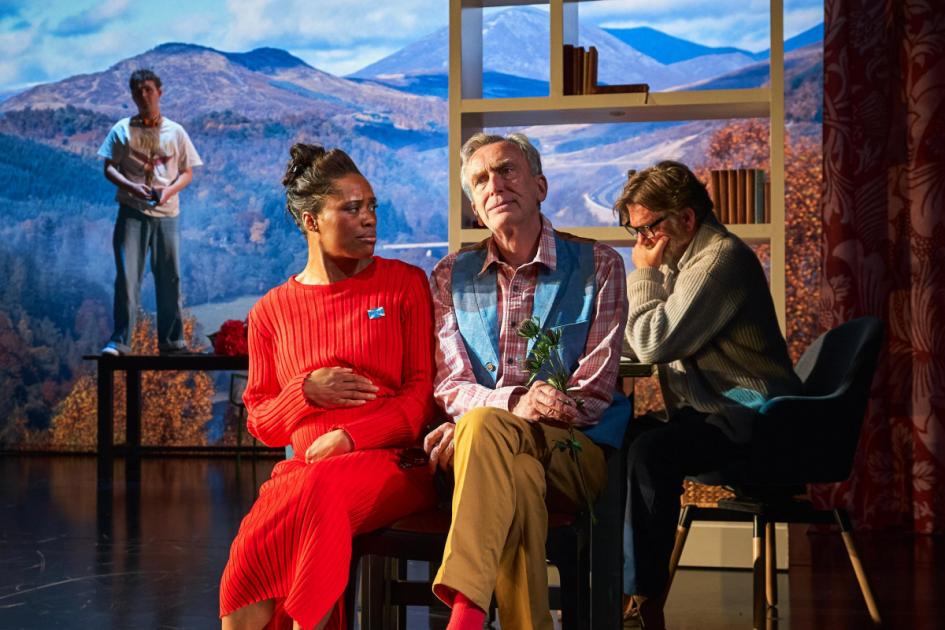
Patriarch Rennie (John Michie) has invited a disparate group of people to his retirement party. He’s had to keep the guest list secret from his wife, Edie (Deirdre Davis), because – with the exception of her old pal, film star Jimmy Moon (Benny Young) – there’s no way she’d agree to hosting the people he has in mind. En route to the couple’s country house in the Scottish Highlands is their daughter Emma’s ex-husband, for example – even though their wedding ended acrimoniously and Charlie (Matthew Trevannion) is renowned for wreaking havoc wherever he goes. Of course, he maximises the antagonism by bringing along his latest girlfriend, Jitka (Nalini Chetty), and why wouldn’t Rennie ask the newly-betrothed Frank (Keith Macpherson) and Kath (Patricia Panther) to join the party? It’s not as if Frank’s always been in love with Emma (Sally Reid) or anything, is it? Oops. There’s an uninvited presence too: the ghost of Rennie and Edie’s son, Will (Robbie Scott), who watches over the day’s proceedings with increasing horror…

Playwright Peter Arnott says he set out to to write a ‘Scottish Chekhov’ and to some extent he has succeeded. At first it seems as though, unlike Chekhov, Arnott is looking back at the political moment that nominally serves as the play’s pivot; he has the advantage of hindsight to create dramatic irony. After all, we know the outcome of the 2014 Scottish independence referendum, the divisive topic inflaming the characters. But we soon learn that this is just a distraction: as Charlie says, it’s mere tinkering around the edges while ignoring the real revolution that is on its way, and which only the rich and ruthless will be able to survive.

If Arnott’s script is retro, then David Greig’s direction is decidedly contemporary, a deliberate jarring of styles that helps to illuminate the sense that something is changing, mirroring the mismatch between parochial politics and apocalyptic predictions, Chekhovian naturalism and magical realism. I like the dissonance.

Jessica Worrall’s set also leans into the contrast, a hyper-realistic backdrop juxtaposed with a more figurative interior: a glorious photograph of a Highland glen and a sketched-in kitchen-diner, symbolised by oversized shelving units, enormous tables and vast floral curtains.

Both Simon Wilkinson’s lighting and Pippa Murphy’s sound are integral to the production: the former spotlighting the snippets of conversation that combine to drive the plot, the latter signalling the shifts to the ghost’s point of view, as the sound distorts and fragmented memories play through Will’s Walkman. This supernatural presence is one of my favourite things about the play: Scott physicalises the spirit’s pain and confusion with a beautiful awkwardness.

The first act is very strong, an interesting set-up that promises something the second doesn’t quite deliver. Although the characters are all cleverly depicted, the piece feels somehow unfinished, as if the story arc has been cut short. Rennie’s revelation, when it comes, is anticlimactic, and I don’t quite buy it as a reason for inviting these particular people to his home (why would anyone ever invite Charlie anywhere?). But, even if it’s a little opaque and doesn’t offer any real answers to the issues it grapples with, Group Portrait in a Summer Landscape is an intelligent and ambitious play, leaving us with a lot to think – and talk – about.

3.8 stars

Susan Singfield

The Play of Light upon the Earth: A Reading

05/09/19

Traverse Theatre, Edinburgh

The Play of Light upon the Earth by Sally Hobson is an unusual piece of writing: a play structured into twenty-seven chapters, representing the psychological fragmentation that follows trauma. For the protagonist, Innocence (Jessica Hardwick), Bloody Friday is the trigger. The shock of this childhood experience, long-repressed, explodes into her adult life, forcing her to confront its impact.

It feels like a genuine privilege to be here at this stage of the creative process: the play is still being developed, still seeking its perfect form. In this rehearsed reading, directed by Muriel Romanes, we get a sense of what it could become. Because there is little movement (the actors are seated behind a trestle table), the focus is inevitably on the language, which is dense and lyrical, packed with literary references, Joycean in its verbal inventiveness.

Maureen Beattie’s reading (as narrator and Mother) is particularly engaging, delivered with intensity and vigour. Benny Young (narrator and Father) is good too: very funny, despite the gravity of what’s being said. There is, in fact, a lot of humour in this play: the light that shows the shade for what it really is.

This is a thought-provoking, intellectually-demanding piece, and I’m fascinated to see how it turns out. Post-show discussion about staging throws up various options, from a grand, large-scale production with a cast of hundreds, to a more minimalist notion, with a few key characters inhabiting a huge stage. I’m struck by the idea of a multi-media approach, which I think might suit this spoken-word/performance-art/play hybrid.

Whatever. I’ll certainly be keeping an eye out to see where this goes.

Susan Singfield