
Benny Goodman

Òran

13/11/25

Traverse Theatre, Edinburgh

Òran is a retelling of the myth of Orpheus and Eurydice, a powerful one-man monologue written by hip-hop artist Owen Sutcliffe and performed by Robbie Gordon. The piece is centred around a pulsing, haunting soundtrack by Vanives and Ben Dean, and the story is given a contemporary makeover. Òran (Gordon) a pupil in a Scottish high school is witness to the cruel cyber-bullying of his best friend, Euan, but does nothing to help him.

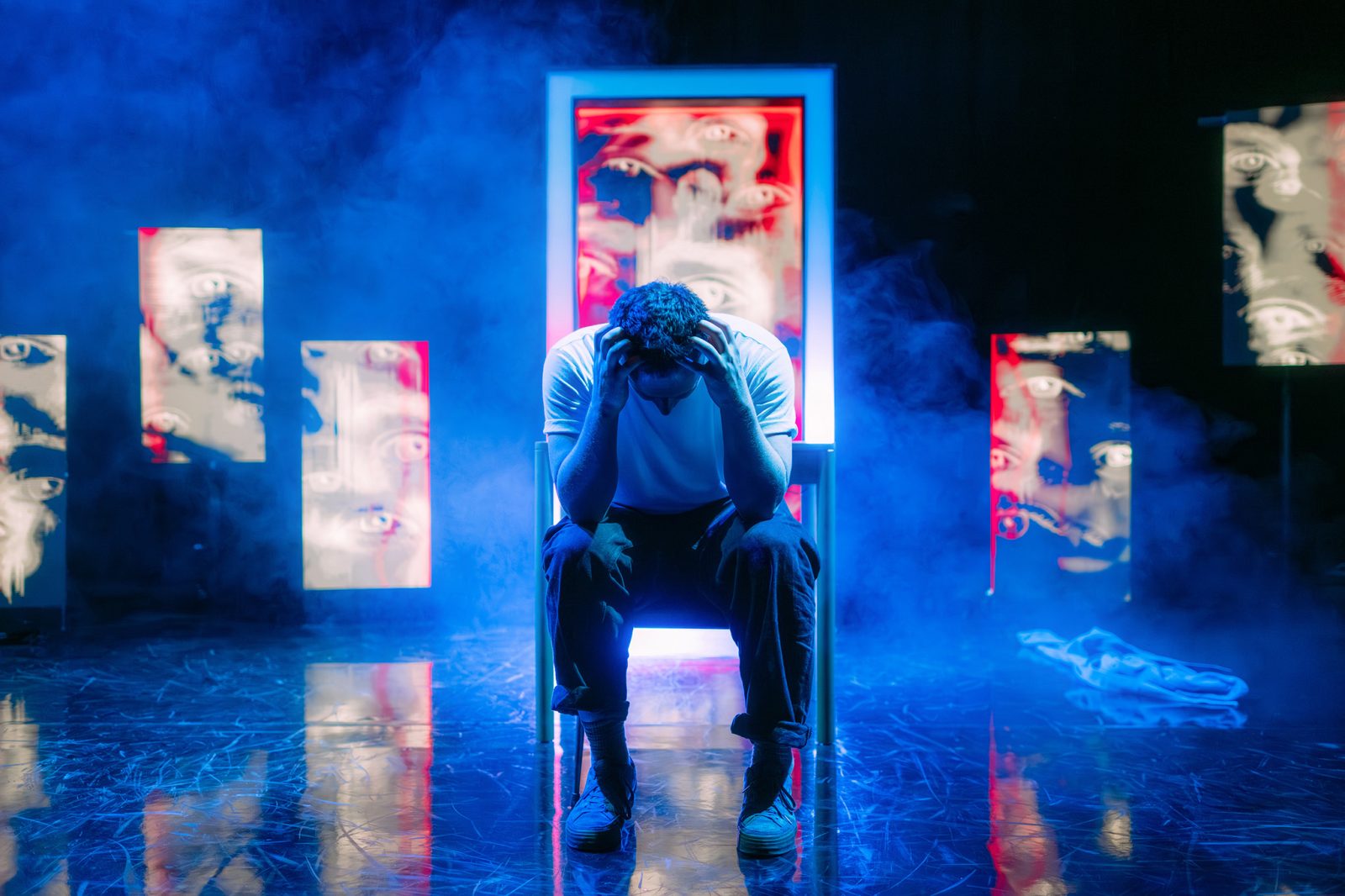
Overcome with guilt, Òran feels compelled to descend into the Underworld (via a conveniently located lift) in an attempt to find Euan and pull him free from the pit of desperation into which he has disappeared.

This is a spoken-word production, with Gordon sitting either at a desk – controlling the small mixing deck which contains the labyrinthine layers of the soundtrack – or racing frantically around the stage, interacting with the audience, making us both witness to and part of the story. This is especially effective in one emotionally-charged moment when we help to create a moment of theatrical magic.

I can’t help but notice that a large group of teens sitting across from me are absolutely spellbound by this performance, staring transfixed as the story unfolds, their reactions writ large. 

Sutcliffe’s Scots poetry alternates between the fierce and the poignant, often breaking into rap. The piece is sensitively directed by Jack Nurse and the production is also elevated by Benny Goodman’s evocative lighting design. I particularly enjoy the clever depiction of the descent into the Underworld, which is simply but effectively achieved. I also like the way that Gordon’s voice is dramatically transformed whenever he assumes the persona of Hades.

Perhaps the story’s late-stage revelation loses some of its power in the midst of what is essentially an aural assault, but that’s a quibble. Òran grabs an ancient myth by the scruff of its neck and gives it a right good shaking.

4 stars

Philip Caveney

Treasure Island

15/10/24

Festival Theatre (Studio), Edinburgh

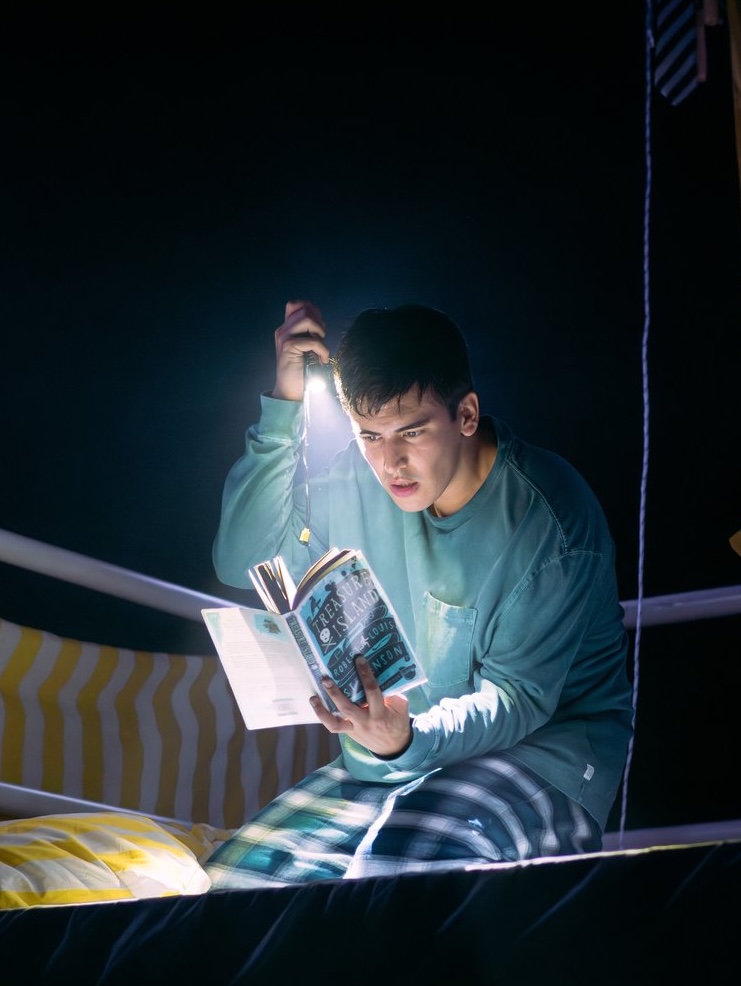
Robbie (Anthony O’Neil) is having some issues at school. He has a good singing voice but, whenever he is required to perform in front of his fellow pupils, he finds himself overcome with anxiety, unable to utter a single word. But Robbie does enjoy reading and, when he picks up a copy of Treasure Island, he finds himself empathising with its young hero, Jim Hawkins – a boy who must conquer all his fears in his quest to find the lost treasure of the mysterious Captain Flint.

Ross Mackay’s sprightly adaptation of Robert Louis Stevenson’s classic tale is sure-footedly aimed at younger audiences and effortlessly displays the ways in which young readers can escape into their own imaginations. O’Neil stays in the central role throughout, while fellow performers Ali Biggs, Megan McGuire and Simon Donaldson slip smoothly in and out of a whole host of other larger-than-life characters. McGuire shines as a Squire Trelawney with an amusing penchant for malapropisms, Biggs makes a dashing Captain Smollet, while Donaldson delivers just the right amount of threat as Long John Silver. Together the threesome also bash out some stirring songs and jaunty sea shanties, lively enough to have the family audience clapping delightedly along with them.

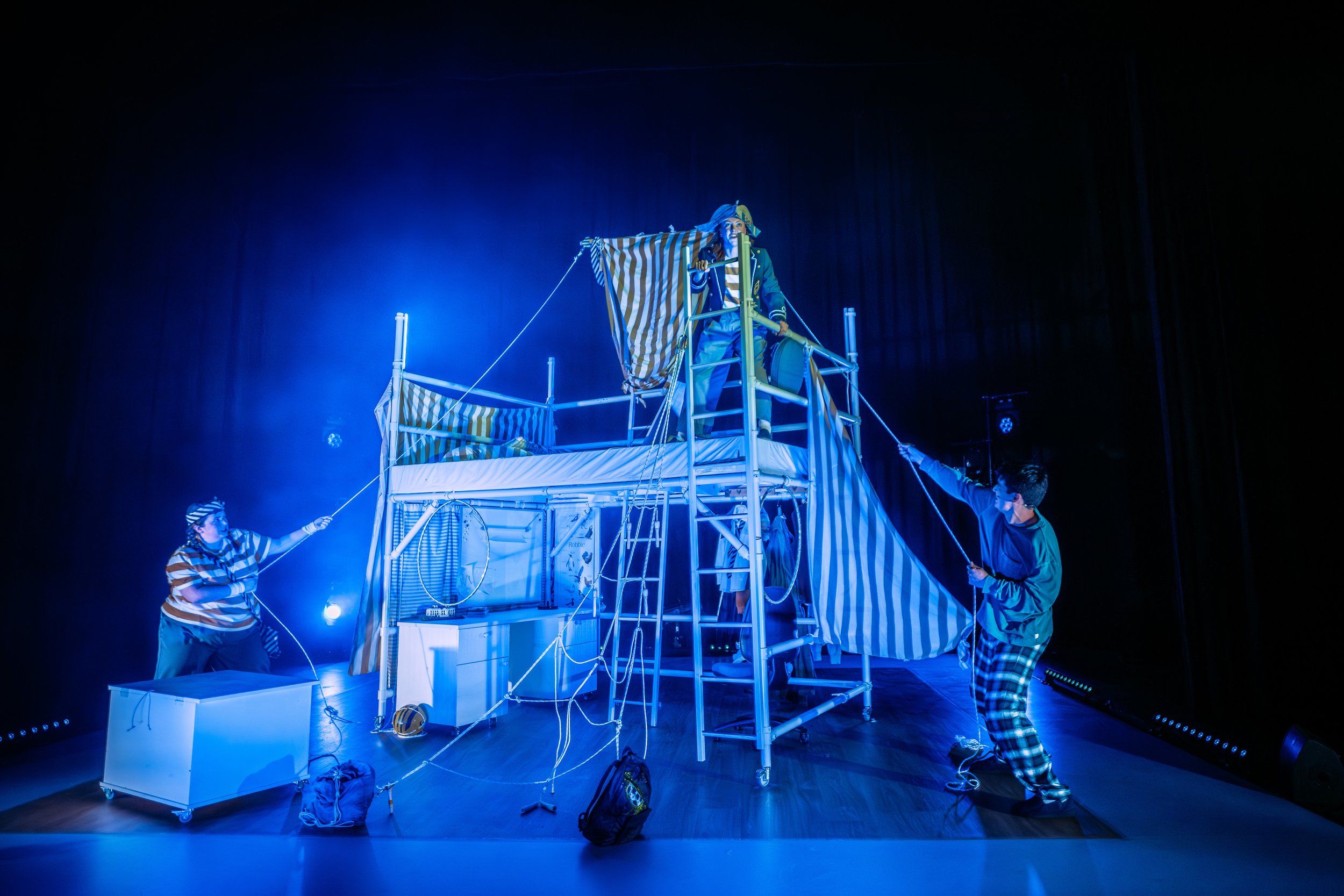
Becky Minto’s deceptively simple set design allows Robbie’s bunk bed to become a whole series of locations and, with Benny Goodman’s lighting, somehow manages to embody The Hispaniola, tossed on the stormy seas of Robbie’s fevered imagination as well as the Admiral Benbow Inn, set alight by a pack of scurvy sea dogs. The complex adventure is deftly packed into a ninety minute running time and there’s enough happening onstage to ensure that the adults in the audience enjoy the action along with the younger crowd.

Parents looking to introduce their children to a spot of theatre have just two more chances to hop aboard for afternoon shows at the Lemon Tree, Aberdeen and Platform, Easterhouse.

4.2 stars

Philip Caveney

549: Scots of the Spanish Civil War


07/06/19

Traverse Theatre, Edinburgh

549: Scots of the Spanish Civil War isn’t exactly what you’d call subtle: in a small pub in Prestonpans, the parallels between four disgruntled millennials and their 1936 counterparts are explicitly drawn.

The 2017 quartet are somewhat disaffected, ground down by austerity and disillusioned with democracy. George (Robbie Gordon), who was famed at school for being the political one, isn’t going to bother voting in the next election. What’s the point? The others disagree, but that doesn’t mean they’re of one mind. They’re angry, polarised; either silent or shouting; held together only by proximity and a shared past.

But, during a powercut, Old George (Michael Mackenzie) appears briefly and then  vanishes, leaving behind a mysterious suitcase. Bar manager Ellen (Rebekah Lumsden) seizes the opportunity to school the boys, telling them that Old George is long dead, and that his suitcase contains mementoes of his time fighting in the Spanish Civil War.

George Watters joins the legendary International Brigade in 1936, spurred on by his deeply held belief that fascism must be thwarted, no matter what the cost. He persuades his mates and his brother-in-law too: Jock (Josh Whitelaw) is keen because he wants to spread his wings, to see the world beyond East Lothian; Bill (Cristian Ortega) is an innocent, young and easily swayed, who just wants to meet some Spanish girls; Jimmy (Nicholas Ralph) is in it for the money. Their ideologies differ, but they bond over the fight.

As Ellen tells the story, the men enact it, using whatever they can find in the bar to represent the tale. Their guns are snooker cues; their barriers bar tables. The lighting (by Benny Goodman) is unusual and most effective: there are banks of brightly coloured pink and yellow spots, almost blinding at times, denoting the present day, while an atmospheric orange gloom settles over much of the past action. It’s a quirky palette, but somehow it makes perfect sense.

The physicality of the drama is excellent, with some inventive set pieces, particularly the bike ride and the battles. The small space feels crowded by soldiers; the pace never lets up, and the characters are well drawn. This is true ensemble work, and very nicely done.

And, in a testament to the power of theatre, the simple reenactment of the tale has a profound impact on the boys, shaking them out of their torpor. I know, I said it wasn’t subtle. But this isn’t the place for subtlety. Maybe, in these troubling times, as the far right rears its head again, we all need to wake up and realise what’s worth fighting for.

4.2 stars

Susan Singfield