The Apprentice

19/10/24

Cineworld, Llandudno

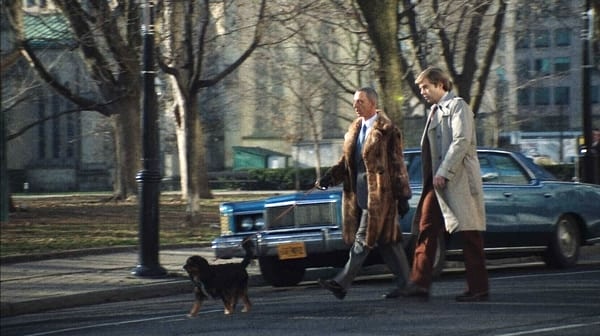
We’re in Wales, visiting Susan’s mum, but Brenda is a bit of an anti-Trump-obsessive and like us, she’s been eagerly awaiting the release of The Apprentice. It’s clearly time to flex the Unlimited card. Abi Abbasi’s biopic couldn’t have come at a more inopportune time for Trump. Of course he’s threatened legal action, though I’m pretty sure that Abbasi’s film doesn’t feature anything that isn’t already common knowledge to those who’ve read some of the numerous books about the man – but what it does, very effectively I think, is to illustrate how the Trump-monster was made and shaped.

Like most beasts, he’s learned his craft through imitation.

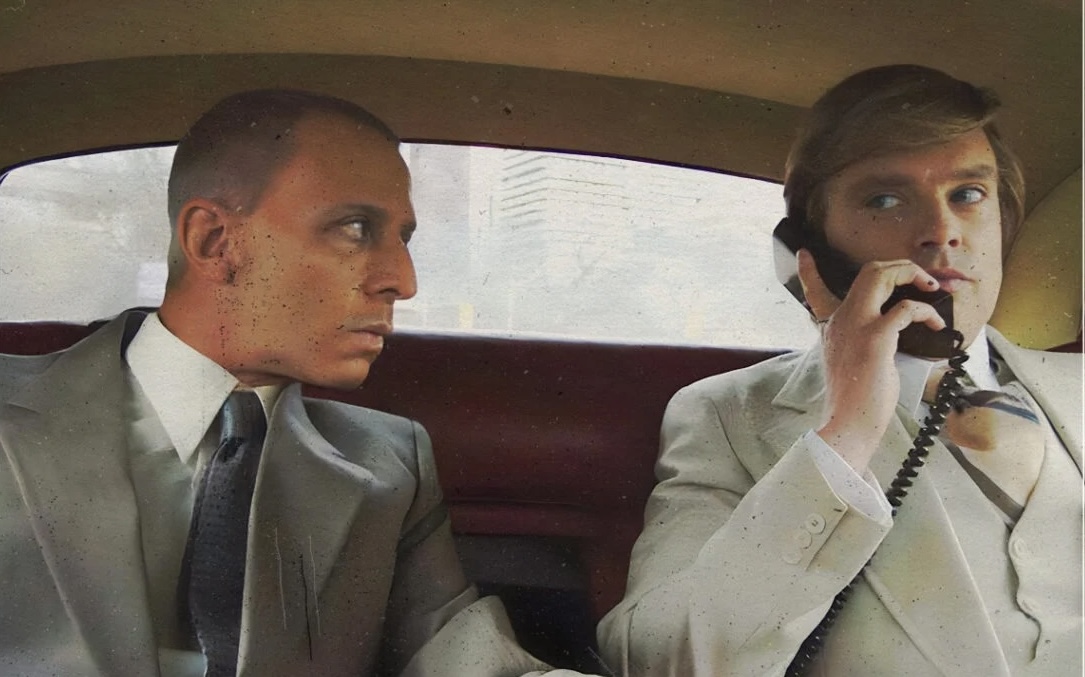
When we first meet Donald (Sebastian Stan) it’s 1973 and he’s essentially a slum landlord in New York City, trying his level best to please his ever-critical father, Fred (Martin Donovan), and deal with his alcoholic older brother Freddy (Charlie Carrick). The family fortune has already been made and the Trumps are currently fighting allegations that they have been discriminating against their African-American tenants – but Donald is looking for ways to better himself and has a vision of turning the long-derelict Gulf and Western building into a gleaming new construction called Trump Tower. But he knows he can’t do it alone.

Then he falls into the company of Roy Cohn (Jeremy Strong), a ruthless lawyer, best known at this point for securing the death penalty for the Rosenbergs, a man who will stop at nothing to get his own way. He takes Donald under his wing and quickly drills into him his personal mantra. Never admit defeat, the truth is what you say it is and always act as though you’ve won, even if you haven’t.

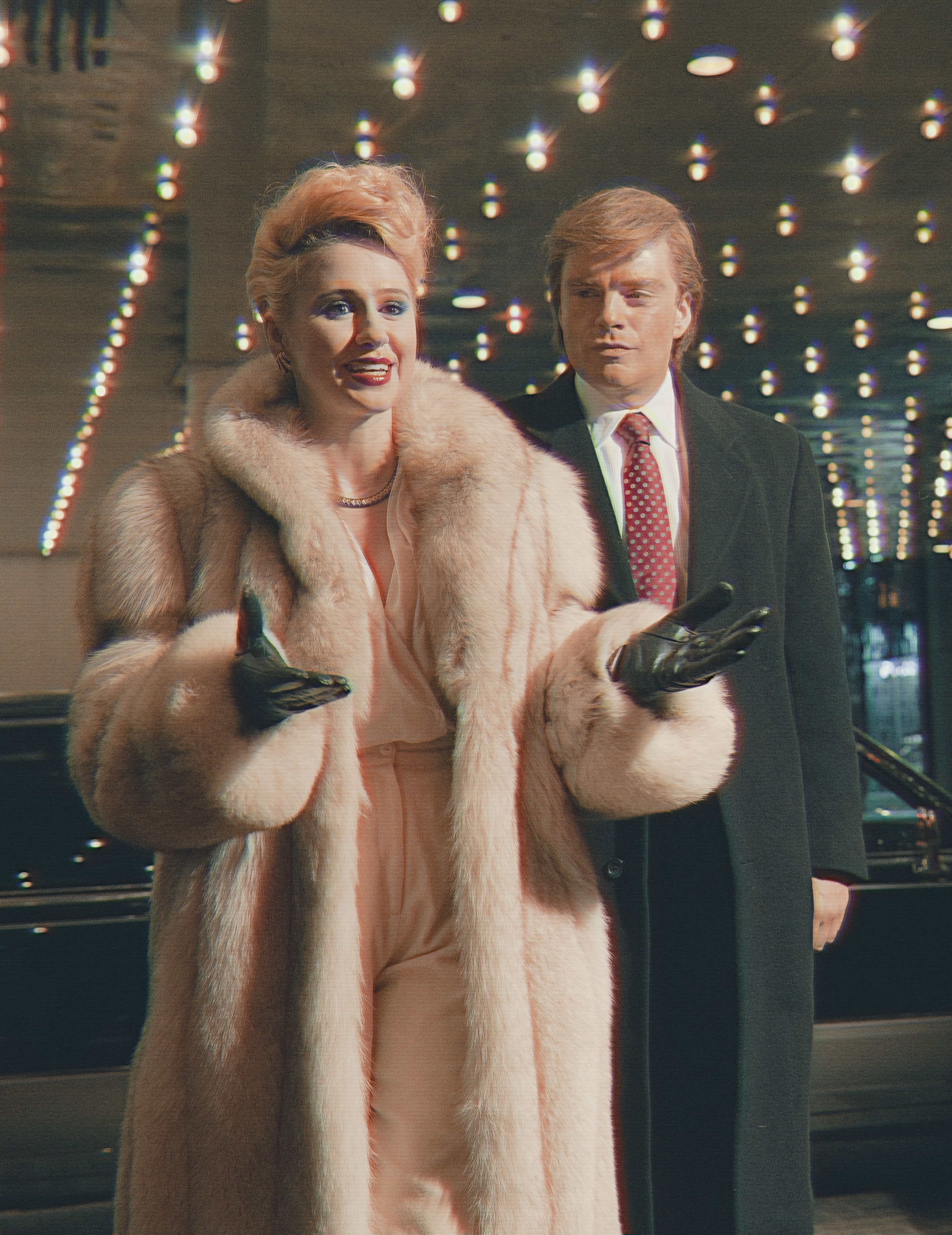
Pretty soon, Trump has become the perfect acolyte, copying all of Cohn’s traits and even doubling down on them. When Donald meets and falls for Ivana Zelničková (Maria Bakalova), there’s a moment where it seems as though the film might be about to let him off the hook. His clumsy attempts to seduce her make him seem almost… relatable – but the feeling is short-lived. The monster soon comes back to the fore and the scene where his affectations turn against his former love is shocking to say the least.

Sebastian Stan does a pretty good job of capturing Trump’s gradual deterioration into the beast we know. Holding back the man’s distinctive hand gestures and vocal affectations until the film’s final furlong, he literally grows into the role. Strong, meanwhile, submits an extraordinarily chilling performance as Cohn: lean, cadaverous, almost alien, he surveys everyone he meets with the same dead-eyed stare. Here is a man who hides his real identity behind a mask, who puts down his enemies with a barrage of verbal abuse, while secretly pursuing a dissolute life with complete abandon. He’s totally toxic and yet, his ultimate treatment by Trump, when he has outlived his use, is all the more shameful because of that toxicity – and it’s hard not to feel some sympathy for him.

Abas meanwhile, captures the look and feel of the changing decades with a skilful combination of found footage and reimagined scenes. His use of music is inspired. Using Yes Sir, I Can Boogie as Ivana’s unofficial theme tune is particularly effective.

Trump can (and surely will) protest that releasing The Apprentice when he is gearing up for the fight to become the US President for a second term is inexcusable – but, as this film so clearly portrays, when it comes to a dirty, underhand fight, this is a man with considerable experience of his own.

4.3 stars

Philip Caveney

Treasure Island

15/10/24

Festival Theatre (Studio), Edinburgh

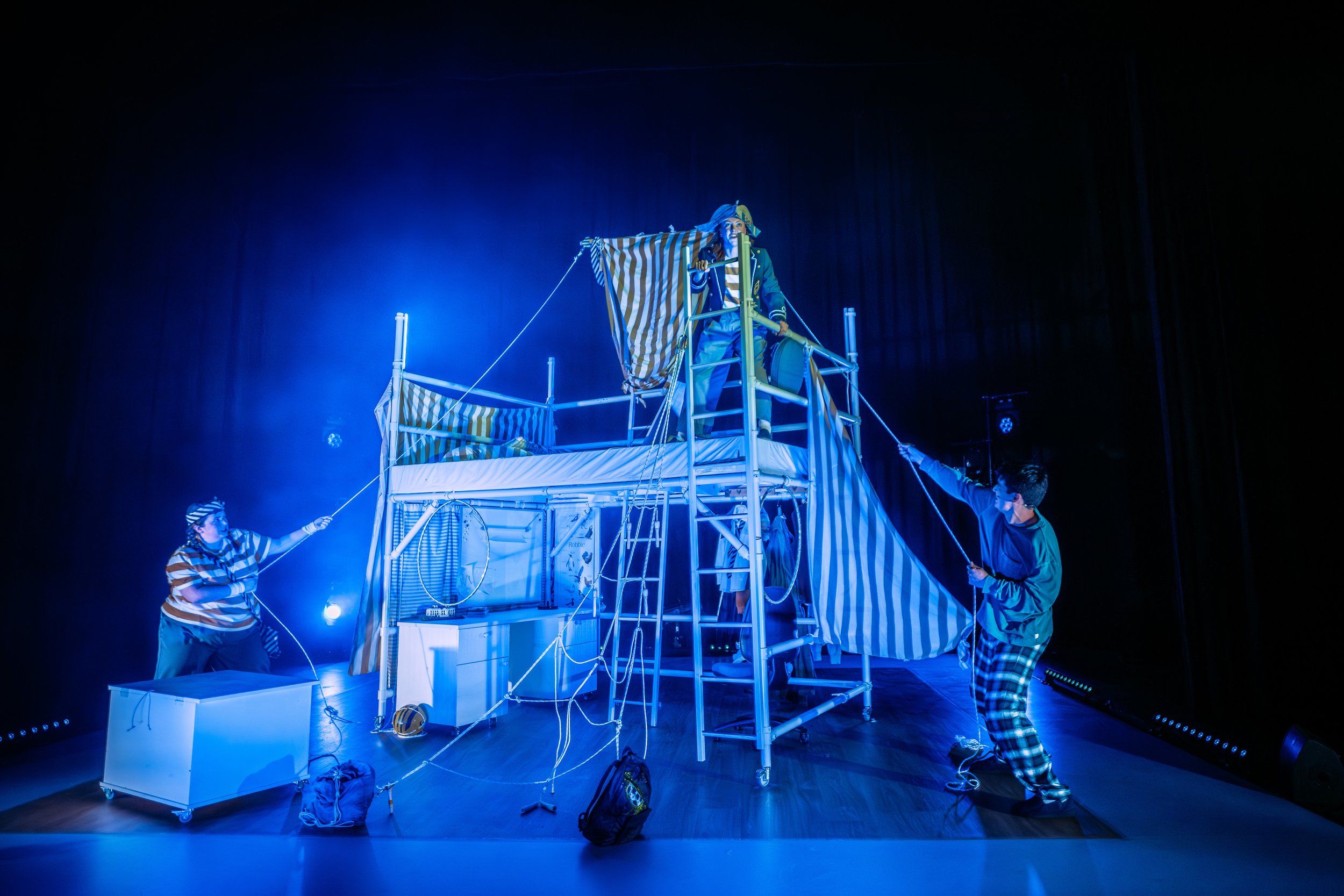
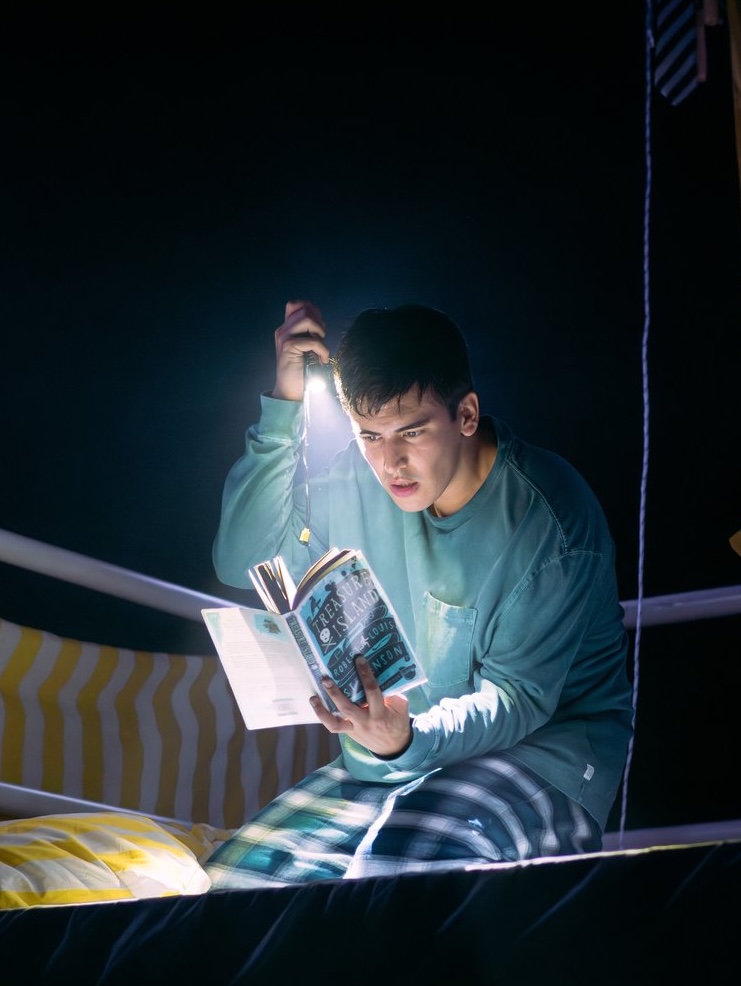
Robbie (Anthony O’Neil) is having some issues at school. He has a good singing voice but, whenever he is required to perform in front of his fellow pupils, he finds himself overcome with anxiety, unable to utter a single word. But Robbie does enjoy reading and, when he picks up a copy of Treasure Island, he finds himself empathising with its young hero, Jim Hawkins – a boy who must conquer all his fears in his quest to find the lost treasure of the mysterious Captain Flint.

Ross Mackay’s sprightly adaptation of Robert Louis Stevenson’s classic tale is sure-footedly aimed at younger audiences and effortlessly displays the ways in which young readers can escape into their own imaginations. O’Neil stays in the central role throughout, while fellow performers Ali Biggs, Megan McGuire and Simon Donaldson slip smoothly in and out of a whole host of other larger-than-life characters. McGuire shines as a Squire Trelawney with an amusing penchant for malapropisms, Biggs makes a dashing Captain Smollet, while Donaldson delivers just the right amount of threat as Long John Silver. Together the threesome also bash out some stirring songs and jaunty sea shanties, lively enough to have the family audience clapping delightedly along with them.

Becky Minto’s deceptively simple set design allows Robbie’s bunk bed to become a whole series of locations and, with Benny Goodman’s lighting, somehow manages to embody The Hispaniola, tossed on the stormy seas of Robbie’s fevered imagination as well as the Admiral Benbow Inn, set alight by a pack of scurvy sea dogs. The complex adventure is deftly packed into a ninety minute running time and there’s enough happening onstage to ensure that the adults in the audience enjoy the action along with the younger crowd.

Parents looking to introduce their children to a spot of theatre have just two more chances to hop aboard for afternoon shows at the Lemon Tree, Aberdeen and Platform, Easterhouse.

4.2 stars

Philip Caveney

Lost Girls/ At Bus Stops

15/10/24

Traverse Theatre, Edinburgh

Lost Girls/At Bus Stops is my favourite so far in this PPP season: I love the marriage of Róisín Sheridan-Bryson’s fragmented, non-linear writing with Laila Noble’s kinetic direction. 

At its heart there’s a simple will-they/won’t they love story. Ever since Jess (Catriona Faint) approached Iona (Leyla Aycan) at a bus stop with a flyer for a Fringe show several years ago, the two have been friends, meeting up every August to make the most of the Festival buzz, weaving their way from show to bar to show again, navigating the crowds, the hills, the closes, the booze. On the surface, theirs is an easy alliance, born of a shared hedonism and an openness about who they are. Underneath, they’re a mess of repressed longing, each too nervous to risk their precious friendship by declaring how they really feel. And this time, with Iona about to leave for pastures new, there’s an added pressure. If neither of them makes a move, it’ll be too late.

Sheridan-Bryson’s script skips nimbly between dialogue and narration, the protagonists referring to themselves in both third and first person, almost mythologising the city, their accounts of various Edinburgh nights colliding as they disagree about details and bring different moments to the fore. The disrupted timeline mirrors a real-life conversation, almost stream-of-consciousness in its construction, bouncing back and forth through their shared memories.

The two actors portray the contrasting characters with aplomb, Aycan’s gentle stillness a perfect foil for Faint’s more manic, agitated demeanour. As Jess reacts to the pressure by downing drink after drink, snogging random men and trying to start fights, Iona – while matching her on the booze front – is altogether calmer, trying time and again to make Jess stop and talk, to say the things they need to say. Their emotions are palpable and it’s impossible not to feel engaged, not to sit silently urging them to take the plunge. 

Zephyr Liddell’s set is simple but effective, the grimy bus stop and disco lights echoing the superficial glamour of a sequin-clad performer in an archetypal dingy Fringe venue. 

Sheridan-Bryson pulls off the difficult task of creating a play that is at once meta-theatrical and down-to-earth, complex in structure but easy to follow. It’s an impressive piece of work. 

4.6 stars

Susan Singfield

Timestalker

13/10/24

The Cameo, Edinburgh

The release of a new Alice Lowe film is a cause for celebration. Actor/writer/director – and as far as I know, she might do the catering as well – Lowe is adept at ensuring that a modest budget goes a long, long way. Her debut feature, Prevenge, was released way back in 2017, shot while she was pregnant (of course it was), so Timestalker has been many years in ahem… gestation. It’s probably best described as a fantasy set across hundreds of years, and the central theme is the general futility of pursuing the heart’s desire.

We first meet Agnes (Lowe) in the 1600s in Scotland, where she’s a lonely spinster, much gossiped about by her neighbours, who pays the occasional visit to a masked preacher, a man given to talking about the dawning of a new religion. When said preacher is arrested and brought to a public place for torture and execution (they made their own entertainment those days), his mask is removed, revealing the handsome face of actor Aneurin Barnard. Agnes is instantly and irrevocably smitten. Attempting to approach him, she trips and falls face first onto the executioner’s axe, which is the bloody end of her.

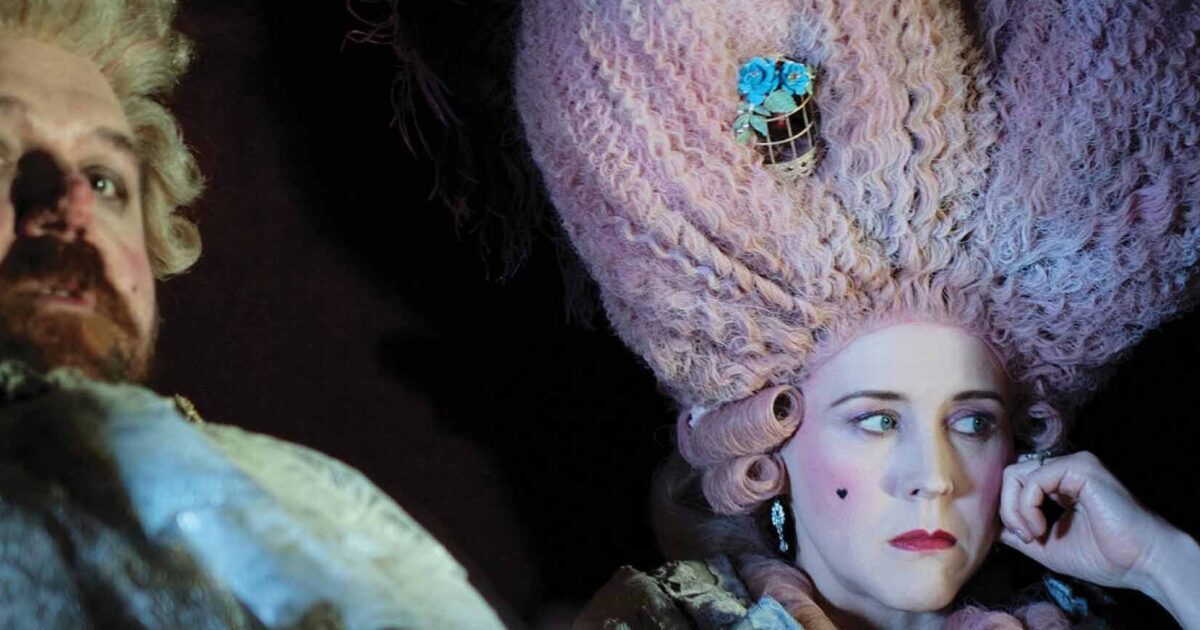
Except that it’s not. She’s promptly reborn in the 1790s, rich but bored, with a toxic husband played by Nick Frost. This Agnes has a penchant for wearing some truly monumental wigs but she’s missing something in her life. When she spies the visage of a handsome highwayman – Barnard again – her passion is reignited and she is, once more, in pursuit of love. But of course it’s doomed to end badly. With each transformation, her luck fails to improve and an added problem is that every new persona harbours memories of the one before… and where exactly does Cleopatra fit into all this?

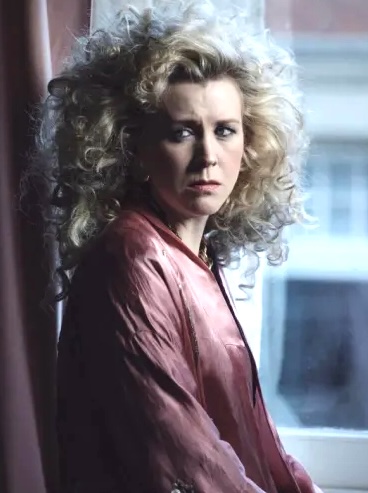
Lowe’s sparky script is laced with deadpan humour, and cinematographer Ryan Eddleston has a lot of fun aping the look of celebrated films. If the opening sequence is Witchfinder General, then the 80s New Romantic section has the muted, pastel tones of Adrian Lyne’s Flashdance – and Lowe has the perm to back it up. Sadly, the budget doesn’t quite stretch to making the Manhattan locations look entirely convincing.

Tanya Reynolds does a good job of embodying the various iterations of Agnes’s perennial sidekick, Meg, and Jacob Anderson is quietly impressive as different versions of a character simply known as Scipio. Frost continues to be suitably malevolent in every loathsome bloke he portrays.

While it might sound faintly bewildering on the page, the myriad twists and turns of the plot are confidently handled and there are some cleverly placed visual clues – a huge heart hidden in a forest, a brightly plumaged songbird in a cage – to keep reminding us of what’s gone before.

As ever with Lowe’s work, the spirit of pure invention is kept proudly to the fore and I find myself wondering what this formidable film maker could achieve given a hundred-million-dollar budget. Until that unlikely event actually happens, why not seek out your nearest independent cinema and sample the delights of her latest gem? It’s well worth your time and money.

4 stars

Philip Caveney
1984

11/10/24

Bedlam Theatre, Edinburgh

George Orwell’s dystopian masterpiece has loomed large over 2024 for us. In April, we listened to Audible’s star-studded ‘immersive’ audio adaptation, where Andrew Garfield, Cynthia Erivo, Tom Hardy and Andrew Scott brought Oceania memorably to life. Immediately afterwards, we both read Sandra Newman’s Julia, a reworking of the novel from the lead female’s point of view. And today we’re here at Bedlam Theatre, ready to see EUTC’s interpretation of the cautionary tale.

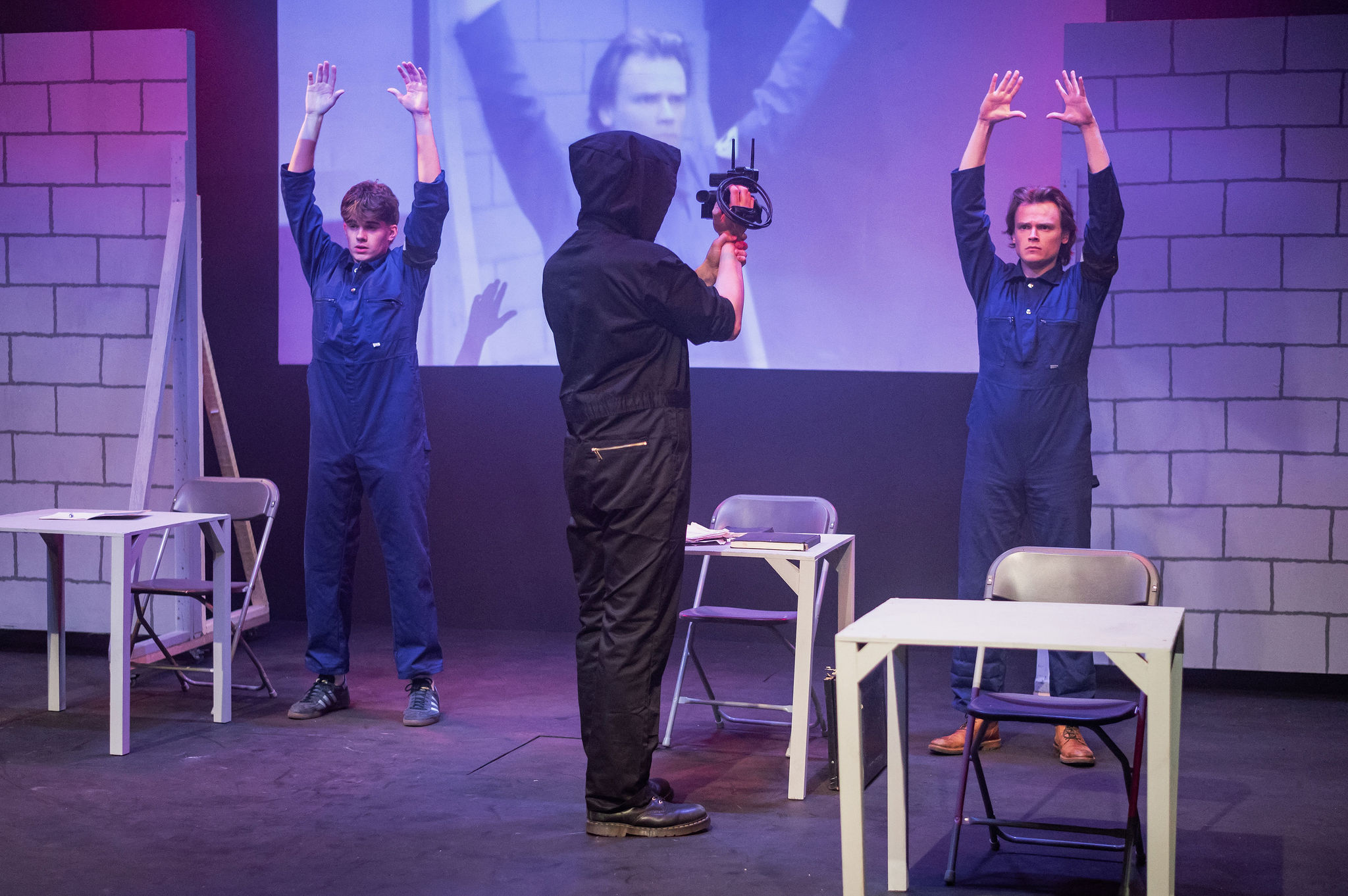
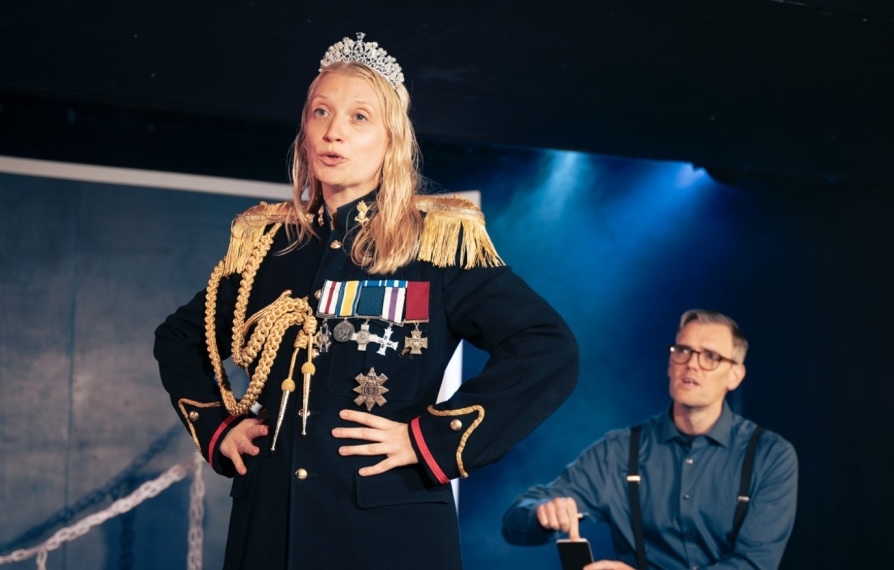
The use of screens projecting both pre-records (Lewis Eggeling) and live video (Tom Beazley) is inspired: there can’t be many stories more suited to a multi-media approach. The scene is set as soon as we enter the theatre: Big Brother (Thaddeus Buttrey) is watching us, a close-shot of his eyes filling the back drop. Instead of ushers, there are guards (Molly Gilbert, Rose Sarafilovic, Dylan Kaeuper and Fergus White), forbidding in their black uniforms, scarfs covering their lower faces. “All hand-held telescreens must be switched off,” one intones; “Silence!” bellows another. Predictably, we all comply.

This adaptation (by Robert Owens, Wilton E Hall Jr, and William A Miles Jr) generally works well, plunging us immediately into the middle of the story. What used to be Britain is now part of Oceania, a sprawling dictatorship led by Big Brother, its impoverished citizens ruled with an iron rod by the unforgiving Party. By falling in love, Ministry of Truth workers Winston (Harry Foyle) and Julia (Francesca Carter) have broken the law and, having crossed that line, find themselves increasingly unable to swallow the propaganda they are fed. But what chance do they stand against the all-seeing apparatus of the State?

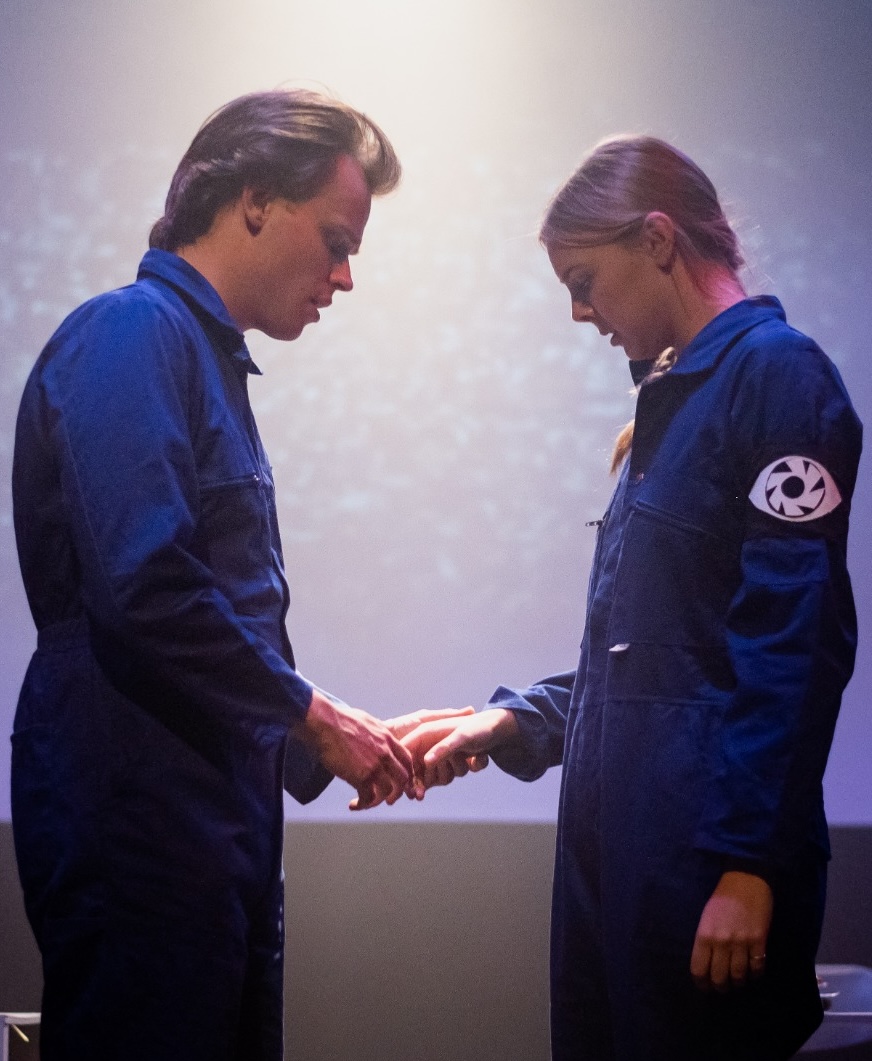
Director Hunter King does a great job of establishing a sense of threat, as well as highlighting the fragile humanity that endures, despite Big Brother’s best efforts to quash it. “They can make us say things,” as Julia acknowledges, “But they can’t make us think them.” As the central duo, Foyle and Carter both deliver flawless performances: Winston and Julia are convincingly reckless, persuading themselves that they are less vulnerable than they really are, caught up in the excitement of their affair. The story is so well known that there is a dramatic irony not present in the original plot, and King exploits this effectively, so that we find ourselves grieving for the couple even as their relationship blooms.

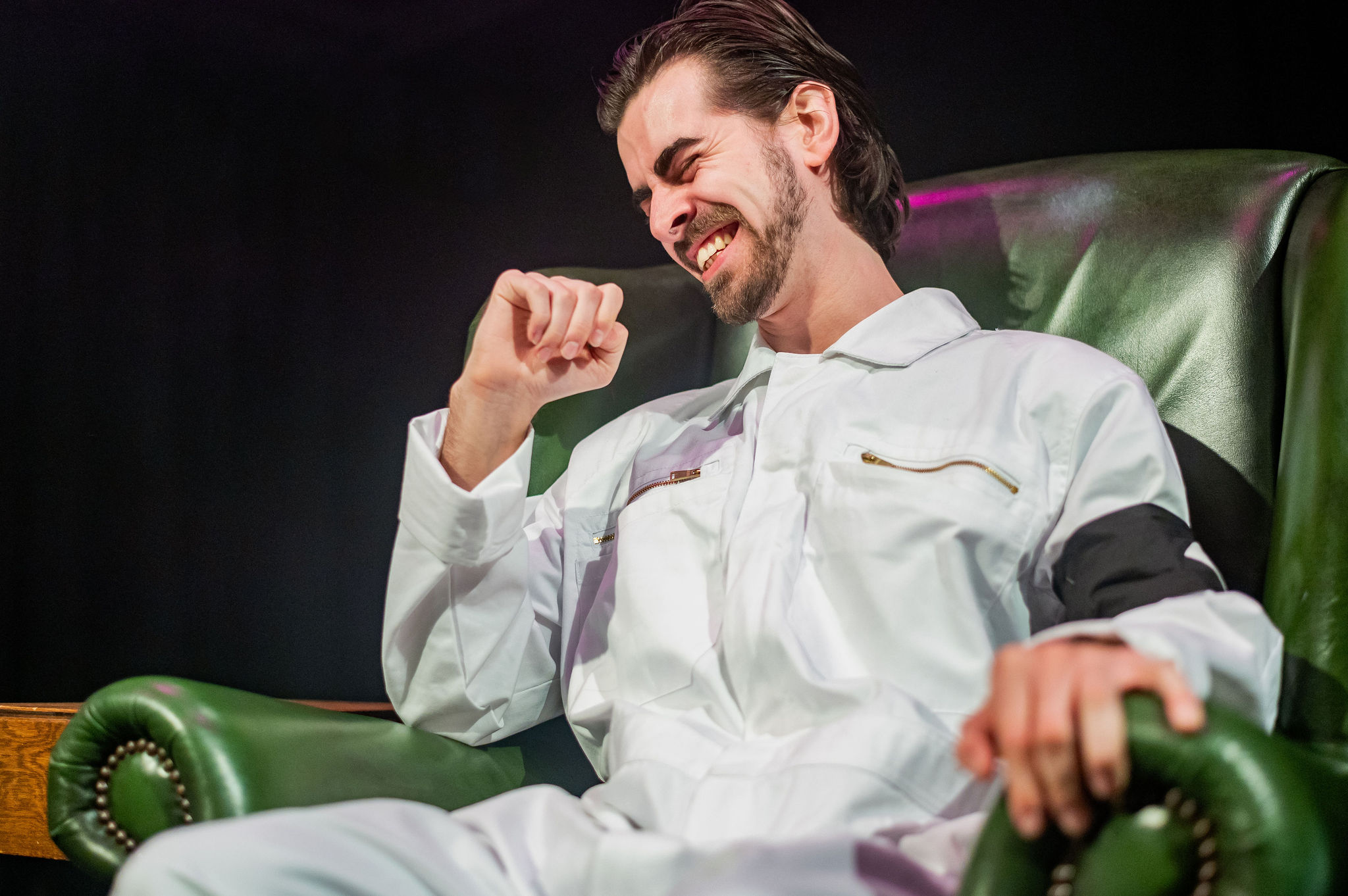
Robbie Morris is clearly having a whale of a time as smarmy backstabber, O’Brien, member of the Inner Party and chief snarer of the unwary. He plays the role as a kind of archetypal villain, complete with maniacal laugh, which makes for an interesting counterpoint, highlighting the freedom that comes with privilege: this is not a man who has ever felt the need to hide or even mute his feelings, unlike even the most loyal Party members. The only other character who seems uncowed is the landlady (Raphaella Hawkins), who owns the apartment Winston and Julia rent for their illicit lovemaking. As a Prole, she has a certain kind of liberty, born of being so poor and lowly that she’s considered unworthy of attention. It’s a dubious advantage.

As we’ve come to expect from Edinburgh University’s student shows, this is an impressive piece of theatre. I especially enjoy the fight sequences, directed by Rebecca Mahar, which are horribly credible and more brutal than I’m used to seeing on stage, ramping up the horror of this too-close-for-comfort imagined world. If I have a criticism, it’s more about the script than this production – there are a lot of actors without much to do, and I think more could be made of the ensemble. I’m also not sure why Winston and Julia get married – that’s not in the book and it doesn’t seem like there’s any dramatic purpose for the change.

That aside, EUTC’s 1984 is remarkable from start to finish, with even the final bows making a statement. It’s double-plus good.

4.4 stars

Susan Singfield

To Save the Sea

10/10/24

Traverse Theatre, Edinburgh

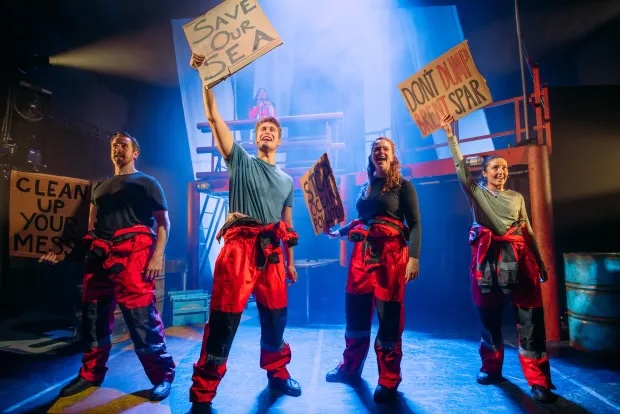
If ever I were asked to compile a list of ‘unlikely ideas for a musical,’ the story of the Brent Spar oil rig might well up there towards the top. How could such a tricky subject, set in such a obscure location, ever be convincingly staged? Well, this rousing production, written and directed by Isla Cowan and Andy McGregor is an object lesson in how to make such a venture work – a heartfelt polemic, for sure, but a supremely entertaining sung-through musical at the same time. And you don’t have to be a committed activist to appreciate the importance of what happened back in 1995 – and to realise that not enough has changed since then.

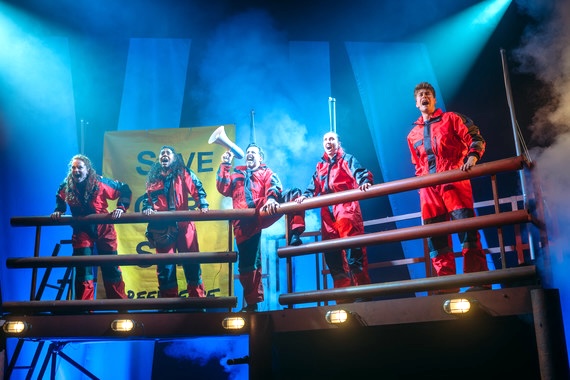
Many will remember the story of the decommissioned Brent Spar, which (largely as a cost-cutting exercise) was scheduled to be blown to bits by its owners, Shell, before being consigned to the depths of the North Atlantic, where it would cause untold damage to the ecosystem. But the company’s plans came to the attention of a team of Greenpeace activists, who sailed out from Shetland, climbed aboard the rig and steadfastly refused to leave, even after being repeatedly blasted by water cannon.

In this version of events, the names of the protagonists have been changed. Team leader Karl (Matthew McKenna) is driven by his desire to do the right thing for the environment. He’s backed up four others: feisty rich girl, Engel (Katie Weir), whose parents made a lot of money from fossil fuels; student, Colin (Nathan French), who has impulsively abandoned his University studies in order to go on this mission; journalist with a conscience, Brianna (Kaylah Copeland), who has promised to do everything she can to bring this matter to the public’s attention; and stay-at-home mum, Rachel (Kara Swinney), taking a break from her domestic duties to make a stand for ‘something that matters.’

Together the disparate team sail out to the rig and prepare to face the opposition.

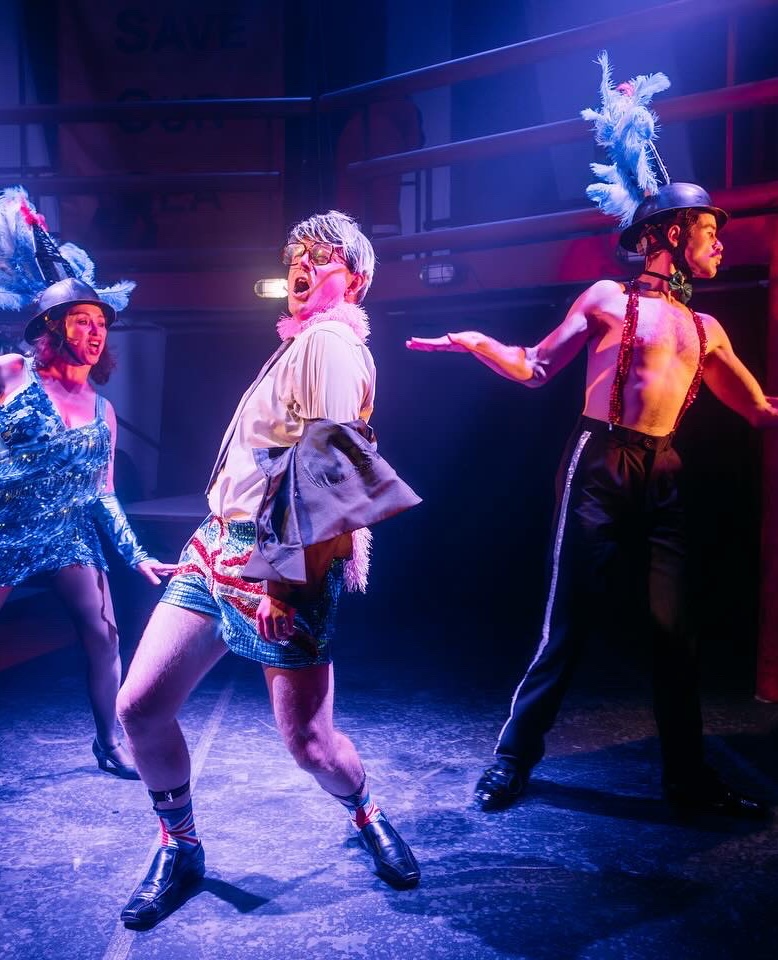
Meanwhile, a scheming triumvirate of Shell executives, Rupert (David Rankine), Karen (Helen Logan) and David (Ewan Somers), are determined to end the occupation as quickly as possible. This could cost them a lot of money! The trio are played as comic relief to the action, drawing up their dastardly plans almost in the style of Gilbert and Sullivan villains, romping around in a variety of costumes and occasionally breaking away to embody real life characters. Somers does a hilarious job of embodying John Major as (trust me) you’ve never seen him before, while Logan briefly dons a bald pate to impersonate German chancellor, Helmut Kohl.

Claire Halleran’s impressive set design convincingly evokes the rugged location and this is accentuated by Fraser Milroy’s sound and Simon Wilkinson’s lighting. The songs (also by Cowan and McGregor) are uniformly impressive, all majestic chords and soaring vocals. All the performers have impressive ranges and, when the five protestors join together in powerful harmony, the results are nothing short of spectacular. A scene where Rachel proudly proclaims the importance of her new-found role is particularly moving and I have to confess to having something in my eye by the time Swinney reaches the final chorus.

This is only at the Traverse for a couple more nights before moving on to tour a series of Scottish locations through October, finishing up in Inverness on November 2nd. If you can get seats, I urge you to make the effort. To Save the Sea is a deeply committed and ultimately moving piece of musical theatre with an important message to deliver.

4.6 stars

Philip Caveney

The Baddies

09/10/24

Lyceum Theatre, Edinburgh

The Baddies, David Greig and Jackie Crichton’s theatrical adaptation of Julia Donaldson and Axel Scheffler’s 2022 book, is well-pitched for its target audience of 3+. This morning’s audience is almost all made up of school trips, with rows of squirming, excited P1s and 2s eating snacks and being cajoled out of their jackets while waiting for the show to begin. The colourful set – designed by Jasmine Swan – intrigues them. Indeed, there’s one little girl in the front row who can’t seem to help getting out of her seat and walking towards the stage, drawn like the proverbial moth to the flame. Every time her teacher asks her to sit down, she does so – but she’s up again a moment later, eyes wide, mouth open.

But as soon as the show begins, she returns to her seat and watches, enthralled. And her reaction is a more important review of this production than anything I can write. Her classmates enjoy it too. The noise level in the auditorium bears testimony to the musical’s success: there are hundreds of young children here, clapping enthusiastically for the songs, waving their hands and shouting when required – but much quieter than the on-stage mice as the story carries them along.

A framing sequence introduces us to Mamma Mouse (Lottie Mae O’Kill), who wants to teach her three bad-mannered children (Dyfrig Morris, James Stirling and Rachel Bird) to say thank you, sorry and please, but it doesn’t go well. They’re more interested in having fun. To calm them down, she decides to tell them a bedtime story about a spotted handkerchief, and then we’re off, as they transform into the titular Baddies: Troll (Morris), Ghost (Stirling) and Witch (Bird). “We’re the very worst baddies,” they sing in the show’s catchiest number (courtesy of Joe Stilgoe) – but there’s a problem. They’re not. They’re rubbish at being bad. They can’t even scare the new young shepherdess The Girl (Yuki Sutton), who’s out in the mountains on her own for the very first time.

As an adult, I have to say that the story doesn’t do a lot for me. There’s not much of a narrative arc. I’d like the manners referenced in the opening sequence to have more bearing on the subsequent narrative. I’d also like Mamma Mouse to refrain from waving around her dirty hanky after exhorting the little mice to sneeze into it to catch the germs. But these are grown-up concerns and, as we’ve established, I’m not the target audience.

Stilgoe’s songs are light and catchy, but most of them are perhaps not sing-along-able enough for little children. I like Katie Beard’s direction: the slapstick is especially nicely done, with lots of silly near misses and amusing sound effects. O’Kill seems to be channelling Mary Poppins – and this works well for the piece, lending her a convincing authority over the proceedings, so that when she assures the audience in advance that, although there are some scary moments in the story, nothing bad happens and there’s a happy ending on its way, it’s clear that the children trust her and so relax into the tale.

But, for me – as for the little front row girl – it’s Swan’s design that steals the show. The set is a glorious riot of hidden delights, like a giant Polly Pocket, the mountainside opening up to reveal a fairytale cottage, while the costumes – although different from the book’s illustrations – seem somehow iconic. I can imagine them as popular Hallowe’en outfits.

The Baddies leaves Edinburgh on the 20th October for an extensive nationwide tour. If you’re a parent or a teacher and you have wee ones you want to treat, an hour in the company of this not-so-dastardly trio is pretty sure to please them.

4 stars

Susan Singfield

Anna/Anastasia

08/10/24

Traverse Theatre, Edinburgh

Berlin, February, 1922. Following a failed suicide attempt, Anna (Kirsty McDuff) is brought to a local police station. She’s dripping wet after trying to drown herself in a local canal. She is interviewed by Franz (Chris Forbes), a straight-laced police officer with a liking for equally straight talking. But when she claims to be the Grand Duchess Anastasia, the lone survivor of the assassination of her entire family by Bolshevik revolutionaries two years earlier, Franz isn’t quite sure what to believe. For one thing, Anna talks so lucidly about her glamorous past: her memories from the court of Nicholas and Alexandra, the glittering balls, the wonderful meals.

And for another, she is wearing an expensive-looking tiara that’s clearly been dented by a bullet…

Inspired by real events, Anna/Anastasia approaches its subject matter with an endearing sense of humour, playing Anna’s volatility off against Franz’s restrained, analytical approach. Franz, we are told, paints china swans as a hobby and keeps them up in the attic out of harm’s way. Anna, with her unrestrained bursts of exuberance, represents something he is unaccustomed to, something that threatens to bring all his most established convictions clattering down around him in pieces – and yet, as the years pass and Anna’s fortunes rise and fall, the couple keep re-encountering each other and a kind of guarded relationship develops.

The sprightly script by Jonny Donahoe (whose Every Brilliant Thing is a popular yearly visitor to the Edinburgh Fringe) maintains just the right mix of comedy and pathos, while the two performers make perfect foils for each other. McDuff stays in character the whole way through, inhabiting Anderson’s turbulent persona with considerable skill, while Forbes occasionally steps out of his main role to play a number of subsidiary characters – at one point breathlessly re-enacting the murder of the entire Romonov family single-handedly. Liz Caruthers handles the direction with an assured touch.

The story of Anna Anderson has formed the basis for many plays and films over the years and, though the mystery has recently been pretty much solved thanks to DNA testing, it continues to exert considerable powers over the public imagination. As Anna/Anastasia seems to emphasise, the actual truth of the story is somehow less important than the speculation it has always kindled – and the play’s bitter-sweet conclusion still manages to leave us wondering about the possibilities.

4.4 stars

Philip Caveney
A Different Man

05/10/24

Cineworld, Edinburgh

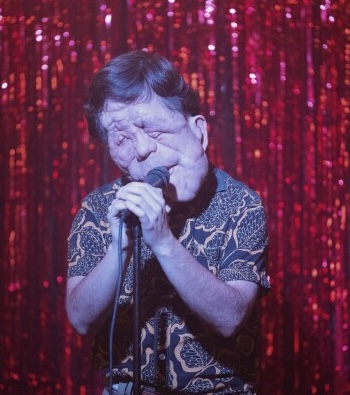
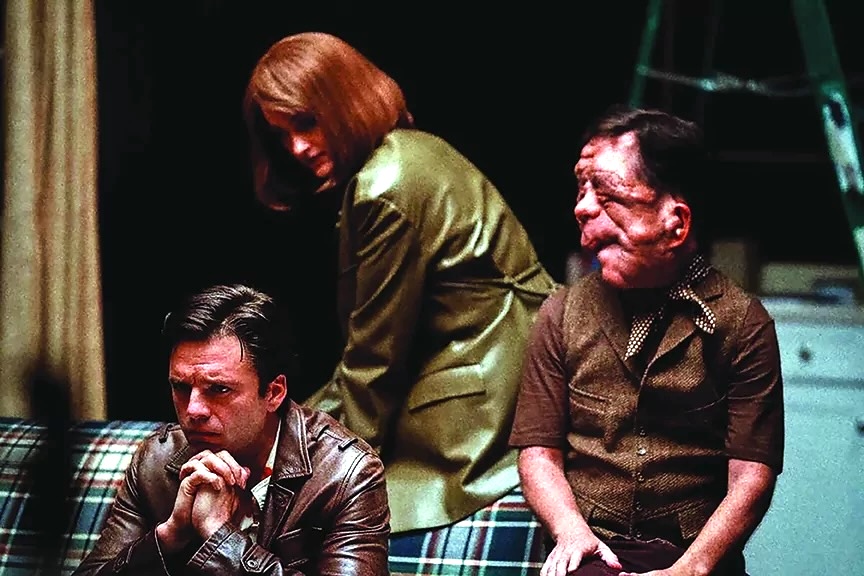
It’s not hard to imagine actor Adam Pearson’s delight on first reading the script for A Different Man. The film, a three-hander, was written expressly for him – and, my word, it gives him a chance to show what he can do. It also challenges our preconceptions and prejudices around disability and disfigurement – but not in any obvious, seen-it-all-before way.

Writer-director Aaron Schimberg has a cleft palate, so he knows something of how it feels to look different. Pearson, meanwhile – along with his character, Oswald, and Sebastian Stan’s character, Edward – has neurofibromatosis, which is a lot more noticeable. Edward copes by keeping his head down and trying to make himself small. He’s quiet, unassuming, and sadly accepting of his lot. He is an actor, but he doesn’t get much work – unless you count condescending corporate training videos of the ‘how to behave around your disabled colleagues’ variety.

And then two things happen.

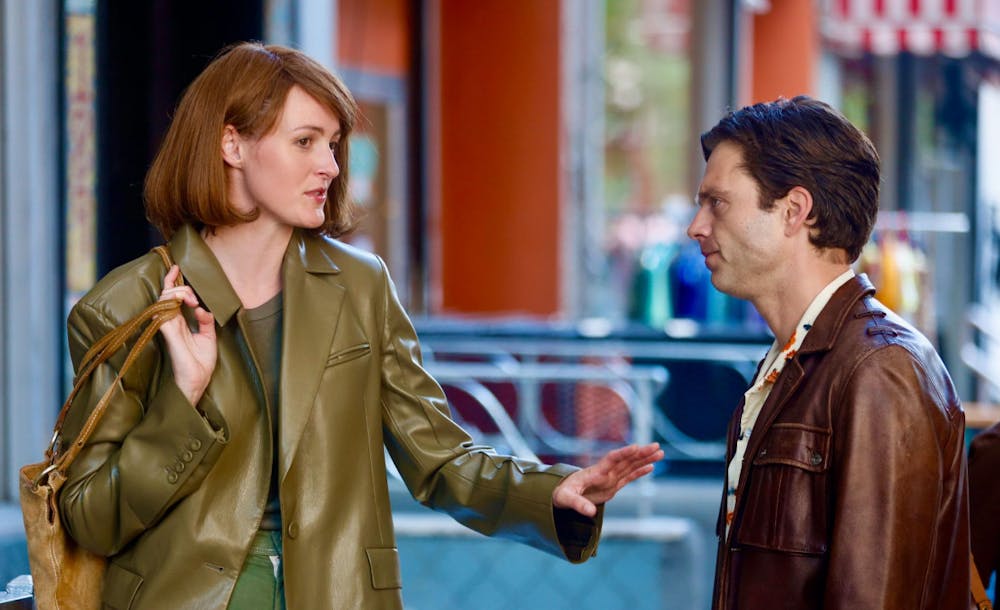
First, Edward is offered the chance to take part in a drug trial for a revolutionary new treatment that will transform his appearance. Next, he meets his new neighbour, aspiring playwright Ingrid (Renate Reinsve), and begins to develop feelings for her. She’s nice to him – but recoils when he makes a tentative move.

He decides to take the plunge.

As the tumours begin to literally fall from his face (courtesy of some pretty impressive prosthetics), a new Edward emerges, smooth-skinned and conventionally handsome. Keen to shuck off his old identity as well as his deformities, he informs everyone that Edward has committed suicide and rebrands himself as ‘Guy’. Before long, he’s living the dream, with a well-paid job, a luxury flat and an active sex life. What more could he want?

The answer, it turns out, is the starring role in Ingrid’s off-off-Broadway play, Edward, which is all about her friendship with her tragic neighbour. But she’s not sure about giving Guy the part – it wouldn’t be authentic and surely a disfigured actor ought to get the role? But, she has to admit, there’s something compelling about Guy, even if he does have to wear a mask on stage.

And then Oswald turns up, cheerily intrigued by the idea of the play with a central part he feels he was born for. He’s keen to see how Ingrid has written the character and what Guy brings to the role. He looks like Edward used to look, but that’s where the similarity ends. Because Oswald is no one’s victim. He’s a happy, talented, popular man, keen to grasp new opportunities, comfortable in his own skin. Edward can’t cope, his cocksure persona crumbling in the face of Oswald’s frank and open confidence. Before too long, he finds himself replaced…

The three central performances are all impressive, although Pearson is the one who shines. Stan is believably conflicted as the shy, awkward Edward, his true nature visible to the viewer even when he’s swaggering and trying to inhabit his brave new world. Reinsve, meanwhile, is perfect as the deluded Ingrid, convincing herself that she’s not only well-intentioned but also alert to discrimination, despite the self-serving nature of her work, and the fact that she keeps referring to Beauty and the Beast as her inspiration.

A Different Man is well-crafted on every level but, primarily, it is a clever piece of writing, as multi-layered as Stan’s prosthetics, unflinching in its examination of how non-disabled people view those with disabilities. Without offering any easy answers, it also explores the ideas of authenticity and appropriation, all the while avoiding anything resembling a cliché. This is the sort of script that sparks ethical discussions – akin in some ways to American Fiction, The Substance or Scottish playwright Kieran Hurley’s Mouthpiece.

Nuanced, shocking, intelligent and insightful, this is a memorable movie for all the right reasons.

4.7 stars

Susan Singfield

Joker: Folie à Deux

04/10/24

Cineworld, Edinburgh

Todd Philips’ 2019 film, Joker, was cinematic Marmite. For every viewer that loved it (and I was firmly in that camp), there was an equal number of comic book fans who detested it, largely because the film had no truck with the conventions of the genre that inspired it. Instead, here was an unflinching exploration of a mentally ill man, abandoned by the healthcare system and ultimately championed by a bunch of deluded followers. It was grubby, brutal and utterly devastating.

Folie à Deux is equally divisive, though this time around what has incensed most social media pundits is the fact that the film is… well, there’s no other way to say this: a musical. In 2024, the genre appears to have fallen into total disrepute with movie fans, to the extent that even films like Wicked are reluctant to depict any actual singing and dancing in their trailers in case it puts off potential viewers.

Go figure.

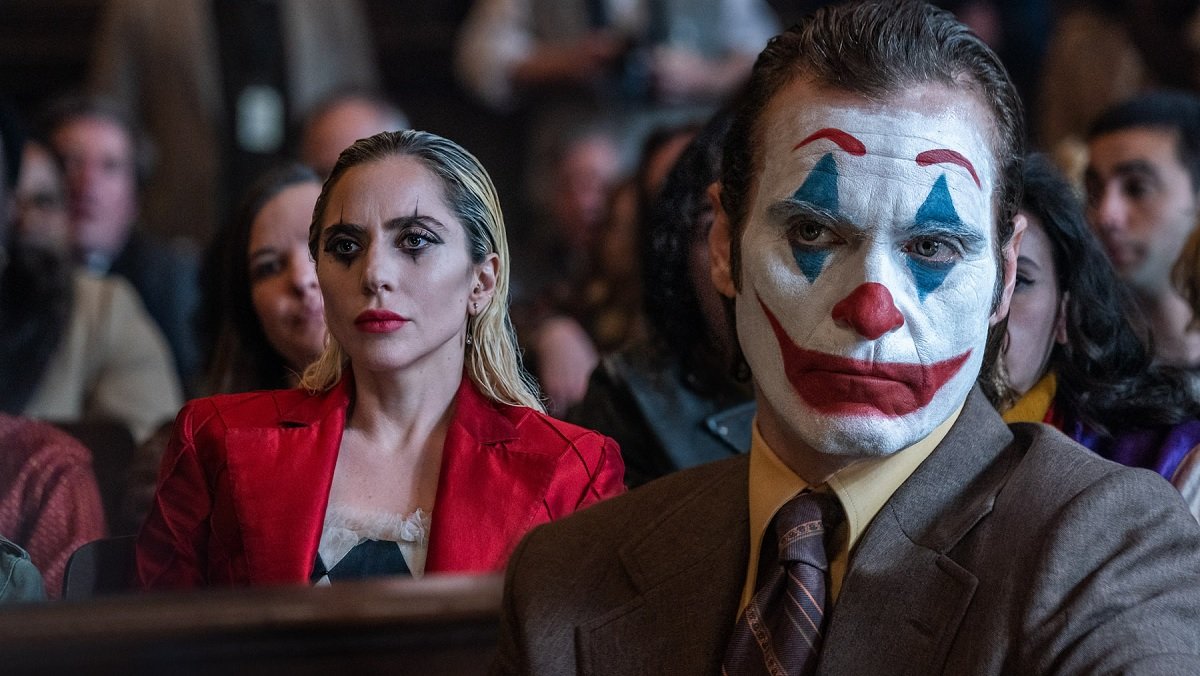
It’s two years after the events of Joker and Arthur Fleck (Joaquin Phoenix) is languishing in Arkham State Hospital, overseen by callous prison warder Jackie (Brendan Gleeson), who seems to delight in humiliating him at every opportunity. (Interestingly, it’s Jackie who tells the nearest thing to an actual joke in this story and, it has to be said, it’s a corker.)

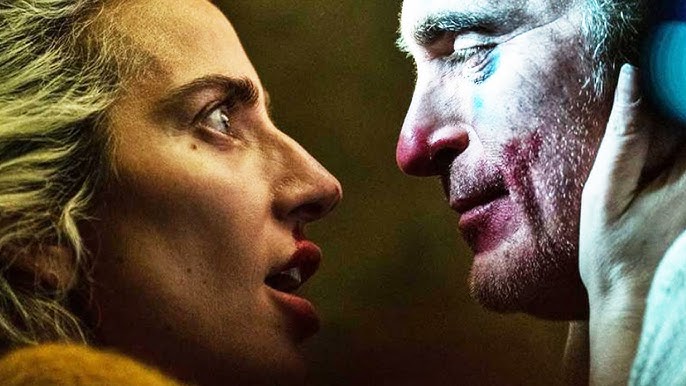
Arthur is fast approaching his day in court, schooled by his defence lawyer Maryanne (Catherine Keener), who is pretty sure that a plea of ‘dissociative identity disorder’ will save him from the death penalty. And then, attending an in-prison musical therapy session where inmates are encouraged to sing their troubles away, Arthur meets Harleen ‘Lee’ Quinzel (Lady Gaga) and, for the first time in his life, he has a reason to want to survive… and to slap that makeup back on his gaunt visage.

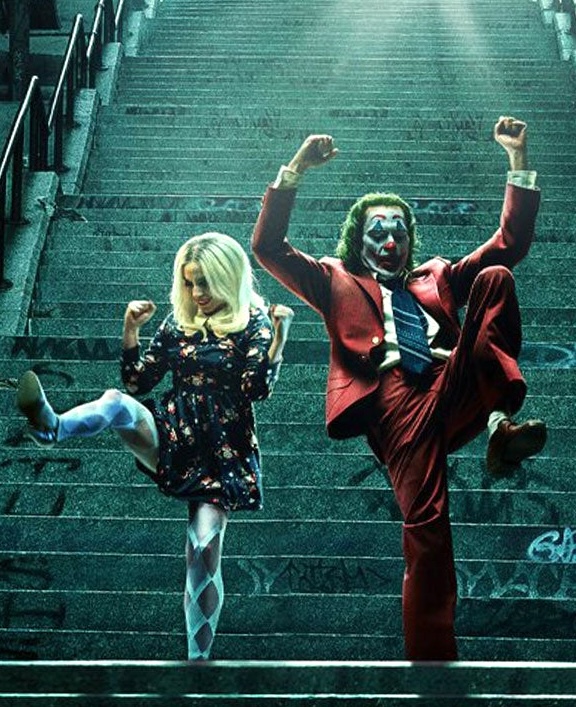
The term ‘musical’ is used quite loosely here. Phoenix and Gaga work their way through a series of solid gold bangers from the likes of Sinatra and Jaques Brel, but it’s made clear from the outset that these sequences occur in the cerebral landscape of Arthur’s head, his way of making sense of what’s happening to him. (Those with long memories may be reminded of Dennis Potter’s Pennies from Heaven, which adopted a similar approach.) A scene where Arthur is being interviewed by TV journalist Paddy Meyers (Steve Coogan) is a good case in point. Midway through the interview, Arthur suddenly breaks into song and dances around his cell – but Paddy remains blissfully unaware of his antics.

Phoenix is an actor of extraordinary ability and he slips into this unfamiliar discipline with his usual aplomb, using his newly slimmed-down frame to accentuate every move. Gaga, who has much more experience in the field, is also sensational, able to imbue an old chestnut like Get Happy with a strangely sinister edge, making me feel that I’m hearing it for the first time. As with the previous film, Philips steadfastly refuses to moderate his approach for the spandex brigade, doubling down on the grime and squalor. Folie à Deux is every bit as unsparing and unforgiving as its predecessor, whilst somehow managing to retain a beautiful humanity.

This may not be the perfectly-honed movie that was Joker, but for my money, it runs it a close second and is far (very far) from the embarrassing misfire that so many are describing it as. Some irate comic fans seem to have been hoping for a rerun of its predecessor, but what would be the point of that? I can’t help feeling they’ve somehow missed the point.

But then, I’m always happy to admit that I love a good musical.

4.6 stars

Philip Caveney