The First King of England in a Dress

14/08/19

theSpace Triplex (Studio), Edinburgh

Epic Tales give a likeable performance in The First King of England in a Dress, a story of Vikings and English folk – and, of course, good ol’ King Canute. Between them, Kate Madison, Chip Colquhoun and Izzy Dawson portray a raft of characters, holding the audience’s attention with ease.

It’s not perfect. For starters, it’s crying out for a soundtrack to help convey both mood and location. And I’m not sure why the audience participation is limited to reluctant adults; it seems to me it would make more sense to take enthusiastic child volunteers. Sure, they’re less predictable and might derail the story a little, but I think the cast should take that risk. The piece could benefit from the silliness that may ensue, and it’d be easy enough for these seasoned storytellers to get things back on track.

The biggest issue for me though is the gender stereotyping, which seems a little out of step with current thinking. Of course, the story demands that girls are disguised as boys to escape the evil woman-hunting monks, but the narrative could surely acknowledge that’s not how we do things now, that signifiers such as dresses and long hair are no longer important.

Still, it’s an enjoyable fifty minutes, and these three performers certainly know how to tell a tale. The props are detailed and interesting, creating a real sense of the time and place. Young performer Izzy Dawson has a truly lovely singing voice, and I like the use of the lyre to accompany her. A rain stick is also utilised to great effect.

These three actors have an easy rapport with the kids in the audience, and have created an enjoyable little show.

3 stars

Susan Singfield

Daliso Chaponda: Blah Blah Blacklist

13/08/19

Gilded Balloon Teviot (Wine Bar), Edinburgh

A heads-up for readers new to Bouquets & Brickbats: Daliso Chaponda is a friend. We don’t usually review our mates’ work (waaaay too awkward), but we transgressed this unwritten rule a long time ago with Daliso, so it seems silly to stop now. Especially when there’s so much to say about his latest show.

Blah Blah Blacklist is deceptively genial: the tone is light, but there’s a controversial undercurrent. The show is about our reactions to fallen heroes: do we need to ‘cancel’ them or can we continue to enjoy their work whilst despising what they’ve done?

But it’s about more than that too. Daliso is an advocate for nuance: Bill Cosby’s criminal activities are beyond the pale, but maybe Louis CK can be redeemed? It’s a brave show in many ways, challenging woke responses as much as racist ones. Daliso has no time for easy answers: this is an intelligent, thought-provoking hour, the gentle, questioning approach belying the force behind it. Oh, and did I mention? It’s very funny too.

The theme is expanded, as Daliso moves from disgraced celebrities to something more personal: his own father (a much-loved government minister in Malawi) is accused of committing a crime. Another potentially fallen hero, and this one much closer to home. He stands by his dad – ‘80% sure he’s as innocent as he claims’ – and witnesses first-hand the ire of those convinced of his guilt.

Daliso has a wider perspective than most: he’s lived in nine countries on four continents; Britain is, he says – despite the polarising views expressed online – the most accepting place he knows. But that doesn’t mean he’s going to let us off the hook…

An astute, perceptive and laugh-out-loud show – you really shouldn’t miss this one.

5 stars

Susan Singfield

Blizzard

13/08/19

Assembly Hall, Edinburgh

I’m not usually a big fan of the circus. The glitzy outfits and macho posturing tend to put me off and prevent me from concentrating on the undoubted skills of the performers. But here I sit amidst a packed crowd at the Assembly Hall. My heart’s in my mouth and I’m thrilled to the core as I watch a team of acrobats hurtle up and down on a trampoline. They land like soaring birds on a precarious wooden perch high above me.

Flip Fabrique hail from Quebec and they are unlike any troupe I’ve seen before, presenting a strange but enchanting blend of circus skills, theatre and music. The conceit of Blizzard is that it takes place during ‘adverse weather conditions.’ Snow flakes drift down onto the stage as people trudge out of the wings wreathed in hooded parkas – but, within moments, the sensible clothing has been cast off and  an aerial act is whirling magisterially overhead.

A snowball fight turns into a symphony of frantic leaping and somersaulting. A performer is thrown effortlessly through the air and caught, an instant before her head makes contact with a wooden floor – no safety nets here! And, throughout the show, Ben Nasrellah performs a live score, tinkling  away on a state-of-the-art keyboard cloned with an upright piano, strumming on a guitar and, at one point, compelling the audience to clap gleefully along with him. He’s as integral to this act as the other performers.

I love the precision of this show, the way that every component (including that amazing keyboard) is wheeled smoothly around to accomodate the next sequence – and the next. The finale features a huge metal rectangle, hoisted up to balance improbably on one corner while the entire troupe clambers around inside it like a swarm of industrious insects. The result is breathtaking.

If you see only one circus act during the Fringe, Blizzard is the family-friendly spectacle you don’t want to miss. It is, quite simply, stunningly good.

4.8 stars

Philip Caveney


In PurSUEt

13/08/19

theSpace at Niddry Street (Lower Theatre), Edinburgh

I’m drawn to this show by the vibrant poster; I quite like Ms Perkins, and the tale of a quirky superfan (apparently based on a true story) is appealing to me. In reality, Eleanor Higgins’ In PurSUEt  isn’t so much about the titular Sue, as it is about the protagonist’s struggle with alcoholism.

It’s not really In PurSUEt’s fault that I’ve seen a few too many introspective shows at this year’s fringe – there are, for some reason, lots of micro-dramas about personal issues. As I tend to prefer more outward-looking work (I like intimacy in drama, but find it more interesting if there’s something more universal in the mix), I guess I’m just not this production’s target audience.

I have a few issues with the story too: I get very little sense of the character’s life outside of booze-and-Sue (she must have one; how else is she funding her impulsive trips in pursuit of her heroine?). And why doesn’t Sue recognise her after so many odd encounters? I’m not even sure what it is about Perkins that attracts Higgins in the first place, because she never says what it is she finds so appealing about the Bake-Off star.

Still, there’s no denying that Higgins is an engaging performer, and there are some funny sequences here and quite a few cutting one-liners. She also, as it turns out, has a lovely singing voice. And, in the end, her redemption feels earned.

3 stars

Susan Singfield

The Professor

12/08/19

Assembly Rooms (Drawing Room), George Street, Edinburgh

The audience files politely into the theatre and we take our seats. The lights dim and in comes our speaker for the day, who assigns us the roles of university students, here to attend his latest lecture. None of us feels inclined to argue the point. He immediately announces that today’s talk will take a break from the advertised subject and will instead make a few unexpected detours. Written by Brian Parks and performed by David Calvitto, The Professor depicts a man on the verge of a change – and moreover, not one he’s making by choice.

So we are offered a scattershot lecture on the joys of mathematics, the history of theatre and a snarling put down of the limitations of dance. Calvitto steers his way expertly through the very witty and hyper-verbose script, occasionally delivering dazzling one-liners and even pausing at one point to perform some lines in verse (because poetry that doesn’t rhyme is worthless, right?), accompanying himself on a mandolin. What’s clever here is that this professor cannot resist thrusting large chunks of his own prejudices and foibles into what ought to be a dispassionate account. He also believes that cats (and racoons) can read books. Don’t ask. And all of this, really, is just an elaborate set up for what must be the most protracted fart gag in history.

This is a slight but pleasing piece that starts and ends strongly enough, but feels a little unfocused in the middle.

Those who have worked in the world of academia will doubtless recognise a lot of what goes on here. The rest of us will just be too busy giggling about that fart joke.

3.5 stars

Philip Caveney

Boswell

Boswell 2

11/08/19

PQA Venues at Riddle’s Court, Edinburgh

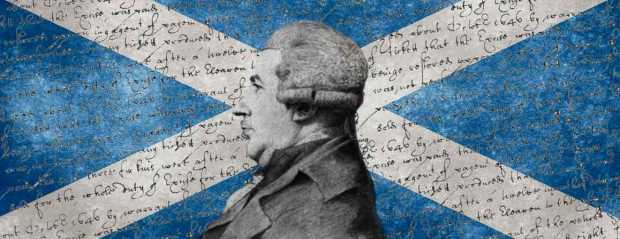
Marie Kohler’s Boswell is an interesting play, offering insight into the relationship between Boswell (Brian Gill) and Johnson (Brian Mani). As the two men embark on their famous 1773 tour of Scotland, they are joined onstage by Joanie Weinstein (Abbey Siegworth), a 1950s American academic, in the UK to research Johnson. Her studies lead her to straight-talking Fiona (Laura Gordon), widow of one of Boswell’s direct descendants, and owner of a trove of unseen documents. Initially dismayed to discover the boxes contain far more Boswell than Johnson, Joanie soon finds herself fascinated by the former’s candid journals, and is determined to find out more about the libidinous ‘scribbler’.

The action cuts nicely between the two time periods. Joanie is ever present; it’s her reading of Boswell’s papers that is being played before us. The script is well-written, with witty dialogue and an energetic pace. Of course it takes liberties with the facts – it’s a play, not a historical document – but it evokes the 1770s well, and gives a real sense of the men’s relationship.

I like most of the humour. An early scene where David Garrick makes an appearance is particularly amusing, and Johnson’s curmudgeonly dismissal of the Scots is laugh out loud funny. Less successful are the repeated ‘don’t Scottish people sound funny?’ lines, particularly as – with the exception of Brian Gill – the Scottish accents deployed by the actors are uniformly atrocious (the acting is generally very good, but those accents… oh dear…). This is, it must be said, a bit tone-deaf.

The thawing of hostilities between Joanie and Fiona is nicely drawn, and the parallels between the two friendships are clear. It’s a neat trick to introduce David Hume as well, one-time inhabitant of this venue here at Riddle’s Court.

3.8 stars

Susan Singfield


Fishbowl

11/08/19

Pleasance Grand, Edinburgh

This quirky, captivating production from French theatre group Le Fils Du Grand Réseau is a recent winner of the Molière award for Best Comedy, and is playing to packed houses at the Pleasance Grand. It’s easy to see why. With its impeccably timed visual gags and ingenious production design, it contains beautifully devised sequences that are comparable to the work of Mack Sennet at his best. It is, essentially, a silent comedy, one that – again and again – elicits absolute gales of laughter from the auditorium.

This is all about the eccentricities and indignities of city living. We observe the lives of three neighbours, living cheek by jowl in adjoining attic apartments in Paris. There’s a shambolic hoarder, eking out a lonely existence amidst chaotic heaps of detritus; a karaoke-loving guy who inhabits a zen-like, white painted box; and a new arrival, a woman who styles herself as a holistic healer-hairdresser-masseur, but who clearly has none of the necessary training to practise these skills with any degree of success. When both men cast an asquisitive gaze in her direction, the scene is set for a series of rivalries and madcap misadventures.

There’s something deliciously old school about this production. I love the way it tells its unfolding story over an extended period of time, showing how people have the capacity to change – and I particularly like a brief moment where the technicians toiling behind the scenes are ‘accidentally’ put on display. If the story occasionally leans a little too heavily on the toilet gags, it’s nonetheless endlessly inventive, and I can truthfully say it isn’t quite like anything I’ve seen before.

Book your seats for the Grand. You’ll laugh mightily, even when the merde hits the fan.

4.5 stars

Philip Caveney

Tess

10/08/19

theSpace at Surgeon’s Hall (Fleming), Edinburgh

Tess (of the d’Urbervilles) might not seem like an obvious choice for a late night Fringe show, but Ondervinden and G & T Productions’ rumbustious interpretation is perfectly suited to its time slot: a lively ‘pint-in-hand’ production, with live folk music and gutsy performances.

The three-hander, written and directed by Elske Waite, is a sprightly affair, illuminating  the core of Hardy’s novel. It’s the same plot (impoverished country girl raped by entitled rich man then spurned by society), but this version is a lot less dour than its progenitor, and there’s a welcome dose of feminism thrown into the mix. The music (courtesy of Jonathan Ip, Tenzin Stephen and Isla Ratcliff) makes a perfect accompaniment for this rollicking adaptation.

Polly Waldron plays Tess, imbuing her with such childish innocence that only a stone-hearted person could fail to be moved by the abuse she suffers. But she’s not silent, and I like that: she knows she is being cruelly wronged, and she stands up for herself. Emily Windham and Colette McNulty play all the other characters, with token costume additions to symbolise a change of role. It’s nicely done: McNulty excels at the comic stuff, while Windham is perfect as Angel Clare, his chilling self-righteousness horribly exposed.

The set design (by Khadija Raza) is simple but witty; I especially like the cow, made from a sawhorse and a rubber glove, and the quirky humour of a tiny piece of astroturf.

So don’t be put off by the idea of Thomas Hardy as an evening out. This Tess knows how to party.

4.2 stars

Susan Singfield

The Legacy of William Ireland


10/08/19

PQA Venues, Riddle’s Court, Edinburgh

Ah, the unforgettable works of Shakespeare! Anthony and Cleopatra, Romeo and Juliet, Vortigern and Rowena… wait… Vortigern and Rowena? Chances are you’ve never heard of that one, mostly because it wasn’t actually written by the bard of Stratford but by a wannabe poet and playwright named William Henry Ireland, who also pursued a lucrative sideline in passing off his mediocre efforts as the work of the great man himself.

It all began modestly enough, with Ireland forging bills-of-sale bearing Will’s signature, mostly in an attempt to impress his Shakespeare-obsessed father, but – as time went on – things got somewhat out of hand…

This wittily scripted monologue by Tim Connery depicts Ireland as his deception is uncovered, understandably nervous and ready to flee for his life. Charlie Jack not only plays the fraudster with self-deprecating aplomb, but also looks uncannily like the man himself. I find myself torn between despising Ireland’s guile and feeling rather sorry for him, since the whole deception appears to be fuelled by a desperate attempt to impress the father who clearly hates him.

This is a fascinating look at a little-known historical event and, apart from a bit of dramatic licence in the final act, it sticks pretty close to the unbelievable truth.

Anyway, enough of this. I’m off to forge a new Harry Potter novel. You never know, it might just work…

4 stars

Philip Caveney


Frankenstein

10/08/19

theSpace on North Bridge (Perth), Edinburgh

I love Frankenstein. I’ve read the novel so many times it’s as familiar as a friend. I love the story behind it too, and never fail to marvel at the nineteen-year-old girl who could produce such a masterpiece. Of course, I’m not alone. This slim volume has inspired all manner of creatives to explore its possibilities in other forms, and now it’s Birmingham-based Blue Orange Theatre’s turn to have a go. What can they add to the mix?

Frankenstein is played here as a three-hander, focusing on The Creature’s story, with Taresh Solanki delivering an impressive performance as the protagonist. He’s all tension and sinew: a feral, frightened beast. Once in the proximity of humans, he begins to emulate their behaviour, and Solanki’s movements change accordingly: he grows more upright, his language skills develop. The physicality of the transformation is arresting.

James Nicholas and Emma Cooper embody all the other roles, taking turns to narrate the story as the action unfolds. I like the way the narration switches from third person to first as The Creature learns to speak, and the way all three performers inhabit the small stage. Between them, they do the novel proud.

Frankenstein, told this way, is an ideal piece for the Fringe, where a few simple props, some wooden crates and a white sheet can evoke an entire world.

4 stars

Susan Singfield