
Home by Nico: Cooking ‘Vietnam’

07/04/21

http://www.home-x.com

In the current situation, the best chance of enjoying a memorable meal – short of making it yourself – is either the perennial takeaway or one of those ‘cook at home’ boxes. Over the past year, we’ve sampled quite a few of the latter, from different sources, with varying degrees of success. Something about the ‘Vietnam’ menu from Home by Nico hooks us, so we book it in for a suitable evening and, on the appointed day, within a designated one hour time slot (always useful), a box with the approximate dimensions of a small continent arrives at our door.

Once opened up, and unpacked, it’s apparent that the Nico team have put quite a bit of thought into this. We notice for instance, that the containers holding the various courses are composed of recyclable materials with a removable plastic veneer. This cuts down considerably on the inevitable landfill. We’ve often felt guilty about the wastage on some of the earlier meals we’ve sampled, so this feels like an important step in the right direction. The chefs have also tried hard to make us feel like we’re being suitably spoiled. They’ve provided enticing little boxes of garnish for each course and, though there is a certain amount of preparation required on our part, it’s no great hardship, with every step carefully explained. You’d be hard put to get it wrong.

For starters there are Duck Bao Buns – gloriously sticky steamed confections with a generous shredded duck filling and a selection of appetising garnishes including pickled vegetables, hoi sin roasted peanuts and crispy shallots. To say that the course is flavoursome would be something of an understatement: it is vibrant with flavour, as indeed is everything else about this meal. And the aromas are exquisite!

Next up there’s Hot and Sour Pho – a bowl of smoky broth, with earthy rice noodles, enoki mushrooms, lemongrass and chilli oil. This is perfectly spiced, just hot enough to set my taste buds alight but never overwhelming them. The pho is studded with red chillis and miniature sweetcorn and we polish it off very quickly indeed.

At this point, we take a short break and enjoy a couple of glasses of the accompanying wine, The Rambler, a fruity South African white that makes a perfect cooler after that fiery broth.

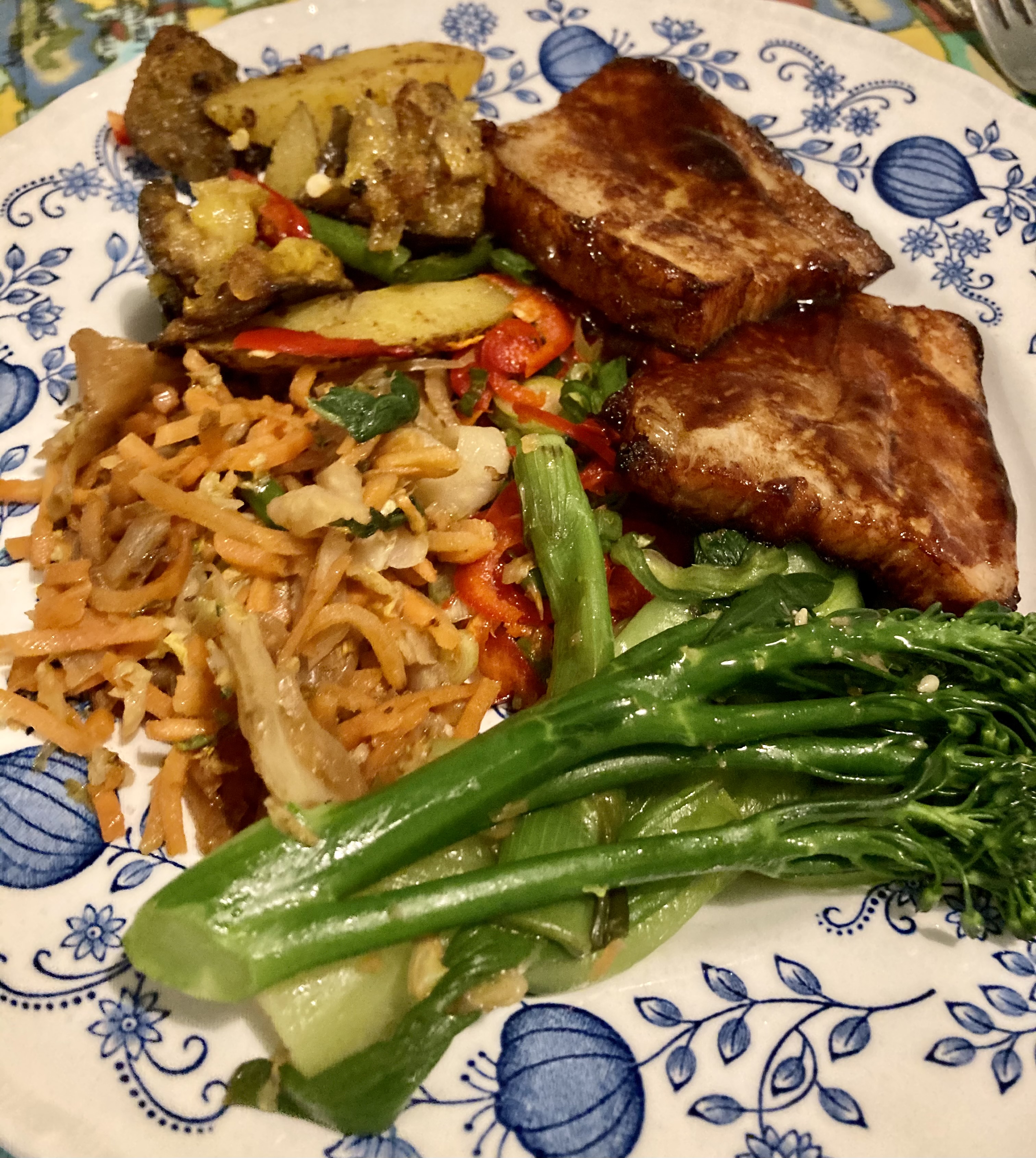
The main course is Caramel Belly of Pork Hot Pot – which is every bit as appetising as it sounds. There are four thick slabs of succulent meat, which need to be fried off, with a covering of aromatic sticky glaze. This is served with stir fried slaw, ginger and chilli. There are also two side dishes – some Sautéed Asian Greens with garlic and ginger; and a Clay Pot Aubergine, with green beans and chunks of potato. Individually, all the elements are good, but, when put together on a plate, they create a kind of magic.

Our past experience has been that the sweet is often a disappointment in these home boxes, but happily, this is not the case here. The Vietnamese Coffee turns out to be a thick, smooth pannacotta, with coffee sponge and a layer of crispy coffee crumb on top. It’s deliciously indulgent, almost velvety in its smoothness – and the fact that it comes in a re-useable glass jar is an added bonus. This pudding is irresistible right down to the last spoonful.

All-in-all, this might just be the most accomplished ‘meal at home’ we’ve tried and it serves to exemplify the Nico brand, offering sophisticated cooking at an affordable price. I can’t recommend it highly enough and I’ll be sure to keep an eye out for their next offering.

5 stars

Philip Caveney

Minari

02/04/21

Curzon Home Cinema

This is our second Korean language film in a row, but the differences between The Gangster, the Cop, the Devil and Minari couldn’t be more marked. While the former is a brutal, no-nonsense punch to the gut, Minari is gentle, lyrical and beautifully understated – yet within those lovingly crafted twists and turns lies a powerful message about the importance of family and the folly of blind ambition. And, while the first film stays within the harsh confines of an Korean city, this one ventures out into the American midwest.

Jacob Yi (Steven Yeun) is a Korean immigrant, doggedly pursuing his personal dream in the wilds of Arkansas, dragging his wife, Monica (Yeri Han), and his children Anne (Noel Cho) and David (Alan S. Kim) along behind him. Jacob and Monica make their living sexing chicks – and trust me, that really is a valued occupation in this neck of the woods – but Jacob has bigger dreams. He longs to own his own farm, to grow vegetables in order to supply the ever burgeoning numbers of Korean supermarkets around the area.

But it’s going to require some hard graft. First a well needs to be dug, one that will supply him with enough water to get him through that all-important first year. And then the crop needs to be tended, around the clock.

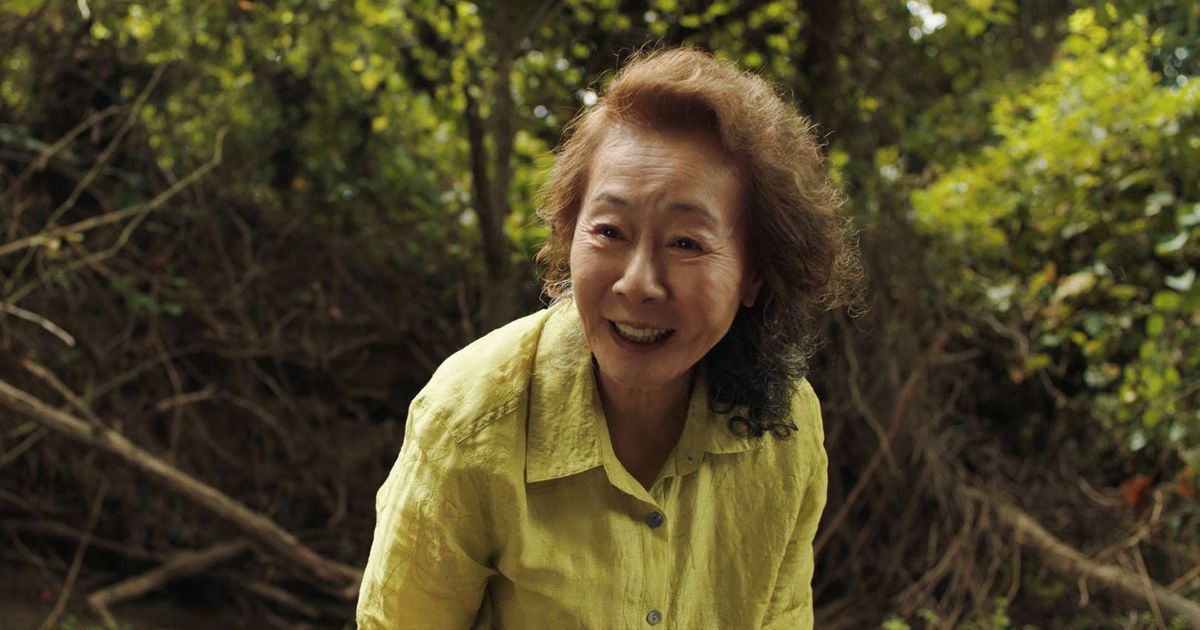
It’s not plain sailing. For one thing, young David has a serious heart condition, which means he must never ever exert himself – and for another, Monica doesn’t share Jacob’s ambitions for the future. She’s not mad about living in a trailer in the middle of nowhere and she hates the unfamiliar wide open spaces that surround her. In order to lighten the load, Monica’s Mother, Soon-ja (Yuh-Jung Youn), is brought over from South Korea to live with the family. Soon-ja is a fascinating character, full of contradictions: at times foul-mouthed and openly rude towards her white neighbours; at others sweet, wise and warmly supportive of her grandchildren. David is initially dismissive of her but her influence on him and the rest of the family soon takes root, just as effectively as the Minari seeds she plants down by the creek…

This is a gorgeous film, beautifully acted by the cast – particularly by Yuh-Jung Youn, whose performance has already been rewarded with heaps of best supporting actor nominations. Alan S. Kim is also a constant delight, offering a skilled performance that belies his tender years.

But this film is much more than just an actor-led piece. Lee Isaac Chung, who also wrote the screenplay, handles the directorial reins with consummate skill, while Lachlan Milne’s shimmering cinematography makes every frame a visual delight. I also love that there are so many surprises here. The local community are not the hostile antagonists familiar from so many multi-cultural dramas, but are supportive and welcoming to their new neighbours. Even the initially forbidding, Paul (Will Paton), a local man given to speaking in tongues and lugging a life-size wooden cross around every Sunday, turns out to be a regular pussycat, who wants nothing more than to befriend these new arrivals.

And… isn’t there just a suggestion here of a miraculous happening within the Yi family? Something that, in their struggle for everyday survival, they barely even notice.

This is an absolute must-see, thoughtful, poignant and at times suspenseful. Miss it and weep.

5 stars

Philip Caveney
The Gangster, the Cop, the Devil

01/04/21

BBC iPlayer

Auntie Beeb seems an unlikely place to find this adrenalin-fuelled, kick-ass action movie, but there it is lurking in the vaults of iPlayer, all ready to be unleashed at the touch of a button. Despite that ‘does what it says on the tin’ title, The Gangster, the Cop, the Devil is sure to appeal to fans of Korean cinema – though perhaps not those who ‘enjoyed Parasite but find scenes of exaggerated violence distressing.’ Like many films in this genre, there’s an inordinate amount of fisticuffs, kicks and bullets being exchanged at regular intervals, albeit in a fairly cartoonish sort of way.

‘The Gangster’ of the title is Jung (Ma Dong-seok, previously seen in Train to Busan), a rather unpleasant fellow to be acquainted with, if the contents of his punch bag are anything to go by. Nattily attired and fond of his cigars, he heads up one of the major crime syndicates in his home city of Cheonan and, thanks to the regular bribes he pays to the resident police force, he’s free to ply his various trades – drugs, gambling, extortion, slapping people around – without too much interference.

But, one night, his car is rear-ended by mysterious serial killer, K (Jung Tae-seok – the ‘Devil’ in this narrative), and when Jung gets out to exchange words with him, K viciously assaults the gangster with a large kitchen knife. Not only is this extremely painful for Jung, it’s also something of a professional embarrassment for a man who is supposedly feared by everybody on his home turf. Honestly, what’s the world coming to?

While convalescing from his injuries, Jung is approached by ambitious cop, Jang (Mu-Yeol Kim). He’s exasperated by the fact that his boss is one of the people happily taking bribes from gangsters, and he’s also become obsessed with apprehending K and achieving a promotion as a result. He suggests that Jung might like to team up with him so they can pool their resources in order to catch the killer – a kind of Jung/Jang approach. This all sounds faintly ridiculous – and the claim that the film is ‘based on a true story’ probably needs to be taken with a large pinch of soy – but nevertheless, the result is a proper thrill ride. There are chases, shoot outs and stand offs galore and it’s all backed up by a story that’s clever enough to keep you hooked, even if your eyebrows are likely to remain permanently raised.

Little wonder TGTCTD has already been earmarked for a Hollywood remake, with Sylvester Stallone rumoured to be the major player. Chances are, the Americans will airbrush it until it loses all of its rough charms, so maybe grab your chance to see Won Tae-Lee’s original before it moves on.

Whatever else you feel, you won’t be bored.

4 stars

Philip Caveney

Penguin Bloom

29/03/21

Netflix

The lockdown rolls relentlessly on, and we’re reduced to seeking out those films which, in normal times, we’d steer well clear of. Penguin Bloom is one such feature, sporting as it does a storyline that threatens to be a little too saccharine for comfort. The fact that it turns out to be a true story and – as a series of genuine photographs over the end credits proudly attests – sticks very closely to what actually happened, helps no end. So does director Glendyn Ivin’s ability to stay just the right side of mawkishness throughout. Whenever things threaten to tip over into the land of treacle, Ivin offers us a nasty flashback or a vitriolic outburst, just to make sure we appreciate the very real tragedy of the tale.

Sam Bloom (Naomi Watts) and her husband, Cameron (Andrew Lincoln, making a decent fist of an Australian accent) live a carefree existence in an idyllic home somewhere in Australia, with their three sons. Cameron is a photographer by trade and Sam, when not making her own honey, is a keen surfer. But everything changes irrevocably on a family holiday to Thailand, when oldest son Noah (Griffin Murray-Johnston) discovers a secluded roof garden above their hotel and leads his mother up there to take in the scenery.

However, a dodgy bit of building work quickly puts paid to all the fun and games, as Sam takes a horrific fall from the roof and winds up with a damaged spine, paralysed from the waist down.

Once back home, despite everybody’s best efforts, she fails to come to terms with her situation and, all too understandably, begins to descend into depression. Then Noah discovers a fledgling magpie that has fallen from its nest and persuades his parents to let him bring her into the house. He promptly dubs the bird Penguin (Peng for short) and it isn’t long before the creature has become a vital member of the Bloom family. Sam is at first resistant to Peng’s feathery charms, but as time moves on, she warms to her – and of course, as she works towards helping Peng to learn to fly, so Sam manages to spread her own wings…

See, that does sound horribly sentimental, doesn’t it? And perhaps, if I’m honest, there is a streak of that in here, but what the heck, this actually happened and maybe I need to cut the Blooms some slack. If there is a problem with the movie, it’s one of continuity. Peng looks markedly different in just about every shot, but as the credits eventually reveal, ten individual birds played the title role, so perhaps it isn’t exactly surprising: and, let’s face it, CGI birds never really convince, no matter how much cash you throw at them. And these stunt magpies, if rumour is to be believed, actually work for birdseed. Oh and before I forget, Sam’s mother Jan, is played by Jacki Weaver, who actually does have some authority here (see what I did there?).

Ultimately, Penguin Bloom turns out to be an agreeable way to spend an hour or so and, until cinemas finally reopen their doors, we’re going to have to keep sifting through the bowels of our streaming services in a never-ending quest to find agreeable ways for movie fans to pass their time.

3.6 stars

Philip Caveney

Ammonite

26/03/21

Apple TV

Francis Lee’s God’s Own Country was one of the most powerful film debuts of recent years – a visceral, unflinching exploration of rural life that would have had James Herriot hiding behind the sofa. For his sophomore effort, Lee has changed the era and the mood, taking us to Lyme Regis in the eighteen hundreds, where fossil hunter Mary Anning (Kate Winslet) plies her trade, selling the smaller pieces she finds on her daily visits to the seashore to holidaymakers. The larger pieces are sold to her male colleagues, who then blatantly take the credit for discovering them. Mary is all too aware of this and, as a result, she’s become a prickly and insular character, a quality that comes across as cantankerous to strangers.

Mary is approached by celebrated palaeontologist Roderick Murchison (James McCardle), who wants to learn from her. He brings with him his young wife, Charlotte (Saoirse Ronan), who is mourning a recent miscarriage and is quite unable to pull herself out of her melancholy. When Murchison is obliged to move on, he leaves Charlotte with Mary for a few weeks, hoping that working alongside the older woman will help her to recover. Mary is at first horrified at the idea – she values her privacy. But Murchison is wealthy and willing to pay for his wife’s internship – and Mary needs the money.

When Charlotte falls ill with a fever, Mary is obliged to nurse her – and, as the days unfold, the two women manage to breach the wall that has kept them apart – and start to realise they are falling in love…

Mary Anning was, of course, a real person, and very little is known about the reality of her personal life. Lee (who also wrote the screenplay) has been heavily criticised for portraying her as a lesbian, accused of taking liberties with the ‘truth’ about her – though I’m willing to bet that, if the film had featured a fictional heterosexual relationship, nobody would have turned a hair. But, having read up on her, it’s impressive to note how much of the story sticks closely to what we do know about the real Mary Anning. What’s most important here is that, because of her gender, she was discriminated against on a daily basis – even though it is now widely accepted that she was one of the most knowledgable people in her field. Like so many Victorian women, she was a victim of the patriarchy, robbed of the credit for so much of what she achieved.

Winslet is simply terrific in the central role, conveying Anning’s awkwardness and inner turmoil in the stolid set of her shoulders, the furtive glances that seem constantly to be seeking escape. She is a misfit, struggling to survive in a world she’s not cut out for. Ronan too, is completely believable as a young woman searching for consolation after an overwhelming loss – and finding it in an unexpected love affair. Shot in what looks like genuinely horrible weather conditions, Stéphane Fontaine’s cinematography captures the bleak, rugged beauty of Dorset and this is echoed by a sumptuous score courtesy of Volker Bertelmann and Dustin O’Halloran. If that’s not enough to entice you, there’s also a lovely cameo performance from Fiona Shaw as Mary’s old flame, Elizabeth.

Ammonite may not have the immediate impact of God’s Own Country, but it’s an exquisitely handled film with an absorbing tale to tell. Lee’s central premise seems to be about the trophies we collect in life, from fossilised remains in glass cases to the lives of those who follow us through the twists and turns of history. It’s well worth your attention.

4.4 stars

Philip Caveney
Moxie

26/03/21

Netflix

Let’s not waste time getting to the point. Here it is: I love Moxie.

Amy Poehler’s second directorial effort tells the tale of Vivian (Hadley Robinson), a sixteen-year-old high school student, who rarely raises her head above the parapet. She’s painstakingly ordinary: quiet but not distressingly so; bright but not a star student; she has friends but isn’t ‘popular.’ When it comes to filling in her university application, her personal statement proves a stumbling block. Because – like countless others – Vivian hasn’t got a ‘thing’: she isn’t on the soccer team, she’s not a cheerleader; she doesn’t act, dance or play chess; she hasn’t got a passion for astronomy or baking; she doesn’t have any burning ambition or sense of what she wants to do. She’s just a kid, muddling through, worried that she’s not good enough.

Although we’re never told exactly where Rockport High School is, there’s a definite sense of small-town claustrophobia. The students have all known each other since kindergarten, and their roles are long-established. Of course, there are some surprises, such as Seth the Shrimp (Nico Hiraga) suddenly appearing a lot less shrimpish after a summer growth spurt, but there’s a general acceptance of how things are. It’s how they’ve always been, right?

But then newcomer Lucy (Alycia Pascual-Peña) shows up, and views her classmates with fresh eyes. She can see that Mitchell (Patrick Schwarzenegger) isn’t just annoying; he’s an entitled bully. When she calls him out, she’s urged to let it go: Principal Shelly (Marcia Gay Harden) tells her to grow a thicker skin, and Vivian offers her advice on how to fly under his radar. But Lucy isn’t prepared to indulge Mitchell. She stands up to him, even though it makes her a target.

Vivian is inspired.

And so Moxie is born: an anonymous fanzine; a call to arms. Vivian starts small, urging girls to decorate their hands with hearts and stars in a gesture of solidarity, but the movement soon snowballs, threatening the core of the establishment.

As I said, I love Moxie. Although it’s billed as a teen comedy, I think it’s more of a drama, albeit with some funny bits. I’ve seen it unfavourably compared to Booksmart or Eighth Grade, but these comparisons seem to me to miss the point. I love those films too, but they’re primarily coming-of-age stories. As is Moxie, but that’s not it’s main function. Instead, it’s a clear answer to the question, ‘But what can I do?’

Okay, so it’s not subtle. What we have here is a stark depiction of what toxic masculinity is: the dreadful impact it has, how it’s enabled, and how it might be challenged. If I had a teenage daughter, I’d want her to watch this. In these polarising times, it’s good to see something that focuses on connections – on what unites us rather than divides us. So yes, there’s a visible effort to tick all the boxes here – it’s done in plain sight. Vivian learns from her mum, Lisa (Poehler)’s mistakes. ‘We weren’t intersectional enough,’ Lisa says of her own activist past. The film acknowledges that white, middle-class Vivian’s isn’t the only voice that should be heard; everyone’s experience is different. Her best friend, Claudia (Lauren Tsai) is exasperated as she tells Vivian why an immigrant might find it harder to draw attention to herself, for example. We hear from black girls, Asian girls, ‘popular’ girls, quiet girls, sporty girls, disabled girls, clever girls, straight girls, queer girls, non-binaries and ally boys. Because representation and inclusion matter if we’re to forge change and build a fairer, better society.

The Mitchells of this world (the Trumps, the Johnsons) believe in their right to win – and they often do. The odds are stacked in their favour. But we can change that, one Sharpie heart at a time.

4 stars

Susan Singfield

Judas and the Black Messiah

25/03/21

Apple TV

The ‘Judas’ in this story is Bill O’Neil (LaKeith Stanfield), a petty car thief who habitually pretends to be an FBI officer in order to ply his trade. Arrested by the police, he’s approached by genuine FBI Agent, Roy Mitchell (Jesse Plemons), who points out that O’Neil is now facing a lengthy stretch in prison – six months for stealing a car and five to six years for impersonating an officer.

Or, he might prefer to do the Feds a favour and become their snitch, posing as a member of the burgeoning Black Panther movement. Agree to that and he can walk free.

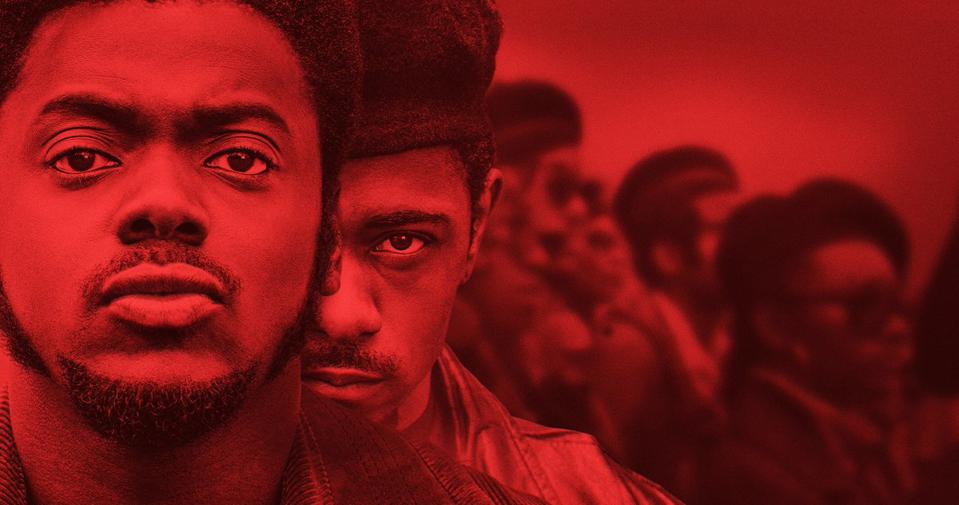
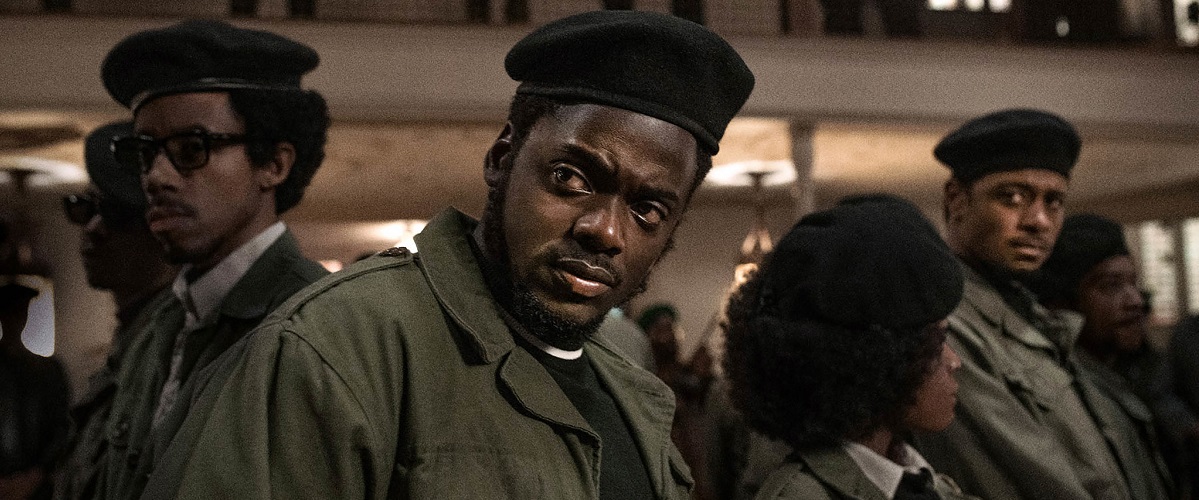
Perhaps not surprisingly, Bill chooses the latter option and, provided with a decent automobile by his new chums, he’s soon acting as driver to the ‘Messiah’ of the story – Black Panther Chairman, Fred Hampton (Daniel Kaluuya). Hampton is a charismatic and influential mouthpiece, who has his eyes resolutely fixed on the emancipation of Black America. With this in mind, he sets about uniting the various gangs of the city into something he calls The Rainbow Coalition. The white powers-that-be are getting decidedly nervous as the Panthers’ power steadily grows and, of course, there will be consequences…

Shaka King’s slickly directed film is set in a grimy, neon-lit vision of Chicago in the 1960s, an urban powder keg perpetually battered by rain; the city almost becomes another character in the narrative. Perhaps it’s a coincidence that Plemons’ smug and smirking Roy Mitchell looks uncannily like Donald Trump and that Martin Sheen’s oily turn as J. Edgar Hoover eerily evokes the oleaginous style of Rudy Giuliani – but I’m inclined to think otherwise. At any rate, the screenplay makes no bones about it. These are power-mad Machiavellian types, who will stop at nothing to assert their absolute authority.

Daniel Kaluuya’s career has soared meteorically since starring in Get Out and he certainly makes the most of his role here. Hamptons incendiary sermons make it easy to understand why he holds so much sway over his disciples – and why the white rulers of America are terrified of his influence. Little wonder the performance has generated substantial Oscar buzz. Stanfield too is excellent in what is arguably the more difficult role, clearly showing in every frame how conflicted his character is, how degraded by participation in Mitchell’s schemes. As well as providing a thrilling narrative, Judas and the Black Messiah is also extremely informative, filling in many of the gaps in my knowledge of the Black Panther movement. When I was a youngster, its members were always painted as evil troublemakers. In retrospect, it’s easy to see that right was on their side.

The list of injustices meted out to Black Panther members is long and shameful – a callous list of beatings, wrongful imprisonments and murders, mostly inflicted on people whose main ambition was to be free. It’s sometimes hard to believe that the incidents portrayed here happened in my own lifetime – and it’s also sobering to reflect that so little has changed since then.

And, lest I try to console myself by saying, ‘well, it was another time,’ the film’s poignant coda reveals exactly what happened to O’Neil, decades after the turbulent events portrayed here.

Shame is clearly something that lasts a lifetime.

4.4 stars

Philip Caveney

Cherry

16/03/21

Apple TV

The Russo Brothers – Anthony and Joe – are among the most successful filmmakers in history. Avengers: Endgame was, until recently, the most watched film ever (it was only a judicious re-release of Avatar that put that particular trophy back into James Cameron’s hands and that may be a temporary arrangement). It was always interesting to speculate about where the Russos would go next.

On the face of it, this Apple Original film seems a surprising move for them. Adapted from Nico Walker’s semi-autobiographical novel, it mostly concentrates on the life on just one man. Even though he’s played by Spider-Man’s Tom Holland, he’s a pretty ordinary Joe, not given to wandering about in brightly coloured spandex or indulging in extended punch-ups with supervillains. This is, ostensibly, an intimate story – and yet, the Russo’s bombastic style somehow gives it an epic scope, an almost operatic quality, which is enhanced by Henry Jackman’s stirring score.

When we first meet Cherry, he’s in the process of robbing a bank (not his first time) and is chatting amiably to the audience as he goes about it, a daring conceit that really pays off. He’s also about to make a decision that will change his life irrevocably.

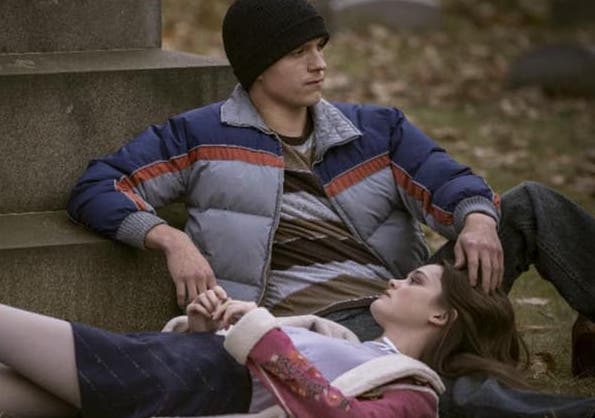
It’s at this point that the film whisks us way back to his fresh-faced teenage years, where, in the first of a series of separate episodes, he encounters Emily (Ciara Bravo), the young woman who will become his significant other. A romance duly ensues but, after Emily announces she wants to move to Montreal, Cherry rashly enlists in the army, realising too late that his partner has changed her mind. and he cannot change his. Soon afterwards, he’s plunged headlong into military training and, subsequently, armed combat. The film’s initial brash, cheerful tone veers into darker waters and keeps on going, full speed ahead.

Once out of the armed forces, and suffering from undiagnosed PTSD, Cherry seeks solace in drugs. At first he’s merely overindulging in Xanax and OxyContin, but then he and Emily start the long descent into hardline heroin addiction, in a series of no-holds-barred sequences that make Trainspotting look like a nice day at the funfair. Yes, this is unremittingly bleak subject matter but the story never relaxes its stranglehold on my attention. I find myself compelled as much as I’m appalled and, occasionally, I’m dazzled by unexpected bursts of brilliance.

The director’s final tour de force is the unfolding of fourteen years of narrative in one mesmerising tracking shot, accompanied by Puccini’s Vissi D’Arte. It’s an audacious move and really shouldn’t work, but somehow it’s pulled off with a flourish. Hats off to Tom Holland, who manages to give his all to a role that sees him age from boy to man with absolute conviction.

This really won’t be for everyone – the film never hesitates to show the depths that can be plumbed when drug addiction holds sway. Others have accused the Russo’s of employing style over content, but I disagree. Cherry’s story must be an all too familiar one for so many young soldiers, put through the mincer of warfare and then left to make their own way back into everyday existence. With its epic feel, Cherry makes that story both heroic and tragic in equal measure.

4.6 stars

Philip Caveney

Adam

15/03/21

BBC iPlayer

Trans men must be one of the most under-represented groups in the UK. I read a lot of news; I watch a lot of films and, when there are no pandemic restrictions, I am an avid theatre goer. But, despite the (anecdotal) fact that I know more trans men than I do women, I very rarely see them referred to; their stories largely seem to go untold.

Adam, then, is important not just because of what it says, but because it exists at all – and on a mainstream platform too. The BBC is under fire at the moment, but we shouldn’t forget what it offers us. If commercial viability is the only factor by which content is judged, marginalised people remain invisible to the masses, their experiences rendered forever ‘fringe.’

Indeed, Adam premiered at the Edinburgh Fringe in 2017, a National Theatre of Scotland production at the Traverse Theatre, where it was highly acclaimed. This new version, written by Frances Poet and directed by Cora Bissett and Louise Lockwood, again stars Adam Kashmiry as himself, and chronicles his experiences as an Egyptian trans man, alone and frightened in a Glasgow flat, awaiting the results of his asylum application. Adam can’t return to Egypt: revealing his true identity there could result in his death. But he can’t use his gender identity to claim asylum in the UK until he transitions, and he can’t transition until he is granted asylum. Trapped in this double bind, no wonder Adam struggles to cope…

This hour-long film is beautifully constructed. It does always feel more like a play than a movie, but that’s not to its detriment. Yasmin Al-Khudhairi appears as Adam’s female-looking outer self, and offers us an occasional and understated glimpse into how others perceive him. The rest of the supporting cast is strong too, especially Neshla Caplan as a sour-faced immigration officer. But this is Adam Kashmiry’s story, and it is his film too: his performance is compelling, haunting – and heartwarming. Because, although this story is one of unimaginable hardship and pain, it’s also one of triumph over adversity. Here he is: a free man, telling his own tale.

4.4 stars

Susan Singfield

Kyloe at Home

15/03/21

http://www.kyloerestaurant.com

We’re in the middle of a pandemic and we’re both longing for a proper Sunday dinner – you know the kind of thing: a succulent roast joint, crispy potatoes, lashings of gravy. Of course, not so very long ago, such meals could be found at the drop of a hat in any number of restaurants and bars around our home city. Kyloe was always first choice for the old Sunday dinner, though. There’s much to be said for that wonderful feeling of anticipation, as you watch a huge joint being carved right in front of you before being dispensed onto dining plates…

Ah well, until those days can be properly recaptured, Kyloe has set up an ‘at home’ dining experience – which is why on the first available Sunday, we find ourselves wandering over to McLaren’s on the Corner in Bruntsfield (it’s part of the same group, Signature Pubs), where we collect a surprisingly huge cardboard box containing everything we need to create the kind of repast we’ve been dreaming of.

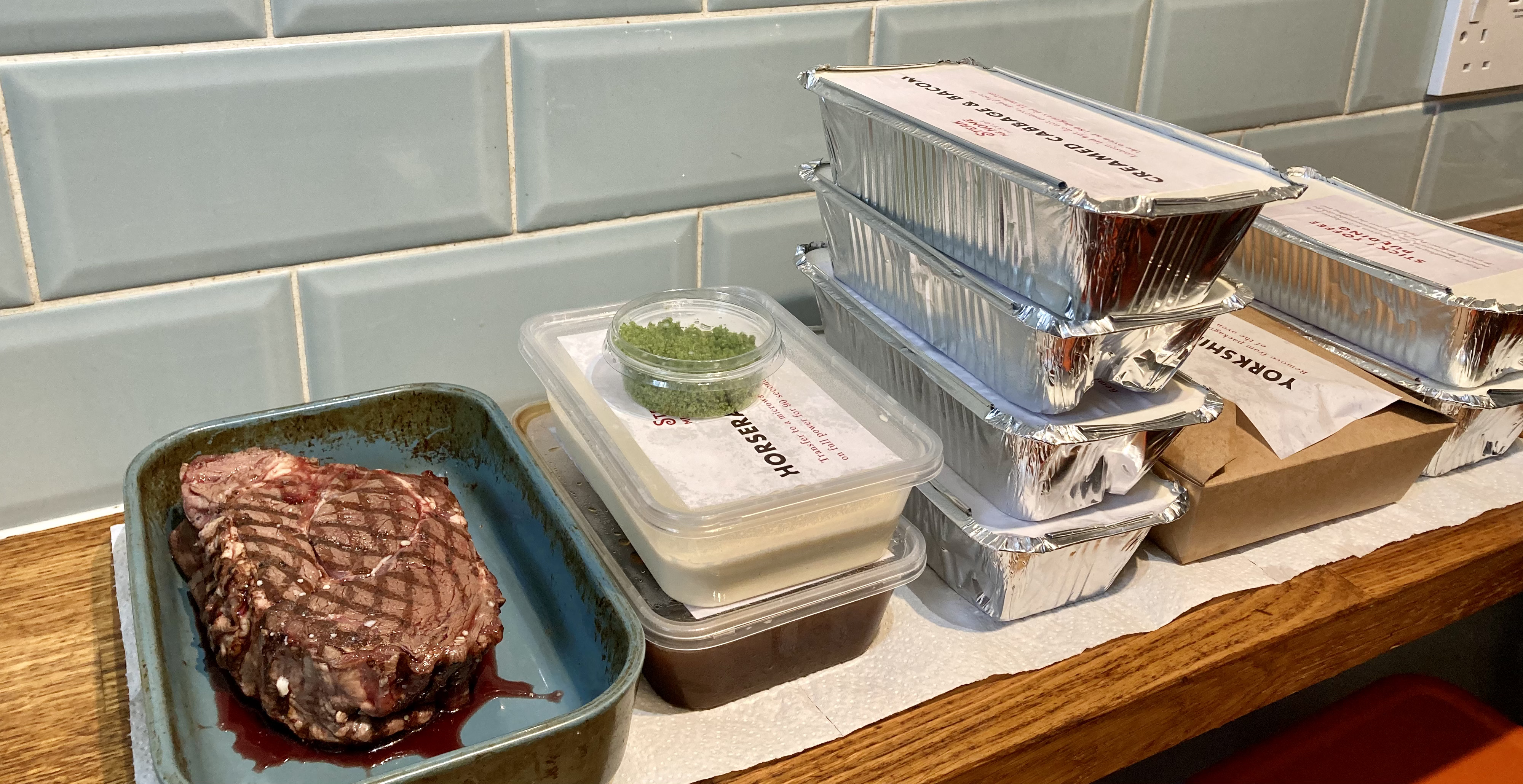
The first thing to say is that Kyloe have thought this through very carefully. The ‘dine at home’ experiences we’ve tried thus far have varied in how simple they are to put together. This one is reassuringly easy. We switch on the oven at 180 degrees and, at clearly designated intervals, we add another container to those already there, leaving ourselves free to indulge in a couple of aperitifs. We’ve ordered a dinner for two and, working on the B & B belief that a side of mac’ n’ cheese goes with just about anything, we’ve added that for a fiver extra.

Once arranged on a plate, the dinner is both generous in proportion and everything you’d expect from this kind of meal. The roast rib of beef is sumptuous, the potatoes crispy, the cabbage and bacon mouthwatering. There’s a container of horseradish sauce to be served hot (not usually a favourite of ours but this one rocks) and naturally there’s a pair of large, crispy Yorkshire puddings, which, when filled with the other veg and ladled with a rich, red wine gravy are just what we were hoping for.

Puddings, I hear you ask? Well, yes, there are some perfectly serviceable sweets – a vanilla cheesecake with raspberry jus and a sticky toffee pudding with a thick gooey sauce. Only the latter of these is a bit disappointing (a portion of custard might have been a welcome addition) but if I’m honest, this is really all about the main course and Kyloe have done an excellent job of providing a spectacular Sunday dinner at home.

Not that I wouldn’t prefer to dine in their excellent restaurant, but fingers crossed on that score.

4.6 stars

Philip Caveney