
Theatre

The Sound Inside

04/08/24

Traverse Theatre, Edinburgh

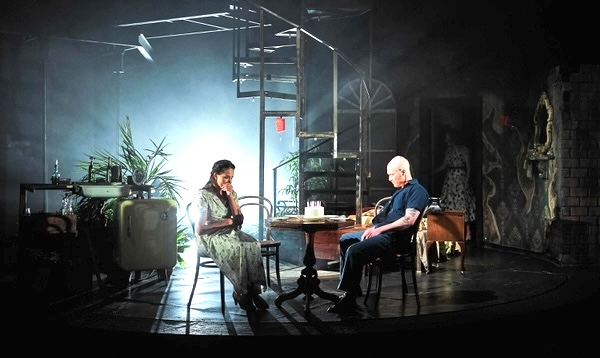
The Sound Inside begins with an engaging example of fourth wall breaking, as Bella (Madeleine Potter), a creative writing professor at Yale, ambles onto the stage to introduce herself and her story. Her relaxed, sardonic tone is engaging, sometimes laugh-out-loud funny, and is liberally crammed with a succession of literary references.

And then in comes Christopher (Erik Sirakian), a garrulous Freshman in one of Bella’s classes, who has a propensity for impulsively saying all the wrong things. He’s arrived at Bella’s office without actually making an appointment and is clearly intent on knowing more about her, wanting to locate the real person hidden behind the curated image she presents in class. Bella is understandably cautious about engaging with him, suspecting that he’s some kind of weird stalker. But when he confides that he has started work on a novel, that he will have no rest until it’s completed, her curiosity is aroused.

She herself published a novel, seventeen years ago, and though it received promising reviews at the time, it has hardly set the literary world alight. Any thoughts of a new project have been stalled by recent worries about her health. She forms a tentative friendship with Christopher, uncertain of what might ensue, but prepared to see where this new path takes her…

Adam Rapp’s exquisite play has all the qualities of a great novel, pulling me deeper and deeper into its labyrinthine heart, providing the audience with puzzles to solve and mysteries to ponder. The two actors inhabit their respective characters with absolute authority, capturing all of their strengths and subtleties. Both of them are loners; both are driven by their inner desires. I love James Turner’s spare set design, which, combined with Elliot Griggs’ lighting and Gareth Fry’s soundscapes, helps to emphasise the twosome’s inner yearnings, their hopes and regrets.

More than anything else, this is a play about the nature of fiction: that elusive ephemeral beast that so many people long to capture. Director Matt Wilkinson handles the various elements of the play with skill and guides it to a poignant conclusion, which – much like Christopher’s novel – ends with an ellipsis.

The team at the Traverse seem to have an unerring ability to find great theatre and The Sound Inside, already a success in the USA, has everything I look for in this medium. It’s a mesmerising piece and should be on every Fringe visitor’s bucket list this year.

5 stars

Philip Caveney

Hamstrung

03/08/24

Pleasance Courtyard (Baby Grand), Edinburgh

Theatre’s most famous skull, Yorick, is amply fleshed out in this playful monologue, written and performed by George Rennie. Shakespeare provides scant detail about the “fellow of infinite jest” –  we only know that he sang, danced, made people laugh and gave the young Hamlet piggybacks. But Rennie mines these few familiar lines to breathe life into a character renowned for  being er… dead. 

Rennie is an engaging actor, strutting and fretting his hour upon the stage and easily connecting with the audience. The early stretches of the play establish Yorick as a jester, keen to do his job and entertain. But his smile stretches thin as he strives to perform his routines; he’s clearly aware that something is wrong. Where is his master? Where is the King?

From here, the monologue takes a darker turn, as Yorick slowly realises that the King isn’t the only one who’s dead. There are some clever touches, including a revelation about what really happened when Hamlet thought he saw his father’s ghost. Most affecting is Yorick’s yearning for the player he loved when they were both touring performers. Being plucked from obscurity to work at court has proved both a blessing and a curse.

There are some elements that don’t work quite so well, including an extended sequence featuring two audience volunteers – in today’s show, it’s Philip and me. Although we have fun participating, the scene is long and it’s hard to see what it adds to our understanding of the character. It’s introduced as Yorick’s attempt to ‘tell his story’ but I can’t work out how it does that. (It could just be that I missed something. I was a little distracted by the fact that Philip and I were sharing one pair of reading glasses because he’d left his at home.) Structurally, I feel like this comic relief would fit better in the first half hour, as it weakens the deepening tension and unsettling atmosphere of the second act.

Still, there’s a lot here to like, including the sound design, which complements the story well, reflecting Yorick’s state of mind. Now get you to the Pleasance Courtyard; to this favour you must come; Rennie will make you laugh at that.

3.5 stars

Susan Singfield

My English Persian Kitchen

02/08/24

Traverse Theatre, Edinburgh

Some productions appeal to all of the senses. My English Persian Kitchen is a good case in point. As we enter Traverse 2, I’m instantly aware of a wonderful aroma permeating the theatre, an enticing combination of chopped red onion, coriander, garlic and mint. The actor Isabella Nefar stands at a kitchen island cooking a meal – but then the lights change and she speaks directly to the audience, telling us that in her homeland of Iran, women rarely cook – and that far more women than men go to university. But of course, not everything about her homeland is quite so female-friendly.

She begins to prepare an Ash Reshteh, a noodle soup which she explains is an Iranian classic and, as she talks, the food begins to simmer and the fragrances intensify. The character relates her backstory, her marriage to a man she trusts only to discover that she is trapped in an abusive relationship with somebody who wants to control every aspect of her life. With her parents’ help she manages to escape to London and sets about trying to start a new life for herself. She learns ways of fitting in, of adapting to this unfamiliar culture, using food as a means of expressing herself and communicating with others.

But even there, the ghosts of the past still come back to haunt her…

Nefar is an engaging storyteller and Hannah Khalil’s compelling script is augmented by Dan Balfour’s eerie soundscapes and Marty Langthorne’s effective lighting design, past turmoil evoked by a flickering lamp and strategically placed spotlights. Jess-Tucker Boyd’s dynamic movement sequences make even the slicing of an onion look like a life and death struggle. We come to understand that cooking has been the character’s salvation, a way to rekindle the happier years of her childhood and the close bond with the parents who taught her so much.

As the story unfolds and those tantalising smells exert their powers, I am drawn ever deeper into the experience – and I’m delighted when, quite by coincidence, I am chosen to be the first person to taste that Ash Reshteh. It is absolutely delicious and, lest you worry that only one viewer gets to try it, let me reassure you that at the play’s conclusion, the entire audience is welcomed onto the stage to sample it for themselves.

This could so easily be dismissed as a mere gimmick but, in the case of My English Persian Kitchen, written by Khalil and cleverly directed by Chris White, it’s more – much more – than that.

4.1 stars

Philip Caveney

In Two Minds

02/08/24

Traverse Theatre, Edinburgh

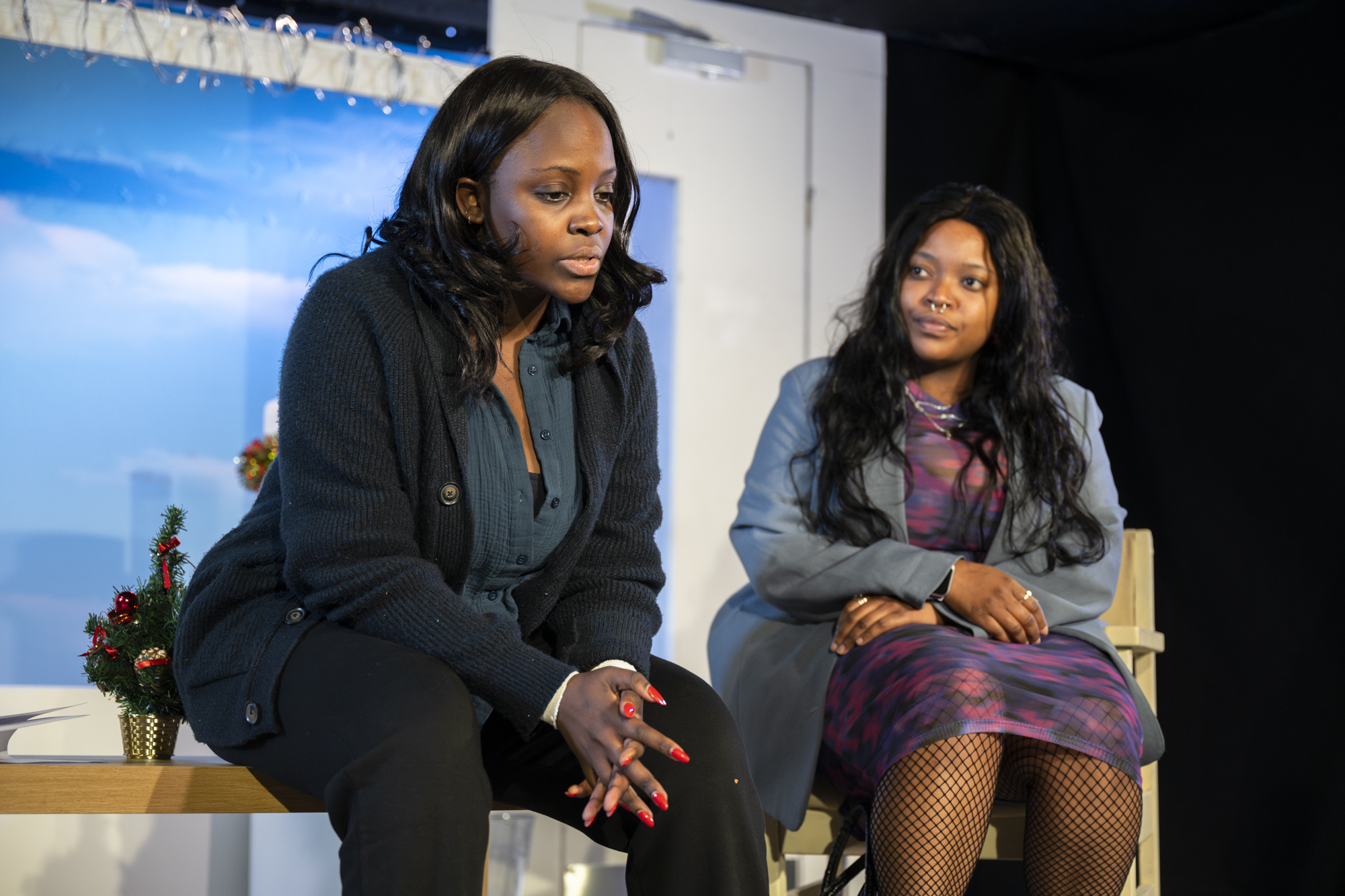
Joanne Ryan’s affecting two-hander explores the complex bond between a woman and her mother. Daughter (Karen McCartney) cherishes the tranquility of her minimalist studio apartment, but Mother (Pom Boyd) needs somewhere to stay while she’s having an extension built. Over the course of her protracted visit, their fragile relationship is pushed to breaking point.

It’s not just the accompanying clutter that grates on Daughter’s nerves. It’s the incessant talking, the veiled (and unveiled) criticisms, the sleeplessness – it’s all an intrusion into her hard-won peace. And she feels guilty too, because none of it is Mother’s fault. She has bipolar disorder.

Both Ryan’s script and Sarah Jane Scaife’s direction deftly convey how accustomed the characters are to Mother’s episodes. They’re not fazed; they have been here too many times before. There’s no dramatic reaction to her illness, rather a weary, frustrated sense of here-we-go-again. They know how this plays out and they know what they have to do. Over the years, they’ve learned to protect their relationship by maintaining some distance; forced together, it begins to disintegrate.

Boyd’s performance is flawless. She perfectly captures Mother’s brittle façade: her inability to stop talking, even when she knows that she’ll regret her words; her vibrant exuberance; her torpid misery. McCartney too is utterly convincing, clinging desperately to her career, trying to care for Mother without losing herself.

Alyson Cummings’ set embodies the quietude Daughter craves: simple, unfussy, light and clean. As soon as Mother enters, we can see the disruption she brings, even her kicked-off shoes a reproach to Daughter’s obsessive tidiness.

I’m not usually a fan of lengthy scene transitions and too many props, but Scaife uses them skilfully to illustrate both the passing of time and the steady accumulation of Mother’s belongings. The tension in these moments is further heightened by Rob Moloney’s unsettling sound design.

In Two Minds is a clever play, at once discomfiting and heartwarming. As well as an unflinching examination of the impact of mental illness on the protagonists’ relationship, it’s also a love story of sorts, and sure to be a success at this year’s Fringe.

4.2 stars

Susan Singfield

Rope

20/07/24

Theatr Clwyd, Mold

Patrick Hamilton’s 1929 play, loosely based on the Leopold and Loeb murder case of a few years earlier, is these days mostly remembered for Alfred Hitchcock’s 1948 movie adaptation, a film that famously changed the rules of cinema to incorporate its theatrical origins. This ingenious production – by Theatr Clwyd’s resident company – layers Hamilton’s (occasionally quite expository) script with slick movement sequences, which are mostly used to indicate the deteriorating psychological state of one of its protagonists.

Jack Hammett (Wyndham Brandon) and his partner in crime, Granillo (Chorag Benedict Lobo), have kidnapped and murdered a young colleague, using that titular length of rope to strangle him – for no reason other than to see if they can get away with it. This isn’t a spoiler, by the way, because at the play’s start we witness the two of them placing their victim’s body into a trunk which stands centre stage throughout. Hamilton’s play isn’t so much a ‘whodunnit?’ as a ‘will-they-get-away-with-it?’

The smug and confident Hammett and the highly-strung Granillo have carried out the murder as a way of demonstrating their superiority over the rest of humanity – Hammett is a devoted reader of Nietzche – and, to further elaborate their point, they have planned to throw a little party for an odd assortment of guests, one of whom is Sir Johnstone Kentley (Keiron Self), the murdered boy’s father. The trunk will be used in place of a table to serve food and drink and Hammett will even jokingly tell his guests that it contains a dead body.

The play opens in almost total darkness, the two criminals making their plans by the light of matches, while the rest of the cast are already onstage, silent witnesses to their conversation. The party ensues and the guests enter one by one, greeted by the central duo’s faithful butler, Sabot (Felipe Pacheco), who knows nothing about the crime. The visitors include the nice but ineffectual Kenneth (Rhys Warrington) and chatty socialite Leila (Emily Burnett). Of course, there’s always one guest at a party who overstays his welcome and in this case it’s Rupert Cadell (Tim Pritchett), who has been around the block a few times and whose suspicions have been aroused. He’s clearly keen to have a look at the contents of that trunk…

This is an inventive production that explores the possibilities of the original play with flair. If it’s not entirely sure of itself in the first half, it certainly gathers strength in the second and I love the closing stretches where the compact performance space is steadily stripped bare of hiding places, the cruel intentions of the murderers finally exposed to the cold light of day.

Brandon is particularly impressive as the callous and self-possessed Hammett, a man so convinced of his own genius that he’s prepared to risk everything to prove a point. And I particularly enjoy Emily Pithon’s portrayal of Mrs Debenham, who makes the most of a tricky role which only offers her the occasional line and a series of sardonic expressions. Frances Goodridge directs the piece with skill and movement director Jess Williams’ Frantic Assembly-style sequences add verve and vigour to the proceedings.

Rope is an assured and intriguing piece of theatre, a slow burner that steadily builds to a powerful blaze.

4.2 stars

Philip Caveney

Shirley Valentine

13/06/24

Lyceum Theatre, Edinburgh

In Edinburgh, the weather is dreich, the rain falling endlessly from grey skies – but in the welcoming environs of the Lyceum Theatre, the sun blazes down onto fine white sand and shimmering Mediterranean waters. It’s here that Shirley Valentine has just experienced a personal revelation. The clitoris really does exist! Who knew?

Willy Russell’s celebrated play gets a welcome revival in this delightful production from Pitlochry Festival Theatre. Many will be familiar with the 1989 film adaptation starring Pauline Collins, where the story is opened out to include the various other characters whom Shirley describes in such hilarious detail, but here it’s presented in its original form – a funny, acerbic monologue in three acts.

We first encounter Shirley (Sally Reid) as she prepares a dinner of “chips ‘n’ egg” for her husband, Joe, and considers the best way to inform him that she has fed the mince he’s expecting to a vegan dog. Meanwhile, she chats to her oldest friend, the wall. In the second act, she’s anxiously preparing to head off on the Greek holiday she has also neglected to tell Joe about.

And, in the final act, she’s there: on an idyllic island, getting to know boat owner, Costas, and coming to terms with a newly-discovered sense of personal freedom.

Of course, the play stands or falls on the strength of its performer and Sally Reid does a fabulous job here, encapsulating Shirley’s strengths and weaknesses, her ability to move from mocking good humour to tragedy in the blink of an eye, the beat of a heart. She also manages to nail a Scouse accent while convincingly frying eggs. No easy matter. And Russell manages that rare thing, a male playwright effortlessly capturing a female personality with what feels like absolute clarity, managing to find the humour in her weary worldview without ever making his subject feel like a caricature.

Emily James’ set design mirrors the play beautifully. Shirley’s Liverpool home is solid and brutally realistic, the walls constricting her. The Greek beach, however, comprises sequinned blocks, all shimmery and dreamlike – a mirrorball of possibilities. Director Elizabeth Newman keeps everything nicely nuanced throughout. I’ve seen other productions of the play that amp up the laughs until the bittersweet charm of it is all but swamped, but here is comes through loud and clear. Those looking for the perfect alternative to a disappointing summer need look no further than the stage of the Lyceum, where Shirley Valentine offers a warm and vibrant alternative.

4.6 stars

Philip Caveney

Sunset Song

30/05/24

Lyceum Theatre, Edinburgh

Lewis Grassic Gibbon’s Sunset Song is widely regarded as one of the most important Scottish novels of the 20th century. There are many who first encountered it as a set text in school and have carried it in their hearts ever since. Playwright Morna Young was evidently one such teenager and this is her adaptation of the tale in collaboration with Dundee Rep. I’ll confess that I’ve never got around to reading the book myself. Set in the 1900s, it’s a dour and sometimes bleak story based around the misadventures of the Guthrie family, farmers who live and work in (the fictional) Kinraddie in the wilds of Aberdeenshire.

When we first meet Chris Guthrie (Danielle Jam), she’s young and ambitious, a keen reader and already planning to seek a career as a teacher. In this, she has the grudging support of her father, John (Ali Craig), though he’s a hard taskmaster, never slow to hand out physical punishment to Chris and her siblings whenever they step over what he perceives as ‘the line.’ 

Chris’s much-loved mother, Jean (Rori Hawthorn), mentally broken by the recent birth of twins, takes matters into her own hands, killing herself and her new babies. Two younger children decide to flee  the family home to start a new life in Aberdeen and it isn’t long before Chris’s older brother, Will (Naomi Stirrat) follows their example and heads off to seek his own fortune in Argentina. This leaves Chris to run the farm with her father and, after he suffers a debilitating stroke, to fend off his sexual advances. When tragedy strikes yet again, Chris finally has an opportunity to start over but (maddeningly) she decides to stay where she is and marry local boy Ewan (Murray Fraser). But by now, the world is heading into a massive global conflict and it’s hardly a spoiler to say that more heartbreak is looming on the horizon…

While it does of course feature more than its fair share of harrowing occurrences, it’s to this production’s credit that it manages to convey difficult themes without ever feeling too prurient. Young’s adaptation remains true to the novel’s Doric dialogue, though occasionally I feel I’m told things that I would rather see – and the decision to have no costume changes when actors embody several different characters does mean that I’m occasionally confused as to who is who.

Emma Bailey’s simple but effective set design is based around a large rectangular section of soil, across which the characters walk barefoot, fight, make love and celebrate. The story’s central theme couldn’t be more evident. To the Guthries, the earth is all-important. It provides sustenance, a wage and a reason to go on living. And of course, it is also the place to which they will eventually return. As if to accentuate this, the backdrop is a closeup of a field of wheat.

On either side of the soil, musical instruments are arranged and the cast occasionally break off to deliver Finn Anderson’s evocative songs, singing in plaintive harmonies, pounding propulsive drums, strumming electric guitars and at one point even launching headlong into a spirited wedding ceilidh. These elements offer a welcome respite from the unrelenting bleakness of the story.

Finn de Hertog’s direction is assured and I particularly enjoy Emma Jones’ lighting design, which manages to convey that simple slab of soil in so many different ways. I like too that many of the props the actors require are clawed up out of the ground like a strange crop.

But much as I’d like to, I can’t really warm to the story, which at times feels uncomfortably like a series of disasters unleashed upon one luckless family.

3.6 stars

Philip Caveney

Macbeth

02/05/24

Cineworld, Edinburgh

Oh, the irony!

This touring production actually came to Edinburgh, the city where we live. But, for reasons far too tedious to go into, we failed to secure tickets for it – and now a screening of the live show at Cineworld offers us an opportunity to catch it after all.

I still haven’t given up on the hope that one day, somebody out there will put on a version of the Scottish Play in which the Macbeths are in their twenties. I’ve always felt that the hubristic actions of the Macbeths would make so much more sense if the duo were little more than reckless kids – and great actors though they are, Ralph Fiennes and Indira Varma hardly qualify in that department.

But a large helping of humble pie awaits me, because this sweaty, immersive interpretation of Shakespeare’s most ubiquitous play is one of the best versions I’ve seen. While it throws in some unexpected twists in the telling, they are never allowed to feel like gimmicks. Three feral-looking witches (played by Lucy Mangan, Danielle Fiamanya and Lola Shalam) appear in the background of scenes I wouldn’t usually expect to see them in, and lend a wonderfully sinister quality to the proceedings.

I won’t bang on about the story, which just about everybody in the world knows by heart (indeed, there are moments when I feel I could find work as a prompt for this play); suffice to say that both Fiennes and Varma acquit themselves admirably, Fiennes mining the seam of dark humour that underpins the mayhem and Varma absolutely nailing Lady M’s vaulting ambition. I’ve seldom seen the couple’s aspirations spelled out with such absolute clarity.

Ben Turner’s portrayal of MacDuff is riveting, particularly in the scene where he’s told by Ross (Ben Allan) of the murder of his wife and two children, the enormity of the revelation spelled out in Turner’s grief-wracked face. This is such an affecting moment that my own eyes flood with tears.

Finally, there’s the violent confrontation at the end, the warriors dressed in contemporary body armour. So often this play is let down by the sight of actors swiping half-heartedly at each other with rapiers, but the deadly looking machetes brandished in this confrontation are swung around with enough abandon to make me flinch in my seat. All in all, this is a faultless production and the mere glimpses I receive of its atmospheric setting make me wish I’d tried harder to hunt down tickets to the original performance.

If this comes to a cinema near you, I’d advise you to grab a seat at your earliest opportunity.

5 stars

Philip Caveney

When Mountains Meet

26/04/24

The Studio at Festival Theatre, Edinburgh

When Mountains Meet is a very personal piece of gig theatre, composed by musician Anne Wood, who stands centre stage throughout, playing her violin and seeming almost to conduct proceedings.

Directed by Kath Burlinson and Niloo-Far Khan, this is the nostalgic story of Wood’s first meeting with her father. Raised in the Highlands by her single Scottish mother, the twenty-something Anne (Iman Akhtar) is a bold and fearless woman, happily hopping on a plane to Pakistan to try to get to know the man whose DNA she has inherited – and to connect with a culture that is both alien and hers.

Told through a blend of music, spoken word, projection and audience interaction, the production is as complex and disorienting as Wood’s relationship with her dad. It’s a gentle, welcoming piece – there’s a pot of kahwa tea on our table and four little ladoo sweets – but it encompasses some thorny themes, including feminism, poverty and the devastating effects of Partition. Anne’s father (Jamie Zubairi) is a kind and courteous man – a doctor, well-respected by all for his selfless commitment to building hospitals and helping the poor – but he is also unwilling to publicly acknowledge Anne as his daughter, her illegitimacy and creative career both proving sticking points. She is ‘taboo’.

With its cabaret-style seating, the storytellers (Akhtar, Zubairi and Hassan Javed) occasionally wending their way through the tables, this is an inclusive piece, and we’re carried along by its deceptively light tone, smiling as we make paper aeroplanes and hold stones in our hands. Wood’s violin is accompanied by Rakae Jamil’s sitar, Mary Macmaster’s electric harp and Rick Wilson’s percussion, and the result is a seamless fusion of Scottish and Pakistani influences. It all adds up to something very life-affirming: about how big the world is and how small we are; about acceptance, endurance and love.

When Mountains Meet is on tour in Scotland until the end of May, so why not seize the chance to see it if it’s in your vicinity? It’s a foot-tapping, thought-provoking gem.

4 stars

Susan Singfield

Chicken

18/04/24

Traverse Theatre, Edinburgh

It’s certainly a memorable entrance as Eva O’Connor struts and pecks her fretful way onto the stage of The Traverse, clad in an ingenious suit (designed by Bryony Rumble) that transforms her into the creature of the title. That said, she is no ordinary chicken. O’Connor plays Don Murphy, a proud Kerry cockerel and a ‘true son of Ireland.’ Hatched on a beach and full of ambition, he begins the long and eventful journey to stardom with dogged determination, working his way from appearing as Jesus in a local nativity play to the dizzy heights of Hollywood. I mean, come on, how many chickens do you know that have actually won a mother-clucking Oscar?

Chicken, co-written by O’Connor with Hildegard Ryan, is certainly like nothing I’ve ever seen before and O’Connor’s performance is a study in utter commitment as she circles the stage, staring intently into the audience, flapping her wings and flinging out chicken-related puns with absolute conviction. Don, it turns out, is also an inveterate name-dropper. He’s worked with all the biggest Irish film stars – Michael Fassbender, Colin O’Farrell, Brendan Gleeson – and he’s had some strange encounters along the way.

But things become more unsettled when he crosses paths with a daring avian performance artist who reminds him that not all chickens are as lucky as he – and that many of them are destined for the dinner plates of humanity.

For all O’Connor’s undoubted skills as a performer, Chicken is ultimately a little too one-note for comfort. Though exquisitely told and punctuated by a couple of spirited, strobe-lit dance sequences (courtesy of Marianne Nightingale), it doesn’t really have anywhere else to go. By the time Don tells us of his return to his roots in Derry – to star in a Martin McDonagh movie, no less – I’m starting to wish the piece would progress in some more fundamental way, other than pointing out the ultimate limitations of Don’s poultry form. But then, quite without warning it reaches its conclusion.

All respect to O’Connor who gives this 100%, but ultimately I am left wanting more. Happily, that doesn’t extend to calling in at Nando’s on the way home.

3 stars

Philip Caveney