Author: Bouquets & Brickbats

The Danish Girl

01/01/15

The Danish Girl tells the true story of 1920s landscape artist Einar Wegener, and his transformation into Lili Elbe, the woman he always knew he was supposed to be. Eddie Redmayne stars as the transgender pioneer, but it is Alicia Vikander, as Gerda (Einar’s wife), who really steals the show.

This is a good movie, with a lot of heart. The central relationship and its emotional complexities are explored unflinchingly, and the characters are nuanced and sometimes difficult. Gerda’s bond with Lili is especially dichotomous, as Lili’s emergence serves both to undermine her marriage and elevate her art (Gerda’s portraits of Lili ensure her success as an artist).

It’s beautifully shot: all gorgeous landscape or cityscape, costumes and décor. There isn’t a drab corner in this film, and maybe that’s the reason why it doesn’t quite reach the heights it could; it’s all a little too pretty, even the ugly stuff.

And there is, or should be, a lot of ugly stuff. Lili was one of the first people to undergo sex reassignment surgery – and the consequences were brutal. There need to be some darker elements to make this really clear.

There’s no denying Eddie Redmayne’s skill in depicting both Einar and Lili, but the performance is a little too mannered for my taste. His portrayal of femininity is somewhat overdone: too arch, too simpering, too coy. Maybe this was true of Lili Elbe herself, but it feels a little old-fashioned for a contemporary audience, as if the telling itself has snagged somehow on the very question of gender constructs it purports to explore.

But these are quibbles. It’s an important story, and a very watchable film.

4 stars

Susan Singfield

Sherlock: The Abominable Bride

01/01/16

The recent small-screen success of the BBC television series, Sherlock has prompted its creators to try something a little different this time around; after successfully updating the concept, they’ve decided to present a standalone episode as a period piece and moreover, to simultaneously release The Abominable Bride in cinemas across the UK in a series of exclusive one-off screenings; all things, no doubt designed to generate excitement in the hearts and minds of its huge army of ardent followers.

The problem is, of course, we’re not quite sure how this switch in time has been achieved – (is it the result of one of Sherlock’s cocaine-adulterated dreams? Or are we simply inhabiting one of the scenarios dreamed up by Doctor Watson in his role as an author of detective fiction?) The fact that we’re never really sure is one of the blades that fatally stabs this enterprise, even as it sprints merrily out of the starting gate, but infinitely more worrying is the ensuing surfeit of intolerable smugness that seems to drip from every sly in-joke and ‘clever’ character interplay we’re presented with. Authors Steven Moffat and Mark Gatiss seem to be hovering in the background, proudly announcing how very arch they’ve been with Conan Doyle’s legacy, but I have to confess that after careful viewing and much consideration, I’m still really not sure what was supposed to be happening in the story and can’t help feeling that the writers have been rather less clever than they suppose.

Anyway, the plot revolves around the case of Emilia Ricoletti (Emily O’ Keefe) dressed in a bridal gown, who appears in a public place, indiscriminately firing pistols at passers-by before committing an apparent suicide; only to reappear shortly afterwards, complete with a large hole in her head, to murder her husband. She then promptly disappears. Baffling? Well, yes. Holmes (Benedict Cumberbatch) and Watson (Martin Freeman), go gamely into detection mode, but the eventual solution for the murder is so risible, it’s hard to believe that the authors thought it would pass muster as anything more than a joke. Blaming it on the Suffragettes? Oh, please… A late appearance by Professor Moriaty (Andrew Scott) at the Reichenbach Falls, has been crowbarred into the story with a total absence of subtlety, which just about puts the deerstalker hat on it.

Of course, Sherlock fans are usually a notoriously loyal regiment, so it must be extremely worrying for Moffat and Gatiss, that amidst the onslaught of social media pronouncements, posted shortly after transmission, only a very few scribes have arisen to defend this debacle and the ones that have, seem to be channelling a definite whiff of the Emperor’s New Clothes (take a bow Lucy Mangan of the Guardian). I’ll admit, I haven’t been a massive fan of the series before now, but this ‘event’ has pretty much put me off investigating further instalments. I’d have loved to have finished this review with the word ‘elementary,’ but sadly, that’s a quality that was missing here.

2 stars

Philip Caveney

In the Heart of the Sea

MV5BMjA5NzUwODExM15BMl5BanBnXkFtZTgwNjM0MzE4NjE@._V1_SX214_AL_images

30/12/15

Around a year ago, searching for a new story to write, I pitched an idea to my editor. Why not, I suggested, rewrite Moby Dick – or rather, base it around the true story of The Essex, the ship that inspired Herman Melville’s classic tale? And just to make it more relevant to younger readers, why not present it from the POV of the cabin boy?

For a variety of reasons, my editor said no and it  would now seem fortunate that she did, because this is exactly what In the Heart of the Sea is and I’d probably have found myself the author of an unreleasable book (or at the very least open to accusations of plagiarism). Ron Howard’s take on the story is a big, sprawling epic of a film, a gorgeous evocation of a lost era and I loved every minute of it.

The story starts some fifty years after the main event, when Melville (Ben Whishaw) visits the grown-up Tom Nickerson (Brendan Gleeson) in Nantucket to research the true story of the Essex. Nickerson grudgingly obliges and we flash back in time to meet Owen Chase (Chris Hemsworth) who despite being promised a captaincy for his next voyage is appointed first mate to the rather better connected George Pollard (Benjamin Walker). The Essex sets sail in search of sperm whale and the crew experience a series of disasters that would try the patience of Job, not least the malevolent intentions of a giant white whale, who seems intent on exacting a terrible revenge on the men who have dared to take him on. The whale itself is an incredibly convincing CGI creation and while the killing of such creatures will not sit easily with contemporary audiences, this is an issue that is addressed (albeit obliquely) in the film – and the truth is that men really did go after these marine giants in tiny rowing boats in search of the precious oil to light their lamps and you have to marvel at their courage and endurance in the face of such danger.

This is ultimately a story of survival against incredible odds and one, moreover that is based on real events. The word is that Howard’s film has failed at the box office and it’s certainly not for everyone, but I thought it a remarkable achievement that kept me enthralled from start to finish – a perfect choice for my birthday.

4.5 stars

Philip Caveney


Joy

Unknownimages

29/12/15

David O Russell seems to have the knack of creating great films from fairly unpromising material – Silver Linings Playbook and American Hustle are two movies that rose far above their IMDB outlines. On paper, the true life story of Joy Mangano, the woman who invented the ‘Miracle Mop’, might suggest that the average viewer should take along a pillow in order to sleep comfortably through the whole experience. But Joy is actually a riveting slice of cinema, made especially enjoyable by a luminous central performance by Jennifer Lawrence.

When we first meet Joy she’s a child, obsessed with building imaginary worlds out of scraps of paper; but very soon, she’s grown up, stuck in a dead end job, and divorced from her husband Tony (Edgar Ramirez) who still lives in the basement and shares parental responsibility for their young children. Joy’s soap-opera-obsessed Mother, Terry (Virginia Madsen) refuses to leave her room, while her wayward husband Rudy (Robert De Niro) has just insisted on moving back into the family home after breaking up with his latest partner. All-in-all, this has to be one of the most dysfunctional families in America and Joy is the one tasked with making everything run as smoothly as possible.

In the midst of the chaos, she gets an idea for a self-wringing mop and persuades the rest of the family, plus Rudy’s hard headed but minted new girlfriend, Trudy (Isabella Rossellini) to back her invention with hard cash. But the path to bringing it to reality is not an easy one and there are shady business people out there queuing up to steal her idea. Joy soon discovers that if she’s going to take her dream to fruition, she’s going to have to be as tough as the sharks she’s sharing the water with…

Russell’s take on the story is quirky, assured and never loses its sense of pace. There are great supporting performances from the ensemble cast (how lovely to see De Niro finally getting a decent role after a string of one-note cameos) and Bradley Cooper also shines as QVC pioneer, Neil Walker. But make no mistake, this is Lawrence’s movie and she makes the most of it. The camera loves her in this and you will too.

4.6 stars

Philip Caveney

The Extra Man

MV5BNzkzMTgxODIxMF5BMl5BanBnXkFtZTcwNDU4MTQ1Mw@@._V1_UX182_CR0,0,182,268_AL_

26/12/15

File this one under ‘films we missed first time around.’ Originally released in 2010 and based on the novel by Jonathan Ames, we only came across it by accident, because we bought the DVD as a Christmas stocking filler for my parents-in-law who adored the book, and we ended up watching it with them. I’m glad we did, because this is something of a little gem – featuring a great cast, brilliant acting and a quirky and engaging story.

Louis Ives (Paul Dano) is a hapless young teacher with a predilection for women’s clothing. When he’s caught trying on a bra at his rather stuffy school, he gets the boot and decides to head off to New York in search of a fresh start (he has vague aspirations of becoming a writer). Looking for somewhere to stay, he ends up as roommate to Henry Harrison (Kevin Kline) a totally unreconstructed ex-playwrite who after falling on hard times, has been reduced to acting as a male escort to older, more fiscally advantaged women. Henry refuses to accept that he is struggling, even when he has to apply boot polish to his ankles because he can’t afford to buy socks – and though his opinions are occasionally shockingly out of touch with any kind of reality, still his character is so charismatic that you can’t help liking the man.

With Henry acting as a sort of life coach, Louis finds himself inexorably drawn into the world of the male escort (or ‘Extra Man’ as Henry prefers to call it). The ensuing tale is a whimsical delight, though I can see exactly why it didn’t trouble the multiplexes – it’s far too offbeat to capture big audiences. There are superb performances from the two leads and excellent supporting roles from the likes of Katie Holmes, John Pankow and Dan Hedaya, but I did feel rather sorry for John C. Reilly, who as the mysterious Gershon Gruen was obliged to talk in a high-pitched comedy voice throughout the proceedings.

The Extra Man was never going to be a cinematic blockbuster but it’s certainly worth checking out on the small screen if you get the chance.

4 stars

Philip Caveney

Fishers In The City


IMG_1735IMG_1736

22/12/15

Thistle Street, Edinburgh

This restaurant came highly recommended and seemed like the perfect place to enjoy a pre-Christmas meal with a couple of friends. The venue was warm and welcoming, arranged on three levels, with subtly twinkling Christmas lights and friendly and attentive staff.

Annoyingly (at least for the purposes of this review) all four diners opted for the same starter – the Twice Baked Crayfish Fondue,  though there were several other temptations on offer. This proved to be a delight, rich, creamy and peppery, served on a bed of fresh rocket with tangy smoked tomato relish. It was simply delicious and all four portions were quickly polished off.

The main courses ended up as a 50-50 split. Two of us opted for the Fillet of Peterhead Halibut. The perfectly cooked fillet was served on a couple of spinach and ricotta rotolos, the pasta deliciously al dente, the layers of spinach rich with the tang of iron. There was a splash of orange and sage dressing to set the whole thing off perfectly. The other two diners chose the Whole Roast Sea Bass. Again, the fish perfectly cooked, the flesh falling from the bone and served with the head on, this came accompanied by a pea shoot pear and fennel salad, with a pecorino, maple syrup and caraway dressing, which was light and refreshing.

Did we have room for dessert? Well, it is nearly Christmas! Once again there was a two way split on this – two of us opted for  the Chocolate and Hazelnut Tart, which was dense and rich with bitter chocolate and came with a slice of salted praline crunch and a scoop of vanilla ice cream. The other two diners had the Pear Parfait, a sweet and delicate confection served with liquorice jelly and mulled pear sorbet.

We drank a couple of bottles of a very decent house white and we all announced that we would recommend Fishers In The City as a lovely place to meet and eat.

4.2 stars

Philip Caveney


Star Wars: The Force Awakens

21/12/15

Let’s start with something controversial. In my humble opinion, Star Wars is one of the most overrated movie franchises of all time. Seriously. Let’s examine the evidence. There were two decent original movies, a third that was spoiled by the overly-cute warrior teddy bears, the Ewoks and then three watching-paint-dry prequels that committed the cardinal sin of being dour and earnest, when they should have soared. And yet the return of Star Wars has been greeted with an unprecedented weight of expectation, with whole multiplexes devoting every screen to J.J. Abrams’ take on the story. I mean, really?

If there was ever a safe pair of hands into which to place this much-loved series, they were his. (Look, for instance, how he dealt with the moribund Star Trek franchise, delivering a great big kick up the backside that jolted it into new life.) So I’m happy to report that Abrams has pretty much nailed it here too, salvaging all the best bits from the original movies and throwing in some cannily judged updates of his own. The keen-eyed will spot a few ‘Easter egg’ references to the original movies liberally sprinkled throughout the film. I should also add that Abrams comes up with a plot twist that will have hard-line fans gasping in their seats.

The events take place some thirty years or so after Return of the Jedi. Rey (newcomer, Daisy Ridley) is a scavenger on a desert planet, eking out a precarious living from finding salvage from wrecked space ships. She encounters, Fin (John Boyega) a former storm trooper for the First Order, the new fascist dictators of the galaxy. Finn has become disillusioned by the cruelty of Kylo Renn (Adam Driver) and has done a runner, with his evil task masters in hot pursuit.

What follows is a series of chases, aerial dogfights and lightsabre battles but scriptwriters Abrams and old hand Lawrence Kasdan have cannily stitched everything together so that all the major characters are able to make an appearance without it feeling as though a crowbar has been used to jam them in to the proceedings – Han Solo, Princess Leia, C3PO, RTD2, Chewbaca… all the usual suspects are trotted out for inspection and it all works splendidly. Most importantly, Abrams has reinstated the humour that was prevalent in the first films and entirely absent from those po-faced prequels. Ridley, a kick-ass heroine from the new school manages to subvert a lot of the tropes that now make the originals feel vaguely misogynistic and Boyega and Oscar Isaac as fighter pilot Po Dameron, offer plenty of scope for the next instalment.

I might be in danger of damning the film with faint praise here but this just might be the best of the series so far.

4.2 stars

Philip Caveney


The Lion, the Witch and the Wardrobe

20/12/15

The Lyceum, Edinburgh

The Lion, the Witch and the Wardrobe is a well-loved and familiar tale with a guest spot for Santa Claus; no wonder it’s become a staple family Christmas show. And the Lyceum’s production starts off wonderfully; the design (by Becky Minto) is breathtaking: the all-important transition from Britain to Narnia eliciting an audible response from the audience.

The parallels between the two worlds (and Narnia’s appeal) are highlighted by the double casting: both places are being torn apart by war but, while in the real world the children are bystanders, exiled from their home with no option but to wait things out, in Narnia they play an active role; they are no longer helpless children, sidelined and ignored.

It’s a shame, then, that some elements of the play seem almost perfunctory. Peter’s battle with Maugrim, for example, lacks any real sense of menace. Some scenes, most notably Aslan’s murder – but there are others too – are crying out for a chorus: ‘Come, every spirit, every wraith,’ chants the White Witch, played with wonderful malevolence by Pauline Knowles. But no one comes, or hardly anyone: three makes for a very sparse crowd. In Manchester, student choruses seem quite the thing; we’ve seen actors-in-training from local universities employed in several professional productions there and this might have been an idea here. The Lyceum’s Narnia would be more convincing if it were more densely populated.

The children’s delivery is a bit stage-school and declamatory for my taste; they’re not actually kids, of course, but young adults, which might account for the vocal tics as they try to make themselves sound more youthful. And I wish that Aslan were more than just a man in a fur suit.

That said, it’s still a magical show in places, with spark and vim enough to keep a young audience entranced. The final battle scene is beautifully done, all lights and ribbons and roaring sound effects. At its best, this play is very good indeed. It’s just a bit uneven, I suppose.

3 stars

Susan Singfield

Tracks of the Winter Bear

19/12/15

Traverse Theatre, Edinburgh

It’s Christmas time, and the theatres are full of pantomimes and children’s tales. And that’s fine: I love a good panto, and some of my favourite stories are written (primarily) for a younger audience. But variety is the spice of life, they say, so the Traverse’s grown-up alternative is a very welcome thing.

Tracks of the Winter Bear comprises two short plays, companion pieces exploring the themes of love and loss. They’re separate yet linked, both intrinsically Edinburgian, set in the Abbeyhill district of the city. The same pub is referenced in both (The Regent Bar), and the two protagonists (Shula and Jackie) are  both lonely, middle-aged women, trying  – in their very different ways – to make some sense of their lives.

Act 1, by Stephen Greenhorn, is my favourite of the two. Using reverse chronology, it charts the tragic love affair of Shula (Deborah Arnott) and Avril (Karen Bartke). It’s a bleak but ultimately beautiful piece, with thoughtful, nuanced performances; Arnott, in particular, seems to embody the brittle hurt of grief.

Act 2 is an altogether stranger beast, telling the tale of a mangy polar bear and a washed-up Mother Christmas, both escapees from a tawdry Winter Wonderland theme park. The bear, cast adrift and hunted in an unknown land, speaks in the voices of those she has killed. Mother Christmas, or Jackie – played with bar-room swagger by the delightful Kathryn Howden – befriends her with promises of shortbread and love, and the two embark on an unlikely journey ‘home.’ It’s a fascinating premise and it’s very well-played (Caroline Deyga’s Bear is physically compelling), but it seems a little uncertain of its way, forsaking the early, earthy humour for a less engaging attempt at profundity.

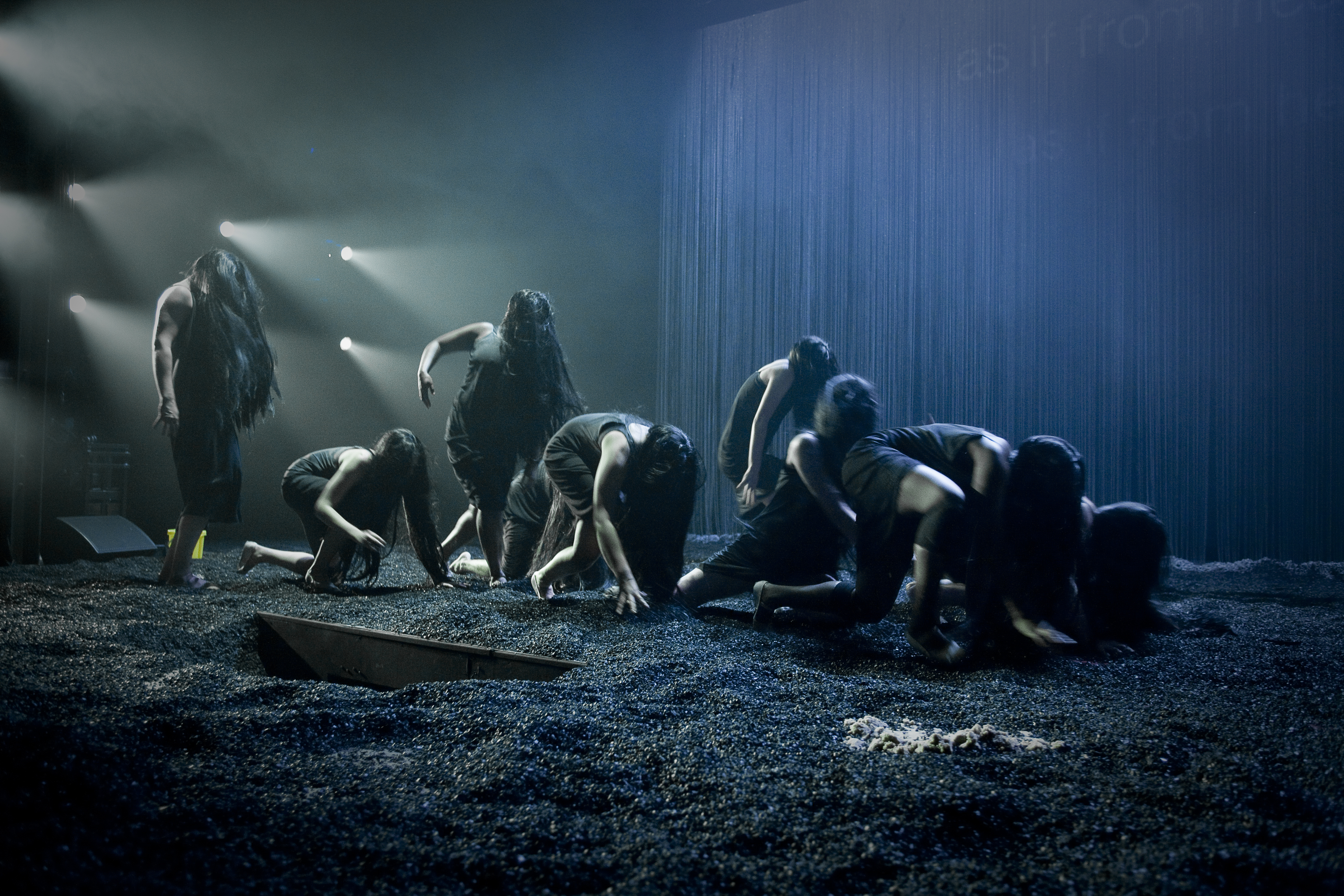
Both pieces use what is essentially the same set, a narrow, snow-covered traverse stage (ironically, this is the first time we have seen this configuration at the, ahem, Traverse theatre). It’s curtained with a light gauze, which serves both to hint at snow in the air, and to create a misty, fairy-tale-like quality. The mirror-audience, visible throughout, magnifies my own reactions; it’s the perfect staging choice for this production, I think.

Overall, then, this is definitely one to watch. It’s interesting and original, and a welcome respite from all the feel-good fare.

4 stars

Susan Singfield


The Sound of Music

23779492316_a49369cec8_z

The Lowry Lyric Theatre, Salford Quays

There’s no other option but to own up on this one – I have always hated this musical. I appreciate that I’m in a minority here, because as blockbusters go, it’s one of the most successful of all time, with an ardent following of die hard fans, the kind of people who will happily camp out for weeks in order to secure a ticket – but I’ve always found its uneasy mix of syrupy songs, precocious children and the most unthreatening Nazis ever seen on stage or screen, somewhat hard to stomach. Just a few bars of ‘The Hills Are Alive…’ and I’m a kid again, trapped at home on a drizzly Sunday afternoon, with my parents watching the film on television and commenting on how ‘nice’ Julie Andrews seems.

So naturally, I approached this assignment with some trepidation. The Lyric theatre was packed with eager punters as the overture began and then the curtain rose and we were in a (pretty convincing) nunnery where four ladies in black habits were asking us how they could possibly solve a problem like Maria (The Voice finalist, Lucy O Byrne). The next thing we know, she’s been enlisted as governess to the seven children of war hero Captain Von Trapp (Gray O’ Brian) and is teaching them that doe is a female deer and ray, a drop of golden sun…

It’s pointless to go over the plot because unless you’ve lived as a hermit all your life, you’ll surely already know exactly what happens. And here’s the thing. Though I can appreciate how professionally this production is delivered – perfectly judged harmonies, elaborate sets that glide effortlessly into place, faultless choreography, this isn’t going to change my mind about Rodgers and Hammerstein’s greatest success. It still feels like treacle pudding with extra treacle. But neither can I reasonably criticise the way its been done (other than to observe that Mr O’ Brian was having a bit of a bad night of it in the vocal department) and neither can I deny the warmth of the standing ovation enjoyed by the cast at the end, with a particularly enthusiastic response given to Jan Hartley as the Mother Abbess, whose climactic rendition of Climb Every Mountain was delivered with enough energy to power the National Grid.

So I’ll simply say this. If The Sound of Music is already a favourite of yours, you’re unlikely to feel shortchanged by this production. If you’re coming to it with no expectations whatsoever, you may find yourself wondering what all the fuss is about.

3.5 stars

Philip Caveney