

18/11/26
Cineworld, Edinburgh
After the phenomenal success of Suzie Miller’s one-woman play – first in Australia and then in the UK – a film version of Prima Facie was surely inevitable. And here it is, adapted for the big screen by Miller herself, and directed by Susanna White. The central role, played most notably on stage by Jodie Comer, belongs here to Cynthia Erivo. However, instead of a stream-of-consciousness internal monologue, the movie offers us a different view of high-flying young barrister Tessa Ensler. This time, we see her from the outside.
Tessa is a brilliant lawyer, everyone agrees, and her success is all the more impressive if you factor in the odds. Black, female, working-class: people like her are not exactly commonplace at the Bar. She made it to Cambridge on a scholarship by being clever and working hard, and she uses the same winning combo to shine in court. She loves the law and believes wholeheartedly in what she does, seeing herself as a kind of chess Grandmaster. Her role is to outwit her opponents.
If a high percentage of her cases happen to be defending alleged sexual abusers, then that’s just the luck of the draw. It’s not for her to consider their guilt or innocence; it’s not for her to worry about the victims. She has a job to do and she’ll do it well.
But then Tessa is raped by her colleague, Julian (Daniel Ings).
The scales fall from her eyes. She can see now that the legal system she’s devoted her life to is unfit for purpose. She knows the legalistic tricks that will weaken her credibility and acquit her attacker. She knows that, if she presses charges, this is a fight she’ll lose.
She decides to fight it anyway.
Miller’s polemic is just as urgently expressed he.re as it is in the play I applaud the decision to open out the narrative, introducing other characters and showing us more of Tessa’s private life. Without it, what would be the point? We already have an NT Live recording of the play; the film needs to do something different to earn its place.
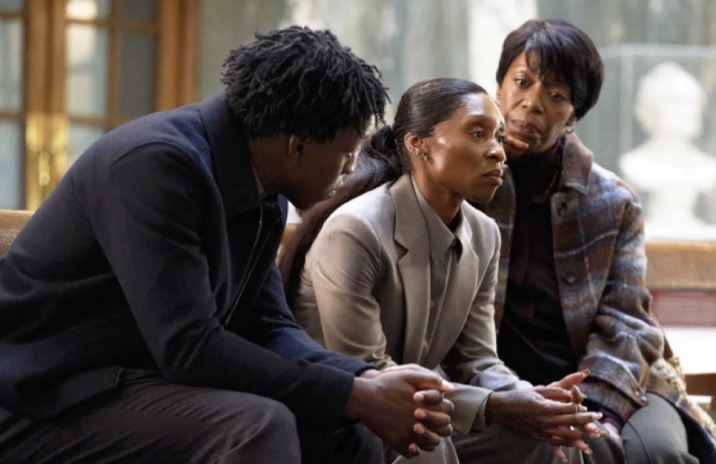
I like the juxtaposition of the barrsisters’ chambers with Tessa’s childhood home, the former stately and grand, the latter cluttered and cosy. At first, she seems happier with her workmates than her family, but the system protects its own and Julian’s dad is a high court judge. When the chips are down, it’s Tessa’s mum (Noma Dumezweni) and brother (Toheeb Jimoh) who support her.
Erivo’s performance is every bit as accomplished as you’d expect, imbuing Tessa with poise and determination, as well as a devastating sense of loss. Her final speech is delivered with such passion and intensity it’s impossible to ignore. Meanwhile, Ings’ depiction of the charming, entitled Julian is horribly credible. He’s such a nice guy – until he isn’t.
The movie’s release feels especially apposite, coming in the same month as Russell Brand’s high-profile rape trial, where the celebrity’s defence lawyer used a barrage of rape myths in an attempt to undermine the victims. His tactic didn’t work. Maybe, just maybe, the tide is starting to turn. Maybe Tessa Ensler’s plea for change is finally being heard.
4.3 stars
Susan Singfield

