Vince Vaughan

Freaky

18/02/22

NOW Cinema

Our on-going efforts to catch up with some of the movies that were lost in lockdown continues. Freaky was released at the worst possible time for a film of this kind. Here is something that really needs to be seen with a bunch of friends, in an actual cinema, to be fully appreciated. But, needs must and all that.

To be honest, Christopher Landon and Michael Kennedy’s spoof slasher movie starts unpromisingly as we see four teenagers gorily despatched by the Blissfield Butcher, a masked killer in the (jugular) vein of Michael Myers. Indeed, there are clear nods to Halloween and other classics of the genre, but the problem is that there’s no real suspense generated here, the killings suspended in that lonely wasteland somewhere between horror and comedy.

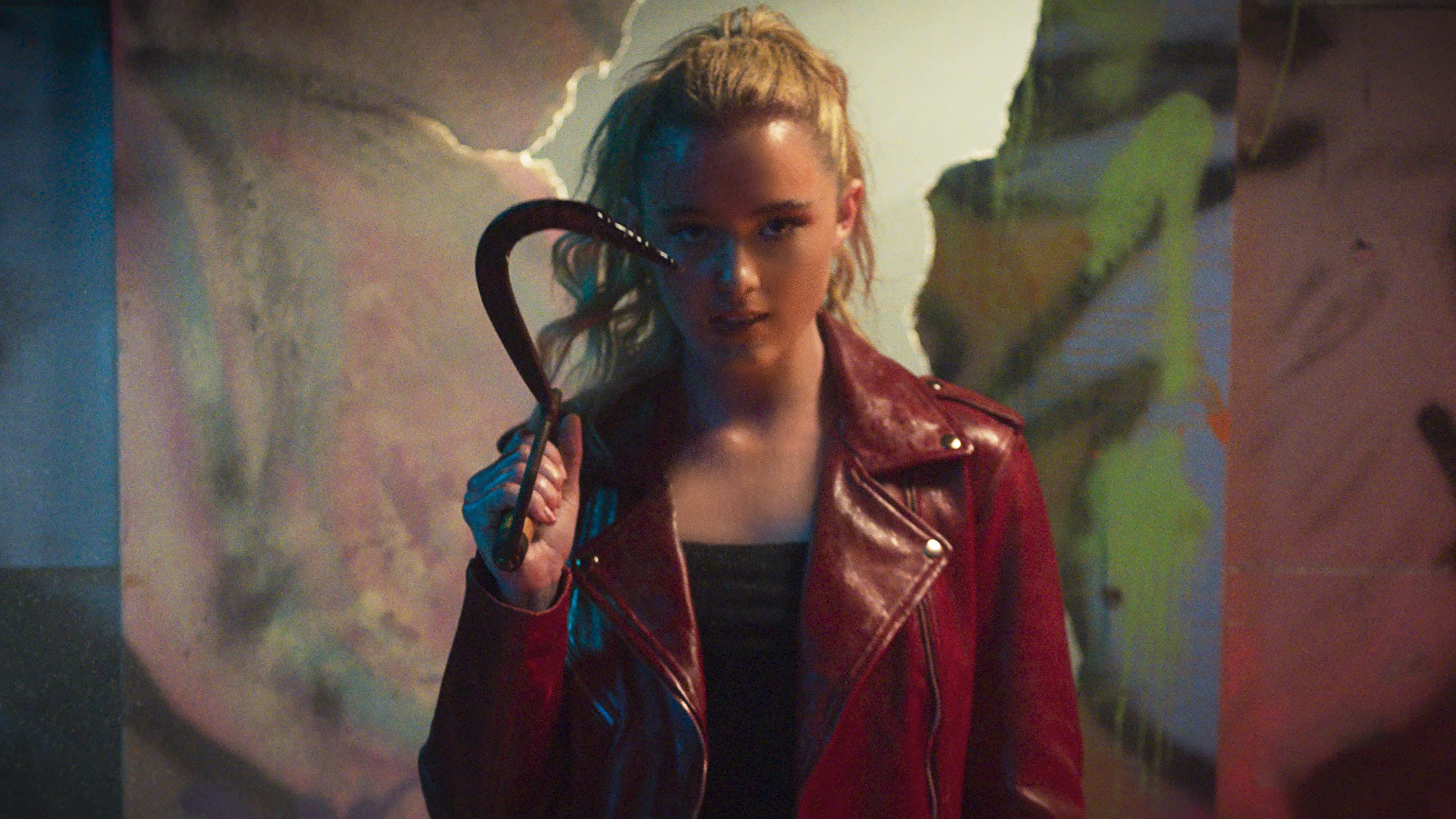
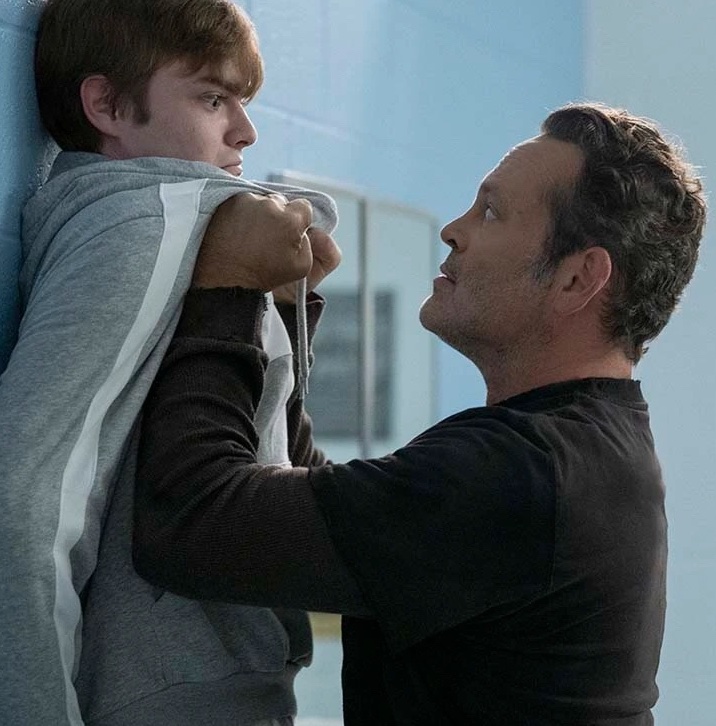
Just as I’m thinking of reaching for the ‘off’ switch, however, the film plays its trump card, as The Butcher (Vince Vaughan) attacks troubled teen Millie (Kathryn Newton) with an ancient Aztec dagger and things change significantly. For this, it turns out, is a body-swap story (working title Freaky Friday the 13th). Now Millie is running around in the body of a six-foot-plus male serial killer and she’s having the devil of a job convincing her best friends, Nyla (Celeste O’ Connor) and Josh (Misha Osherovich), that she’s worthy of their trust.

Meanwhile, The Butcher is wandering gleefully around the high school in Millie’s petite frame, exacting bloody revenge on everyone who is mean to him – and that vengeance is not exclusively directed at his fellow students, either. Teacher Mr Bernardi (Alan Ruck) is also due a healthy dose of comeuppance.

And suddenly it’s working! This edgy mix of killer-thriller and high school romcom feels fresh and inventive, while Vaughan gives a nicely nuanced performance that’s much more adept than the high-camp caricature familiar from this genre. Newton handles her inner malevolence with skill and Osherovich, as Millie’s snarky gay friend, is given some genuinely funny lines to deliver. As he observes to Nyla: ‘You’re black, I’m gay. We are SO dead!’

The subsequent killings have much more impact now that we actually have characters that we can care about – and the pace is too frantic to allow time to consider the improbabilities of the plot.

But, you can’t help but wonder, how on earth are they ever going to tie these various strands into a satisfying conclusion? Suffice to say they do, and, most refreshing of all, there’s no attempt to dangle the possibility of a sequel.

4 stars

Philip Caveney

Seberg

13/01/20

In the year 2020, who even remembers the name of Jean Seberg? Not many people judging by the meagre crowd gathered at tonight’s screening. 

But hers is a fascinating story of toxic stardom, of a young performer whose life was systematically destroyed by the FBI; of a reckless but well-intentioned young woman, who got embroiled in events she couldn’t hope to control – events that would eventually destroy her. 

Catapulted to stardom at the age of seventeen, Seberg starred in Otto Preminger’s Saint Joan and suffered serious burns when her character’s onscreen immolation went horribly wrong. A few years later, she became the darling of the French New Wave when she starred in Jean Luc Godard’s Breathless. But Seberg, directed by Benedict Andrews, examines her ill-fated trip to Hollywood in the late 60s, where she’d gone to film the Western musical Paint Your Wagon. (Or ‘Clint Eastwood Sings!’ as it’sfondly remembered my many.)

Seberg (Kristen Stewart) reluctantly leaves her husband Roman (Yvan Attal) at home with their young son. On the plane to America, she meets up with Hakim Jamal (Anthony Mackie), an influential player in the burgeoning Black Power movement. She shows solidarity with his cause, contributing funds for the school he runs and, shortly afterwards, embarks on an affair with him. This brings her to the attention of the FBI, where operative Jack Solomon (Jack O’Connell) is directed to put her under intense surveillance. When Seberg starts to engage with more powerful members of the Black Panthers, the agency sets put to discredit her by making the details of her affair with Jamal public – and, in the increasingly poisonous atmosphere that ensues, Seberg’s sanity is pushed to the edge of the abyss…

Seberg is an interesting if somewhat flawed film. Stewart is an assured actor (and, given the invasive media coverage she herself has endured, it’s easy to see what attracted her to this role), but the fictional elements of this retelling of Seberg’s story are rather less successful. O’Connell’s tightly buttoned FBI man doesn’t really have enough to do, hanging around the edges of events, listening in on her via bugging devices and serving as the audience’s collective conscience. His exchanges with his hard nosed colleague Carl Kowalski (Vince Vaughan) are nicely drawn but don’t add much to the telling.

The era is nicely evoked but I would have liked to have seen some recreations of the filming of Paint Your Wagon thrown into the mix. (This is, after all, a biopic.) Perhaps there simply wasn’t the budget for that approach or more likely the filmmakers couldn’t obtain the rights. There are a couple of tantalising glimpses from St Joan and Breathless, but its not enough.

In some ways, this could be seen as the tale of a luckless individual crushed by the corrupt might of American law enforcement. But really, as Seberg herself says, ‘I am not the victim here.’ There is a much bigger  story – a shocking demonstration of the depths that the American justice system will sink to in order to prevent black people from ever achieving any sort of equality.

There seem to be quite a few such stories around right now. Add Just Mercy and Richard Jewell to the mix and we’re beginning to see a familiar trope. All of these films offer the same narrative: America is a corrupt and unforgiving place and things aren’t getting any better for the poor and the dispossessed.

This is worth seeing for Stewart’s powerful performance in the title role, but I can’t help feeling it could have been more effective than it ultimately is.

3.8 stars

Philip Caveney


Hacksaw Ridge

15/01/17

Former megastar Mel Gibson has been persona non grata around Hollywood for quite some time, but Hacksaw Ridge looks like the film that will restore his reputation. Rightfully so, I think, because no matter what he’s done in his private life, he remains a gifted film maker. This assured war movie tells the true story of Private David Doss, a God-fearing young man from the Blue Ridge mountains of Virginia, who after nearly killing his brother in a youthful fight takes an oath never to pick up a weapon ever again. Which is all fine and dandy until the days following Pearl Harbour, when his brother and most of the other young men around the town, join the army, and Doss decides that he really can’t stay at home and let them take all the punishment; so after much consideration, he too enlists – which, as you might imagine causes all manner of problems. His intention to be a medic but of course, things don’t go quite as smoothly as planned…

Having just given us a saintly Jesuit in Martin Scorcese’s Silence, Andrew Garfield offers us another take on the idea, this time as that rarest of creatures, the weaponless war hero. The conflict he is sent to is the American invasion of Okinawa, one of the bloodiest conflicts. We’re often told that war is hell and Gibson’s re-enactment of the events certainly look the part – indeed this must qualify as one of the most visceral movie battles ever. Much of the footage here makes Saving Private Ryan look like a pleasant day at the seaside and those who cannot relish bloodshed would be well advised to give this one a miss. Heads, limbs and brains are propelled around the screen with gusto and, if there’s a criticism of the film, it’s simply that there may be just a little too much of it. I’m not advocating more tasteful bloodshed, you understand, but the sheer volume of the slaughter eventually begins to inure you to the film’s message – that war is a terrible thing and we need to stop sending people off to fight them.

Garfield is terrific though and there’s a pleasing turn from Teresa Palmer as the young nurse he woos in earlier, gentler scenes. Hugo Weaving plays Doss’s alcoholic father, turned bitter by the loss of his best friends in the First World War and watch out for Vince Vaughan, taking a break from his usual slapstick comedy schizzle to give us  a nicely restrained variation on the ‘tough Sergeant with a heart of gold’ – a cinematic line that goes all the way back to John Wayne in The Sands of Iwo Jima and which Gibson himself made a decent fist of in We Were Soldiers.

Towards the end, we start to suspect that Gibson is over-egging Doss’s sanctity a little too much; but a post credits interview with the (late) great man himself seems to confirm that he really was the quiet, unassuming hero that the film makes him out to be.

Harrowing stuff, not for the faint-hearted.

4.4 stars

Philip Caveney