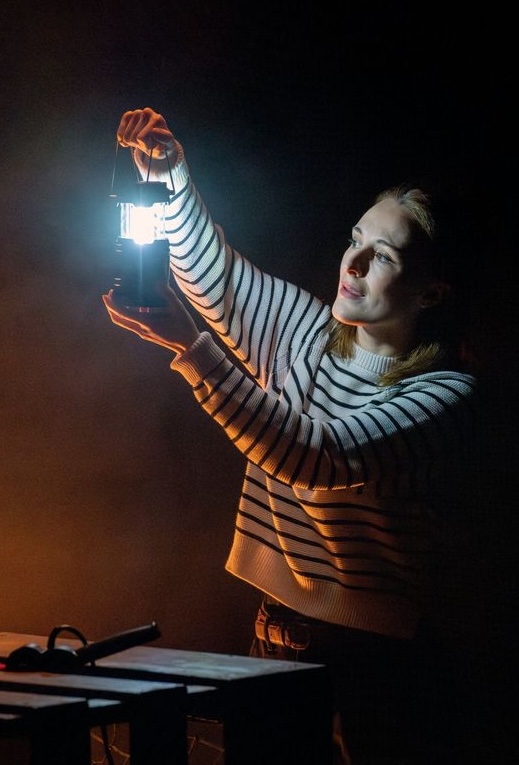
Traverse Theare

Lear

05/06/25

Traverse Theatre, Edinburgh

It seems at first an act of incredible hubris: to take one of Shakespeare’s most accomplished works, chuck out all those pesky words and attempt to tell the story entirely through movement. But only a few minutes into Raw Material’s adaptation and I am beginning to appreciate what a clever idea this actually is – one that opens out the play’s central story to encompass a whole range of different interpretations. Anybody who has watched helplessly as an aging relative slips inexorably into the fog of dementia, for instance, will find plenty to identify with here.

Anna Orton’s simple set comprises mostly heaps of sandbags, which we will soon discover are stuffed with what look like ashes and which, when scattered around the stage, seem to accentuate the central character’s failing grasp on reality. When Lear (Ramesh Meyyappan) first strides confidently into view, he is fearless, energetic, reenacting his past conflicts for the entertainment of his three daughters.

But we cannot fail to notice that he is already jumping at shadows, reacting to every bump and thud of David Paul Jones’s vibrant score, every flash and flicker of Derek Anderson’s vivid lighting design. Director Orla O’Loughlin keeps him centre stage while his daughters move around its periphery, cooly observing as he begins a slow but steady decline. As his grasp on the war-torn kingdom grows ever more precarious, so he goes to his daughters seeking refuge. Regan (Amy Kennedy) and Goneril (Nicole Cooper) are not the grasping, cruel sisters of the source play, but rather two concerned siblings that strive their hardest to accommodate their Father’s eccentricities. Cordelia (Draya Maria) keeps to the sidelines, always giving way to her more manipulative sisters – but her affection for her father is evident, making it clear that she will love him unconditionally.

And then the fog really begins to take hold as Lear don’s his Fool’s old hat and adopts the gurning, slapstick attitude of his former jester, Meyyappan pantomiming exquisitely as he slips effortlessly between the two characters, bicker and competing with each other for the sister’s affections. His bewildered daughters try their best to cope with their father’s mounting instability but once taken hold, these changes cannot be denied. In Lear’s latter stages, stripped to his underwear and no longer able even to wash himself, the character’s ultimate tragedy really begins to hit home.

Lear’s story is also true of so many people as they begin to slip helplessly into their twilight years – as they succumb to drug addiction – as they are weighed down by advancing depression – the transformation witnessed by their partners and their children. This daring adaptation nails such experiences with considerable skill.

Despite my initial reservations, I have to raise my hat to a fearless and thought-provoking piece of theatre.

4.2 stars

Philip Caveney

Blinded By The Light

21/05/25

Traverse Theatre, Edinburgh

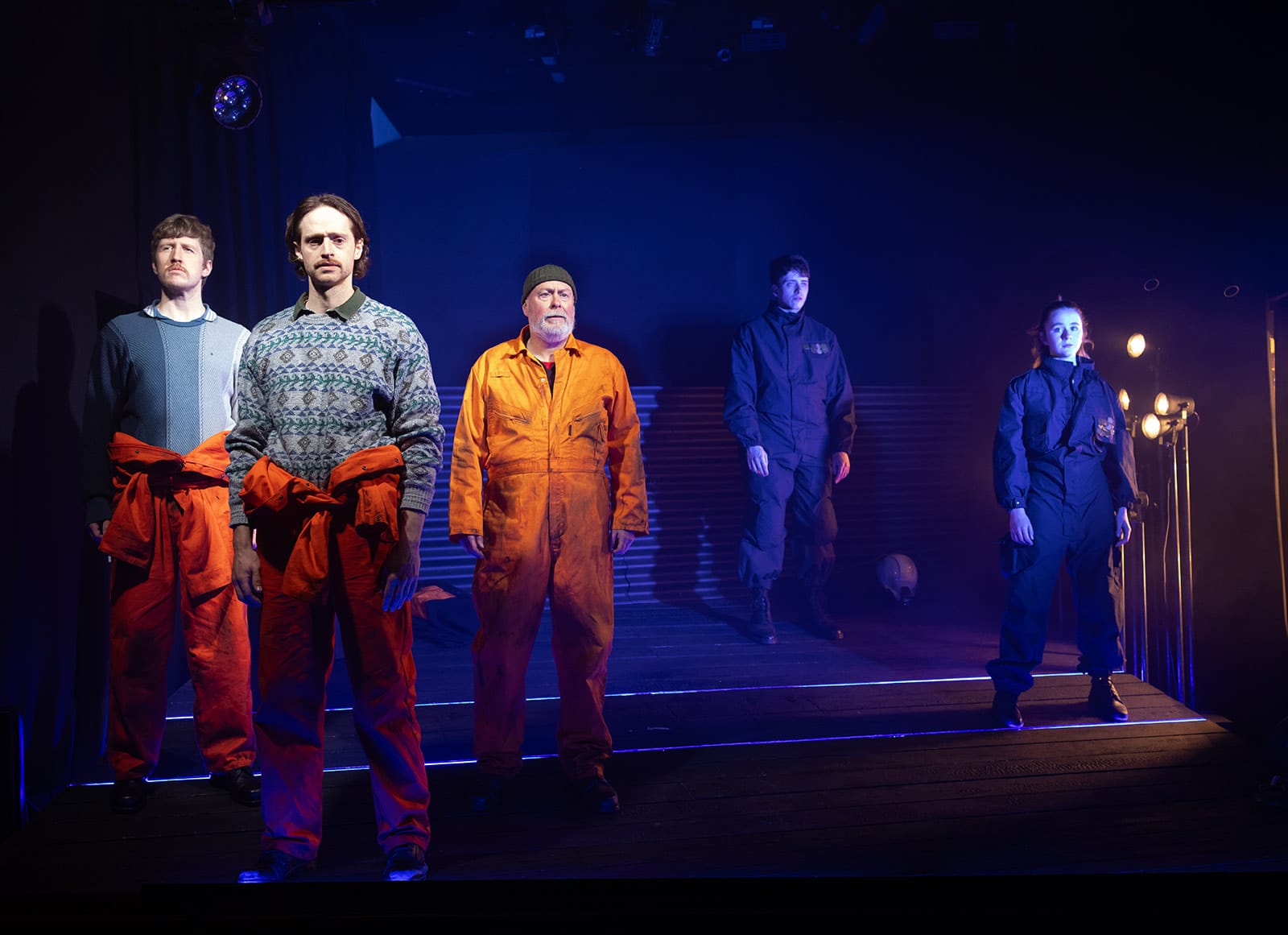
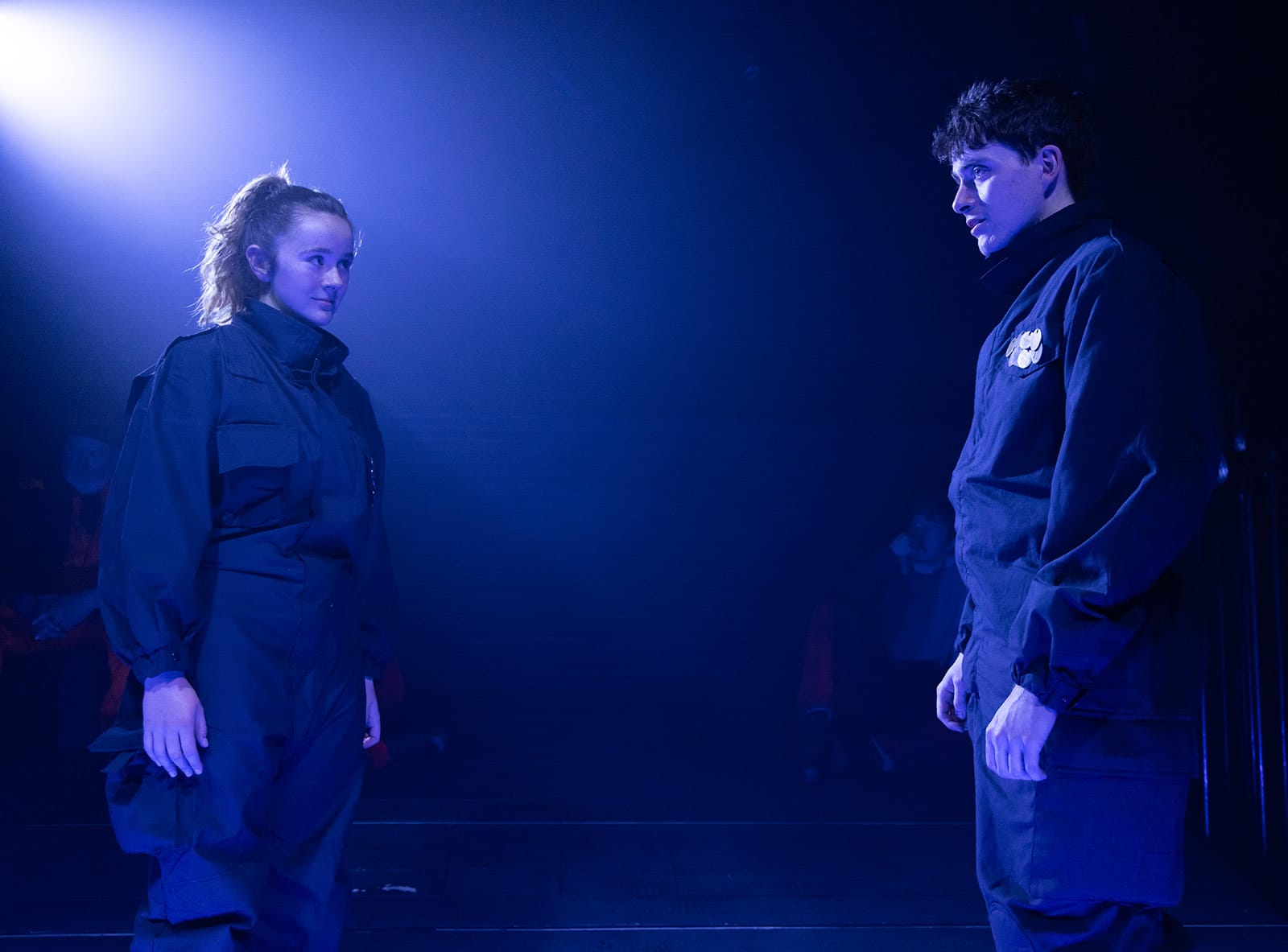
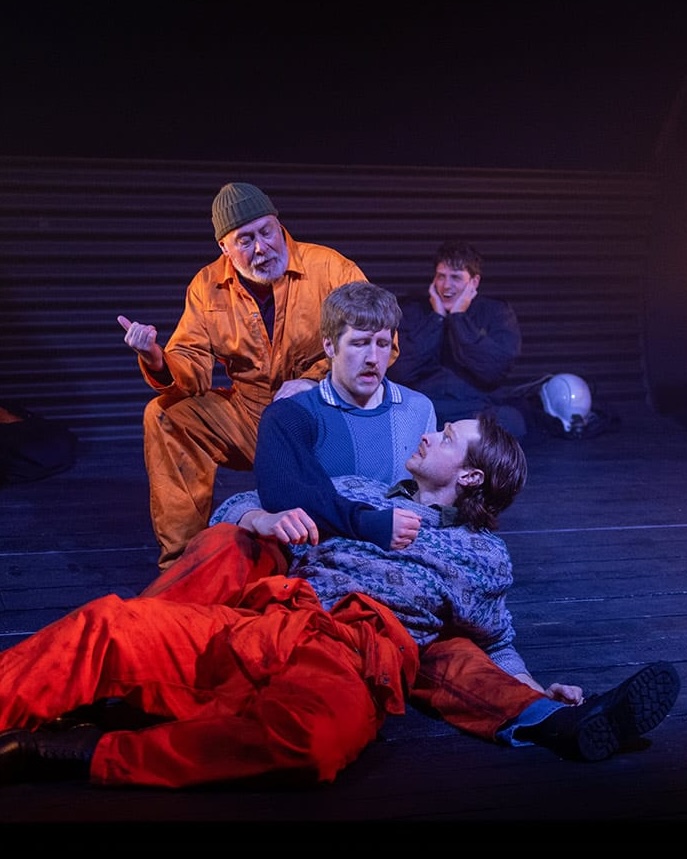
Drawing on the true story of a historical protest, Sylvia Dow’s Blinded by the Light illuminates two distinct timelines: first, the real-life miners who held a ‘stay-doon’ in the pit at Kinneil Colliery in 1982; second, the fictional inhabitants of a near-future dystopia, forced underground by the climate crisis and now occupying those same Bo’ness tunnels.

Nimbly directed by Philip Howard, the disparate worlds intersect seamlessly, the stories harmonising into something bigger and brighter than the sum of their parts. For Lily 7 (Holly Howden Gilchrist) and Freddie 9 (Reece Montague), the coal-black warren is a prison: they’ve never been ‘up’; never seen the grass or felt the rain; to them, the sun is nothing more than an enticing concept, gleaned from forbidden books. Meanwhile, two hundred years earlier, Andy (Rhys Anderson), Matt (Barrie Hunter) and Matt’s son, Jerry (Andrew Rothney), view the mine very differently. For them, it represents a well-loved way of life – not just their workplace but also their community. Of course, they also have friends and family in the outside world, but it’s their mining jobs that define them. The looming pit closure threatens everything they know and love.

Becky Minto’s simple set design works well. A steeply-raked wooden floor emphasises the precariousness of the situations, and the small footprint forces all five characters into close proximity, highlighting their interdependence across the centuries. The script employs repetition and echoes to stress these links, and Howard mines this (sorry!) for full effect, as the tunnels’ inhabitants occasionally finish each other’s lines or speak in perfect unison. A scene where Lily and Freddie place their palms in the handprints left by their ancestors is particularly affecting.

The performances are uniformly strong, but Howden Gilchrist and Rothney are the standouts for me, perhaps because their characters share a wide-eyed optimism, which makes their inevitable defeat all the more heart-rending.

In a play where light – or lack of it – is literally the point, the lighting designer’s role is even more important than usual. Colin Grenfell rises to the occasion, conveying the mine’s darkness while simultaneously directing our attention to the action as it unfolds. The clear distinction between the timelines is also achieved primarily through stage lighting (along with some wonderfully atmospheric sound design by Philip Pinsky).

Dow writes with a lightness of touch, exploring big political ideas without ever straying into the didactic or expositional. The plight of Britain’s striking miners, sacrificed to Thatcherism, is effortlessly laid bare, as is a warning about the bleak future we’re stumbling towards, with its shades of both Fahrenheit 451 and 1984.

Blinded by the Light has left Edinburgh now, but there are still two more chances to see this thought-provoking production: at St Andrews’ Byre Theatre on the 23rd May and Stirling’s Macrobert Arts Centre on the 24th. Catch it if you can!

4.3 stars

Susan Singfield

Eilidh, Eilidh, Eilidh

18/03/25

Traverse Theatre, Edinburgh

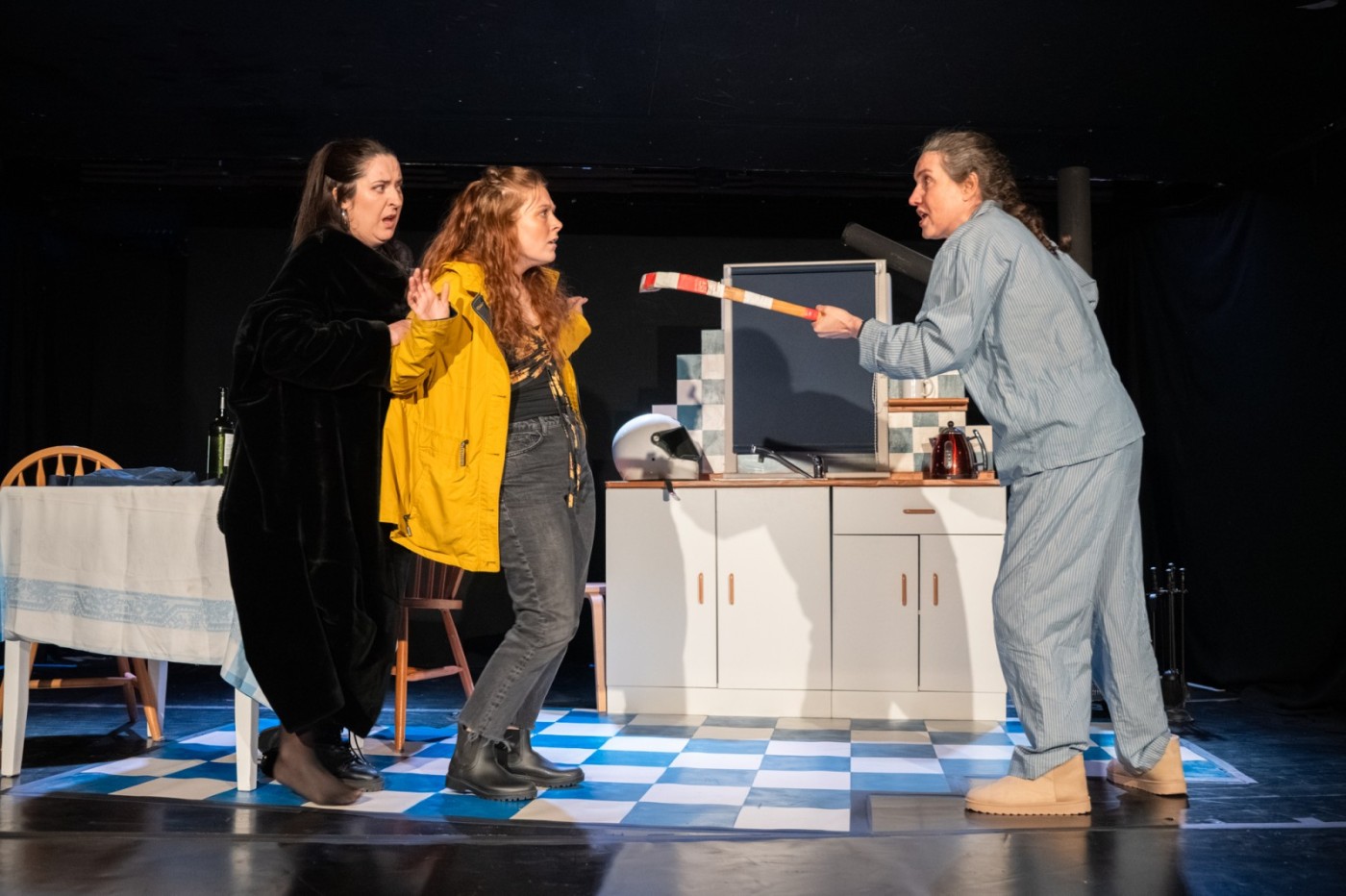
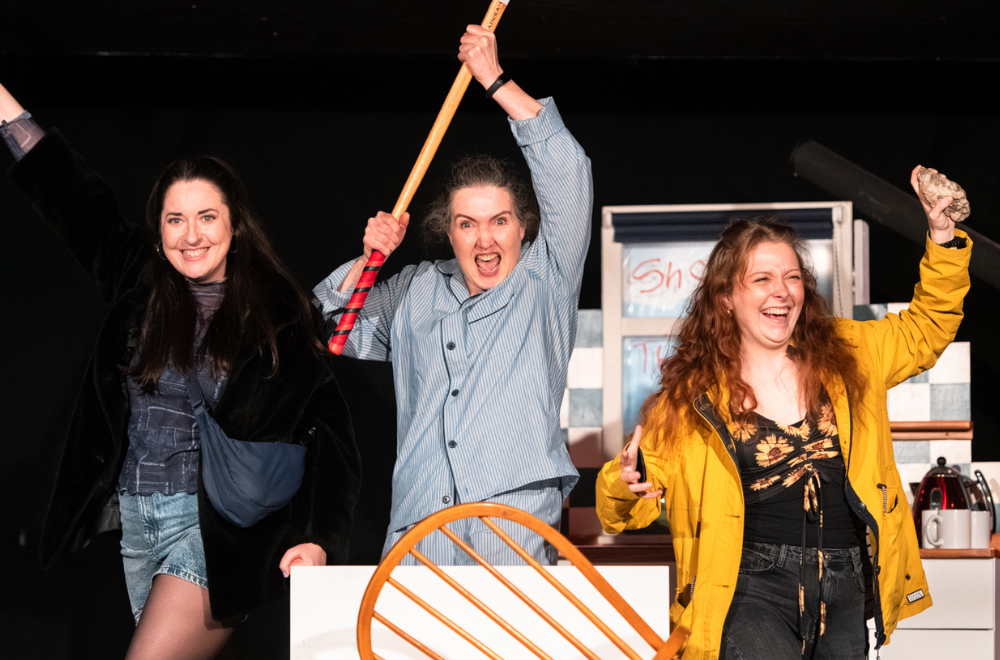
This three-hander, written and directed by Lana Pheutan, explores the rural housing crisis through the lens of drunken cousins, Eilidh (MJ Deans) and Eilidh Bheag (Chelsea Grace). The two women are in their late twenties, ready to embrace their adult lives but thwarted by the prevalence of AirBNBs on their native island, Skye. “I’m a teacher!” wails Eilidh. “I deserve my dream home…” While her sense of entitlement is quite comical – she’s been working for just a few years and her unemployed boyfriend isn’t even looking for a job – she’s not wrong in her assessment of a broken housing market, where flats are snapped up by remote investors before locals can even get a look in. But living back at her mum’s is starting to wear her down…

Her solution? To persuade Eilidh Bheag to break into a holiday let with her and then… um… Well. She hasn’t really worked out what should happen next. It just seemed like a good idea half an hour ago, when the pub landlord refused them a lock-in.

MJ Deans imbues Eilidh with lots of sass and self-righteousness, while Chelsea Grace’s Eilidh Bheag provides a calmer foil, tempering the former’s outrage with a few gentle home truths. After all, Eilidh Bheag is the one who’s stayed on Skye, while her cousin’s been living the high life in Glasgow for the past eight years. How dare she come back to the island and accuse her of pandering to tourists, being “part of the problem”? “You only care when it directly affects you,” snaps Eilidh Bheag at last, tired of being hectored. 

The altercation is disrupted by the unexpected arrival of Miss Nicille Mhicheil (Annie Grace), an elderly local resident. The dynamic changes, and an inter-generational element is added to the polemic, injecting more nuance. 

Pheutan’s direction is sprightly and the pace never drops, although the dialogue occasionally sounds a little too much like rhetoric, the issues taking precedence over the characters and their immediate situation. On the plus side, the occasional use of Gaelic serves as a reminder of the culture the community stands to lose, and also sounds very authentic (I’m from North Wales, so the pattern is a familiar one: it feels very natural to me to speak English with a smattering of Welsh phrases). 

Eilidh, Eilidh, Eilidh succeeds in raising awareness of an important problem – and even moots an answer, albeit a little simplistic.  All in all, this is a heartfelt and ultimately heartwarming piece of drama. 

4 stars

Susan Singfield

Armour: A Herstory of the Scottish Bard

01/10/24

Traverse Theatre, Edinburgh

Today’s A Play, A Pie and A Pint production is a welcome revival of Shonagh Murray’s Armour: A Herstory of the Scottish Bard. Unwieldy title notwithstanding, this is a taut, well-scripted piece of theatre, the music deftly evoking the lyrical poetry at its heart.

It’s thirty years since the death of Scotland’s beloved poet, Robert Burns, and his widow, Jean (Irene Allan), still misses him. But she has plenty to occupy her time, not least her headstrong young granddaughter, Sarah (Karen Fishwick), who’s been sent to live with her in Dumfries, while her dad’s away in India. And then there’s Nancy Maclehose (Hilary Maclean), Burns’ erstwhile mistress, who seems very keen to talk to Jean. There’s something important she needs to say…

Tom Cooper’s direction and Heather Grace Currie’s set design both serve to highlight Murray’s clever structure, ensuring that Burns’ absence forms the centre of the play, a model of his mausoleum gleaming from the mantlepiece, white against the dark furniture. Armour is a feminist piece but it doesn’t shy away from the fact that we only know these women in relation to a man, that they are destined to remain almost unknown, circling the ghost of a famous heavyweight, as small as the dolls that Sarah plays with.

Murray’s script breathes life into the women, imagining their responses to the scant details we have of their real circumstances. Allan imbues Jean with a sharp dignity, a refusal to be shamed or diminished by her husband’s infidelities. What’s more, Maclean’s Nancy defies the image of a paramour: she admits to feeling guilt for not thinking about Jean, but there’s no room here for any moral outrage. She loved Rab. He loved her. He loved Jean too. People are complicated and you can’t change that. What you can do, as Jean explains to Sarah, is choose whether to be “a sitter or a do-er”. And being a do-er is infinitely more admirable.

Fishwick shines as the motherless young child, fascinated by her granny’s stories and determined to follow in her grandad’s footsteps and become a bard herself. Her wistful demeanour – as she remembers India and her dad – contrasts beautifully with the irrepressible spirit she shows as she sings and dances around her granny’s house. Jean and Nancy might have been consigned to a life in the shadows, but Sarah believes she can have much more. Especially with those great women behind her.

Armour is a deceptively melodic piece, which smoulders gently before bursting into full flame.

4.1 stars

Susan Singfield

The Wolves at the Door

24/09/24

Traverse Theatre, Edinburgh

The Wolves at the Door, the second in this season of A Play, A Pie and A Pint at the Traverse, is a heartfelt polemic, written by Jack Hunter and directed by Amie Burns Walker. As Winter crooks its frosty finger and beckons, this timely piece zooms in on the issue of energy companies forcing impoverished people to use expensive prepaid gas and electricity meters.

The allegory of a Big Bad Wolf threatening the security of a vulnerable Little Pig might not be subtle but it’s certainly effective, and Heather Grace Currie’s dingy set design reminds us exactly how Grimm (sorry) the situation is.

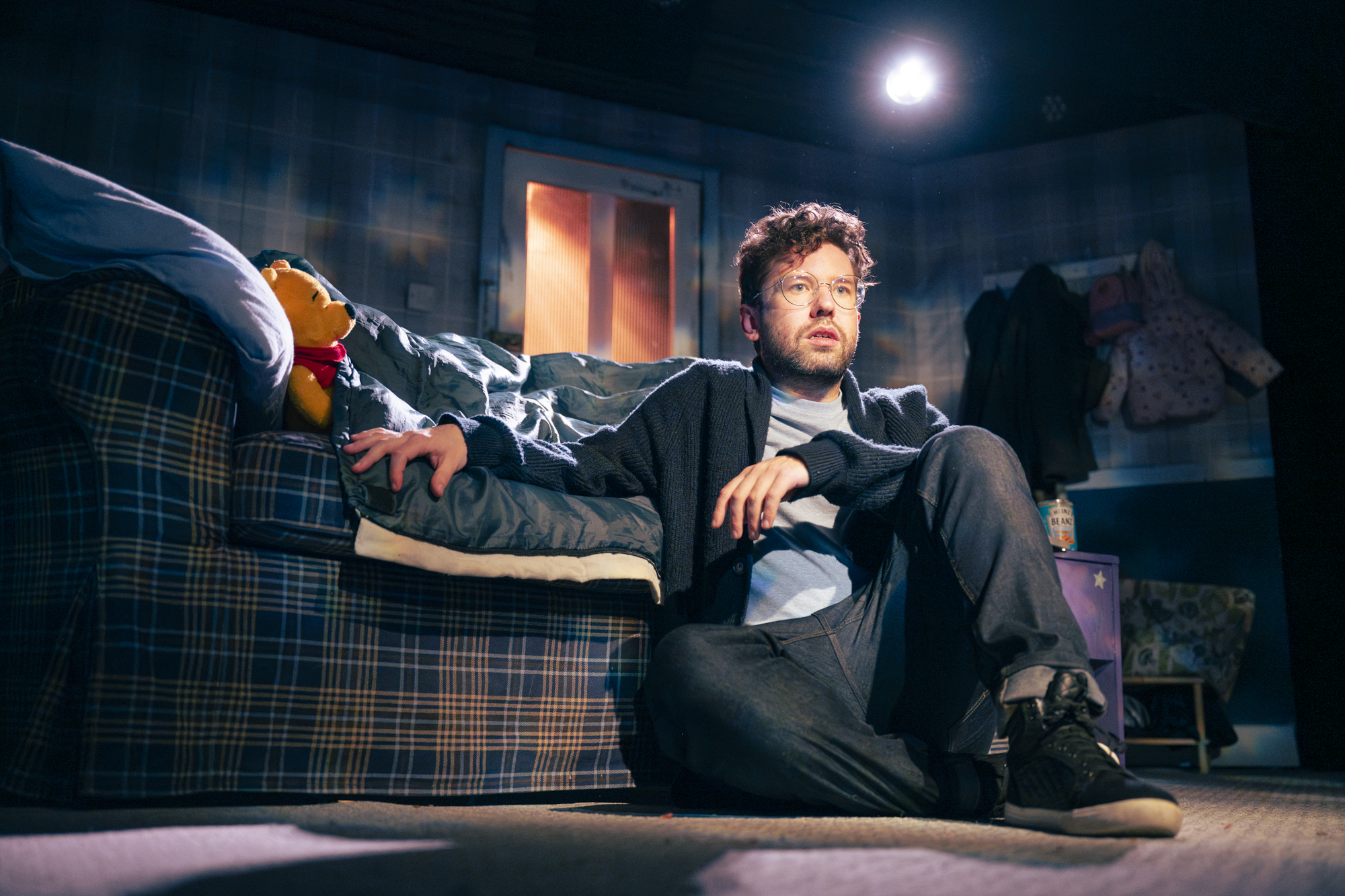
The Pig, Daniel (Ciaran Stewart), is struggling. He’s lost his job, his marriage has fallen apart and he’s desperate to maintain a good relationship with his seven-year-old daughter. But how can he do that when the flat he’s renting is mouldy and damp, and a combination of Universal Credit and part-time shelf-stacking barely leaves him enough to feed himself, let alone put the heating on? Worst of all, his daughter knows. She puts on a brave face for him, trying to reassure him that the crappy pizza he’s heated up is exactly what she wants for her tea. He can’t bear it.

Enter the Wolf, Malc (Ben Ewing), and his sidekick, Sussanne (Beth Marshall). He’s a debt collector and she’s an engineer, and they’re here at the behest of the energy company, to install a new smart meter – one that requires prepayment. If he doesn’t have the money up front, Daniel will be left without power.

Malc is unsympathetic. He knows what poor looks like; it’s how he grew up. But he believes it’s up to individuals to get off their arses and sort themselves out – like he has done. Ewing portrays the GB News-loving cynic with a charismatic swagger. “How can someone call themselves broke if they’re still drinking ground coffee, if they’ve got a TV and a Playstation?” he demands. Sussanne is less world-weary – it’s her first day – and more sympathetic too: she doesn’t think it’s a lot to ask for a warm, safe home and enough food in your belly; she’s in favour of a benefits system that allows people a few small treats. Marshall imbues the conflicted newbie with real heart – but hey, she’s got a job to do, and if she doesn’t do it, she’ll be in the same boat as Daniel.

Hunter makes some important points in this play, but the dialogue focuses too intensely on the issue, reducing the characters to representatives of their respective positions, rather than fully-rounded people. While the dark humour works well in places, a lighter touch is needed throughout to stop the story from being bogged down by its own good intentions – and perhaps the brusque conclusion ties everything up a little too neatly to be entirely convincing.

3 stars

Susan Singfield
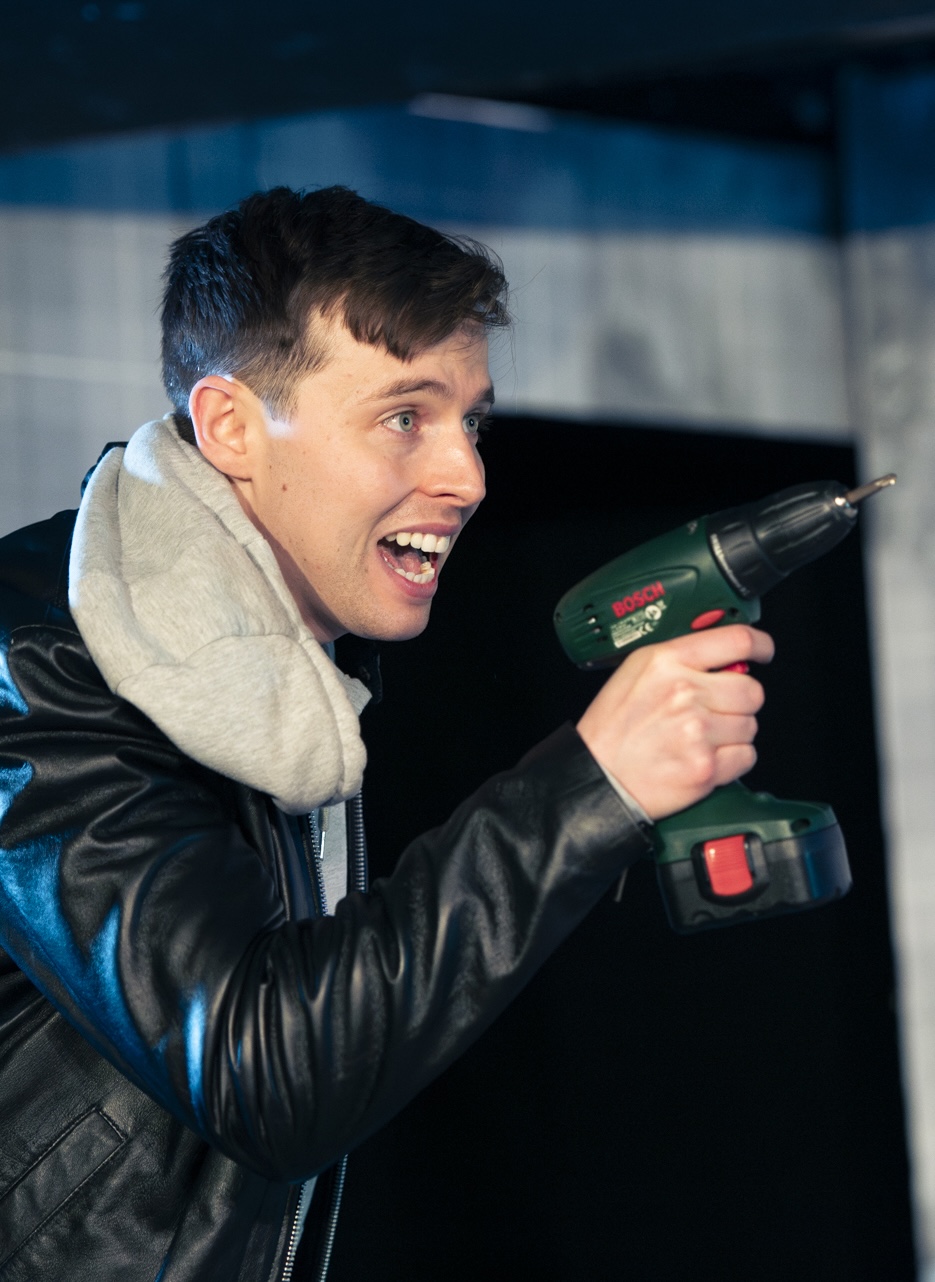
The Spark

04/04/23

Traverse Theatre, Edinburgh

It’s hard to believe it’s taken until now – the 2020s – for the term ‘perimenopause’ to enter popular discourse, although, ironically, my computer has just underlined it in red, signalling an unknown word – so maybe we’ve still got a way to go. Nevertheless, we’re moving inexorably away from hushed murmurings about ‘the change’ and oblique references to ‘hot flushes’, and instead naming all of the physical and mental symptoms of this life-altering process. It turns out it’s not just your periods petering to a halt. No such luck. Instead it’s some or all of the following: joint pain, exhaustion, menstrual cramps, decreased (or increased) libido, mood swings, anger, vaginal dryness, brain fog… it’s quite the gut punch. Almost literally.

In The Spark, playwright Kathy McKean explores the impact of the perimenopause on a politician. Robin (the brilliant Nicole Cooper) is struggling in a system that seems designed to constrain her. And whereas, in her younger years, she might have bitten her lip and done what needed to be done in order to get ahead, she’s at ‘that age’ now, and the fuck-it factor has set in. No, she won’t stand by while a group of men harass a young girl at a bus stop. No, she won’t deliver the anodyne presentation her speech-writer, James (Johnny Panchaud), has concocted – a bowdlerised version of her own from-the-heart first draft. No, she won’t accept that she’s powerless to affect change. Because otherwise, what’s it all for?

Directed by Gordon Barr, the three actors effortlessly illuminate the chaos inside Robin’s head, as her adversarial discussions with both James and her long-suffering GP, Maggie (Beth Marshall), build to a cacophony. Maggie’s got enough problems of her own – and she blames Robin for some of them. After all, Robin was, until recently, the minister for health. She knows how over-worked the nation’s doctors are; how can she possibly think Maggie has time to deal with what seems on the surface like a pretty bog-standard set of symptoms? Except that Robin’s menopausal heat seems to manifesting itself outside her body, and who knows where that will end…

The writing here is sharp and the delivery fast-paced and engaging. The Spark seems like a fitting finale to what has been a particularly strong season of A Play, a Pie and a Pint. It’s not perfect – it’s a simple idea that builds well at first, but doesn’t deliver the shocking crescendo it perhaps should, and maybe takes aim at the wrong target (I can think of many institutions more deserving of a middle-aged woman’s ire than the parliament at Holyrood). But it’s good to see this subject aired, and in such a witty, thought-provoking way.

4 stars

Susan Singfield

Variant

28/03/23

Traverse Theatre, Edinburgh

The latest in this A Play, A Pie and A Pint season is Variant, written by Peter Arnott and directed by Kolbrún Björt Sigfusdöttir. It’s a distinctly Beckettian slice of absurdist theatre, a slippery two-hander that seems to question the very essence of identity. Who are we? Are we who we really think we are? And are the people we believe we are closest to, actually who they appear to be? Such heavy questions are just the tip of the iceberg in this taut and unsettling play.

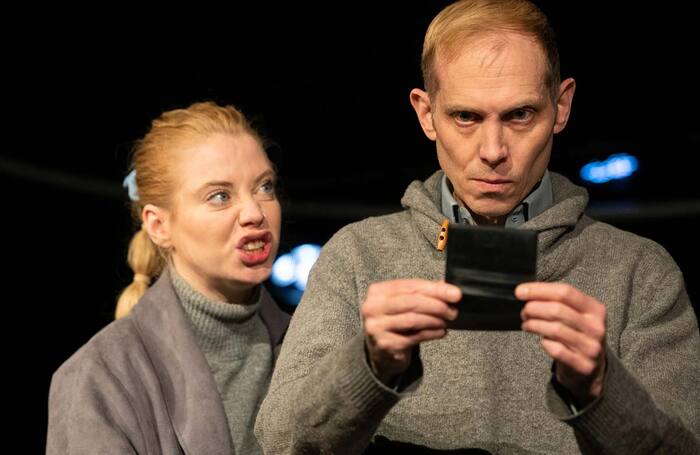
A woman (Meghan Tyler) and a man (Simon Donaldson) saunter into the circular performance space, dressed in muted tones that perfectly match the simple setting. The woman begins to write in a notebook, the man reads a novel, but the silence is almost immediately broken by the arrival of a fly, buzzing annoyingly around the man’s head, interrupting his reading. He kills it. And then he pauses to make a remark to the woman.

‘I see you’ve changed your hair.’

But she quickly questions what he means by this. Was there something wrong with her hair before? Does he approve of what she’s done to it? Or would he have preferred something else? What’s wrong with her hair?

At first the conversation seems innocuous, the bickering of a long-married couple – but as it progresses, it becomes increasingly complicated, loaded with allusions to other things. I find myself asking questions. Are the two people actually married? Because isn’t this beginning to feel distinctly like an interview? And why does the woman keep steering the conversation into darker waters? Why are the images she refers to so violent?

Arnott’s play is cleverly constructed, raising many questions but offering no answers, and – just as we’re beginning to think we have a handle on it – the piece resets itself, and pursues another line of thought, steering us in a different direction. All credit to Tyler and Donaldson, who inhabit their complicated roles with absolute authority. If I’m not always entirely convinced that the piece has as much substance as it has ambition, it’s still nonetheless an engaging, and wryly amusing play, weighing in at a taut forty-five minutes, during which it switches back and forth like a cerebral rollercoaster. 

Did I like the play? Well, let me ask you something. What do you mean by the word ‘like’? Are you asking if it entertained me? Or puzzled me? Or even baffled me? Do you think I should review it? But then, what is a review? And perhaps more to the point, who’s writing this one? Oh, hang on a minute. I think it must be me. Whoever I am.

3.8 stars

Philip Caveney

Write-Off

21/03/23

Traverse Theatre, Edinburgh

The A Play, A Pie and a Pint season continues its cracking run with this intriguing two-hander, written by Aodhan Gallagher and directed by Irene McDougall. It’s a play about writers and writing, so naturally I’m fascinated to see what it has to say about the subject – and, as it turns out, it has plenty. What’s more, I’m delighted to note how many unexpected twists and turns are packed into a brisk fifty-minute running time.

Freddie (Richard Conlon) is a long-established fiction writer, currently preparing to start work on a new novel – most of which is already a stack of crumpled notes in his wastebasket. He’s never seen the necessity for incorporating elements from his own life into the gritty psychological thrillers he’s made his reputation on. These are brutal tales filled with violence and action. But lately, Freddie’s publishers have become a little twitchy, pointing out that his earlier work is increasingly being perceived as ‘problematic’. 

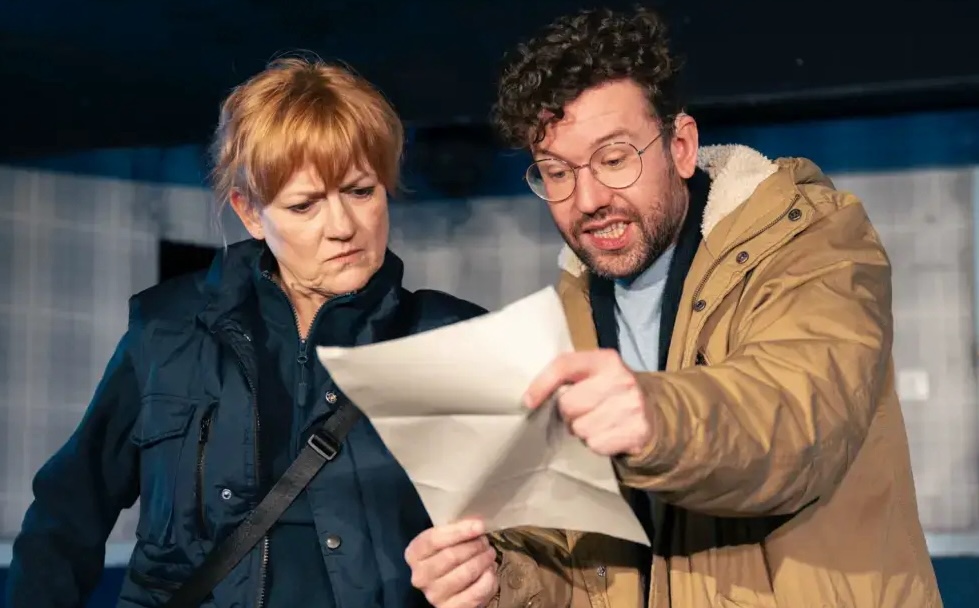
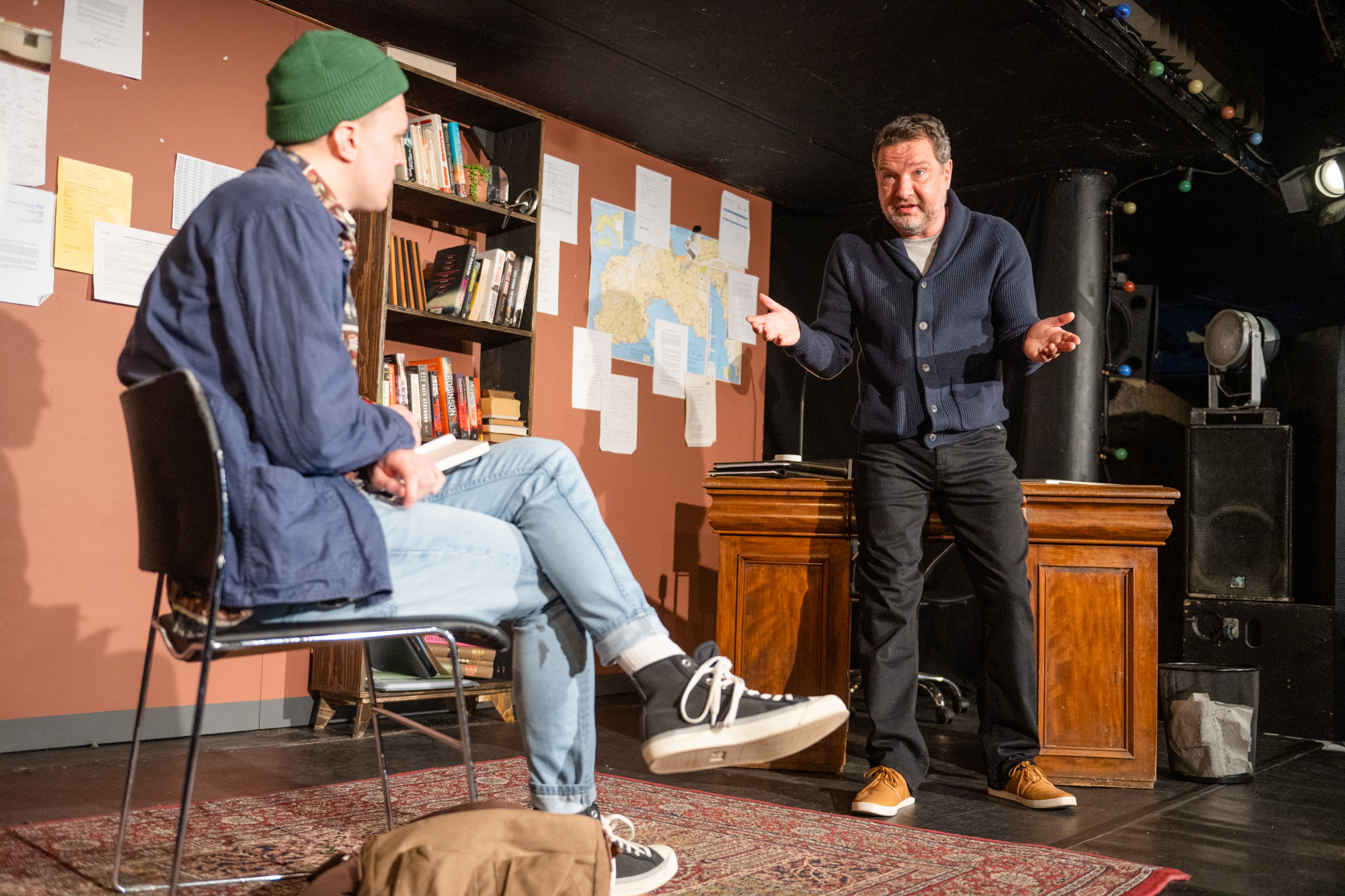
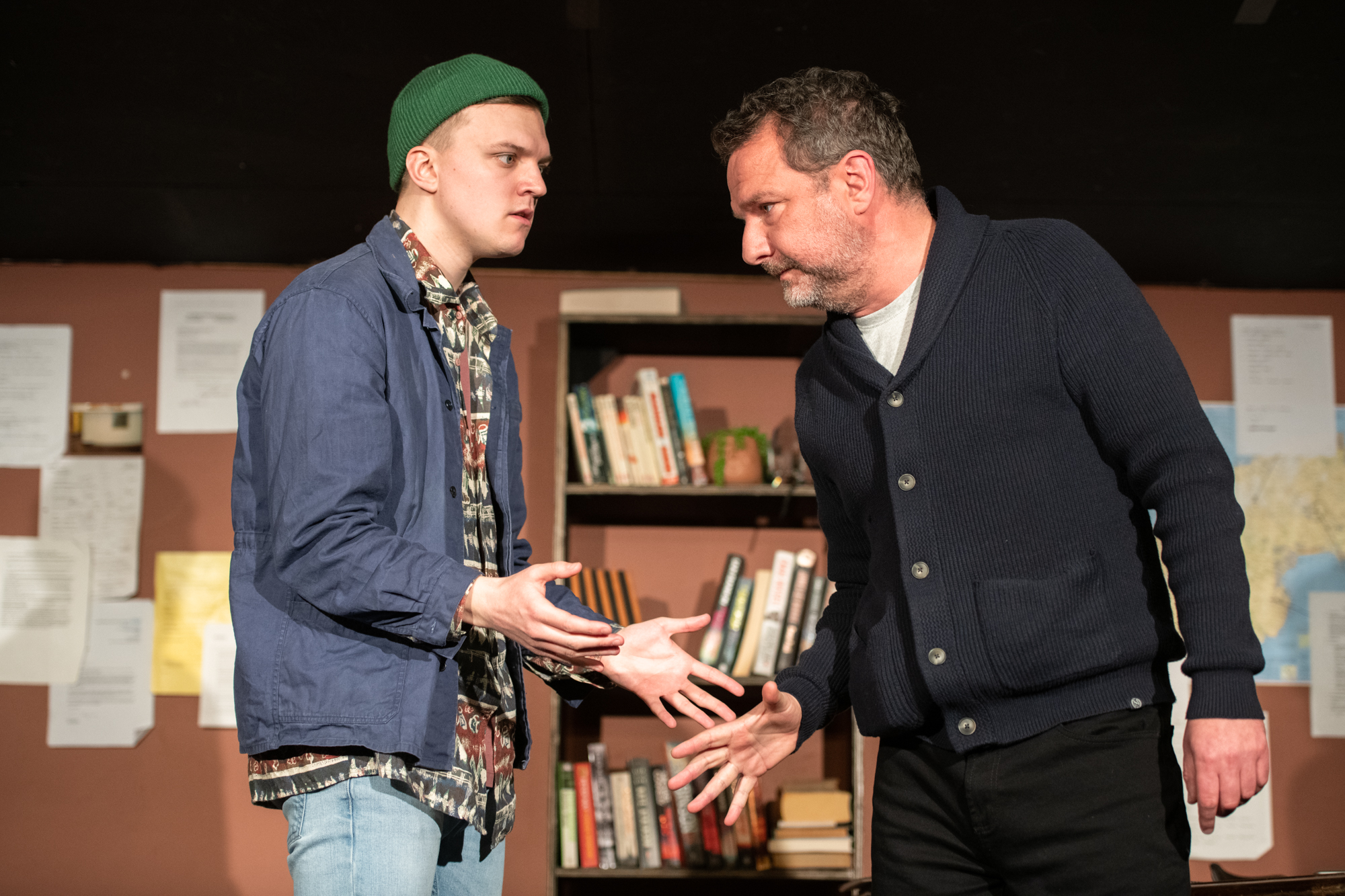
With this in mind, they’ve suggested that this time around, he might want to employ a ‘sensitivity reader’, somebody more attuned to contemporary issues. Enter Ben (Bailey Newsome), the promising student of one of Freddie’s literary acquaintances. Ben is young, gay and confidently in touch with the zeitgeist. He sports a beanie hat and trendy footwear. He also has an unpublished novel of his own that he’s very keen to get noticed…

Write-Off’s acerbic dialogue hooks me from the get-go and my sympathies bounce from character to character as the two men, by turns adversaries and allies, discuss their respective ambitions, beliefs and motives. One moment I’m laughing out loud at Freddie’s caustic observations, the next I’m gasping at some new revelation from Ben, which I genuinely haven’t seen coming. Can these two men ever hope to settle their differences enough to work together on a project?

The performances of the two actors are utterly believable and while it could be argued that this is a piece that’s completely predicated on its quickfire dialogue – and might work just as effectively as a radio play – it’s nonetheless a compelling and challenging production that maintains its propulsive edge right up to the final scene.

I head straight from the play to The National Library of Scotland where – inevitably – I’m working on my new novel. Who says life doesn’t imitate art?

4 stars

Philip Caveney

Jinnistan

08/11/22

Traverse Theatre, Edinburgh

Jinnistan, directed by Niloo-Far Khan, is the last of this season’s PPP productions, and – in a break with the norm – it’s in the ‘big theatre’, aka Traverse One. This seems fitting, as the play’s parameters are bigger than normal too, encompassing not just the world as we know it, but the spirit realm as well. The Jinnistan of the title co-exists with Pakistan – but relations are strained, to say the least.

Malik (Taqi Nazeer, who also wrote the script) moved from Scotland to Pakistan a year ago. His wife, Layla (Avita Jay), and teenage daughter, Asiya (Iman Akhtar), have followed him there. Asiya’s not happy, and neither is Malik. She wanted to stay at home with her pals. and he – well, he isn’t saying. I guess it isn’t easy to tell your family that it’s your destiny to be a genie-fighter, and that there are annual rituals you need to perform in order to save lives.

This is essentially a low-fi horror, and all the genre’s tropes are in evidence here. Spooky graveyard? Check. Family secret? Check. Wayward teenage girl possessed by an evil spirit? Check. Nazeer keeps things fresh by transposing the action to a different culture, seamlessly blending Arabic and English to give a clear sense of place. The setting is enhanced by special effects, which – though obviously constrained by budget – are serviceable enough, conveying a feeling of unease.

Akhtar delivers an impressive performance, imbuing Ayisa with a convincing mix of swagger and insecurity. The sound design (by Niroshini Thambar) is also excellent: the jinn’s voice truly seems to emanate from somewhere beyond the here and now.

I do have some quibbles: the script is a little uneven, for example, and there are jarring moments of humour that undermine the building tension, so that – ultimately – the stakes are never really raised. The recorded voices, though well-delivered, are over-used: all too often, I find myself listening to a block of exposition, while looking at a blank or static stage.

Nonetheless, Jinnistan is an entertaining piece of lunchtime theatre, and a fitting end to this round of PPP’s lunchtime offerings.

3 stars

Susan Singfield

(Can This Be) Home

28/03/19

Writer/performer/poet Kolbrùn Björt Sigfúsdóttir fully expected her extended examination of the Brexit conundrum to have reached some kind of a resolution by now – it is after all, the night before the UK is scheduled to leave the European union – but the slow separation lumbers inexorably on, with nobody any the wiser.

Icelandic by birth, Sigfúsdöttir has lived and worked in the UK for five years now and is understandably concerned about what’s going to happen to her ability to travel and work in Europe after Brexit has changed the rules. (Can This Be) Home is essentially a series of poems about what it means to be an immigrant, though it should be said, that she’s speaking from a fairly privileged point of view, something that she really only acknowledges in her final (and most successful) poem.

Her readings are counterpointed with short pieces by musician Tom Oakes, who plays a wooden flute and a stringed instrument that, to my untutored eye, looks like a lute crossed with a guitar. Tom features a nice line in anecdotal patter and his observation that it’s hard to write a protest song when you’re an instrumentalist gets the evening’s biggest laugh. His musical influences come from all over the world, but particularly from the Scandi-regions where he has often been based – so he too is waiting for the results of Brexit with some apprehension.

While Sigfúsdöttir recites her work, Oakes immerses himself in a book, and while Oakes tootles his flute, Sigfúsdöttir models house-shaped images from what appears to be a mixture of sand and putty. This pointed ignoring of each other’s efforts is obviously intentional but I would actually like to see them combining their respective talents to create a more cohesive whole. It’s also true to say that tonight, at the Traverse Theatre, the two performers are pretty much preaching to the converted. I doubt there’s a single person in the room who actively disagrees with what they are saying.

The result is therefore a strangely muted affair. It would be very interesting to see this performed to a more partisan audience, one featuring people with an entirely different view of the Brexit situation. As it stands, this feels a little too comfortable, a little too lacking in fire and urgency.

3 stars

Philip Caveney