Tom Hanks

Sully: Miracle on the Hudson

16/11/16

For his previous cinematic outing (the indifferently reviewed Inferno) Tom Hanks broke out the Grecian 2000 and presented audiences with an airbrushed version of his real self, trying to pass for someone considerably younger. Here, he’s playing someone closer to his own age, veteran airline pilot Captain Chesley Sullenberger,  who in 2009 managed to do the seemingly impossible, by crash-landing a stricken airliner in the Hudson River without incurring a single fatality. (Well, that’s 155 tickets sold, right there.)

Clint Eastwood’s retelling of the story is never less than compelling. Since we already know the outcome of the story, he can’t really hope to generate any real suspense; so he opts instead for a strange, circular narrative, opening with the moment that Sully and his co-pilot Jeff Skiles (Aaron Eckhart) realise that they are deep in the doo-doo after a catastrophic bird strike. From here, the story loops around like a plane looking for somewhere suitable to land, touching briefly on Sully’s early days in aviation, before finally revealing the workings of the crash landing itself.

The main tension in the story is generated when a team of crash investigators (including Breaking Bad’s Anna Gunn), assigned to examine the circumstances of the accident begin to look as though they might disagree with Sully’s account of the story, something which threatens to turn him from overnight hero to an absolute zero. A series of computer simulations have raised the distinct possibility that the plane might have been able to return safely to Laguardia airport, from where it had recently taken off. Hanks does his usual ‘Everyman’ persona with the understated dignity we’ve come to expect from him and he’s ably supported by Laura Linney as Sully’s unfortunate wife, stuck on the end of a telephone line, while her husband faces the hearing that could destroy his career.

It’s only in the film’s post credit sequences where Eastwood cannot quite resist tipping the project into cheesiness – we see the real Sully and the real survivors, making speeches at one of those celebrations the Americans love so much – and there’s an onscreen credit that pays tribute to the emergency services in New York who worked together to save so many lives. But ultimately you can’t help concluding that Sullenberger took a chance in a desperate situation and (luckily for him) it paid off.

Still, this is nonetheless an entertaining film, particularly when projected onto an IMAX screen, which makes the crash landing a startlingly immersive experience. Nervous fliers might want to give this one a miss.

4 stars

Philip Caveney
Bridge of Spies

MV5BMjIxOTI0MjU5NV5BMl5BanBnXkFtZTgwNzM4OTk4NTE@._V1_SX214_AL_Unknown

29/11/15

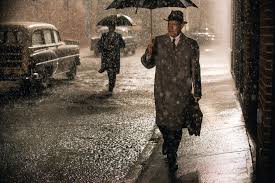
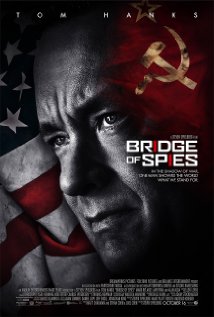
Stephen Spielberg wears two hats. There’s the backwards baseball cap he wears when he’s directing superior popcorn entertainments like Indiana Jones and Jurassic Park – and sometimes, he reaches into the back of the wardrobe and pulls out a sombre black homburg, which is his hatwear of choice when helming ‘darker’ material like Schindler’s List and Munich. Bridge of Spies is definitely a homburg movie, but in its quiet own way, its as gripping and involving as any of his other films. Spielberg has the uncanny ability to take the most complex story and tell it with effortless style, making it accessible and involving.

It’s 1957 and the ‘Cold War’ between America and Russia is at its height. Rudolf Abel (Mark Rylance) an apparently innocuous amateur artist is arrested on a charge of spying for the USSR. He is, arguably, the most hated man in America. Veteran lawyer, James B. Donovan (Tom Hanks) is assigned to defend him, mainly because the law must be observed and despite the fact that even the judge on the case openly declares that Abel should be found guilty. But Donovan is a liberal, who believes implicitly in the American constitution. He fights Abel’s case (unsuccessfully) through the courts and finds himself vilified for doing so – but he does manage to prevent him from going to the electric chair, pointing out that Abel might be a useful bargaining tool in the future.

Sure enough, shortly afterwards, American pilot, Francis Gary Powers is shot down whilst carrying out a spy mission over Russian territory. He’s taken prisoner and the CIA are terrified that he might be persuaded to leak the secrets of the U2 spy plane. A possible exchange of prisoners is mooted and once again, Donovan is recruited to head out to East Berlin to negotiate the exchange…

This is a beautifully made film, that brilliantly invokes the austere look of the era and provides a fresh perspective on the business of espionage. Hanks is perfectly cast as the American everyman, a role that would have been played by James Stewart back in the day, his chunky features emanating absolute integrity. Rylance, meanwhile, as the dry, sardonic Abel gives a masterclass in acting. Together, the two actors strike sparks off each other and they are aided and abetted by a razor sharp script, created by Matt Charman and the Coen Brothers.

There’s little to dislike here and plenty to admire. It’s essentially a ‘small’ movie, which tells its story with skill and precision and never puts a foot wrong. As the story moves towards its conclusion, it bills up levels of suspense that will have you twitching in your seat.

Spielberg wears both his hats with equal success but I have to say, I do prefer him in the homburg.

4.6 stars

Philip Caveney