Robert Zemeckis

Here

08/01/25

Cineworld, Edinburgh

If a film deserves accolades for originality then Here definitely earns them. I’ve never seen anything quite like it. That said, it does feel very much like an experiment, with director Robert Zemeckis continuing the fascination with movie technology he’s been relentlessly pursuing since 2004’s The Polar Express. Not everything in the film quite comes off – but the parts that do are extraordinary.

Take the opening sequence for instance, where a fixed camera offers a changing view of a particular point on the compass and, through a series of portals, we are offered glimpses of the ever-changing landscape from the world’s inception and onwards across the unfolding centuries. The gimmick of the film – and there’s no better word to describe it – is that the camera never moves its position. Eventually, we see the woodland where it stands being cleared and, later, a house is constructed around it until it is enclosed in a room. Through the window there’s a view of a much grander house, which once belonged to the illegitimate son of Thomas Jefferson, but here, in the more modest home across the street, a series of middle-class families move in and play out scenes from their lives. The aforementioned portals are used to zip the viewer back and forth in time, allowing us to catch glimpses set in different eras.

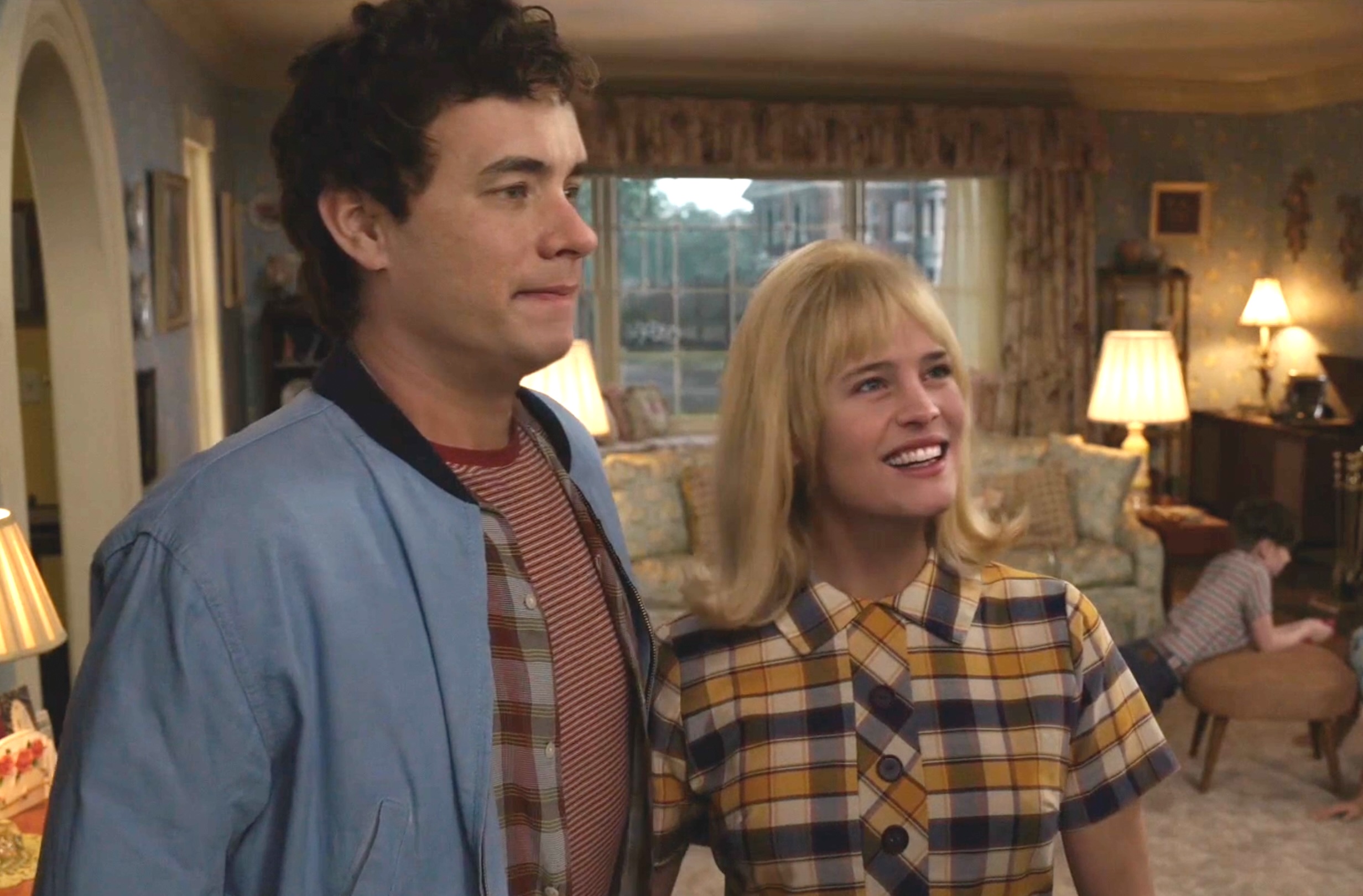
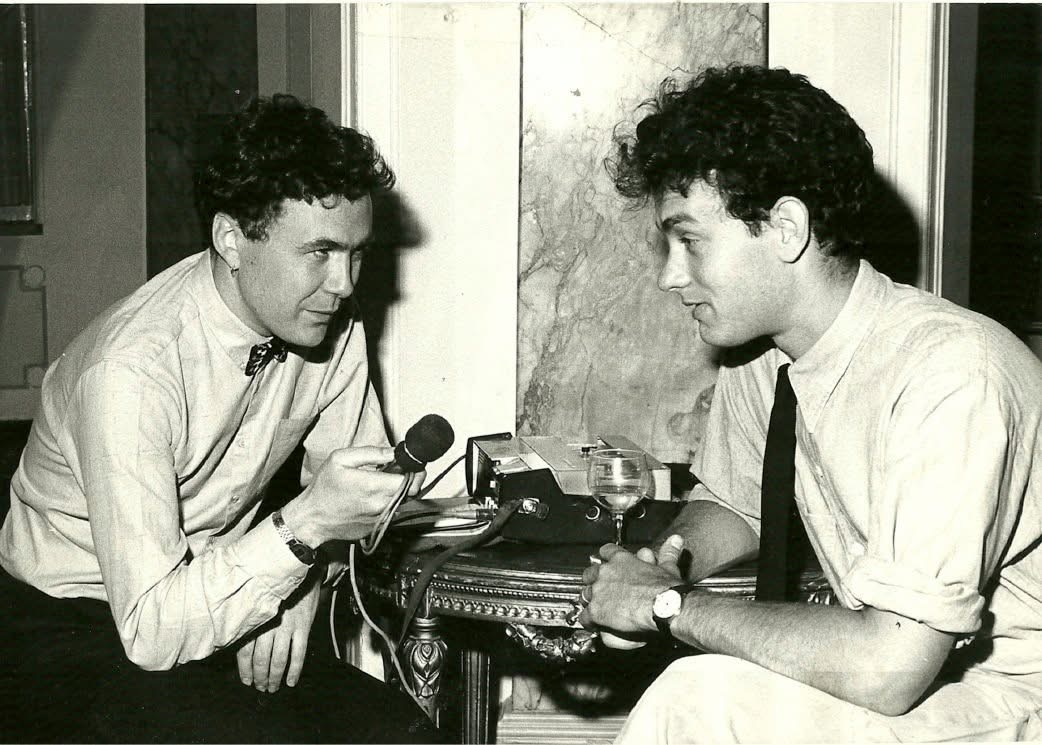
Al (Paul Bettany), who has recently returned from the Second World War, and his wife, Rose (Kelly Reilly), move into the house and start a family. One of their children is Richard, a frenetic, hyperactive sort, played by four different kids before transforming into Tom Hanks. The growing-up process encompasses cowboy hats, drum kits and eventually an obsession with the idea of becoming an artist. (Substitute the word ‘writer’ and I’m pretty much looking at my own youth.) With the use of sophisticated de-aging software, Hanks is exactly how I remember him in 1984 when, as a reporter for Piccadilly Radio, Manchester, I interviewed him for the film Splash. I make no apology for including that image here, because to my mind, this is the quality that Here (adapted by Eric Roth from a graphic novel by Richard McGuire) handles with considerable skill: the ability to transcend the limitations of time.

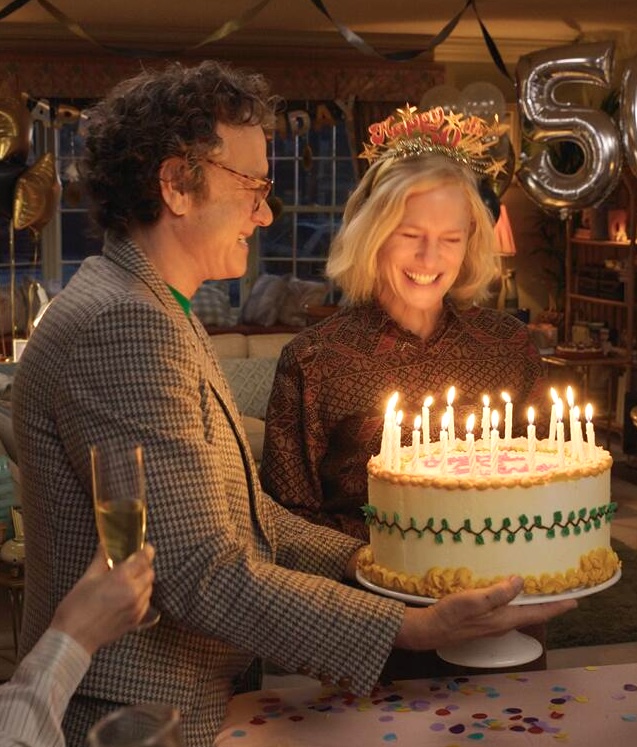
Richard introduces his parents to Margaret (Robin Wright) and, soon enough, she’s pregnant and Richard is beginning his own journey into adulthood, with all its joys, disappointments and trials. This central thread works well, but some of the other strands are less convincing. A narrative about a romance between a Native American brave and a young woman from his tribe feels too picture-book cute to be convincing – and I’d like to learn more about the Black family that moves in after Richard and Margaret have left the house. A scene where Devon Harris (Nicholas Pinnock) instructs his son Justin (Cache Vanderpuye) about what to do if his car is ever stopped by the police, hints at bigger themes that might have been more challenging than the invention of the La-Z-Boy armchair.

Here won’t be for everyone. The many strands that make up the narrative are occasionally somewhat confusing and that insistence on keeping the point of view so stubbornly fixed occasionally necessitates some unlikely seating arrangements in order to ensure that everybody remains in shot.

Still, I admire Zemeckis’s determination to keep pushing the boundaries of cinema and I think it’s fair to say that the man who gave us Back to the Future, Forrest Gump and Cast Away has earned the right to spend his time playing in the sand box. Here isn’t up there with his best work but it’s nonetheless an intriguing and highly original concept.

3.8 stars

Philip Caveney

Guillermo del Toro’s Pinocchio

19/12/22

Netflix

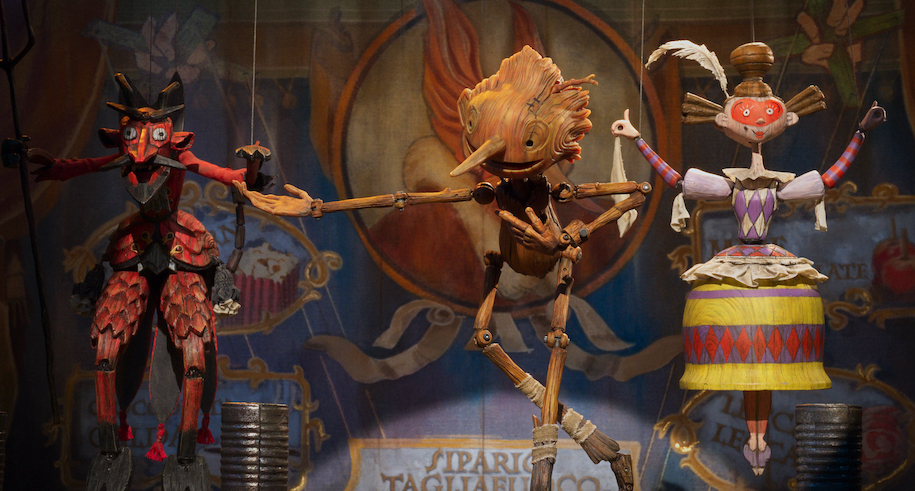
Guillermo del Toro is one of my favourite film directors – and Disney’s Pinocchio one of the formative films of my childhood. So when I first hear the news that the Mexican director is planning to deliver his own version of Carlo Collodi’s classic tale, it’s naturally something I eagerly look forward to – for a very long time. Indeed, it turns out that del Toro has actually been working on this astonishing stop-frame animation for something like fifteen years.

As the release date finally approaches, I look everywhere for a cinema in Edinburgh that’s planning to show del Toro’s film on the big screen, but alas, with the Filmhouse out of action, it cannot be found. So Netflix it must be. As it turns out, some visions are so powerful, so perfect, that they can blaze out of a small screen like meteors. Guillermo del Toro’s Pinocchio is an astonishing film, that has the audacity to take everything we know about the story and give it a thorough makeover. What’s more, the changes that he makes (he co-wrote the screenplay with Patrick McHale) all seem to enrich the original, making it more logical, more explicable.

Revelation number one: when we first encounter woodcarver, Geppetto (David Bradley), he has a real son, Carlo (voiced by Gregory Mann). But Carlo dies tragically when Italian air force planes unload their bombs onto the church, where Gepetto is working on a huge crucifixion. This backstory helps flesh Geppetto out and makes his subsequent actions more believable – especially when Pinocchio is forged from the very tree planted to mark Carlo’s grave.

Revelation number two: the Pinocchio that Geppetto eventually carves in a drunken rage looks nothing like a ‘real boy’. He’s a strange, spindly, half-finished marionette, generally shunned and mistrusted by the people in his home village. Contrary to the original tale, it’s the villagers who have to learn to accept Pinocchio, rather than the other way around.

Revelation number three: this version is set in Italy in the 1930s, under the rule of Benito Mussolini. Pinocchio’s adventures on the ‘Donkey Island’ are exchanged for scenes where he unwittingly becomes a poster boy for fascism. (It’s nakedly clear what del Toro is saying here. And it makes perfect sense, because to take on Disney’s most iconic scenes would be a pointless exercise. If you can’t better a scene, do something entirely different, right?)

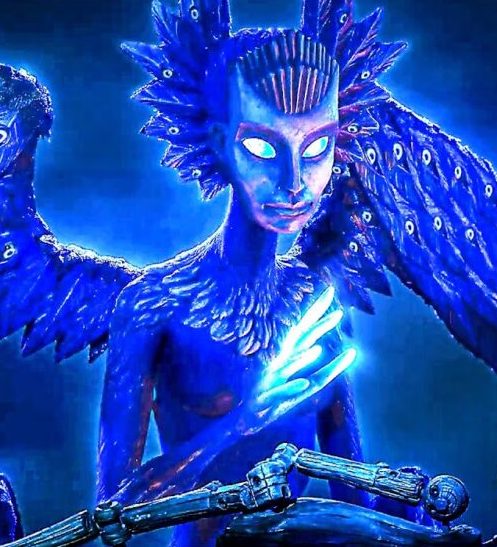
There’s more, much more, packed into the film’s two hour run. We meet Sebastian J Cricket (Ewan McGegor), an ambitious, self-aggrandising would-be author, who only agrees to take on the task of being Pinocchio’s ‘conscience’ in the hope off getting a book deal. There’s Count Volpe (Christoph Waltz), the greedy, venal owner of a travelling freak show, who spots an opportunity to make lots of money and who bullies his monkey assistant, Spazzatura (Cate Blanchett) at every opportunity. And wait till you see what the animators (and Tilda Swinton) have done with the infamous Blue Fairy, rechristened here as the Woodland Sprite. More than anything else, there are fundamental changes to the character of Pinocchio himself. He’s no longer the obnoxious, pig-headed lout of the novel, but a sweet, misguided misfit, desperately trying to be liked. A scene where he can’t understand why all the villagers hate him, but adore the other wooden figure nailed to a cross on the church wall is a stand-out.

It’s not just the levels of invention in the story that make this such a unmitigated triumph. It’s the loving attention to detail: every character, every set, every painted landscape; it all pulses and dazzles with imagination of the highest calibre. There’s so much to see here, it’s clearly going to need repeated viewings to really take it all in. And watching it makes me wish that dear old Ray Harryhausen was still alive to see where modern technology has brought the art of stop-motion animation.

Many films have the word ‘masterpiece’ attached to them, but few deserve it as thoroughly as this one. All you need to do it hit the Netflix button, so… no pressure.

5 stars

Philip Caveney

Welcome to Marwen

05/01/19

Robert Zemeckis is a veteran director who refuses to rest on his laurels. Over the years, he’s been responsible for some major hits – Back to the Future, Forest Gump, Who Killed Roger Rabbit?  – and, of course,  there’ve been a few misfires –  Beowulf for example? And The Polar Express is a film that tends to divide viewers.

Welcome to Marwen is a ‘so weird it must be true’ story, based on the life of artist, Mark Hogancamp, though it should be noted that, like a lot of ‘true’ stories, the scriptwriters don’t hesitate to jettison those facts that don’t fit with their vision of the tale.

Hogancamp’s backstory is a harrowing one. A talented artist with a passion for World War 2 imagery and an obsession with wearing women’s shoes, he drunkenly confessed this to some strangers he met in a bar, who then ambushed him and beat him mercilessly, putting him into a coma for nine days. When he finally came back to his senses, he found that he had lost all memory of what happened to him before the night of the attack – and he could no longer remember how to draw.

When we first encounter Hogancamp (Steve Carell), he is engaged in a long-established photography project that is an attempt both to rekindle his artistic abilities and to come to terms with the awful hate crime that has robbed him of his former life. In his garden, he has constructed Marwen, a miniature Belgian town, occupied by Nazis and populated by dolls. It’s here that his avatar, Captain Hogie, a fearless maverick (who also has a liking for high heels) is running an energetic resistance movement, backed up by five female freedom fighters – all based on women who are important in the artist’s life,

It must be said that the women in question seem to take his somewhat creepy depictions of them with unbelievably good grace, but I guess they knew him before he was attacked, and are prepared to cut him some slack.

Of course, this being a Robert Zemeckis film, Hogie’s adventures are recreated through state-of-the-art motion-capture and there’s no denying that the ensuing scenes are an extraordinary technological achievement. But the main problem is that the film can’t seem to decide what it wants to be. For the most part, it’s about a man going through a slow healing process and gradually gaining the necessary strength to confront his assailants in court, but the real life scenes are regularly interspersed with more of those mo-cap sequences and I can’t help feeling there’s rather too many of them and that – until the very end – they all seem to play out in exactly the same way, without really advancing the story.

There’s a tendency too to punch home the film’s messages with a heavier hand than seems strictly necessary. Déja (Diane Kruger)’s significance, for example, is immediately apparent, but spelled out laboriously for the hard of thinking,

Carrell, it must be said,  is terrific in the lead role and Merritt Wever is appealing as the manager of the local toy shop who quietly carries a torch for him.

Welcome to Marwen is never less than interesting – but, despite all that cutting-edge brilliance, there’s something here that doesn’t quite add up to a satisfying night at the cinema.

3.8 stars

Philip Caveney 


The Walk

MV5BNTY4MzA4Mzc5Nl5BMl5BanBnXkFtZTgwNDIzMzk5NjE@._V1_SX214_AL_

11/09/15

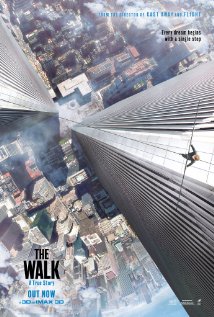
In 1974, tightrope walker Philippe Petit performed a stunt that defied belief. He strung a wire between the twin towers in New York (illegally) and walked backwards and forwards across it eight times while an entranced audience of passers-by watched in stunned amazement. The ‘Coup,’ as Petit called it, has of course already been the subject of a film, James Marsh’s riveting documentary, Man On Wire (2009), but Petit only had a couple of still photographers with him. So this is Robert Zemeckis’s attempt to reconstruct the event.

We open with Petit (Joseph Gordon-Levitt) talking directly to camera. Gordon-Levitt is a charming performer (considerably more charming than Petit himself who was famously unfaithful to his long-suffering girlfriend, Annie, played here by Charlotte Le Bon the night after the Coup, a fact that the film makers choose to ignore). Indeed, the charm offensive may be what skewers the early sections of this, as a young Petit conceives his dream of walking between the towers (in a dentist’s waiting room, as it happens), enlists the help of circus stalwart, Papa Rudy (Ben Kingsley) to teach him the secrets of wire walking – and mawkishly romances Annie, who, when we first meet her is a street performer, bashing out drippy ballads on an acoustic guitar. The tone here is too whimsical for what follows, too self consciously comic for comfort and at times it threatens to derail the film completely. Matters aren’t helped by one of the murkiest 3D prints I’ve ever seen, which sets the first half of the story in deep shadow.

The momentum is happily regained somewhat once Petit and his ramshackle bunch of accomplices actually set about trying to achieve their objective. This section is filmed like a heist movie, with the tension steadily rising as the team try to get everything in place for the walk.

The Coup itself is a hair raising, terrifying, vertigo-inducing nightmare. I sat there, desperately reminding myself that history has already assured us of the outcome of the exercise, but it was to no avail. I’m not particularly good with heights and watching Gordon-Levitt walk back and forth, kneel down and at one point lie down on that narrow steel cable must have taken several years off my life. If the rest of the film had been up to this standard, it would doubtless have been granted five stars much higher score.

As it is, that uncertain first half is hard to forgive, particularly when it’s coming from a director of Zemeckis’s stature. A warning though. If you genuinely suffer from vertigo, this really may not be the film for you.

3.9 stars

Philip Caveney