Magnolia

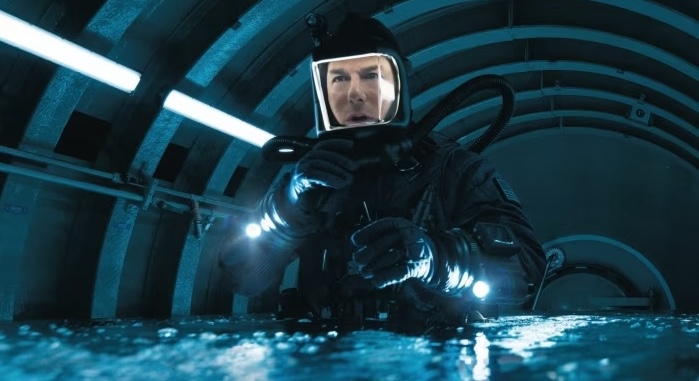
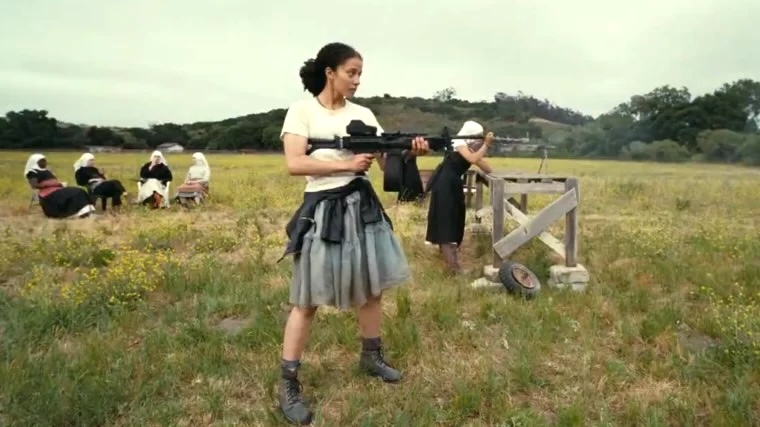
One Battle After Another

04/10/25

Cineworld, Edinburgh

We’re uncharacteristically late to this one, mostly because in its week of release we are in a camper-van in the wilds of Scotland and no cinema in that vicinity is showing it. Not complaining, you understand, people need to have holidays, but this is a film by Paul Thomas Anderson, whom I’ve held in special esteem ever since watching Boogie Nights way back in 1997. And all those ‘best film of the year’ reports make me impatient to get back to civilisation.

Mind you, I’d be the first to admit that, in recent years, PTA has (at least for me) gone off the boil a bit. Unlike many of his followers, I didn’t really care for 2017’s Phantom Thread and his last offering, 2021’s Licorice Pizza, though a warm and appealing slice of nostalgia, wasn’t the finest work from the director of There Will be Blood and (in my humble opinion) his masterpiece, Magnolia.

One Battle After Another, as the name suggests, is an action film, perhaps the last genre I’d have expected this most enigmatic of film-makers to explore but, happily, he puts his own unique spin on it, producing a sprawling, multi-faceted tale set over the best part of two decades. It’s larger than life, peopled by a series of eccentrically-named caricatures and yet, once it settles into its stride, it manages to exert a powerful grip.

We first join the action as Pat Calhoun (Leonardo DiCaprio) and Perfidia Beverly Hills (Teyana Taylor), along with other members of their far-left terrorist group, French 75, launch an armed attack on a detention centre in California and free all of the captives. During the action, Perfidia encounters the unit’s commanding officer, Steven Lockjaw (Sean Penn), and – in a move intended to humiliate him – makes him masturbate at gunpoint. However, this only causes him to fixate on her, something that will have inevitable consequences further down the line.

Pat and Perfidia become partners, but their haphazard attempts to parent their baby daughter, Willa, seem doomed to failure – especially when Perfidia is captured and forced into witness protection, and Pat is left to deal with the situation alone.

Sixteen years later, Willa (Chase Infiniti) has grown to be an independent teenager, preferring to follow the guidance of her karate instructor, Sergio (an underused Benicio Del Toro), than her drug-addled old man. Pat hasn’t been involved in any terrorist activity in years, preferring to experiment with every drug he can lay his hands on but when, out of the blue, a coded telephone call reaches him, announcing that Lockjaw (now a Colonel) is coming after Willa, he’s forced to get up off the sofa and go to her aid…

From this point, the film pretty much delivers on the promise of the title – it’s a frenetic, explosive and breathless chase filtered through cinematographer Michael Bauman’s VistaVision lenses, and backed by Jonny Greenwood’s eccentric score. Written by Anderson and loosely based on Thomas Pynchon’s novel, Vineland, the director has reputedly been working on this project for something like 20 years so it’s remarkable that it feels as timely as it does.

DiCaprio is wonderfully endearing as the hapless Pat, desperately trying to remember passwords that he hasn’t used for far too long, while Penn, as the heinous, macho Lockjaw, is the personification of a living GI Joe action figure, a man committed to preserving his outward appearance, while inside he’s a festering, ambitious wreck. But strangely, it’s newcomer Infiniti who really impresses here as the quietly determined Willa, who, when pushed, snaps back with the stubborn tenacity she’s inherited from her mother.

One Battle After Another is a searing condemnation of contemporary America, a world where freedom has to be fought for with extreme violence, where the most cold-blooded assassins hide behind the personas of smiling, corn-fed patriots. PTA finds original ways to explore the most well-worn conventions. Even the old fall-back of the car chase is given a mesmerising makeover, as vehicles glide silently through a shimmering waterfall of desert roads like some kind of LSD-induced hallucination.

Despite a hefty running time of two hours and 41 minutes, the film flashes by in what feels like half that time and it’s clear pretty much from the outset that Paul Thomas Anderson is back on form. Whatever comes next, I’m already looking forward to it.

4.8 stars

Philip Caveney
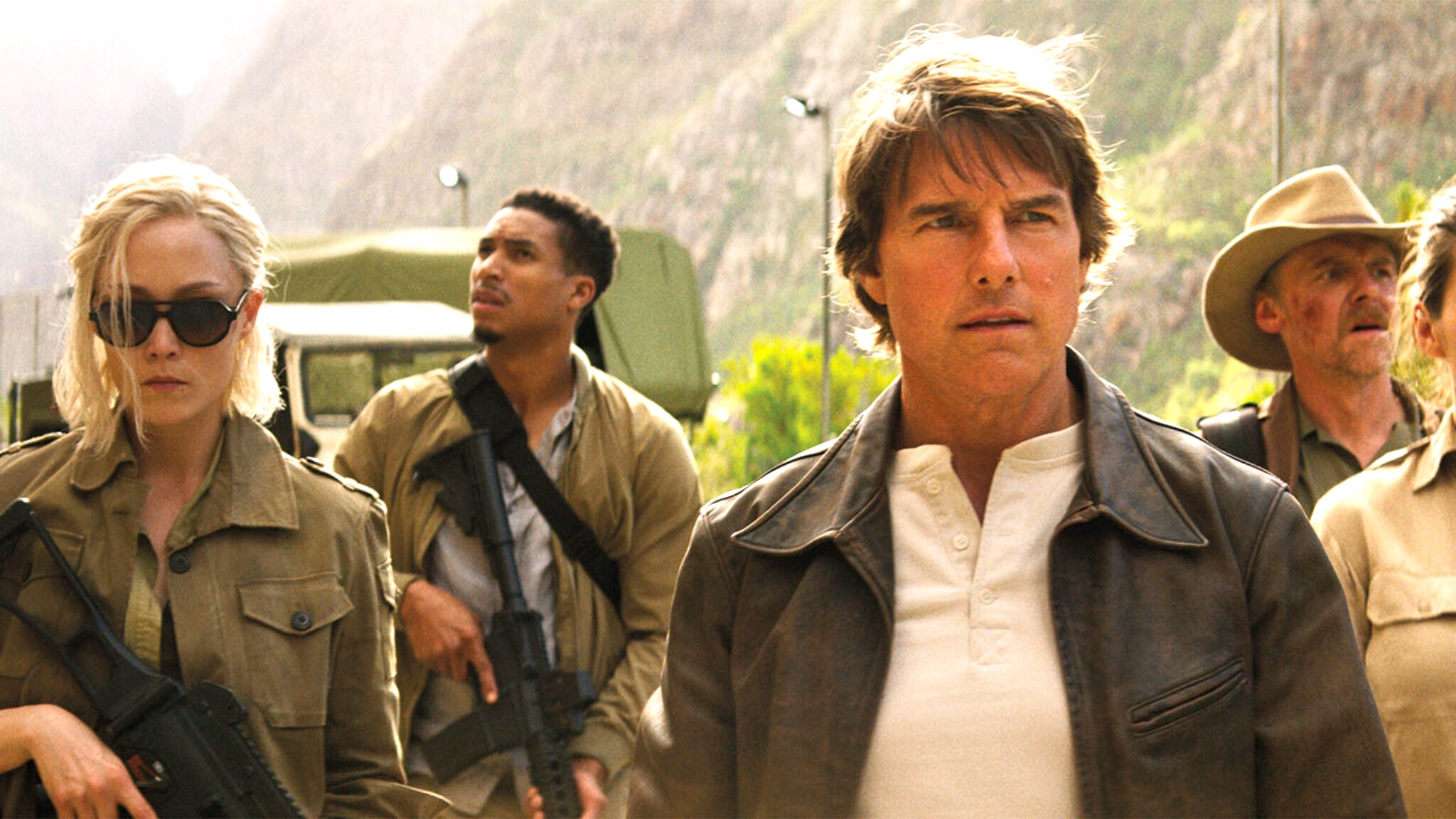
Mission Impossible: The Final Reckoning

22/05/25

Cineworld, Edinburgh

And so, it would seem, the end is nigh – though I’m cynical enough to believe that will depend entirely on The Final Reckoning’s box office. It’s been a long and varied ride for Mission Impossible. As I’ve observed before, most franchises start strong and have a couple of decent follow-ups, before eventually running out of ideas and becoming pale shadows of their former selves. MI – based on the popular 60s TV series – began its cinematic journey way back in 1996 (originally helmed by Brian de Palma) and then struggled through a bunch of variable sequels until director Christopher McQuarrie came on board for 2015’s Rogue Nation. In that film, all the disparate elements finally gelled.

For my money, 2018’s Fallout was MI’s pinnacle: tense, propulsive, gloriously inventive, it kept me hooked right to the final frame and earned itself a five star B&B review. 2023’s Dead Reckoning wasn’t quite as perfect and the fact that it was a Part One didn’t help, particularly when Part Two wasn’t set to rear its head for another couple of years. Realising, no doubt, that viewers’ memories will need a significant nudge, The Final Reckoning opens with a kind of overview: a greatest hits package offering glimpses of a younger, leaner Ethan Hunt going through his frenetic paces.

After that, we arrive in a darker, gloomier world than we’re used to seeing in MI, where super-powerful AI Big-Bad, The Entity has taken control of the entire planet’s nuclear weapons and appears to be on the verge of initiating World War Three. (Sound familiar?) Ethan Hunt is now in hiding after the shenanigans of Part One so the American President (played by Angela Bassett, who, let’s face it, is the leader we all wish America currently had) puts out an urgent plea for him to show himself and to bring along that mysterious key he got hold of in Part One.

Will Ethan step up to this new challenge? Well, what do you think?

Aided by Grace (Hayley Atwell), Luther (Ving Rhames) and Benjie (Simon Pegg), plus former adversary, Paris (Pom Klementieff), Hunt devises ever more ingenious ways of taking on the all-powerful Entity and, if the storyline is patently absurd, well of course it is. This is Mission Impossible, FFS!

To give Cruise and McQuarrie their due, they have put everything they’ve got into making this the ultimate MI adventure and, to a large degree, they’ve succeeded. There are some incredibly-assured sequences, not least a claustrophobic and nail-biting return to that Russian submarine we saw in Part One. There’s also a nerve-racking aerial routine, where Hunt clambers all over the fuselage of a single-engined plane (in mid-flight) in a desperate bid to come face-to-face with human villain, Gabriel (Esai Morales). The fact that Cruise has done all these stunts for real is, of course, admirable, though I do wonder what professional stunt performers must think about such grandstanding. (I note from the credits that Cruise actually employs a stunt double, which begs the question ‘What does that man do to earn his fee?’ Make the coffees?)

On the debit side, the film’s ponderous running time does leave me with the onerous task of choosing the right moment to nip out for a toilet break – and I’d argue that thirty minutes could easily be clipped from this, simply by removing some of those references to past adventures. Having a call-back to a character who actually appeared in the very first movie is a nice touch, but I ask myself how much does it actually add to the story?

Still, kudos to Team Cruise-McQuarrie, who have devoted so much of their time, energy and (let’s face it) money to this franchise. But it does seem like the right time to bow out. And I’m pretty sure I’m not the only film fan who wistfully remembers Cruise in films like Jerry McGuire, Rain Man and Magnolia, where he was actually required to act and turned out to be pretty damned good at it.

I’m already looking forward to seeing what he does next.

4 stars

Philip Caveney

Licorice Pizza

03/01/22

Cameo Cinema, Edinburgh

Paul Thomas Anderson has directed some of my all-time favourite films.

Boogie Nights, Magnolia and There Will Be Blood are all gems, a triumvirate that any filmmaker would be proud to leave as a cinematic legacy. But more recently, his work has underwhelmed me. Inherent Vice (2014) was an incoherent mess and 2017’s Phantom Thread – though wildly acclaimed by many critics – left me curiously unmoved.

On the face of it then, Licorice Pizza feels like a return to his comfort zone, exploring the sleazy canyons of the San Fernando Valley in the early 70s, an era that yielded such delights in Boogie Nights. This is the story of Gary Valentine (Cooper Hoffman), a supremely confident fifteen-year-old child ‘actor’ and all- round entrepreneur, with an extended family working to his orders on a variety of different projects. While it quickly becomes clear that Gary may be overestimating his own genius, he seems to have convinced a surprising number of others to give his projects a whirl.

Then, out of the blue, he falls in love at first sight with Alana (Alana Haim) who is twenty-five and makes no bones about telling Gary that he hasn’t a hope in hell of ending up with her. (This age thing, by the way, feels needlessly controversial. Hoffman’s actual age is eighteen and Haim thirty, so it would have had the same dynamic if they’d simply nudged Gary’s age up a year or so. Just saying.)

Despite Alana’s protestations, something sticks and she agrees to meet him for a drink. Soon enough, she becomes his loyal sidekick (although she’s insistent that they’re just friends), and he’s trying to get her into the movies…

What follows is an exuberant scramble of a film, as Gary and Alana run (and I mean literally) all around the valley, struggling through the ups and downs of an on/off relationship, while Gary tries out his madcap enterprises, setting himself up as a purveyor of waterbeds and – when the oncoming fuel crisis puts the kibosh on that – relaunching himself as the owner of a pinball arcade. The anarchic sprawl that ensues in that emporium probably mirrors the kind of youthful carnage that was played out in the Licorice Pizza record stores from which the film takes its name. – but that’s just my best guess.

Along the way, the duo encounter ageing action-movie star, Jack Holden (Sean Penn), desperate to impress Alana with an impromptu motorbike stunt, and terrifying coke freak Jon Peters (Bradley Cooper) who urgently wants to purchase a water bed for his wife, Barbara Streisand! Watch out too for a sensational cameo from Harriet Samsom Harris as Gary’s agent, Mary Grady, who delivers an object lesson in how to make the most of limited screen time.

This is a kinetic, adrenalin-fuelled movie, pushed along by bold, swooping cinematography and a no-holds-barred 70s soundtrack. Hoffman (the son of Anderson’s old muse, Philip Seymour Hoffman) is terrific as Gary and has great chemistry with Haim. She is, of course, a member of the rock trio that bears her name (for whom Anderson has shot several videos) and, as if to emphasise the ‘home movie’ feel of the project, Haim’s sisters – and even her parents – have supporting roles to play in this story.

While Licorice Pizza can’t claim to be up there with the very best of Anderson’s films, it nevertheless delivers a thoroughly enjoyable ride as Gary and Alana run side-by-side and finally – inevitably- towards each other. I fully expect to see its two stars going on to greater things.

And for Paul Thomas Anderson, this is definitely a step in the right direction.

4 stars

Philip Caveney

Bad Times at the El Royale

22/10/18

Drew Goddard has made his name mostly as a writer on various projects over the years with only 2012’s The Cabin in the Woods under his directorial hand. With Bad Times at the El Royale, he finally goes the full Orson Welles: writing, producing, directing – and no doubt making the tea whenever he has a spare moment.

It’s clear from the get go that this is a true labour of love and, what’s more, a considerable cinematic achievement. The film looks absolutely stunning and its multilayered characterisations and linking narratives recall Paul Thomas Anderson’s work on the equally labyrinthine Magnolia. Praise indeed.

The story opens in 1959 in a room of the titular hotel, where something mysterious and very film noir kicks off the proceedings with a loud gunshot. We then cut to the same location, ten years later. The El Royale is situated slap bang on the border between sunny California and dusty Nevada – indeed, a red line runs through the lobby and guests can choose to stay in their preferred state, so long as they agree to abide by its rules. A disparate group of travellers book themselves in for the night. They comprise shambolic priest, Father Flynn (Jeff Bridges), angel-voiced pop singer, Darlene Sweet (Cynthia Erivo), loud-mouthed vacuum cleaner salesman, Laramie Seymour (John Hamm), and the mysterious and sullen Emily Summerspring (Dakota Johnson). They are greeted by the hotel’s lone employee, Miles Miller (Lewis Pullman), who, after delivering a well-rehearsed introduction, assigns them to their various rooms.

It soon becomes clear that hardly any of the guests are quite what they seem – and that the hotel too has many dark secrets to be uncovered. Indeed, the story has so many fascinating twists and turns, it makes it difficult to relate much in the way of plot without risking major spoilers. Suffice to say that Goddard’s masterful script is packed full of genuine surprises. Just when I think I know where I am, he gleefully pulls the rug from under me, again and again. And each time I fall for it. Every occupied room number is assigned a title header – think of them, if you will, as chapters – and there is much about this film that makes me think of great books rather than films.

At two hours and twenty one minutes, Goddard is clearly happy to take his own sweet time to let his characters fully develop; indeed, it’s a good forty minutes before we even get so much as a glimpse of  the Charles Manson-esque, Billy Lee (Chris Hemsworth), and it’s only in the film’s final stretches that he comes swaggering into the action, dispensing violent retribution to whoever is unlucky enough to cross his path.

This is simply glorious filmmaking and if there’s a more intelligent thriller this year, I’d love to have it pointed out to me. Bridges is terrific (let’s face it, he always is) but it’s Erivo as the quietly determined Darlene who is the true revelation here, her presence absolutely illuminating every frame she’s in. There’s a superb soundtrack of Motown classics (with a little Deep Purple to emphasise Billy Lee’s satanic connections) and, despite the complexity of those interweaving stories, complete with various flashbacks to earlier days, I never have any questions left unanswered.

There aren’t many people in the viewing I attend and that’s a real shame. Sadly, films of this quality don’t come around too often.

My advice? See it now, before it’s gone. That gorgeous cinematography won’t look half as ravishing on the small screen.

4.8 stars

Philip Caveney


Phantom Thread

03/02/18

Phantom Thread comes to our screens burdened with promise. Written and directed by Paul Thomas Anderson (Magnolia, There will Be Blood), it abandons his usual Californian locations for 1950s UK, and stars Daniel Day Lewis in what is purported to be his final role. Little wonder it has received so many Oscar nominations.

Unsurprising then, that there is plenty here to admire, even if there is very little to actually like. As a character study, it’s cleverly done and the acting is sublime. Day Lewis’s personification of spoiled and finicky fashion designer Reynolds Woodcock is as detailed and compelling as we’ve come to expect; Lesley Manville’s portrayal of his sister Cyril an object lesson in understated acerbity. Newcomer Vicky Krieps is an enigmatic delight, breathing warmth and freshness into the role of Alma, the young waitress who catches Reynolds’ eye. It’s great to see Julia Davis revelling in the depiction of arch gossip Lady Baltimore, and there’s a host of supporting actors doing cracking stuff on screen. And it all looks wonderful, of course: from the gorgeous fashions to the sumptuous decor; from the washed-out lighting to the grandeur of their homes.

And yet…

It’s the plot, I think, that bothers me. I don’t have the obvious concerns (rich, successful man with an overwhelming sense of entitlement meets poor foreign waitress with no understanding of her own potential – and proceeds to change her life) because I think these are successfully subverted by the way that Alma is portrayed; she has agency from the beginning, and makes her own desire as clear as his. She and Reynolds talk as equals; she is not quashed by him, even as she stands submissively allowing him to dress her. The set-up itself is fine: his unreasonable demands are shown for what they are; Cyril’s role as mediator between her brother and the world is clearly a necessary one. He’s a genius, and a successful one; allowances must be made, because he tends to tire of his girlfriends quickly, and treats them with evident contempt. But Alma is different. She challenges his behaviour, won’t allow him to dispose of her.

Some critics have suggested that this skews the power dynamic in her favour, or puts the couple on an even footing, but I find myself squirming at this suggestion. Because (minor spoiler alert!) Alma’s only power, in the end, is negative.  She doesn’t become stronger, she just weakens him. If mimicking the behaviour of Munchausens-by-proxy is the only means to sustain a relationship, then I’d argue the relationship is very toxic indeed. And it’s not that I’m suggesting that a film cannot portray a toxic relationship. Of course it can. Neither is it that I expect morals from my movies. It’s just… the story arc suggests this is a happy ending, of sorts, and the reviews I’ve read don’t even hint that this resolution is at least problematic for the characters involved. Misogyny is not challenged by feminine wiles and culinary arts, it’s merely reinforced. And, to my mind, this is a fatal wound from which Phantom Thread never quite recovers.

3.8 stars

Susan Singfield