James Gray

The Fabelmans

28/01/23

Cineworld, Edinburgh

In the wake of the pandemic, several film directors seem to be have been inspired to take a closer look at at their own roots. Already this year we’ve had Sam Mendes’s Empire of Light, Alejandro G Innarutu’s Bardo and James Gray’s Armageddon Time – though good luck tracking down any cinema or streaming service showing the latter.

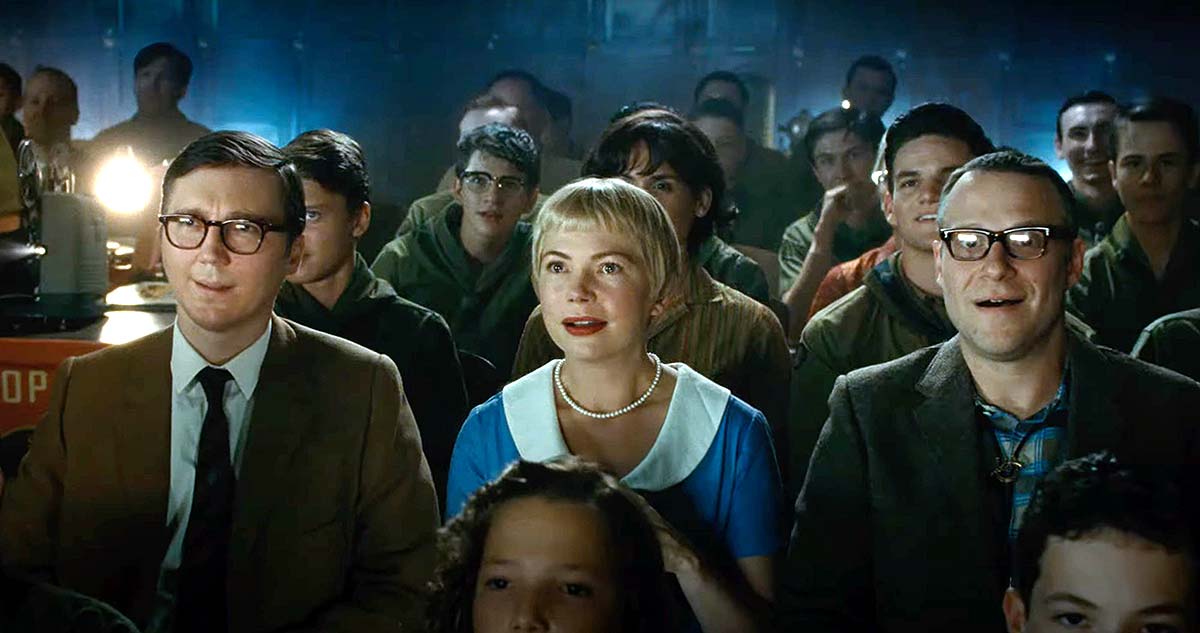
Now comes the turn of Steven Spielberg, arguably one of our greatest living directors, who is clearly looking to settle some old ghosts with The Fabelmans. The film is preceded by a short clip featuring an avuncular-looking Spielberg, humbly thanking the audience for coming to the cinema to see his latest offering. What we are about to watch, he tells us, is his most personal film ever.

It begins in 1952, when the young Sam Fabelman (Mateo Zoreyan) goes to his very first picture show along with his parents, Burt (Paul Dano), a computer programmer, and Mitzi (Michelle Williams), a talented pianist. Sam is initially apprehensive about the upcoming experience – he’s heard terrible things! – but is transfixed by Cecil B DeMille’s The Greatest Show on Earth, particularly an extended sequence that depicts an epic train crash. That Christmas, Sam is given a lovely toy train set and he cannot stop himself from attempting to recreate what he saw in the movie and, inevitably, capturing it on film.

Time rolls on, and a teenage Sam (Gabrielle LaBelle) is living in Arizona, where Burt has gone for work. He’s still obsessively making amateur movies, aided by his willing schoolmates (including the famous World War 2 on a budget epic Escape to Nowhere) and thinks nothing of the fact that Burt’s friend, ‘Uncle’ Bennie (Seth Rogan), is a constant presence in the family’s life. It’s only when he is editing a film about a recent family camping trip that the camera reveals something he has previously had no inkling of…

The Fabelmans is essentially a family drama, but one that encompasses some weighty topics: mental health issues, the prevalence of anti-semitism and the expectations that parents can sometimes place on their children. Above all hovers the love of cinema, the almost magical ability it has to transform a viewer’s world, to allow them to escape from reality into a variety of uncharted realms. This is a warm and affectionate study of the director’s beginnings and, if it occasionally ventures perilously close to schmaltz, Spielberg is deft enough to repeatedly it snatch back from the abyss. The world he creates here is utterly believable.

There’s plenty to enjoy. I love the brief appearance by Judd Hirsch as all-round force of nature, Uncle Boris – a former silent movie actor, who recognises the nascent director lurking inside Sam and calls him to do something about it. There’s a beautifully nuanced performance from the ever-impressive Williams as a woman who has sacrificed her own creative ambitions to the demands of her family and is suffering because of it, and there’s a delicious, foul-mouthed cameo from (of all people) David Lynch. Throw in Janusz Kaminski’s gorgeous cinematography and legendary composer John Williams’ music, and you’ve got something a little bit special.

And while The Fabelmans is not quite the five-star masterpiece that so many critics have declared it to be, it’s nonetheless a fascinating look at the filmmaker’s roots and one that never loses momentum throughout its duration.

So don’t wait for streaming. See it where it belongs, and Steven will thank you in person.

4.6 stars

Philip Caveney

Ad Astra

22/09/19

Imagine, if you will, that in Apocalypse Now, Captain Willard’s journey takes him not upriver to the dark heart of Vietnam, but out across the cosmos, to the Moon, Mars and ultimately Neptune – and you’ll have the essence of Ad Astra, a story about a son’s hazardous search for his lost father.

Roy McBride (Brad Pitt) is an astronaut famed for his self-control. In the film’s hair-raising opening sequence, he survives a terrifying near-death experience without so much as a discernible rise in his heart rate. But, capable though he undoubtedly is, that reserve has cost him his relationship with Eve (a barely glimpsed Liv Tyler), and he still suffers from the loss of his father, Clifford (Tommy Lee Jones), a pioneering space explorer last seen approaching Neptune and long presumed dead.

But, when a series of catastrophic power surges threatens the very existence of the universe, evidence emerges that Clifford might still be very much alive out there and, what’s more, he may have caused those power surges. Roy is given a thankless mission: to head out to Jupiter to reunite with his father and, if he can, to save the world from destruction (so no pressure there).

Director James Gray (who helmed the much-underrated Lost City of Z) has created a fascinating and original slice of science fiction. The film somehow manages to balance ravishing planet-scapes and nail-biting action set-pieces with slower, more cerebral stretches, concentrating on Roy’s internal conflict as that legendary self-control starts to break down. It’s a long journey and an eventful one, taking in a colonised moon with branches of Virgin Atlantic and Starbucks, an eerily silent space-buggy chase and, best of all, a sequence where Roy has to make a forced entry onto a spaceship, seconds before it blasts off from its launch pad.

As his quest progresses, he is increasingly confronted with a terrible realisation – that his long-missed father might not be quite the hero that Roy has always believed him to be. Pitt does an extraordinary job in the lead role, managing to emote so much from behind a permanently impassive mask; it’s probably a career-best performance from him and one that may well get a nod at next year’s Oscars.

That said, Ad Astra is surely destined to be a marmite movie. Those who turn up expecting a rollicking space adventure are in for a severe disappointment. Those seeking something more meaningful, however, are likely to have a very good time with this, particularly those who opt for the eyepopping majesty of an IMAX screening

4.7 stars

Philip Caveney


The Lost City of Z

06/04/17

Colonel Percy Fawcett was the quintessential ‘Boy’s Own’ hero. When he went missing deep in the Amazon jungle in 1924, along with his elder son Jack, he became a cause celebre. Many rescue attempts were mounted, resulting in the deaths of over a hundred men and there has been untold speculation ever since about what might have happened to them. James Gray’s film is an attempt to give us a fuller picture of Fawcett and his extraordinary life. It’s an unapologetically old fashioned movie, one that takes its own sweet time to tell its complex story.

When we first meet Fawcett (Charlie Hunnam) in 1912, he’s an ambitious army officer, stationed in Northern Ireland. His attempts to further his career are constantly dogged by the bad reputation left by his dissolute father, but he is ably supported by his incredibly pragmatic wife, Nina (Sienna Miller). When Fawcett is approached by the Royal Geographical Society to helm an expedition into uncharted Bolivia, he sees an opportunity to advance his fortunes and readily accepts, even though it means he will have to leave Nina and his first child, Jack for what could be years. On route to Bolivia, Fawcett meets the man who will be his assistant, the taciturn Henry Costin (Robert Pattinson) and together they set off into the heart of the jungle. It is just the start of a whole series of explorations into the Mato Grosso and as time goes on, Fawcett becomes increasingly obsessed with the idea of a lost ancient civilisation, the titular Z – but all attempts to find it seem doomed to failure and his speculations about it are greeted with general ridicule by everyone back in England, who cannot bring themselves to believe that such ‘primitive savages’ could ever have been so sophisticated.

The film lovingly recreates the era of intrepid exploration and Hunnam is an appealing Fawcett, but the slow, at times almost hallucinogenic nature of the proceedings certainly won’t be to everybody’s taste. Furthermore, though the film sticks closely to the facts for the most part, it cannot help but slip into the realms of speculation in the final furlong. The truth is we do not know (and almost certainly never will know) what actually happened to Fawcett and his son – indeed it is this very nebulous quality that has contributed to the legend.

Nevertheless, though far from perfect, this is an intriguing and sometimes enthralling production that deserves your attention.

4.2 stars

Philip Caveney