J A Bayona

Society of the Snow

11/01/24

Netflix

The story of the Andes ‘miracle’ plane crash is something I’ve been interested in since reading Piers Paul Reed’s book on the subject, when it was published just a couple of years after the event. Like a lot of people, I also watched Frank Marshall’s 1993 film, Alive, and thought he’d made a decent fist of it, given that the setting was mostly recreated using green screens, and that North American actors like Ethan Hawke and Vincent Spano took the main roles.

So I was initially surprised to learn that JA Bayona had, for a long time, been planning his own take on the story. For Society of the Snow, he also acts as co-screenwriter, using Pablo Vierci’s book of the same name as his source. He’s shot the film in Spanish and filmed much of the story in the actual location where the crash occurred, which must have presented a logistical nightmare for him and his team.

But I’ve loved Bayona’s previous work – The Orphanage and The Impossible are two particular highlights. So I popped a note in my mental diary, promising myself I’d watch it on the big screen at my earliest opportunity. But of course, this is a Netflix production, afforded a limited theatrical release from the 22nd December, a time when I would be far from a cinema, which is why I eventually settle (once again) for watching it on streaming.

Two hours and twenty-four minutes later, I’m a blubbering wreck and fully aware that, if I’d managed to see this when it first came out, it would have been one of my top ten films of 2023, no question.

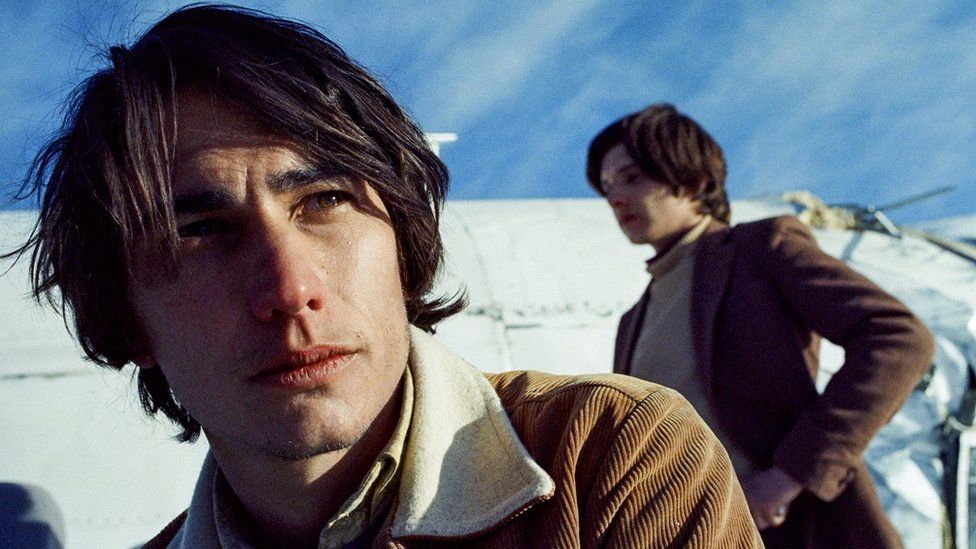
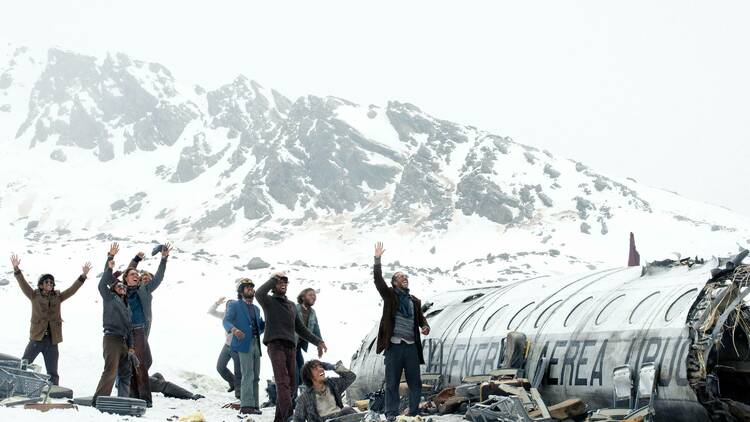
The film opens in October 1972, when a team of young rugby players, together with members of their family and some friends and supporters, are preparing to climb merrily aboard a charter plane in their home town of Montevideo, Uruguay. They are planning to make the relatively short flight across the Andes to Santiago, Chile, where they are due to play a match. But things go disastrously wrong and – in one of the most brutal and horrifying sequences I’ve seen in a long while – crashes onto a remote mountainside. 

Three crew members and nine passengers die in the impact and, for the twenty-three survivors, there’s the awful realisation that they are trapped in sub-zero temperatures, with no source of heating and just a few scraps of food foraged from suitcases.

Hopes of rescue soon fade as the planes searching for them fail to spot a trace of wreckage in the thick snow. The survivors hear a heartbreaking radio broadcast: the search has been called off until the spring. A dreadful  realisation begins to set in. They are going to have to try to survive until the weather improves. Meanwhile, they are horribly aware that the only source of nutrition available to them is the frozen bodies of their friends and family, lying just a short distance from the plane’s fuselage…

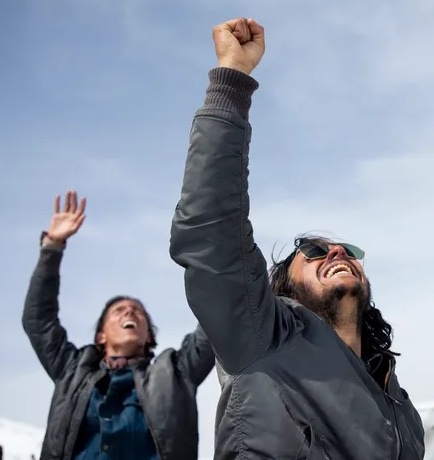
Society of the Snow is a powerful and thought-provoking account of humanity’s impulse to survive, told in unflinching detail, but it is never allowed to become merely the horror story that the media is so keen to promote (try to find an account of the story that doesn’t trumpet the word ‘cannibal’). On the contrary, it’s a testament to the team spirit of the young men who manage to keep themselves alive and motivated in that wilderness for seventy-two days, never accepting their fate, even when nature seems intent on sending them to their doom at every opportunity. 

The story is told from the point of view of Numa (Enzo Vogrincic), a charismatic young lawyer, who is instrumental in inspiring his friend, Nando (Augustin Pardella), to step up and become the team’s leader. That said, this is very much an ensemble piece, with every actor performing their respective roles to with convincing authenticity. There are some heartbreaking exchanges between the survivors and it’s at these moments that the screen in front of me keeps blurring as my eyes fill with tears.

Amidst the bleakness of the story, Pedro Luque’s exquisite cinematography explores the majesty of the location and Michael Gicchino’s score provides an emotive backdrop to the suffering and the eventual hard-won triumph of rescue. This is an immersive film in every sense of the word and watching it makes me fully appreciate the hardship and suffering that the protagonists experienced, but their refusal to capitulate to the slings and arrows that assail them is also inspiring.

Some of the films on Netflix can be underwhelming, but Society of the Snow is an extraordinary achievement and confirmation, if ever it were needed, that Bayona is an exceptional talent. Don’t miss it.

5 stars

Philip Caveney

A Monster Calls

05/06/20

Old Vic/YouTube

Looking back through my diary of another life, in another time, I note that I was due to see the touring production of this play at the King’s Theatre, Edinburgh, in early April 2020. It now seems unlikely that this was ever a possibility. Sitting in a crowded auditorium, enjoying a live performance? Is that really how we used to carry on?

Some productions have added resonance because of personal experience. Back in 2006 when I’d just embarked on my career as a children’s author, I was fortunate enough to meet Siobhan Dowd, when our respective debut novels were nominated for the same award. She was utterly charming and I had no inkling then that she was only a year away from her untimely death from breast cancer. A Monster Calls was an outline for a future novel that she didn’t live long enough to deliver to her publishers. It was subsequently completed by Patrick Ness and became a huge success in 2012.

I also loved the film version, directed by J A Bayona in 2017, which (another coincidence) featured one of Susan’s drama school pupils in the lead role (although she didn’t actually teach him). Even without these connections, this would still be a powerful and affecting story. I remember leaving the cinema, red-eyed from weeping.

This production, filmed onstage at the Old Vic in 2018, is now available for a limited run on YouTube. Though perhaps not as slickly filmed as many of the recent  ‘live’ theatre performances, there’s no doubting the emotional heft of the story. The central premise, clearly inspired by Siobhan’s own circumstances, is utterly heartbreaking.

Thirteen-year-old Conor McGregor (Matthew Tennyson) is in meltdown. His beloved Mother (Marianne Oldham) is gradually succumbing to cancer and he doesn’t know how to handle it. Estranged from his father (Felix Hayes), who now lives in America with his new family, Conor has nobody to confide in. He is being perpetually bullied at school and is resisting all attempts by his well-meaning grandmother (Selina Cadell) to make him accept that his life is about to undergo a massive change.

When his mother points out an ancient yew tree near to the family home, Conor begins to experience a series of bizarre visitations from The Monster (Stuart Goodwin) who lives within the tree. He relates a series of bizarre fairy stories and encourages Conor to face up to an awful truth…

There’s so much to relish here: the exquisite staging which ranges from stripped-back simplicity to explosions of almost pyschedellic colour; the ingenious use of ropes to evoke a whole series of images and settings; and there’s a sumptuous electronic soundtrack played live by Will and Benji Bower that adds a lush, dreamlike quality to the proceedings. The thirteen-strong cast all offer exemplary performances, though of course it’s Tennyson, in the lead role, who carries the heaviest load.

Is it as good as witnessing the play live? No. Am I glad it exists? Damn right!

Those who haven’t experienced A Monster Calls should catch this while it’s still available (you have until 12th June). And those who already love it could do a lot worse than indulging in another helping, just to relish those bitter-sweet flavours.

4.6 stars

Philip Caveney

Jurassic World: Fallen Kingdom

11/06/18

Another day, another instalment of a well-worn movie franchise.

I’ll be honest with you, when I first heard about this, I wasn’t overly inclined to bother with it. Colin Trevorrow’s Jurassic World (2015) was okay, but nothing in it instilled in me the appetite for another monster helping. But then I noticed, that this time out, the movie was to be directed by J A Bayona and my curiosity was aroused. I’ve admired his three previous offerings, all very different beasts – The Orphanage, The Impossible and A Monster Calls, exceptional films, every one. Could he possibly bring something new to the table?

Fallen Kingdom begins with news that the ex-theme park of Isla Nubla, now a dinosaur haven, is in big trouble. The island’s resident volcano has decided to blow its top and its saurian inhabitants appear to be doomed to extinction all over again. John Hammond’s former partner, Benjamin Lockwood (James Cromwell) has devised a rescue mission, which means that eleven different species will be captured and shipped off to a new, safe haven. Lockwood is terminally ill so the organisation of this complex mission has been left to his young assistant, Eli Mills (Rafe Spall), a man we just know at a glance is not entirely trustworthy. Mills calls in Clare Dearing (Bryce Dallas Howard) to help with the mission and she enlists former love interest, Owen Grady (Chris Pratt, as affable as ever), to assist her. With a couple of young associates in tow, they head off to Isla Nubla. (The good news is that Clare actually remembers to pack some sensible footwear this time!) Once on the island, they quickly discover that the mission is nothing like as straightforward as they originally supposed…

All right, so the first third of the movie is beautifully filmed and there are some decent people-versus-lava scenes. The dinosaurs are state-of-the-art CGI and, though there’s nothing here to disgrace Stephen Spielberg’s game-changing original, neither is there very much in the way of surprises. Indeed, this first section is haunted by that most deadly of dinosaurs, the Nothingnewbeforeus. Isla Nubla goes up in smoke and I start to think that this is the fate that’s inevitably going to befall the franchise.

But then the action shifts to Benjamin Lockwood’s estate in California and the film instantly takes a big step up, heading in a different, and much more compelling direction. The idea here is that no matter how well intended an original idea is, there are ruthless people waiting in the wings, ready to step in and monetise it. In comes the ever-dependable Toby Jones as Gunnar Eversol, a smug and utterly repellant dino auctioneer. He’s there to sell off the ‘rescued’ creatures to the highest bidder. There’s also a new addition amongst the specimens, a hybrid dinosaur called the Indoraptor,  a super killing machine that’s just crying out to to be ‘weaponised.’

When the auction goes a bit haywire, Bayona ramps up the suspense to almost unbearable levels and, there are some scenes that ride very close to the wind in terms of the film’s 12A rating. Best of all, there’s a fabulous sequence where Lockwood’s granddaughter hides in her bedroom, as the Indoraptor resolutely makes its way towards her. Bayona uses shadows and music to create something both menacing and enchanting – like a dark Grimm’s fairy tale with the wolf replaced by the most terrifying creature imaginable. If the film had all been as good as this, we’d be talking a much higher star rating.

Still, against all the odds, Bayona has managed to imprint his own DNA into this over-familiar franchise and in so doing, has created his own hybrid beast. The concluding announcement of yet another new direction for the series seems suddenly a much more interesting proposition. If they can get Bayona to direct, I for one, am in.

4 stars

Philip Caveney