EdFringe2023

Tony! (The Tony Blair Rock Opera)

17/08/23

Pleasance at EICC, Edinburgh

Having hot-footed it here from one political satire that doesn’t work, it’s gratifying to find one that actually does. The fact that the venue offers the most comfortable seating on the fringe is a wonderful bonus. Tony! (The Tony Blair Rock Opera) is bold and propulsive and packed with clever observations. As well as making me laugh out loud, it also makes me think

As one of the people who voted Tony Blair into power – and voted for him twice again – even after the debacle of the ‘weapons of mass destruction’ – it feels like the right time to reappraise the story of the man who changed the Labour Party, who made them electable for the first time in just about forever.

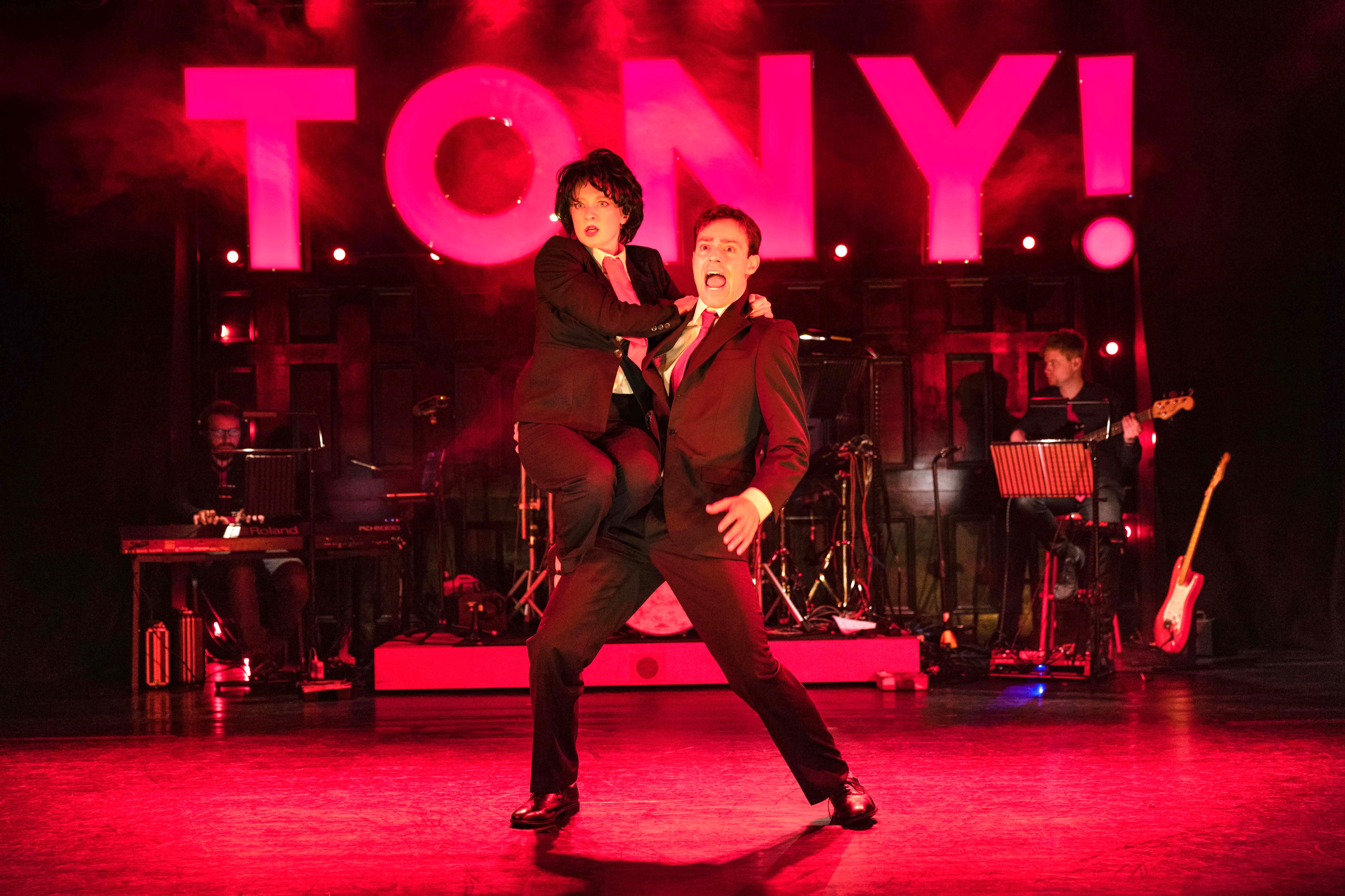
With lyrics by Harry Hill and music by Steve Brown, Tony! begins at the very beginning as our hero (Jack Whittle) emerges fully formed from his mother’s womb, complete with that winning smile and the belief that the world is his oyster. Within minutes, he’s grown up, been given his first electric guitar, grown his hair long and gone to University. Pretty soon, he’s fronting rock band Ugly Rumours and knocking out some funky riffs with moderate success. His greatest ambition at this time? To meet Mick Jaggers (sic). But instead he meets Cherie Booth (Tori Burgess), who introduces him to the world of politics and… well, you know the rest.

Or do you? With three musicians blasting out a series of catchy rock songs, the production hammers merrily along, introducing major political figures as it goes, with the ensemble cast given plenty of individual opportunities to shine. Howard Samuels impresses as a wonderfully creepy Peter Mandelson (with a sideline in making balloon animals); Phil Sealy is a (perhaps unfairly) buffoonish Gordon Brown; and Martin Johnston’s Neil Kinnock feels perfectly pitched.

Watch out too for Emma Jay Thomas as Princess Diana, who nails ‘the people’s Princess’ with aplomb. Through it all, Whittle is the consummate front man, singing, dancing and grinning like he’s breakfasted on amphetamines.

This is an object lesson in how to satirise a political figure, playing for laughs but hinting at so much more. At the fringe, you go past the sixty-minute mark at your peril and Tony! goes to ninety without ever losing its impetus. I exit the theatre with an ear worm, happily singing the chorus to the climactic number, even though it prominently features the word ‘assholes.’ 

Apologies to the people at the bus stop. I wasn’t referring to you, honest.

4.6 stars

Philip Caveney
Blue

14/08/23

Assembly George Square (The Box), Edinburgh

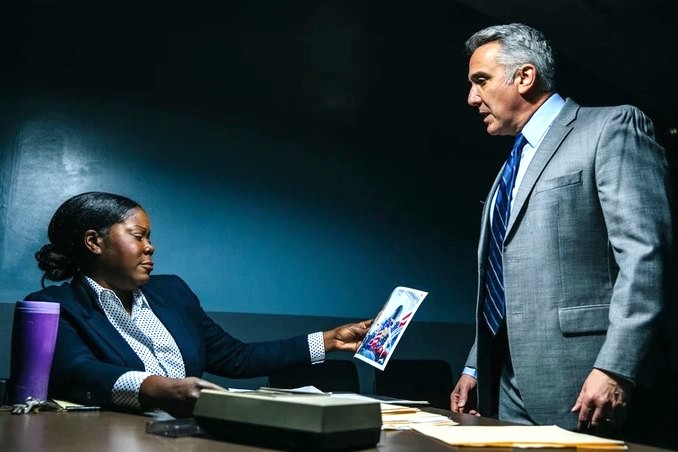
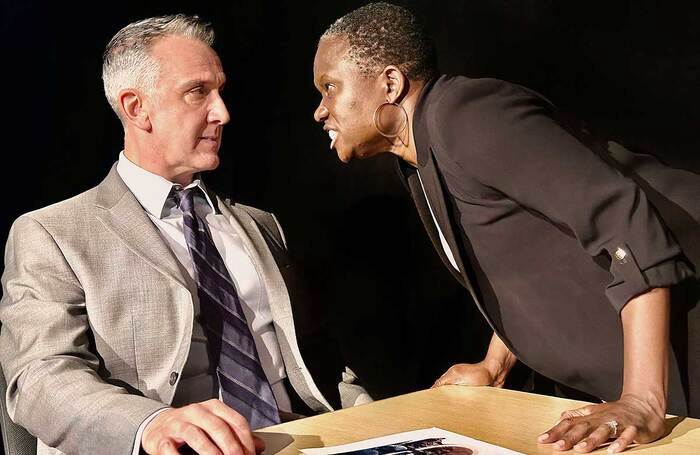
Blue by June Carryl is an intense two-hander, focusing on the aftermath of a police shooting.

Sully Boyd (John Colella), sorry, Sergeant Sully Boyd, as he is quick to remind us, is used to the Police Department’s internal discipline procedure. He’s had complaints levied against him before. Being interviewed by a fellow officer is just a formality, isn’t it? And anyway, this time the investigator is Rhonda Parker (Carryl), an old family friend. Sully’s known Rhonda since she was a kid; he was pals with her dad; heck, her husband used to be his partner, before he quit the force.

But something is different. For starters, this ‘mistake’ is much, much worse than the others. He’s shot and killed a Black motorist, and there’s no evidence that the guy did anything wrong. There is evidence, however, of Sully’s mounting racism, his conviction that something is being stolen from him, from all white men. As the aphorism goes, “When you’re accustomed to privilege, equality feels like oppression.”

Sully can reminisce about the good old days as much as he likes, but his true feelings have been brutally exposed, and another Black man has paid the price. African-American Rhonda isn’t about to let him off the hook…

Post-George Floyd, there has been a sea-change: first the groundswell of the Black Lives Matter movement and then pushback from those who think that, if Black lives matter, it means that white lives don’t. Blue is a blistering illustration of what this looks like in practice, of how a police force that is supposed to serve and protect us all equally is incapable of doing so, because its vision of ‘us’ is rooted in white supremacy.

It is to both Colella’s credit as an actor and Carryl’s as a writer that Sully does not come across as a two-dimensional baddy. He clearly sees himself as a decent guy, someone who’s put in his time serving his country, and just doesn’t understand why things have to change. He likes his position of privilege, even if he won’t acknowledge it.

However, it’s Carryl’s emotive performance that brings this important two-hander to its powerful and devastating conclusion.

4.6 stars

Susan SIngfield

Bangers

14/08/23

Roundabout at Summerhall, Edinburgh

Bangers is a tale told in rhyme, rap and R&B, a propulsive slice of gig theatre that feels as much like a party night as a performance. Set somewhere in the city of London, it’s the story of two unconnected characters, Aria (Danusia Samal – who wrote this) and Cleff (Darragh Hand), both of whom are going though rocky patches in their lives.

Cleff is coming to terms with the recent death of his father and struggling to decide whether to pursue his musical ambitions or, to please his Mum, take the safer route of passing exams and going to college. Aria is still haunted by a crush she had years ago, on the teacher who first mentored her and inspired her to perform. When Cleff and Aria bump into each other in a nightclub, it’s clear from the outset that they’re capable of making sweet music together, if only they can find a clear path through the debris of their respective issues.

The performance is presided over (you might more accurately say refereed by) an acerbic house DJ (Duramaney Kamba), who often intervenes when Aria and Cleff squabble and who employs a whole range of sound motifs to keep them in check. There’s a genuine good-time vibe to this show and Roundabout is packed to the rafters with cheering, clapping onlookers.

The story is told through ten different tracks. Samal and Hand take on several different personae as the story unfolds, but there are no real visual clues to help me spot when there’s been a change – which makes things a bit confusing at times. And, while I believe in Cleff’s story arc, Aria’s stretches my credulity. Could somebody really be hung up for so long over something so slight?

A late plot twist is probably meant to come as a big surprise, but I’m sure I’m not the only one who can see it coming.

Nonetheless, it’s hard to resist the sheer exuberance of the performances and the overall mood is so celebratory, I find myself compelled to go with the flow. By the show’s conclusion, I’m up on my feet with the rest of the crowd, urging the three performers on to their final joyful song.

4 stars

Philip Caveney

Candide

14/08/23

theSpace @ Surgeons Hall (Grand Theatre), Edinburgh

Ima Collab is a young theatre collective from Hong Kong, and their spirited version of Candide opens this week in the Space @ Surgeon’s Hall. Condensing Voltaire’s sprawling epic into a forty-minute slice of theatre is a tall order, but the fourteen-strong cast give it their all, and the result is both energetic and entertaining.

Like his C18th contemporaries Tom Jones and Gulliver, the eponymous Candide is an ingénue, whose epic journey from innocence to experience spans many decades and several distinct acts. His idyllic youth in a Baron’s castle, under the tutelage of renowned optimist Pangloss, comes to an abrupt end when he is caught kissing the Baron’s daughter, Cunégonde. Cast out, he endures a series of hardships: he is forced into joining the Bulgarian army, for example, and also survives both a shipwreck and an earthquake. Along the way, he is repeatedly reunited with and then parted from Cunégonde, until at last they marry and live unhappily ever after. (I think it’s okay to give spoilers to a three-hundred-year-old story.)

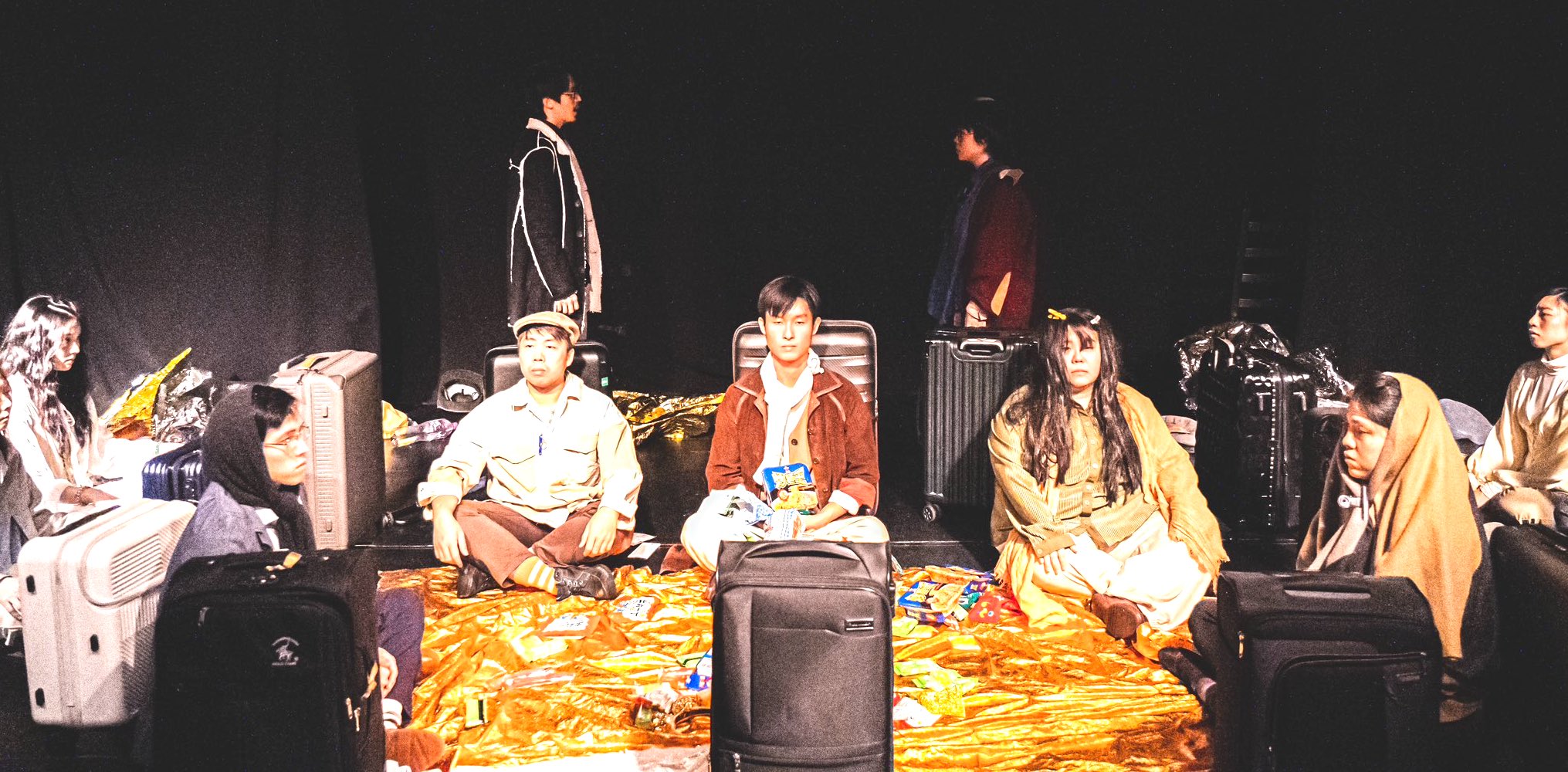
In this production, the tale is narrated to an eager group of travellers, keen to know why one of their number is obsessed with Voltaire’s novel. The contents of their suitcases are pressed into use as props, and the fourth wall is continually broken, as the cast ask questions of the audience, and issue demands to one another (“Can you make me a boat, please?”).

This breathless retelling is vibrant, and the cast are very engaging. There are a lot of jokes, most of which land well, although I’m not so keen on the fat-phobic jibe at the aged Cunégonde, who, played for the most part by one actor, is briefly replaced by a perfectly lovely-looking larger one – a move clearly intended to suggest that she is less desirable than she used to be.

The direction is imaginative and, if the ensemble movement sections sometimes lack precision, they are always enthusiastically performed.

An ambitious and diverting piece of theatre, Candide is certainly a lot of fun.

3.4 stars

Susan Singfield

Concerned Others

13/08/23

Summerhall, (Demonstration Room), Edinburgh

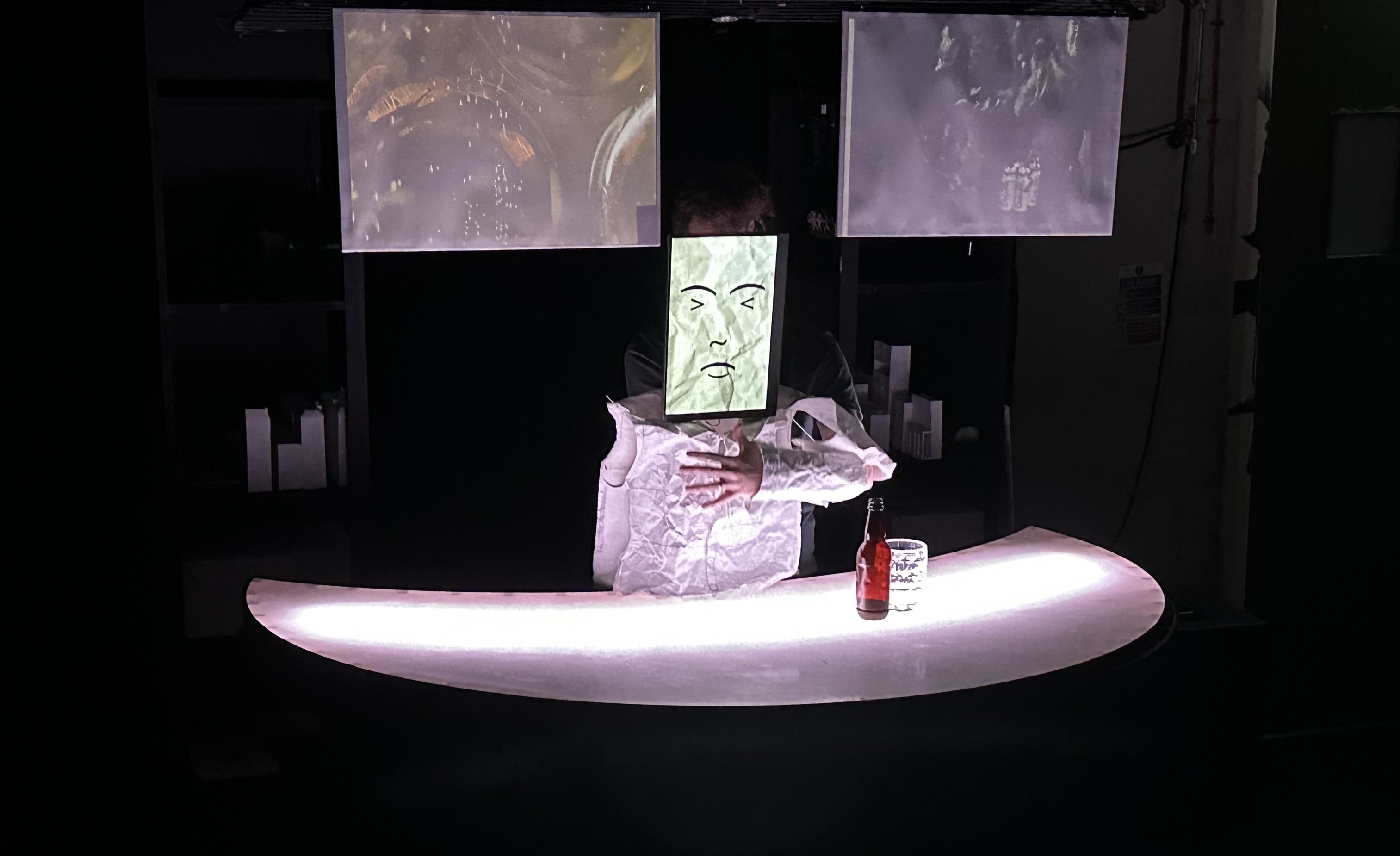
Concerned Others is a meditation on addiction – a vast, sometimes overwhelming subject for which there really are no ready answers. Tortoise In a Nutshell approaches the subject from a different perspective – using an intimate table-top performance, above which spoken verbatim dialogue is also displayed on a series of screens, while immersive music plays.

A miniature camera glides cinematically past rows of tiny houses and intricately detailed miniature figures as the words spill onto the screens. The effect, curiously, is to focus my attention on what’s actually being said and while it’s not saying much that I haven’t heard before, it does have the effect of making me concentrate. No easy matter when I’m sitting in the Demonstration Room, arguably the most uncomfortable venue of the Fringe.

Now the scene shifts to a character whose face is a video screen, a vapid smile interspersed with mixed-up advertising videos extolling the virtues of various beers, and I’m reminded of my youth, when television adverts like these ones made me long to look old enough to go into a pub and buy a drink.

Again, we’re back to the little camera, which now glides through a series of empty rooms, emphasising the loneliness and desolation of addiction, the fact that so many people are obliged to face it alone…

By the conclusion – which somehow manages to end on a rising note of optimism about the future – I leave thinking about the ubiquity of addiction, it’s prevalence and it’s many different forms. We’re all of us addicted to something, aren’t we?

You could argue that perhaps Concerned Others could delve a little deeper into its chosen subject but there’s no mistaking the superb and affecting style in which this story is told.

4 stars

Philip Caveney

Polko

11/08/23

Roundabout at Summerhall, Edinburgh

Joe (Elliot Norman) spends a lot of time sitting in his parked car, listening to the weird distorted noises which are the only sounds he can get from his radio. Sometimes he shares the space with his old friend, Emma (Rosie Dyer), recently returned to the area after losing her job. She’s now living with her parents and clearly isn’t enjoying the experience very much, but Joe gets it. He’s been living with his mum for ages and claims he’s getting along just fine, even if he’s not actually allowed to sit on the sofa after spilling chilli oil on it.

Sometimes, Joe sits in the car with an older man, the hapless Peter (John McNeil), who has a bit of a thing about Joe’s mum, and was recently rejected by her – which is awkward to say the least. Peter is fond of a drink. Rather too fond, as it happens. The car they are sitting in used to belong to him but now he’s lost his licence and has sold it to Joe at a knockdown price, though he still has a proprietorial attitude towards the vehicle.

The in-car conversation often turns to an absent friend, somebody called Polko. He’s not around any more and nobody seems quite sure where he’s gone…

Polko is a strange, sinewy sort of play, where the characters talk around things rather than coming to the nub of what they are actually discussing. At various points, it becomes clear that these three dispossessed characters are all unreliable narrators, each of them having to revisit what they’ve said earlier in order to tell the full story. We probably shouldn’t trust them – even if we want to.

And the mystery of the titular character really doesn’t fall into place until the very last scene.

Written by Angus Harrison and sparely directed by Emily Ling, this is an intriguing, slowly-unfolding story that ultimately raises more questions than it has answers for, but the performances are strong – especially McNeil’s brooding and mysterious loner, who never manages to be direct – and the sense of slowly-building intrigue keeps me guessing right up to the end.

3.8 stars

Philip Caveney

The Grand Old Opera House Hotel

06/08/23

Traverse Theatre, Edinburgh

Occasionally you see a production that not only exceeds your expectations, but sends you out of the theatre exhilarated by its sheer invention. The Grand Old Opera House Hotel is one such play, a piece that fearlessly swings for the fences and hits all of its targets bang on. Part slapstick, part comic-opera, part mad-as-a-box-of-frogs spectacle, this is something you really don’t want to miss.

Aaron (Ali Watt) arrives at the titular establishment for his staff training and quickly learns that the recently rebuilt hotel is suffering from teething troubles. The electronic door numbers keep changing without warning, the lights flicker constantly and Aaron can hear people singing. A staff member tells him that, back in the day, the place was an actual opera house. It burned down sometime in the 1920s, killing the show’s cast in the process. Could Aaron be hearing their ghosts?

One of the singers he can hear is actually his opera-obsessed colleague, Amy (Karen Fishwick) – but Aaron doesn’t know that. He naturally thinks the place is haunted. If he just met up with Amy, in person, it would all be explained in an instant, but in a building with so many rooms, that’s not going to be easy…

It’s almost pointless to talk about the plot other than to say it all makes a twisted kind of sense. This delicious, sprawling extravaganza galumphs merrily through a whole gamut of different moods, characters and connections, barely stopping to draw a diaphragmatic breath. Isobel McArthur’s script is playful and exciting, while Ana Inés Jabares Pita’s set design opens up and interconnects like a Chinese puzzle box. Director Gareth Nicholls keeps his six-strong cast on their toes, moving through a whole series of lightning-fast costume changes, interacting, singing and sometimes even dancing for all they’re worth. It feels as though there are a lot more than half a dozen people on that stage. And in a way, there are.

McArthur keeps the pot simmering throughout, moving inexorably towards a tantalisingly prolonged conclusion. This is that rarest of creatures, an ambitious production that takes plenty of risks and somehow never puts a foot wrong. If you’re looking for something you’ll remember long after the final curtain, you’ve come to the right place.

5 stars

Philip Caveney