
Cosmo Jarvis

Warfare

19/04/25

Cineworld, Edinburgh

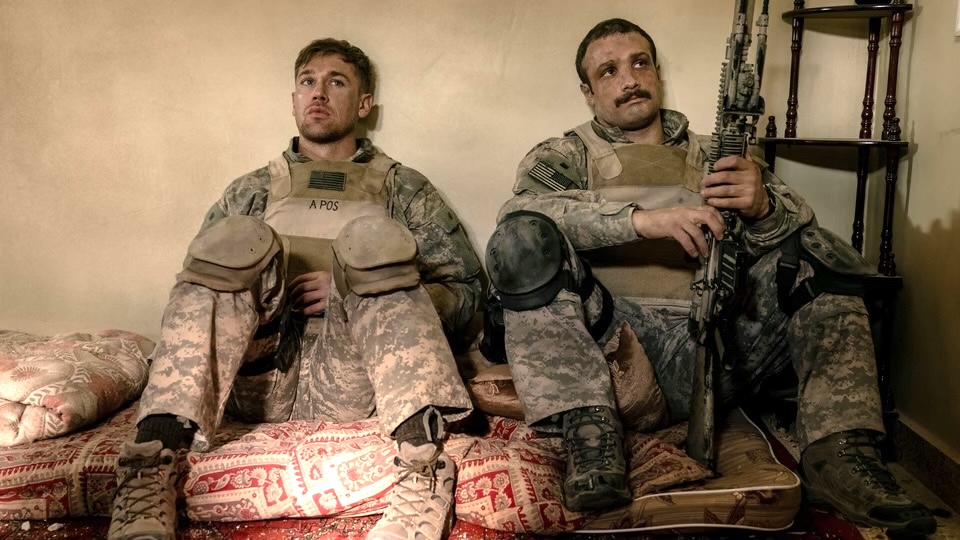
After the ferocity of Civil War, perhaps it was inevitable that Alex Garland’s next project would see him heading further into the world of military action – though it must be said that Warfare, co-written and co-directed with former marine Ray Mendoza (depicted in the film by D’Pharoah Woon-A-Tai), may qualify as the most realistic slice of it ever recreated on camera. Based on a real event, which took place in November 2006 in Ramadi, Iraq, it follows a platoon of Navy SEALS into action, as they occupy a house and await incoming Iraqi forces.

We first meet the platoon in their downtime as they watch an Eric Prydz workout video featuring some statuesque women and one man, bobbing about to the strains of Call On Me. The men laugh along and react to each other’s antics, letting off steam before heading into action. But the fun is short-lived. All too soon, they’re sneaking down darkened streets, singling out the house where they are going to hole up overnight while they wait for things to kick off. Two Iraqi families live there and are taken captive and secured in one room ,while the troops take up their positions, keeping watch for the insurgents they are told are gathering in this area.

As a new day dawns, I begin to recognise some of the actors. That’s Will Poulter as Erik and Joseph Quinn as new recruit, Sam. And there’s Cosmo Jarvis as the sniper, Elliott. But I can’t recall seeing a film where recognising the actors matters less, because this is a true ensemble piece, the characters’ identical uniforms making it difficult to tell them apart, just as it must be in reality. 

Warfare does exactly what it says in the title. It takes you from your safe seat in the cinema and plonks you down in the midst of the action – and it’s not somewhere you really want to be. There are none of the tropes that we so often associate with movies about war. There are no heroes here, no villains, no miraculous dodging of incoming bullets, no conveniently-timed lulls in the action.

At first what there is in abundance is waiting. The troops sit around, bored, longing for the action to start but only so it will eventually be over. And I share that awful anticipation with them. I flinch at every unexpected sound; I hold my breath whenever a radio crackles into life. And, when the action does come, it occurs with such unexpected shock that I find myself wincing at every explosion, every unexpected rattle of gunfire. 

The real-life event I spoke of is actually a tragedy. This is not the story of a platoon of soldiers who act with extraordinary valour and emerge with everything intact. It’s the story of a bunch of guys who have their asses handed to them in a string bag. It’s hard to watch and occasionally even harder to stomach, because there’s very realistic injury detail here and the troops who went through the experience have contributed all their memories to ensure that nothing is left out.

Warfare is truly game-changing. Does it qualify as entertainment? The truth is, I’m really not sure that it does, but it feels to me like an important film and a unique achievement, a construct that doesn’t try to tailor its narrative in an attempt to make it more palatable, preferring to depict warfare as it really is: bloody horrible. 

Those of a nervous disposition may want to give this one a wide berth – and anybody out there who harbours illusions about the nobility of war is about to have them well and truly shattered.

4.6 stars

Philip Caveney 

Calm With Horses

03/05/20

Curzon Home Cinema

There’s something of the young Marlon Brandon in Cosmo Jarvis’s performance in Calm With Horses; indeed, there are plot similarities here that make this feel like a West of Ireland homage to On The Waterfront. But that doesn’t detract from the film’s power, nor the intensity of the performances.

Jarvis plays ‘Arm,’ a promising boxer in his youth, whose career hit the skids when he accidentally killed an opponent in the ring. Now he’s reduced to being the hired muscle for the Devers clan, a family of criminals who hold sway over the town where he lives. Arm is accompanied by his minder, Dympna (Barry Keoghan), who is the nephew of Hector (David Wilmot), the gang’s head honcho. Dympna is desperate to prove his worth and seems capable of making Arm do pretty much anything, no matter how brutal, usually by getting him drunk and stoned beforehand. It’s clear though, that Arm is basically a decent bloke who’s taken a wrong turn back in the day.

He has a son, Jack, with his former partner, Ursula (Niamh Algar), but the boy is severely autistic, only really happy when he’s riding a horse (hence the title). Ursula wants to move Jack to Cork, where there are specialised schools that can help him, and she asks Arm for financial help, but Dympna manages to dissuade him; he has another job for Arm, one that requires him to more than just beat somebody up…

Nick Roland’s debut picture, with a screenplay by Joe Murtagh, is set in those parts of the West of Ireland where tourists would fear to tread – indeed, a visit to Paudi (Ned Dennehy)’s garage is not for the faint-hearted. It’s not just sides of beef he has hanging in that outbuilding. This is mostly Jarvis’s film, though Keoghan once again displays his uncanny knack of choosing the right role at the right  time, and Dennehy’s smirking, scowling performance shows why his is one of the most familiar faces in Irish cinema.

If there’s a certain inevitability to the story’s ending, it’s more than compensated for by the film’s raw power and those memorable characterisations. Those looking for a charming, lyrical tale of simple country folk may wish to look elsewhere.

4.2 stars

Philip Caveney


Lady Macbeth

27/04/17

The ancestral origins of this movie are vaunted by its title, which leads us from Shakespeare’s ruthless anti-heroine to Nikolai Leskov’s Lady Macbeth of the Mtensk District. This film, adapted from Leskov’s 1865 novel by Alice Birch and set, this time, in the northeast of England, is a dark and unnerving piece of work, as chilling as it is spare.

Florence Pugh is Katherine, a young Victorian woman sold into marriage. Her husband, Alexander (Paul Hilton), has no interest in her at all, and his father, Boris (Christopher Fairbank), is a brutal tyrant. Both men are often absent from home, and Katherine is alone and bored. At first she sleeps the days away; then she seeks solace in alcohol. And then she encounters Sebastian (Cosmo Jarvis), a farmhand, and they begin a passionate affair. So passionate, in fact, that it is dangerous, in a Heathcliff-Cathy kind of way; it’s surely no coincidence that these two women share a name. There is nothing Katherine won’t do to protect her illicit relationship,  and no one she won’t sacrifice. Even Sebastian himself isn’t safe: “I’d rather kill you than not have you with me,” she says.

This is an extraordinary debut by director, William Oldroyd (he’s made a couple of critically acclaimed shorts in the past, but this is his first full-length film), one of stark originality. It looks like other costume dramas, but it doesn’t feel like them at all. There’s no sound track, which is oddly disconcerting, and accentuates every noise in the horribly quiet house: the cat chewing, the floorboards creaking; everything grates and enervates. Katherine’s frustration is palpable.

This isn’t an easy watch: there is violence and savagery throughout. Katherine’s response to oppression is spirited to say the least; she refuses to be confined. Race and class are important themes here too: mixed-race Sebastian knows he – not she  – will be hanged if their crimes are discovered; black housemaid, Anna, is abused and exploited throughout. Katherine might be isolated, forced into a marriage she doesn’t want, but she has far more power and privilege than those with whom she spends her time.

Unlike her namesake, Katherine never wavers, never feels remorse. She’s powerful and subversive: loud when she’s supposed to be quiet; rebellious to the very end. Florence Pugh has an earthy vitality, and her performance is the foundation on which this remarkable film is built.

4.4 stars

Susan Singfield