

Caitlin Skinner

Detained

22/10/24

Traverse Theatre, Edinburgh

In a week when the Home Office has found the time to issue the fictional Paddington Bear with an official passport, it’s sobering to be faced with a stark reminder of the realities of the UK immigration system and the human lives caught up in it.

Playwright Michelle Chantelle Hopewell’s professional debut has a strong premise, exploring the uneven power dynamic between two friends, where a single impulsive moment of spite has a profound and devastating impact.

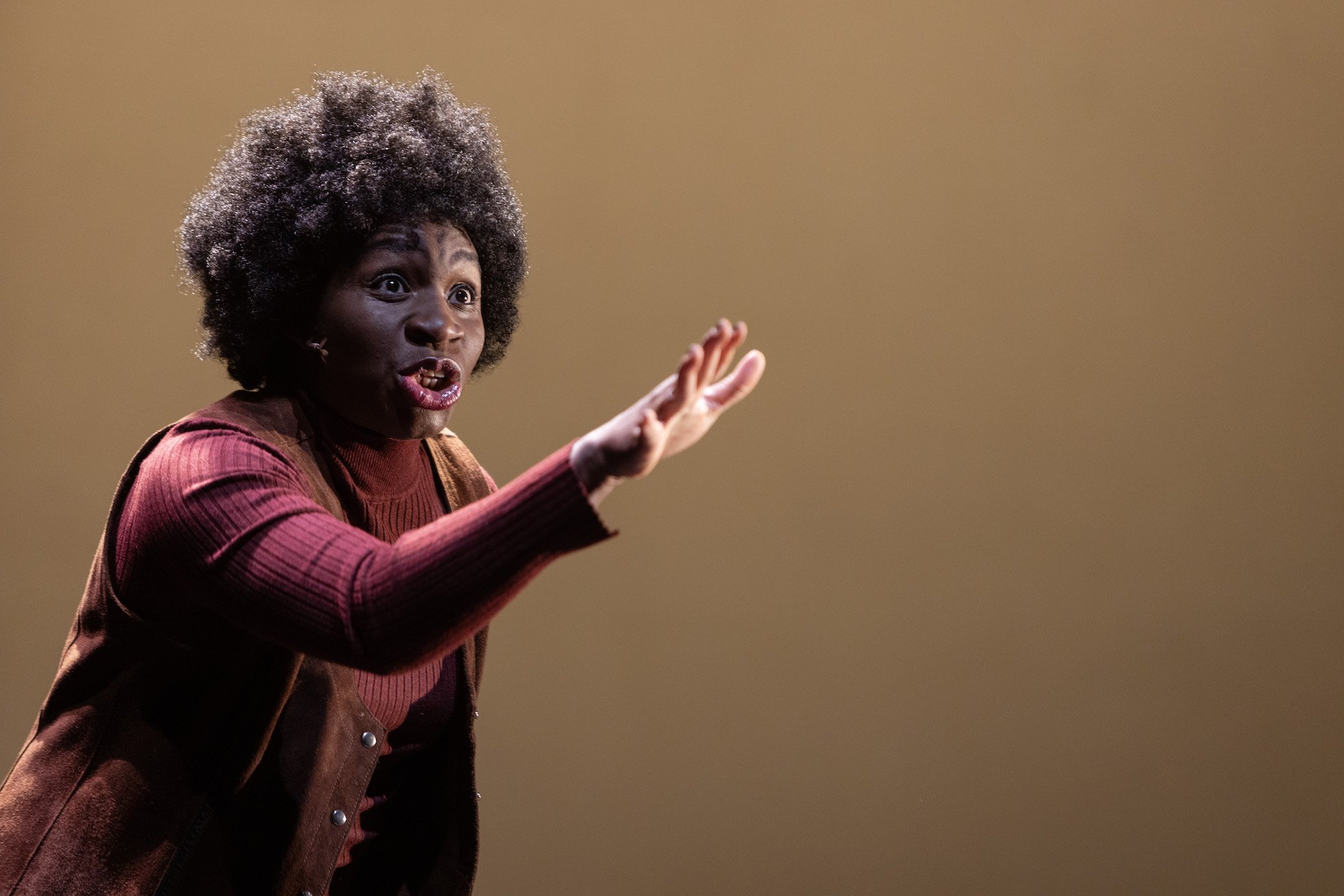
South African asylum seeker Yemi (Titana Muthui) is incarcerated in a detention centre, and she’s appalled to learn that she’s there because of her best friend, Bea (Laura Lovemore). The women work in the same restaurant, and Bea, catching her boyfriend in the arms of another waitress, has called the authorities to report her for being there illegally. She doesn’t know that Yemi’s visa has run out, that her ‘sister’ will get caught in the crossfire.

We’re witness to a series of visits spanning two years, as Yemi languishes in ‘jail’, refusing to open up about her traumatic past, even to the lawyer who might be able to assist her. Through her conversations with Bea, we learn how horribly dehumanising the process is, and how a simple oversight – such as not filling in a form on time – can change a person’s life. Bea is impacted too, learning to live with the guilt of what she’s done, trying – and failing – to compensate by campaigning for Yemi’s release.

Both Muthui and Lovemore are compelling in their roles, with Muthui in particular exuding a desperate dignity. Even though I want to shout at Yemi to tell the lawyer what he needs to know, I can’t help but be impressed by her quiet determination not to be forced to share her nightmares to appease others. Muthui makes this awful choice entirely credible.

Caitlin Skinner’s direction ensures that this wordy drama remains dynamic, and Heather Grace Currie’s simple set design manages to include both the barbed wire holding Yemi back and the blue skies still offering her a glimmer of hope.

Even for A Play, A Pie and A Pint, Detained is short, and doesn’t perhaps make the most of its potential, with a lot of ideas left unexplored. I’m also not convinced by the single section addressed to the audience by Yemi, which feels stylistically (but not tonally) different from the rest. I think for this to work, she would need to be revealing something we haven’t previously seen from her – a greater anger, maybe, or a deeper exploration of her situation.

A piece that asks more questions than it answers, Detained is certainly a play for our times. Let’s hope that fewer pretend bears and more actual people are afforded access to asylum over the coming years.

3 stars

Susan Singfield

Through the Mud

11/08/24

Summerhall (Main Hall), Edinburgh

Plus ça change, plus c’est la même chose

Apphia Campbell’s Through the Mud is a chilling reminder of how little has changed over the years when it comes to Black liberation in America. Campbell plays Assata Shakur, the 1970s civil rights activist, who – convicted of murder – escaped from jail and has been living in exile in Cuba ever since. In a parallel storyline, forty years later, college student Ambrosia Rollins (Tinashe Warikandwa) finds herself caught up in the beginnings of the Black Lives Matter movement.

This is a powerful piece of theatre, as much a call to arms as anything else, and it feels especially apposite as racist riots are breaking out just over the border in England. Of course, Through the Mud pertains specifically to American politics, but bigotry and prejudice aren’t confined to one continent and we have just as much blood on our hands.

Co-produced by Stellar Quines and Edinburgh’s Royal Lyceum Theatre, the production values are as high as you’d expect, and director Caitlin Skinner deftly leads us through the intertwining timelines, allowing the women’s individual stories space to breathe as well as highlighting the connections. The characters contrast and complement one another perfectly: Campbell imbues Assata with a fierce dignity and a fighter’s strength, while Warikandwa’s Ambrosia is altogether sweeter and more naïve – until her first weeks of college coincide with the fatal shooting of Michael Brown by a white police officer, and she can no longer cling to the fair-world fantasy that her parents built for her. 

The sense of outrage at the heart of the play is brought to life by the music, where spirituals and gospel songs give voice to the protest. The women’s vocals are impressive: Campbell deep and powerfully resonant, while Warikandwa’s more plaintive tones offer an enchanting counterpoint. When the two harmonise, the effect is positively thrilling.

In the face of all the awful evidence, it’s to Campbell’s credit that Through the Mud feels somehow hopeful rather than dispiriting. The women’s indefatigable spirits spur us into thinking we ought to act too. 

Not enough has changed – but the fight goes on.

4.5 stars

Susan Singfield

Until It’s Gone

28/02/23

Traverse Theatre, Edinburgh

This sprightly two-hander packs a lot into its fifty-minute running time. Until It’s Gone is the first of 2023’s A Play, a Pie and a Pint offerings, and it’s a corker: Alison Carr’s tight and cleverly-crafted script imagines a future where all of womankind have disappeared, and men are left to make the best of a world without them. In stark contrast to Charlotte Perkins-Gilman’s Herland, where women have created a female Utopia, this male-only Scotland is a dystopian mess, its citizens desperate for the women to return from their unspecified and unexplained exile.

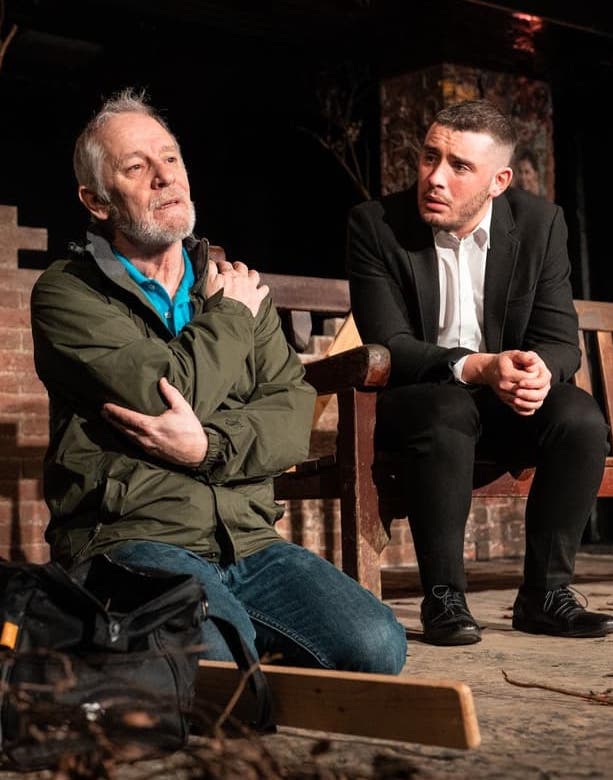
We’re offered a glimpse into this terrifying scenario through a simple park-bench, chalk-and-cheese set-up: a meeting between an eager young man of twenty-five (Sean Connor) and a gruff older one (Billy Mack). They’ve been matched by a supposedly ‘world-beating’ app, but this is not a date – or at least, not a conventional one. They are two avowedly heterosexual, cis-gendered men, following a strict government mandate to ‘connect’ – because things aren’t sustainable as they are. Through this smallest of microcosms, Carr seeds just enough information into the men’s darkly comic dialogue to allow us to envisage the bigger picture, the tortured society in which they live, where schools are closed, most interactions happen online, and everything feels wrong.

The characters are beautifully realised, played with warmth and humour by Connor and Mack, even as they expose the men’s real pain. The generational divide is deftly managed, the initial chasm between them narrowing as they talk and share confidences, slowly realising that they’re more alike than not, that their shared fate should bind them rather than pull them apart.

Under Caitlin Skinner’s assured direction, the play’s political points are clearly made without ever feeling intrusive. I like the cheeky use of tableaux and blackouts to mark the passage of time at the beginning, and the set – by Gemma Patchett and Jonny Scott – is modest but strikingly effective. I’m especially drawn to the myriad images of women adorning the tumbledown walls, and find myself wondering if they are ‘missing’ posters or simply photos, there to remind the men of what they’ve lost. 

Because, of course, you never know until it’s gone…

4.4 stars

Susan Singfield

Five From Inside

21/04/20

Traverse Theatre YouTube

We were looking forward to Donny’s Brain at the Traverse, but then along came a global pandemic to scupper our plans. Enter writer Rona Munro, director Caitlin Skinner and the rest of the cast and crew with a plan to fill the gap: a series of five short monologues, free to view on the theatre’s YouTube channel.

Thematically, we’re in all too familiar territory: one way or another, the characters are all trapped, either physically incarcerated or marooned within their own introspection. It’s a ghastly reminder of the zeitgeist.

First up, there’s Jacob (Bhav Joshi), who’s literally locked up: he’s in prison, desperately seeking help from his brother. The off-kilter camera angles create a sense of panic and disorientation; his fear is palpable. Next comes twitchy Fern (Lauren Grace), who’s also being kept against her will, apparently in some kind of clinic. She’s struggling to ‘colour her mood’ correctly with her crayons. ‘I’m normal,’ she keeps insisting, frantically trying to banish her demons.

Mr Bubbles (Michael Dylan) is a children’s entertainer whose career is on the line after an embarrassing live TV bust-up with his partner; he’s trapped in his character, wiping at his make-up, trying to reveal the self below. And Siobhan (Roanna Davidson) is locked in a cycle of resentment against an employer who ostracises her, and refuses to recognise her contribution to the firm’s success.

My favourite of the five is the last one, Clemmy, performed by Suzanne Magowan (last seen by Bouquets & Brickbats in the thought-provoking Fibres), which takes the form of a filmed confession from a mother to her young daughter. She’s caught in a web of her own lies, and her anguish is heartbreaking. The back story is tantalising; this clearly has the potential to be developed into a longer piece.

But there’s no weak link here, and an astonishing tonal mix, considering the self-limiting nature of the project. Although each one is a stand-alone, they work best when viewed together, a series of lives connected by a sense of isolation.

Available until 9pm on 2nd May, these vignettes are well worth fifty minutes of your time.

3.8 stars

Susan Singfield

Hope and Joy

01/11/19

Traverse Theatre, Edinburgh

Ellie Stewart’s Hope and Joy is a quirky, absurdist piece of whimsy, set in a near future where environmental change has wrought a radical shift in nature. A shift so radical, in fact, that the opening scene shows Hope (Kim Gerard) giving birth to an egg. The father is a Whooper swan, we learn, and her son, Magnus (Ryan Havelin), a human-swan hybrid – costumed, delightfully, in a fabulous winged hoody. Hospital cleaner Joy (Beth Marshall) sees the boy’s ability to fly as a definite plus-point, but – as he grows up – the kids at school are less accepting of his differences. Hanging out with a gang of dissolute pigeons only makes things worse, and Magnus soon realises he needs to spread his wings (sorry…), and seek the company of others who are more like him.

It’s a fun play with some serious points underlying the humour, such as the letter Joy receives regarding her mum’s social care. The melting ice caps are, of course, a real cause for concern, and this fantastical imagining of where we might end up serves to highlight how unknown and precarious our planet’s future is. Themes of friendship, parenthood, otherness and isolation are also clear throughout, although rather superficially explored.

Becky Minto’s set is as wonderful as you might expect if you’ve seen her work before: a jagged white hospital bed/house/pole -dancing stage surrounded by stark black tree trunks. Caitlin Skinner’s direction is lively and dynamic, and – for the most part – works in harmony with the set, although I’m not convinced by the actors crouching off-stage, half-hidden in the woods; I think they need to be either properly concealed or more explicitly visible.

The performances are strong: Gerard and Marshall inhabit their roles effectively, creating bold, sympathetic characters, and Havelin is engagingly awkward as the diffident teenage bird-boy. The section in the pole-dancing club is less believable however: it’s an interesting twist, but the posing and spinning need to be more carefully choreographed, and delivered with more precision and control if they’re to be convincing.

Hope and Joy is throughly entertaining and an absolute pleasure to watch: an enjoyable way to spend an hour.

3.4 stars

Susan Singfield