Antonio Banderas

Babygirl

06/01/25

Cineworld, Edinburgh

It’s ironic to note that while most 18 certificate films released in recent times have been perfectly happy to depict characters being shot, stabbed and bloodily hacked to pieces, when it comes to scenes of a sexual nature, all but the most fearless filmmakers shy away from the subject. Writer/director Halina Reijn’s last film, the enjoyable slice-and-dice romp, Bodies Bodies Bodies belongs squarely in the first camp. Babygirl, on the other hand, sets out its stall in the latter and strides boldly across a landscape where few others dare to tread.

Romy (Nicole Kidman) is to all intents a powerful woman, the CEO of a major company and married to a (presumably successful) theatre director, Jacob (Antonio Banderas). The couple have two teenage daughters to their credit and seem to be blissfully happy. When we first meet them, they’re having sex. Romy appears to achieve an enthusiastic climax – so why does she feel compelled to slip away immediately afterwards and watch porn on her laptop, a submissive woman being sexually dominated by a man? The quiet orgasm she has this time, we feel sure, is more genuine than its noisy predecessor.

On her way to work, Romy chances upon an incident in the street, a young stranger handling an aggressive dog, making it obey him with a single word. This event kindles something within Romy and when, shortly afterwards, she is introduced to a bunch of new interns, she instantly recognises Samuel (Harris Dickinson), as the guy she saw earlier. Something clicks between them and it isn’t very long before the two of them have launched themselves into an intense, secret and potentially dangerous sub-dom affair. As things begin to develop between them, the relationship threatens to cost Romy everything: her family, her job, her sanity…

If this sounds like the plot of some second-rate bodice ripper, don’t be misled. Babygirl is much more nuanced than a plot summary might ever suggest. Kidman launches herself fearlessly into the piece, demonstrating how somebody can be compelled and pushed to the limit by their inner yearnings, how these compulsions can shape and dominate her life, pushing beyond the boundaries of her carefully constructed persona. Dickinson offers the latest chameleon change in his varied career, playing Samuel as an opportunistic hustler: gauche, unpredictable, never entirely in control of his own impulses, but happy enough to take the ride and see where it leads him.

While the film’s intentions are evident, it perhaps pulls too many punches in its second half, when, after a messy confrontation, Romy realises that the real problem is her own sense of shame. If she can embrace her kink, then she can be true to herself – and maybe Jacob can accept her as she really is. But perhaps this is a little too pat to be entirely convincing.

Babygirl is, for the most part, well-handled, but it does feel ultimately like a missed opportunity. I’d like to have seen it take some wilder swings in its latter stages, but I applaud Reijn’s courage for daring to go there in the first place. Anyone hoping for a violent and bloody conclusion will be very disappointed.

3.6 stars

Philip Caveney

Paddington in Peru

11/11/24

Cineworld, Edinburgh

After the success of Paddingtons 1 and 2, it was perhaps inevitable that a third instalment would eventually amble into view. But previous director Paul King did set a high bar. His films were perfect family-friendly adventures that kept both children and adults thoroughly entertained. King has now transferred his talents to the somewhat under-appreciated Wonka franchise, so this time out, directorial duties fall to Dougal Wilson, while the screenplay is the work of four writers, one of whom is original scribe Simon Farnaby.

As the title suggests, the third film sees Paddington and his adoptive family, the Browns, leaving their London home in search of Paddington’s beloved Aunt Lucy (voiced by Imelda Staunton), who has gone missing from her nun-run retirement village, deep in the jungles of Peru. The alarm has been raised by the Reverend Mother (Olivia Colman, in yet another scene-stealing role). It’s apparent pretty much from the outset that there’s something a bit dodgy about her – though she’s still unmistakably, adorably, Olivia Colman, singing and dancing her socks off. Once in Peru, the Browns – Hugh Bonneville, Emily Mortimer (replacing Sally Hawkins), Madeleine Harris and Samuel Joslin, accompanied as before by Mrs Bird (Julie Walters) – fall in with mysterious riverboat captain, Hunter Cabot (Antonio Banderas) and his daughter, Gina (Carla Tous). Cabot is introduced via an obscure film reference (Werner Herzog’s 1982 jungle odyssey, Fitzcarraldo), that only a few movie buffs are likely to spot.

A convoluted South American adventure dutifully ensues with occasional nods to Indiana Jones and the like, but it must be said that this isn’t quite as sure-footed as the previous offerings. Paddington (Ben Whishaw) is still utterly delightful and just as prone to pratfalls, but the slapstick isn’t as assured and the ‘fish-out-of -water’ premise of the first film doesn’t really work so well in a jungle. Furthermore, with just about every actor that has appeared in the series popping up for an obligatory cameo, plus scenes where Cabot is haunted by no fewer than five of his gold-obsessed ancestors, the film feels too busy and over-stuffed for its own good. There’s also a tendency for the film’s messages to be pounded home with a huge mallet rather than trusting younger audiences to take them on board.

Don’t get me wrong, Paddington in Peru has enough endearing moments to make it worth the watch and I’m sure youngsters will still be suitably entertained by the little bear’s antics but, all things considered, this offering comes in a good distance behind its predecessors.

Make sure you stay in your seats through the lengthy credits for a welcome call-back to (yet another) character from one of the earlier movies. Sadly, although I’m happy to see him, this only serves to emphasise that the latest adventure doesn’t offer anyone else quite as memorable.

3.8 stars

Philip Caveney

Puss in Boots: The Last Wish

21/02/23

Cineworld, Edinburgh

All things considered, this must be the least anticipated ‘sequel’ of the year. The Shrek franchise began way back in 2001 and, over the years, there have been three sequels of steadily diminishing quality. In 2011, Puss in Boots emerged as a Shrek spin-off and, it must be said, not a particularly memorable one. So Puss in Boots: The Last Wish is essentially a sequel to a spin-off. But those who take note of such things can’t fail to have missed the fact that the film has been nominated for an Oscar and a BAFTA. This is because it has something up its sleeve that nobody expected. It’s really good.

In the adrenalin-fuelled opening sequence, we meet our titular hero (voiced once again by Antonio Banderas), who is singing and dancing for an adoring audience. Shortly thereafter, he takes on a whole army of warriors single-handedly, and rounds things off by doing battle with an ancient woodland bogeyman.

And then he er… dies. 

Of course, he’s a cat and everyone knows that felines have nine lives, right? But, as a helpful doctor explains, Puss has just used up life number eight. From now on he needs to be very careful indeed, because – if he allows himself to be killed one more time – his heroic escapades will be over for good. So when he encounters the genuinely creepy Wolf (Wagner Moura), he realises that this is an enemy he can never hope to defeat, and for the first time in his life, he’s afraid. Almost before you can say ‘game over,’ he’s hiding out in Mama Luna (Da’Vine Joy Randolph)’s cat refuge and pursuing a quiet, domesticated existence.

What follows is a clever meditation on the subject of death, but if that sounds like something you really don’t want to watch, let me assure you that yes, you actually do! As scripted by Paul Fisher and Tommy Swerdlow, this is a witty – sometimes hilarious -quest tale that never misses an opportunity to propel the franchise headlong into previously uncharted waters, while Joel Crawford and Januel Mercado’s flamboyant direction allows the animation department to steer the visuals into challenging new dimensions. Suffice to say that there are scenes here that challenge Spider-Man: Into the Spider-Verse for eye-popping, jaw-dropping panache and make the original film look positively pedestrian.

There’s a welcome return for Puss’s ex-girlfriend, Kitty Softpaws (Salma Hayek), and a new sidekick in the shape of the criminally adorable Perrito (Harvey Guillén), a wannabe therapy dog who’s just pretending to be a cat, in a desperate attempt to extend his friendship group. And since the Shrek series has always riffed on popular fairy tales, we’re offered a villainous Goldilocks (Florence Pugh), plus her adoptive ursine family (Ray Winstone, Olivia Colman and Samson Kayo). There’s also arch-nemesis, Jack Horner (John Mulaney), a decidedly Trumpian creation, who – despite inheriting an entire pie-factory from his entitled parents – still insists on sticking his grubby thumbs into every opportunity that comes his way.

And did I mention the fabulous Latin American flavoured soundtrack by Heitor Pereira? I leave the cinema dancing.

While PIB:TLW might not be a comfortable fit for younger kids, for everyone from eight years and upwards, it’s a rollicking, rib-tickling adventure that never loses its momentum. My advice? Put aside your expectations and see this on the big screen. You won’t be disappointed.

4.4 stars

Philip Caveney

Uncharted

20/02/22

Cineworld, Edinburgh

Has there ever been a truly satisfying movie adapted from a video game? Not that I’ve seen.

It’s a conundrum when you consider that most games are cinematic in their scope and yet, time and again, they somehow fail to make the transition. Uncharted has been wallowing in production-hell for a very long time. Indeed, the original plan was to have Mark Wahlberg play young adventurer Nathan Drake, but time has moved on, and he has to be content with playing the father-figure, Sully, to Tom Holland’s Nathan.

Holland, fresh from box-office-conquering success in Spider-Man: No Way Home, could probably have chosen pretty much anything for his next project, so it’s interesting that he’s gone for this. He’s a self-professed gaming fan, so perhaps that’s what lured him. I should perhaps state at this point that I have never played the Uncharted game – in fact, apart from a few goes at Tomb Raider way back in the day, I have never felt the need to scratch the gaming itch.

Uncharted is a fun project, which makes no secret of the fact that it’s highly derivative, borrowing heavily from films that have gone before it: a splash of Oceans 11, a measure of National Treasure and a great big dollop of Indiana Jones. Indeed, the script, put together by no less than five screenwriters, openly references the latter movie several times, just in case we’ve missed the allusion.

When we first meet Nathan, he’s hanging grimly onto a shipping container trailing out of the back of a transport plane (as you do), a sequence lifted directly from the Playstation game that inspired the film. It’s pretty full on for an introduction, but happily the story then skips back to young Nathan’s life in an orphanage and his hero worship of his younger brother, Sam (Rudy Pankow). Sam is obsessed with the idea of finding treasure – specifically the lost gold of Spanish explorer, Ferdinand Magellan. But after breaking too many rules, he’s obliged to skip town and, after that, Nathan only hears from him occasionally, via a series of mysterious postcards from all around the world.

Back in the present day, Nathan is approached by Sully, who’s looking for somebody to help him find a lost treasure and, of course, it turns out to be the same one that Sam was looking for all those years ago. Sully also mentions that he knows Sam, so Nathan dutifully enlists with him. What follows is an elaborately plotted heist-treasure-hunt-action-spectacular. Thrown into the mix are Antonio Banderas as the ruthless Santiago Moncada, a man whose family history makes him believe the treasure rightfully belongs to him, his vicious hench-woman, Braddock (Tati Gabrielle), who is very handy with a blade, and another treasure seeker, Chloe Frazer (Sophia Ali), who might be trustworthy, but probably isn’t.

The action set pieces are nicely done, though the film’s 12A certificate sometimes jars with the onscreen violence. Vicious punches leave not a hint of a bruise and there’s what must qualify as the least bloody throat cutting-scene I’ve ever witnessed on the big screen. It just feels odd. But I enjoy the banter between Nathan and Sully, and a climactic sequence featuring helicopters and Spanish galleons is definitely a highlight.

All in all, this is a pleasant way to spend a couple of hours, but there’s nothing in Uncharted that will linger long in the memory. Fans of the game will doubtless complain that this doesn’t stick closely enough to the source material, while for me, the inevitable post-credit sequence which teases a second instalment, doesn’t feel in the least bit tempting.

3.4 stars

Philip Caveney

The Laundromat

03/12/20

Netflix

The Panama Papers – the massive exposé of hundreds of shady shell companies, dating back to the 1970s – was revealed in 2016 by a mysterious whistle-blower known only as ‘John Doe.’ It’s a fascinating tale of greed and deceit and one that was inevitably going to find its way onto cinema screens sooner or later. Furthermore, Steven Soderbergh is exactly the kind of director I would have picked to helm such a project. And yet, The Laundromat doesn’t quite work – mostly, I think, because of its scatter-shot approach.

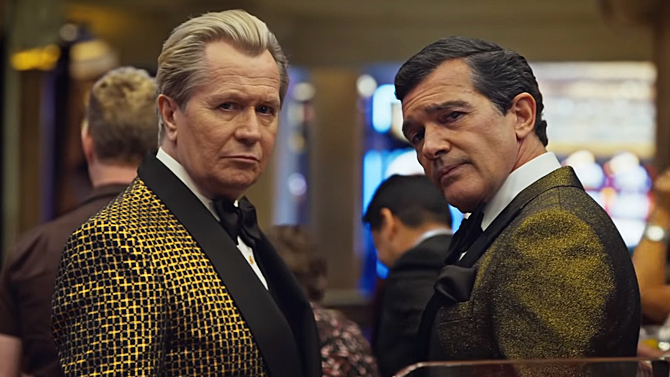
It starts well. We are introduced to Jurgen Mossack (Gary Oldman) and Ramon Fonseca (Antonio Banderas) wandering through a variety of exotic locations as they chat direct to camera, sip cocktails and explain that shell companies aren’t exactly illegal, they are simply ways of ensuring that billionaires won’t have the tiresome burden of paying all those pesky taxes they owe.

No big deal. The way they tell it, it sounds almost reasonable. But it can more succinctly be described in two words. Money laundering.

And then we meet Ellen Martin (Meryl Streep), recently widowed when she and her husband were on a cruise on Lake George and their hire boat capsized. First Ellen learns that the insurance policy she and her hubby took out for the trip won’t pay up because the firm they bought it from has itself been purchased by a shell company known only as ‘Nevis.’ And then her plans to retire to a condo that overlooks the place where she and her husband first met are brutally scuppered when the apartment is purchased – for cash – by a couple of Russian oligarchs.

Understandably miffed, she decides to devote some time to investigating the dealings of Nevis…

So far, so good, but it is at this point that screenwriter Scott Z. Burns takes us on a whistle-stop tour around the globe, to meet other people who, because of the wheelings and dealing of Messrs Mossack and Fonseca, are the nominal owners of shell companies, purportedly worth millions of dollars, but in reality not worth the paper they are printed on. African billionaire Charles (Nonso Anonzie) is attempting to pay off his wife and daughter over an affair he’s been having with a teenage girl, by making them the ‘owners’ of two such companies – and, in China, Madame Gu (Rosalind Chao) will seemingly go to any lengths to protect the reputation of her husband, whose main method of generating income seems to be trading in human organs.

These side-stories whizz past and aren’t investigated deeply enough to make them feel like part of the overall narrative arc. The unfortunate effect is that, by the time we get back to Ellen Martin’s quest, much of the story’s momentum has been lost. The film is by no means terrible, but it is unfocused – and even a late reveal (which I have to admit I didn’t see coming) fails to salvage it.

There’s certainly food for thought here. It’s interesting to note that the victims focused on in these stories are not the poor and impoverished, but middle-class people who’ve failed to realise that they are toiling at the behest of the greedy rich, whose paramount intention is to hang on to every penny they have generated, with no concern for the human wreckage left in their wake. It’s also sobering to learn that Mr Mossack and Mr Fonseca were able to walk away from this debacle with what amounts to little more than slapped wrists. Because, you know, it’s not really illegal…

For a winter evening stuck at home, this provides a decent night’s entertainment, but it certainly won’t figure among Steven Soderbergh’s best films – and there’s surely a more definitive adaptation of the Panama Papers story waiting somewhere in the wings.

3.6 stars

Philip Caveney

Life Itself

02/01/19

There’s a lovely little movie trapped inside Life Itself. An arch, playful, beautifully acted and intriguingly populated film, with a gently emotive storyline. It’s all there: ripe and ready. Unfortunately, it’s covered in an unwelcome layer of fridge-magnet cod-philosophy, with a side helping of pomposity thrown in. Oh dear.

Things start well. We meet Will (Oscar Isaac) as he stumbles drunkenly into a coffee shop, clearly having hit hard times. His therapist (Annette Bening) encourages him to talk about his relationship with his wife, Abby (Olivia Wilde), and their back-story is revealed in a series of flashbacks. The idea of the unreliable narrator is introduced early on, and reinforced by Abby’s student thesis on the subject. Life, concludes Abby, is the ultimate unreliable narrator, more random and unpredictable than anyone cares to acknowledge. Her friends like the idea, but she fails her course, because the essay strays too far from literary criticism.

Still, as the film goes on to show: she’s right. Time and again, writer-director Dan Fogelman pulls the rug from under our feet, throwing us swerve balls and catching us unawares. The action moves, almost arbitrarily,  from Will and Abby’s New York to Javier González (Sergio Peris-Mencheta)’s Spain – where all the dialogue, naturally, is in Spanish – and back again to New York, where we meet Will and Abby’s daughter, Dylan (Olivia Cooke). All this I like. The characters are captivating, and the seemingly unrelated strands are pulled together expertly. Segmenting movies into ‘chapters’ seems to be a bit of a recent phenomenon, and it works well here. Antonio Banderas is wonderfully understated as the emotionally needy Mr Saccione, and Laia Costa, as Javier’s wife, Isabel, really lights up the screen.

So why doesn’t it work? Because that premise, of life being the ultimate unreliable narrator, is overworked. It’s not left to be played out; we’re not trusted to understand without an actual lecture, delivered in the final chapter by Elena (Lorenza Izzo), Dylan’s teenage daughter, who, we discover, has been narrating throughout. There’s not enough substance to the idea to merit this much talk; it’s a simple – dare I say banal? – concept, enough to carry a story but not to bear such scrutiny. It takes itself too seriously, accords itself too much weight. And that’s a real shame.

There’s a filmed Q and A at the end of our screening, but it reinforces rather than alleviates our concerns. The interviewer, Jenny Falconer, talks of weeping copiously as she watched, but we both feel curiously unmoved. It’s clearly a movie that wants to tap into our emotions, but the narration distances us from events, and makes that level of engagement difficult. I don’t mind this – the film is at its best when it’s witty and stylised, which it is, a lot of the time – but it feels muddled, as if the ‘message’ is getting in the way of all the good stuff that’s on offer here.

3.3 stars

Susan Singfield