Andy Clark

Wild Rose

20/03/25

Lyceum Theatre, Edinburgh

Rose-Lynn Harlan (Dawn Sievewright) has a dream: to appear on the stage of Nashville’s legendary Grand Ol’ Opry, belting out a country song – not a country and western song, mind you. It’s an important distinction. So, being banged up in prison for a year wasn’t part of the grand ol’ plan – but now she’s served her time and is finally able to head back to her mum, Marion (Blythe Duff), who has been dutifully looking after Rose-Lynn’s two young children, Lyle (Leo Stephen) and Wynonna (Jessie-Lou Harvie).

Rose-Lynn is dismayed to find that her kids have become disaffected by her long absence and that their former trust in her has been all but eroded. What’s more, they view her long-cherished dream as selfishness. And that’s not all that has changed. When she calls in at the Grand Ol’ Opry, Glasgow – where she previously had a residency – she discovers that her regular slot has been handed to the dreaded Alan Boyne (Andy Clark), a long-haired carpet fitter with a sideline as a charisma-free country singer.

Desperate to keep her head above water, Rose-Lynn takes a part-time post as a cleaner, working for the highly-privileged Susannah (Janet Kumah). She’s a go-getter and, once she’s heard Rose-Lynn sing, she becomes determined to put her in touch with legendary DJ Bob Harris, who Susannah believes might be able to offer some good advice.

Rose-Lynn realises that her long-cherished ambitions are still burning as fiercely as ever…

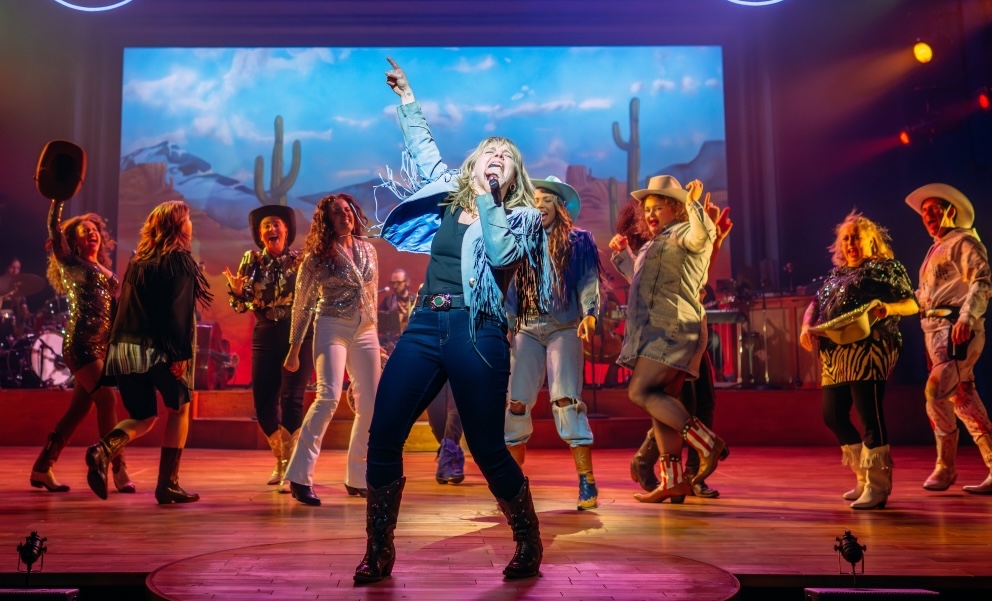
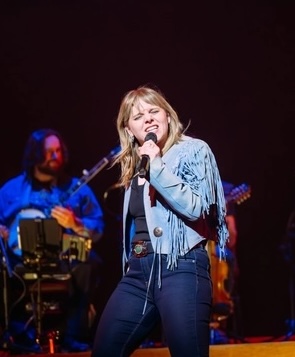
This assured version of the 2018 film (adapted by its original screenwriter, Nicole Taylor) makes a seemingly effortless transition to the stage. A prison-set opening where Rose-Lynn and her fellow inmates launch headlong into a propulsive rendition of Country Girl sets the tone perfectly, with Sievewright stepping into Jessie Buckley’s cowboy boots with absolute authority. An eight-piece band ranged across the back of the stage performs a varied selection of numbers, from banging rockers to lilting, steel-guitar layered ballads. And it’s not just Sievewright supplying the singing.

As bar-owner, Jackie, Louise McCarthy belts out her own fair share of raunchy vocals, Duff does a fabulous job with a haunting song of regret and even the two youngest members of the cast have the opportunity to shine as vocalists. Clark – who takes on a number of roles – proves himself an invaluable asset to the production, as does Hannah Jarrett-Scott, who appears as two (very different) characters.

Chloe Lamford’s simple but effective set design works beautifully alongside Jessica Hung Han Yun’s inventive lighting and Lewis den Hartog’s simple-but-effective video design. John Tiffany handles the directorial reins with absolute aplomb. It’s worth mentioning, I think, that Wild Rose will be the final production under David Greig’s eight-year spell as the Lyceum’s artistic director. He leaves on an impressive high note.

Wild Rose is a fabulously entertaining story about ambition and acceptance, anchored by a knockout performance from Dawn Sievewright. Anyone in search of an uplifting night at the theatre will find it here. And you don’t have to be a die-hard country fan to enjoy this fabulous show.

5 stars

Philip Caveney

So Young

04/08/24

Traverse Theatre, Edinburgh

A new play by Douglas Maxwell is always a treat. He’s an insightful playwright, able to walk that precarious tightrope between hilarity and tragedy with absolute authority. So Young is up there with his best work.

The play opens in the bedroom of married couple Liane (Lucianne McEvoy) and Davie (Andy Clark). They are in flagrante delicto and it appears to be going well – all four minutes of it. We know it’s that long because Andy has been timing it on his phone. In the afterglow, he wistfully talks about the years when their couplings could last the entire day, but there’s little time to linger on such details because the couple are already running late. They’re due to meet up with their friend, Milo (Nicholas Karimi), who they have known for years – in Andy’s case since they were best mates at school.

Liane is somewhat dismayed when Davie casually mentions that Milo is planning to introduce them to a new female friend. Both Davie and Liane are uncomfortably aware that Milo lost his wife, Helen, to COVID only three months earlier. The new friend turns out to be Greta (Yana Harris), just twenty years old and a former pupil at the school where Liane teaches. When she mentions that she and Milo are now engaged, Liane cannot help reacting badly to the news. After all, Helen was her best friend in the world and, thanks to the pandemic, there still hasn’t been a proper funeral service. 

As glasses of wine are consumed, it’s clear that there’s going to be a confrontation…

Maxwell always creates utterly believable characters. McEvoy is terrific as the caustic, fearless Liane, who has the ability to nail any target with a few well-chosen phrases and does so with abandon. She also manages to provoke a spontaneous round of applause for her discourse on the importance of female friendship. Gray, meanwhile, is brilliantly funny as the hapless Davie, at one point managing to have the entire audience convulsed with laughter, with nothing more than a series of exasperated looks and the repetition of the words, ‘Three months?’ Karimi has perhaps the trickier task of conveying Milo’s world-view, the difficulties of carrying on alone when his partner is gone. Harris is convincingly bright-eyed and resolute as Greta, fielding Liane’s dismissal of her as a child who knows nothing.

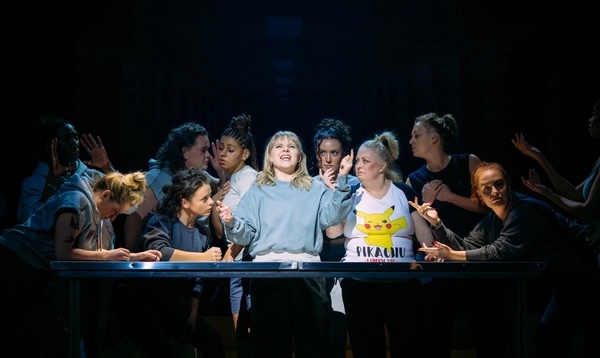
Having got his four characters into such strife, it’s left to Maxwell to conjure a conclusion that satisfies the audience and, once again – ably assisted by director Gareth Nicholls – he manages it with considerable panache. So Young is a perfectly-pitched drama that keeps me hooked throughout.

4.8 stars

Philip Caveney

Lost At Sea

20/05/19

King’s Theatre, Edinburgh

Morna Young’s seafaring play is a searing, tempestuous examination of fishing communities in the Northeast of Scotland. From the heydays of the 1980s, when the money was rolling in, to the more elitist issues of the early 2000s, when only a select few were still living it large, we are shown the strengths and divisions within these close-knit neighbourhoods and the cruel toll the sea exacts on them.

Journalist Shona (Sophia McLean) returns to the fishing village she left when she was just a child. She is looking for answers: her father, Jock (Ali Craig), died, lost at sea, and she needs to find out more, to know what happened on that fateful day. But the locals close ranks on her: they’ve lost too many; suffered too much; accepted the Faustian exchange that keeps them all in work.

Young’s own father was lost at sea, and this piece blends fiction with that reality. There are verbatim voices – telling of the fishermen’s arduous days at sea and their families’ agonising waits on land – interwoven with constructed dialogue; the authentic details of a fishing life and a fictional account of one woman’s family. It’s a powerful mixture.

There are politics here too: the cameradie and team spirit of the 1980s gives way to a far more cynical individualism and – by 2012 – the community is bitterly divided. Shona’s Uncle Kevin (Andy Clark) has taken advantage of the UK’s strange decision to enable its fishermen to sell their EU quotas to the highest bidder, often to foreign investors. (No other EU country allowed this – for obvious reasons.) In Kevin’s case, it means he’s safe, no longer endangering his life at sea, just staying home and waiting for the money to pour in. But, as Skipper (Tam Dean Burn) reminds him, this means that those around him are risking their lives for an ever diminishing slice of the pie. What price community?

This could be a heavy, sombre tale, but Ian Brown’s nimble direction ensures that it is fleet of foot, as restless as the sea itself. The ensemble work is precise and light, the movement (by Jim Manganello) evoking rolling waves, and turbulent emotions. The spare set (designed by Karen Tennent) lends the piece a stark brutality, with restless projections of a dark and ominous sea.

If we don’t quite get the cathartic thrill of a dramatic climax, we do at least get a thought-provoking piece of theatre, straddling introspection and social commentary. It’s not exactly an easy watch, but it’s certainly most worthwhile.

4 stars

Susan Singfield


The Winter’s Tale

14/02/17

Lyceum Theatre, Edinburgh

The Winter’s Tale is famously a play of two halves, and Max Webster’s production for the Lyceum exaggerates and develops this juxtaposition in every possible way – and the result is thrilling.

This is an modern-day version of the play: ‘Sicilia’ is now Edinburgh; ‘Bohemia’ is Fife. Although Leontes (John Michie) and Polixenes (Andy Clark) are still ostensibly ‘kings’, they are presented more as middle-class business men, rich and successful, with teams of staff assisting them. The set design helps to cement the contrasts between them: Leontes’ apartment, slightly raised and framed in black, looks exactly like the glass boxes lining Edinburgh’s Quartermile; a walled-off sound-booth reinforces this image. It’s an inspired idea: those apartments look like stage-sets anyway, their fourth walls removed to allow us to peep in. And they are sterile and hard, seemingly perfect but ultimately lacking – just like Leontes’ relationship with Hermione (Frances Grey). The pastoral scenes, on the other hand, are deliberately hokey. The fake grass is rolled out before us: there is no attempt at realism here. The props are more panto than serious Shakespeare, all bright-bunting and shopping trolleys and rickety wooden stuff. The costumes  all look hand-made, in a local am-dram kind of way. It’s hard to imagine we’re watching the same play. Polixenes  is a big fish here, but he’s in a very different kind of pond.

The contrasts are further underlined by both dialogue and acting style. While acts one, two, three and five retain Shakespeare’s original language, act four has been recast in Scots, an audacious undertaking performed with evident delight by writer James Robertson. The performances are mismatched too: whereas the Sicilian scenes are very serious and actorly, the Bohemian scenes are played for laughs, with comedic exaggeration and audience interaction; it’s beautifully done.

If I’ve a criticism of this play – and I haven’t much – it’s that the fayre goes on too long, without adding much to the plot. It is a lovely interlude, and the scene-setting is vital, but it starts to drag after a while: we want to know what happens next.

The performances here are universally strong, but Maureen Beattie’s Paulina is a definite stand-out; she imbues the character with warmth, vitality and strength. The musicians, led by composer Alasdair Macrae, deserve a mention too: their on-stage accompaniment is integral to the story-telling, and their presence adds a strange unearthliness that really elevates the play.

Do get yourself along to the Lyceum to see this: it’s really rather wonderful.

4.9 stars

Susan Singfield

Walking On Walls

walking-on-walls

19/10/16

Traverse Theatre, Edinburgh

Walking On Walls by Morna Pearson is part of the Traverse’s latest ‘A Play, A Pie and A Pint’ season. There are five plays, each one shown at 1pm from Tuesday to Saturday, with one later performance on a Friday evening. It’s a successful concept and clearly very popular; today’s show is sold out. And really, what’s not to like about a £12.50 theatre ticket that also includes a savoury pie and a pint of ale (wine or soft drinks are also available)?

We’ve extolled the virtues of the Traverse and have invited friends to join us today, so we’re extra keen for this one to be good. And (quite by chance) Philip met one the actors at an event in Glasgow, last night, which adds another level of pressure; he wants to be able to offer genuine praise!

Luckily, we’re not disappointed. Morna Pearson’s script is sharp and liberally laced with dark humour. It tells the tale of Claire, a young woman still traumatised by the bullying she experienced at school. Her solution is to become a masked vigilante; after work each evening, she stalks the city’s streets, looking for people to help and reporting ‘criminals’ to the police.

As the lights go up, she is keeping an eye on her latest project: a man, bound and gagged, sits listening to her, growing more and more agitated. She’s called the police, she says; they’ll be here soon. But we quickly learn more about Fraser and how his past interconnects with Claire’s.

It’s a simple two-hander in a black box studio, with minimal props and a basic set (two desks, two  chairs, a scattering of stationery). But the simplicity absolutely suits the piece.  Both actors (Helen Mackay and Andy Clark) inhabit their characters convincingly. Their relationship – with all its tensions and revelations – is deliciously  uncomfortable, but there are plenty of laughs amid the heartache and despair.

It might be tough to get a ticket for this, but I do urge you to try. It’s a cracking little play – and the pies are pretty good too.

4.3 stars

Susan Singfield