

Heron

16/06/24

Henderson Street, Leith

Birthdays are an opportunity to push the boat out and we’ve heard good things about Heron, a Michelin starred restaurant out in the culinary kingdom of The Shore. We like the sound of their tasting menus and decide the best way to work up an appetite for them (standard for me and pescatarian for Susan) will be to walk there via the Water of Leith. There’s a few light rain showers en route but we arrive right on time, order our drinks and settle down in the light and spacious dining room. We don’t have to wait long. The service here is prompt and attentive.

First up there’s something called cucumber (Heron, it turns out, has a gift for understatement). This is a bowl of chilled cucumber granita, vibrant with stem ginger and jalapeno. It’s closely followed by langoustine (mini cups of squid ink nori filled with the titular shellfish) and Isle of Wight tomato, light and sumptuous parcels stuffed with burrata. Pop these into your mouth and they sort of melt away in an explosion of pure flavour.

There are chunks of freshly baked sourdough with smooth crab butter, which I tell myself I shall eat slowly, but I fail, simply because it’s just too damned delicious.

Now comes mackerel, the salty fish liberally sprinkled with chunky hazelnuts, ponzu and blackcurrant leaf and I keep reminding myself I’m supposed to be critical but I’m too busy eating. Potato may be the most unassuming name given to a dish in the entire history of fine dining and yet this single new spud, cooked hasselback style, studded with crisps and sprinkled with orange roe, is a little wonder. It’s surrounded by a creamy oyster sauce that makes me reach for ever-more elaborate words to describe its joys. Scrumptious? Mouthwatering? De-fucking-licious? So far it’s the stand-out and it’s early yet.

Next there’s turbot, a chunk of perfectly-crisped fish, drizzled with white crab, lovage and thinly-sliced courgette, another inspired creation.

After that, Susan has spelt, an unprepossessing bowl of what looks suspiciously like porridge but which tastes of wild mushrooms and comes with a generous measure of summer truffle grated over it. And for me it’s East fortune pork, slices of slow-cooked belly meat, decorated with wild garlic, tonka and coffee.

Now to the ‘main courses’. Susan’s is red mullet; mine is Aberdeen Angus beef, perfectly cooked and accompanied by veal sweetbread, buckwheat, pepper dulse and girolle mushrooms, the whole thing liberally covered with a red wine jus. This is best described in three letters. O.M.G.

For puddings, first up is carrot – a powerfully flavoured dish, rich with ginger and pistachio. It’s hard to believe that such a little morsel can provide so much flavour.

And finally there’s lemon, something that looks every bit as fabulous as it tastes: a swirl of soft meringue, a scoop of basil sorbet, succulent pools of lemon curd, white chocolate and toasted almonds. If this meal has been a series of wonders then the last dish tops every delicious offering that has gone before.

I’m not sure there are enough accolades in the lexicon to adequately express how good this meal is. Put it this way: if you love adventurous cooking and you’re looking to celebrate a special occasion, I’d be hard pressed to think of anywhere better than Heron to spend your hard-earned cash. It’s ridiculously easy to see why it was awarded that much-coveted star and, if they keep up this kind of impeccable standard, a second surely won’t be long in coming.

5 stars

Philip Caveney

Inside Out 2

16/06/24

Cineworld, Edinburgh

In 2015, Inside Out was a deserved hit for Pixar Animation, a clever and sophisticated story about the antics of the various emotions that dwell within a human being, helping them – and, for much of the time, hindering them. We awarded the film 5 stars and wondered if its creators would deem it worthy of a sequel. Nine years later, here it is and, while it might not be quite as perfect as its innovative predecessor, it’s nonetheless beautifully executed and full of glorious invention.

Riley (voiced by Kensington Tallman) is now thirteen years old, a promising ice hockey player who makes up a formidable sporting trio with her best friends, Grace (Grace Lu) and Bree (Sumayyah Nuriddin-Green.) Meanwhile, the inner team that maintains Riley’s everyday existence is being ably supervised by Joy (Amy Poehler), who manages to keep Fear (Tony Hale), Sadness (Phyllis Smith), Anger (Lewis Black) and Disgust (Liza Lapira) in check as Riley approaches adolescence.

But when she and her friends are invited to a weekend hockey camp by an influential coach, a puberty alarm goes off, and some new recruits promptly turn up to join the party. They are Anxiety (Maya Hawke), Envy (Ayo Edebiri), Ennui (Adèle Exarchopoulos) and Embarrassment (Paul Walter Hauser.) Suddenly, Riley isn’t the calm, capable creature she used to be; she’s a nervous wreck – and Joy and her team are going to have a heck of a job getting her through the weekend…

There’s enough progression here to make this worth the price of the ticket, and screenwriters Meg LeFauve and Dave Holstein have a lot of fun unleashing a whole torrent of problems for Joy and co. to deal with as best they can. We’re introduced to a bunch of eye-popping new locations, many of them built around puns. Ever tried drifting along the Stream of Memory whilst braving a Brainstorm? Here’s your opportunity.

As ever, the animation is bright and brash and beautifully detailed. Check out Grace’s chipped nail varnish for starters! I worried first time out that there might not be enough here to appeal to younger kids and this sequel seems even more intent on aiming for the teen market. The wee ones at the screening I attend seem to spend an awful lot of their time going back and forth for toilet breaks. Their parents on the other hand are doubtless having a field day playing ‘spot the movie reference’ and there’s enough inventive twists here to keep them on board. I love the repeated joke about sweet Grandmother figure, Nostalgia, who keeps making hopeful appearances only to be told to ‘come back in a few years.’ Clever. The ultimate message – of course there’s a message, there always is – manages to avoid being chock full of schmaltz and the ending is nicely handled.

Pixar have been in a bit of a slump in recent years, but despite that unadventurous title, Inside Out 2 puts them back where they belong, ahead of most of the Hollywood competition. Not sure there’s enough left to risk making this a trilogy, but we’ll see how that pans out. Meanwhile, the message remains the same. For best results, see it on a cinema screen!

4.5 stars

Philip Caveney

Sasquatch Sunset

15/06/24

Cameo Cinema, Edinburgh

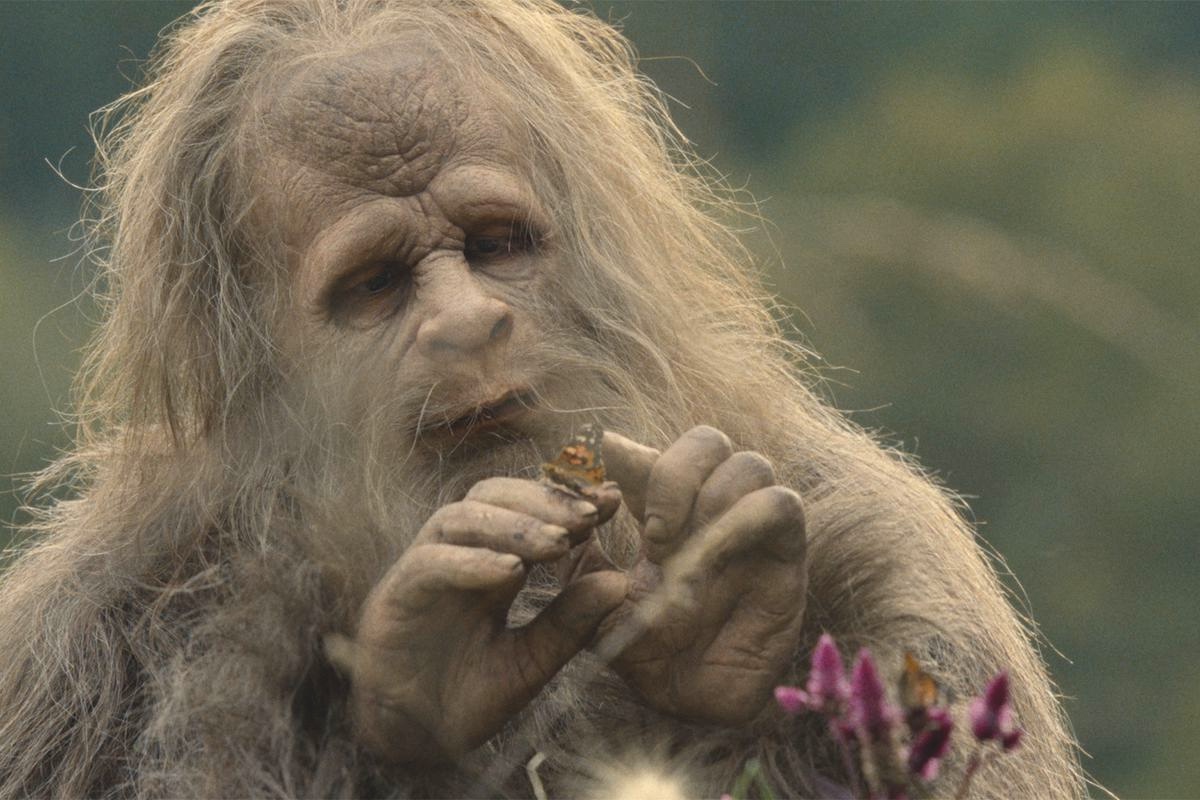
There’s a charming idea at the heart of Sasquatch Sunset, which follows, season by season, a year in the lives of four sasquatches (sasqui?). They live in a remote forest somewhere in North America. There’s an alpha male (Nathan Zellner), a beta male (Jesse Eisenberg), a pregnant female (Riley Keough) and a child (Christophe Zajac-Denek) and the four of them amble around the forest, foraging for food, attempting to procreate and every night constructing a crude shelter in which to sleep. They also spend time thumping tree trunks with branches in an attempt to contact others of their species – with no success.

The conceit of this film, conceived and directed by Nathan and David Zellner, is to treat it with all the seriousness of a nature documentary and, as our four protagonists go about their shuffling business in the tranquility of various woodland settings, there are indeed moments of wry amusement and occasionally some suspense as they stumble into peril.

The creature makeup is pretty convincing – though the film’s budget clearly didn’t extend to making a new-born sasquatch look convincing – and there are surely some cogent observations about the process of survival that can easily be extended to endangered species in the real world. Sasquatch Sunset is, I suppose, an allegory and it doesn’t take a Sherlock Holmes to work out what it’s really about.

But ultimately, there isn’t really enough here to fill the film’s (relatively short) running time and, by the halfway mark, I find myself longing for some more progression. Though the film flirts with the possibility of the creatures encountering humans, this never happens. It would have made an excellent short but, to my mind at least, as a feature-length movie it feels like an interesting failure.

2.8 stars

Philip Caveney
Shirley Valentine

13/06/24

Lyceum Theatre, Edinburgh

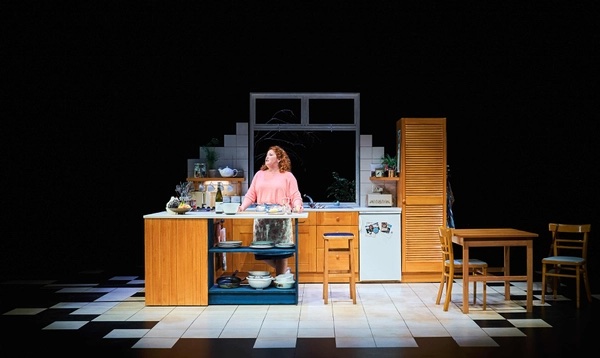
In Edinburgh, the weather is dreich, the rain falling endlessly from grey skies – but in the welcoming environs of the Lyceum Theatre, the sun blazes down onto fine white sand and shimmering Mediterranean waters. It’s here that Shirley Valentine has just experienced a personal revelation. The clitoris really does exist! Who knew?

Willy Russell’s celebrated play gets a welcome revival in this delightful production from Pitlochry Festival Theatre. Many will be familiar with the 1989 film adaptation starring Pauline Collins, where the story is opened out to include the various other characters whom Shirley describes in such hilarious detail, but here it’s presented in its original form – a funny, acerbic monologue in three acts.

We first encounter Shirley (Sally Reid) as she prepares a dinner of “chips ‘n’ egg” for her husband, Joe, and considers the best way to inform him that she has fed the mince he’s expecting to a vegan dog. Meanwhile, she chats to her oldest friend, the wall. In the second act, she’s anxiously preparing to head off on the Greek holiday she has also neglected to tell Joe about.

And, in the final act, she’s there: on an idyllic island, getting to know boat owner, Costas, and coming to terms with a newly-discovered sense of personal freedom.

Of course, the play stands or falls on the strength of its performer and Sally Reid does a fabulous job here, encapsulating Shirley’s strengths and weaknesses, her ability to move from mocking good humour to tragedy in the blink of an eye, the beat of a heart. She also manages to nail a Scouse accent while convincingly frying eggs. No easy matter. And Russell manages that rare thing, a male playwright effortlessly capturing a female personality with what feels like absolute clarity, managing to find the humour in her weary worldview without ever making his subject feel like a caricature.

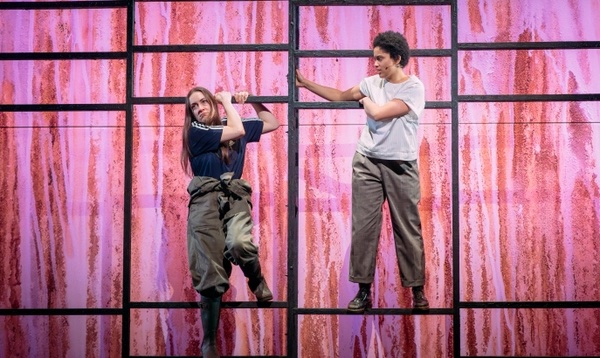
Emily James’ set design mirrors the play beautifully. Shirley’s Liverpool home is solid and brutally realistic, the walls constricting her. The Greek beach, however, comprises sequinned blocks, all shimmery and dreamlike – a mirrorball of possibilities. Director Elizabeth Newman keeps everything nicely nuanced throughout. I’ve seen other productions of the play that amp up the laughs until the bittersweet charm of it is all but swamped, but here is comes through loud and clear. Those looking for the perfect alternative to a disappointing summer need look no further than the stage of the Lyceum, where Shirley Valentine offers a warm and vibrant alternative.

4.6 stars

Philip Caveney
The Dead Don’t Hurt

10/06/24

Cineworld, Edinburgh

I’ve always had a soft spot for Westerns but these days (on the big screen, at least) they’re about as rare as hens’ teeth. The Dead Don’t Hurt is clearly a passion project for Viggo Mortensen. As well as starring, he wrote it, directed it and even created the distinctive folk-tinged score. (For all I know, he did the catering as well.) As Westerns go, this is an atypical example, featuring few of the genre’s familiar tropes and cleverly subverting the ones that it actually does borrow. It’s handsomely mounted and beautifully filmed by cinematographer Marcel Zyskind.

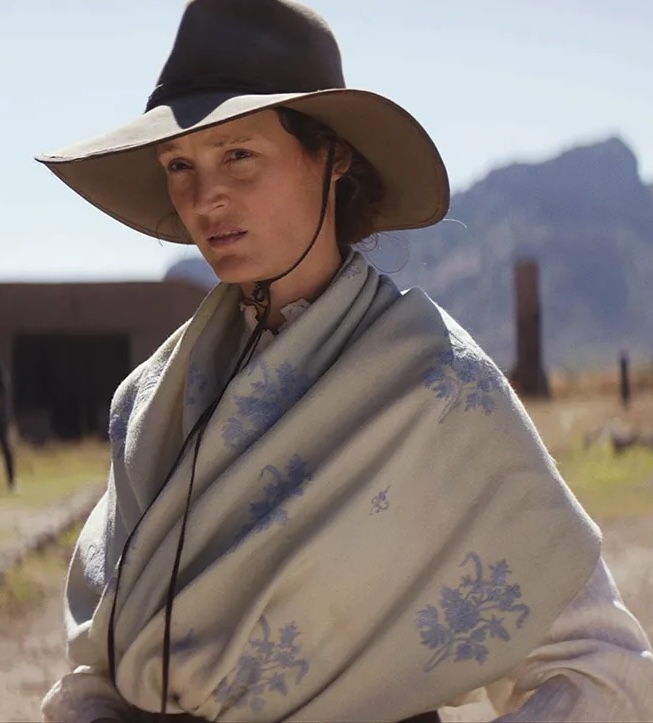
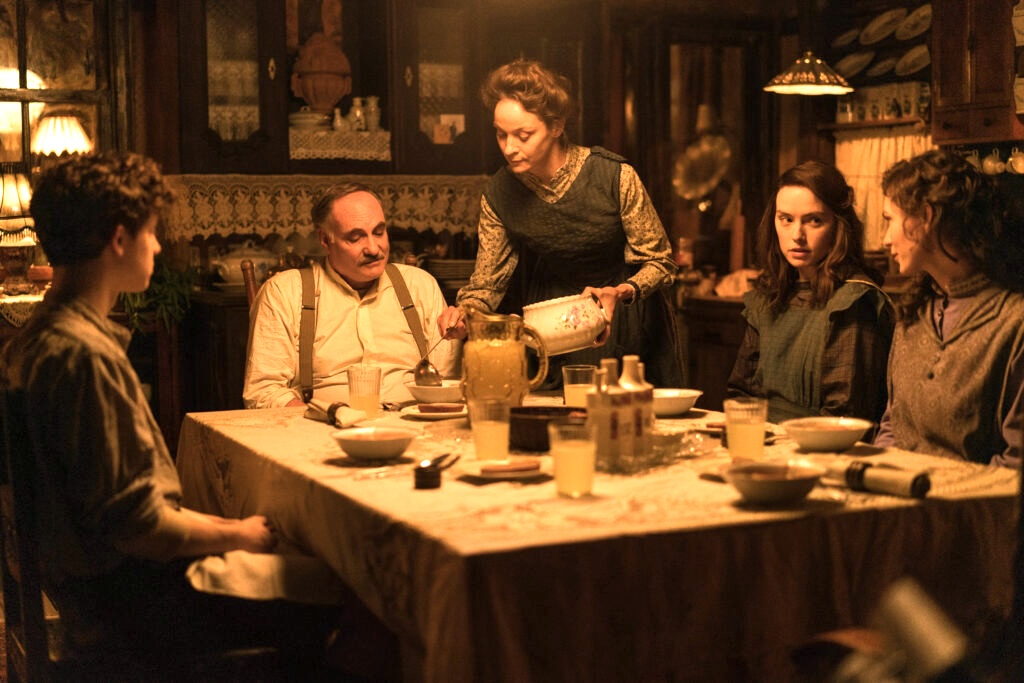
Mortensen plays Danish immigrant carpenter, Holger Olsen, who, when we first encounter him, is bidding a sad farewell to his dying partner, Vivienne Le Coudy (Vicky Krieps), watched by their young son, Vincent (Atlas Green). From here the story flashes back to Holger’s first meeting with Vivienne, showing how he instantly falls under the spell of this headstrong, unconventional young woman.

The main action of the story occurs when Holger and Vivienne set up home together in a remote cabin, close to the town of Elk Flats, Nevada, a place dominated by corrupt landowner, Alfred Jeffries (Garret Dillahunt) and his violently-inclined son, Weston (Solly McLeod). Together with crooked Mayor Rudolph Schiller (Danny Huston), the Jeffries have the place pretty much under their collective thumbs – the evils of capitalism are already exerting a powerful influence and God help anyone who dares to oppose it.

When Holger decides to enlist in the Union Army to fight in the Civil War, his only option is to leave Vivienne alone to run the homestead and, of course, he is away for years. While he’s gone, Vivienne is at the mercy of Weston, who has had his eye on her from their first meeting…

The Dead Don’t Hurt unfolds a compelling story of anger and retribution and both Krieps and Mortensen portray their characters with sensitivity. The various shifts in time and place are handled with considerable skill and the scenes where Vivienne manages to grow exotic flowers in the heart of the Nevada badlands are particularly memorable. It’s clear from the outset that the story is heading (inevitably) towards darker territory and, while Weston is a relentlessly unpleasant character, there’s some explanation for why this might be the case.

Even a climactic showdown between hero and villain is understated and the film is brave enough to offer an open-ended conclusion as to where Holger and Vincent may be headed next.

While it’s unlikely to make much of a dent at the box office, this is enjoyable stuff and those who have a hankering for a decent Western should seek it out on the big screen, where those Nevada landscapes will look more impressive than on streaming.

3.8 stars

Philip Caveney
La Bête (The Beast)

08/06/24

Cameo Cinema, Edinburgh

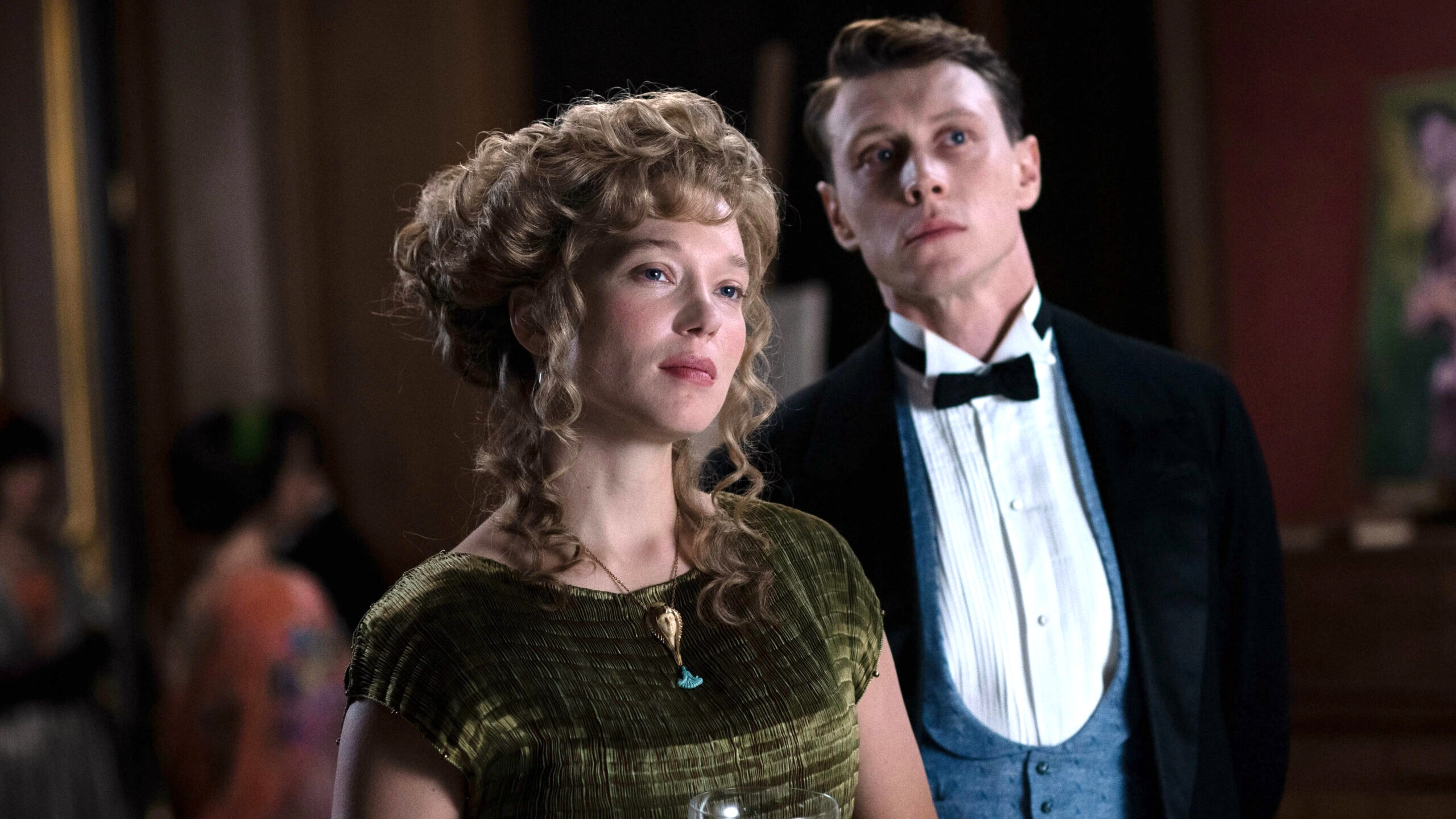
Some films almost defy logical analysis and Bertrand Bonello’s La Bête is one such er… beast, depicting as it does three distinct time-strands, each one featuring different versions of the same two characters. We first meet Gabrielle (Léa Seydoux) in a green-screen room, where the film’s director is talking her through a scene where she must pick up a knife from a kitchen table. This instantly alerts the audience to the fact that what we are about to see is an elaborate construct.

The story begins in 2044, where AI has pretty much taken over everyone’s lives, leaving them with precious little to do. Gabrielle is struggling to come to terms with a thankless job, which requires her to put her hand on a glass screen every so often. She decides to undergo ‘purification’, a procedure which will remove all of her troublesome human emotions. Meanwhile, she is offered the companionship of a doll, Poupée Kelly (Guslagie Malanda), who will do anything that Gabrielle asks of her.

As the purification begins events flash back to Paris in the year 1910, where Gabrielle meets Louis (George McKay) at a society party. In this version of her life, Gabrielle is a talented musician and she’s happily married to Georges (Martin Scali), a doll-maker, but her chance encounter with Louis clearly strikes a significant chord with both of them.

Have they already met somewhere else? Gabrielle confides to Louis that for most of her life she has lived with the fear that something terrible is going to happen to her. And just when that’s starting to sink in, we flash forward again to the year 2014, where Gabrielle is trying to make a living as a model and Louis is a terrifying incel, spewing hatred onto social media, intent on destroying all those women who have so callously spurned him over the years…

Bonello’s film is the very definition of a slow-burner, a whole series of events and repetitions gradually building to relate a mystifying narrative. Gina (Marta Hoskins), a blank-eyed clairvoyant, keeps popping up to put an even more disturbing spin on what’s happening. If I claimed to absolutely understand everything that happens in the film’s two hours and twenty-six minutes, I’d be exaggerating. I’m also unsure if a climactic scene, which appears to echo David Lynch’s Blue Velvet, is an intentional homage or just a coincidence.

Whatever, as the story moves assuredly through its many (often startling) twists and turns, I find myself increasingly fascinated with what I’m watching. Seydoux is fabulous in all of her versions and McKay (who took over the role of Louis at very short notice – and also learned to speak French into the bargain) continues to be a chameleon, seemingly able to transform himself into whatever is asked of him.

La Bête arrives heavily laden with five-star reviews and, though I’m not quite in that camp, I do feel this is a bold, ambitious film that goes to places where few others have dared to tread. I also readily accept that it won’t be for everyone.

Please note, in place of the usual rolling credits, viewers are offered the opportunity to scan a QR code instead, something I did for the purposes of this review. I urge everyone to do the same, only because there’s also a short clip on there that offers yet another piece to this enigmatic puzzle of a film.

4.2 stars

Philip Caveney

Young Woman and the Sea

03/06/24

Cineworld, Edinburgh

As true stories go, few are as inspiring as that of Trudy Ederle, who in 1926 was the first woman to swim the English Channel. If it sounds a bit so-so now, when so many people have managed it, consider how difficult it must have been in an era where there was little in the way of swim technology – and at a time when women were expected to stay quietly at home and look after the family.

We’re first introduced to young Trudy (Olive Abercrombie) in 1914 when she’s suffering from a bout of measles that’s expected to kill her. Out in New York harbour, a fire on a passenger boat has killed a large number of people, most of them women, who burned to death because none of them had ever been taught to swim. When Trudy makes a miraculous recovery from her illness, her indefatigable mother, Gertrude (Jeanette Hain), decides that Trudy (now played by Daisy Ridley) and her sister, Margaret (Tilda Cobham-Hervey), shall have swimming lessons, even though the concept is virtually unheard of. The girls’ father, Henry (Kim Bodnia), a butcher by trade, doesn’t encourage the idea. He would rather see his daughters married with kids at the earliest opportunity and preferably to other German butchers. Whatever will these women want next? The vote?

Luckily, the girls fall under the influence of fearless swimming trainer Charlotte (Sian Clifford), who can see no logical reason why women shouldn’t be allowed to swim competitively and, sure enough, they take to the sport like… ahem… ducks to water. Trudy soon has her eyes on bigger prizes and even gets to take part in the 1924 Summer Olympics – but her determination stretches to different horizons and she’s very aware that, so far at least, no woman has ever swum across the English Channel…

This is a Disney film, but screenwriter Jeff Nathanson mostly manages to steer clear of the schmaltz, only occasionally flirting with it in the shallows. Of course, there has to be a villain in a film like this, and that duty falls to Christopher Eccleston (sporting a spectacularly dodgy Glaswegian accent) as Jabez Wolffe, the man picked to be Trudy’s trainer for her first attempt. A failed channel swimmer himself (22 attempts!), Wolffe is clearly the wrong man for the job and it’s hardly surprising that the enterprise is doomed to failure – but then Trudy falls in with Bill Burgess (Stephen Graham), the second man to make it across (in 1911!), who can see her potential and is prepared to pick up where Wolffe left off.

The rest, as they say, is history, but director Joachim Rønning does a spectacular job of creating almost unbearable suspense even though the ending is a matter of record. And Trudy’s epic swim, through bad weather, stinging jellyfish and – worst of all – almost total darkness, makes for an absorbing and compelling experience in the cinema.

How well this will fare in a summer where some excellent films are failing to find an audience is anybody’s guess, but as ever, it’s worth catching this one on the big screen before it drifts on by.

4.3 stars

Philip Caveney

Sunset Song

30/05/24

Lyceum Theatre, Edinburgh

Lewis Grassic Gibbon’s Sunset Song is widely regarded as one of the most important Scottish novels of the 20th century. There are many who first encountered it as a set text in school and have carried it in their hearts ever since. Playwright Morna Young was evidently one such teenager and this is her adaptation of the tale in collaboration with Dundee Rep. I’ll confess that I’ve never got around to reading the book myself. Set in the 1900s, it’s a dour and sometimes bleak story based around the misadventures of the Guthrie family, farmers who live and work in (the fictional) Kinraddie in the wilds of Aberdeenshire.

When we first meet Chris Guthrie (Danielle Jam), she’s young and ambitious, a keen reader and already planning to seek a career as a teacher. In this, she has the grudging support of her father, John (Ali Craig), though he’s a hard taskmaster, never slow to hand out physical punishment to Chris and her siblings whenever they step over what he perceives as ‘the line.’ 

Chris’s much-loved mother, Jean (Rori Hawthorn), mentally broken by the recent birth of twins, takes matters into her own hands, killing herself and her new babies. Two younger children decide to flee  the family home to start a new life in Aberdeen and it isn’t long before Chris’s older brother, Will (Naomi Stirrat) follows their example and heads off to seek his own fortune in Argentina. This leaves Chris to run the farm with her father and, after he suffers a debilitating stroke, to fend off his sexual advances. When tragedy strikes yet again, Chris finally has an opportunity to start over but (maddeningly) she decides to stay where she is and marry local boy Ewan (Murray Fraser). But by now, the world is heading into a massive global conflict and it’s hardly a spoiler to say that more heartbreak is looming on the horizon…

While it does of course feature more than its fair share of harrowing occurrences, it’s to this production’s credit that it manages to convey difficult themes without ever feeling too prurient. Young’s adaptation remains true to the novel’s Doric dialogue, though occasionally I feel I’m told things that I would rather see – and the decision to have no costume changes when actors embody several different characters does mean that I’m occasionally confused as to who is who.

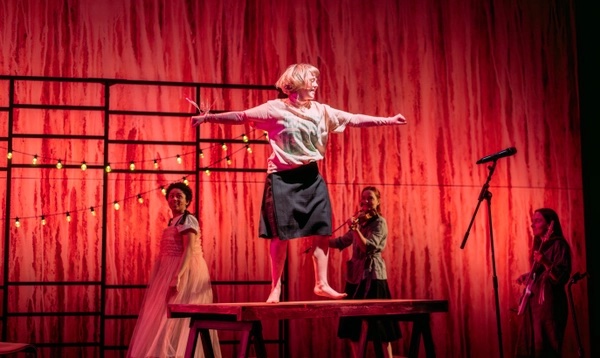
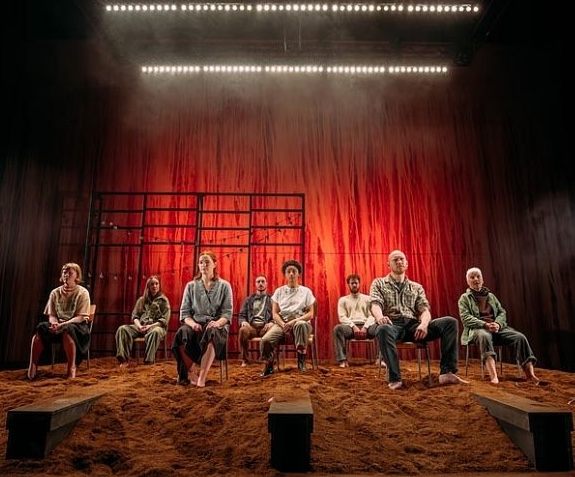
Emma Bailey’s simple but effective set design is based around a large rectangular section of soil, across which the characters walk barefoot, fight, make love and celebrate. The story’s central theme couldn’t be more evident. To the Guthries, the earth is all-important. It provides sustenance, a wage and a reason to go on living. And of course, it is also the place to which they will eventually return. As if to accentuate this, the backdrop is a closeup of a field of wheat.

On either side of the soil, musical instruments are arranged and the cast occasionally break off to deliver Finn Anderson’s evocative songs, singing in plaintive harmonies, pounding propulsive drums, strumming electric guitars and at one point even launching headlong into a spirited wedding ceilidh. These elements offer a welcome respite from the unrelenting bleakness of the story.

Finn de Hertog’s direction is assured and I particularly enjoy Emma Jones’ lighting design, which manages to convey that simple slab of soil in so many different ways. I like too that many of the props the actors require are clawed up out of the ground like a strange crop.

But much as I’d like to, I can’t really warm to the story, which at times feels uncomfortably like a series of disasters unleashed upon one luckless family.

3.6 stars

Philip Caveney

Hit Man

30/05/24

Cineworld, Edinburgh

Here’s that increasingly rare creature, a Netflix original movie that’s actually been given a theatrical release before being dumped onto streaming. Hit Man is a curious creation, loosely based on the career of the recently deceased Gary Johnson, a University lecturer from New Orleans who also had a sideline working for the local police department as a fake contract killer. As you do. Wearing a wire, he would meet with potential ’employers’, accept their money and coax them into confessing their desire to pay him to murder somebody… on tape.

It’s best not to dig too deeply on that score. Suffice to say that this is a witty, amoral confection which travels to some unexpected places, mostly because it doesn’t bother sticking too closely to the truth.

Johnson (Glen Powell) finds himself taking over the fake hit man role from his police colleague, Jasper (a wonderfully seedy performance by Austin Amelio), and, though initially reluctant to do so, Johnson quickly discovers that his background in philosophy has equipped him to be really good at the different roles he has to take on, each one tailored to appeal to his latest client. It all goes swimmingly until he encounters Maddy Masters (Adria Arjona), who wants to call down a hit on her husband, Ray (Evan Holtzman), who appears to be a thoroughly nasty piece of work.

Sensing that she’s headed for trouble – and at the same time, powerfully attracted to her – Johnson talks her out of going through with the hit and ends up having a wild affair with her, allowing her to continue in the belief that he is actually ‘Ron’, a professional contract killer.

Powell, who has been hotly tipped to become a major star ever since his supporting role in Top Gun: Maverick, is undeniably watchable here, inhabiting a whole range of different personas with considerable aplomb. As if that wasn’t enough, he also co-wrote the screenplay with veteran director Richard Linklater. Arjona, too, seems destined for bigger things, managing to make us care about a character we’d probably be best advised to steer clear of if we met her in real life.

As Hit Man twists and turns through a series of increasingly problematic situations, I find myself both entertained and puzzled. The script takes great pains to assure me that hit men are a fictional invention (Linklater even includes a sequence showing some memorable ‘hits’ from famous films across the decades). But if this is true, should we really be prosecuting people who attempt to hire them? Isn’t that entrapment? Or does an attempt to hire a killer automatically make the hirer guilty?

One other thought. Where do hit men advertise their services? The Times? Exchange and Mart?

Whatever the case, this film is funny, intelligent and well worth catching on the big screen, providing you can find a cinema near you that’s showing it. If you’re happy to stream it, you won’t have long to wait.

4.2 stars

Philip Caveney

Furiosa: a Mad Max Saga

25/05/24

Cineworld, Edinburgh

Furiosa is my most anticipated film of the year but to fully explain why, it’s necessary to briefly look back at the career of writer/director George Miller. I saw the first film in the Mad Max franchise way back in 1979, a modest, low-budget revenge thriller starring a young Mel Gibson. It was perfectly watchable but gave no idea of the wonders that were to follow. 

In 1983, The Road Warrior brought back the titular character with a bigger budget and an iconic look that depicted Australia in the years following a nuclear war. It was louder, more ambitious and gloriously inventive, an unstoppable thrill ride. In 1985, Beyond Thunderdome brought in Tina Turner for a guest appearance and appeared to round off the franchise in grand style. 

In normal circumstances, that would probably have been the end of it. So when Miller resurfaced nearly thirty years later with Fury Road, I had very low expectations. Tom Hardy stepped into the scuffed boots of Max and Charlize Theron played a new character, Furiosa. The film was an extraordinary, foot-to-the-metal, adrenaline-powered masterpiece, one that left me stunned at its conclusion. I saw it a second time in 3D and, two years later, was one of the first in the queue for the special Black and Chrome edition. How was Miller ever going to follow such a powerful creation?

He took his time. I was astonished to realise just the other day that it’s a full nine years since Fury Road’s release. The worst thing that could happen, I thought, would be if he tried to replicate the previous film’s simple, propulsive structure – and happily he’s gone in an entirely different direction. Of course he has. He’s George Miller.

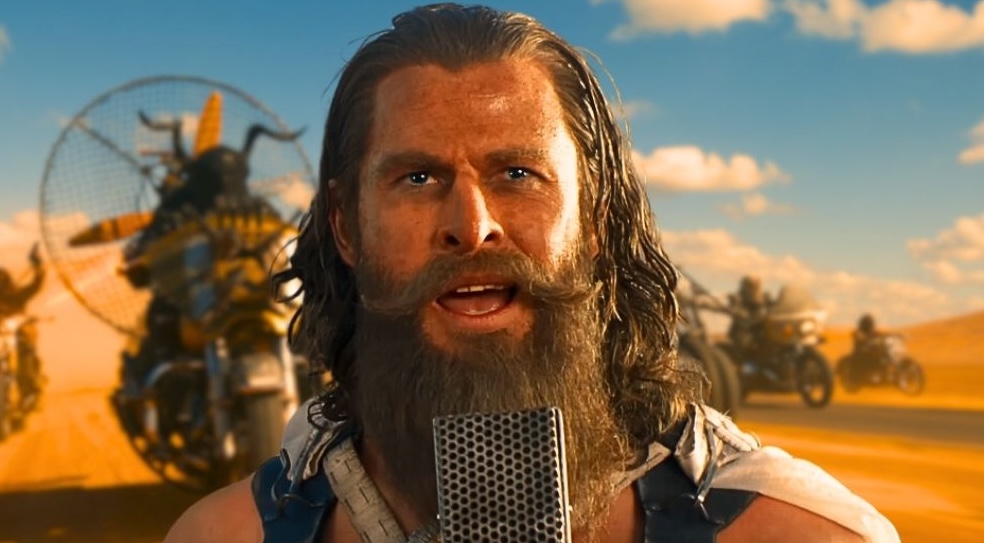
Furiosa is a prequel, a much more episodic affair than its predecessor, divided into five chapters (each with a portentous title) and, unlike Fury Road’s three and a half day timeline, this is set over something like eighteen years. We first meet the young Furiosa (Alyla Browne) in ‘The Green Place,’ the childhood home she spent most of Fury Road trying to get back to, and it’s clear at a glance why she was missing this verdant ‘place of abundance’ in the midst of a desert. But her tranquil life is rudely disrupted when she is kidnapped by a gang of bikers from the wasteland and taken to the kingdom of Dementus (Chris Hemsworth), a motor-mouthed, self-aggrandising ruler, who is used to taking whatever he wants whenever he wants it. Furiosa is merely his latest acquisition. But the girl’s mother, Mary (Charlee Fraser), follows her, intent on taking her home again at any cost…

What immediately hits me about this film is the glorious world-building that’s going on. This is an eye-popping spectacle. Every shot caught by cinematographer Simon Duggan is ravishing and Jenny Beavan’s costume design is endlessly inventive. Add the powerful sound design and you have a film that literally shakes you in your seat. It’s a full hour before Alyla Browne mutates into Anya Taylor-Joy in one of the most accomplished on-screen transformations I’ve ever witnessed. Given only thirty lines of dialogue in the entire film, Taylor-Joy has to convey her character mostly using her eyes. She somehow manages to show Furiosa’s inner turmoil, only briefly finding solace in the affection of rig-driver Praetorian Jack (Tom Burke). Her most powerful motivator – a desire for revenge – is ever present and often propels her into rage. It’s fascinating to watch her. Hemsworth is also wonderful as Dementus, so much more than a cardboard cut-out villain. Here is a man with his own inner turmoil and awareness of his failings. He really should play bad guys more often.

Motor lovers shouldn’t despair because Miller’s trademark behemoth vehicles are in evidence – including a chariot pulled by three motorbikes – and there’s an extended chase sequence that pulls out all the stops, particularly in the part where Praetoran Jack’s rig is attacked by paragliders. As ever, hats off to the stunt performers who make this such a thrill ride. 

But Furiosa is more – much more – than just another action flick. It’s also about the power of mythology, the ways in which stories of epic odysseys perpetuate and endure across the centuries. It’s about the desire of humanity to survive against overwhelming odds and the ways in which religions are shaped by those who invent them. But mostly, it’s about a 79-year-old director at the height of his powers, being unleashed into the world’s biggest sandbox and invited to play. And here, Miller shows more unbridled invention than I’ve seen in a very long time. 

My advice? Get thee to the biggest IMAX screen available, buckle in and enjoy the ride. Oh, and Max? He’s there… but you’ll need to keep your eyes peeled to spot him.

5 stars

Philip Caveney