My Scientology Movie/Going Clear

14/10/16

With its unusual release scheduling, it was actually quite difficult to see Louis Theroux’s My Scientology Movie. Most cinemas seemed to be showing it as a one-off on Monday 10th October and, we were dismayed to discover, tickets had sold out across all venues in Edinburgh, days in advance.

Really? Were we not going to be able to see it? Luckily our local indie – the lovely Cameo Picture House – eventually decided to put on a couple of extra showings, so we trooped along last night, late to the party but glad to have blagged a pass. And these extra shows all sold out too, so it seems odd that it’s not been given more of an airing, unless the scarcity is a strategy in itself. If it is, it’s working…

The film itself is a bit of a curate’s egg. It’s hard not to enjoy Theroux’s antics: he’s immensely likeable – quirky, funny,serious, demanding, self-reflective – and the film is never less than entertaining, engaging my attention throughout.

But… well, it’s impossible to ignore the emptiness at the film’s core. It’s supposed to be a documentary about Scientology, and it isn’t really. Not much is illuminated here.

I’m minded, this morning, to watch Alex Gibney’s 2015 Scientology documentary, Going Clear, referenced by Louis Theroux in the Q & A session broadcast after his film. So I rent it from amazon – and the comparison is stark. Gibney’s film is a much richer affair, explanatory and revelatory in a way Theroux’s is not. It’s clear that Gibney’s movie has impacted on Theroux’s, made him realise he needs a different angle to give it a USP – but, honestly, I don’t think his solution really works.

Going Clear is truly an exposé. It traces the origins of Scientology, reveals plenty about L Ron Hubbard’s motives (primarily to make a lot of money and pay no tax) and raises a lot of important issues that Theroux just doesn’t touch upon. There’re those Sea Org members, for example, who work for 40c per hour, a slave wage that has led to the FBI investigating  the church on suspicion of human trafficking.

From Theroux, I learn that the Scientologists are neurotic about their privacy, that they don’t welcome journalists, that they go out of their way to intimidate those who speak out against them. I learn that new recruits sign up for classes and pay their way up the scale, and that those who reach the upper echelons become members of the elite Sea Org (no mention here of the menial work they are expected to do). I learn that the church is rich and litigious. I don’t learn much else.

And this vacuum is a fatal flaw. Okay, so it’s fascinating to watch former Inspector General Marty Rathbun run the full gamut of emotions, to witness the mixture of contempt and awe he still feels for Scientology. It’s painful to witness his inability to examine his own culpability and the naked defensiveness that emerges when he’s questioned. But even here, Gibney elicits more than Theroux. In Going Clear, Rathbun admits to feeling shame, to regrets that haunt him all the time. We also gain a greater understanding of why people choose to stay in a cult that bullies and abuses them: some have grown up within its confines; others can’t bear to admit that they have been so duped, so compromised. Some are frightened, not just of the persecution they know follows those who leave, but also of what might be revealed: the regular ‘audits,’ where their deepest, darkest thoughts are analysed, are all recorded and kept on file. And they all know that these can be used against them, should they try to break free of their cage.

Theroux does succeed in showing us clear evidence of the Scientologists’ stonewalling technique: by talking to him only about trespass and private vs. public access, they manage to dominate the conversation and stymy all efforts to find out more. He attempts to fill the space left by their silence, hiring actors to recreate some of the church’s practices as described to him by Marty. But it’s not clear to see what these achieve: the young hopefuls are game and give it all they’ve got, but it isn’t real, and it certainly doesn’t have the impact of the reenactments in, say, Joshua Oppenheimer’s The Act of Killing, where the subjects were telling their own tales. Nor does it carry as much weight as the testimony of Tom Cruise’s ‘arranged’ girlfriend, Nazanin Boniadi, or Sara Northrup’s painful description of being cut off from her daughter, who chose to stay with the church when her family left.

Theroux’s My Scientology Movie is thoroughly enjoyable, but curiously dissatisfying as a documentary, revealing little, leaving the church’s shiny facade pristine and unscratched. If you want to be entertained and amused, then Theroux’s film will deliver the goods. But if you really want to learn about Scientology and its dodgy practices, then Gibney’s is the one to watch.

My Scientology Movie: 3.3 stars

Going Clear: 4.6 stars

Susan Singfield

Supersonic

14/10/16

If the Gallagher brothers hadn’t existed somebody would probably have had to invent them. The story of their meteoric rise from two monobrowed wannabes living on a council estate in Burnage to one of the most successful rock bands in history makes for enjoyable, sometimes hilarious, viewing.

This fast paced rock doc, culled mostly from home movie footage, interviews and news clips,  looks at the three eventful years where Noel, Liam and the other members of the band went from playing to half a dozen people at King Tut’s Wah Wah Hut in Glasgow to headlining at Knebworth.

It’s all here, spiced with that irrepressible Manc wit – the rehearsals, the recording sessions and, above all, those great songs from Definitely Maybe and (What’s The Story) Morning Glory? which, as Noel correctly asserts, are going to be played for many years to come. The film wisely eschews going beyond the glories of 1996 – the disappointing third album, Be Here Now, doesn’t even merit a mention and we’re not privy to footage of that final tour where the brothers fell out so violently that they are no longer on speaking terms. (They are both billed,  separately, as executive producers on this film.) But it’s not all sunshine and roses – there’s a section about Noel’s abusive relationship with his father and the cool dismissal of first drummer, Tony McCarroll, is examined in unflinching detail.

Talks of a possible reunion linger on but surely it’s better to remember them as they were in those first few years – swaggering scallies with their collective gaze fixed unerringly on the glittering prizes. That they managed to achieve their goal in such a short space of time is remarkable – and as rock docs go, this is one of the better ones.

4.6 stars

Philip Caveney

The Girl on the Train

10/10/16

The Girl on the Train‘s transition from page to screen was inevitable: Paula Hawkins’ novel has been a huge hit, its popularity earning its author over ten million dollars, and pretty much guaranteeing that this film adaptation will attract a large audience.

It’s a thriller, of sorts, unpicking the tangled lives of three women. Rachel (Emily Blunt) is a tragic figure, an alcoholic, obsessed with her ex-husband, Tom (Justin Theroux), and the baby she never had. Anna (Rebecca Ferguson) is Tom’s new wife, and Megan (Haley Bennett), is a neighbour who works as Tom and Anna’s nanny  (yes, they do have a baby) and seems to have the perfect life – at least, as far as Rachel can tell from what she glimpses from the train. Let’s be honest, the story stretches credulity at times, and it’s kind of irritating that the women are all defined by their motherhood – or lack thereof. It verges on the histrionic in places, and there are moments where it lacks pace or drive. But, where it works, it does work well.

There’s a change of location: we’re in New York instead of London, but this isn’t detrimental to the film. In fact, the cinematography is lovely; the contrasts between the urban mayhem and the glassy smoothness of the lake help add a layer of eeriness and tension to the piece. And the shift is only geographical: the social and sexual mores of affluent white suburbanites seem similar in both locales.

Emily Blunt in particular deserves some accolades: she absolutely convinces as the drunken, broken Rachel, desperately searching for a way back to herself. And there’s a stellar supporting cast, including the ever fabulous Allison Janney and the ‘why-doesn’t-she-do-more?’ Lisa Kudrow.

Overall, then, it’s kind of… okay. There’s a soggy middle section where your mind might wander, but you’ll be pulled back in for the rather racier (if somewhat predictable) ending.

If you liked the book, you’ll probably like this.

3.8 stars

Susan Singfield

War On Everyone

null

09/10/16

Writer/director John Michael McDonagh dazzled with his first two movies – The Guard and Calvary, both set in Ireland – but his relocation to New Mexico for the nihilistic War On Everyone has resulted in a decidedly botched end-product. It’s a bit like one of those budget boxes of fireworks you buy cheap after November 5th – sure, there are some stunning pyrotechnics in the box, but there’re also a lot of damp squibs and even a few complete duds.

Bob and Terry (in what may or may not be a knowing nod to The Likely Lads) are a pair of corrupt cops, careering gleefully around their home town, taking bribes, sharing class A drugs with their perps and mercilessly beating up anybody who stands in their way. Much of this is presented as knockabout comedy, though most of it is very hard to laugh at. Bob (Michael Pena) appears to be the brains of the operation, a man as likely to start discussing philosophy in the course of his duties, as he is to read the Miranda rights. Terry (Alexander Skarsgard) is a hulking boy child who idolises Bob and doesn’t have much in his life, other than an addiction to the songs of Glenn Campbell and a complete belief in his partner’s genius. When the two men are sent to investigate a stabbing, they start to uncover a high-level crime syndicate, headed up by the suave and cultured Lord James Mangan (Theo James, channelling a young Rupert Everett). Much blood, gunfire and reckless driving ensues…

This is a film that will inevitably divide audiences. It’s true that there are inspired moments here – a scene where the two cops stand over a stabbed man, while his wife sobs helplessly in the background, yet somehow can’t stop themselves from eating burgers is brilliant; likewise the scene where Terry waltzes new girlfriend, Jackie (Tessa Thompson) around his empty flat to the strains of Rhinestone Cowboy is an unexpected joy amidst all the senseless violence and destruction – but for every scene that impresses, there’s also an artless collection of ‘jokes’ about Islam, gays, blacks and women, that are so stunningly inappropriate that it beggars belief – it’s as though McDonagh is trying so hard to be ‘cool’ that he’s lost all sense of quality control and, overall, the film suffers for his woeful lack of insight.

This is a shame because there are enough excellent moments here to convince you that the film could have been superb, if only McDonagh had managed to rein in some of its baser elements. As it stands, this can only be described as a great big missed opportunity.

3 stars

Philip Caveney

Free State of Jones

free-state-of-jones

08/10/16

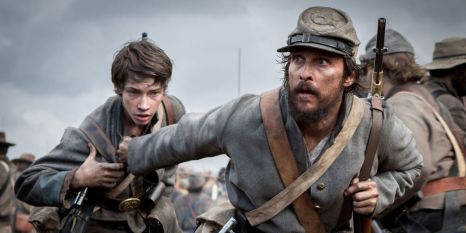
Free State of Jones tells the almost unbelievable true story of the lengths the Confederates went to in order to protect their interest during the American Civil War.

Confederate army nurse Newton Knight (Matthew McConaughey) realises he is a pawn in a rich man’s game and, after his nephew (Jacob Lofland) is killed in battle, he deserts. “It’s not my fight,” he says, noting that he has more in common with the black slaves than he does with the white elite. And so, he bands together a group of runaway slaves, fellow deserters and poor white women and, from their base deep in the swamps, leads a rebellion against the plantation owners, asserting their right to reap the crops they sow and live their lives as free humans, eventually establishing Jones County as a free state and seceding from the Confederacy.

It’s an undeniably important story, highlighting the the vile racism at the heart of American history, and showing how this echoes through the ages with sequences that flash-forward eighty-five years, where Knight’s descendent, Davis (Brian Lee Franklin), is put on trial and eventually jailed for failing to disclose, when marrying, that his great-great-great-grandmother – Newt Knight’s second wife, Rachel (Gugu Mbatha-Raw) – was black.

There’s plenty to admire in this film: it’s a story that needs telling; we need reminding that the Black Lives Matter movement has deep roots, and that racism is firmly embedded in American society. The rich still work hard to protect their own interests, turning the poor against each other to deflect attention from their own excess. And it’s beautifully acted, creating a clear sense of the times; it’s unflinching in its portrayal of the brutality of war and the harsh conditions endured by all.

A shame then that the narrative lacks pace. There’s no clear story arc, no real climactic moment, no drive propelling us to the end. It’s almost dull at times: a series of ponderous moments that don’t quite engage, that keep us at arm’s length. Terrible things happen but I’m never emotionally involved; my reactions are all intellectual.

It’s a good movie and worth seeing, but it’s hard to escape the notion that it could easily have been so much more.

3.9 stars

Susan Singfield

Chitty Chitty Bang Bang

12670848_1117369241640749_442539499123961624_nchitty-1170x476

06/10/16

Festival Theatre, Edinburgh

The crowds of eager-faced youngsters milling happily around the foyer of the Festival theatre say it all – there’s a bona fide family show in town and everyone’s up for some good old-fashioned feelgood entertainment. Ian Fleming’s Chitty Chitty Bang Bang, first published as a novel in 1964 and made into a Disney movie in 1968,  made it to the stage in 2002 and it’s been thrilling audiences pretty much ever since.

Caractacus Potts (Jason Manford), a would-be inventor and recent widower, desperately needs to make thirty shillings in order to save an old racing car from the scrap-merchants. His two young children, Jeremy and Jemima (played on the night we attended by Hayden Goldberg and Caitlin Surtees) love the car too – particularly when their father has managed to buy it and has applied his unusual skills to customising it. Pretty soon the Potts family have a car that can do all kinds of amazing things… and then along comes Truly Scrumptious (Charlotte Wakefield), and a romance is soon in the air…

Of course, if your play is named after the car rather than a human character, you’re going to expect it to be pretty special and sure enough, the ingenious staging of this production really does convince you that the titular vehicle can race down roads, speed across water and even take to the skies. But perhaps the real revelation here is Manford, who has managed to make the difficult transformation from Northern stand up to an all-singing, all-dancing trooper. The boy really can hit those notes. And there’s no getting around the powerful spell woven by the wonderfully sinister Child Catcher (Jos Vantyler) who seems to have wandered in from a small child’s nightmares.

Okay, so not everything in the henhouse is perfect. The spectre of the scary foreigner, which hangs over the production in the shape of the Vulgarians, headed up by Baron and Baroness Bomburst (Phill Jupitus and Claire Sweeney), might make more enlightened hackles rise, but CCBB is very much a product of the era in which it was conceived – and perhaps it’s no great surprise from the creator of James Bond, a man who spent his early years working for Naval Intelligence. Nevertheless, there’s much here to enjoy.

What CCBB has in spades, of course, is those memorable songs – you’ll almost certainly exit the building humming the Sherman Brothers’ incredibly catchy theme song – I know we did. This is a classy production, slickly staged and perfectly tailored for a family audience. Be sure to take your kids to see it. They’ll believe a car can fly.

4.6 stars

Philip Caveney


Gangsta Granny

05/10/16

King’s Theatre, Edinburgh

The Birmingham Stage Company’s children’s shows are well-known throughout the UK (as well as further afield), and this touring adaptation of David Walliams’ best-seller lets us see why they are so popular. This is theatre with its target audience firmly in its sights, every detail carefully judged to ensure it hits its mark.

It tells the tale of Ben (Ashley Cousins), whose ballroom-obsessed parents (played tonight by Benedict Martin and understudy Louise Bailey) force him to spend every Friday night with his boring Granny (Gilly Tompkins). But, as Ben soon discovers, there’s more to Granny than cabbage soup: her secret alter-ego is an infamous jewel thief – and anything but dull. It’s a charming story with a simple message: don’t underestimate people just because they’re old. “I wasn’t born a little old lady,” as Granny says to Ben.

The production is big and bold, the supporting characters a series of Roald Dahl-style grotesques. The children in the audience love these comic exaggerations: Mr Parker, the nosy neighbour (Benedict Martin again), seems a particular favourite, eliciting squeals of delighted laughter with his heightened mannerisms.

There are some stand-out moments and ideas. The mobility scooter is used to good comic effect, and the unflinching approach to mortality is very refreshing in a production of this ilk. The characters are all well-drawn and clearly delineated throughout. I love the way that sound effects are employed, not just in the inevitable (and very funny) fart jokes, but also to facilitate our acceptance that there is, for example, a car on stage. It’s a neat, efficient means of conveying ideas, and the performers physicalise it well.

In fact, if there’s a criticism, it’s that there could be more of this. The set seems overly complex, with too many distracting scene changes that often seem unnecessary. A simpler, more pared-down approach would mean less stage traffic and less ‘busy-ness’ (the constant setting up/taking down of the kitchen table and chairs seems particularly pointless), and would make the story’s through-line clearer and more direct.

All in all, though, this is a lot of fun, and a huge success with its intended audience. The children near us were shiny-eyed and excited as they left the theatre, and that’s surely what this is all about.

4 stars

Susan Singfield

The Suppliant Women

10850529676962992_8e7a020135_b

Royal Lyceum, Edinburgh

05/10/16

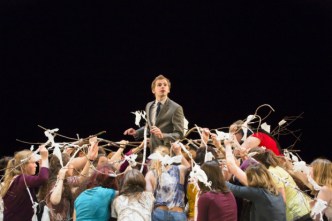
It’s a rare thing indeed when you go into a theatre and are treated to something unique – but that is the word that kept coming to me, as I sat entranced in the stalls of The Lyceum, watching David Greig’s production of The Suppliant Women. Written by Aeschylus two thousand, five hundred years ago, this wasn’t the usual contemporary adaptation of classic Greek theatre, but an attempt (costumes aside) to present it pretty much as it must have been performed in its original incarnation, complete with libations of wine and milk, choral odes and synchronised movement.

Add to this the fact that the cast of more than fifty performers is composed mostly of amateurs and you might have some notion of what an ambitious production this is, but you certainly won’t be prepared for the skill and grace with which the performers deliver their roles. Here’s a chorus, speaking as one, where you can hear every single word – a chorus that moves around the crowded stage with uncanny precision. They have only been rehearsing this since early September, yet their dedication shows at every turn.

The story may be thousands of years old and yet it’s remarkably prescient for our troubled times. The women of the title have fled their native Egypt where they are being forced to marry their cousins and, accompanied by their father, Danaaus (Omar Ebrahim), they arrive in Argos, seeking asylum. They take shelter in the temple of Zeus where they are met by The King (Oscar Batterham) who feels conflicted about their presence – to turn them away will offend Zeus, but the King is also aware that the local populace may take against these women, who are after all, migrants – and what if their presence here should cause a war between Argos and Egypt?

Skilfully directed by Ramin Grey, with musical accompaniment of percussion and Aulos (a traditional double-reeded instrument), this is a feast for the senses. The performance area is a bare breeze block paved space, that utilises the whole depth of the Lyceum’s curtainless stage, but there’s wonderfully atmospheric lighting (a scene set in near darkness where every woman carries a lantern is particularly effective) and plaudits must go to chorus leader, Gemma May, who manages to deliver all of her potentially tongue-twisting lines with absolute authority. If the idea of watching traditional Greek drama leaves you cold, don’t be misled – this is a riveting slice of theatre that deserves a wide audience.

Go, enjoy. There may not be a show like this one for another two thousand, five hundred years.

4.8 stars

Philip Caveney

Amanda Knox

netflix-amandaknox

03/10/16

Amanda Knox is a household name, known around the world as a convicted murderer, a promiscuous young woman who killed her flatmate, Meredith Kercher, as part of a twisted sex game. No matter that her conviction has been overturned; no matter that the stories about her are founded on nothing more than prejudice and conjecture: her infamy precedes her, and those who’ve swallowed the tabloid tales remain convinced of her guilt.

This Netflix documentary doesn’t ask whether she’s guilty; her innocence is assumed as a given, and – once we hear the self-satisfied testimonies of Giuliano Mignini, the chief prosecutor, and Nick Pisa, a tabloid journalist – it’s easy to see why. By his own admission, Mignini finds Knox’s behaviour inappropriate: he doesn’t like the fact that she is seen kissing her boyfriend just hours after learning of her flatmate’s death, and paints her as the ‘whore’ to Kercher’s ‘Madonna'(“Maybe,” he hypothesises, “Meredith didn’t like coming home to find men in in her house…”). There’s literally no evidence to support Knox’s conviction, except for a soon-retracted confession, extracted after several gruelling hours of being interviewed/harangued and slapped around the head. Mignini is just a misogynist, reading a young woman’s sexuality as a sign of evil.

Nick Pisa doesn’t fare any better: he relishes the salacious details Mignini feeds to the press, laughing and crowing at the scoop, openly revelling in the fact that there’s blood, murder, young women, sex. Juxtaposed with footage of the crime scene, and interviews with Kercher’s family, the sheer heartlessness of this is hard to watch. And the tabloid’s gleeful exploitation of poor Kercher’s death means that Knox’s life is also destroyed: a young woman, wrongly accused of a dreadful crime, her diary exposed to the world, her (frankly unremarkable) sex life made public and used to shame her… for what?

Her boyfriend, Raffaele Sollecito, was always portrayed as her dupe, a nice young man being manipulated by a Jezebel. What emerges here is a different view: he is indeed a nice young man – and as innocent as his girlfriend of this revolting crime.

Okay, so this isn’t as detailed an exposé as Serial or Making a Murderer – it would be interesting to learn more about how the judicial system got it so wrong – but it’s a compelling documentary nonetheless, and at least gives Knox an opportunity to set her critics straight.

4 stars

Susan Singfield


Deepwater Horizon

deepwater-horizon-movie-reviews

03/10/16

The name is synonymous with one of the worst industrial accidents of all time. In April 2010, the titular drilling rig suffered a catastrophic explosion that spilled millions of tonnes of crude oil into the Gulf of Mexico, causing untold damage to the eco-system. The environmental impact was unprecedented – but Peter Berg’s film is much more concerned with the human story behind the disaster. One hundred and twenty six crew members worked aboard the Deepwater Horizon and, sadly, not all of them lived to tell the story.

The events are seen largely from the POV of engineer Mike Williams (Mark Wahlberg). We first join him at his home, shortly before he leaves for an eventful three-week shift on the drilling platform and we catch his interplay with his wife, Felicia (Kate Hudson) and his young daughter, Sydney (Stella Allen). Barely ten minutes in, we care about him. And then we’re aboard the rig, watching as he goes about his daily routine, exchanging pleasantries with the other crew members and noting the concerns of safety officer, Jimmy Harrell (Kurt Russell), who feels that safety checks are being ignored because the drilling is forty three days behind schedule, something that’s encouraged by BP executive, Vidrine (John Malkovich, playing a character almost as oily as the stuff the crew are drilling for). Of course, history tells us that something went badly wrong and the suspense racks steadily up to the moment when it actually does.

From here on, we’re in disaster movie territory, as all hell breaks loose. It’s a horribly immersive experience and there’s barely time to draw breath as the crew run desperately around the rig, trying to stay alive. Strangely, it’s only after the blitzkrieg of special effects is over that the emotions are hit – there’s a key scene here that had me filling up and it will be a stony individual indeed, who doesn’t feel similarly compelled.

Ultimately, Deepwater Horizon is a tale of heroism – both Williams and Harrell went far beyond what might have been expected of people in such circumstances. It also makes for a thrilling cinematic experience. As the credits roll, we see the real people behind the story, who – surprise, surprise – are nothing like as photogenic as the actors who portray them, but it drives home the fact that this is a true story, where once again corporate greed puts profits above human lives.

4.4 stars

Philip Caveney