
Uncategorized

Consumed

03/08/25

Traverse Theatre, Edinburgh

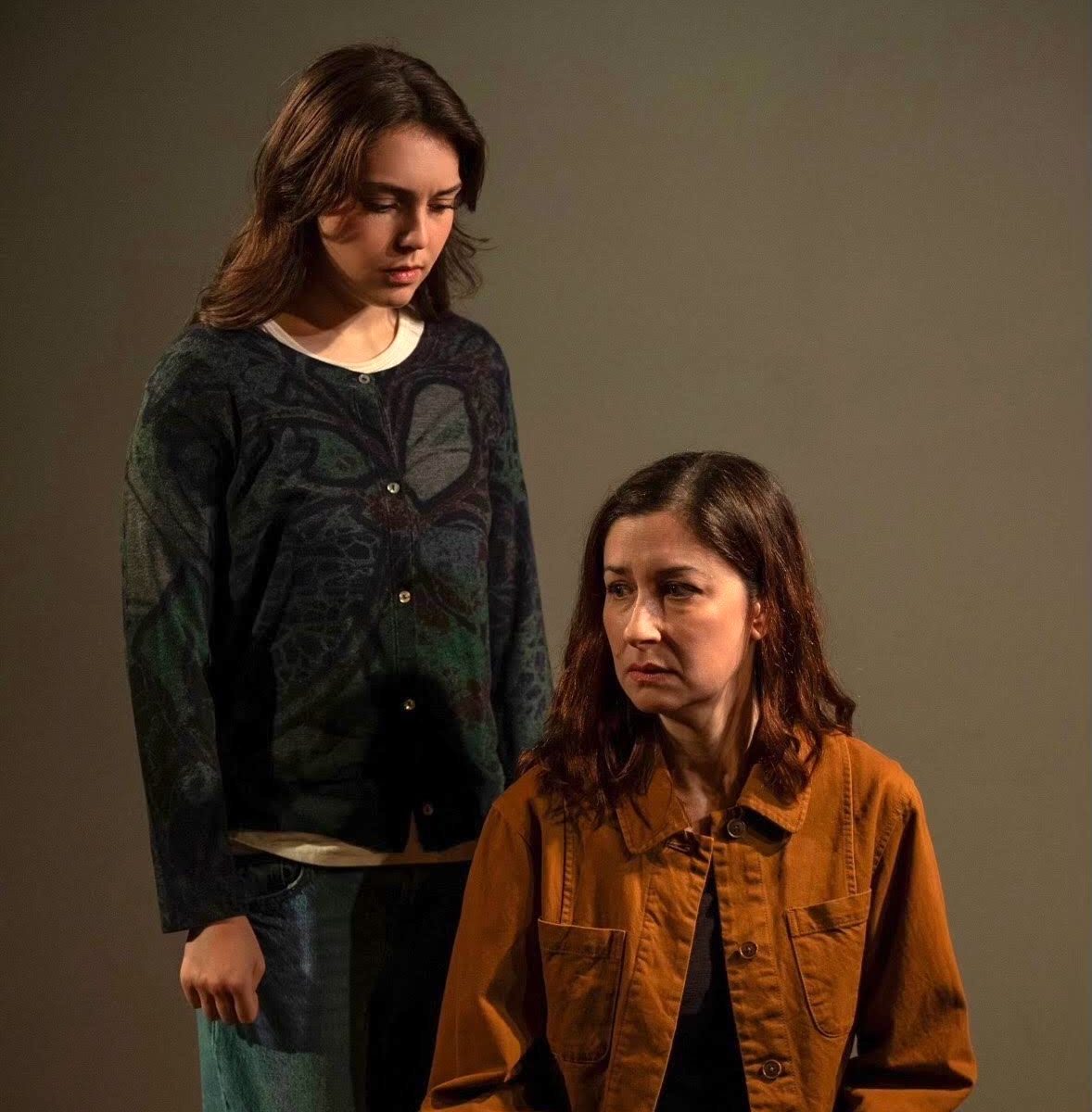
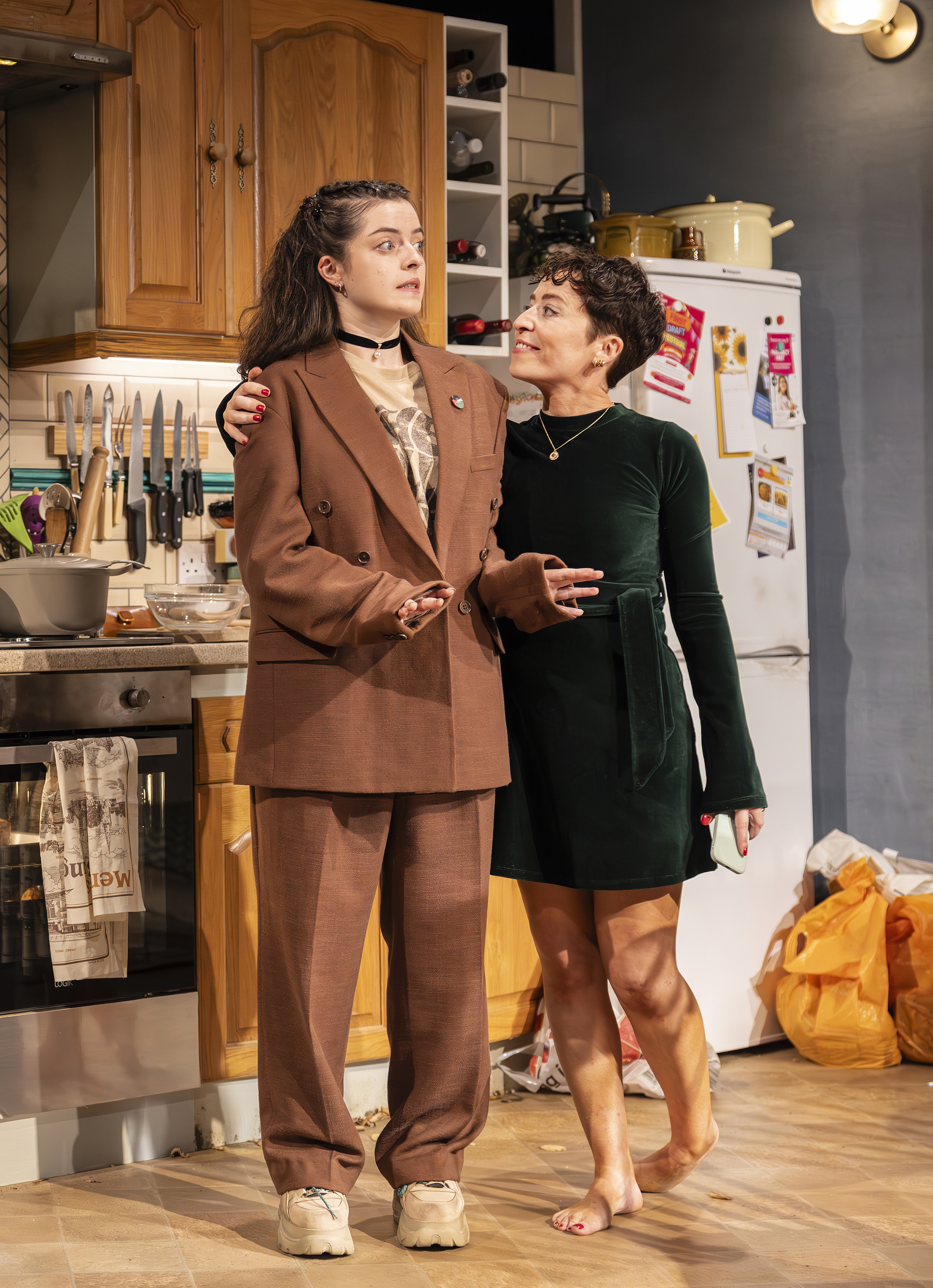
In a suburban home, somewhere in Northern Ireland, a ninetieth birthday celebration is about to begin. Gilly (Andrea Irvine) is preparing a special meal for her mother, Eileen (Julia Dearden), sparing no expense. After all, as Eileen seems to delight in pointing out, this might be her last chance for a decent shindig. Gilly’s daughter, Jenny (Caoimhe Farren), has travelled all the way from that London especially for the occasion, but – wouldn’t you know it – there’s no sign of her husband. Instead, she’s brought along her teenage daughter, Muireen (Muireen Ní Fhaogáion), who is… whisper it… a vegetarian.

But as the celebration gathers pace, it soon becomes clear that something here isn’t quite right. Why can’t the four generations of women find some common ground? Why is Eileen so dismissive of her visitors’ privileged lives? And… why is there absolutely no sign of Gilly’s husband?

Karis Kelly’s pitch-dark comedy, Consumed, winner of the Women’s Prize for Playwriting in 2023, is a multi-layered tale of intergenerational conflict, sumptuously situated in Lily Arnold’s incredibly realistic set, where even items of food appear to be genuinely cooked and served as we watch. The four characters are all convincingly portrayed, with Dearden ruling the roost as a gloriously foul-mouthed Granny from Hell, levelling her curses at Feinians and the English with equal venom.

Meanwhile, Muireen can’t understand why Gilly’s house is so cluttered with plastic bags and other non-recyclables – is she turning into a hoarder? And when people ask awkward questions, why does Jenny always seem to take refuge in a glass of red wine?

As a whole series of twists are gleefully unravelled, the pressure cooker atmosphere in the house steadily builds up an explosive head of steam. In the final stages, there’s an abrupt twist from realism to a kind of dreamlike symbolism, as Eileen and Muireen enter a shared experience – and it’s in this section that for me, the play loses a little of its drive.

But quibbles aside, Consumed is a delicious confection, sensitively directed by Katie Posner – an affecting narrative, which has me laughing throughout, while also giving me plenty to think about.

4.4 stars

Philip Caveney

Shake Rag Hollow

02/08/25

Assembly (Front Room), Edinburgh

The Edinburgh Fringe is a place where precious gems can sometimes be unearthed in the unlikeliest places. Shake Rag Hollow is a perfect example of the phenomenon. This tightly-constructed three-hander, written by Arlene Hutton (whose Blood of the Lamb was also a bit of a revelation back in 2023) and directed by Eric Nightengale, is set at the top of a mountain in Southern Tennessee – though in reality, it’s taking place in an unprepossessing metal storage container on George Street. 

That gentle voice we can hear, extolling the virtues of the eponymous hollow, belongs to the late Sherman, who always loved this place, and delighted in revealing its charms to his young niece, Denise. But Sherman is long gone and now Denise’s daughter, Laurel (Sofia Ayral-Hutton), lives in the remote cabin with her grandmother, Pauline (Beth Links). Denise has been in prison for years, convicted of a horrendous crime, and Laurel has learned to despise the mother she has never met.

But then Denise (Dana Brooke) turns up unannounced, lugging a suitcase and looking for somewhere to stay. Recently released, Denise needs space to complete the online Masters in psychology she’s so close to achieving. Pauline grudgingly gives her daughter sanctuary, despite Laurel’s hostility – and, as Denise and Laurel gradually start to connect, unexplained mysteries from the past begin to resurface – raising questions that have remained unanswered for far too long…

This is a powerful play that gradually builds to a shattering crescendo. The three actors portray their characters with authority, allowing the audience to vividly imagine the rural setting, so that I can accept that an upturned table and a couple of chairs represent a wild forest through which Denise and Laurel must pick their way – and that a humble cardboard box really can hold the key to so many secrets. Brooke in particular manages to convey the inner desperation of her character, a woman seething with pent-up trauma, who has been obliged to live with a lie for decades and is now finally confronting the truth – and Ayral-Hutton is also compelling as the naïve and impressionable Laurel.

The climax when it arrives actually brings me to tears. This play deserves as big an audience as can be crammed into the available space, so my advice would be to book your tickets for this one before it’s swamped.

5 stars

Philip Caveney

Sinners

20/01/25

Cineworld, Edinburgh

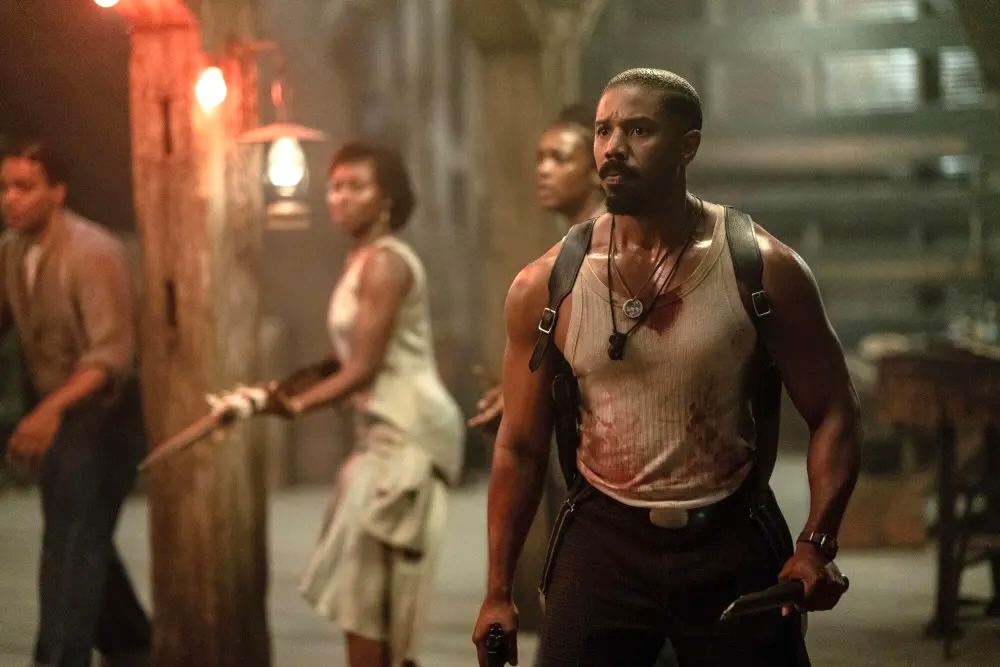
After Black Panther and Wakanda Forever, Ryan Coogler clearly needed to strike out in a new direction, and here’s the long-awaited result. While on the face of it, Sinners initially comes across like a more complex version of From Dusk Till Dawn, it’s far more ambitious than Tarantino’s film: a Gothic vampire-musical mashup, though more seriously intentioned than that description might suggest.

It’s 1936 and shady twins, Smoke and Stack (both played by Michael B Jordan), return to their old stomping ground in Mississippi. They’ve been working for mobsters in Chicago for quite some time and have returned with mountains of cash and noble intentions. They are determined to set up and run a juke joint, where the local Black community can gather to drink and dance and listen to music. Of course there’s money to be made from the enterprise, but that’s almost an afterthought. Is it a problem that they’ve purchased the building and the land from members of the Ku Klux Klan?

In order to set the right tone for their venue, the twins recruit their cousin, Sammi (Miles Caton), a young musician, who – despite being the son of a local preacher – has a near supernatural ability to play guitar and sing the blues. They also secure the services of veteran musician, Delta Slim (Delroy Hatton), who is as much lured by the twins’ access to good booze as by the handsome wages they offer him.  Also present on the launch night  are the twins’ respective old flames. Smoke’s ex, Annie (Wunmi Mosaku), is a cook and ‘Hoodoo’ priestess (the latter talent sure to come in handy at some point), while Stack’s former girlfriend, Mary (Hailee Steinfeld), is a white-presenting mixed-race woman with an uncanny ability to instigate trouble.

It’s all going swimmingly until the unexpected arrival (at sundown) of a fugitive called Remmick (Jack O’Connell). He’s being pursued by Native American trackers, but they are forced to give up once darkness falls. Remmick is a wandering Irish musician with an unusual method of recruiting others to his cause. He’s a vampire… and he’s soon lured by the sounds of music issuing from the juke joint, music that he wants to claim as his own, even if he does want to bowdlerise it, make it white. But he can’t come inside the juke joint unless he’s invited…

Sinners – as you may have gathered – is a great big allegory, where the word ‘vampire’ could just as easily be substituted for ‘colonialism’. It’s handsomely filmed in 70mm and expensively mounted, meaning that just about every frame looks ravishing. The recreation of the pre-war era is beautifully visualised and the cameras linger hungrily on the details. For me, it’s the many musical aspects that provide the most memorable sections: three mournful-looking vampires harmonising beautifully on a plaintive version of The Wild Mountain Thyme; a slow and languorous pan around the juke joint where Sammi’s performance is augmented by unnamed musicians from a whole variety of different eras; and, best of all, the massed vampire hordes outside the building, bashing out a rollicking version of The Rocky Road to Dublin while O’Connell dances a frenzied Irish jig.

Not everything about Sinners is quite as assured. For one thing, having two Michael B Jordans for the price of one might seem like a great idea on paper but, when the action kicks off, I’m sometimes unsure which twin I’ve got eyes on. At times, the mumbled dialogue makes me wish I’d chosen a subtitled presentation. And furthermore, there’s a general ponderousness to the storytelling, an earnest  desire to show every last detail, that too often slows down the momentum, allowing my attention to wander. I feel sure that a tighter edit would help no end. This could lose thirty minutes and be all the better for it.

Nitpicks aside, Sinners is an unusual venture in these troubled times: a big-budget extravaganza that is neither a sequel nor a prequel, and that furthermore has no glimpse of spandex in the mix – unless you count that weirdly-dressed dude with the electric guitar, adding a frenzied solo to Sammi’s acoustic performance.

Do stay in your seats until the credits have rolled for a while. Eighty percent of the audience at the screening I attend wander off and miss an important 90s-set coda, where Sammi (now played by blues legend, Buddy Guy) is still touring the clubs – and still playing his ol’ guitar.

3.8 stars

Philip Caveney

Restless

05/04/25

Cineworld, Edinburgh

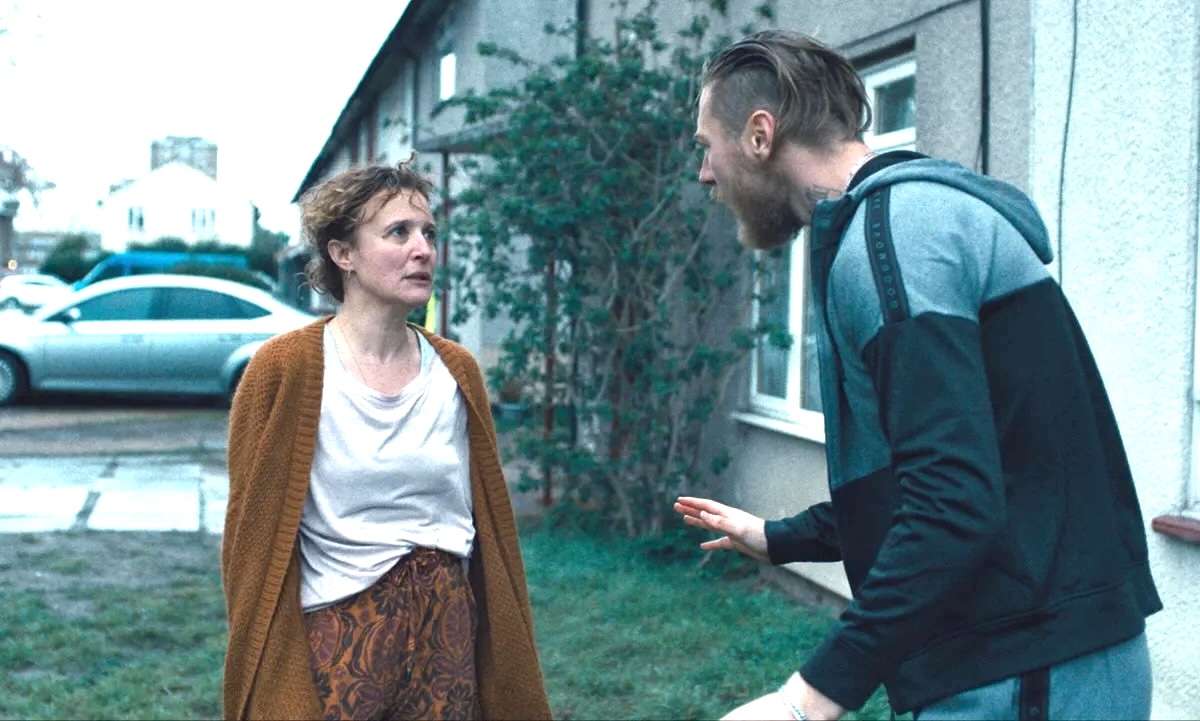
Writer/director Jed Hart’s debut feature uses the tropes of a psychological thriller to tell the mundane tale of a woman driven to distraction by her noisy neighbours. It’s a clever conceit and the resulting film is funny, tense and very engaging.

Nicky (Lyndsey Marshal) is lonely. First her mum died and then her dad; since then, their house – adjoined to hers – has lain empty. She puts on a brave face for her son when he calls from uni, and bats away her sister’s concern. She’s fine. After all, she’s got plenty to keep her occupied: her job (she’s a carer in a home for the elderly), her hobbies (baking and listening to classical music), and, of course, her beloved cat, Reggie. 

But then Deano (Aston McAuley) moves in next door, and Nicky’s fragile peace is shattered. He’s a sociable guy – way too sociable for Nicky’s liking. It’s an affront to her parents’ memory to have this loutish brute living in their house, playing loud dance music all night long. She needs to sleep…

At first, Nicky tries to be friendly, politely asking if he can keep it down. Sadly, Deano does not take well to criticism, and things soon escalate out of control. But, as Nicky starts to fight back, we find ourselves wondering: who’s the real nightmare neighbour here?

Hart’s script is well balanced, with moments of laugh-out-loud humour undercutting the tension just as it becomes unbearable. Marshal is utterly convincing as the put-upon Nicky, struggling to cope with her empty nest, while McAuley is deliciously boorish without ever straying into caricature. Barry Ward provides the comic relief as Kev, Nicky’s traffic warden pal and potential love interest. Again, despite the heightened characteristics, Kev is never a cartoonish figure; he’s a flawed but sweetly-charming bloke. 

With its moody gloominess, David Bird’s cinematography borrows horror motifs to excellent effect, ramping up the fear factor and turning a domestic dispute into something much more elemental. 

At its core, this is a story of learning to cope with grief – of digging deep to find the strength required for letting go and moving on.

But don’t overlook the fearsome battleaxe, Jackie (Kate Robbins), whose intervention is the final straw… 

4 stars

Susan Singfield

Ghost Stories

26/03/25

Festival Theatre, Edinburgh

What a strange thing, the passing of time. Taking my seat in the Festival Theatre, I can’t help being transported back to thirteen years ago, when Susan and I travelled from Manchester to London, with the express purpose of catching Ghost Stories as it neared the end of its first run. We’d heard great things about the show, created by Jeremy Dyson and Andy Nyman – and we were not disappointed.

Fast-forward to 2018 and now we’re in the cinema, watching the big-screen adaptation of the story, which has been skilfully retooled for a different medium, but still delivers a feast of creepy moments and heart-stopping jump-scares. 

And now, here’s the original production, out on tour and taking its twisty-turny narrative to a series of new locations. Over the intervening years, the show’s creators have somehow managed to compel audiences not to reveal too much about what actually happens in that intense hour-and-a-half and they continue to implore us to keep its secrets. Of course, this makes a reviewer’s job harder, but hey, those are the breaks. 

Suffice to say that Ghost Stories is a deliciously old-fashioned portmanteau, which incorporates three quite dissimilar stories and links them all together with an intriguing framing device. We are greeted by Professor Goodman (Dan Tetsell), a staunch disbeliever in all things supernatural, but he does have some puzzling cases to share with us. There’s the one about the chatty, chirpy nightwatchman, Tony Matthews (David Cardy), who has a particularly troubling evening at work; the cautionary tale of nervy Simon Rifkind  (Lucas Albion), who really should never have been put behind the steering wheel of an automobile; and let’s not forget the recollections of snarky businessman, Mike Priddle (Clive Mantle), who has a sobering memory to recount for anyone thinking of becoming a parent…

And that is about as much as I’m willing to share, other than to say that if you’ve never seen Ghost Stories in the theatre, this is your chance to rectify that situation. And if you have seen it, go back and admire the details. You may even spot the clues that have been artfully scattered throughout. You’ll relish Jon Bauser’s extraordinary set, forever opening up like a puzzle box to reveal its hidden depths. James Farncombe’s lighting design amps up the intense atmosphere of dread, which is also amplified by Nick Manning’s nerve-shredding sound design. Scott Penrose’s special effects will have you flinching in your seat at several key moments, while director Sean Holmes brings all the elements together and ties them up with a great big blood-curdling bow.

And if you’re of a nervous disposition, then my advice is to go along and see it anyway, because you’ll be so relieved to step out of the theatre to find that the real world is a whole lot less scary…

4.6 stars

Philip Caveney

Macbeth

05/02/25

Cineworld, Edinburgh

Macbeth is a ubiquitous play. Searching back through the B&B archive, I’m not entirely surprised to find that this is the ninth time we’ve reviewed a version of Shakespeare’s celebrated tragedy and I note too that there are three other related items that reference that infamous surname in the title. It’s easy to understand why it’s such a perennial. One of the bard’s most propulsive stories, it’s a lean, mean tale of aspiration and the overriding lust for power, which – in these troubled times – seems all too relevant. This Olivier-award winning adaptation, filmed live at London’s Donmar Warehouse, features David Tennant in the title role with Cush Jumbo as the manipulative Lady M. The screening we attend is sold out.

It’s a stripped-back production, freed from any issues with costuming or elaborate set design. The actors wear simple, monochrome outfits and the performance space is a stark white rectangular dais. It’s set in front of a transparent screened box, behind which other members of the cast occasionally gather, like a chorus of half-glimpsed ghosts, to comment on the action. Prominent among them is a young boy, who at one point hammers his fist repeatedly against the screen and also reappears in the midst of the final battle. His presence serves to remind me that the Macbeths have earlier lost a child – and that perhaps it is this loss that’s the driving force behind their callous bid to seize the throne and betray their former friends.

Tennant is extraordinary, speaking those familiar lines (often direct to camera, as though sharing confidential material) with such utter authority that I almost feel I’m hearing them for the first time. Jumbo is also compelling. She’s the only one here without a Scottish accent, which seems to emphasise her solitude and her distance from the other characters. Cal McCaninch is a stately Banquo, Nouff Ousellam smoulders powerfully as Macduff and it’s a delight to hear Benny Young’s cultured drawl delivering Duncan’s self-satisfied lines as he arrives at the castle where he is destined to die.

Ros Watt is a delightfully punky Malcolm and Jatinga Singh Randawa offers a rambunctious turn as the Porter. In the only scene that takes a wild swing away from what’s actually written on the page, the latter chats to members of the audience and displays all the symptoms of a man suffering from a raging hangover. It’s a gamble but it pays off. And the witches? In what might be the production’s bravest move, they are barely glimpsed in the first act, only heard in giggling off-stage asides as they arrive and depart with a flap of supernatural wings.

Gareth Fry’s sound design adds extra layers of suspense to the production (I note that the audience at the live performance all wear headphones for a truly immersive experience), while Alistair McCrae’s music offers jaunty reels, Celtic airs and, at one point, a spirited highland fling as a brief respite from that all-pervading air of menace. Director Max Webster brings all these disparate elements together to create a powerful and absorbing drama that dares to experiment with the source material. And, at the conclusion, designer Roanna Vize really does – magically – bring Birnam Wood to Dunsinane. 

The final confrontation doesn’t leave me wanting and the face-off between Macbeth and Macduff is unlike any version I’ve seen before. Of course, the only valid reason for doing this immortal story one more time is to offer audiences something new – an aim that this extraordinary production has clearly taken to its dark heart.

5 stars

Philip Caveney

Run, Rebel

07/11/24

Traverse Theatre, Edinburgh

Theatre productions are always a team effort but I’ve rarely been so aware of the fact as I am watching this sprightly offering from Pilot Theatre, written by Manjeet Mann and directed by Tessa Walker.

Amber (Jessica Kaur) is a fifteen-year-old Punjabi girl making her way through a world that seems determined to put obstacles in her path. She is nursing a serious crush on her friend David (Kiran Raywilliams) and is somewhat disconcerted that he is spending a lot of time with her other close friend, Tara (Heather Forster). Meanwhile, Amber is a talented athlete, always leading the field for her school running team, and her coach is talking seriously about the possibility of her one day qualifying for the Olympics…

But Amber’s controlling father, Harbans (Pushpinder Chani), keeps telling her that it’s time for her to think about settling down and accepting a husband, like her older sister, Ruby (Simran Kular). Meanwhile, their mother, Surinder (Asha Kingsley), is trapped in a violent, loveless marriage, unable to read or write a word of English. It doesn’t help that Harbans is a hopeless alcoholic, who spends nearly every penny that comes in on drink…

If the plot of Run, Rebel occasionally feels a little over-familiar, Mann’s script is sure-footed enough to keep me hooked throughout, while Walker’s direction moves the players from scene-to scene with absolute authority. Kaur is compelling in the lead role, and her co-stars move effortlessly through a selection of different characters, all of whom have enough individual quirks to make them feel real.

Debbie Duru’s fabulous set design features ramped edges, so that the running sequences are suitably propulsive as the actors literally race back and forth through Kuldip Singh-Barmi’s cleverly-choreographed sequences. Daniel Denton’s atmospheric video designs lend the story added depth and I particularly relish the moments when Amber steps out of the action to replay those scenes that go particularly well for her.

Only the most impassive viewer will fail to be thrilled as Run, Rebel races headlong to the finish line. It will be at the Traverse until Saturday 9th November, so anybody in search of an uplifting couple of hours in the theatre should grab some tickets without delay.

Ready? On your marks, get set, GO!

4 stars

Philip Caveney

Megalopolis

03/10/24

Cineworld, Edinburgh

Well, I can’t say I wasn’t warned. Francis Ford Coppola’s long-nurtured passion project, Megalopolis, arrives garlanded with the kind of vitriolic advance reviews that instantly sank its chances of making any money at the box office. But why all the furore? What has the man done that’s so unspeakable? You’d think he’d murdered somebody. Instead, at the age of eighty-six, he’s made a vanity project, self-financing the hundred million dollar film by selling one of his vineyards. (We’ve all been there.) He hasn’t bankrupted a movie studio, which makes a refreshing change.

Lest we forget, Coppola has made some underwhelming films before. Yes, he gave us The Conversation, The Godfathers (One and Two) and of course, Apocalypse Now, but there was also One From the Heart and er… Jack, both of which were less than perfect.

It’s important to note that right from the opening credits, Megalopolis is described as ‘A Fable,’ so those who describe it as ‘unrealistic’ may be missing the point.

Somewhere in an imagined future, New York has become New Rome, and those that run the city have taken on the aspects of senators and emperors, strutting around in toga-like garments and looking very pleased with themselves. Cesar Catalina (Adam Driver) is a sort of genius / town-planner, who has discovered a mysterious and indestructible building substance called Megalon. He has also found a way to stop time by clicking his fingers (as you do) and has a penchant for lapsing into Shakespeare soliloquies for no apparent reason.

Cesar is currently intent on building the titular inner city area, which he believes will be the first step in creating a bright new future, but his main adversary in this project is Mayor Cicero (Giancarlo Esposito), who seems to be opposed to any kind of progress. Cicero’s daughter, Julia (Nathalie Emmanuel), on the other hand, finds herself increasingly drawn to Catalina and it’s not long before sparks begin to fly between them. It’s clearly going to cause trouble.

There are other powers at work in the city. TV presenter, Wow Platinum (Aubrey Plaza), is suffering from failing audience figures and is keen to take a step up in the world by marrying Cesar’s rich uncle, Hamilton Crassus III (Jon Voight). She uses her nephew, Clodio (Shia LaBeouf), to help her to get there, by any foul means he can devise. (The odious Clodio is clearly inspired by Donald Trump, right down to the bloody insurrection he foments and is perhaps the one place in the ‘fable’ that does relate to real life.)

Overall, Megalopolis doesn’t work and it’s not that it’s short of ideas. On the contrary, it is virtually struggling to contain them all and it doesn’t help that there are too many big names in cameo roles here, most of them improvising their lines. The likes of Dustin Hoffman and Talia Shire flit briefly across the screen and it feels as though Coppola, having secured their services, is unsure of exactly what to do with them. Sometimes, when you work too hard on a project, you stop seeing it objectively.

On the plus side, the film looks magnificent in IMAX, a succulent, shimmering wonder to behold (Coppola did his own cinematography) and, in the film’s latter stages, there are sequences that might best be described as psychedelic, the massive screen appearing to erupt at regular intervals in a blaze of light and colour. If you’re going to see this, do try to catch it in the cinema, because its going to lose all of its majesty on streaming. The running time of two hours and eighteen minutes soon elapses and, after everything that Coppola has given us over the years, surely it’s not too much to ask that movie buffs make the effort to actually go out to see it.

3 stars

Philip Caveney

Ruckus

02/09/24

Traverse Theatre, Edinburgh

We first saw Ruckus at the Fringe back in 2022, in the confines of Summerhall’s Cairns Lecture Theatre. We loved it, and so were keen to see it again, this time in the more spacious Traverse Two. This hard-hitting piece of theatre, written and performed by Jenna Fincken, is perhaps even more affecting this time around, and we can’t recommend it highly enough. It’s on until Thursday, so you’ve only two more chances to see it here before it moves on to the Nottingham Playhouse.

Read our earlier review here: https://bouquetsbrickbatsreviews.com/2022/08/08/ruckus/

4.7 stars

Susan Singfield & Philip Caveney

The Critic

15/09/24

Cineworld, Edinburgh

A film about a theatre critic? Well, that’s irresistible for a start, despite a series of rather sniffy advance reviews that have – much like this film’s protagonist might – damned the endeavour with faint praise. So I’m both surprised and delighted that I enjoy this as much as I do.

Written by Patrick Marber and loosely based on Anthony Quinn’s novel, Curtain Call, this is set in London in 1935, a time when the titular critic, Jimmy Erskine (Ian McKellen), the long-established theatre reviewer at ‘The Chronicle,’ really does have the clout to sink a production with a few well-aimed barbs. Jimmy is quick to point out that he has a genuine love of the theatre and will always dispense praise when he feels it’s been earned. Lately, most of his ridicule is directed at actress Nina Land (Gemma Arterton), who Jimmy believes has no business being on the stage. It doesn’t help that she holds him in high esteem – indeed, it was reading his reviews as a little girl that lured her into becoming an actor in the first place.

Jimmy is covertly gay – a crime punishable by imprisonment in the 1930s – and when one night he is caught in a compromising position with his live-in assistant, Tom (Alfred Enoch), he is called in to the office of The Chronicle’s new proprietor, David Brooke (Mark Stong), and handed a month’s notice. But Jimmy isn’t going to take it lying down. He has too much to lose, not least the opportunity for fine dining and lashings of booze to go with it.

And it has come to his attention that Brooke is an avid fan of Nina Land…

What’s particularly enjoyable about The Critic is the fact that all of the characters we encounter are nuanced enough that, despite a stereotypical set-up, none of them ever feels like a caricature. McKellen is clearly having a whale of a time as the venal and calculating Jimmy, a man who – because of his sexuality – has had to learn to be adaptable in order to survive, yet is bold enough to coyly ask a follower of Oswald Mosley if he has ironed his black shirt all by himself. There’s the delicious paradox of Arterton playing an allegedly bad actress, giving quite the best performance I’ve seen from her, by turns vengeful and vulnerable. There’s a lovely cameo from Lesley Manville (who seems to be popping up in just about everything lately) as Nina’s mother, Annabel – and Strong too invests his character with just the right touch of pathos.

The 30s setting is nicely evoked and, as The Critic moves ever deeper into the realms of tragedy, I find myself wondering what compelled others to be so er… critical of it. For my money, this is an assured film, nicely directed by Arnand Tucker and hauntingly photographed by David Higgs. It would, of course, have been great fun to lay into this with a hatchet (oh, the irony!) but, annoyingly, I find myself completely unable to do so. The Critic is, in my humble opinion, an absolute delight.

4.5 stars

Philip Caveney