Uncategorized

Gold

04/02/17

We’re getting used to those Matthew McConaughey mega-performances. In Gold, he goes full Jake La Motta, transforming himself into an overweight, balding, snaggletoothed chain-smoking alcoholic and yes, it’s the kind of impressive tour de force we’ve come to expect from the man, who used to make a living taking his shirt off in Jennifer Aniston comedies; but you can’t help wondering why he’s gone to such extreme lengths when the character he plays is semi-fictional anyway.

In Gold, he plays Kenny Wells, a down-on-his-luck prospector who gambles everything on one last-ditch expedition after having a dream about striking gold in Indonesia. (Let’s face it, we’ve all had that dream!) He hooks up with geologist, Michael Acosta (Edgar Ramirez), a man who talks a good game and Wells raises the money to finance a trip to the Indonesian rain forest. Once there they pitch their tents and settle down to the wearisome task of drilling soil samples and having them assayed. For a long, long time, nothing happens, (unless you count Wells’ debilitating bout of malaria) but then they do find gold and almost before you can say ‘yippee’ the entire might of Wall Street is rushing in to get their hands on a piece of the action…

We’ve all seem films that are ‘based on a true story.’ This one is ‘inspired by real events’ and sure enough, a little searching on the internet pulls up the story of a man called David Walsh, who founded a tiny mining company called Bre-X in 1989. In the early 90’s he and one Michael Guzman discovered gold in Indonesia and generated billions of dollars off the back of it, before it was discovered that the whole thing was built on a lie. Gold alters some of the facts and shifts the events firmly into the 1980s (which if nothing else, does give the excuse for a cracking soundtrack) but the film is rather dominated by McConaughey, relegating most of his fellow-actors to the sidelines (including Bryce Dallas Howard as his long-suffering wife, Kay) and, rather like the star’s waistline, the film does get a bit lumpy towards the middle section.

A firmer hand in the editing suite would have helped to streamline proceedings, but this is nothing like as bad as some critics have suggested and here and there, the film does manage to fizz into life. Mind you, if you were looking for something to improve your opinion of the American financial system, this one isn’t for you. You’ll leave the cinema with the impression that every last person in the industry is a venal, money-grubbing back-stabbing piece of excrement.

Just sayin’.

3.8 stars

Philip Caveney

Paterson

20/11/16

Jim Jarmusch is one of America’s most respected indie directors. After the somewhat disappointing Only Lovers Left Alive, he’s back on more confident form with this quirky tale of a would-be poet and the daily grind which he must endure, whilst filling all of his available down-time with his cerebral scribblings.

Paterson (Adam Driver) lives in Paterson, New Jersey – in typical Jarmusch fashion, this is presented as mere coincidence. By day he’s a bus driver and the film follows a week in his life, starting each morning with him waking up beside his partner, Laura (Golshifteh Farahani) and then following him to work, sharing his bus route and after he has returned to one of Laura’s nightmarish attempts at cooking,  accompanying him on his evening walk with Marvin (the couple’s bulldog) which inevitably ends with Paterson having a beer at his local bar. If this sounds dull, rest assured, it’s not. Through Paterson’s eyes we meet a host of fascinating local characters and experience their disparate stories – and we also share Paterson’s attempts to write new poems, which announce themselves onscreen as lines of text. His poems aren’t exactly earth-shattering, (his writing hero is William Carlos Williams, and the influence is apparent) but they do show a real intellect at work, and the fragmentary quality of them is strangely beguiling. I’ve rarely seen a more convincing onscreen portrayal of the writing method.

Back at home, Laura seems completely obsessed with making it big as something – a cake maker, an interior designer, a fashionista, a country and western singer – she’s not fussy, she’ll try anything, despite the fact that she never really rises above the ‘fairly accomplished’ in each successive project she takes on; and in the end, this is essentially what Paterson is about; the way in which people nurture some particular talent they have (or think they have) as a way of dealing with the mundanity of everyday existence.

The film throws us a late googlie-ball in an incident that really is any writer’s worst nightmare.  I  wish Jarmusch had resisted signposting it quite as much as he does; although the gasps from the row behind us suggested that not everyone had seen it coming. This however, is a minor niggle. As a celebration of the creative spirit, Paterson is a little delight, and one that deserves your consideration.

4.6 stars

Philip Caveney

Fantastic Beasts and Where to Find Them

19/11/16

Question: how do you turn a rather slim World Book Day volume into not one, not three, but five big movies? Answer. Ring up JK Rowling. She has elaborated extensively on said slim volume to create a wizarding tale set, not in the familiar confines of Hogwarts, but in New York city in the year 1926. The more cynical amongst us will be tempted to dub this with an alternative title – Newt Scamander and the Cow of Cash – but to give the film its due, it is undoubtedly a serious attempt to step away from the path already trodden and for that, at least, it should be applauded; and the attention to detail that’s been applied to the creation of the wizard world is truly impressive. But the ranks of parents accompanied by bewildered looking youngsters as the credits rolled on the afternoon show we attended, spoke volumes. Despite that 12A certificate, this is not a film for the very young, simply because there’s no child protagonist here to fully engage their attention.

Instead we have English wizard Newt Scamander (Eddie Redmayne) arriving in New York city carrying a magical case of strange creatures with him and it’s no great surprise when some of those creatures escape and start running amok in the (beautifully recreated) city. These range from tiny, cute and obsessed with stealing shiny things, to large, rhinoceros-like and ready to mate with something (seriously – you need to prepare yourself for Scamander’s mating dance). Newt soon falls under the watchful gaze of ministry of magic jobs worth, Tina (Katherine Waterston) and things take a more complicated turn when ‘No-Maj’  (the American term for a Muggle) Kowalski (Dan Fogle) inadvertently ends up with the wrong suitcase. Much hilarity ensues, and many landmark buildings are spectacularly destroyed…

Which is all well and good, but it has to be said that something in this mix doesn’t quite work. The resulting film is neither fish nor fowl. Surely, the parade of beautifully rendered CGI creatures are aimed at children, while the human characters behave in a manner that’s more appropriate for their parents – but because neither aspect fully coheres with the other, both sides of the audience are somehow left wanting. Don’t get me wrong. There’s plenty here to enjoy, not least the delightful Queenie (Alison Sudal, channeling her inner Marilyn Monroe) and Fogle’s winning turn as the poor schlep who finds himself suddenly immersed in a world of wizarding is good too. Redmayne rather overdoes it as Scamander – sure, he’s meant to be shy and introverted but he gurns his way through this first film and I can only hope that he’ll dial it down a bit for episodes 2,3,4 and 5. Whether I’ll be watching any of them is another matter.The major villain here is Graves (Colin Farrell), a powerful wizard with a hidden agenda, but he really doesn’t have all that much to do and seems a poor exchange for the villainous Voldemort.

A lot of money and huge amounts of technical skill has clearly been lavished on this project – and it’s by no means the worst thing you’ll see this year – but for me at least, it fails to live up to its famous progenitor. And I can’t help thinking – how are they going to string this out for another four movies?

3.8 stars

Philip Caveney

Free State of Jones

free-state-of-jones

08/10/16

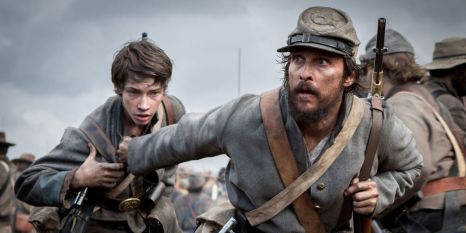
Free State of Jones tells the almost unbelievable true story of the lengths the Confederates went to in order to protect their interest during the American Civil War.

Confederate army nurse Newton Knight (Matthew McConaughey) realises he is a pawn in a rich man’s game and, after his nephew (Jacob Lofland) is killed in battle, he deserts. “It’s not my fight,” he says, noting that he has more in common with the black slaves than he does with the white elite. And so, he bands together a group of runaway slaves, fellow deserters and poor white women and, from their base deep in the swamps, leads a rebellion against the plantation owners, asserting their right to reap the crops they sow and live their lives as free humans, eventually establishing Jones County as a free state and seceding from the Confederacy.

It’s an undeniably important story, highlighting the the vile racism at the heart of American history, and showing how this echoes through the ages with sequences that flash-forward eighty-five years, where Knight’s descendent, Davis (Brian Lee Franklin), is put on trial and eventually jailed for failing to disclose, when marrying, that his great-great-great-grandmother – Newt Knight’s second wife, Rachel (Gugu Mbatha-Raw) – was black.

There’s plenty to admire in this film: it’s a story that needs telling; we need reminding that the Black Lives Matter movement has deep roots, and that racism is firmly embedded in American society. The rich still work hard to protect their own interests, turning the poor against each other to deflect attention from their own excess. And it’s beautifully acted, creating a clear sense of the times; it’s unflinching in its portrayal of the brutality of war and the harsh conditions endured by all.

A shame then that the narrative lacks pace. There’s no clear story arc, no real climactic moment, no drive propelling us to the end. It’s almost dull at times: a series of ponderous moments that don’t quite engage, that keep us at arm’s length. Terrible things happen but I’m never emotionally involved; my reactions are all intellectual.

It’s a good movie and worth seeing, but it’s hard to escape the notion that it could easily have been so much more.

3.9 stars

Susan Singfield

Wil Greenway: The Way The City Ate The Stars

2016WILGREE_APL

19/08/16

Underbelly, Med Quad, Edinburgh

What a curious and delightful confection this is – one of the most original productions we’ve seen at this year’s fringe. Wil Greenway’s show is a delightful blend of storytelling and music (the latter supplied by Will Galloway and Kathryn Langshaw). It’s set in Melbourne Australia and proves to be the perfect antidote for a cold, rainy afternoon in Edinburgh.

Greenway spins a magical yarn that blurs the lines between prose and poetry. It begins with a chance encounter between Greenway and Margaret, a mysterious woman he meets in a Melbourne bar. It then speeds effortlessly forward in time to the impending birth of Margaret’s child and there’s a series of coincidences that send three men speeding along the same remote road to an encounter with fate.

Greenway’s dazzling words and the haunting harmonies of his musical collaborators combine to create something quite extraordinary. The packed crowd at the event we attended would seem to suggest that good word of mouth about this show is already spreading fast. Our advice? Grab a ticket for this while you still can. Only those made of stone will be able to resist its charms.

5 stars

Philip Caveney

John Osborne & Molly Naylor

Naylor-Osborne_main

23/01/16

The Lowry, Salford Quays

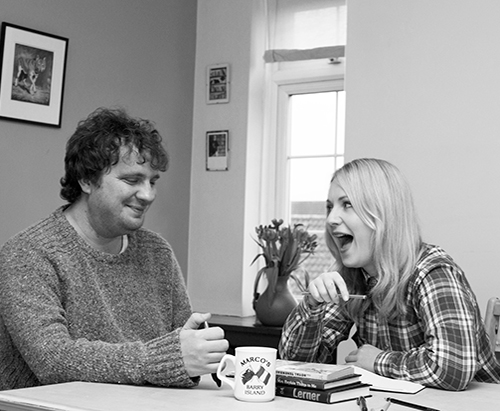
There’s a pleasingly ramshackle quality to tonight’s poetry reading. Not the poetry itself; that’s not ramshackle at all. But this is certainly more about the poems than the performance, and it’s all the better for it.

First up is the shambling, self-effacing – and very engaging – John Osborne. He pulls the sleeves of his jumpers over his hands like a recalcitrant teenager, and tells us about the poetry tour the pair have been on. Tonight’s the final night; they’ve driven up from Norwich. Some of the shows have been sell-outs, he says; another had an audience of only six. He doesn’t seem perturbed. We number about fifty, I think, and we’re an appreciative crowd. We laugh at his jokes. Why not? They’re funny.

The poems are funny too. Not comic pieces, exactly; just wryly amusing. There’s one about being served by a waitress who is ’employee of the month’, for example; another about conducting an affair with a colleague. They’re prose poems, really; little anecdotes, condensed. I like them. They make me smile.

There’s a break, and then it’s Molly Naylor’s turn. She’s a more confident performer, with a stronger stage presence, and the same likeability that made the first half so much fun. Her poems are more crafted too; she plays with form, experiments. There’s a trilogy about love (before, during, after… “Well, sort of during…”), a long piece about beach combing. There are personal anecdotes between poems: she comes from Cornwall; she used to travel to school by boat. (Actually, when she starts this tale, she says, “I used to go to school on a boat.” It takes me a while to realise the boat is the transport, not the institution. I am mildly disappointed.)

I enjoy listening to Naylor. I like the way she reads. The excerpt she shares from her play, Whenever I Get Blown Up I Think Of You, is riveting, detailing as it does her experience in London on July 7th 2005: she was on a tube train when it was bombed. It’s the minutiae that make this piece so absorbing: the scarf, the Sainsbury’s toilets, the walk home in the aftermath.

And then they’re gone. No bows, no joint moment, no milking of applause. It’s thank you, goodnight, and off we go.

What a lovely way to spend a Saturday.

4 stars

Susan Singfield


Chris Dugdale: Sleightly Dishonest

Unknown

26/08/15

Assembly George Square Studio 2, Edinburgh

There’s something distinctly old school about magician Chris Dugdale: the sharp suit, the comic patter, the cheeky persona… and many of his tricks are well-worn too. The opening routine where he swallows razorblades was popularised by Harry Houdini, while the bullet-catch is the same one that so tragically finished the career of Chung Ling Soo (William Ellsworth Robinson) in 1918, even if Dugdale has adapted it slightly, substituting a paintball gun for a revolver. But actually it’s great to see these classic routines done with such style and aplomb.

However, it’s his sleight-of-hand routines with playing cards that are (if you’ll forgive the pun) his strongest suit. These are conducted at a small table with a member of the audience sitting right beside him and a video camera projecting the whole thing onto a big screen behind. As you watch mesmerised, the cards appear to change suit every time he turns them over. It’s an accomplished piece of close up magic, one of the best I’ve seen.

Another routine, which he spins out through the show has a jaw-dropping payoff as Dugdale appears to undo all traces of everything we’ve seen during his act; and there’s a ‘mind-reading’ trick that had us wracking our brains in a ‘how did he do that?’ sort of way. It’s accomplished stuff, and his invitation to play cards for money with anyone from the audience later on is wisely ignored.

Maybe he might think of doing something bigger, more flamboyant next time out, but for now, this will do nicely. Oh yes, I just remembered. The trick with the Rubik’s cube. How on earth did he do that?

4 stars

Philip Caveney

The Orchid and the Crow

Orchid-and-the-Crow-700x455

20/08/15

Assembly Roxy, Edinburgh

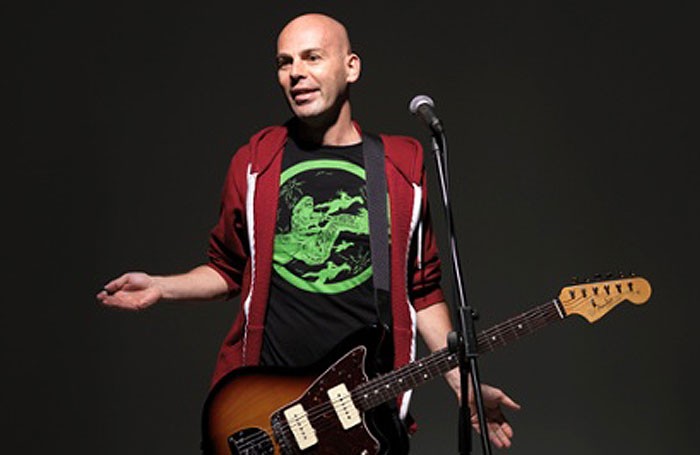
In a hard-to-categorise show, Australian musician and cancer survivor, Daniel Tobias offers a meditation on a variety of subjects: the Jewish Faith, Father Christmas, Lance Armstrong and testicular cancer. These may seem unlikely bed fellows but it’s all expertly stitched together and along the way we are offered songs in a variety of styles – some jaunty rock n roll, a cabaret-style piece with a guest appearance from God and most effective of all, an Italian aria about the loss of one of the artist’s testicles, accompanied by a short film. It’s a quirky collection of ideas, never less than entertaining and in several places, it’s surprisingly informative – did you know, for instance that the word ‘orchid’ and the word ‘testicle’ have the same etymology? No? Me neither.

This show was a winner at the Ottawa Fringe Festival and it’s not hard to see why. Tobias has a likeable stage presence, and a decent voice, while the illustrative songs, written with various collaborators are of a suitably high standard to please the pickiest of crowds. If you’re looking for something a bit different than the usual Fringe fare, this would be a good bet.

4 stars

Philip Caveney

Sarah Jane Morris

2015BLOODYR-8W-300

13/08/15

Assembly Rooms, George Street, Edinburgh

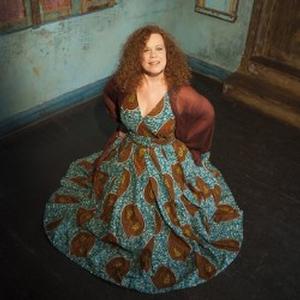
Soul, R n’ B and jazz singer, Sarah Jane Morris is a veteran of the music scene and she’s here in Edinburgh to play selections from her latest album, Bloody Rain. The album itself is a collaborative piece, comprising live recordings with a host of musicians including Seckou Keita, Courtney Pine and the Soweto Gospel Choir.

Today, Sarah Jane is is performing ‘unplugged’ with acoustic guitarists Tony Remy and Tim Cansfield and they make a skilful trio, all musically talented, so the sound is superb. It has to be said we like them best when they’re performing covers: a slow soulful version of Nick Cave’s Into My Arms is a thing of beauty and Sarah Jane’s voice is at its best on soul standard Little Piece of My Heart.

Some of the original material though, doesn’t quite hit the mark. Songs about honour killings and the Boko Haram kidnappings are clearly well-intentioned but the lyrics are a bit too sixth form and simplistic to really have much effect.

A few of the Soweto-style numbers were absolutely crying out for a drummer, but overall the undoubted musical ability of the trio meant that most of the songs had the necessary heft. To get the full effect though, you’ll certainly need to check out the album.

3 stars

Philip Caveney and Susan Singfield

Patrick MacNee: An Appreciation

Unknown Unknown-1

26/06/15

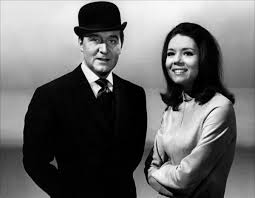
It’s one of my earliest memories from childhood; sitting with my parents in the little living room of whichever RAF home we were in then, waiting for our favourite programme to start. A little flickering screen in the corner. And then that music, Laurie Johnson’s strident theme, the brass section blasting out four notes which seemed to quite literally trumpet the programme’s title. The Avengers! The Avengeeeeers! Then the black and white credit sequence, cutting edge cool in the 1960s. And finally the episode itself, a delicious slice of surreal cold-war spy fluff as John Steed and Emma Peel took on the villains in their own spectacular style. These days of course, the same title conjures up images of brawny superheroes clad in latex and blessed with underwhelming ‘special’ powers, but in those far off times, it meant something quite different.

There had of course been an earlier series with Honor Blackman as Cathy Gale, but I don’t really remember that as clearly. The second series is imprinted so perfectly in my memory, that even now, more than fifty years later, I can recall entire scenes, even lines of the witty dialogue. I know that I was absolutely besotted with Diana Rigg who seemed to me the very epitome of feminine mystique – lithe, pretty, intelligent and powerful enough to fell a villain with one perfectly timed karate chop (even if, in long shot, you could sometimes see that she had been cunningly substituted by a burly bloke clad in an ill-fitting leather jumpsuit.) And of course, I saw all the later incarnations. I never really warmed to Linda Thorson as Tara King, but I did like Joanna Lumley as Purdey in The New Avengers, almost as much as I despised Gareth Hunt as the perpetually smirking ‘bit-of-rough’ Mike Gambit.

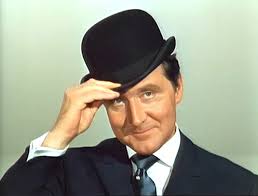
Through it all, Patrick MacNee’s John Steed remained unchanged, suave, stylish, outfitted in Saville Row’s finest suiting, his trademark bowler hat in place and his deadly weapon (an umbrella) poised ready to take out the toughest opponent. (Apparently, the umbrella was McNee’s idea. He’d been a naval officer in the war and had emerged from the experience with an intense dislike of violence of any kind, so much so, that he steadfastly refused to be pictured with a gun. ‘I’ll carry an umbrella,’ he suggested at an early script meeting and everyone went along with that. It was an inspired idea.)

Of course, the problem with a successful show like The Avengers was the danger that it might typecast the stars. Rigg had no problem escaping its clutches, becoming a major star of the theatre, but McNee didn’t manage much else but some forgettable television and an occasional film cameo; a shady psychiatrist in Joe Dante’s The Howling, a delightful turn as Sir Dennis Eaton-Hogg in This Is Spinal Tap, even a decent showing in a Bond film, opposite Roger Moore in A View To A Kill. But John Steed would remain his signature role, as much a fantasy image perhaps as those created by his female co-stars. In real life, you suspected, you’d actually hate someone like John Steed. With his Gentlemen’s Clubs, his impeccable manners and his old style courtesy, he was, even in the swinging 60s, something of a dinosaur – but MacNee’s charming manner made you believe that underneath it all he was a really nice chap, that should you bump into him in real life, he’d be every bit as charming as his fictional counterpart.

It’s always a jolt when you read that one of your earliest heroes has died. MacNee was 93 years of age, which by any standards is (as Steed himself might have observed) a jolly good innings. Back in the day, we tended to sneer at television shows. It’s only recently that TV has had something of a renaissance and we wax euphoric about the likes of Breaking Bad and True Detective. But The Avengers was an example of television at its most groundbreaking. Re-watching that opening credit sequence on YouTube still gives me the same thrill I had when I was a little boy. And if Patrick MacNee will always be John Steed in the nation’s memory, well that’s no bad thing. Because in his own way, he was one of the greats.

Philip Caveney