Theatre

Sleeping Beauty

01/12/21

King’s Theatre, Edinburgh

The King’s panto is an Edinburgh institution, and this year’s is extra special for a number of reasons. It’s the first one since the pandemic forced the theatres to go dark. The last one before the King’s closes for refurbishment. And the first one since the demise of Andy Gray, one third of the beloved triumvirate synonymous with Christmas theatre in this city. This Sleeping Beauty isn’t just a pantomime; it’s a tribute to him too.

There’s nothing new here. If you think you’ve seen it all before, well, you probably have. This is a tried and tested formula. Elaborate tongue-twisters? Check. Queen May hovering over the audience on a cantilever? Check. That thing they do with the chocolate bars? Check. It’s all there, like a greatest hits album. And thank goodness for that. Because this is as warm and familiar as a comfy cardy or a mug of hot chocolate – exactly what we need on a cold winter’s night.

The theatre is busy and bustling, but it feels relatively safe. People are taking the mask-wearing seriously; we’re all used to it now, and it doesn’t seem to impede the fun or mute the atmosphere. Anyway, we’re all putty in Queen May’s hands: Allan Stewart is a consummate comedian, and he knows how to work an audience, proving the adage that it’s not the joke, it’s the joker. Even the cheesiest of cheesy lines is funny when he utters it.

Grant Stott is here too, of course, and he’s a towering presence, playing Queen May’s – ahem – identical sister, Carabosse. In this version of the story, she’s the villain who curses Princess Aurora (Sia Dauda), dooming her death when she pricks her finger on a spinning wheel. The Good Fairy (Nicola Meehan) isn’t powerful enough to reverse the spell, but she can modify it, and Aurora falls asleep instead…

It’s nice to see the fool conflated with the love interest. Jordan Young plays Muddles, the jester whose heart belongs to Aurora. He delivers a wonderfully energetic performance, and appears to be having the time of his life as he hurtles from one ridiculous moment to another.

Andy Gray might be gone, but he’s not forgotten. His daughter, Clare Gray, has picked up the family panto-mantle, playing punky Princess Narcissa. She must be proud as punch when the audience applauds ‘King Andy’ – the affection is sincere and profound.

As ever, the King’s panto is a real treat, and not to be missed.

5 stars

Susan Singfield

Death Drop

17/11/21

King’s Theatre, Edinburgh

There’s nothing subtle about Death Drop. This pantomime-style murder-mystery spoof is as big, bold and spangly as a sequinned frock, and there are plenty of them in evidence too. Director Jesse Jones has embraced the ostentatious, which is, let’s be honest, the only option for a show with an international cast of Drag Race stars.

The set-up is familiar: we’re in a spooky manor house on a remote island. It’s 1991 and Lady von Fistenburg (Vinegar Strokes) is hosting a party in honour of Prince Charles and Princess Diana’s tenth wedding anniversary. Okay, maybe not all of it is familiar. Blue, Brie and Spread Bottomley (three sisters – or peas, named after cheese – all played by writer Holly Stars) have been engaged to do the catering for an eclectic mix of guests. These are: has-been pop starlet, Shazza (Willam); TV weather girl, Summer Raines (Ra’Jah O’Hara); odious newspaper editor, Morgan Pierce (Karen from Finance); Tory MP, Rich Whiteman (Richard Energy), and film-maker, erm, Phil Maker (Georgia Frost). But – oh no! – there’s a storm! Cue OTT sound and lighting effects from Beth Duke and Jack Weir. The phone lines are down, the electricity’s playing up and a fallen tree has blocked the only bridge to the mainland. And, one by one, the guests begin to die. Someone is clearly intent on murder. But who?

I spend the first ten minutes thinking I’m going to hate this show. I like drag, but the humour here is way beyond broad. They’re establishing the context, so there are lots of 90s references, but it’s all a bit sub-Peter Kay. I mean, just mentioning ‘Anne Diamond’ shouldn’t be enough to get a laugh, should it? I want my comedians to work harder than that: tell me a joke about Fray Bentos; don’t just say the words.

But it soon hits its stride, and I find myself laughing with everybody else. The assembled drag artists strut their stuff with aplomb, and the silliness is disarming. There are a few songs thrown in to good effect (penned by the ever-marvellous Flo and Joan), and these really help the carnival atmosphere. I’m less familiar with the work of drag kings than I am drag queens, but they make perfect sense: like their counterparts, they focus on exaggerated gender and cartoonish caricatures.

Holly Stars is a standout: her deadpan delivery guaranteed to entertain. Richard Energy’s Rich Whiteman is noteworthy too, a study in extravagant characterisation. I like Karen from Finance’s Morgan Pierce; it’s a peach of a part and Karen aces it.

There are a few issues. The second act is baggy, and the payoff isn’t strong enough. Death Drop peters out instead of climaxing, and – in a show as dependent on innuendo as this – that really matters. Nonetheless, this is fun. If your three favourite things are Drag Race, The Play That Goes Wrong and panto, then this is your dream production.

3.4 stars

Susan Singfield

Eric and Ern

15/11/21

Festival Theatre, Edinburgh

Picture this.

It’s sometime in the late 1960s and I’m a kid. (Yes, I actually was a kid, back in the day. I have a birth certificate to prove it.) I’m with my parents and my older sister, sitting in our modest house on an RAF base somewhere in the UK (probably Lincolnshire). We’re all gathered in front of a television set, housed in a walnut cabinet the size of East Anglia, with a screen that has the dimensions of a postage stamp. This is of course in the years BS (before streaming), so if there’s a show you want to see you have to be there, on the dot, otherwise the chance will be gone pretty much forever… or at least until somebody invents the concept of reruns. I’m a typical kid, already displaying symptoms of being an individual, and there aren’t many shows my parents like that I’m willing to watch. But there is one notable exception. Morecambe and Wise.

The decades move on, but still all four of us are happy to sit down together and watch these two northern comics whenever they have a new series or a Christmas special. What is it about them that’s so good? Nobody could accuse Eric Morecambe of having brilliant material – his stuff was kind of hack – but he was just a genuinely funny man, who, with a wiggle of his glasses and a sidelong glance, could humiliate the pompous, overbearing Ernie Wise, a man so convinced of his own talent that he was willing to employ major stars to appear in ‘the plays what he wrote.’

I never tired of the act and, like many, I was gutted when Eric Morecambe died, Ernie Wise retired and there would be no more nights worshipping at their shrine.

Eric and Ern is, I suppose, a tribute act but it seems somehow more than just that. While Ian Ashpitel and Jonty Stephens look, move and sound like the real McCoys, there’s such warmth in this performance, such evident affection for the original duo, that it feels like stepping into a time machine and heading back to those long-mourned nights. The show is cleverly paced, composed of excerpts from classic sketches, each one just long enough to ensure it doesn’t outstay its welcome. There’s also a stooge in the form of vocalist Sinead Wall, who somehow succeeds in keeping a straight face through her lovely rendition of Send in the Clowns, while ‘Eric’ and ‘Ern’ cavort in costume just behind her.

Long cherished routines are observed: the paper bag trick (which I have been shamelessly unleashing on various young relatives over the years); the Austrian dance routine; the ‘two men in bed reading newspapers;’ even ‘Mr Memory,’ who knows everything about anything…. given enough prompts. From the opening scenes, I’m laughing helplessly, a condition I find myself in until the duo finally dance offstage, legs akimbo in time-honoured fashion.

This is a great big warm hug of a show. If you’re already fans of M & W, you’ll have a whale of a time. If they are new to you – I suppose such a thing is possible – why not go along and see what all the fuss was about?

Your time machine awaits!

4.4 stars

Philip Caveney

The Legend of Sleepy Hollow

09/11/21

Kings Theatre, Edinburgh

On the face of it, Tilted Wig’s adaptation of The Legend of Sleepy Hollow would seem an appropriate choice for Autumnal viewing.

Washington Irving’s short story, published in 1819, is one of the very first Hallowe’en tales, replete with ghostly hauntings, a plethora of pumpkins and, of course, the infamous headless horseman who pursues superstitious schoolmaster Ichabod Crane and chases him clear out of town. But that is hardly ideal material for a full-length story, so playwright Philip Meeks pitches Crane (Sam Jackson) as a man of mystery, who arrives unexpectedly in Sleepy Hollow and quickly establishes himself as the town’s schoolmaster. But what is his secret agenda? And why does he never seem to do any teaching?

Local landowner, Balthus Van Tassel (Bill Ward), grudgingly accepts Crane’s presence, much to the disgust of local bully boy Brom Van Brunt (Lewis Cope), who is convinced that the incomer has set his sights on Van Tassel’s daughter, Katrina (Rose Quentin). And when local matriarch Mariette Papenfuss (Wendi Peters) takes Crane under her wing, it starts to look as though the schoolmaster will soon be offering Katrina his hand in marriage and, consequently inheriting all of her father’s wealth.

But the true reasons for Crane’s presence in the area are complicated. Perhaps too complicated, because at times the plotting here becomes almost unfathomable. Sometimes I find myself struggling to understand what characters are doing and, more importantly, why they’re doing it.

Still, there are elements to enjoy. I like the stylised linking devices, where the cast dance their way from one scene to the next; an ingeniously staged shadow-play relating one of the county’s oldest myths is clever and effective – and Sam Glossop’s ominous soundscapes give the production an atmosphere of mounting dread. Director Jake Smith pulls off a few effective jump scares and one sequence in particular, where Crane finds himself caught up in an ingeniously staged nightmare, complete with magical effects, is a highlight.

But there are rather less successful elements – too many scenes of characters climbing up a perilous-looking ladder for no apparent reason soon become wearisome – and, when the legendary headless horseman is finally glimpsed (as of course he really must be), the impact has been somewhat diminished by an earlier scene where two members of the cast burst in dressed as a pantomime version of the real thing. And then there’s a final plot twist which just feels… baffling.

Ultimately, The Legend of Sleepy Hollow is a mixed bag of a production, but it does have some saving graces.

3 stars

Philip Caveney

Life is a Dream

02/11/21

Lyceum Theatre, Edinburgh

There’s something decidedly dreamlike about our return to the Lyceum.

It’s been so very long since we’ve entered these hallowed portals and, now that we’re here, we hardly recognise the place. It’s had a major makeover for this play, with a new floor built up over the stalls. The result is a more intimate performance space; this production is presented in the round, with some members of the audience sitting right next to the actors. I’m reminded, more than anything, of the Royal Exchange in Manchester, our old ‘go to’ venue for new and innovative theatre, and this reinvention seems like an astute move on the part of the Lyceum. And if director Wils Wilson doesn’t maximise the reconfigured space’s potential quite as well as, say, Sarah Frankcom might, that’s only to be expected; after all, the Exchange’s artistic directors have had a lot of practice at this!

Life is a Dream is one of those weird seventeenth century fairy tales, written by Pedro Calderon and first staged in Madrid in 1630. This translation, by Jo Clifford (who, coincidentally, is sitting in the row in front of us), is strong on acerbic humour and gender confusion and, while it probably wouldn’t do to think too closely about the bizarre machinations of the plot, the actors’ confidence seems to grows steadily throughout the performance, exerting a powerful grip on the audience.

This is the story of captive prince, Segismundo (Lorn MacDonald), imprisoned in a tower by his own mother, Queen Basilio (Alison Peebles), who once dreamed that her son would turn out to be a tyrant, so decided to be proactive and imprison him just in case. But Segismundo is released by his old tutor, Clotaldo (John McCaulay), and pretty soon, the prince has the opportunity to show that he can be kind and considerate, but, driven half mad by his long imprisonment chooses to do exactly the opposite – until he is told that life is all a dream, and so he should do his best to behave well and stop the nightmares. Then there’s angry, jilted Rosaura (Anna Russell Martin) and her companion, Clarin (Laura Lovemore), the latter of whom keeps breaking the fourth wall to make sarcastic comments about what we’re watching…

Actually, there’s little point in going over the plot in detail, because it’s quite frankly bonkers, but what comes across so powerfully here is the magical feel of the production and the excitement of seeing something new, fresh and innovative. McDonald is terrific as the near feral Segismundo, scampering around the stage, snorting and quivering like a hunted animal, seemingly unable to make a quick decision. Peebles brings a sense of quiet authority to her role as the much misguided Queen of Poland and Russell Martin has a delightful knack for uttering sarcastic asides.

More than anything else, it’s great to back at the Lyceum and this sparky piece makes for a delightful return.

We’re already excited to see what comes next.

4 stars

Philip Caveney
The Enemy

20/10/21

King’s Theatre, Edinburgh

Ooh. I’m VERY excited about this one. I’m an avid admirer of Ibsen – what self-respecting theatre-lover isn’t? I’m in awe of the way he combines theatrical innovation and political conviction with accessible story-telling. I’m also a fan of Kieran Hurley’s work (Chalk Farm, Mouthpiece and Beats are all excellent), so I’m fascinated to see what he and director Finn den Hertog do with the Norwegian’s masterpiece, An Enemy of the People.

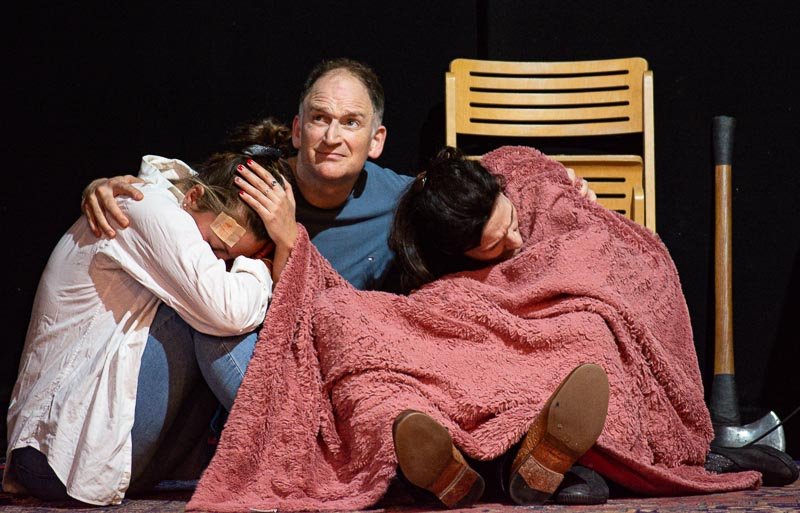
In fact, Hurley doesn’t change much at all, plot-wise. This 140-year-old play is uncannily prescient. The difference is all on the surface: in the modes of communication, and the cadence of the dialogue – and it’s beautifully done. The story shifts easily to a contemporary “once-great Scottish town,” where a new spa resort promises regeneration, and offers hope to the poor and dispossessed who live there. But Dr Kirsten Stockmann (Hannah Donaldson) is concerned: a sickness bug is spreading, and she’s almost certain the town’s water supply has been contaminated. But how? Could blame lie with council-approved shortcuts, aimed at bringing forward the resort’s opening? Maybe. If so, it’s more than a little awkward, because the provost is Kirsten’s sister, Vonny (Gabriel Quigley). Still, surely she will be grateful for the heads up, pleased to be able to avert a public health disaster, no matter what the cost? But no. Vonny has no qualms: without the resort, the people have nothing. They’re not sick because of poison, she tells her sister; they’re sick because they’re poor. She has a point.

Although the story remains unchanged, the staging is bang up-to-date: video designer Lewis den Hertog has created a multi-media piece à la Katie Mitchell, with ‘live cinema’ (where the onstage action is filmed and projected simultaneously onto a large screen) a key feature. There are pre-filmed sequences too, such as a jarringly upbeat advert for the new resort, and a series of enthusiastic vox pops on the local news. And there are text messages, and YouTube videos, and Skype and BTL comments a-plenty. It’s Ibsen with all the socials. It works. There’s a dizzying sense of things spiralling out of control, with Kirsten in the middle, alone, holding on to the damning test result – a dreadful talisman.

But Kirsten isn’t quite alone. She might have broken ties with her sister; her friend, Benny (Neil McKinven), and local celeb, Aly (Taqi Nazeer), might have sidled away – but her teenage daughter, Petra (Eléna Redmond) is firmly on her side. And so, perhaps, is Derek Kilmartin (Billy Mack), who has a proposal for Kirsten to consider…

It’s wonderful to see creative theatre projects taking shape again (I’ve nothing against old favourites, and it’s clear to see why theatres are being cautious post-pandemic, but it’s definitely time for something new). This particular project seems like a canny move, combining Ibsen’s timeless appeal with something bold and fresh. It’s almost guaranteed to get bums on seats, while simultaneously allowing playmakers the chance to experiment. Good call!

For the most part, it pays off. I have a little trouble hearing some of the dialogue, especially in the first act. I’m sitting quite far back in the stalls, which might have something to do with it, but I wonder if it’s more about the actors delivering their lines to cameras rather than to the auditorium. But this is my only gripe. The performances are natural and convincing, the relationships well-defined.

The message is clear: the truth matters, however unpalatable. It’s a timely homily. We need to heed the experts. The only problem is, we all think we’re Kirsten Stockmann.

4.3 stars

Susan Singfield


The Woman in Black

12/10/21

King’s Theatre, Edinburgh

I’m somewhat amazed to realise that this is actually the fourth time I’ve seen this play – but it’s one I somehow never tire of watching. Its beauty lies in its simplicity, and in the late Stephen Mallatratt’s canny adaptation of Susan Hill’s gothic chiller. It’s proof if ever it were needed that a decent novel can be elevated by the way it’s interpreted on the stage. While The Woman in Black incorporates all the tropes of the traditional ghost story, the staging still – thirty years after its debut performance – feels fresh and innovative.

Something bad happened to Arthur Kipps (Robert Goodale) back down the years and, in an attempt to purge himself of those memories, he has decided to do a performance of it in a down-at-heel theatre, just for friends and family. He has engaged the services of ‘The Actor’ (Anthony Eden) to help him bring this about, but the latter is horrified by Kipp’s stilted attempts at reading and, in a moment of inspiration, he suggests that the two men should swap roles. He will play Kipps, while the older man will portray a number of supporting characters.

And so the rehearsal begins and we are inexorably drawn into the story of Kipps as a younger man, when he was a solicitor, engaged to go to Eel Marsh House in a remote spot on the North East coast of England. There he is to attend the funeral of Mrs Alice Drablow – and to settle her estate. It doesn’t help his mood to discover that the house can only be reached via a causeway that will leave him trapped alone in the place for hours at a time. As he goes about his mundane duties, it begins to dawn on him that all is not as it should be – and he learns that the area is haunted by the titular character, a woman intent on seeking revenge for tragic events that happened in the past.

Robert Herford directs with consummate skill, using shadows and sounds and an oppressive atmosphere to conjure an sense of mounting dread. Michael Holt’s exquisite set design keeps finding new places to explore: hidden within what first appears to be a one dimensional setting is a meticulously detailed child’s playroom, a white-shrouded cemetery, a ghastly silhouetted staircase. And has so much apprehension ever been generated from the simple device of a door that can’t be opened – until it opens itself?

It’s all wonderfully evocative. Of course, the fact that I’m so familiar with the play inevitably means that some of the jump-scares are less effective than they were on first viewing. I find myself envious of those undertaking this theatrical thrill ride for the first time.

Some plays are classics for very good reasons. If you’ve never experienced The Woman in Black, here’s your opportunity to sample its twisted delights. Don’t have nightmares.

4.6 stars

Philip Caveney
Looking Good Dead

05/10/21

King’s Theatre, Edinburgh

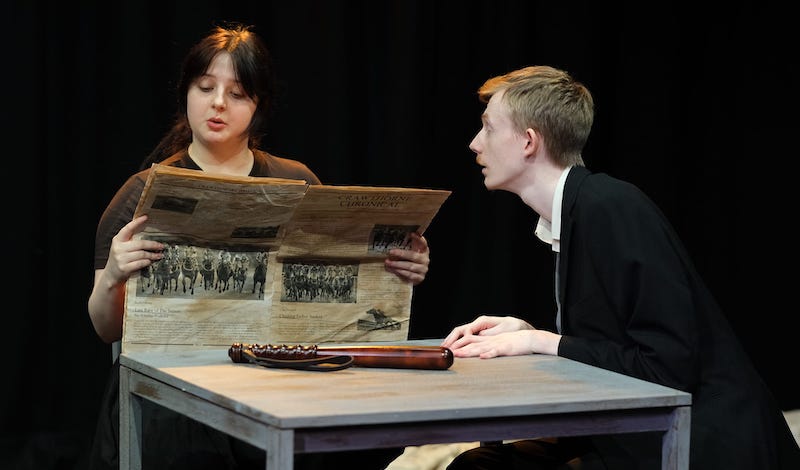
Superintendent Roy Grace is the protagonist of Peter James’ popular police procedurals – a diligent but troubled policeman, who’ll stop at nothing to solve a case. In Shaun McKenna’s stage adaptation of the second novel, Looking Good Dead, Grace (Harry Long) is relegated to a supporting role. Instead, the focus here is on the Bryce family, inadvertently caught up in a terrible crime. I think this is a wise move; they, after all, form the crux of the story.

Top of the bill, therefore, are soap favourites Adam Woodyatt and Gaynor Faye, as Tom and Kellie Bryce. They enjoy an affluent, suburban life. Tom works; Kellie cleans a lot; their teenage sons, Joe and Max (Luke Ward-Wilkinson), are – respectively – in Venezuela climbing mountains and on the sofa listening to silence through NOISE CANCELLING HEADPHONES. Did you get that? NOISE CANCELLING HEADPHONES. I’ll mention them again anyway, just in case. (Director Jonathan O’Boyle is clearly a fan of Chekhov’s, holding dear the great playwright’s principle: if, in the first act a character has worn noise cancelling headphones, then in the following act, someone must fail to hear something important.) It all seems fine and dandy until a stranger leaves a memory stick on Tom’s commuter train. Tom makes the rash decision to bring it home; he plans to play the good Samaritan by tracking down its owner and ensuring its return. However, when Max plugs the stick into Tom’s computer, it reveals a link… to a murder. Happening in real time before their eyes. What have they been witness to? And what will the killer do when he realises he’s been seen?

Woodyatt and Faye inhabit their characters convincingly, and I especially enjoy Ian Haughton’s performance as the enigmatic Kent. I like Sergeant Branson (Leon Stewart)’s bad jokes, and the way Grace responds to them; this shift in tone works well to undercut some of the more histrionic scenes. The way Michael Holt’s set design incorporates the villain’s lair as well as the Bryces’ home is ingenious, and I am especially impressed with the decisive way the lighting is used to move us from one to the other at the flick of a switch.

There are some issues though – and the main one is the plot. Quite frankly, it’s risible. I’m more than happy to suspend my disbelief, but this stretches the elastic beyond its capacity. I’m unconvinced by any of the characters’ motivations, and am aghast at the ineptitude of the police, who keep politely agreeing to step outside so that suspected serial killers can have a private chat. And why exactly does everyone keep talking and revealing secrets in a room they’ve been told, quite clearly, is bugged? And why exactly exactly is it being bugged in the first place?

In addition, the police station set seems clumsy in comparison to the slick kitchen/lair: it’s pushed on and pulled off with wearisome regularity, and is so small that the actors seem constrained by it. There’s no space for movement, and they lean and perch awkwardly as they deliver their lines. I’m not a fan of the bigger action scenes either; the direction here just isn’t dynamic or fleet-footed enough.

So yes, there are problems. But do I enjoy myself? Yes, I do. Looking Good Dead might be silly but it’s entertaining, and I am more than happy to be back in the environs of the lovely King’s Theatre.

3 stars

Susan Singfield

Grease

29/09/21

Festival Theatre, Edinburgh

We’ve been denied the magic of theatre for far too long… so what’s the ideal production to get us back in our seats, clapping our hands and grinning behind our face masks? I put it to you that Grease is a pretty sound option. It has everything you need for a guaranteed good time – brash, funny and shot through with a heady mix of nostalgia. What’s not to like? And, what’s more, where most big musicals can offer you four or five great numbers, Grease is packed with wall-to-wall, solid gold, five-star bangers. A couple of chords into that memorable theme song and I’m already sold.

We all know the story of course. Prim, virginal Sandy Dumbrowski (Georgia Louise) arrives at Rydell High School having already spent a summer being romanced by handsome Danny Zucco (Dan Partridge) – but he finds it hard to be romantic in front of the other members of his gang, so a troubled courtship ensues. Those who only know the story from the movie version may be surprised to discover that this production, based on the original musical by Jim Jacobs and Warren Casey, is quite different from that familiar screenplay. This slick, adrenalin-fuelled adaptation gallops effortlessly from scene to scene and is at its finest in the ensemble dance numbers where Arlene Philips’s nifty choreography has the whole cast hoofing up a storm.

We also have Peter Andre in the dual role as disc jockey Vince Fontaine (cunningly housed in a circular booth at the top left of the stage) and as the Teen Angel, where he delivers a delightful version of Beauty School Dropout to Frenchy (Marianna Nedfitou). Andre might appear to be stunt casting, but he’s terrific in this production and a moment where he holds a top note for what seems an impossibly long time is proof that he possesses an accomplished singing voice – as does Georgia Louise who gives a super-powered rendition of Hopelessly Devoted to You.

There are also some memorable visual motifs. A scene where Danny and Sandy watch a drive in movie in glorious 3D is a particular delight.

If the first half is good, the second is even better – and the finale, where the cast lead us through a spirited singlalong of the best known songs has the entire audience up on its feet, clapping and stamping out the rhythms. I don’t mind admitted to being quite emotional at this point. I’ve missed live theatre so much and it’s just great to be back, relishing the shared experience. we’ve all been longing for.

So if you’re looking for a guaranteed good night out, Grease is the word!

4.2 stars

Philip Caveney

Charlie and Stan

17/09/21

The Lowry, Salford Quays

Told by an Idiot’s Charlie and Stan is a charmingly whimsical piece, a musing on what might have happened when Charlie Chaplin and Stan Laurel first met – as cabin-mates on a steamer bound for New York, both members of Fred Karno’s music hall troupe. Fittingly, it’s a largely silent piece of theatre, reliant on mime, music and physical comedy.

The performances are as peppy as you’d expect from Told by an Idiot, and it’s a fascinating premise. There is lots of potential for silly jokes and tomfoolery, which writer/director Paul Hunter enables his ensemble cast to utilise to full advantage. The choreography (by Nuna Sandy) is sharp, and the movement (courtesy of Jos Houben) is precise, as it needs to be in a piece like this. Danielle Bird’s Chaplin is glorious, all verve and spirit, while Jerone Marsh-Reid’s Laurel personifies sweetness and likability. The piano and drum accompaniment (Sara Alexander and Nick Haverson) works well too, and I like how it’s incorporated into the action.

I am also impressed by Ioana Curelea’s set: the wonky ship’s interior and hanging bunk beds contribute to the sense of impermanence and making do.

There’s so much to admire here, and yet – for me – it doesn’t quite come off. I think it’s to do with the tech. I need lighting that directs my eye; some of the physical jokes don’t land because I don’t know where I’m supposed to be looking, and simple sound effects to underscore some of the more obscure punchlines would also be helpful. Without these guides, I sometimes feel overwhelmed by the business of the stage, and I miss a lot in the mayhem.

I’m also unconvinced by the flashback and flash forward sequences. The former – depicting Chaplin’s troubled childhood – seems tonally wrong. It’s a weighty topic, but it’s depicted in exactly the same way as the rest of the piece; I feel it needs to be markedly different. The latter just seems grafted on: Haverson’s portrayal of Oliver Hardy is uncannily accurate, but the scene doesn’t fit with the rest of the story.

So, for me, this is a bit of a mixed bag. A nice idea, a pleasant way to spend an evening, and some undeniably strong performances but, in the end, a little disappointing.

3.4 stars

Susan SIngfield