
Theatre

Titanic the Musical

21/06/23

Festival Theatre, Edinburgh

The tragic story of The Titanic has exerted a powerful hold on the public imagination ever since its doomed maiden voyage in 1912. It seems horribly ironic that, as we take our seats in The Festival Theatre, the vessel (or at least an ill-fated attempt to visit what remains of it) is once again dominating the news channels. Still, whatever you think about the subject, this stately musical by Maury Weston and Peter Stone offers an assured account of the events that led to one of the biggest disasters in maritime history.

In the first half, we’re introduced to the players as the ship prepares for departure. There’s Captain Edward Smith (Graham Bickley), looking forward to what he believes (rightly as it turns out) will be his final voyage. There’s the ship’s designer, Thomas Andrews (Ian McClarnon), proud of his own ingenuity and convinced that the ship he has built is ‘unsinkable.’ And there’s J. Bruce Ismay (Martin Allanson), the managing director of the White Star Line, presented here as the villain of the piece, a man whose rampant hubris is held largely responsible for the disaster. The truth is rather more complicated than that, but every story needs a villain, I suppose.

Around this triumvirate flock the passengers: the privileged toffs in first class, the hopeful emigrants looking forward to a brand new start in second, and the poor and the dispossessed down in third. There’s also the many members of staff who wait on more than two thousand passengers. The twenty-five members of the cast certainly have their work cut out to represent so many doomed travellers and, it has to be said, with umpteen speedy costume changes, they do a pretty good job of it.

Yeston’s sombre score avoids the cheesy power ballads so often associated with this kind of production, opting instead for a kind of operetta approach. In the jollier moments (and yes, there are a few in the first half), there’s even a hint of Gilbert and Sullivan in the delivery, as members of the cast waltz merrily across the deck.

But of course, the second half can’t be anything but mournful as the ship, having kept its rendezvous with that iceberg, begins (spoiler alert!) to sink beneath the waves.

It’s here, to be honest, that the production struggles to recreate the ensuing chaos. David Woodhead’s set design is impressive but stolid, and I find myself longing for some state-of-the-art special effects to contribute more Sturm und Drang to the closing moments. What’s more, it’s impossible to be surprised when the story I’m watching is so ingrained into my memory that I find myself picking up on its occasional deviations from the truth.

Still, there are some strong moments here. I particularly enjoy the duet between Frederick Barrett (Adam Filipe), sending a marriage proposal to his sweetheart back in England, and Harold Bride (Alistair Hill), the Marconi radio operator who enables him to do so. And anybody who can keep a dry eye through the final duet of elderly couple, Isador Straus (David Delve) and his wife, Ida (Valda Aviks), as they decide to face their fate together, is certainly made of sterner stuff than me.

The production closes with a tribute to the 1,500 people who lost their lives on that fateful night – and, after the enthusiastic applause has died away, Bickley steps forward to deliver the cast’s heartfelt hope that the passengers aboard the missing Titan submersible might be found safe and well.

That of course – like the Titanic itself – will soon become a matter of historical record.

4 stars

Philip Caveney
Leopoldstadt

16/06/23

National Theatre At Home

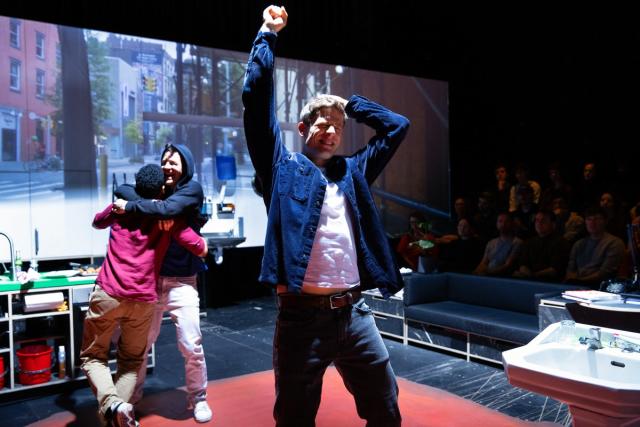
With live theatre events relatively thin on the ground at the moment, it seems a propitious time to indulge in NT Live’s ‘At Home’ selection – and the obvious first choice is Tom Stoppard’s Leopoldstadt, a play in five acts, which chronicles the lives of the Merz family in Vienna. With a cast of forty actors, this is a mammoth undertaking and, while Patrick Marber’s direction occasionally struggles to contain so many disparate characters, it’s nevertheless an education for me, providing an overview of world events that eventually led the Jewish people to the edge of annihilation.

The play opens in 1899, where Merz family patriarch, Hermann (David Krumholtz), his wife Greta (Faye Castelow), and their extended family are celebrating Christmas. Hermann (like many other Jewish businessmen) has converted to Catholicism in order to prosper in his everyday dealings, but he’s only too aware of the antisemitic sentiment of the true gentiles around him and at the party (where one of the children unthinkingly puts a Star of David at the top of the tree) there is already wistful talk of the idea of a Jewish homeland in Palestine.

As the story progresses – we jump first to one year later, then to the jazz era of the 1920s – we are aware that nothing has improved for the Merz clan and that their freedom to thrive is being rapidly diminished. The next section, set in November 1938 on the evening of Kristallnacht, is perhaps the most harrowing sequence, as the family home is visited by a sneering Nazi overseer, who quite literally gives them their marching orders, his callousness exemplified by the seemingly small act of brazenly stealing Hermann’s beloved fountain pen.

A moving coda, set in 1955, features three of the few survivors of that night, comparing notes and remembering the many – the very many – who died in the Nazi death camps. The play begins with a huge extended family on stage, but as the story progresses, their numbers steadily diminish until there are hardly any of them left and the performance space is almost empty. It’s a powerful moment when, in the final minutes, the rest of the cast drift back to stand behind the three survivors, silent witnesses to their own terrible fates.

While it’s nobody’s idea of an uplifting evening at the theatre, Leopoldstadt – which may well be Stoppard’s swan song – is an important and ambitious piece of theatre that highlights how an entire race of people, perhaps because of their very determination to succeed in the face of overwhelming odds, has been systematically tyrannised and subjugated throughout history.

While the complex nature of the Merz family tree (and the actors doubling as different characters) occasionally gives rise to some confusion as those we first see as children return as adults, it’s worth persevering for the powerful melancholy of that extraordinary epilogue, which for quite some time leaves the live audience in stunned silence before the applause finally begins.

3.8 stars

Philip Caveney

ChildMinder

10/06/23

Traverse Theatre, Edinburgh

Edinburgh-born Joseph lives in New York, where he is a celebrated child psychiatrist. He seems to be living his best life, with a beautiful, clever girlfriend, as well as a stellar career. But Joseph’s success is built on shameful foundations and a reckoning looms. Reparations need to be made on both the micro and the macro level – for his own transgressions as well as his country’s.

There are two distinct strands here, each echoing the other, their links compelling if not always quite clear.

On the one hand, we have a pretty straightforward ghost story, its origins laid bare in the opening scene, where Joseph (Cal MacAninch) is confronted with a repressed memory from when he was five years old: his baby brother’s murder. This shocking revelation opens the door to other carefully-buried feelings of guilt, and Joseph soon finds himself tormented by the ghost of a thirteen-year-old patient, Sam (Ben Ewing), who holds the doctor accountable for his death.

On the other hand, we have a meditation on the nature of colonisation, symbolised by Joseph’s relationship with Cindy (Mara Huf), a Native American anthropologist. Cindy’s culture, all-but erased by white settlers, has now been commodified for their entertainment, and the couple indulge in an ‘authentic’ 1700s dinner in a fancy Manhattan restaurant. At first, the pair are in celebratory mode. After all, Cindy has just completed her PhD. But, as Joseph insists on sharing a long and rambling fantasy, a feeling of unease begins to grow, and it’s a relief when Cindy calls him out, and the allegorical nature of his proprietorial daydream is made evident.

This is an ambitious piece of theatre, and the actors are clearly revelling in its complexity. Ewing is particularly striking, both as the mysterious “wait”-er and the troubled Sam. The set, by Kenneth MacLeod, is stark and simple, the squares of light redolent of the glass-box apartments on Edinburgh’s Quartermile, ex-home of the Royal Infirmary, where Joseph used to work. These borders also serve to hem the characters in, trapping them in a claustrophobic nightmare.

For the most part, Kolbrún Björt Sigfúsdóttir’s direction is flawless, imbuing the piece with all the gravitas it requires. Even the scene transitions are eerie, each prop moved with intent – all carefully choreographed for maximum impact. However, all this precision makes the use of dry ice especially irritating. It adds nothing; it’s just invasive, obscuring the stage and making the audience cough.

I like what McClure is trying to achieve here. It’s an exacting script with a vast scope. I’m not sure it always comes off – a little more transparency wouldn’t go amiss – and it’s certainly not a crowd-pleaser (there are five walk-outs in tonight’s show). But we need theatre that pushes boundaries and challenges our expectations, and ChildMinder certainly gives us that.

3.7 stars

Susan Singfield

The Best Exotic Marigold Hotel

31/05/23

Festival Theatre, Edinburgh

I was a big fan of Deborah Moggach’s books back in the 80s and 90s. You Must Be Sisters, in particular, made an indelible impression. Although I didn’t read These Foolish Things, when it hit the silver screen in 2011 as The Best Exotic Marigold Hotel, I was primed to enjoy it – and I kind of did. Under John Madden’s direction and with a stellar cast, it struck me as a good-natured, feel-good slice of cinema.

It seems to be a truth universally acknowledged that a successful, ‘uplifting’ film should be adapted into a touring play, so it’s no surprise to find TBEMH added to the roll call. This gentle comedy tells the tale of the widowed Mrs Kapoor (Rekha John-Cheryan) and her hapless son, Sonny (Nishad More), owners of the dilapidated titular hotel. His mother wants to sell the failing business, but Sonny has another idea. He’s been reading about the way old people are treated in the UK: abandoned by their families; ripped off by care homes. Why not repurpose their building as a residential hotel, where elderly white English people can see out their days?

Enter a rag-tag of pensioners: mousy Evelyn (Tessa Peake-Jones), recently widowed and terribly timid; smug married “been-there-done-that” know-it-alls Jean (Eileen Battye) and Douglas (Paul Nicholas); mysterious ex-broadcaster Dorothy (Paola Dionisotti); would-be comedian Norman (Graham Seed); sexy Madge (Belinda Lang), on the hunt for a fourth husband; and Muriel (Marlene Sidaway), ex-cleaner and current bigot. Of course, they’re all on journeys of self-discovery, and India provides the perfect exotic backdrop…

The jokes land well with tonight’s audience and there is much laughter in the auditorium but, in all honesty, it’s an uncomfortable watch. It’s 2023, and we’re all more aware than we were back in 2011. Now, the white saviour narrative feels dated and horribly self-aggrandising. I wince as Muriel points out the inequity of the caste system, thus enlightening Mrs Kapoor and convincing her to promote the ‘Untouchable’ sweeper (Anant Varman). I cringe as the old white women solve Sonny’s relationship problems by telling him to marry for love and reject the idea of an arranged marriage. I squirm as Evelyn educates the lively call-centre workers (Shila Iqbal and Kerena Jagpal), smashing their sales targets with a bit of good English common sense. There is the occasional attempt to temper this (“It was the young people’s idea”), etc., but – basically – it’s the Indians’ role to inspire the Brits by smiling through adversity, and it’s the Brits’ role to show the Indians how to get things done. Sigh.

I’ll file this one under ‘A’ for ‘Awkward’.

2.5 stars

Susan Singfield

The Stamping Ground

24/05/23

Festival Theatre, Edinburgh

As jukebox musicals go, The Stamping Ground – inspired by the back catalogue of the near legendary (and now, sadly defunct) Gaelic rock band, Runrig – is more coherent than most. Writer Morna Young has skilfully repurposed twenty of the band’s songs into the story of a community of contemporary villagers struggling to save their way of life.

Euan (Ali Watt) is the author of a series of bodice-ripping novels set in the Scottish Highlands, but his career has stalled. After his teenage daughter, Fiona (Caitlin Forbes), is beaten up by a gang of bullies, he and his wife, Annie (Jenny Hulse), decide to relocate from their home in London to Glenbeag, (‘Little Valley” in Gaelic), the remote village where they were raised, and where his widowed mother, Mary (Annie Grace), still lives. But Euan is horrified to discover that Mary is now close friends with Summer (Naomi Stirrat), the daughter of the man who, years ago was responsible for Euan’s father’s death.

The family have arrived at a turbulent time for the village. The local inhabitants, who have already lost their cafe and post office, are now reeling from the news that their beloved pub may be the next thing to go, repurposed into holiday flats for visiting tourists. They all put their heads together to think of ways to raise money and it’s Annie who comes up with the idea of hosting a harvest festival. But when bad weather intervenes, its clear that a solution to the problem is not going to be easily found…

The Stamping Ground is, quite simply, a love letter to Scotland, a paean to the concept of people’s relationship to the land in which they live. It’s bold and vivacious, filled with likeable characters and fuelled by a mixture of plaintive melodies and rousing reels powered along by Stuart Semple’s propulsive drumming, John Mckenzie’s guitar and John Kielty’s keyboards. Members of the talented cast regularly grab other instruments to augment the songs as the story unfolds. While events occasionally come perilously close to sentimentality, I’d be lying if I denied filling up during Summer’s emotive ballad about leaving her friends – and, likewise, if I denied laughing out loud at some of the villager’s mischievous banter.

There’s a lot more here to enjoy. Kenneth McLoud’s fabulous set design, centred around the broken remains of an ancient standing stone, is a particular delight, while Jade Adams choreography and Luke Kernaghan’s direction keeps the whole enterprise bubbling to its stirring conclusion. By the end of the night the audience is on its feet clapping joyfully along to a rousing rendition of Loch Lomond.

The Stamping Ground is Scottish to its roots and never shies away from proudly saying so.

4 stars

Philip Caveney
Anna Karenina

21/05/23

Lyceum Theatre, Edinburgh

As dares go, this one – from Scottish writer Lesley Hart to British-Russian director Polina Kalinina – has turned out rather well, resulting in this sparky adaptation of Tolstoy’s classic novel. It certainly disproves Kalinina’s original contention that Russian texts tend to “lose vigour and immediacy in translation”: this piece is both vigorous and immediate.

The plot is well-known. Anna (Lindsey Campbell) – bored society wife and loving mother – visits her sister-in-law Dolly (Jamie Marie Leary)’s family estate, hoping to persuade her to forgive Anna’s feckless brother, Stiva (Angus Miller), for his affair with a governess. But it’s a fateful visit, because it’s here that Anna meets Vronsky (Robert Akodoto) – and embarks upon a tumultuous affair that will have a terrible impact. The story is pared back here, of course – four-hundred-thousand words of prose are condensed into a tight two-and-a-half-hours of drama – and it’s all the better for it. The book’s lengthy histrionics are economically conveyed by Xana’s deliberately grating sound design, which feels akin to being in a dentist’s chair, the screeching somehow inside your head. It’s not pleasant, but it’s strikingly effective.

Hart’s script highlights the biting unfairness of a patriarchal order, where Stiva’s many sexual transgressions cause him only minor trouble when they’re revealed, while Anna’s single affair turns her into a social pariah, shunned by her former peers, and – most painfully – banned from seeing her own son (played tonight by Noah Osmani). Her tragic end, prefigured by a brutal train accident at the start of the play, hangs literally over her head throughout: Emma Bailey’s stark design is dominated by this sword of Damocles, a huge screw-like ceiling pendant, each action causing it to turn another notch, embedding itself into Anna’s heart.

I love the urgency of the opening: a dinner party tableau that stutters and lurches into life. The characters are boldly drawn and instantly recognisable, from Karenin (Stephen McCole)’s supercilious reserve to Stiva’s self-indulgence and Levin (Ray Sesay)’s naïve modesty. The sliding screen upstage is ingenious too, opening to reveal a snowy railway platform, or pastoral wheat fields that seem to offer the hope of a simpler life.

Campbell’s Anna is a believable creation, beautiful and confident and relatively content – until she’s blindsided by her attraction for Vronsky. The tragedy here is as much about the corruption of their love as it about her death. What they have is real, but it’s destroyed by social mores and jealousy. It’s not their relationship that ruins Anna; it’s the stifling rules we humans impose upon ourselves.

So is Tolstoy still relevant and appealing in the twenty-first century? If this Royal Lyceum and Bristol Old Vic production is anything to go by, the answer is a resounding yes!

4.2 stars

Susan Singfield

Dear Billy

18/05/23

Traverse Theatre, Edinburgh

Gary McNair’s Dear Billy is a charming and affectionate love letter to the much adored comedian/musician, Billy Connolly. McNair is a self-confessed fan – and, it must be said, that there’s something about his looks and general demeanour that chime with The Big Yin’s own personality. But rest assured, this isn’t some kind of a tribute act.

Instead, McNair has wandered the highways and byways of Scotland, talking to Connolly’s fans – and, over ninety minutes, he recounts the various things they’ve said about the man they (mostly) idolise, assuming their voices and mannerisms to comic effect. If this sounds like an unpromising premise, don’t be fooled. Mostly because of McNair’s consummate skills as a raconteur, I find myself laughing pretty much throughout the proceedings.

He’s joined onstage by musicians Simon Liddell and Jill O’ Sullivan (the latter occasionally given the opportunity to sing some of her own songs in a truly astonishing voice) and it’s fun to note the struggles they have to keep straight faces as McNair lets rip. But this is essentially a showcase for his comic skills, as he strides fearlessly back and forth between four microphones, inhabiting a whole range of personae, from grandmothers to dockers, with testimonies that range from the heartrending to the hilarious.

There may not be an awful lot of substance here, but it’s certainly an entertaining show. McNair references many of Connolly’s most iconic routines, so fans of the Big Yin in particular, will have a field day. But it’s worth saying that you don’t have to be a fan in order to enjoy what’s on offer.

Anyone looking for a much-needed giggle will find what they’re looking for right here.

4 stars

Philip Caveney
Who Killed My Father

11/05/23

Traverse Theatre, Edinburgh

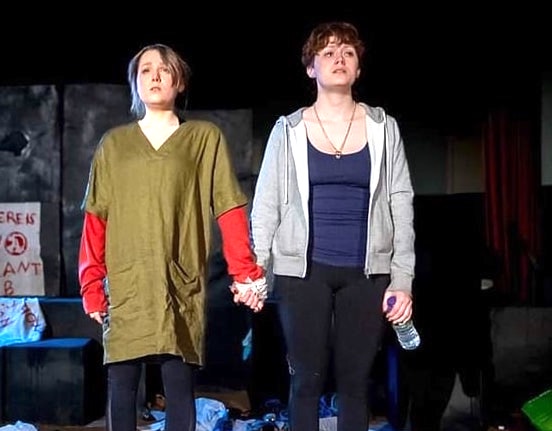
Who Killed My Father is based on Édouard Louis’s 2018 autobiographical novel, Qui a tué mon père. Adapted and directed by Nora Wardell, it’s an eviscerating piece. Part polemic, part memoir, this monologue is presented as an address to Édouard (Michael Marcus)’s invisible father, thus casting the audience in the paternal role. It’s an interesting conceit.

Édouard’s father is disabled, thanks to his (literally) back-breaking work in a factory. But Édouard’s relationship with his dad is complicated: although he feels sympathy for the dependent old man he has become, he remains angry with the alcoholic homophobe, who made growing up gay in their small French village so very difficult. Still, now that he is an adult, Édouard is able to take a step back, and finally recognise the systemic inequalities that have shaped his father’s destiny, and to extrapolate from that the myriad ways in which so many marginalised people’s lives are damaged by political figures, uncaring and oblivious to the consequences of their acts. This play – where he denunciates these figures – is Édouard’s revenge.

It’s a compelling idea, but – for me – it doesn’t quite come off. For starters, there’s nothing to indicate that we’re in France until the very end, when a number of French politicians are named and shamed. This should be a powerful moment, but instead it momentarily confuses me, so that I’m mentally relocating the story rather than focusing on the point being made. In addition, the stage is cluttered with a vast array of props that just aren’t used, including a fabulously complex Scalextric. (I only had the figure-eight version when I was young; this one is the stuff of dreams, so it’s particularly frustrating that it’s given such prominence but never called into play.)

In the end, the message feels a little muddled, lost in a scattershot of anecdotes and directorial flourishes.

2.8 stars

Susan Singfield

Good: NT Live

28/04/23

Cameo Cinema, Edinburgh

We miss the first screening of Good due to health issues and are resigned to our fate, but happily The Cameo Cinema offers this encore screening just as we’re scratching our heads and wondering what we should see tonight.

Written by the comparatively little known C P Taylor (who tragically died soon after Good had its London premiere in 1981) this excoriating piece of theatre feels weirdly askew from the opening scene. Why has set designer, Vicki Mortimer opted to use so little of the Harold Pinter Theatre’s stage, confining the action to a narrow, wedge shaped, performance space, which only really opens up at the play’s startling conclusion?

Well, it’s this confined quality which emphasises the chilling claustrophobia of the piece, the story of a man consumed by his own hubris and his willingness to repeatedly spin his own heinous crimes as the actions of a ‘good’ person.

The man in question is Halder (David Tennant), a German literary professor whose published works catch the eyes of important people in the rising Nazi party, and who is invited to join their swelling ranks. But there’s an obvious problem with this suggestion: Halder’s best friend, psychiatrist Maurice (Elliot Levey), is Jewish and doesn’t see why he should be expected to hide the fact. Meanwhile, Halder is struggling to maintain a marriage to his hapless wife, Helen (Sharon Small), whilst looking after his mother, who is stricken by dementia – and he’s also starting an affair with one of his students, Anne. How is he going to square all these issues to his own satisfaction whilst proudly taking his place in the ranks of the SS? And at what point will he decide that he’s being asked to go too far?

Tennant, making his long awaited return to the West End, is incredibly assured in the complex role of Halder, switching from slyly funny to chillingly mercenary with aplomb. At one point, he even sings and dances with absolute authority, personifying the charmer with a steely inner self. Levy too is excellent, both as Maurice and in the other roles he inhabit, but for me it’s Small who really commands the stage, flicking effortlessly between her three female characters – and the persona of an alpha male SS commandant – simply by changing her voice and her posture. It’s a superbly nuanced performance that ensures I’m always fully aware of who she is embodying at any given moment.

Essentially a three-hander (although the play does feature other performers in its final stages), Good is an ambitious and original piece of theatre that makes me wonder what Taylor might have achieved if only he’d lived longer.

4 stars

Philip Caveney

The Shawshank Redemption

26/04/23

Festival Theatre, Edinburgh

It’s been a long journey for The Shawshank Redemption. Stephen King’s novella, first published in his Different Seasons collection in 1982 was adapted into a feature film in 1994. Nominated for a clutch of Oscars (none of which it won), the film became a slow burner and has often featured on critics’ ‘best of’ lists. This adaptation, by comedians Owen O’ Neill and Dave Johns, premiered at the Gaiety Theatre, Dublin in 2009, and then reappeared in Edinburgh in 2013 (where coincidentally, we saw it on one of our first forays to the Fringe). Now, in a significantly rewritten version, it lands at the Festival Theatre.

It’s the tough and relentless tale of Andy Dufresne (Jo Absolom), who – wrongly accused of murdering his wife and her lover – finds himself incarcerated in the titular prison in the 1950s. Quiet and unassuming, Andy is repeatedly bullied (and even sexually abused) by a couple of hard cases he’s obliged to share space with. But he makes one real friend in the prison, Ellis ‘Red’ Redding (Ben Onwukwe), the Shawshank’s resident fixer. You need something bringing in, something that’s not officially available? Red’s the guy who can get it for you… at a price.

As the years slip inexorably by, the timescale effortlessly enforced by a series of popular songs from the period, Andy keeps his head down, doing his time and ingratiating himself with the prison’s crooked ruler, Warden Stammas (Mark Heenahan). Through it all, his Andy’s determination to escape from this hellhole never diminishes…

This is a dour and workmanlike retelling of what must rank as one of King’s bleakest stories. Gary McCann’s stark set design, coupled with David Esbjornson’s taut direction, reflects the hopelessness and depravation of prison life well enough, but the action feels somewhat dwarfed by the enormity of the Festival Theatre. This would surely have been better suited to the more intimate surroundings of The King’s but, for obvious reasons, that isn’t a possibility right now. There’s a distancing effect in that huge auditorium and I find myself wanting to be closer to the action, to feel more of the the physicality of the piece. Furthermore, I become increasingly aware of the many, quite complicated, scene changes that punctuate the proceedings and I feel unconvinced at what is revealed when that famous poster of Rita Hayworth is ripped away.

The performances are strong, though it’s the two central characters who dominate. Absalom handles the quieter, more restrained role of Andy Dufresne with ease, but its Onwukwe, as the story’s acerbic narrator, who is given more of an opportunity to shine, particularly in the second act, as events build to a stirring and optimistic conclusion. Of course, the latter was always intended to come as a startling revelation, but the tale is so well known by now, there surely can’t be a soul in the theatre who doesn’t know what’s coming in the end.

3. 5 stars

Philip Caveney