Film

The Dumb Waiter

07/07/21

Old Vic: In Camera

Some questions are no-brainers. Would I like to see The Old Vic’s production of The Dumb Waiter by Harold Pinter? Well, as I consider it to be among the finest one-act plays in history, the answer to that is a resounding yes.

Am I able to be part of the socially-distanced audience for one of its live performances? Well, no, that’s awkward. It’s a long way from Edinburgh to London – but luckily, for a small fee, I can choose to watch it online as it is transmitted live, so it’ll be the next best thing to actually being there.

And who are the chosen performers for this production? David Thewlis as Ben and Daniel Mays as Gus. When I think about it, I can’t come up with two more appropriate actors for those roles. Thewlis promises to be a perfect fit for the snappy, irritable Ben, while Mays, with his perpetual hangdog look, is just right for his hapless subordinate, Gus.

The tickets are duly booked and a reminder is popped into the diary. All good.

The Dumb Waiter first arrived on the London stage in 1960 and, in many ways, it’s the play that first cemented Harold Pinter’s reputation. It’s the tale of two hit-men, sequestered in a grubby room, waiting to kill whoever walks through the doorway. The room is pretty featureless apart from the titular dumb waiter, and the men’s rambling conversation is punctuated by a series of seemingly meaningless instructions that are delivered within it.

Of course this antiquated piece of machinery is a metaphor for something – and the beauty of the play is that a viewer’s interpretation of what it might actually represent can be wide-ranging and inventive. Across the years, I’ve seen this performed in various venues and, back in the dim and distant past, have even been part of a youth theatre production of it. The play has been a huge influence on so many other productions – Martin McDonagh’s wonderful film In Bruges, for instance, clearly owes it a considerable debt.

So, the play begins at the appointed time, and yes, Thewlis and Mays are every bit as good as anticipated. Perhaps it doesn’t help that I know the script so well I could probably be working as a prompt – so there was never any chance of surprising me here, since director Jeremy Herrin has opted to play it straight, sticking to the original staging. What’s missing, of course, is the subtle electricity that’s generated by being present at the actual event, the indefinable frisson of watching the play unfold right in front of my gaze without the inevitable distancing that ensues whenever a play is turned into a movie.

In short, I’m still longing to return to the theatre for real. Until that time, The Dumb Waiter is a fine way to pass an hour and I urge you to watch it while you still have the chance. You’ll find the link here: https://www.oldvictheatre.com/whats-on/2021/live-stream-from-home/old-vic-in-camera-the-dumb-waiter

4 stars

Philip Caveney

Supernova

01/07/21

Cineworld, Edinburgh

Ah, timing. It’s unfortunate for Supernova that its release comes so hot on the heels of the infinitely superior The Father, and that – given their overlapping subject matter – comparison is inevitable. Harry Macqueen’s film isn’t bad by any means, but it’s polite to the point of missing the point, with so much unsaid – and unshown – that it’s difficult to accept the enormity of the endpoint.

Tusker (Stanley Tucci) is a novelist with early-onset dementia; Sam (Colin Firth) is his partner. As an uncertain future looms, the couple take a camper van on a road trip, revisiting significant locations from early in their relationship and calling in on Sam’s sister (Pippa Haywood), until finally they reach a guest house with an out-of tune piano, which – it seems – is all the practice Sam is going to get before he gives his first recital in an unspecified ‘long time.’

Both Tucci and Firth give the sterling performances you’d expect: they’re believable long-term lovers, with all the tics and tender bickering that signify something solid. Neither actor is showy, and that’s good; this is a sombre story, and it deserves the gravitas they bring. Dick Pope’s cinematography is rather lovely too: all long, languorous shots, highlighting the simple beauty of the British countryside.

And yet. There’s not enough here. It’s all anticipation and no substance. There are some poignant moments: the blank pages in Tusker’s notebook giving lie to the fact that he’s still writing; Sam’s realisation that their dog, Ruby, has been bought specifically to keep him company when Tusker no longer can. But we never see any devastation, either clinical or emotional. The worst we see of the encroaching Alzheimer’s is a brief moment when Tusker wanders off and doesn’t know where he is; the most misery we witness is a muted discussion about suicide. Where are the sharp edges, the corners, the spikes? Where is the anguish? Of course, this film is all about not wanting to confront those truths: Tusker wants to die before grim reality kicks in, and Sam wants to pretend it’s never going to happen at all. But we, the audience, need to feel afraid and we don’t: it’s all too glossy, too glib, too bloodless, too bland.

In all, Supernova feels like a slightly wasted opportunity. It’s almost there, but it needs unbuttoning.

3.7 stars

Susan Singfield
In the Earth

24/06/21

The Cameo Cinema

Ben Wheatley is an enigma. Undeniably prolific, he’s also versatile. Unlike most directors, who find an approach they’re happy with and stick pretty closely to it, Wheatley flits happily from genre to genre with no apparent game plan. Indeed, recent rumours that he’s signed on to helm the sequel to Jason Statham’s big budget creature-feature, The Meg, sound implausible enough to be true. But of all his releases, only a couple of them (Sightseers and High-Rise) stand up as true successes. The rest feel like missed opportunities and his much-lauded shoot-’em-up, Free Fire, is one of the few times I’ve been in a cinema and longed for a fast-forward button.

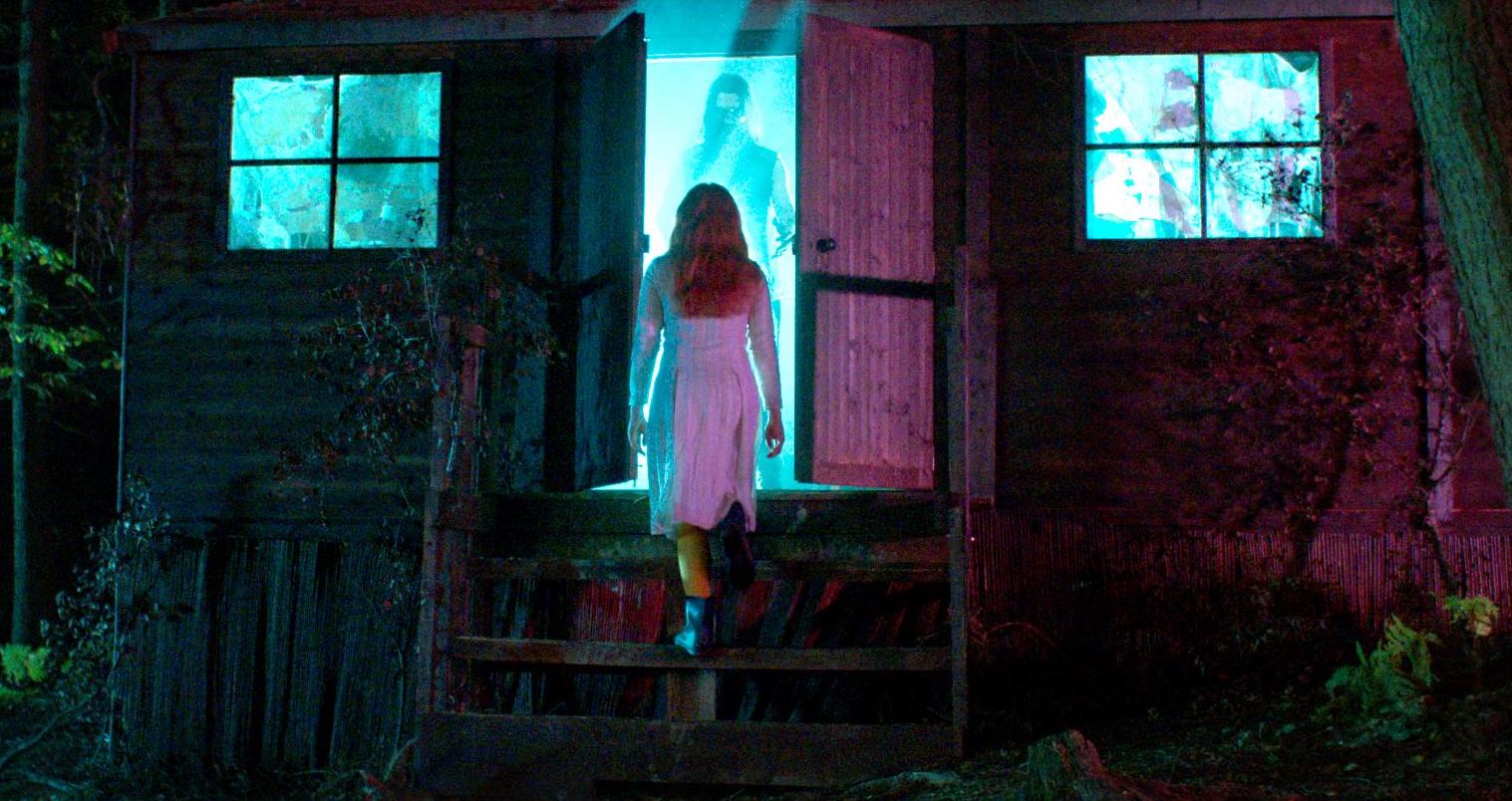
In the Earth sees him returning to the kind of folk-horror elements he mined so effectively in A Field in England, although this time he’s opted for a contemporary setting. The cities of the world are suffering through a crippling pandemic (sound familiar?) and scientist Martin Lowery (Joel Fry) arrives at a remote research facility in a forest on the outskirts of Bristol. He’s looking for his former colleague, Olivia Wendle (Hayley Squires), and is informed that she is conducting some ‘crop research’ in deep forest, several days’ walk from there. He’s assigned forest ranger, Alma (Ellora Torchia), as his guide and the two of them set off into the woods.

But one night, they are attacked by unknown assailants and robbed of their footwear. Shortly thereafter, Martin gashes his foot badly, something we’ve been kind of expecting because of a pointed pre-credits sequence. Then the two of them bump into mysterious loner, Zach (Reece Shearsmith), who takes them to his encampment and performs a bit of impromptu – and extremely grisly – surgery on the damaged foot. Martin is soon to discover that Zach is not the man to entrust his foot – or indeed, any other part of his anatomy – to. Zach is, to put it mildly, bananas, a man who believes that there are ancient spirits in this part of the forest, ones that are taking advantage of the pandemic to exert their power and influence over humanity… and then things start to get really weird.

In the Earth sets out its stall effectively enough and, though it takes a while to build up a head of steam, it boasts performances – especially Shearsmith’s – that are accomplished enough to make me suspend my disbelief over the various loopy shenanigans unfolding under the ancient oaks. Mind you, Martin is so hapless he may as well have the word VICTIM tattooed on his forehead. And why exactly is he there in the first place? A full day after viewing the film, I’m still not sure. And herein lies the main problem with this film. It’s nebulous to the point of being infuriating.

A local legend about a woodland deity called Parnag Fegg is introduced early on, but is never effectively followed up and, instead, we are offered fleeting glimpses of earlier happenings, often flung at us in the midst of psychedelic sequences, when a bunch of fungi start throwing out hallucinatory spores. The first of these passages is impressive, but I could have done without the second one, which just feels like more of the same and, once again, has me thinking wistfully about a fast-forward function. More damningly, for a horror film, apart from a couple of wince-inducing injury details, this doesn’t feel remotely scary.

In the end, I realise that I don’t really care what happens to any of the characters, mostly because I haven’t learned anything about them. File this one under ‘Y’ for ‘Yet another missed opportunity.’

3.2 stars

Philip Caveney

In the Heights

18/06/21

Cineworld, Edinburgh

Lin-Manuel Miranda’s award-winning stage musical makes a successful transition to the big screen, with Jon M Chu’s direction really capturing the community spirit at the heart of the piece. Washington Heights is a Manhattan suburb, home to a diverse range of Latin-American people. The film is a raucous celebration of Latinx culture, and – although it touches briefly on issues of poverty, racism and immigration – it’s essentially joyful: a sweet love story; “there’s no place like home.”

Anthony Ramos plays Usnavi, owner of a corner store/bodega, who dreams of returning to his native Dominican Republic to re-open his late father’s beach bar. He’s got a bit of a thing for Vanessa (Melissa Barrera), who works in a nail salon, although she really wants to be a fashion designer. Meanwhile, Nina Rosario (Leslie Grace) has come back home from Stanford University for the summer, and – though the whole-neighbourhood’s in awe of her achievements – she’s decided not to return. The grass isn’t always greener, and she misses belonging. At Stanford, she will always be an outsider.

Christopher Scott’s choreography is sublime: it’s vibrant and sexy and sometimes dizzyingly gorgeous. The huge ensemble cast are expertly utilised. There’s a scene on the fire escape that almost literally takes my breath away, and the Busby Berkeley-esque synchronised swimming provides another unexpected delight. The cinematography (by Chu and Alice Brooks) is also spectacular: you can feel the heat rising from every shot, shimmering and crackling, and – during the blackout – it’s genuinely oppressive. The neighbourhood is fully realised, and captured with love.

The film is long; some might say too long. Even though it’s bursting with energy and sparky, likeable characters, it does start to flag at around the eighty-minute mark, and there’s still more than an hour to go. A little tightening wouldn’t go amiss, but – in spite of this – watching In the Heights is, on the whole, a fun way to spend an afternoon.

Although I’m captivated, I sadly find myself at odds with the film’s underlying message, which seems to be an exhortation to appreciate what you have and stay put. I love the community pride that is feted so exuberantly here, but I’m also perturbed by the ‘don’t try anything new’ connotation, which literally nobody gets to challenge. It feels right for Usnavi to realise that home is where the heart is, that he already has exactly what he needs, but the same doesn’t ring true for Vanessa – or Nina. I wish there was more nuance here.

I’d probably like a bit more grit too, if I’m honest. The racism Nina encounters at Stanford is delivered almost as an aside; the plight of DREAMers only briefly touched upon. These are urgent, interesting topics, and there’s space here, I think, for a little more depth, more heft. As it is, In the Heights is lovely, but ephemeral. I can’t see it lingering in my mind, or having a lasting impact.

Still, if what you’re seeking is escapism, this movie more than ticks the box.

3.9 stars

Susan Singfield

Nobody

15/06/21

Cineworld

Since the success of Liam Neeson’s Taken, there’s been a trend for mature actors reinventing themselves as superannuated action heroes. The latest to throw his toupee into the ring is Bob Odenkirk (better known to many as Saul Goodman in Better Call Saul/Breaking Bad). Here he plays Hutch Mansell, the ‘Nobody’ of the title and, in a series of rapid fire clips, we’re shown just how ordinary his everyday existence is. Married to Becca (Connie Neilsen), with a couple of young kids to support, his biggest concern seems to be getting the household garbage out on time for the weekly pickup. You know. An ordinary guy with an ordinary job and an ordinary past.

But a household burglary intrudes upon his routine and the fact that the thieves steal his little girl’s Kitty Kat bracelet makes him snap – whereupon we learn that Hutch isn’t quite as ordinary as he seems. He is a former ‘auditor’ for the FBI, a man adept at using his fists and a variety of weapons to lethal effect – which he now proceeds to do with unwholesome relish, first by taking on a bunch of bullies who have the misfortune to get onto the same bus as him and latterly, by taking on Russian mobster Yulian (Aleksey Serebryakov), a man who is no stranger to violence himself and who seems to have half the Russian population of America at his beck and call.

Nobody is decently acted and glossily filmed and it has a penchant for putting Vegas-style ballads behind the action sequences, which sometimes works to good effect – but what’s utterly repugnant about this film is the neanderthal subtext, the suggestion that a man cannot be truly happy unless he’s driving a broken bottle into another man’s face. Even more insulting is the notion that women secretly respect this – a scene where Becca responds sexually to Hutch, after years of abstinence, because he has reinvented himself as a ‘tough guy’ is pretty much the final straw. All the female characters here are either silent victims or, like Becca, they respond to the overtures of a ‘real man’.

It’s 2021 for Christ’s sake! This kind of nonsense would have seemed hopelessly outdated back in 2008, when Taken was originally released, but now you wonder how anybody could be so insensitive as to create something so morally reprehensible. (Derek Kolstad, step forward and accept the Misogynist of the Year prize.) Odenkirk must also carry some of the blame, since his production company is behind this farrago.

As the film progresses (if I can use that verb), the mayhem becomes ever more over-amped and ridiculous, as Hutch – aided by his aged dad, David (Christopher Lloyd), and the mysterious Harry (RZA) -takes on hordes of Russian hitmen, none of whom appear to have had any weapons training and who are summarily beaten, shot, stabbed and blown to smithereens. Kolstad, of course, created the character of John Wick and that franchise is no stranger to extended fight scenes, but here the prolonged action just becomes monotonous, as limbs are snapped, eyes gouged out and bodies blown to pulp.

By this time, I’m just praying for it to end – and don’t get me started on the film’s ludicrous conclusion, which appears to be hoping for another instalment of this drivel. The most depressing thought of all is that Nobody might just succeed in that ambition.

1 star

Philip Caveney

The Father

11/06/21

Cineworld

It’s been over a month since the 2021 Oscars, where The Father won awards for best male actor and best adapted screenplay, but somehow it seems I’ve been eagerly awaiting its arrival for much longer than that. It’s finally here, available to view on the big screen, where its powerful narrative pulses from every frame.

Anthony Hopkins is, it seems, the oldest recipient of the best actor award and we know, don’t we, that sometimes such honours are handed out because it’s late in an actor’s career and there might not be another chance to reward him? But make no mistake, his performance in the lead role is a genuine tour de force. As ‘Anthony,’ a widowed man enduring the terrifying, mind-scrambling rigours of Alzheimer’s, he pulls out all the stops, taking his character through a range of moods and manifestations – from grandstanding showoff to sly insinuator – before delivering a final, desperate scene that is absolutely devastating.

Those seeking a rollicking, sidesplitting comedy should be warned: this is not the film for you.

Anthony – when we first encounter him – is living alone in his spacious London apartment, where he’s receiving regular visits from his compassionate daughter, Anne (Olivia Colman). Anthony has recently dismissed his paid carer, claiming that she’s stolen his watch, and he’s adamant that he will not, under any circumstances, move out of the place that he has always regarded as home. But as the story progresses, the touchstones of his life crumble one by one as the familiar things around him begin to change at a terrifying rate. The place doesn’t look the same… items have been moved, rearranged. Anthony’s favourite painting is missing… and why does somebody by the name of Paul (Mark Gatiss) parade around saying that this is actually his apartment? Who is Paul exactly? Anne’s ex-husband? If so, who’s the other Paul (Rufus Sewell), and why does he act like he owns the place? And what’s all this nonsense about Anne moving to Paris?

Perhaps the new home help, Laura (Imogen Poots), might be able to put things in order, but why does she remind Anthony so much of his other daughter, Lucy, the one he seems to have lost touch with? And most bewildering of all, why is it that sometimes, even Anne appears to be a different person than she used to be?

Florian Zeller’s astonishing film, adapted from his stage play, unfolds almost like a psychological horror story, as Anthony struggles to take in what’s happening to him. While I expected this to be bleak, I’m not fully prepared for the power with which it hits me. There’s doubtless extra impact because, for the last ten years of her life, my own mother was afflicted by Alzheimer’s and I recognise many of the beats here as being absolutely authentic. Perhaps that’s why the tears are rolling so copiously down my face.

Despite being confined mostly to one set, The Father never feels stage bound, because so much of what I can see onscreen is in a constant state of flux and because, at times, I feel every bit as unsettled as Anthony does. I’m never entirely sure where a scene is taking place, when it it is set and who is present in it – and that’s not meant as a criticism, but as an observation about the story’s unsettling grip on me. While there was aways a danger of The Father being completely dominated by Hopkin’s extraordinary performance, Colman is as excellent as always, managing to kindle the audience’s sympathy with a mere glance. And Olivia Williams is also compelling as the film’s most enigmatic character.

I walk out of the cinema, bleary-eyed from crying and, if I still have a few unanswered questions, well, that feels exactly right. This is an assured film that handles its difficult subject with rare skill.

So, worth the wait? Most definitely. But maybe remember to take some hankies?

5 Stars

Philip Caveney

Dream Horse

09/06/21

Cineworld, Edinburgh

Yeah, yeah, we’ve seen it all before. A British film about a bunch of working-class people, cast adrift by the closure of whatever industry has kept them going, left to fend for themselves, lost, broke and frightened. Until – hurrah! – they’re saved, thanks to their plucky can-do attitudes and a sense of community… Miners saved by joining a brass band, steelworkers redeemed by stripping, you know how it goes. And yeah, it’s all very inspiring, but somehow it leaves a nasty taste in the mouth, because what’s it saying? That our government doesn’t owe us a duty of care; we just need to dig deep enough, try hard enough, find our own way out of the mire? I don’t buy it.

But I really like this film, written by Neil McKay and directed by Euros Lyn. I just do. I’m not really expecting to, but I can’t help myself. My heartstrings are well and truly tugged.

It’s very, very Welsh. And, as a Welsh person who no longer lives in Wales, I find myself filling up as Katherine Jenkins sings Hen Wlad Fy Nhadau, the crowds at the racecourse joining in, and when the Cefn Fforest locals line the streets, singing Bread of Heaven. There’s quite a lot of singing, actually – which is no bad thing.

The plot is no great shakes. It’s based on the true story of supermarket cashier Jan Vokes (Toni Collette), her unemployed husband, ‘Daisy’ (Owen Teale), and city accountant Howard Davies (Damien Lewis), who make a plan to breed their own racehorse. Jan has experience of breeding greyhounds and pigeons, and Howard has previously owned a racehorse – which was so expensive it nearly cost him both his home and his marriage. But they’re all trapped and fed up, and this plan offers them a glimmer of hope. However, they can’t afford it alone. And so the syndicate is born, and – although only twenty-three people actually commit to stumping up the ten pounds a week required for part-ownership – it seems like the whole village is invested in the group’s success.

First, the Vokes buy an injured mare named Rewbell. Then, they breed her to Bien Bien, a thoroughbred stallion. The resulting foal is Dream Alliance, owned by the syndicate, and trained by Philip Hobbs (Nicholas Farrell). Howard warns the syndicate that they are unlikely to make much money from their horse – that they have to be “in it for the hwyl,” not financial gain. This proves to be wise advice. It’s not too much of a spoiler to say that Dream Alliance becomes a relative success (because it would be a very different kind of movie if the venture were a flop), but no one makes more than a couple of grand. The hwyl though. The hwyl. That’s life-changing.

There’s such a lot of hope in this film, such a lot of joy. The importance of simple camaraderie, of sharing a goal, of feeling part of something; it’s all writ large here. Kerby (Karl Johnson) is a shambling alcoholic until the syndicate gives him new hope; widow Maureen (the inimitable Siân Phillips) finally has something other than Tunnock’s teacakes (delicious thought they are) to divert her. The whole crew take a minibus to the races and crash into the owners’ bar, claiming their place among the elite with their heads held high. It’s glorious. And there is, genuinely, some real suspense in those final furlongs.

If you’re looking for something to raise your spirits, Dream Horse is it.

Enjoy. Mae’n grêt.

4.3 stars

Susan Singfield

A Quiet Place: Part Two

04/05/21

Cineworld

A Quiet Place was, in many ways, an extraordinary film. The levels of tension it generated led to a new phenomenon in multiplexes across the world – audiences actually being afraid to munch their popcorn or slurp their soft drinks too loudly, for fear of attracting those audio-activated monsters to their auditorium. The main question in my mind when a second instalment was mooted was simply this: can they possibly hope to pull off the trick for a second time? Well, to a large degree, they have, and this despite the fact that (spoiler alert!) a major character was killed off at the end of the first movie.

Part Two opens with a flashback to Day One of the alien invasion, as Lee Abbott (writer/director/actor John Krasinski) wanders to a baseball game in his hometown, where his son, Marcus (Noah Jupe), is just about to step up to the plate. Then there’s some commotion in the skies above them and, before you can yell, ‘Scarper!” those nasty reptiles arrive on the scene and start killing people. All hell breaks loose and the focus moves from Lee to his daughter, Regan (Millicent Simmonds). We see much of the ensuing carnage through her viewpoint. Long sequences are enacted in total silence – Regan is hearing impaired – and with brilliant use of this device, the resulting action is a masterclass of impeccable timing and effective jump-scares.

Then we cut back to where we left off in Part One. Evelyn (Emily Blunt) and her three children – one of them a newborn baby – are forced to wander off the silent path they’ve so painstakingly built to go in search of other survivors. Eventually they find one in the shape of Emmett (Cillian Murphy), a former friend of Lee’s, a man who is himself mourning the death of his wife and children. Can Evelyn persuade to forget his misery long enough to help her? And what’s the point if life is going to be the miserable existence that they’re all toiling through?

Well, the thing is, Regan has this cunning plan, one she’s convinced can give humans a competitive edge over the creatures that have invaded their planet. But making it work isn’t going to be easy…

Once again, the AQP team manage to raise the suspense to almost unbearable levels and at times I find myself holding my breath as the next nail-biting sequence unfolds. Okay, so this time out, there are a few implausibilities in the mix. In quieter moments, I find myself asking questions like, ‘Do these guys ever get to eat anything?’ Or, ‘How can Evelyn generate enough milk for that baby if she’s not getting any nutrition?’ and ‘How come the aliens only ever (okay, usually) arrive one at a time?’

And… while I’m being picky, Krasinski does pitch us a few too many cross-cut sequences where what’s happening in one scene mirrors the action in another one happening miles away. The first time you see it, it’s really impressive, but Part 2 is a little over-reliant on this conceit. And… if I’m really honest, the central message about the children needing to measure up to their fearless father is hammered home a little too forcefully for comfort.

But look, here’s the bottom line. As an immersive cinematic experience, A Quiet Place: Part Two does deliver on its main mission to thoroughly terrorise viewers – and that’s this series’ raison d’etre, surely? Emily Mortimer’s recent announcement that AQP is going to be a trilogy makes me sigh a little. Hardly anyone ever manages a successful hat trick, but of course, that’s all somewhere in the future. We’ll see.

For now, why not pop along to your socially distanced cinema and raise your stress levels even more than they already are? Come on, you know you want to.

4 stars

Philip Caveney

Frankie

01/06/21

Cameo Cinema, Edinburgh

Frankie had its premiere at Cannes in 2019 and, for obvious reasons, has been waiting ever since for a UK release. Finally, here it is in all its underwhelming glory. Starring the seemingly ageless Isabelle Huppert in the title role, this is the story of a successful film and TV actor (so no stretch there) who, when she finds herself stricken by incurable cancer, summons her extended family for one last vacation in Sintra, an idyllic beach location in Portugal.

She’s accompanied by (amongst others) her husband, Jimmy (Brendan Gleeson), her wayward son, Paul (Jérémie Renier), her former husband, Michel (Pascal Greggory), and her close friend, Ilene (Marisa Tomei), who, we are told, works in the film industry, currently on Star Wars. Frankie appears to be hatching a scheme to matchmake Paul and Ilene, so it’s a bit of a nuisance when she turns up with a boyfriend in tow, cinematographer Gary (Greg Kinnear) – and even more of problem when he proposes. But Frankie is skilled at manipulating the lives of those who love her and she likes nothing so much as a challenge…

Ira Sach’s languorous film is a melancholy affair that sets a bunch characters down in an idyllic location, and then fails to give them enough to do. They interact with each other, but no great drama is generated through their conversations and not much in the way of interest, either. Frankie is a siren figure, the brilliant star around which all the others circle like satellites. As Jimmy says in a key moment, he cannot really envisage any sort of life ‘after Frankie’ and nor, it seems, can the rest of them. But is this enough to create a satisfying movie? Well, no, not really, especially when some of the characters remain enigmas.

Frankie’s daughter, Sylvia (Vinette Robinson), for instance, is going through a separation from her husband, Ian (Ariyon Bakare), but we’re never really sure why – and we learn even less about their teenage daughter, Maya (Sennia Nanua), other than the fact that she likes to spend time on the beach. (But then, who doesn’t, especially in a place like Sintra?) Huppert is as enigmatic as ever, giving an almost ethereal performance – although for somebody succumbing to the ravages of cancer, she appears to be in perfect health.

Ultimately, this is pleasant enough, but it fails to kindle enoughof sparks to set the proceedings alight.

2.9 stars

Philip Caveney

Army of the Dead

28/05/21

Netflix

‘It’s fast, it’s frantic and above all, it’s fun to watch.’

That’s what I said about Train to Busan. Unfortunately, this is Army of the Dead and, though the expertly-edited trailer suggests that this could be up there with Sang-ho Yeon’s movie, the end result is frankly not in the same league. This is a film by Zack Snyder.

Snyder has previous form in this genre. His 2004 reworking of George Romero’s horror classic, Dawn of the Dead, was actually pretty good. It was the film that originated the idea that the undead didn’t have to shuffle along like… well, zombies, but could hurtle after their prey like Mo Farah on steroids. This might not sound like much but, in its own way, it was a bit of a game-changer. Of course, over the intervening years, Snyder has pursued a path of making his films bigger, louder and er… longer. Sadly, Army of the Dead is no exception. To be fair, it opens brilliantly. The title sequence galumphs merrily along to a jaunty tune, and manages to convey the film’s entire back story in a blood-spattered nutshell.

But then the titles end and we realise we’ve still got got two hours and twenty six minutes to go…

Former mercenary Scott Ward (Dave Bautista) has been a major part in saving the world from a zombie epidemic. His reward is a dead-end job, flipping burgers in a cafe. He’s understandably miffed. Then, he’s approached by Casino owner, Bly Tanaka (Hiroyuki Tanaka), who informs him of millions in dollars in cash, locked up in a vault beneath Las Vegas. The only problem is, the place is currently a walled-off zone, housing all the remaining zombies from a disastrous outbreak, and it’s due to be tactically nuked in a few days’ time. Would Scott be prepared to assemble a squad of former associates and head into the city to ‘liberate’ the money? He can keep fifty million and divide it up however he wants.

Before you can say “Hmm, sounds risky,’ Scott has his team assembled and is heading into Las Vegas intent on setting himself and his friends up for a more prosperous future. He has a way in. His estranged daughter, Kate (Ella Purnell), works in a detention centre right next to the barricades. Scott and Ella are distant, mostly because Scott had to push a knife into his wife (Ella’s mother)’s brain back in the day, but, to be fair, she was turning in to a zombie. So here’s the ideal opportunity to reconnect.

Anyhow, in the mercenaries go and we’re all set for a taut, exciting bloodfest, right?

But no, Snyder wants to take every opportunity to establish his characters. It doesn’t help that they are a fairly tedious bunch, who seem incapable of making the right decision in any given situation. They say things that no real person would ever say, have a predilection for making bad jokes at importune moments, and an attempt to play up a feminist angle for Lily (Nora Arnezeder) is woefully misjudged. The most interesting of the characters is undoubtedly safe-cracker, Dieter (Matthias Schweighöff), but a plot hole the size of Nevada means that there’s no logical reason for him to to be on the team in the first place.

But what really weighs this down is the film’s lack of pace. Busan threw its characters headlong through a whole series of frantic set-pieces, hardly giving an audience the chance to take a collective breath, but Army takes us along at a slow trudge, with too many tedious stops along the way. Snyder always has a great eye as cinematographer – indeed, I suspect this is where his true talents lie. The world building here is skilfully done and the renderings of a devastated Las Vegas are spot on. There are also some stirring action sequences, including a thrill-packed helicopter flight, towards the end.

But it’s not enough to salvage the dead weight of what’s gone before. An odd conclusion (with another gigantic plot hole) seems to be setting up for a sequel but perhaps that’s just wishful thinking on Snyder’s part.

In short, this zombie film is ultimately toothless – and it sucks.

2.5 stars

Philip Caveney