Film

Marcel the Shell with Shoes On

15/02/23

Cineworld, Edinburgh

Marcel is an unlikely star. He began his film career in a short clip on YouTube in 2010 and, over the next few years, starred in two more brief adventures. These subsequently went viral and were viewed by over 50 million people. A feature film was a possibility, but could something created on a whim have sufficient clout to sustain a running time of one and a half hours? On the evidence of Marcel the Shell with Shoes On, the answer to that is a resounding ‘yes!’

Marcel seems to have been inspired by one of those weird little items you’ll sometimes encounter at the bottom of a long-forgotten drawer. You don’t remember where you got him or even why you hung onto him for so long – maybe you had a vague notion that he might come in useful one day? Created by Dean Fleischer Camp and endearingly voiced by Jenny Slate, Marcel is the cutest one-eyed shell with doll’s feet you’re ever likely to encounter. He can talk! He can sing! He can even knock out a mean version of Amazing Grace, using a piece of pasta as a trumpet. He lives in an Airbnb with his nanna, Connie (Isabella Rossellini), and he misses the other members of his family, who were inadvertently swept into a suitcase when the apartment’s previous occupants went their separate ways.

Now Marcel and Connie have a visitor called Dean (Fleischer Camp), a filmmaker who has decided to capture the duo’s antics on camera and who, in a move that echoes Marcel’s origins, decides to post the resulting footage online…

If this sounds like an unpromising concept, don’t be misled. Marcel is a delightful creation, who easily charms his way into my affections without ever being over sentimental. It’s hard to pin down his appeal in words, but pretty much everything he says makes me warm to him, whether he’s explaining his daily routines, demonstrating one of his Heath Robinson-like inventions or merely interacting with Connie. The screenplay, written by Fleischer Camp, Slate and Nick Paley, is beautifully nuanced, which means that – while younger viewers can simply enjoy the jokes and the lo-fi stop frame animation – more mature audiences will appreciate the more serious topics, like dementia and bereavement.

When Marcel wonders if his online followers might be able to help him locate the missing members of his family, the film cranks up a gear, drawing in real life TV personalities like Lesley Stahl of 60 Minutes, and even chat show titan Conan O’ Brien, who are clearly as impressed by Marcel as the rest of us. Utterly goofy and totally irresistible, MTSWSO has one other plus point worth mentioning: the various trailers for the movie utilise material that you won’t find in the actual feature. Trust me, I see a lot of trailers and this makes a refreshing change.

This film has, of course, been Oscar-nominated and – while I personally believe that Guillermo del Toro’s Pinocchio truly deserves to lift the ‘best animation’ gong – I won’t be totally surprised if a one-eyed shell beats everyone’s expectations. Whatever happens, this is a must-see.

But be warned: all but the most cynical will be in serious danger of falling head-over-heels for Marcel’s considerable charms.

4.6 stars

Philip Caveney

Blue Jean

14/02/23

Cineworld, Edinburgh

It’s hard to remember sometimes, from our current vantage point, just how deeply ingrained homophobia was in 1980s Britain. Writer/director Georgia Oakley’s debut film takes us back to 1988, and the implementation of Margaret Thatcher’s controversial Clause 28, which explicitly banned schools and local authorities from ‘promoting’ homosexuality. I was in sixth form then, and I mostly remember finding it ridiculous – as if, without the clause, there would be advertisements everywhere. “Come on, kids! Be gay! It’s great!” But I only had the luxury of dismissing it as stupid because I was straight. I don’t know how it made the gay kids feel. I didn’t know anyone who said they were gay back then (although, of course, many have come out since). I don’t blame them for keeping schtum. I don’t remember the schoolyard as a place that celebrated difference.

Jean (Rosy McEwen) is a PE teacher. She’s also a lesbian, recently divorced from her husband, and enjoying a new relationship with Viv (Kerrie Hayes). But while Viv is at ease with herself – out and proud and politically engaged – Jean is less confident about her sexual identity. She’s still keen to fit in with the heteronormative world; she doesn’t want to draw attention to herself, either at school or with her family. It’s a matter of survival: however shocking it may seem, she’s right to fear her that job is on the line. She manages by drawing a clear distinction between work and home: she lives in a different town from the one she teaches in, and refuses drinks invitations from her colleagues. Her social life revolves around a gay club and a lesbian commune, and here she’s free to be herself.

Until fifteen-year-old Lois (Lucy Halliday) shows up in the club. She’s belligerent and bold – and she’s also Jean’s student. Suddenly, Jean’s worlds collide. Her carefully segregated life is under threat, and she’s torn between fight or flight.

Oakley’s script gives us a clear insight into the era, and into the overt discrimination that permeated popular culture. McEwen shows us a young woman forced into a choice she doesn’t want to make: she has to be a hero or a failure; she can’t just be; the government’s weird preoccupation with consenting adults’ sex lives has a profound impact on real people. Hayes is heartbreaking as Viv, whose clear-eyed view never dulls her pain, and newcomer Halliday is mesmerising on the screen.

Clause 28 was finally repealed in 2003, and things have certainly improved – although, of course, there’s still a way to go. Blue Jean serves as an important reminder of why we can’t ever relax our vigilance, and why we mustn’t let things slide. People’s lives and happiness depend on it.

4 stars

Susan Singfield

The Whale

11/02/23

Cineworld, Edinburgh

Charlie (Brendan Fraser) is rapidly approaching the end of his life. Since the death of his partner, Adam, he has allowed his health to decline. Inanimate, a binge eater and a housebound recluse, he now weighs in at over 600 pounds and, as his friend, Liz (Hong Chau), repeatedly tells him, if he doesn’t get himself to a hospital he will, inevitably, suffer a massive heart attack. But Charlie has no health insurance and insists on working at every opportunity, teaching English Literature online – though he pretends that the camera on his computer is broken so his students cannot see him.

But Charlie still has one burning ambition, – to reconnect with his estranged daughter, Ellie (Sadie Sink), whom he abandoned when she was eight years old. It’s not going to be easy, because she is hostile to his approaches, blaming him for the fact that her mother, Mary (Samantha Morton), is a heavy drinker and still very much a loner. Into this scenario wanders Thomas (Ty Simpkins), a young missionary, seeking to give Charlie some spiritual help – but mostly looking for his own salvation.

Directed by Darren Aronofsky with a screenplay by Samuel D Hunter (based on his stage play), The Whale was filmed during lockdown, and (very fittingly) feels trapped by its stage origins, confining itself almost completely to Charlie’s dark and claustrophobic apartment. It’s been accused by some as an exercise in fat-shaming, though this seems unfair: Charlie is an engaging and complex character, dealing with grief and addiction. Fraser wears convincing prosthetics, created by a whole team of artists, which serve to illuminate the almost cartoonish grotesquery of his size, while still making us empathise with his plight.

There’s no doubting the power of Fraser’s Oscar-nominated performance in the central role, fuelled to some degree, I think, by his own punishing experiences in the movie industry. In fact, all of the performances here are skilled, particularly Sink’s incandescent turn as an anger-fuelled teenager, determined to exact her revenge on just about everyone she encounters. The scene where Charlie has to offer to pay her to visit him is particularly tragic.

If I’m honest, I think there are better, more nuanced films in this year’s Oscar contenders, but I won’t be at all surprised if Fraser gets the nod for best actor. His performance here is exemplary, and The Whale is a powerful and affecting drama.

4.4 stars

Philip Caveney

The Fantastic Life of Minnie Rubinski

09/02/23

The Fruitmarket Gallery, Edinburgh

Vision Mechanic’s production of The Fantastic Life of Minnie Rubinski was conceived during the pandemic and is inspired by creative director Kim Bergsagel’s mother (real name Sondra Rubin). Part movie, part installation and part puppet-show, it’s an affecting look into the memories and changing fortunes of one woman’s life.

Entering the performance space, we find ourselves in a darkened room dominated by a central ‘brain,’ a little shelter where we are invited to sit awhile and listen to the recorded sounds of a jumble of voices and musical cues. From there, we can follow one of a number of illuminated ‘synapses’ to a whole series of screens showing vignettes of key incidents from Minnie’s life. The characters are puppets, moving around custom-built sets, which are presented in intricate detail – check out the sequence in a 1950s supermarket and take a close look at the hundreds of items ranged on the shelves. The attention to detail is astonishing!

The scenes we are offered range from charming glimpses of Minnie’s childhood, to the years of her unfulfilling marriage, her time spent running a swish art gallery and latterly, her final days in a care home as she increasingly descends into dementia. It’s in these latter stretches that some of her adventures become particularly bizarre and the lines between memories and hallucinations are allowed to blur. We can choose to watch the sequences chronologically or simply go to whichever screen is vacant at any given time and piece everything together from what’s onscreen. (I really recommend this approach. It’s oddly like playing detective and the storyline is so skilfully handled, it never becomes confusing.)

Of course, a production like this isn’t the work of one person, but of a whole team of creative artists – puppet makers, set dressers, musicians, you name it – and their splendid endeavours are up there on the screens for all to see, as they pool their diverse talents to create a charming and fascinating narrative. I can honestly say I’ve never seen anything quite like this before.

Interested parties should make a beeline for the Fruitmarket Gallery, because this delightful production, showing as part of the Manipulate Festival, is only available to view until Sunday 12th February. Go and spend forty-five minutes in Minnie’s extraordinary world. It’ll be time well spent.

4.4 stars

Philip Caveney

Saint Omer

06/02/23

Cameo Cinema, Edinburgh

To describe Saint Omer as a courtroom drama would be doing it an immense disservice. Yes, the action does take place in a courtroom in the titular French town – and yes, the story is inspired by real-life events, namely the trial of Fabienne Kabou, accused of the infanticide of her young daughter in 2016. But Alice Diop’s slow-burn feature is about so much more than what meets the eye.

In this version of the tale, the accused is Senegalese Laurence Coly (Guslagie Malanda), whose only defence for leaving her daughter on a beach to die is that witchcraft impelled her to do it.’ The court’s Président (Valérie Petit) is understandably mystified and exasperated by the woman’s apparent conviction that, having admitted to the murder, she is perfectly justified in submitting a plea of not guilty.

Successful author, Rama (Kayije Kagame), also Senegalese, feels impelled to attend the trial. She’s pregnant herself and is in the process of writing a new book based around the myth of Medea, and believes that elements of the story are echoed in Coly’s situation. Rama also meets up with Coly’s manipulative mother, Odile (Salimata Kamate), who exerts a quiet sense of control, while utterly refusing to discuss her daughter’s claims of sorcery. As the trial progresses, Rama feels herself increasingly drawn to Coly’s plight.

Slow-paced and deeply compelling, Saint Omer feels like a meditation on the unfair demands of womanhood – that, purely because of their biology, women are forever cast as unremittingly evil whenever they are unable to fulfil the demands that motherhood places upon them. Everything builds to an impassioned address from defence lawyer, Maître Vaudenay (Ayrélia Petit), her remarks addressed direct to camera, so there can be no doubt of their intention.

It’s interesting to note how little cinematic artifice is on display here – hardly any of the cuts, dissolves and pans we associate with a movie are utilised, while characters remain curiously inert throughout proceedings. Coly is even dressed in clothes that virtually blend with the wood panelled background of the courtroom. She is, it seems, already virtually invisible. An extract from Pier Paolo Passolini’s film Medea (1969) seems to have been included merely to accentuate the gulf between Rama’s original notion and the stark reality of Coly’s situation.

And, unlike any other courtroom drama I’ve seen, there’s no interest in recording the outcome of the trial, and this seems entirely appropriate. Saint Omer is much more interested in what is left unsaid. It’s an undeniably powerful and illuminating film, expertly told.

4.4 stars

Philip Caveney

The Fabelmans

28/01/23

Cineworld, Edinburgh

In the wake of the pandemic, several film directors seem to be have been inspired to take a closer look at at their own roots. Already this year we’ve had Sam Mendes’s Empire of Light, Alejandro G Innarutu’s Bardo and James Gray’s Armageddon Time – though good luck tracking down any cinema or streaming service showing the latter.

Now comes the turn of Steven Spielberg, arguably one of our greatest living directors, who is clearly looking to settle some old ghosts with The Fabelmans. The film is preceded by a short clip featuring an avuncular-looking Spielberg, humbly thanking the audience for coming to the cinema to see his latest offering. What we are about to watch, he tells us, is his most personal film ever.

It begins in 1952, when the young Sam Fabelman (Mateo Zoreyan) goes to his very first picture show along with his parents, Burt (Paul Dano), a computer programmer, and Mitzi (Michelle Williams), a talented pianist. Sam is initially apprehensive about the upcoming experience – he’s heard terrible things! – but is transfixed by Cecil B DeMille’s The Greatest Show on Earth, particularly an extended sequence that depicts an epic train crash. That Christmas, Sam is given a lovely toy train set and he cannot stop himself from attempting to recreate what he saw in the movie and, inevitably, capturing it on film.

Time rolls on, and a teenage Sam (Gabrielle LaBelle) is living in Arizona, where Burt has gone for work. He’s still obsessively making amateur movies, aided by his willing schoolmates (including the famous World War 2 on a budget epic Escape to Nowhere) and thinks nothing of the fact that Burt’s friend, ‘Uncle’ Bennie (Seth Rogan), is a constant presence in the family’s life. It’s only when he is editing a film about a recent family camping trip that the camera reveals something he has previously had no inkling of…

The Fabelmans is essentially a family drama, but one that encompasses some weighty topics: mental health issues, the prevalence of anti-semitism and the expectations that parents can sometimes place on their children. Above all hovers the love of cinema, the almost magical ability it has to transform a viewer’s world, to allow them to escape from reality into a variety of uncharted realms. This is a warm and affectionate study of the director’s beginnings and, if it occasionally ventures perilously close to schmaltz, Spielberg is deft enough to repeatedly it snatch back from the abyss. The world he creates here is utterly believable.

There’s plenty to enjoy. I love the brief appearance by Judd Hirsch as all-round force of nature, Uncle Boris – a former silent movie actor, who recognises the nascent director lurking inside Sam and calls him to do something about it. There’s a beautifully nuanced performance from the ever-impressive Williams as a woman who has sacrificed her own creative ambitions to the demands of her family and is suffering because of it, and there’s a delicious, foul-mouthed cameo from (of all people) David Lynch. Throw in Janusz Kaminski’s gorgeous cinematography and legendary composer John Williams’ music, and you’ve got something a little bit special.

And while The Fabelmans is not quite the five-star masterpiece that so many critics have declared it to be, it’s nonetheless a fascinating look at the filmmaker’s roots and one that never loses momentum throughout its duration.

So don’t wait for streaming. See it where it belongs, and Steven will thank you in person.

4.6 stars

Philip Caveney

Bank of Dave

19/01/23

Netflix

Netflix’s Bank of Dave claims to be a true(ish) story. While I appreciate that there has to be a degree of artistic licence in any film based on real events, it only takes a quick Google search to persuade me that in this case, that licence may have been pushed a tad too far. ‘Ish’ doesn’t quite cover it. Others, of course, may disagree. Oddly enough, if this were presented to me as a work of fiction, I’d be much happier about it.

Dave Fishwick (Rory Kinnear) is a cheery, plain talking Northerner. He’s also a highly successful businessman with a fortune created from selling vans. Based in Burnley, he’s been lending money to local friends and businesses for years and, what’s more, he donates all his profits to charities. He eventually decides he’d like to set up his own bank (as you do) and engages the services of London-based corporate lawyer, Hugh (Joel Fry), in order to help him achieve that goal. Though initially sneery about anything north of Watford Gap and, fully aware that no new bank has been granted a licence for 150 years, Hugh heads off to Burnley. Once there, he’s swiftly converted by Dave’s cheery persona and by the charms of Dave’s niece, Alexandra (Phoebe Dynevor), an A & E doctor – who, it must be said, appears to have more spare time on her hands than most in her profession. 

But Hugh soon comes up against a cabal of snooty London bankers, led by the villainous (and entirely fictional) Sir Charles Denbigh (Hugh Bonneville, once more steering his career into darker waters). These toffs are determined to block the deal by any means possible. What, let some Northern oik get into the business of banking? No fear!  It soon becomes evident that founding a new bank is going to be no easy matter.

The early stretches of the film feel somewhat caricatured as the evil privileged elite stamp gleefully over everything the cheery Northerners attempt to do. The latter are depicted as a bunch of saints, fond of a good laugh, a foaming pint and a night at the karaoke bar, clapping along as Dave belts out the greatest hits of Def Leppard. (Fans of the veteran band will doubtless enjoy the film as it features several of The Lepp’s best known songs and even a guest appearance from the musicians themselves.)

Once it hits its stride, Bank of Dave is a cheerful and uplifting movie with an overall ‘greed is bad’ message that few viewers will disagree with. Piers Ashworth’s script is funny, Kinnear provides a genuinely affable presence and Fry, once he’s loosened up a bit, is immensely likeable as a leading man. Most viewers will feel genuinely uplifted by the triumphant ending.

So why the relatively low score?

Inevitably, I must return to my original point. How ‘true’ should a true story be? How much massaging of the facts are viewers expected to accept? And why can’t filmmakers – just for once – own up to the fact that a ‘true’ story might not need the unconditionally joyful ending that’s been invented here? 

You be the judge. For me, it’s an issue.

Still, that said, hats off to the real Dave – he might not have achieved the dizzy heights this film credits him with, but he has made a real difference to a lot of people’s lives.

3.2 stars

Philip Caveney

M3GAN

18/01/23

Cineworld Edinburgh

M3gan is a retread of a very familiar trope. The toy that’s more dangerous than a mere plaything. The AI that goes awry. We’ve seen it all before, haven’t we? And yet, having said that, this is terrific fun, brilliantly executed and perfectly paced, with a running time that never allows its deliciously sinister title character to overstay her welcome. There’s also a mischievous sense of humour, which can’t be said for many of its predecessors.

Gemma (Alison Williams) is a roboticist working for a toy company called Funki. They’re best known for producing jolly little companions for children – think more sophisticated Furbys. Indeed, the film opens with their latest cheesy commercial featuring entranced children interacting with their cute little ‘pets’.

Gemma’s ball-busting boss, David (Ronny Chieng) is furious that other toy companies are copying their ideas and selling them at half the price. He wants Gemma to concentrate on creating a cheaper, furrier version of their current best-seller, but she has bigger ambitions. Together with co-workers, Cole (Brian Jorden Alvarez) and Tess (Jen Van Epp), she’s been secretly working on a more sophisticated AI called M3gan (Model 3 Regenerative Android), a super-smart robot, designed to bond with the child that owns it.

When Gemma’s young niece, Cady (Violet McGraw), is orphaned in a car accident, Gemma has to take on the responsibility of parenting a child, something she has no experience of. So wouldn’t it be great, she thinks, if she could enlist a helper, someone who will always put Cady’s welfare first, while also freeing Gemma to pursue her own interests? And before you can say ‘This is a very bad idea!’ Gemma has activated M3gan and synched her with Cady. Now the AI stands ready to oppose anyone who opposes her new best friend. What could possibly go wrong?

This is a ton of fun. M3gan is a wonderfully chilling central character, created using a clever combination of animatronics, puppetry and the stylings of 10 year old actor, Amie McDonald. You’ll believe a doll can dance, whilst simultaneously brandishing a deadly weapon. McDonald’s efforts are matched by a nicely nuanced performance from McGraw, and the scenes between the two of them are spellbinding – especially when M3gan sings one of her syrupy songs! 

As you’d expect in this genre, it’s not all lighthearted fun. There are moments of bloodshed in the later stretches and, though writers Akela Cooper and James Wan don’t flinch from the body horror, director Gerard Johnstone knows exactly when to cut away from images that could so easily nudge this into the realms of an 18 certificate.

In my experience, horror films have a habit of careening out of control in the final third, but once again, M3gan confounds expectations, keeping the momentum going right through to the final scenes. Those expecting a lacklustre reworking of Child’s Play will be pleasantly surprised. Here’s a film that dances to its own tune. I leave the cinema having been thoroughly entertained – though I can’t help reflecting on the world of litigation that poor Gemma is going to face in the aftermath of M3gan’s climactic carve up.

Those in possession of an Alexa, be warned. This may make you a tad nervous about asking her to switch off the lights at bedtime.

4.2 stars

Philip Caveney
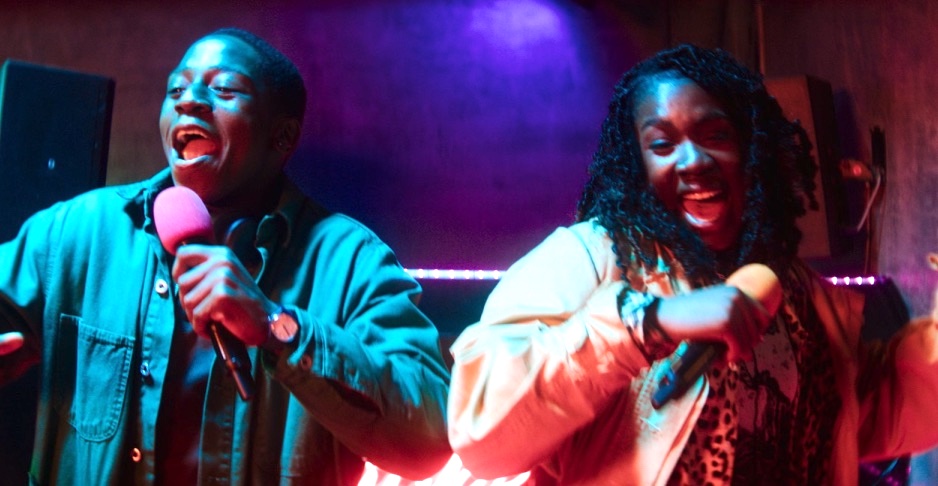
Enys Men

15/01/23

Cameo Cinema, Edinburgh

Mark Jenkins made an impressive feature debut in 2019 with Bait – a story about the gentrification of a Cornish fishing village. Filmed in monochrome, using hand-cranked 16 mm stock, it had a distinctive look, akin to one of those old public information shorts that still pop up on Youtube. The film received a well-deserved BAFTA for ‘outstanding debut by a British director’.

Enys Men (Stone Island) is both more ambitious and more nebulous than its predecessor. Jenkins has progressed to colour, but even that is done on his own terms, retaining that grungy, scratchy look he’s known for. He’s also retained the services of Mary Woodvine, who played a wealthy, holiday-cottage owner in Bait. Here, she’s ‘The Volunteer,’ marooned on a remote island off the Cornish coast, tramping industriously around the rocky landscape in a vivid red waterproof jacket. Her daily task is to keep tabs on a bunch of rare flowers.

According to her daily log, it’s the year 1973; day after day, she steadfastly records the fact that nothing has changed. Not a thing. But it’s clear from early on that her life is shadowed by vivid memories and by a series of troubling hallucinations. Who is ‘The Girl’ (Flo Crowe), who hangs around the woman’s cottage, observing her routine? And who is the elusive ‘Boatman’ (Edward Rowe, another familiar face from Bait), who regularly contacts The Volunteer via a short wave radio, promising to bring supplies, most crucially petrol for the generator.

And then there are other characters, less easy to explain – silent milkmaids, singing children, and dirt-plastered tin miners – whose expressionless visages seem to stare across the centuries in silent accusation.

Enys Men is the kind of film that flings out plenty of questions but takes its own sweet time before offering just one or two answers. Indeed, the glacial pace and the constant use of repetition test my patience at times (as does the guy sitting next to me, who spends most of the evening looking at his phone) and it’s probably fair to say that Jenkins’ script needs a little more flesh on its bones to adequately fill the film’s one-hour-thirty-six-minute running time.

Still, for all that, this is an offering that will inspire plenty of conversation long after the final credits have rolled. Jenkins is a true auteur and, though Enys Men certainly won’t be for everyone, it’s nonetheless a unique viewing experience.

3. 6 stars

Philip Caveney

Tár

13/01/23

Cineworld, Edinburgh

Todd Field’s Tár is a complex, demanding film. And yet, despite its difficult themes and its contemptuous, autocratic central character, it’s also engaging and exciting.

At first, I’m not quite sure. The film begins with the credit sequence. This feels pretty audacious in itself. They’re called ‘end credits’ for a reason, right? They’re for putting your coat on and fumbling your way down the stairs in the dark, not for actually watching. I mean, I don’t care who provided the catering truck, or who the post-production supervisor is. Here, I’m forced to watch, and to listen to the music (Elisa Vargas Fernandez’s Cura Mente).

Okay, so I’m unsettled, which I guess is the point, but from here we’re into an equally long opening scene, where we meet the eponymous Tár being interviewed. The discussion itself is deferred by an interminable introduction, listing not just the highlights, but every one of the great conductor’s achievements, and – when the questions do begin – they’re dry and academic, the answers a forensic examination of classical music from a maestro’s perspective. I find myself shifting in my seat, wondering how this is the film that’s just won Cate Blanchett a Golden Globe.

And then…

Suddenly, there’s a shift. We’re with Tár at Julliard, where she’s teaching a class. She’s angered by a young student’s dismissal of Bach as ‘irrelevant’, and we’re offered a glimpse of her scathing nature as she belittles his concerns. It’s a shocking moment – and it’s not the last. Because somebody is watching her…

Blanchett is utterly compelling. She towers; she glowers. Lydia Tár is both maestro and monster, impressive and imperious. She’s living her best life: conducting the prestigious Berliner Philharmoniker, launching her autobiography, Tár on Tár, flying first class around the world, and sharing a stunning apartment with her wife, Sharon (Nina Hoss), and their young daughter, Petra (Mila Bogojevic). But she’s also careless of other people’s feelings, and ruthless in her dealings, both personal and professional. She has dalliances with some of the impressionable young women she mentors, then ditches them when she grows bored. Nothing seems to touch her – until it all comes crashing down.

The whole thing is disquieting, elements of melodrama and thriller juxtaposed with the minutiae of how a professional orchestra works. I’ve never seen anything quite like it. Both the story arc and the characters are unconventional, the precise, deliberate nature of the structure mirrored by Tár’s meticulous dissection of Mahler’s fifth symphony.

By the time the end-end credits roll, I’m a complete convert. This is a fascinating film, so densely packed I know I need to watch it again (something I rarely do). Quite simply, Tár is a masterpiece.

5 stars

Susan Singfield