Author: Bouquets & Brickbats

Annie

MV5BMTAyNDYxOTI4MzNeQTJeQWpwZ15BbWU4MDQ3MDU3NjIx._V1_SX214_AL_

4/1/15

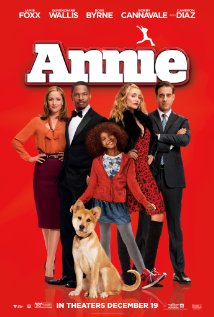
Will Gluck’s reworking of Annie is a curate’s egg of a movie. The screening we attended what not so much peopled by ‘little girls’ whose freckles needed stamping on, as by women my age, who had clearly been fans of the 1982 version – and if they were anything like me – had high hopes this might have more verve and sparkle than the anodyne 1999 Disney adaptation. It certainly does have more verve and spark. In the lead role, Quvenzhané Wallis (an absolute delight in Beasts of the Southern Wild) is as feisty, kooky and determined as she needs to be and, she’s charming too, so that her disarming of Jamie Foxx (the restyled Daddy Warbucks) is quite credibly portrayed. The modernisation is nicely handled also. Foxx plays Will Stacks, a self-made mobile phone entrepreneur in need of a better media image; his cribs-style apartment is pure property porn. Rose Byrne as his PA, Grace Farrell, is perfectly adequate and it’s good to see Annie’s friendship with the (accidentally) racistly-drawn character of ‘mystic’ Punjab ousted in favour of a more sympathetic relationship with Warbucks’ chauffeur, Nash (Adawale Akkinuoye-Agbaje.)

But there are some unfortunate mis-steps too. Cameron Diaz’s Miss Hannigan really doesn’t work. She’s unconvincing as a foster mother of any sort, lurching and gurning her way drunkenly around the children’s home, clearly playing at trashy rather than living it. The music’s a bit hit-and-miss too. There are some interesting re-arrangements of the the old songs and a few new numbers thrown in to good effect, but they all lack lung-power and musicality; surely every musical needs at least one big blousy number? In 1982 Annie had some to spare. Here, they have been summarily kicked out and this is a mistake I think. Likewise the half-hearted choreography. Back in the day everyone hoofed it up in great style but here the actors stumble apologetically around as though they don’t quite want to admit they’re actually in a musical.

Overall, I liked it. Sort of. But I don’t see it capturing the imaginations of today’s kids in the way that Aileen Quinn and Carole Burnett did in the 80’s. This version simply isn’t strong enough to compete with everything that has gone before.

3.1 stars

Susan Singfield

Birdman

MV5BODAzNDMxMzAxOV5BMl5BanBnXkFtZTgwMDMxMjA4MjE@._V1_SX214_AL_

1/1/15

The first film of the New Year turns out to be this quirky and offbeat offering from Alejandro Gonzalez Inaritu, a riveting slice of cinema that’s actually all about live theatre and the essential differences between the two media. It’s heartening to see a packed screening on opening night for what is essentially a highly experimental work, one that has as many questions as it does answers and one moreover that is cleverly edited to look like one continuous tracking shot.

Riggan Thomson (Michael Keaton) is undergoing a long dark night of the soul. Formally the star of a series of successful superhero movies, he is attempting to rejuvenate his career by appearing on Broadway in an adaptation of a Raymond Carver short story which he has written himself. When his lead actor is injured the night before the first performance, he manages to acquire the services of Mike Shiner (Ed Norton) a conceited method actor who is as destructive as he is accomplished. Meanwhile Riggan juggles the affections of his daughter cum personal assistant, Sam (Emma Stone), his lover Laura (Andrea Riseborough) his lead actress Lesley (Naomi Watts) and his manager, Jake (an unusually retrained Zach Galifiniakis.) But the spectre of his previous screen persona still haunts him and he is having terrible trouble differentiating between what is real and what is imaginary…

The film is never less than captivating and from time to time takes off on inspired flights of fantasy that dazzle the eye and stir the imagination. Keaton is a revelation in the lead role, giving the audience insights into the mind of a man who is constantly on the edge of insanity (his previous incarnation as Tim Burton’s Batman gives the story added poignancy) and the script comes laced with a vein of dark humour that never shrinks from savaging the very industry that has nurtured it. If the other films of 2015 are in this league it’s going to be a fine year indeed.

4.8 stars

Philip Caveney

Exodus: Gods and Kings

MV5BMjI3MDY0NjkxNl5BMl5BanBnXkFtZTgwNTM3NTA0MzE@._V1_SX214_AL_

30/12/14

Ridley Scott is perhaps the closest thing we have to a director of the stature of David Lean. Unabashedly old school he is never happier than when commanding armies of extras on a massive scale, so perhaps it was inevitable that he would eventually take on a biblical subject – the story of Moses. Here, the great man is played by a scowling Christian Bale who at the beginning of the film is fighting the Hitites alongside his ‘bessie mate’ Ramses (Joel Edgerton.) But when Ramses becomes pharaoh, word gets out that Moses is actually an adopted hebrew, a fact that gets him banished from Egypt and sent back to join ‘his people’ where before very long he is instructing them to seek their freedom.

There has already been some controversy about this film which features two caucasian actors in the lead roles and Scott’s reply (that it was all about getting funding and who would pay to see Mohammed Whatever in the lead role?) was understandably badly received, but I’m going to put that matter aside and concentrate on what’s on the screen, which really is a great big curate’s egg of a film. This being a Ridley Scott production, there are scenes of incredible cinematic splendour – the construction of the pyramids is amazing, the Plagues of Egypt are particularly jaw-dropping and the climactic parting of the waves is nail-biting stuff – but along the way we have to endure too many turgid scenes of people standing around in temples talking in (suspiciously contemporary terms) about fairly boring subjects. And one has to wonder why Scott bothered to engage the services of Sigourney Weaver when he wasn’t going to bother to give her anything to say. What I did like was the daring treatment of many of the accepted fantastical elements of Moses’ story. The parting of the waves is quite clearly a tsunami, we see Moses himself carving the ten commandments onto stone tablets and most contentious of all, ‘God’ is depicted as a scruffy kid with a bad haircut. Some will hate this, but what was the alternative? A white haired, bearded old geezer speaking in a stentorian voice? A bit too Life of Brian, methinks.

in the end, Scott does it his way and God help anyone who stands in his path. Overall, I enjoyed this, but those slow lengthy passages dragged down the final score somewhat. One thing is clear. When it comes to epic cinema, nobody else comes close to the majesty that is Ridley Scott. On a sad note, the film is dedicated to his brother, Tony, who took his own life in 2012.

3.8 stars

Philip Caveney

Big Eyes

MV5BMjA2ODM5MDE3N15BMl5BanBnXkFtZTgwOTIxNjc1MzE@._V1_SX214_AL_

30/12/14

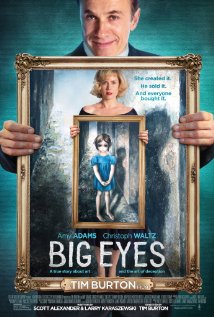
Tim Burton’s latest offering eschews the weird and wonderful fantasy for which he is best known and concentrates instead on a ‘so weird it has to be true’ tale about bad art and flawed people. In many ways, this is Burton’s best work since Ed Wood, with which it shares some DNA – scriptwriter Scott Alexander worked on both movies.

The film opens in the late 1950’s and Burton has skilfully evoked the era in his own exaggerated, slightly surreal way. Amateur painter, Margaret (Amy Adams) has just run out on her husband, taking her young daughter Jane along with her for the ride. She finds work and in her spare time tries to sell her paintings, a series of (rather dodgy) portraits of big-eyed children. She soon encounters Walter Keane (Christophe Waltz) another wannabe artist and the two of them hit it off. Within weeks they are married. When Keane’s flair for publicity starts to kindle interest in Margaret’s art, he persuades her to let the world believe that he is actually their creator and to release them under the signature of ‘Keane.’ She reluctantly goes along with it. But neither of them have realised quite how successful Margaret’s paintings will become. As the millions begin to roll in, Margaret finds herself increasingly tortured by the deceit that they have created; and the desire to be recognised as an artist. When the marriage starts to founder, it’s clear that one way or another, the truth will have to come out.

This is an intimate, small scale story that gets to the heart of the thorny subject of intellectual property. Adams and Waltz are both superb in their roles (Waltz has some particularly funny scenes, particularly in the courtroom drama at the film’s conclusion) and Burton is always better, I think, when his creative juices are reined in and he works with somebody else’s script. (Like many critics, I feel he’s lost his way lately – Alice In Wonderland was a particular disappointment, even though it racked up huge receipts at the box office.) Big Eyes however, is an excellent film and one that stands with his best work.

4.4 stars

Philip Caveney

One Chance

MV5BMTA5MzQxMzEzOTVeQTJeQWpwZ15BbWU4MDY2NzM5NzIx._V1_SX214_AL_

24/12/14

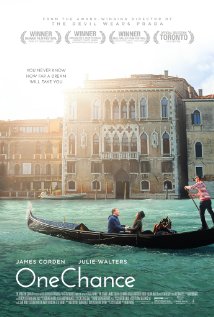
Biopics are a notoriously difficult medium in which to score a cinematic hit, especially when the subject of said biopic is not particularly famous. Paul Potts’ singular claim to fame is that he was the winner of the very first series of Britain’s Got Talent. Since then, he’s remained pretty much out of the public eye, though by all accounts, he’s doing quite well for himself.

This film follows Paul (James Corden) through his episodes of childhood bullying, his inability to please his steelworker father (Colm Meany), his more sympathetic relationship with his mother (a criminally underused Julie Walters) his days as a salesman at Carphone Warehouse and his on-off romance with Julz (the ever-delightful Alexandra Roach.) Matters come to a head when, on a self-financed opera-course in Venice, despite showing considerable promise, his nerves eventually get the better of him when asked to perform for his hero, Pavarotti. There are also a couple on incidents of incredible bad luck which seem solely designed to put him off pursuing opera-singing as a career. Corden does a good job of making us care about Potts (indeed, it’s hard to understand why such large numbers of the general public reserve levels of contempt for this actor that would seem more suited to a fascist dictator.) While One Chance is hardly world-shattering stuff, it’s nonetheless an enjoyable slice of entertainment that actually managed to make me listen to the words of Simon Cowell without breaking out in hives.

The film died at the box office and it’s easy to see why – after all, who was it aimed at? Too trivial for opera-lovers, too serious for fans of BGT, too obscure for those who enjoy a good biopic. But nonetheless, this makes for decent family viewing on DVD.

3.8 stars

Philip Caveney

3.9 stars

Philip Caveney

Mr Jones

MV5BMTA3NzIxOTA4MTFeQTJeQWpwZ15BbWU4MDY4NjQxMzEx._V1_SY317_CR6,0,214,317_AL_

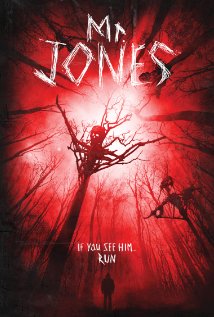
Mr Jones is one of those low budget fright movies that allows a brief glimpse of the very good idea that lies at it’s heart, shortly before driving it into oblivion with a stack of ‘seen-it-all-before’ cliches. Unusually, this one starts unpromisingly, gets really good for about twenty minutes and then goes right off the boil, to the point where it’s a real challenge to stick with it to the bitter end.

Scott (Jon Foster) and Penny (Sarah Jones) are a pair of young film makers with a relationship that has drifted into the doldrums. In order to try and fix things, they take the unusual step of heading off into the wilderness for a whole year to see if they can ‘find’ each other. To make matters even worse, Scott decides to film a daily log and even devises a camera that can film the two of them simultaneously. (This will prove handy later on when things get nasty for them, but doesn’t always convince as a cinematic device). When a mysterious hooded hermit steals Scott’s rucksack, the couple go in search of it and find the workshop of ‘Mr Jones’ a mysterious clandestine artist (think Banksey only with weird sculptures) and quickly decide that the best way to rescue their relationship is to shoot a sneaky documentary about him. Because that makes perfect sense, right?Scott heads back to the city to invite various art experts to comment about Jones’ work (this is where the film all too briefly becomes rather interesting.) On Scott’s return however, things get uncomfortable as Jones starts hanging around the couple’s backwoods cabin, acting in a threatening manner.

This is where the film blows it all with a succession of (supposedly) creepy scenes of the silence, silence, silence, boo! persuasion and the story’s ultimate ‘twist’ (Jones’ identity) surprises absolutely nobody, since we all guessed it ages ago. The shame here is that this could have been a lot better than it actually is.

File it under ‘missed opportunity.’

2.5 stars

Philip Caveney

Venus In Fur

MV5BMjM0ODgyOTM1Ml5BMl5BanBnXkFtZTgwMzI5ODM4MTE@._V1_SX214_AL_

17/12/14

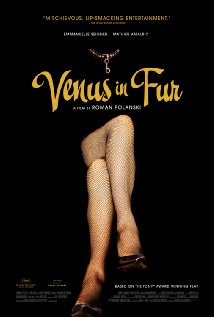
In his private life, Roman Polanski has incurred the wrath of many people. He’s also the cinematic genius who created masterpieces like Repulsion, Rosemary’s Baby and Chinatown. It’s often hard to weigh these two truths against each other. Can we really judge him only on his work and conveniently blank out what he gets up to in private? You’d have thought that in his current state of disgrace, he’d stay well away from films of a questionable sexual nature, so what are we to make of Venus In Fur, a movie whose very raison d’être is to stir the murky waters of human sexuality? Based on the play by David Ives, it’s a two-hander, which is played out in a deserted theatre and as with his previous movie, Carnage, Polanski has made no real attempt to ‘open it up’ for cinema viewing. To further cloud the waters, the film stars Emmanuelle Seigner (or as she’s sometimes know, Mrs Polanksi) and Mattieu Amalric, an actor who bears a strong physical resemblance to the director. What was Polanski trying to say here? Is this intended to be some kind of vindication of his personal life? It’s hard to say but surely these things cannot be mere coincidences?

Amalric is Thomas, a writer and director, who has just been auditioning a series of actresses for the lead role in his titular play, an adaptation of the infamous novel by Baron von Sacher Masoch (from whom the word ‘masochism’ derives.) We join Thomas at the end of a fruitless audition, where he’s expressing his hopelessness at ever finding a young woman capable of playing his heroine, Varda. Then a woman stumbles into the theatre, a woman with that very name, who begs him for the opportunity of a quick read-through with him. Tom is reluctant at first, but eventually succumbs to persuasion and quickly begins to realise that not only is this Varda very accomplished in the role, she seems to know an awful lot more about him and his work than he might have expected. As the actors become subsumed into their respective characters the sexual politics swing back and forth as they struggle for supremacy…

First of all, both Seigner and Amalric offer nicely nuanced performances and the onstage antics aren’t anything like as overt as you might have supposed. There’s little in the way of nudity and the film has comfortably managed a 15 certificate. The script veers from clever and incisive to occasionally rather clumsy (some vague hints that Seigner’s character might be supernatural are never really consolidated.) Ultimately, the film is fatally skewered by a sudden (and frankly rather risible) ending that undoes much of the actors’ best efforts to make this unwieldy contraption fly. It’s by no means awful, but neither is it in the same league as Polanski’s best work and this one should be filed under ‘interesting failures.’

3.5 stars

Philip Caveney

The Stand Comedy Club

landingheader

12/12/2014

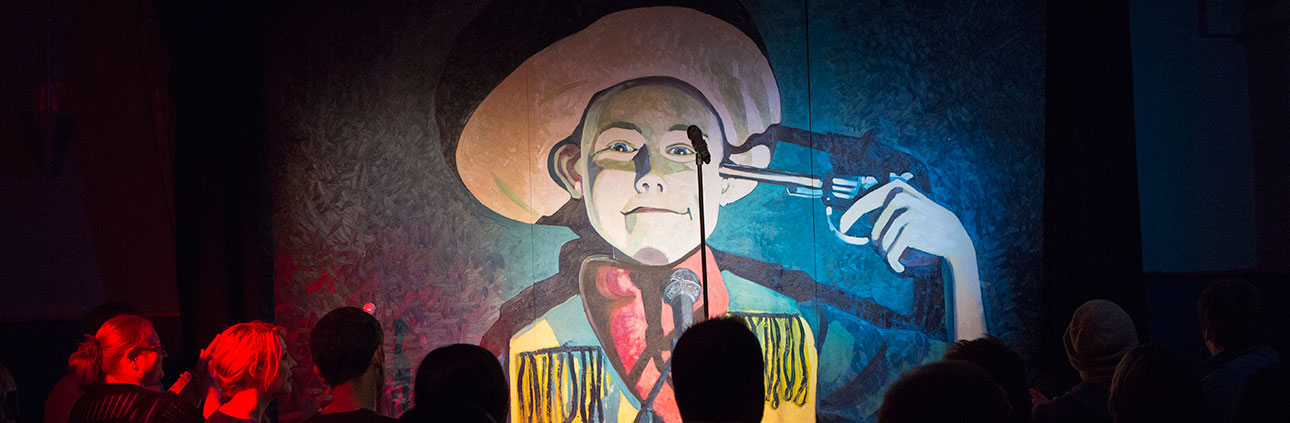
It probably wasn’t a great idea to come out to this when we were supposed to be sorting out the new flat, but hey, Dylan Moran is top of the bill and when did we last get the chance to see him in a gig as intimate as The Stand? So off we troop, early enough to get seats at the front and a couple of drinks later, the event kicks off.

JoJo Sutherland is our host for the evening and she’s brash, confident, good at milking the crowds for material. She swigs at a pint all the way through and swears enough to make the proverbial navvy blush and then introduces the first act of the evening.

Eleanor Morton stumbles on stage holding a ukele and delivers a great set that’s built around her supposed inability to communicate with others. It’s toe-curling stuff, expertly put together, though it’s clearly not to everyone’s taste – a couple sitting across the stage from us don’t crack a smile throughout. This is Marmite comedy, you’ll either love it or hate it and I fell into the first category. I’m sure we’ll be seeing a lot more of Eleanor.

Next up is Ally Houston, who could be Eleanor’s perfect partner, judging by the persona he adopts, a gormless social misfit with a guitar, some truly awful lyrics and (disturbingly) a plastic doll sellotaped around his waist, to whom he dedicates a couple of songs. Once again, the couple opposite us clearly aren’t getting the jokes at all, but Houston is walking a tricky comedy tightrope and is surely a name to watch in the future.

I felt a bit sorry for Chris Martin (not that one!) who after all the weirdness somehow came across as a bit ‘safe.’ He was perfectly pleasant and delivered his routine with confidence, but it all felt a little too familiar and, dare I say it, not as edgy as we might have expected at this venue.

And then it was time for the headline act and out shambled Dylan Moran, a little chunkier than I remembered him (aren’t we all?) and still maintaining the persona of a man who has had a few too many red wines before stepping onto the stage. I’ve never been sure if that’s just an act he puts on or whether it’s genuine (he was certainly drinking red wine throughout this performance) but I do fondly remember being in stitches at some of his earlier appearances and I’m also acutely aware that tonight, he seemed unfocused and sloppy and (dare I say it?) slightly out  of tune with contemporary tastes. A routine about the ‘Asian lady inside him’ felt uncomfortably like borderline racism and his long-winded tirade about the pitfalls of buying a decent cup of coffee in Starbucks seemed frankly, too easy a target. That said, there were a few moments here, when you briefly glimpsed the brilliant raconteur he once was and I’m sure, could be again. If appearing at The Stand is a prelude to him returning to a tour of bigger venues, then he really needs to hone his material more carefully,jettison anything that comes across as lazy and concentrate on the surreal observations that have always been his greatest strength.

An interesting night and one in which the newer names shone brighter than the actual ‘star’ of the show.

3.8 stars

Philip Caveney

Little Shop of Horrors

LSOHPosterWebsiteNoText

Royal Exchange Manchester

9/12/14

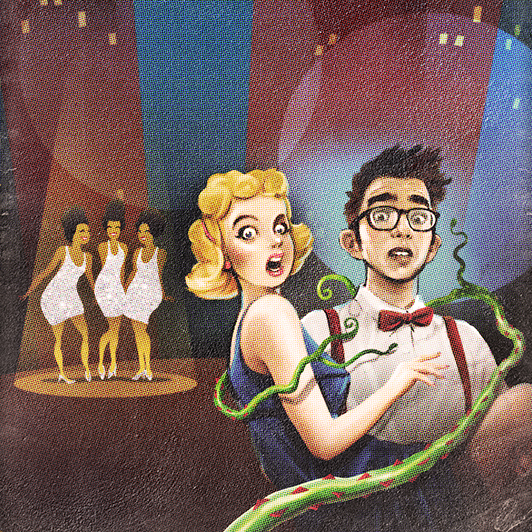
As guilty theatrical pleasures go, Little Shop of Horrors is right up there with the very best of them. I first saw Howard Ashman and Alan Menken’s musical in the early 80s at Manchester’s Library Theatre and I’ve been a devout fan ever since. To my mind, it’s the perfect blend of great songs, weird humour and 50s-style science fiction (and let’s face it, you don’t find many of those!) While it might seem an unusual choice for a Christmas Production – where’s the tinsel, where’s the saccharine? – the Royal Exchange are on to a winner with this superlative show and if the idea of a Christmas musical is to create joy, then this does so in spades. It had the audience securely wrapped in its tendrils from the opening bars onwards and never let go.

Seymour Krelborn (Gunnar Cauthery) is an orphan, working at Mushmik’s Florists on New York’s notorious Skid Row. Shy, much put-upon by the florist’s scheming owner, Mr Mushnik (Sevan Stephan) Seymour quietly carries a flame for his co-worker, Audrey (Kelly Price), but she, unfortunately, is going out with sadistic dentist, Orin Scrivello (Ako Mitchell) who treats her as his personal punchbag. As a business, Mushnik’s isn’t exactly flowering; indeed, it’s on the verge of withering up completely. That’s when Seymour reveals his secret project, a strange and unusual plant which he chanced upon (as you do) during a total eclipse of the sun. He’s named it Audrey Two, in honour of his beloved and he soon realises that the plant only thrives on one kind of food. Human blood. However, despite this inconvenience, the arrival of Audrey Two has an unexpected effect on business. Things at Mushnik’s are on the up and up. But, as with any Faustian pact, there is always a terrible price to be paid somewhere down the line…

LSOH is, of course, ubiquitous, beloved of school drama and amateur dramatic societies alike. There’s a reason for that. Most musicals have one or two memorable songs, but in this, every song is memorable. It’s so expertly put together that it’s hard to make a really bad version of it (little wonder that Ashman and Menken were soon snapped up by Disney.) The Royal Exchange have come up with a note-perfect production, cleverly staged and directed with brio by Derek Bond. The role of Audrey is pivotal and Kelly Price makes this her own, her superb voice ranging from delicate and plaintive in ‘Somewhere That’s Green,’ to strident and soaring in the show-stopping, ‘Suddenly Seymour.’ There’s wonderful support from the 10-strong role-swapping cast (at times, it seemed that there must be thrice that number.) The fact that the musical is played ‘in the round’ means that the various manifestations of Audrey Two require onstage puppeteers, but it matters not a jot – in fact, special mention must go to head puppeteer Nuno Silva, who as well as manipulating the (eerily convincing) ‘mean green mother from outer space’ also provides him with a voice that would do Levi Stubbs proud.

Of course, there has to be a big ending and trust me, this production has one. It would be unfair to reveal any more than that but suffice to say that the usually austere Royal Exchange crowd made their feelings known, leaping to their feet to deliver an enthusiastic standing ovation to a clearly delighted cast. The musical’s run has been extended by two weeks and I’m told there are still a few tickets available, so if you can get hold of some, I would urge you to do so. This is unadulterated theatrical joy and like most of the audience, I came out singing. Simply the best Christmas production involving a man-eating plant from outer space that I have ever witnessed. Miss it and weep.

5 stars

Philip Caveney

The Love Punch

MV5BMTcyNjAyOTMxMV5BMl5BanBnXkFtZTgwMTM5NDc3MTE@._V1_SX214_AL_

6/12/14

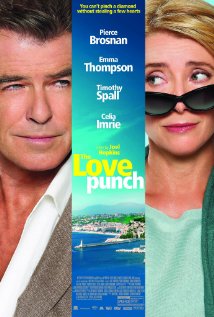
Sometimes in cinema, you encounter a bit of fluff. And other times, you encounter double fluff with extra fluff and i suppose this is the file to which you would safely consign The Love Punch. This light comedy featuring more mature actors than you’d normally expect to see in this kind of story was probably aimed at the same audience that The Exotic Marigold Hotel mined so effectively, but it’s nothing like as assured and it has to be said, it’s profoundly silly, to boot.

Pierce Brosnan plays Richard, an affable chap who works for a multi-national company (in what capacity, we’re never entirely sure.) He’s divorced from Kate (Emma Thompson) with whom he maintain an affable friendship (cynics will mutter that we’re already straying into the realms of the unbelievable.) When the company is purchased by a ruthless asset-stripper, the pension scheme into which Richard and most of his staff have bought, (Kate too, as it happens) is rendered entirely worthless. The head asset-stripper decamps to Paris in order to get married and publicly purchases a ten million dollar diamond necklace for his beloved, whereupon Richard and Kate hatch a plan to pop across the channel and nick it (as you do.) They also enlist the help of their plucky neighbours, Penelope and Timothy (Celia Imrie and Timothy Spall) and with a confidence that belies their humble origins, the foursome set off to take on the bad guys.

The problem is, that the characters manage to assay their chosen mission with such aplomb everything seems faintly unbelievable. And more fatally, there’s never any real sense of danger, no fear that something might go wrong for them, even when Richard and Kate find themselves in the back of a van perched on the edge of a cliff. Obviously, the veteran actors all make the most of this meagre material and the film’s enough to pass an undemanding hour or so, but nothing more than that. This is perfunctory film-making at best. You’ll have forgotten the details before the credits have finished rolling. And will Richard and Kate get back together? Who cares?

2.8 stars

Philip Caveney