Author: Bouquets & Brickbats

London Road

Unknown-2Unknown-1

28/06/15

London Road is an extraordinary film. Although clearly indebted to its theatrical roots, this is a truly cinematic work – and quite unlike anything I have seen before.

Centred around the infamous Ipswich murders of 2006, when five prostitutes were killed over the course of a few months, London Road tells the stories of the local residents: their discomfort at their street becoming part of the red-light district; their horror at the murders; their reactions to the revelation that the killer was Steven Wright, a neighbour of theirs. Through verbatim accounts, drawn from interviews conducted with the real life residents of the street , we learn of a community torn apart – and then, ultimately, uniting to reclaim its heart.

And it’s a musical.

Actually, it’s not really a musical, as such, but it is mostly sung – and the effect is stunning. The dialogue is faithfully reproduced, with every ‘um’ and ‘ah’ included; every hesitation, interruption, exclamation rigorously documented in the lines. The language dictates the rhythms, and the score stretches and amplifies the natural cadences of speech, creating a kind of hyper-realism that is utterly compelling. Some lines are repeated to create a kind of chorus or refrain, thus reinforcing some of the more prevalent ideas (‘He could be one of us…’).

There’s no driving narrative here, no one character whose tale defines the story. It’s exactly what you might imagine a series of interviews to amount to: a collage of disparate accounts. And yet, this collage serves to create a very clear whole picture. There are conflicting emotions, as the prostitutes move away from the area to somewhere where they feel safer, and the residents begin to take a pride in where they live again. ‘I know it’s awful,’ says Julie (Olivia Colman), as she looks around the resurgent neighbourhood, ‘but I’d like to shake his hand.’ It’s an uncomfortable truth, made more so by the brooding presence of Vicky (Kate Fleetwood) walking through the street, untouched and unobserved, clutching a balloon like a hopeful child. No one can condone the murder of these troubled women, but none of us would like them working where we live.

There are some big names attached to this film: Tom Hardy makes a fleeting appearance as a taxi driver obsessed with serial killers. But it doesn’t feel right to single anyone out: this is an ensemble performance, with all parts contributing fully to the whole.

It’s a game-changer, I think.

Go see it.

5 stars

Susan Singfield

Patrick MacNee: An Appreciation

Unknown Unknown-1

26/06/15

It’s one of my earliest memories from childhood; sitting with my parents in the little living room of whichever RAF home we were in then, waiting for our favourite programme to start. A little flickering screen in the corner. And then that music, Laurie Johnson’s strident theme, the brass section blasting out four notes which seemed to quite literally trumpet the programme’s title. The Avengers! The Avengeeeeers! Then the black and white credit sequence, cutting edge cool in the 1960s. And finally the episode itself, a delicious slice of surreal cold-war spy fluff as John Steed and Emma Peel took on the villains in their own spectacular style. These days of course, the same title conjures up images of brawny superheroes clad in latex and blessed with underwhelming ‘special’ powers, but in those far off times, it meant something quite different.

There had of course been an earlier series with Honor Blackman as Cathy Gale, but I don’t really remember that as clearly. The second series is imprinted so perfectly in my memory, that even now, more than fifty years later, I can recall entire scenes, even lines of the witty dialogue. I know that I was absolutely besotted with Diana Rigg who seemed to me the very epitome of feminine mystique – lithe, pretty, intelligent and powerful enough to fell a villain with one perfectly timed karate chop (even if, in long shot, you could sometimes see that she had been cunningly substituted by a burly bloke clad in an ill-fitting leather jumpsuit.) And of course, I saw all the later incarnations. I never really warmed to Linda Thorson as Tara King, but I did like Joanna Lumley as Purdey in The New Avengers, almost as much as I despised Gareth Hunt as the perpetually smirking ‘bit-of-rough’ Mike Gambit.

Through it all, Patrick MacNee’s John Steed remained unchanged, suave, stylish, outfitted in Saville Row’s finest suiting, his trademark bowler hat in place and his deadly weapon (an umbrella) poised ready to take out the toughest opponent. (Apparently, the umbrella was McNee’s idea. He’d been a naval officer in the war and had emerged from the experience with an intense dislike of violence of any kind, so much so, that he steadfastly refused to be pictured with a gun. ‘I’ll carry an umbrella,’ he suggested at an early script meeting and everyone went along with that. It was an inspired idea.)

Of course, the problem with a successful show like The Avengers was the danger that it might typecast the stars. Rigg had no problem escaping its clutches, becoming a major star of the theatre, but McNee didn’t manage much else but some forgettable television and an occasional film cameo; a shady psychiatrist in Joe Dante’s The Howling, a delightful turn as Sir Dennis Eaton-Hogg in This Is Spinal Tap, even a decent showing in a Bond film, opposite Roger Moore in A View To A Kill. But John Steed would remain his signature role, as much a fantasy image perhaps as those created by his female co-stars. In real life, you suspected, you’d actually hate someone like John Steed. With his Gentlemen’s Clubs, his impeccable manners and his old style courtesy, he was, even in the swinging 60s, something of a dinosaur – but MacNee’s charming manner made you believe that underneath it all he was a really nice chap, that should you bump into him in real life, he’d be every bit as charming as his fictional counterpart.

It’s always a jolt when you read that one of your earliest heroes has died. MacNee was 93 years of age, which by any standards is (as Steed himself might have observed) a jolly good innings. Back in the day, we tended to sneer at television shows. It’s only recently that TV has had something of a renaissance and we wax euphoric about the likes of Breaking Bad and True Detective. But The Avengers was an example of television at its most groundbreaking. Re-watching that opening credit sequence on YouTube still gives me the same thrill I had when I was a little boy. And if Patrick MacNee will always be John Steed in the nation’s memory, well that’s no bad thing. Because in his own way, he was one of the greats.

Philip Caveney

Mr Holmes

MV5BMTg5MjE0Njk0MF5BMl5BanBnXkFtZTgwNTgwMjQ4NTE@._V1_SX214_AL_

24/06/15

There can be few fictional characters who have enjoyed as many interpretations as Sherlock Holmes – we’ve already seen him as a young man, so it was perhaps inevitable that somebody would take him in tother direction. Here, he’s played by Ian McKellan as a 93 year old, convincingly aged in state-of-the-art latex. It’s 1947 and he’s long retired to a village in Sussex, where he’s looked after by housekeeper, Mrs Munro (Laura Linney making a decent fist of an English accent). Her young son, Roger (Milo Parker) clearly idolises the old man and has a bit of an interest in detection himself. Directed by Bill Condon, the film is adapted from the short story A Short Trick of the Mind and has Holmes struggling with the onset of dementia, whilst desperately trying to piece together and write about the particulars of his last case, the one that made him retire from the detection game. In this parallel universe, Sir Arthur Conan Doyle never existed. The Holmes stories really were written by Dr Watson (who we only glimpse in flashback) and Holmes is clearly a lost soul without his old partner to back him up.

This is a slight though pleasing story, dominated by a perfectly nuanced performance from McKellan (though it has to be said, there’s more than a passing resembance to his turn as James Whale in Gods and Monsters, which Condon also directed.) He’s ably supported by the other members of the cast, particularly young Milo Parker and by Hattie Morahan as the young woman who’s tragic story causes Holmes to ditch sleuthing and take up beekeeping instead. If the tale occasionally strays into the realms of sentimentality, it’s of no great consequence; this is diverting enough but the earth doesn’t move and it makes you think that in the end, Holmes tales are a bit like buses – there’ll be another one along soon.

3.8 stars

Philip Caveney

Kafka’s Monkey

Kathryn Hunter in Kafka's Monkey at the Young Vic (photo by Tristram Kenton) Kafka's Monkey - pic 1

17/06/15

Home, Manchester

Based on Kafka’s short story, A Report To An Academy, and adapted for the Young Vic by Colin Teevan, (though it follows the original text pretty much word-for-word) Kafka’s Monkey is a fascinating monologue by Kathryn Hunter. It tells the story of Red Peter, an ape, captured in Africa and taught by his human masters to walk, talk and behave as a ‘human,’ mostly by aping the very worst aspects of humanity. Over a taut 50 minutes, we follow Peter’s progress from helpless captive to celebrated music hall performer and are left to speculate about the question of identity. Peter ultimately emerges as a misfit, a creature neither ape nor human but somewhere in between, and consequently a tragic figure. The play is completely dominated by Hunter’s extraordinary performance. Make no mistake, this is a tour de force of the actor’s art. She shuffles onstage, her body stooped and twisted and brilliantly embodies her simian character, eerily conveying Peter’s eccentric moves and his stylised way of speaking.

Sadly, the production’s other aspects aren’t quite in the same league. Teevan’s script attempts a form of iambic pentameter for Peter’s ‘human’ utterings and free verse form for his ‘monkey’ self – but the story is short on anecdotal material. The presentation is after all supposed to be taking place in a scientific establishment, which may go some way to explain its curious sense of detachment, but a more intimate approach would surely have elicited more empathy with Peter’s plight. A central screen seems somewhat underused, displaying as it does just one image, that of a chimpanzee. It’s left blank for most of the running time and might perhaps have been used to indicate different scenes – the hold of a ship, perhaps or a music hall. There’s a sparse electronic score, which again seems perfunctory, particularly when set against Hunter’s bravura performance.

There are a couple of welcome touches of humour scattered throughout the proceedings as ‘Peter’ interacts with people in the front row, hugging them, offering them bananas, coaxing them to join him onstage. Hunter also performs some contortions that elicit gasps of amazement from the audience. She’s worth the price of admission on her own, but I can’t help feeling that more supportive staging would have lifted this production to another level entirely.

3.8 stars

Philip Caveney

Damson, Heaton Moor

Unknownimages

16/06/15

It’s not our usual practise to re-review a restaurant only a few weeks after we’ve visited, but in Damson’s case, our previous visit was spectacularly mistimed – only a few weeks before the place was given a major refurbishment and the menu overhauled. What’s more, since Steve Pilling’s establishment sets the bar for dining on ‘the Moor’ and because it was Susan’s birthday, now seemed as good a time as any to make an exception to the rule.

Apart from a few touches, Damson hasn’t changed that much inside, but the exterior has been completely repainted and the terrace is now surrounded by higher wooden enclosures, liberally planted with flowers and shrubs, while the seating and tables have all been replaced. It’s now an absolute pleasure to sit out in sunny weather with a drink (assuming, that is, that you can find such weather in Stockport!)

As for the menu, there’s a new selection of reasonably priced cocktails on offer and some sharing platters, one of which we decided to try instead of a conventional starter (though the platters are usually available only on the lunch menu.) These are generously sized wooden boards, which come loaded with four kinds of cured meat, four kinds of cheese, plenty of sourdough bread, butter, chutney, homemade pickles and your choice of three jars, each one packed with a delicious spread – there are eight jars to choose from. We opted for Duck with potted pear and hazelnut, Whitby Crab and Crayfish with avocado and Herb Goat’s Curd with salt baked beetroot. To say that each of these was delicious would be something of an understatement. They were, quite frankly, exquisite. A sharing board costs just £15 and at lunchtime, accompanied by a drink, are clearly a brilliant idea for two diners.

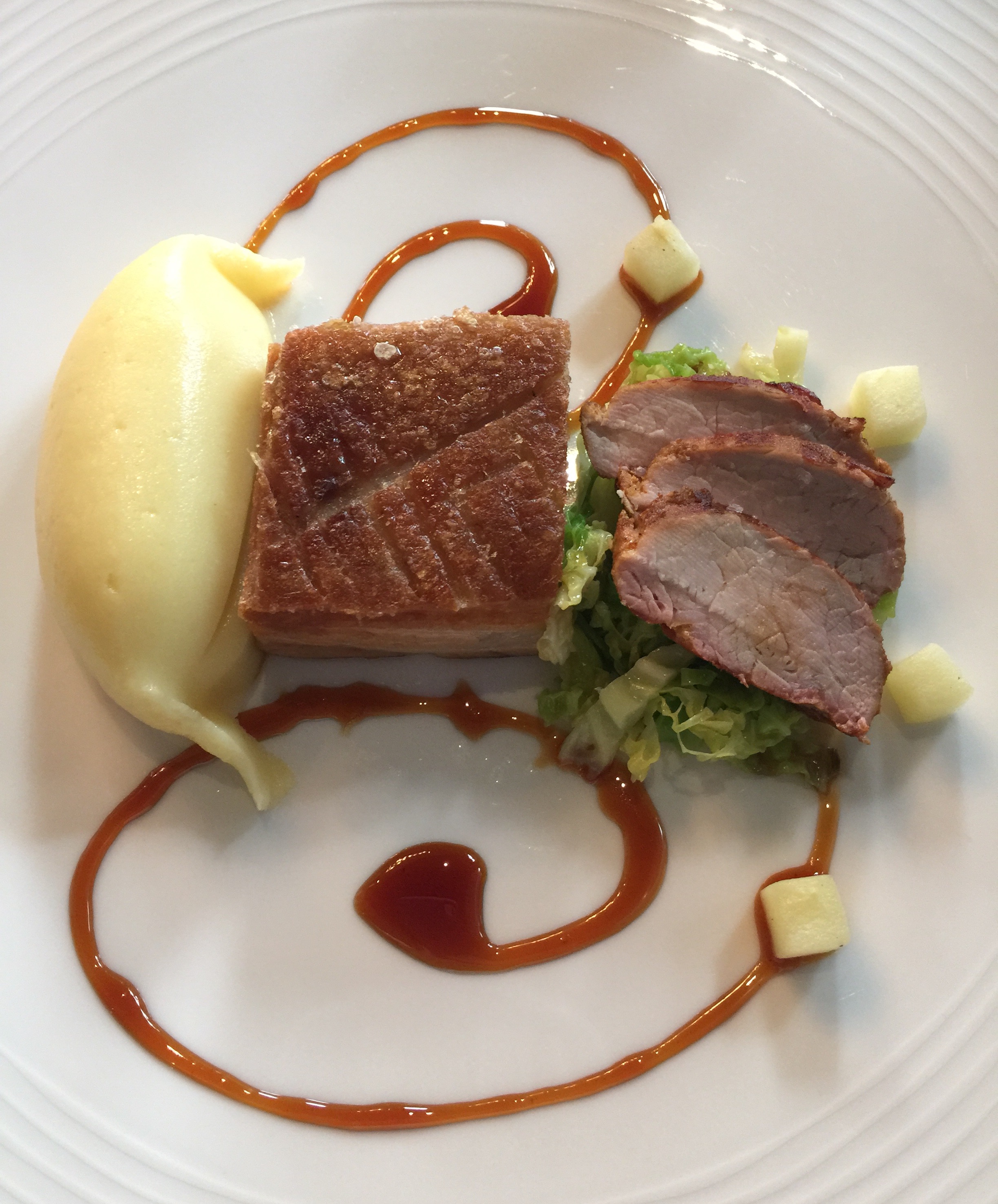
But this was a birthday evening so we moved on to a couple of main courses from the new set menu, now available till 9.30 on a weekday and till 6.30 at the weekend. it costs £15 for a main course, £20 for two courses and  £25 for three. My choice was the Slow Cooked Middle White Pork Belly with apricot, pak choy, curried lentils and potato. As ever, this was note perfect, the mildy spiced lentils proving the perfect accompaniment to that succulent, mouth-watering meat. Susan sampled the Grilled Fillet of Mackerel, with pesto creamed potato, tomato, olives, coriander and lemon. The fish was perfectly cooked, with a crispy exterior and a moist, richly flavoured interior, the intense flavour perfectly counterpointed by the delicately flavoured pesto mash.

Would there be room for any of those delicious desserts? Sadly no, mainly because the sharer had been so generously proportioned, but I’m not complaining. (See our previous review for our thoughts on Damson’s desserts!) Suffice to say that after six years, Damson is not resting on its laurels and the Moor’s other contenders are going to have to work really hard if they hope to challenge its dominance. Our meal with a decent bottle of Pino Grigio came to around £65, proof positive that you don’t have to pay out a fortune for fine cuisine.

5 stars

Philip Caveney

Man Up

MV5BMTUzODcxNDcxMl5BMl5BanBnXkFtZTgwODE1NjM4NTE@._V1_SX214_AL_

06/06/15

Some films are little more than entertaining fluff, but as entertaining fluff goes, Man Up is right there with the best of them. It boasts two likeable leads in Simon Pegg and Lake Bell, a great supporting cast, a witty script by Tess Morris and a genuine ‘feel good’ tone that carries you effortlessly through to its (pleasingly predictable) ending.

Lake Bell is Nancy, a thirty something female with a poor record in the relationships game. At the film’s start, she’d supposed to be attending the engagement party of a couple of friends, where she’s been set up on a blind date, but opts instead to eat a burger alone in her hotel room and watch The Silence of the Lambs. Pestered by her sister, Elaine (Sharon Horgan) to get in there and give it a shot, she goes to meet the man in question. The ensuing toe-curling conversation is one of the film’s funniest scenes. On the train home, she meets Jessica (Ophelia Lovibond) who is herself en route to a blind date, carrying a cheesy self-help book for the purposes of identification. By chance, Nancy ends up with the book and with the blind date, Jack (Simon Pegg), a forty year old would-be artist who is still hurting from the pain of the separation from his ex. Caught up in the moment, Nancy allows Jack to think that she is actually Jessica and the two of them embark on a night of drinking and conversation, made all the more challenging by Nancy’s desperate attempts to ‘be’ Jessica – who it turns out, is a twenty four year old triathlete! It’s all going swimmingly until they visit a bowling alley and bump into Sean (Rory Kinnear) one of Nancy’s ex schoolmates and a man who has been nursing a (rather creepy) obsession with her ever since…

Mistaken identity is a familiar conceit in the movies and many have tried this idea with average results, but Man Up is a superior product in most respects. The quirky script has far more surprises up its sleeve than you might expect from a subject like this and there are some genuinely laugh-out-loud moments along the way, even if we know all along that Jack and Nancy are made for each other and there’s no way the filmmakers would dream of letting us down in that regard. If you’re expecting the earth to move, this may not be for you, but if you’re in the market for a quirky, heartwarming feel good picture, you could frankly do a lot worse than this.

4.4 stars

Philip Caveney

Funfair

GC_Home_Funfair_Wide-056 GC_Home_Funfair_DressR-491

2/6/15

Home, Manchester

We were (ironically) away from home for the launch of Home – Manchester’s brand-spanking new arts centre, which takes over from two legendary local institutions, The Cornerhouse and The Library Theatre. Home is housed in a great big serious-looking building at the end of First Street, replete with cinema screens, theatres, exhibition spaces, a cavernous bar and a restaurant. What’s not to like?

There’s certainly plenty to like about its inaugural theatre presentation, The Funfair. This is Simon Stephens’ astute adaptation of Odon Von Harvath’s late 20s play Kasimir and Karoline. Stephens must be the hardest working person in theatre right now and if Von Harvath’s play seems a wilfully obscure choice as the opening gambit for a brand new venue, its certainly a prescient one – the original play was set in austerity-stricken Munich just a few years before the rise of the Nazi party. It’s surely no coincidence that the story strikes a whole series of ironic chords with what’s happening in the UK right now. The action takes place in and around a seedy fairground and Ti Green’s design captures perfectly the tawdry splendour of such settings. Neon lights flicker, carousels whirl and you can almost smell the fried onions.

Cash (Ben Batt) is a former chauffeur, himself a victim of the stricken economy. Out of luck and now out of work, he worries that his already turbulent relationship with fiancé Caroline (Katie Moore) is doomed to failure by his lack of employment – and there are certainly plenty of temptations lying in wait for her when, after a row with Cash, she decides to visit the fair, with the professed intention of going on ‘all the rides’. She soon elicits the attentions of John Chase (Rhodri Meilir) a dorky but ambitious salesman with a liking for ice cream. When John’s rich boss, Billy Smoke (a superbly lascivious Ian Bartholomew) turns up accompanied by his equally venal companion, David Spear (Christopher Wright) their combined gaze falls upon Caroline… and the stage is set for a deliciously dark allegory about the human condition and its propensity for excess.

The Funfair is a dazzling box of delights, a real multi-media event that employs lights, shadows, live rock music, back and front projection, masks, movement and a central turntable that’s used to stunning visual effect, but none of this is ever allowed to overwhelm the splendid performances from the ensemble cast. Stephens’ canny script flips us back and forth like a well-oiled rollercoaster between the various intertwining stories and the events culminate in a bitter-sweet scene that will stay with you long after you’ve stumbled out of the building.

Home really couldn’t have asked for a better opening salvo than this. It’s on until the 13th of June and it’s an unqualified delight. Miss it and weep.

5 stars

 Philip Caveney

Scotland Short Play Award 2015

Unknown-1 Unknown

Traverse Theatre, Edinburgh

28/05/15

The Traverse is a writers’ theatre, its commitment to new writing intrinsic to its existence. This makes it an exciting place to visit; one thing here is always certain: you won’t be watching a tired old revival or an over-exposed crowd-pleaser.

Last night’s showcase of the four finalists in the Scotland Short Play Award 2015 was a case in point: a genuinely compelling selection of pieces, all simply staged but powerfully performed, with all the wit, vigour and contention you could hope for from a group of emerging young playwrights.

First up was Morven by Emily Ashton. This was a disturbing howl of a play, with Nicola Roy superb as the anguished mother, who may or may not have murdered her child. Hounded by both press and social workers, at once devastated and furious, the eponymous Morven forced the audience to confront the idea that we can never really know the truth about some stories, no matter how clear cut they appear in the tabloids. The play’s structure was simple, and the director (Tony Cownie) utilised this to advantage, employing some nice techniques, e.g. the disembodied voice of the invisible questioner filling the theatre; the headline-like questions projected onto the wall; the Katie Mitchell-esque ‘live’ projections emphasising the minutiae of Morven’s movements and expression (not least, in fact, at the end, when the projection ceased to mirror Morven, showing how dissociated even she had become). A cracking start.

The second play was Romance by Ross Dunsmore, and this was our favourite of the night. A two-hander, performed with charm and gusto by Joanne Thompson and Cristian Ortega, it explored the complexities of a teenage relationship in the social media age, laying bare the insecurity and vulnerability that leads young girls to share explicit images of themselves. If that sounds bleak, it does the play a disservice, as this was laugh-out-loud funny, depicting the sweetest of boys remaining doggedly  loyal to the girl he likes. It even had a hopeful, warm-hearted ending. In some ways, it made a mockery of the media hysteria around sexting. ‘Yeah ok,’ it seemed to say, ‘people do stupid stuff, and there can be ugly consequences, but – you know – this too will pass. It doesn’t have to be the end of the world.’ A poignant, endearing and humorous play. Lovely stuff.

Next was Cameron Forbes’ It Never Ends, another two-hander about a modern relationship, this time focused on the slightly older demographic of the undergraduate. This was perhaps the most controversial piece of the night, dealing as it did with two young people heading out to a club, both keen to let loose: get drunk, get high and get laid. Their intentions were clear and stated, and the first half of the play was full of hope and hedonism, dancing and fun. The following morning, however, waking up in a stranger’s bed, the young woman had no recollection of their sexual encounter, and crept away, bereft and violated. There was no redemption here, and no easy ‘answer’ for the audience. The young man was not a rapist (he was as inchoate as she) but she certainly felt raped. Neither of them found the joy they were seeking. It’s a sad and complex issue, and the tragedy was made clear here.

The final play of the night was Potterrow by Martin McCormick. This was the most ambitious piece by far, and perhaps the least suited to the fifteen-minute time-frame. Nevertheless, it was a fascinating monologue, charting a man’s breakdown: a new parent’s sleep deprivation leading to paranoia and obsession, and – eventually – to the murder of an old woman whose dog fouls The Meadows. We were never quite sure if he was a policeman or not, or if the uniform he wore was just another symptom of his ailing mind. The footprints laid out on sheets across the stage mapped out the man’s demise, and also emphasised how often he became derailed, his intentions thwarted along the way. The performance, by Gavin Jon Wright, was both nuanced and convincing. This playwright is certainly one to watch.

All in all, then, this was a fascinating night, and bodes well for the future of theatre. With these young playwrights at the helm, things look very promising indeed.

4 stars

Susan Singfield

Damson, Heaton Moor

images Unknown

29/05/15

Of all the restaurants I’ve ever eaten in (and they are many and varied), Damson remains my favourite – and not just because of the food.

Make no mistake, the food here is consistently delicious. But there’s that friendly, convivial vibe as well; the calm, relaxing decor; and the understated professionalism of the front of house team.

We’re here tonight for the early bird menu, which offers two courses for £16.95, or three for £19.95. Of course, we will eat three. The portions here are perfectly balanced, leaving the diner satisfied but not too full. There’s always room for one of their exquisite puddings.

To start, I opt for the tartare of Cheshire beef fillet, while Philip has  a chicken Caesar salad. The tartare is light and fresh and melts in the mouth, but Philip’s salad is even better. There’s an egg, which has been caught at exactly that moment between soft and hard, its orange yolk glistening most attractively. It’s anchovy-rich, a creamy delight of a starter, and certainly whets the appetite for what is yet to come.

Next up, I have the grilled fillet of sea bass, which comes with pesto creamed potato. Again, this is note-perfect, the fish all crispy skin and moist soft flesh. Olives and tomatoes add piquancy to the dish. I want to lick my plate. Philip has the roasted rump of lamb (for a supplement of £5); this comes with goats’ cheese mash, sweetbreads, braised baby gem, peas, broad beans and morels. It sounds like hearty fare, but it’s as delicate as can be, and the lamb is softer and richer than any I’ve tasted before.

Then there’s the pudding. Philip has the creme fraiche tart with crushed raspberries and strawberry sorbet, a sweet-sharp combination that literally has him whimpering with delight. I go for the chocolate cremeux with macerated strawberries and vanilla ice cream, the richness of the chocolate perfectly offset by the freshness of the fruit.

We’ve eaten in restaurants with bigger reputations than Damson, but nowhere else we’ve been to has yet rivalled it for such unpretentious but accomplished food. There is confidence here, and care too, and it makes for a most satisfying experience. We’ll certainly be back for more.

5 stars

Susan Singfield

Pomegranate, Edinburgh

UnknownUnknown-1

28/05/15

Situated just off Leith Walk, Pomegranate is an unpretentious bistro-style cafe serving Middle Eastern cuisine. The bright vibrant decor gives the place a cheery atmosphere, but be warned, the only wines and beers on offer are of the non-alcoholic variety, so if you want to drink something more punchy with your meal, bring your own. (No corkage is charged, which makes eating here even better value for money.)

There were three of us to dine and we were all very hungry. For starters we chose Soujek (Spicy Lebanese sausages sautéed in tomato, green pepper, garlic and chilli), Baly Merishke (barbecued lemon-scented chicken wings) and Kubba Halub (Seasoned minced lamb, mixed with sultanas, encased in crushed rice.) All three starters were lovely – the sausages were enveloped in a rich spicy sauce, the chicken wings crisp yet succulent and the Kubba Halub had a crunchy exterior and a melt-in-the-mouth centre.

On to the mains – I sampled the Joujeh (half a chargrilled chicken marinated in lemon, tomato and garlic), Susan went for the Chargrilled Whole Sea Bass (marinated with lemon and Persian sumac and served with a side of bamya – a beef and okra stew, or tapsi – an eggplant sauce). Our companion, who’d eaten here before, went for his favourite,  Qozy Lamb (braised lamb on the bone, served with tapsi or bamya.) Once again all dishes were note perfect and came accompanied with generously-sized mounds of clean-tasting basmati rice and the restaurant’s own naan breads, thinner and somewhat crispier than their Indian brethren, but absolutely delicious.

Did we eat everything that was put before us? Yes, we did and licked our platters clean. Did we have any room to sample the selection of great-sounding desserts on offer? No we did not. But one thing’s for sure. If you’re looking for great tasting middle Eastern cuisine in the heart of Edinburgh, this is where you should come. Outstanding! Oh yes, and I promised to mention our waitress for the evening, the charming and friendly Alicja, who looked after us in friendly but unobtrusive style!

4.5 stars

Philip Caveney