13/05/26
Royal Lyceum, Edinburgh
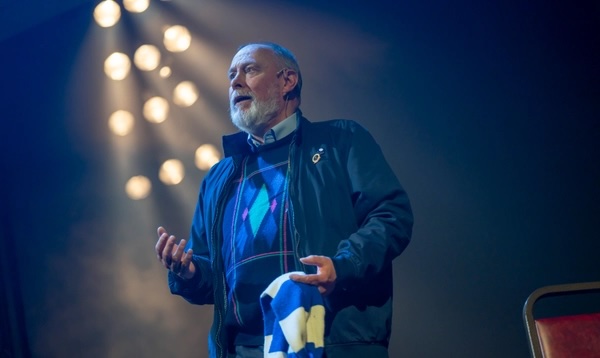
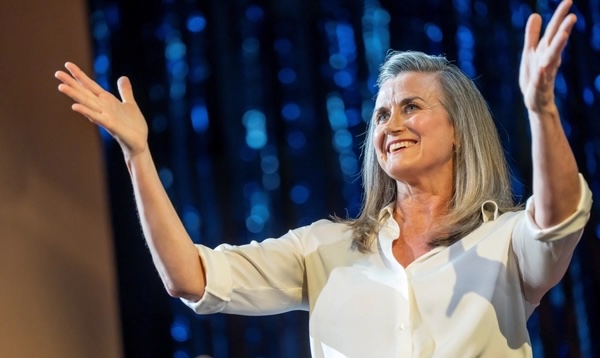
Sally (Dawn Steele) works in the high-pressure cauldron of a London-based law firm but, after the death of her beloved father, she is called back to her home town of Cowdenbeath to attend his funeral. Dad (Barrie Hunter) was a lifelong fan of the local football team – the ‘Blue Brazil’ of the title. One of her father’s friends informs Sally that her dad’s deepest wish was to have his ashes scattered on the team’s home ground of Central Park.
She initially surmises that the ritual will take place after the next game, only a few days away but soon learns that Dad has requested it should only happen after Cowdenbeath’s next win. And it turns out that his team doesn’t have a great record of scoring actual goals. In fact, their ability to snatch defeat from the jaws of victory is almost beyond belief.
Sally’s sojourn in her Dad’s council house is haunted by recollections of her father’s obsession with his team’s history and her own terrible memories of what happened to her Mum. As the season slips inexorably by, Sally begins to wonder if she’ll ever get back to the career she’s worked so hard for…
Black Diamond and the Blue Brazil, based on the book by Ron Ferguson and adapted by Gary McNair, is quick to point out that you don’t have to be a Cowdenbeath fan to enjoy this story, but it certainly helps if you are. It’s clear from the laughter (and at one point some actual tears) in tonight’s packed audience that there are many supporters in the house.
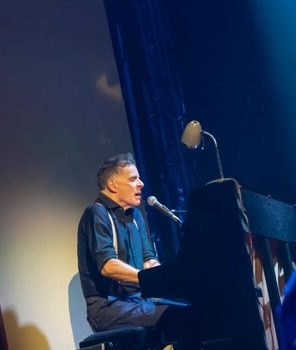
Steele does an excellent job of the world-weary, comedic patter, evincing plenty of perfectly-timed laughs from the crowd, but the story is essentially one long litenany of failure, which doesn’t exactly make for an easy watch. The story is punctuated by Ricky Ross’s plaintive ballads which are a little too one-note to help lift the mood – and since each song appears to be a retelling of the scene we’ve just witnessed, they don’t quite generate enough momentum to power the story. Sitting way back at stage left, Ross feels somehow distanced from what’s happening, commentating rather than collaborating.
This play first surfaced as an audio piece and its staging seems a little uneven in its adaptation. Jessica Worrall’s set design is unapologetically realistic in concept, right down to an urn containing the deceased remains. I prefer the occasional moments when the songs are illuminated by Lewis Den Hertog’s video projections, hinting at the long history of the team and its roots in the black soil of coal mining.
At this point, I should confess that I’ve never had any interest in football, though I do sometimes enjoy theatrical interpretations of it (SameTeam immediately springs to mind). However, it’s clear from tonight’s heartfelt standing ovation that the majority of the crowd are with this every step of the way.
Maybe I’m the problem, but for me, this doesn’t quite hit the back of the net..
3 stars
Philip Caveney

