Month: January 2024

Night Swim

07/01/24

Cineworld, Edinburgh

As regular cinema-goers, we’ve experienced quite a few haunted locations over the years: haunted cabins, haunted mansions, haunted theatres. But a haunted swimming pool? I think that’s a first. And yes, I can guess what you’re thinking. A haunted swimming pool – how scary is that going to be?

So it’s to writer/director Bryce McGuire’s credit that Night Swim is genuinely unsettling. (Note of caution: if being immersed in water makes you nervous, this film may not be for you).

The swimming pool in question comes included in the knock-down price of the new property purchased by former baseball star, Ray Waller (Wyatt Russell), and his wife, Eve (Kerry Condon). Their kids, Izzy (Amélie Hoeferie) and Elliot (Gavin Warren), are understandably thrilled, mostly because – unlike me – they haven’t watched the film’s opening sequence, which depicts what happened to the little girl who lived there before…

Ray is in the early stages of a degenerative illness and struggling with the thought of not being able to play his beloved sport any more, but a doctor has assured him that swimming is the ideal exercise for him. So having the pool there is a good thing, right? Soon, Ray discovers that his regular swim sessions do appear to be improving his health, so he’s keen to dive in at every opportunity. But we know, don’t we, that in stories like this, apparent good fortune generally comes with a hefty price tag? And the two kids are starting to experience unpleasant things down in those shadowy depths.

Somehow, Night Swim never feels repetitive – and, unlike those films that beggar your belief (no way would they ever dive back in there!) – there are always convincing reasons for the major players to re-immerse themselves. What’s more, these are not the kind of 2D characters that so often inhabit films in this genre. They are well-rounded, likeable people, who we actually care about. The ghostly goings-on are at first just glimpsed or suggested, observing the rule that what we don’t quite see is so much scarier than splatter laid on with a trowel. And yes, there are expertly handled jump scares – though I’m not sure the shuddering, swooping 4DX seats at the screening we attend add very much to the experience.

This is a superior fright flick in almost every respect. Even the eventual explanation for what’s happening in the Wallers’ pool carries water (sorry). Advance reviews suggested that this film was lacklustre but for me, Night Swim keeps delivering the chills right up to its watery conclusion, without ever jumping the shark.

Hey, now there’s an idea. A haunted shark in a swimming pool! Hollywood, give me a call. I’m always open to offers. Meanwhile, Night Swim is a tight little chiller that keeps me hooked. Come on in, the water’s er… unpredictable.

4 stars

Philip Caveney

Pho

06/01/24

St James Quarter, Edinburgh

We’re not usually big on chain restaurants but, after dashing around the city on an ‘escape hunt’, we end up in the vicinity of the St James Quarter. The friend who gifted us the challenge has generously covered our lunch too – and we’re more than ready for it. Post-Christmas, I’m looking to shed a few pounds, so we need to find somewhere offering a healthy range. Pho seems to fit the bill.

I know it’s a contentious issue, but the 2022 law requiring businesses with more than 250 employees to display calorie information on their menus is useful to me today. I’m tracking my consumption, and it’s great to know that I can enjoy two courses without derailing myself.

For my starter, I have cuốn diếp chay (spicy salad rolls), which come in at an almost unbelievable 44 calories. They’re fresh and vibrant: strips of raw vegetables, enoki mushrooms and herbs wrapped in a lettuce leaf and served with a very more-ish peanut sauce. Philip has a Nem hải sản (a seafood spring roll), which is large, crispy and filled with king prawn, crab and pork. He says it’s crunchy, not at all greasy and packs a real punch.

For my main, I want a cauliflower rice bowl with char-grilled chicken, but I’m told there’s no cauliflower rice today. ‘Real’ rice takes me over my allowance, so I opt for the Phở gà instead. This Vietnamese rice-noodle soup (347 calories) is no mean substitute: the broth is fragrant, the chicken nicely cooked and the noodles as slippery and delicious as you’d expect. I especially like the side plate of fresh herbs, allowing me to tailor the dish to my own taste. Philip opts for the phở xào (wok-fried noodles) with chicken and prawn. This is a delightful dish, full of earthy goodness, replete with lemongrass, chilli and Asian greens.

We’re not drinking at the moment, so we’re pleased to see a good range of soft and alcohol-free beverages. Philip samples the Freestar 0.5% lager, while I try a Negroni spritz. Both hit the requisite spots. We enjoy the eclectic juke box too, and the lively, buzzing atmosphere.

All in all, we’re impressed. If you’re looking for a quick healthy lunch in the city, you could do a lot worse than Pho.

4.3 stars

Susan Singfield

Ferrari

04/01/24

Cineworld, Edinburgh

Director Michael Mann has been plying his trade since the late 60s, with varying degrees of success, occasionally coming up with pure gold with films like The Last of the Mohicans and Heat. Recently, he’s concentrated on more personal works and Ferrari is very much a passion project, something he’s been tinkering with for years, based on a screenplay by the late Troy Kennedy Martin.

It’s not the kind of biopic we might have expected, but instead focuses on a single turbulent year in Enzo Ferrari’s life(1957), when his iconic sports car company is speeding dangerously close to extinction, mainly because Enzo (a convincingly-aged Adam Driver) is much more interested in his cars winning races than he is in selling them.

Meanwhile, his domestic life is also a holy mess. Since the untimely death of his much-loved son, Enzo has become estranged from his wife, Laura (a smouldering Penélope Cruz, threatening in every scene to steal the film from its titular hero). Enzo is spending much of his spare time in the company of his mistress, Lina (Shailene Woodley), with whom he has another son. This seems to be an open secret in Enzo’s neighbourhood of Modena, but Laura is yet to find out – and there are sure to be fireworks when she does.

And then Enzo’s business manager gives him an ultimatum. If he wants to sell enough cars to save the company, he must enter – and win – the gruelling Mille Miglia road race, at the same time seeing off his main competitor, Maserati. If he fails, it will be game over.

So, no pressure.

Ferrari is a handsome production, the 1950s era convincingly evoked right down to the last detail. Despite the nominative determinism, Driver doesn’t get to sit behind a steering wheel unless you count the knackered old jalopy in which he putters around the countryside. It’s left to younger men like the ambitious Alfonso de Potago (Gabriel Leone) or old hand Peter Collins (Jack O’Connell) to climb into those vintage cars and send them roaring around the track.

The racing scenes are perhaps the film’s strongest suit, the cars screaming along country roads with such visceral intensity you can almost smell the petrol, feel the wheels juddering beneath you. Incredibly, the cars had no roll bars back then, not even seat belts, so accidents were generally disastrous. One such scene is so brilliantly staged it actually has me exclaiming two words out loud (the first of them being ‘Oh!’). In another sequence, a nerve-wracking race is intercut with scenes of Enzo at a church service, amplifying the point that, in Modena, sports car racing is perceived as a kind of religion. And I Iove the scene on the eve of Mille Miglia where drivers write letters to their partners, for all the world like soldiers about to go into battle.

There’s plenty to enjoy in Ferrari but it won’t be for everyone. Petrolheads will doubtless feel that there isn’t enough actual racing to keep them happy, while the many scenes of marital discord and the various wheelings and dealings behind the scenes can sometimes feel suspiciously like padding. But there’s no doubting Mann’s obsession with his subject and his ability to capture every detail with considerable flair.

Ferrari offers a distinctly bumpy ride, with no opportunity to strap in.

3.6 stars

Philip Caveney

One Life

02/01/24

Cineworld, Edinburgh

One Life, written by Lucinda Coxon and Nick Drake, is the true story of Nicholas “Nicky” Winton (played at different life stages by Johnny Flynn and Anthony Hopkins), the self-effacing man who orchestrated his own Kindertransport, managing to rescue over six-hundred children from Nazi occupied Czechoslovakia in 1938.

Winton never sought recognition; despite this extraordinary endeavour, he was by all accounts a resolutely ordinary man. But, fifty years on, urged by his wife, Grete (Lena Olin), to tackle the clutter in his study, he finds himself confronted by an old scrapbook, carefully detailing the names and foster homes of the refugees he helped. It’s an important artefact and Winton doesn’t want it to languish unseen in a library. The plight of the Czechs at the start of the war must not be forgotten; the scrapbook must be seen, must be used as a reminder that it’s our duty to help those in need.

Winton approaches his local press but they don’t know what to do with it. Undeterred, he calls on his erstwhile colleague, Martin Blake (Ziggy Heath/Jonathan Pryce), to see if can pull any strings and, before long, Elizabeth Maxwell is on board. From there, it’s not a great leap to the pages of the Daily Mirror, owned by her husband, and thus to wider recognition. Readers of a certain age might remember the 1988 episode of the always tonally-uneven That’s Life! where Esther Rantzen (played with gusto by Samantha Spiro) veered from tittering about nominative determinism to reuniting Winton with some of the youngsters he helped, now middle-aged and keen to meet their saviour.

But Winton was always quick to point out that he didn’t work alone, that he was just one member of a team, so I shouldn’t neglect to mention the others here. Along with Blake, Doreen Warriner (Romola Garai) and Hana Hejdukova (Juliana Moska) worked tirelessly in Prague, identifying those in need of refuge and sorting out their paperwork. Meanwhile, Nicky’s mother, Babette (a rather magnificent Helena Bonham Carter), slogged away in the UK, fundraising, finding foster families and chivvying the government.

Hopkins’ performance is heartbreaking. It’s hard to convey the inner turmoil of a quiet and unassuming man, but Hopkins makes it look easy. In his face, we see how Winton’s sadness about the children he couldn’t save clouds his whole life, even as he’s lauded for what he has achieved. Flynn is a surprisingly good physical match for Hopkins, and he perfectly encapsulates the younger Winton’s clarity and sense of purpose. The children need saving. So he saves them.

I don’t know how anyone can sit through this film without weeping. The cruelty inflicted on the Jews is breathtaking. Director James Hawes doesn’t dwell long on any one act of inhumanity. Instead, he shows us snippets of frightened faces, close-ups of guns, a family huddled together under a blanket, the thin arm of an evacuee stretching piteously towards a parent. Heightened by Volker Bertelmann’s moving score, the cumulative effect is devastating. I don’t want to believe that such evil is possible.

669 only accounts for a small percentage of those who needed help, but every one of those is a person; every one of those matters. Winton’s stoic “Save one life, save them all” mantra stands, and this clear-eyed, unsentimental film shows us why.

4.3 stars

Susan Singfield

Brief Encounter

30/12/23

Royal Exchange Theatre, Manchester

It’s my birthday (hurrah!) and I’m in Manchester, visiting my daughter and her husband, which is already a massive improvement on last year. (In 2022, Susan and I found ourselves stranded in Carlisle for two nights when flooding interrupted our train journey back to Edinburgh. Deep joy.) As an added bonus, we’re also visiting the Royal Exchange Theatre, always a favourite venue when we actually lived in this neck of the woods. 

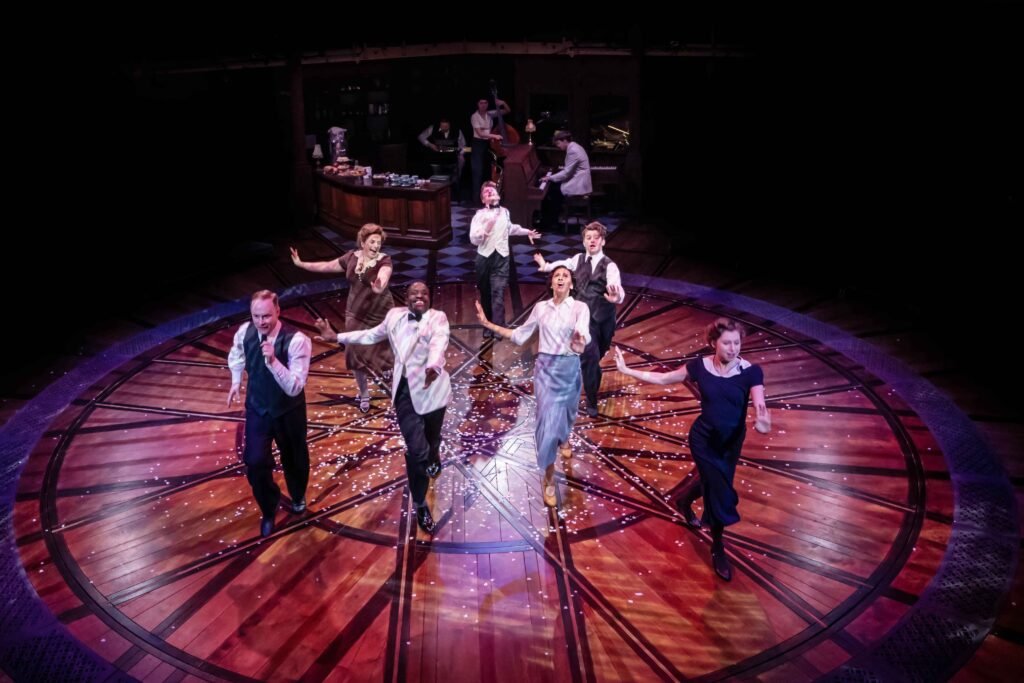
Tonight, we’re seeing Emma Rice’s adaptation of Noël Coward’s Brief Encounter, perhaps most fondly remembered for David Lean’s iconic 1945 film adaptation. But of course, it began life as a theatre production in a collection of works entitled Tonight at 8.30. Rice has had the brilliant idea of incorporating some of Coward’s songs into the narrative, making it not exactly a musical so much as a play with music cleverly incorporated into the narrative, with four musicians onstage throughout. This is an ambitious move and much more interesting than a straight recreation of its much-adored progenitor.

The plot is so familiar I won’t spend too much time recounting it. Laura (Hannah Azuonye) is awaiting her train at Milford Junction when she gets a bit of grit in her eye. GP Alec (Baker Mukasa), who happens to be having a cup of tea in the café when she stumbles in, comes to her assistance. From this inconsequential incident a friendship develops, which becomes increasingly problematic as the twosome keep bumping into each other. All too soon, they realise they are falling in love. 

But both of them are happily married and are tortured by the thought of deceiving their respective partners. So what should they do for the best?

Anyone familiar with Lean’s film will be aware that Rice sticks fairly close to that script (something that we confirm by rewatching it on the long journey home the following day), but she does some astute restructuring. Some of the film’s minor characters are given more developed roles here: the relationship between railwayman Albert (Richard Graves) and cafe manager Myrtle (Christina Modestou, most recently seen by B & B at the Edinburgh Fringe in the wonderful Grand Old Opera House Hotel) is more prominent and there’s also a developing romance between café worker Beryl (Ida Regan) and porter Stanley (Georgia Frost). The contrast between the polite conversations of the middle-class protagonists and the earthy, working-class station employees is effectively captured.

At key moments, the actors slip effortlessly into one of the ‘The Master’s’ torch songs, giving the proceedings a louche, cabaret feel, and there’s a brilliantly-choreographed routine where the whole cast move around the Exchange’s circular stage to a series of different musical pieces, culminating in a frenzied jitterbug. The performances are all exemplary, but I particularly enjoy Modestou’s soulful rendition of No Good at Love and Regan’s plaintive interpretation of Mad About the Boy

There’s also a delightful coup de théâtre involving the big station clock that hangs over the proceedings, while hats should also be lifted to the versatile Matthew Allen, who handles a whole string of smaller roles, singing, tap dancing and, at one point even playing the flipping saxophone! 

Sarah Frankcom directs with considerable skill – I fondly recall seeing her delightful production of Blithe Spirit in this very theatre, way back in 2009 – and, all in all, this is a delightful and occasionally surprising production that celebrates the spirit of its illustrious predecessor.

4.2 stars

Philip Caveney