Month: August 2023

Nassim

24/08/23

Traverse Theatre, Edinburgh

Nassim (the play) is six years old, and has been performed by hundreds of acclaimed actors, including Whoopi Goldberg, David Greig and Cush Jumbo. The conceit is simple: each actor only performs the show once – without any rehearsal and having never seen the script. Nassim (Soleimanpour – the playwright) directs via a backstage camera and a loose-leaf script. Soleimanpour is Iranian but his plays have never been performed in Iran; Nassim is about his attempts to express himself creatively without being able to use his mother tongue. One by one, the actors speak for him, acting as a conduit for Soleimanpour’s words. It’s powerful and affecting.

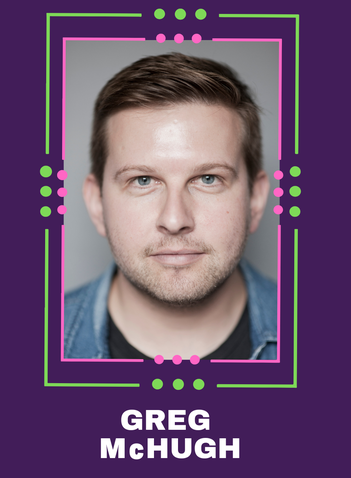
Tonight’s actor is Greg McHugh, best known to us as the terrifying Teddy in BBC Scotland’s Guilt. I’m happy to report that he seems a lot cuddlier in person, approaching Soleimanpour’s script with warmth, respect and humour. He gamely follows all of the instructions, including the more out-there ones, such as holding a sugar lump in his teeth (it makes sense soon after) and accepting cherry tomatoes as punishment for errors in a language game.

But Nassim isn’t just a play: it’s a lesson in Farsi and a reaching out across divides. The tone is gentle and benevolent, provoking smiles rather than laughs – and then, finally, tears. It’s a way for Soleimanpour, a conscientious objector, to reclaim his voice, to subvert the Iranian government’s attempts to silence him. For years, he was unable to leave Iran, and so he sent his scripts out into the world without him; now, he lives in Germany, and travels with them, joining the paper-doll chain of performers onstage, forging those connections in person. He’s freer than he used to be, but it comes at a price. He’s left behind his home, his family. His mother. Mumun. He teaches us a phrase: Delam tang shod barat. I miss you.

Only the hardest of hearts could fail to melt.

4.5 stars

Susan Singfield

Upstart! Shakespeare’s Rebel Daughter

23/08/23

Gilded Balloon Patter House (Big Yin), Chambers Street, Edinburgh

The story of Shakespeare’s younger daughter, Judith, is one that I know very little about, so Upstart! seems the perfect opportunity to learn more – though I have to say this is much more entertaining than your average history lesson. It’s a sprightly and engaging piece about a woman who is constantly denied the opportunity to be her true self, never allowed to explore her own creativity.

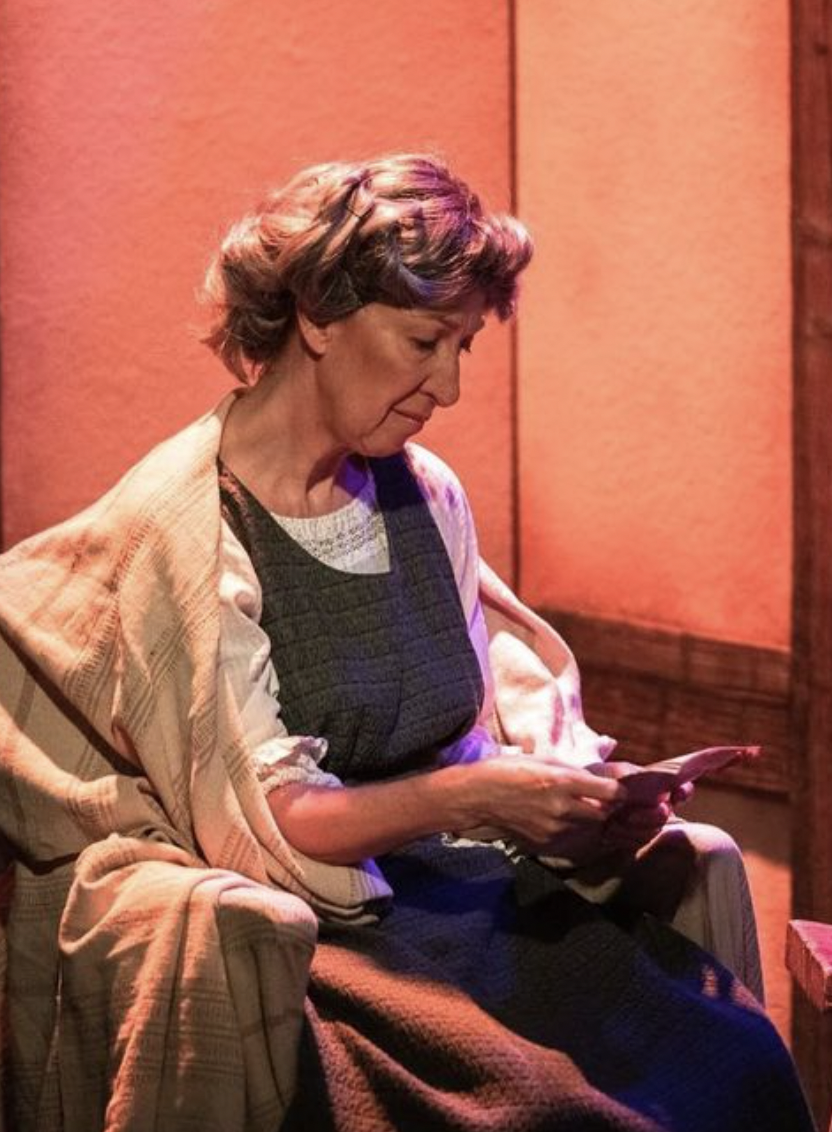
When we first meet her, she’s elderly Judith (Susannah May), who has long outlived her famous father, her husband and even her three children. She now delights in spreading mischievous falsehoods of Shakespeare’s final days to his over-persistent fans, but still finds time to tell us her story.

In flashback we meet the younger Judith (Rachel Kitts), her long-suffering mother, Anne (Aisling Groves-McKeown), her older sister, Susanna (Becky Sanneh), and of course, Will himself (Luke Millard), the successful young playwright spending far too much time in that London, and carrying on with the lady he will later write sonnets about. We learn too of young Judith’s ill-fated relationship with Tom Quiney (Angus Battycharya), her first love, whom she eventually marries against her father’s wishes.

Written by Mary Jane Schaefer, this intriguing tale illustrates how Judith is denied pretty much everything she ever wants – she never even learns to write – and how she always feels that she exists in the shadow of her twin brother, Hamnet, who died of a fever when the pair were only little. Judith cannot rid herself of the powerful conviction that her father would have preferred it if she had died in her brother’s place.

This is a complicated tale and the eight-strong cast are compelled to inhabit a variety of roles, which they do admirably, switching costumes and handling the many scene changes with considerable skill, especially impressive on such a small stage. The dialogue feels authentic to the era and there are some short musical interludes, songs of the ‘hey nonny no’ persuasion, which are pleasant distractions as tables and stools are rearranged. Director Alexandra Spence-Jones keeps everything moving along at a brisk pace, right up to the play’s ironic conclusion.

I leave the venue feeling I’ve been informed and entertained. Result.

4 stars

Philip Caveney

Lie Low

22/08/23

Traverse Theatre, Edinburgh

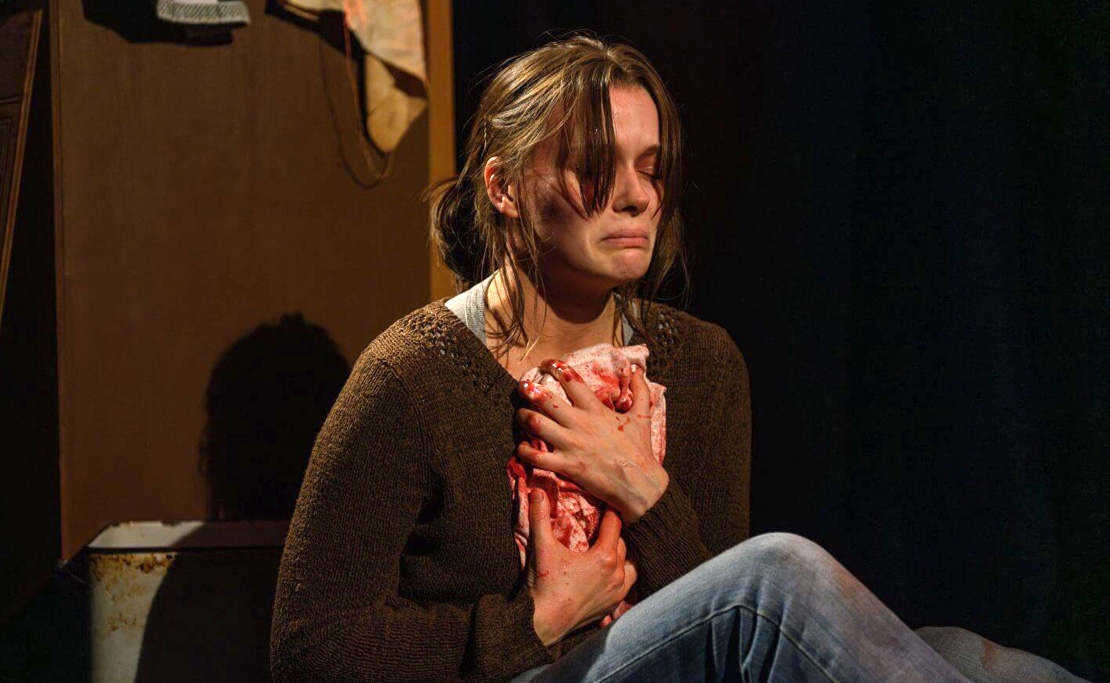
Lie Low is a disquieting play, where nightmares are funny but the waking hours are bleak. It’s a year since Faye (Charlotte McCurry) was attacked, a year since a masked man broke into her house, hid inside her wardrobe and attacked her. She’s fine, she insists; she’s been coping. It’s just that she hasn’t been able to sleep for the last three weeks. If she could just sleep, then she’d be okay…

The disembodied, recorded voice of her doctor emphasises how little help Faye is getting. He suggests pills, meditation, no screens before bed, etc., but Faye has heard it all before. The doctor’s response might not align exactly to what a real doctor would say, but it’s an excellent representation of how it must feel when you’re not being heard, a cry for help met with distance and reserve.

But maybe the point is that nobody can help Faye. We talk glibly of wellness – “reach out, talk to someone, be kind to yourself” – but we can’t live laugh love our way to mental health. Faye is traumatised and she can’t do anything except paper over the cracks.

When Faye’s brother Naoise (Thomas Finnegan) phones her out of the blue, she seizes on the opportunity to try something out. He hasn’t spoken to her since the attack – he hasn’t known what to say, he tells her – but he can make amends now.

By donning a mask, getting into the wardrobe and re-enacting the attack…

Ciara Elizabeth Smyth’s script veers from humorous to horrific in the blink of an eye. The shift in tone is awkward, but that’s what makes it work, disorientating the audience, so that our laughter dies on our lips and makes us uncomfortable, as we recognise the deep-seated anguish behind Faye’s preposterous requests. Occasionally there is perhaps a little too much exposition: the piece works best when we are left to fill in the gaps for ourselves.

But when Naoise reveals the real reason for his call, things become even darker, and we find ourselves reeling, just like Faye, unsure of whose narrative to trust, uncertain what is real and what is not.

Directed by Oisín Kearney, Lie Low is a masterclass in precision and exactitude, every move carefully choreographed. The dancing is wonderfully jarring, at odds with Faye’s state of mind but reinforcing the metaphor of the duck mask: Faye’s brave face.

“I’m fine.”

4 stars

Susan Singfield

Dark Noon

21/08/23

Pleasance EICC (Lennox Theatre), Edinburgh

Once in a while, you chance upon a show at the Fringe that almost defies description. Dark Noon is one such show, but I’m a reviewer so I’m going to give it my best shot. This extraordinary co-production between Danish director Tue Biering and South African director and choreographer Nhianhia Mahlangu, is an epic recreation of the American West, seen through the eyes of not the victors but the vanquished – the people from whom the country was stolen.

It’s a shattering, exhilarating experience.

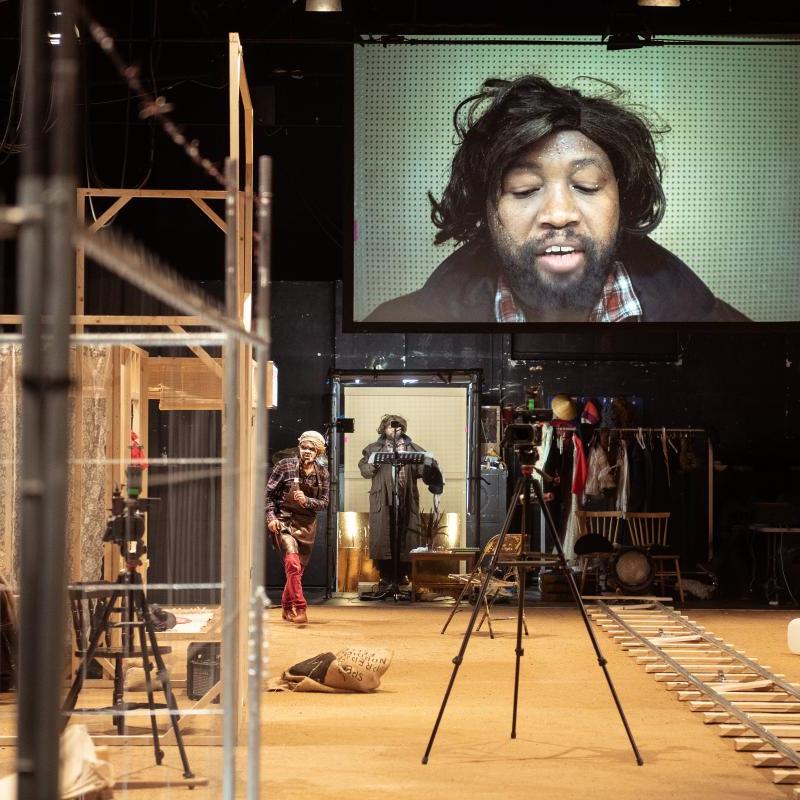
On a dusty expanse of ground, two gunfighters face each other in a scene that could have been plucked from a Sergio Leone movie. They shoot each other and fall in slow-mo – and then, the big screen that hangs over the massive horseshoe stage flickers into life and and actor Lilian Tshabalala talks directly to camera, telling us that we are about to see the story of one place, told in chapters.

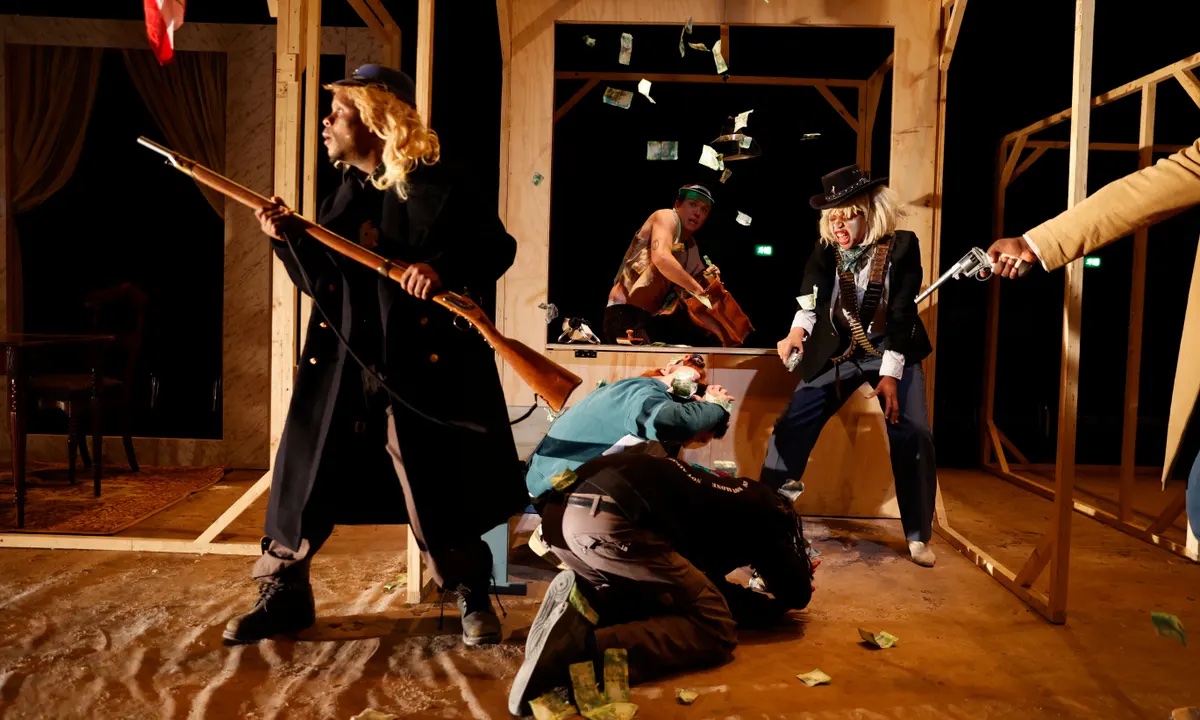
We watch the seven-strong company as they race back and forth in a variety of guises, talking, singing, dancing – sometimes dragging members of the audience onto the stage to help create crowd scenes. At first, the actors are figures in an empty landscape but, as the story unfolds, they somehow manage to create a railroad, and then an entire Frontier town, which grows up one structure at a time, as necessity dictates: a homestead, a jail, a store, a brothel, a church and, perhaps inevitably, a bank. The sheer ambition of the undertaking is jaw-dropping.

Along the way, we witness the awful fate of the Native Americans, shot, exploited and eventually locked safely away behind wire fences; we see the mainly Black cast don ‘whiteface’ in order to assert authority over others. We see scenes of casual racism and are witness to fights and rapes and robberies. One by one, all the cosy myths of Western movies are blown to smithereens, right in front of our eyes. Occasionally, even the cavernous reaches of the Lennox Theatre struggle to contain so much action.

This is a unique piece of devised theatre, sprawling and multi-faceted. It’s sometimes funny, but more often it’s shocking and humbling. At the conclusion, the sell-out crowd rises to its collective feet and the applause reverberates around the room like thunder.

Watching this in the final week of Fringe makes me wish I’d seen it earlier, so I could have urged even more people to go and immerse themselves in it. It’s a wonder to behold.

5 stars

Philip Caveney

Where is Love

21/08/23

theSpace @ Surgeon’s Hall (Theatre 3), Edinburgh

Bloomin’ Buds is a Bradford-based theatre company, founded by Katie Mahon (who also produces this play), with the aim of offering “drama-based support for working class communities who are struggling to access opportunities and the arts due to facing class inequalities.”

This seems especially important at the moment, as the cost-of-living crisis means that people have even less money than usual to spend on ‘non-essentials’, and arts subjects continue to be squeezed in state schools (though still highly valued in private ones… go figure). But, as Dana Gioia says, “The purpose of arts education is not to produce more artists… It is to create complete human beings capable of leading successful and productive lives in a free society.”

Where is Love‘s protagonist, Shelly (Maeve Brannen), is certainly a complete human being, although she’s not convinced she’ll have a successful and productive life. She’s a fighter; she’s had to be. Abused by her dad and taken into care, Shelly has learned to look after herself. She’s sixteen when she first meets Will and he seems exciting. But several kids and a lot of bruises down the line, Shelly is at breaking point…

This play, written by Jennifer Johnson, is based on a real life story and, if you think you’ve heard it all before, therein lies the tragedy. Shelly’s experiences are anything but unusual: one in three women in the UK experiences domestic violence. Perhaps some elements of the piece could be expanded on – it’s not quite clear, for example, how long a time period is covered, nor how many children Shelly has – but it all adds up to a compelling and surprisingly uplifting tale. The cycle can be broken: Shelly can give her kids the stability she never had and, through her work, help others who’ve been let down by the system.

Brannen performs the monologue with absolute conviction, imbuing Shelly with an impish appeal, and I like the addition of the real Shelly’s recorded voice, her words used to provide extra background information or to move the story along.

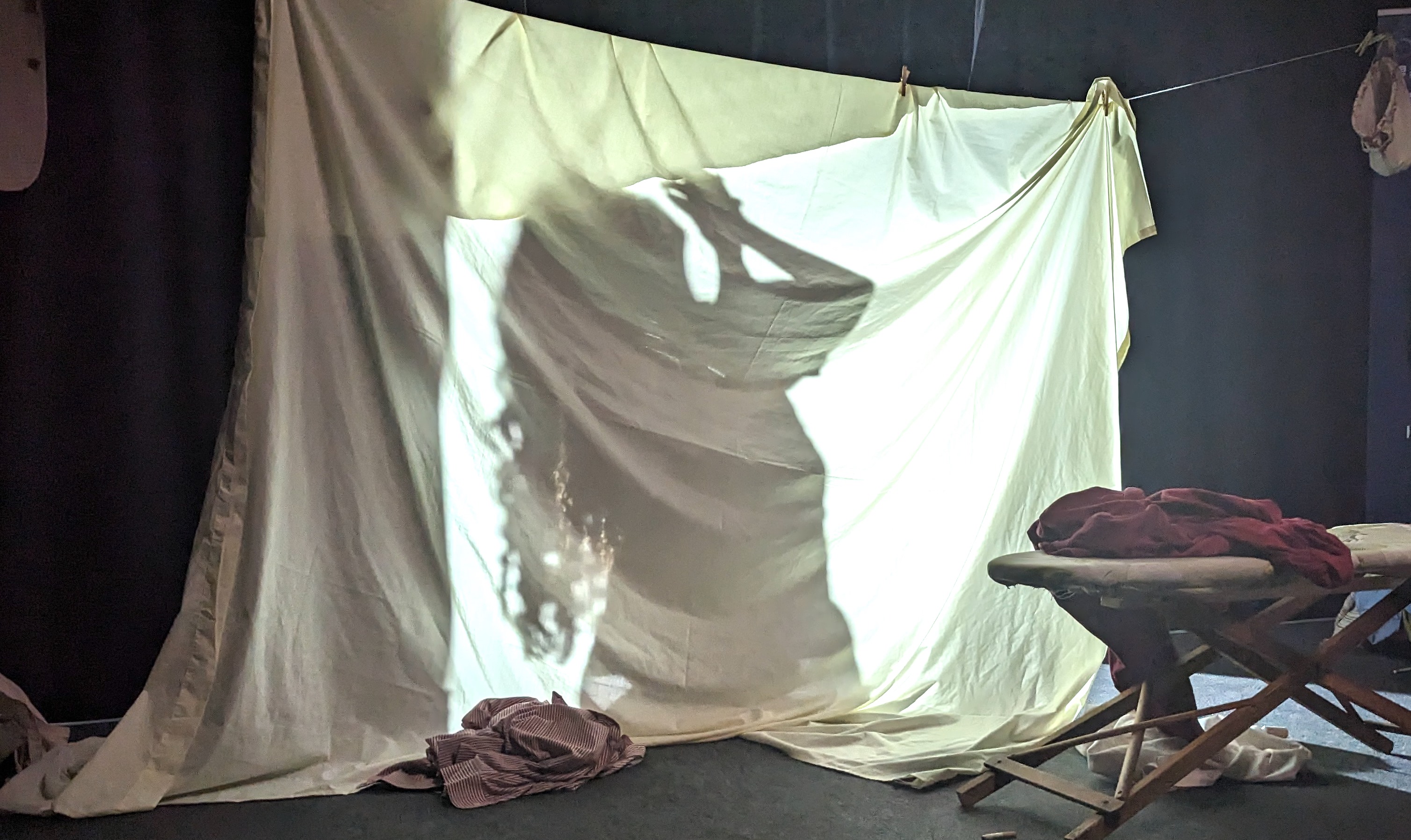
Grace Wilkinson’s direction is assured and imaginative: rarely has a washing line been put to such a variety of uses. This one serves not only as a symbol of Shelly’s domestic load, but also as the hanging strap on a bus, a shower screen and lots more. The music (by Claire O’Connor) is noteworthy too, particularly Shelly’s plaintive refrain, “I’ll be your landmark…”

Bloomin’ Buds are doing an important job in opening up access to the arts and ensuring that working class voices are not excluded from the mix. In fact, the theatre company’s own backstory would make an interesting play in itself. Next time, maybe?

3.5 stars

Susan Singfield

After This Plane Has Landed

20/08/23

theSpace @ Surgeon’s Hall (Theatre 1), Edinburgh

If I were ever asked to compile a list of subjects unsuitable for musical adaptation – it’s an unlikely occurrence, but bear with me – the story of John McCarthy and Jill Morrell would probably figure fairly prominently.

McCarthy is the British journalist, who in 1986 was kidnapped in Lebanon and spent over five years in captivity, being systematically beaten and interrogated – hardly the stuff of song and dance. Meanwhile, back in England, his fiancée and fellow-journalist, Morrell, tirelessly campaigned to keep his name and his predicament in the public eye. And although (spoiler alert!) McCarthy was eventually released and returned safely to his homeland, the couple didn’t have anything resembling the traditional happy ending.

When we first meet John (Benedict Powell) and Jill (Claire Russell) they are on the London Underground. As the music swells and Russell readies herself to launch into the opening song, Powell actually expresses incredulity. “This is going to be a musical?” he cries. And if I’m honest, I’m of the same mind.

But my reservations are quickly swept aside as soon as they’re a few bars into one of Adrian Kimberlin’s lovely, melodic ballads. Both Powell and Russell are gifted vocalists, especially when their plaintive voices are joined together in harmony. The script (also by Kimberlin) is clever enough to occasionally remind us of the artificiality of the piece, and this meta-theatricality provides a useful touchstone.

Most interestingly, the section that deals with the aftermath of the kidnapping – John’s ongoing struggle to reclaim some kind of normal existence after the living hell he’s been through – yields some of the most poignant moments. And Jill gets her chance to shine too. I particularly love the ballad where she insists that she will not be dismissed as ‘the woman who waits’, that she has a life and an identity of her own. I have to confess to tearing up a little during that song.

After This Plane Has Landed is a sweet and engaging musical, based around a turbulent few years in the relationship of two real people. Against all my expectations, it makes for a very entertaining hour – and I’ve just had to cross two names off that imaginary list.

4.2 stars

Philip Caveney

Artist/Muse

20/08/23

Assembly George Square (Studio Five), Edinburgh

The Wednesday Women’s Writing Collective (WWWC) is “a group of women and femmes dedicated to fostering creativity and uplifting marginalised voices”. In this piece, written by Diana Feng, Tegan Verheul, and Clarisse Zamba, their focus is on the anonymous artist’s muse, who – they posit – is a co-creator, and so merits some credit.

The Assembly’s Studio Five has a day job, spending eleven months of the year as a lecture theatre. On entering the small space today, I note that there are sheets of paper and pencils on the long bench tables. “Please feel free to do some life drawing,” the usher says.

On the stage, standing inside a large gilt frame, there is a woman. We pick up our pencils and begin to draw.

It’s a neat conceit, positioning the woman as an object, a thing for us to look at and attempt to recreate. It positions us as the artist too: we’re in charge of our creations, aren’t we? Except… without her, we have nothing to draw. Her style, the expression on her face, her demeanour; we have had no say in those. She is the image and we mere interpreters. (In my case, a pretty poor one at that…)

We never finish the drawings. Once the lights go down, the story begins. The woman steps out of the frame and bursts into life. She is Olivia Fernandez (Caterina Grosoli), a life model in the middle of a screaming row. Her sculptor boyfriend, Laurent (Luke Oliver), has found a new, much younger subject – and Olivia isn’t going to go quietly. As their argument grows more violent and heated, she seeks refuge in a stranger’s house. He – “Of course!” says Olivia, despairingly – turns out to be another artist, albeit a much quieter one. He’s Paul Patel (Sushant Shekhar) and he recognises Olivia: he’s seen her image captured many times. Before long, the two have fallen in love – but Paul is jealous and begs Olivia not to pose for anyone else. But how can their relationship survive if her wings are clipped? And, if his body of work depends on her body, how can he claim full ownership?

It’s an interesting premise and we find ourselves grappling with the thorny questions it raises for a long time afterwards. (What if the subject is a mountain or a piece of fruit? What if it’s a building – should the architect be acknowledged? Can we compare life models to musicians, in that a session player/occasional model doesn’t need to be named, but a band member/muse does?)

If the script itself isn’t as weighty as its themes, losing gravitas by centring on an improbable love story, it’s engaging nonetheless. Grosoli gives a sprightly performance as Olivia. Based on Fernande Olivier, Pablo Picasso’s muse, she is a bold, sassy young woman, and Grosoli imbues her with verve and spirit. I especially like the way that dance is used to symbolise her restless nature.

The play’s design is clever too, and I’m impressed by the judicious use of projection on the enticingly blank canvases.

The first thing I do when I get home is put a face to Fernande Olivier’s name, seeking her likeness in photographic as well as painted form.

3.4 stars

Susan Singfield

Lear Alone

19/08/23

The Space Triplex (Studio), Edinburgh

“Poor naked wretches… How shall your houseless heads and unfed sides […] defend you from seasons such as these?”

King Lear is probably my favourite Shakespeare play; Lear Alone is a distillation of the titular character’s descent into madness and destitution. This Lear isn’t just isolated from his friends and family, he’s isolated from the rest of the story too, and – with the spotlight turned on him – we see with brutal clarity exactly what is happening. Old age is upon him. The signs of dementia are stark: his judgement is poor; he is capricious and sometimes violent; he’s confused; he struggles to remember things – and he goes off, wandering. 

Created in partnership with Crisis UK, this project began life as a web series, focusing on older people’s homelessness. It’s an inspired notion. Using just Lear’s words from the first Folio, Edmund Dehn plays Lear as a shambling elderly man, ignoring his frantic daughter’s answerphone messages, traipsing the streets and talking to the air. He is Shakespeare’s king from 800 BC, but he is also an ordinary man of the 21st century. The words he speaks belong to his character, but they could just as well be memories, lines from his schooldays, recalled because of their present aptness.

He both is and is not Lear.

Dehn cuts a tragic figure, and it’s easy to empathise with him – as well as with his offstage daughter, who keeps trying to contact him. As he rails against the world, the sadness of his situation becomes ever more apparent. The symbolism is bold and simple and very effective: from the Lidl bag he carries everywhere to the blanket he clutches to him, Lear is desperately clinging to what little he has left, holding on to the familiar in the hope of warding off his demons.

Directed by Anthony Shrubsall, Lear Alone is a thought-provoking piece of theatre – a big performance on a tiny stage.

4.1 stars

Susan Singfield
The Hunger

19/08/23

Assembly George Square (Studio 3), Edinburgh

Somewhere in the wilds of the Yorkshire Dales, there’s something seriously wrong down on’t farm.

Deborah (Helen Fullerton) is desperately trying to protect herself and her teenage daughter, Megan (Madeleine Farnhill), as a terrifying epidemic holds the country in its sway. Something is turning ordinary people into creatures to be feared. Oh, they look normal but they have developed unnatural appetites.

The situation has been ongoing for a couple of years now, and is completely out of control, but Deborah is determined to soldier on, putting her trust in her free-range pigs, the way she always has. And thankfully, the prize sow is about to farrow, which will mean a fresh supply of good, wholesome food.

As for those occasional strangers who stumble upon the farm, they are dealt with in no uncertain terms because Deborah is very handy with a rifle and she’s not afraid to use it. She’s also determined to ensure that Megan will eat her three square meals a day…

The Hunger opens with a high-octane scene and keeps the same histrionic tone throughout. Both actors deliver intense, convincing performances, but I’m less happy with the storyline, which isn’t always entirely credible. If the two women have been cooped up together for so long, why does Megan have no idea what’s happening? There’s a revelation waiting down the line but this aspect of the script conspires to defuse it somewhat and, when it finally comes, it isn’t exactly a surprise.

A tense, horror-tinged production from Black Bright Theatre, this is the kind of dystopian end-of-the-world scenario that’s currently enjoying much popularity (and there are definitely echoes of The Last of Us here), but it needs a little more light to go with all that unremitting shade. Still, it keeps me hooked throughout, and I particularly enjoy the tense, open-ended conclusion, which steadfastly refuses to allow the audience to relax as we leave the theatre.

Maybe skip the visit to the kebab house on the way home.

3.8 stars

Philip Caveney

Martin Urbano: Apology Comeback Tour

18/08/23

Pleasance Courtyard (Bunker Three), Edinburgh

You can’t say anything theeeese days.

Martin Urbano has been cancelled, but – despite the title of his show – he’s not sorry in the least. He’s a good guy, unfairly victimised just for articulating what everyone’s thinking. And, you know, assault. “Have you tried tickling a woman you don’t know on public transport recently? Apparently, it’s not allowed any more.”

Just to be clear: this is satire, punching up at the likes of Louis CK and Bill Cosby rather than down at their victims. It’s not an hour of whinging from an entitled twat complaining loudly via a Netflix special that they’ve been de-platformed – it’s a very obvious parody of that. Indeed, at times I think the parody is too signposted: the show might be more hard-hitting if Urbano were to commit more fully to the loathsome character he has created (although I can see that further blurring those delicate lines might actually be dangerous for him. After all, he does spend fifteen minutes telling us that he’s a paedophile).

Urbano is saved from this potential danger by a self-deprecating demeanour and by regularly corpsing at the very awfulness of what he’s saying. These qualities combine to reinforce the fact that he does not stand by the ideas he’s espousing, that they are just jokes, intended to make us roar in horror and disbelief. It works. The dingy underground space of Bunker Three is alive with laughter.

The Mexican-American comedian makes his audience complicit too, handing out bits of script for several of them to read. They acquiesce, and so become a part of the phenomenon, happily making statements that conflict with their ethics. Why do I feel qualified to make this assumption about how they feel about their participation? Because I am one of them: I actually stand on the stage and read some very dodgy things into a microphone. It’s a neat reminder that, just like me, Urbano is playing a role.

For a show dominated by misogyny and paedophilia to land as well as it does proves that we’re in the hands of a professional. The hour flies by and the audacious ending really takes me by surprise.

4 stars

Susan Singfield