Vincent Van Gogh

Beyond Monet/Van Gogh

23/12/25

Royal Highland Centre, Edinburgh

Beyond Monet: The Immersive Experience offers visitors the chance to see “Monet like they’ve never seen him before.” This isn’t quite true for us though: we’ve been to the Carrières des Lumières in Provençe about a dozen times, and – unsurprisingly – many of those exhibitions have focused on the famous impressionist’s work, particularly those pieces that depict the area. So, although we’re keen to see what this travelling showcase has to offer, we don’t really expect images projected onto the interior walls of the Royal Highland Centre – where we went to get our Covid jags – to wow us in the same way as they do in the disused quarry beneath Les Baux’s castle.

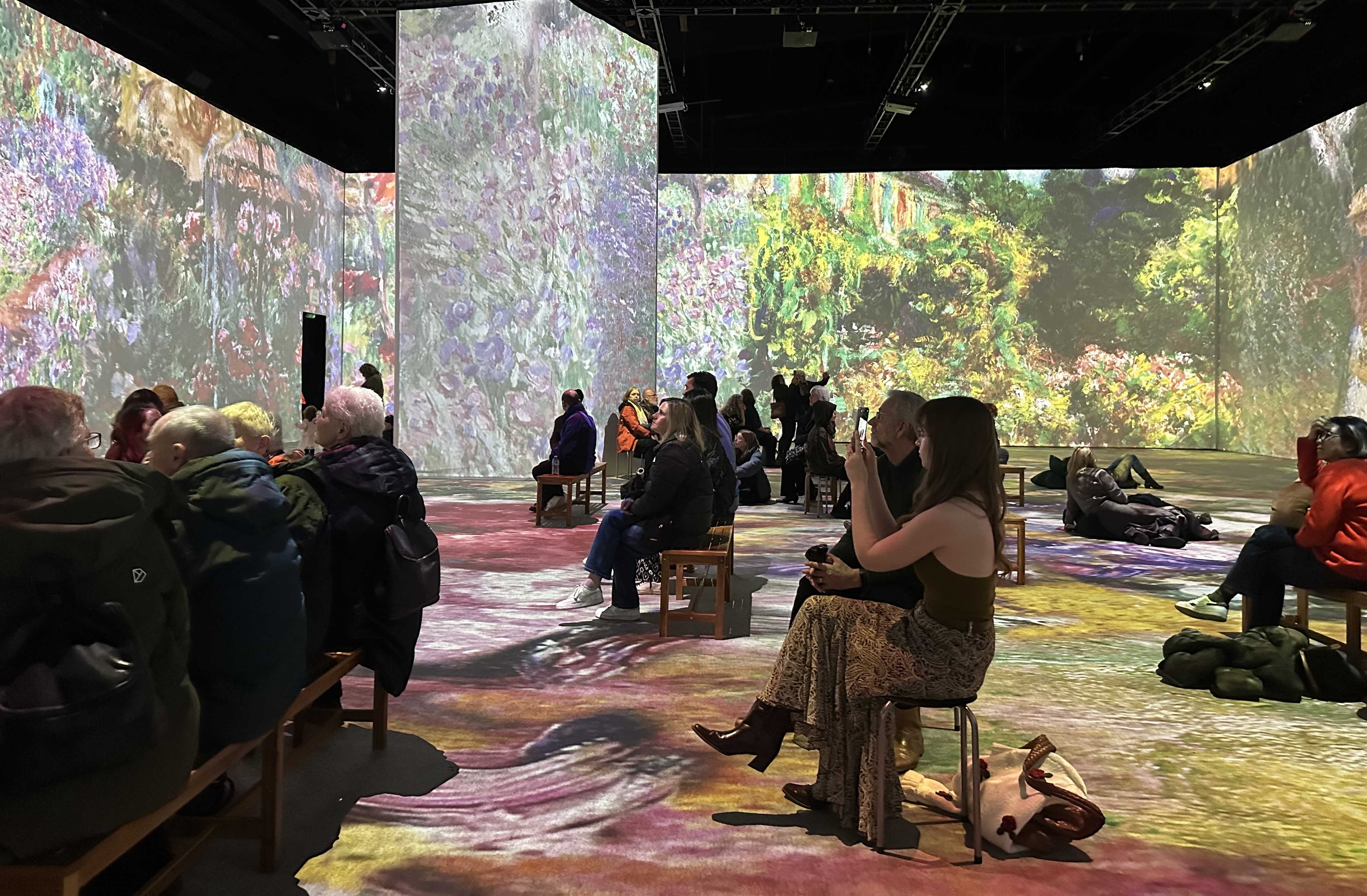
We’re pleasantly surprised. Despite the conference-venue vibes of the building, the immersive experience has been so cleverly curated that we soon forget where we are. What we lose in size and majesty, we gain in subtle animation and a clear visual narrative. Beyond Monet is showing ‘in rep’ with Beyond Van Gogh and, in all honesty, we’d have chosen to see Vincent if we could have made the dates work. That didn’t pan out, so we’ve settled for Claude – and we’re delighted with the result.

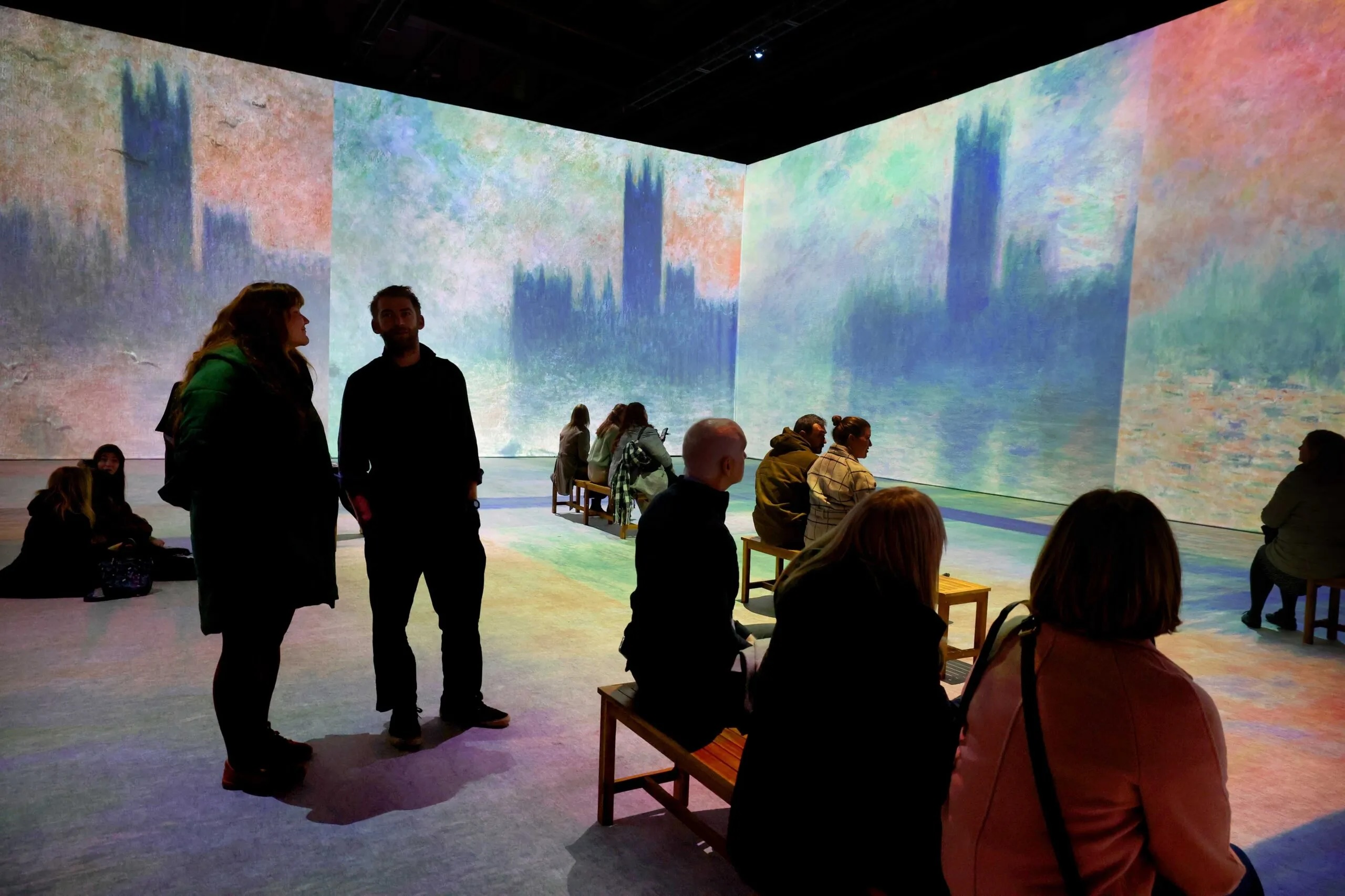
We already knew we loved Van Gogh, but we’ve tended to dismiss Monet as a bit too pretty, a bit too safe. But under Mathieu St-Arnaud’s creative direction, we see just how transgressive the artist really was, not only for the ‘unfinished’ look of his art, but also in his obsession with painting the same scene over and over, in order to capture it in different weathers, different lights. Seeing the various giant iterations of the Haystacks and the Houses of Parliament – sometimes side by side, sometimes layered over one another – really helps to illustrate his aim of capturing his immediate sensory reaction to a particular scene.

The Waterfall Room, which we enter first, gives us an eight-minute ‘starter’, where we stand, enraptured by the fleeting impressions (sorry!) of what is coming up, with glimpses of Monet’s paintings projected onto the walls and floor. In the Infinity Room next door, people are sitting on benches and cushions, settling in for the ‘main course’ – which runs on a thirty-five minute loop. Combined with Jean-Sébastien Côté’s hypnotic soundtrack, the hallucinatory imagery wraps itself around us, creating an intense auditory and visual experience that keeps us entranced for the whole running time.

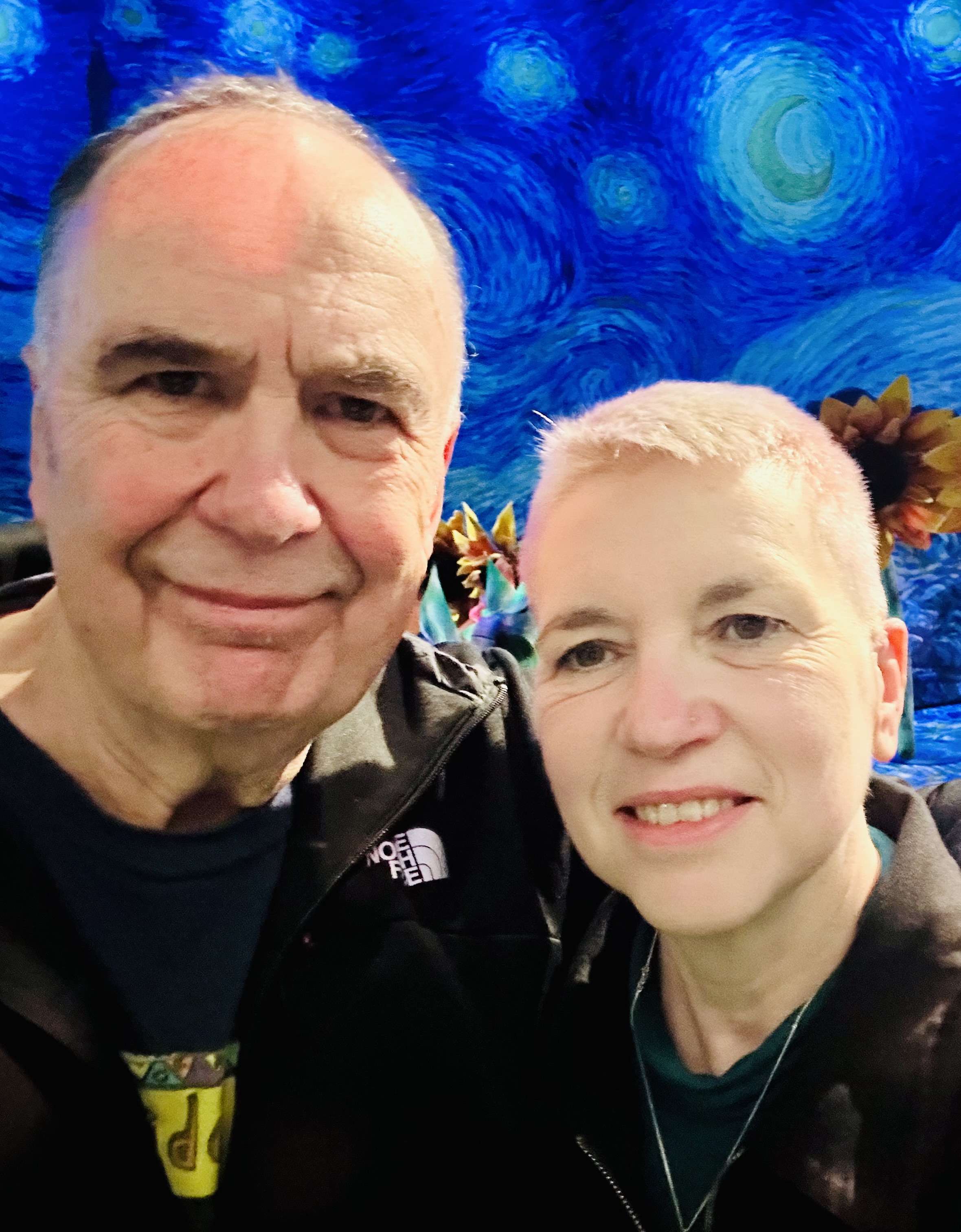
Finally, we enter the Reflection Room, which has been mocked up on one side to look like the Giverny gardens, while the other features Van Gogh’s starry night skies looming over a field of giant sunflower sculptures. Like all the best desserts, it’s fun and light – and gives us an opportunity to take a selfie or two.

If it’s showing near you, I highly recommend you visit this extraordinary exhibition – and take the chance to see Claude Monet in an entirely new… ahem… light.

4.5 stars

Susan Singfield

At Eternity’s Gate

14/11/19

Here’s one I missed at the cinema, but – as is increasingly the case these days – it’s right there on Netflix for anyone to see at the click of a button. While this would definitely benefit from the immersive qualities of a big screen, beggars can’t be choosers.

Julian Schnabel’s film of Vincent Van Gogh concentrates on his years in Arles and, later, at Auvers Sur Oise. Willem Dafoe stars in what is possibly the role he was born to play, so convincingly does he settle into the great man’s persona, and he greatly deserved his Oscar nomination.

This is far from a straightforward biopic, however. Indeed, anybody who prefers a clear narrative arc will probably have a tough time with this. There’s a lot of footage of the artist, easel strapped to his back, wandering for miles across the French countryside in search of the elusive ‘perfect light’ and the film takes its own sweet time over those sections. But there’s no doubting the power of the sumptuous cinematography of Benoit Delhomme, which really does capture the unique look of Van Gogh’s paintings.

A lot of big names pop up in cameo roles. Oscar Isaac is a suitably swashbuckling Paul Gaugin, Rupert Friend is Vincent’s endlessly patient brother, Theo, and Mads Mikkelsen gets the dubious honour of portraying the priest at an asylum, who unashamedly informs the artist that his work is ‘ugly and without merit.’ Dafoe, meanwhile, suffers for his art in utterly convincing style and generates pity for Vincent as well as anger at the horrible treatment he receives on an almost daily basis.

There’s a powerful payoff when, after his mysterious death (which is frustratingly skipped over), we witness Vincent lying in his coffin, surrounded by his paintings and we cannot help but see that the mourners are already taking more interest in his work than they ever did when he was alive.

An interesting effort, then, and – while it lacks the jaw-dropping power of Finding Vincent – it’s still essential viewing for fans of one of history’s greatest artists.

3.8 stars

Philip Caveney


Loving Vincent

02/11/17

Once in a while a film comes along that is so original, it almost defies definition. This Polish-UK collaboration, is one such film. Billed as the first ‘fully-painted’ feature, it represents ten years’ work by more than one hundred artists. Shot conventionally at first, with a cast of distinguished actors, all chosen for their similarities to characters in Van Gogh’s art, each frame (and there are 165,000 of them) has then been painstakingly overpainted with oils. The result is that the screen seems to writhe and flicker with vibrant colours, the technique plunging the viewer headlong into the artist’s idiosyncratic world. At first, the effect is dazzling, almost overpowering, but once you settle into it, you begin to take notice of the story, which is presented rather like a detective mystery. Did the famous artist really commit suicide? Was he murdered? Or was he the victim of a childish prank gone wrong?

It’s a year since Van Gogh’s death and Armand Roulin (Douglas Booth), the son of Vincent’s close friend, Postman Joseph (Chris O Dowd) is charged with the thankless task of delivering the artist’s final letter to his brother, Theo. Armand reluctantly heads off to Paris where he talks to Pere Tanguy (John Sessions), who tells him that the letter cannot be delivered, as Theo too, is dead. He also assures Armand that Vincent was happy in the days leading up to his death and would never have dreamed of killing himself. Intrigued by this information,  Armand heads for Auvers Sur Oise, the little town where Vincent spent his last days, and starts looking for answers. But it seems everyone he talks to has a different opinion about what might have happened to him…

There’s no doubting the care and attention to detail that filmmakers Dorieta Kobiela and Hugh Welchman have lavished on Loving Vincent – and it’s amazing to note, that no matter how manipulated the film images are, the actors are always identifiable as themselves, even whilst looking exactly like their portrait counterparts. Jerome Flynn who plays Doctor Gachet is a particularly good example of this. The scene where we first meet him is like watching a famous painting come to life. I particularly like the regular monochrome flashbacks, where a more photorealistic technique is employed, which offers a welcome break from the barrage of multi-coloured visual fireworks. Lovers of Van Gogh’s work will have an absolute field day here spotting all the references to his most famous paintings (there are 120 of them) and though the various theories surrounding the artist’s death are nothing new in themselves, it’s interesting to have them presented for consideration in this way. It’s good too that we are left to make up our own minds about which particular theory to believe.

Does this work as a movie? Yes, I think so, but it certainly won’t appeal to everyone. If you don’t care for the artist’s work, this certainly isn’t going to float your boat. Loving Vincent has a limited release across the UK and may end up finding its biggest audiences on the small screen, but if you do get the chance to see it in a movie theatre, then go and immerse yourself in Vincent’s world. It really is quite an experience.

4.4 stars

Philip Caveney