Tom Burke

Black Bag

15/03/25

Cineworld, Edinburgh

Meanwhile, back in the most unconvincing retirement since Frank Sinatra announced his ‘final’ tour, Steven Soderbergh has a new film. (We reviewed his previous effort, Presence, in January.) So he’s more productive than most of his peers and, if it sometimes feels as though he’s simply ticking some boxes here – “Ooh, I haven’t done a proper spy movie before!” – Black Bag is yet another notch on his belt, even if it seems like his latest opus is a little too understated for comfort.

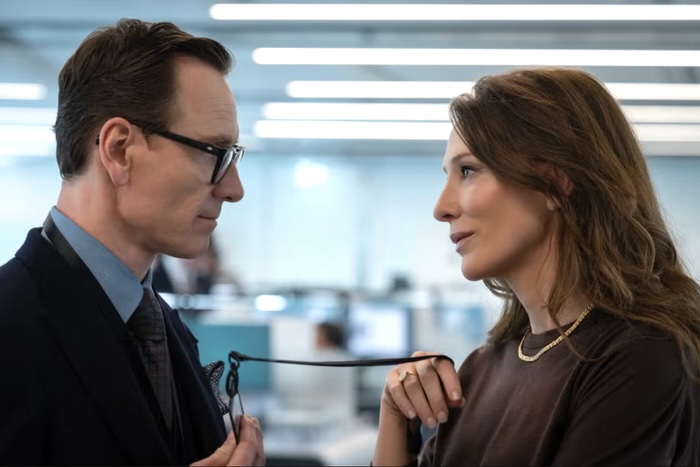
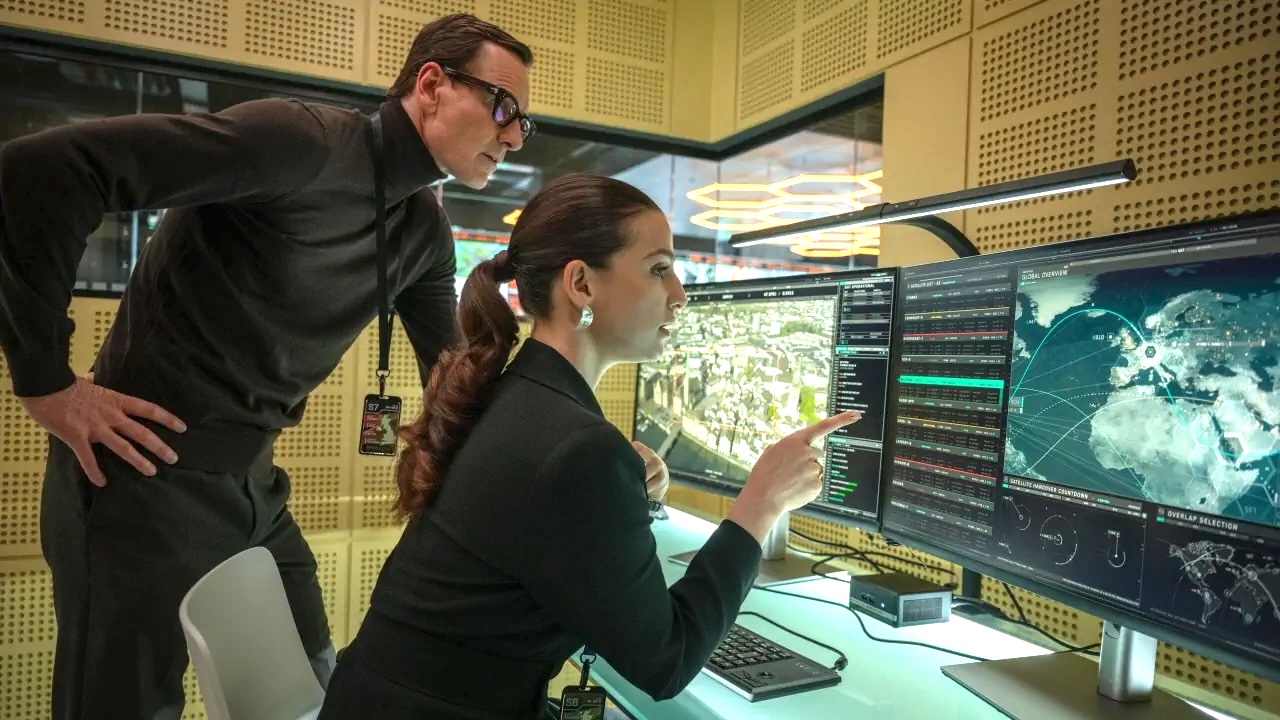
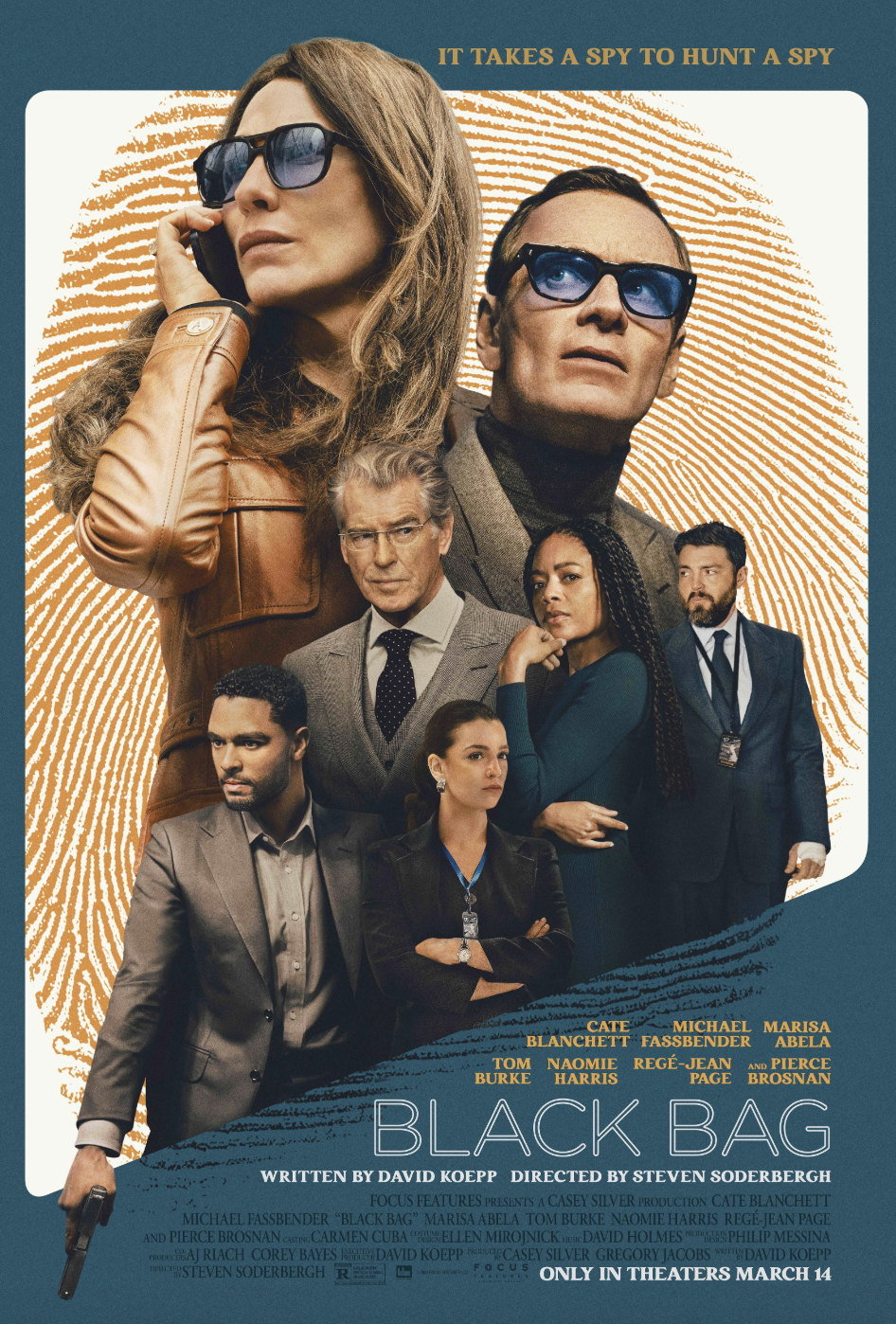
British intelligence officer George Woodhouse (Michael Fassbender) is contacted by his superior, ‘Meachum’ (Gustaf Skarsgaard), to investigate the leak of a top-secret software programme called ‘Severus.’ (It might just as readily have been named ‘McGuffin.) All we really know about Severus is that, if it falls into the wrong hands, thousands of people could die, though exactly how is a matter of conjecture. Meachum warns George that amongst the suspects is Woodhouse’s wife and fellow-operative, Kathryn (Cate Blanchett), who – George has to reluctantly admit to himself – has been behaving rather suspiciously of late. But he trusts her implicitly… doesn’t he? Meachum gives George a week to find out who is responsible but, shortly afterwards, Meachum succumbs to an unlikely heart attack and dies.

George is a meticulous operative and he promptly invites the four other suspects – all of them fellow spies – to a dinner party at his house, where he spikes a bowl of curry with a truth serum (after first warning Kathryn not to eat any). But who is the most likely candidate for this betrayal? Could it be satellite imagery expert, Clarissa (Marisa Abela)? Her current boyfriend, Freddie (Tom Burke), who is himself having an affair with… somebody? What about the agency psychiatrist, Zoe (Naomi Harris), who is privy to all their secrets? Or her current squeeze, James (Regé Jean Page), a man who is perhaps a little too cool and handsome to be entirely trustworthy?

To add a little extra spice, the agency’s overall boss, Arthur Steiglitz (Pierce Brosnan), would also appear to have some skin in the game…

Black Bag is, I suppose, a slice of cold-war claustrophobia. The title refers to the two-word excuse given by operatives when they don’t want their recent escapades to be investigated too closely. Soderburgh keeps everything bubbling along as David Koepp’s script switches slickly back and forth between the various machinations, and there are some cyber-tech scenes where suspects are investigated by hidden cameras… but there’s a problem here: it’s that I’m simply not invested enough in the characters to care what happens to them. The most interesting scene is the one where the four suspects undergo lie-detector tests and Soderbergh has fun cutting back and forth between their respective POVs, but that’s not really enough to keep me hooked through the entire hour-and-a-half run time.

And the closing scene’s final ‘twist’ doesn’t feel like enough justification for the whole enterprise. So, decent-ish, I guess, but certainly not up there with the director’s finest work.

So, let’s see what he has up his sleeve. It occurs to me that he’s never really done a cannibal holocaust movie. Who knows? It could just happen.

3.2 stars

Philip Caveney
Furiosa: a Mad Max Saga

25/05/24

Cineworld, Edinburgh

Furiosa is my most anticipated film of the year but to fully explain why, it’s necessary to briefly look back at the career of writer/director George Miller. I saw the first film in the Mad Max franchise way back in 1979, a modest, low-budget revenge thriller starring a young Mel Gibson. It was perfectly watchable but gave no idea of the wonders that were to follow. 

In 1983, The Road Warrior brought back the titular character with a bigger budget and an iconic look that depicted Australia in the years following a nuclear war. It was louder, more ambitious and gloriously inventive, an unstoppable thrill ride. In 1985, Beyond Thunderdome brought in Tina Turner for a guest appearance and appeared to round off the franchise in grand style. 

In normal circumstances, that would probably have been the end of it. So when Miller resurfaced nearly thirty years later with Fury Road, I had very low expectations. Tom Hardy stepped into the scuffed boots of Max and Charlize Theron played a new character, Furiosa. The film was an extraordinary, foot-to-the-metal, adrenaline-powered masterpiece, one that left me stunned at its conclusion. I saw it a second time in 3D and, two years later, was one of the first in the queue for the special Black and Chrome edition. How was Miller ever going to follow such a powerful creation?

He took his time. I was astonished to realise just the other day that it’s a full nine years since Fury Road’s release. The worst thing that could happen, I thought, would be if he tried to replicate the previous film’s simple, propulsive structure – and happily he’s gone in an entirely different direction. Of course he has. He’s George Miller.

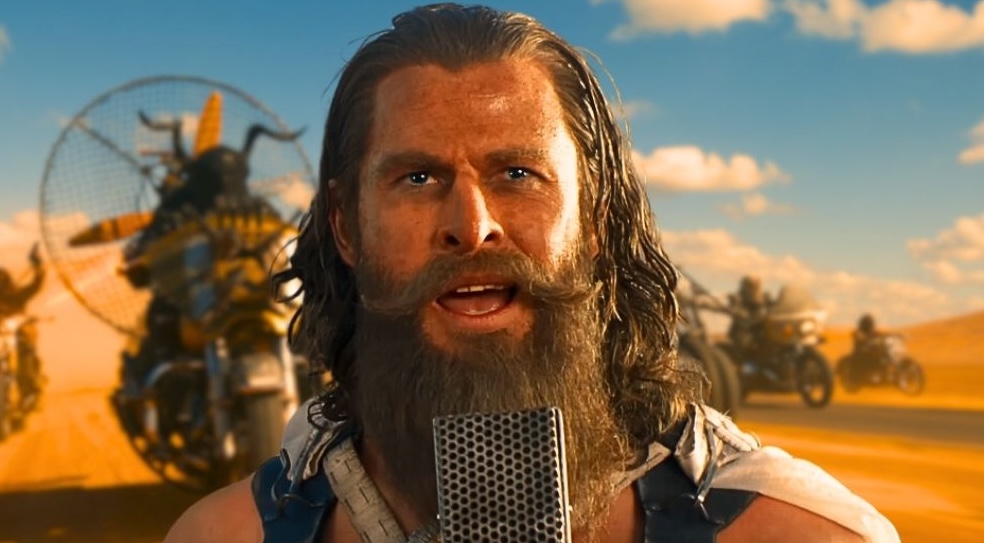
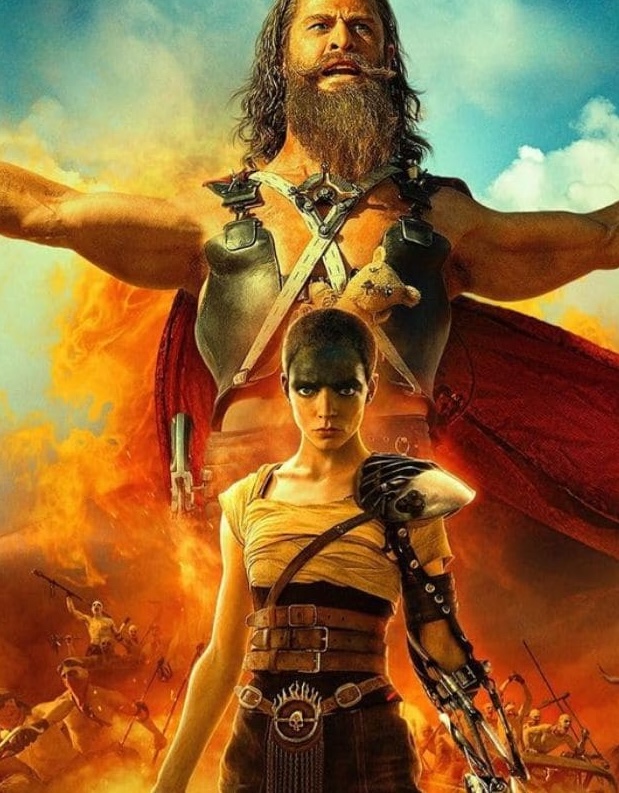
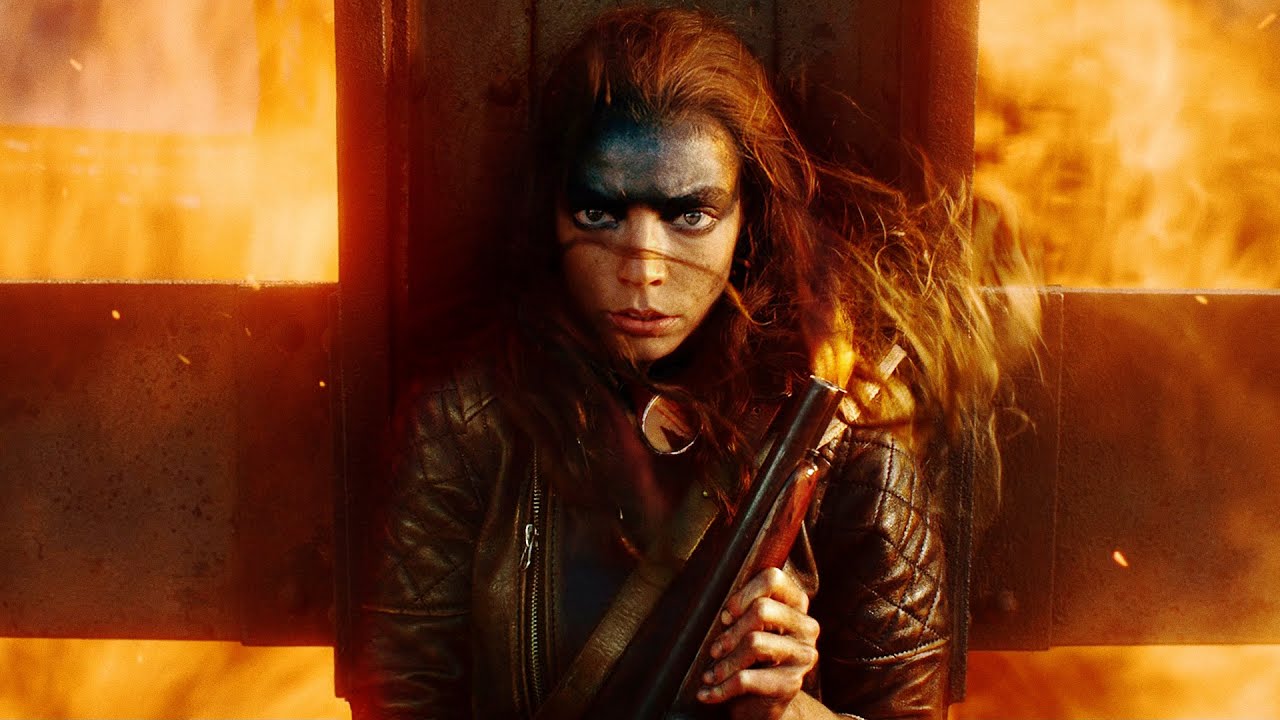
Furiosa is a prequel, a much more episodic affair than its predecessor, divided into five chapters (each with a portentous title) and, unlike Fury Road’s three and a half day timeline, this is set over something like eighteen years. We first meet the young Furiosa (Alyla Browne) in ‘The Green Place,’ the childhood home she spent most of Fury Road trying to get back to, and it’s clear at a glance why she was missing this verdant ‘place of abundance’ in the midst of a desert. But her tranquil life is rudely disrupted when she is kidnapped by a gang of bikers from the wasteland and taken to the kingdom of Dementus (Chris Hemsworth), a motor-mouthed, self-aggrandising ruler, who is used to taking whatever he wants whenever he wants it. Furiosa is merely his latest acquisition. But the girl’s mother, Mary (Charlee Fraser), follows her, intent on taking her home again at any cost…

What immediately hits me about this film is the glorious world-building that’s going on. This is an eye-popping spectacle. Every shot caught by cinematographer Simon Duggan is ravishing and Jenny Beavan’s costume design is endlessly inventive. Add the powerful sound design and you have a film that literally shakes you in your seat. It’s a full hour before Alyla Browne mutates into Anya Taylor-Joy in one of the most accomplished on-screen transformations I’ve ever witnessed. Given only thirty lines of dialogue in the entire film, Taylor-Joy has to convey her character mostly using her eyes. She somehow manages to show Furiosa’s inner turmoil, only briefly finding solace in the affection of rig-driver Praetorian Jack (Tom Burke). Her most powerful motivator – a desire for revenge – is ever present and often propels her into rage. It’s fascinating to watch her. Hemsworth is also wonderful as Dementus, so much more than a cardboard cut-out villain. Here is a man with his own inner turmoil and awareness of his failings. He really should play bad guys more often.

Motor lovers shouldn’t despair because Miller’s trademark behemoth vehicles are in evidence – including a chariot pulled by three motorbikes – and there’s an extended chase sequence that pulls out all the stops, particularly in the part where Praetoran Jack’s rig is attacked by paragliders. As ever, hats off to the stunt performers who make this such a thrill ride. 

But Furiosa is more – much more – than just another action flick. It’s also about the power of mythology, the ways in which stories of epic odysseys perpetuate and endure across the centuries. It’s about the desire of humanity to survive against overwhelming odds and the ways in which religions are shaped by those who invent them. But mostly, it’s about a 79-year-old director at the height of his powers, being unleashed into the world’s biggest sandbox and invited to play. And here, Miller shows more unbridled invention than I’ve seen in a very long time. 

My advice? Get thee to the biggest IMAX screen available, buckle in and enjoy the ride. Oh, and Max? He’s there… but you’ll need to keep your eyes peeled to spot him.

5 stars

Philip Caveney

The Wonder

19/11/22

Netflix

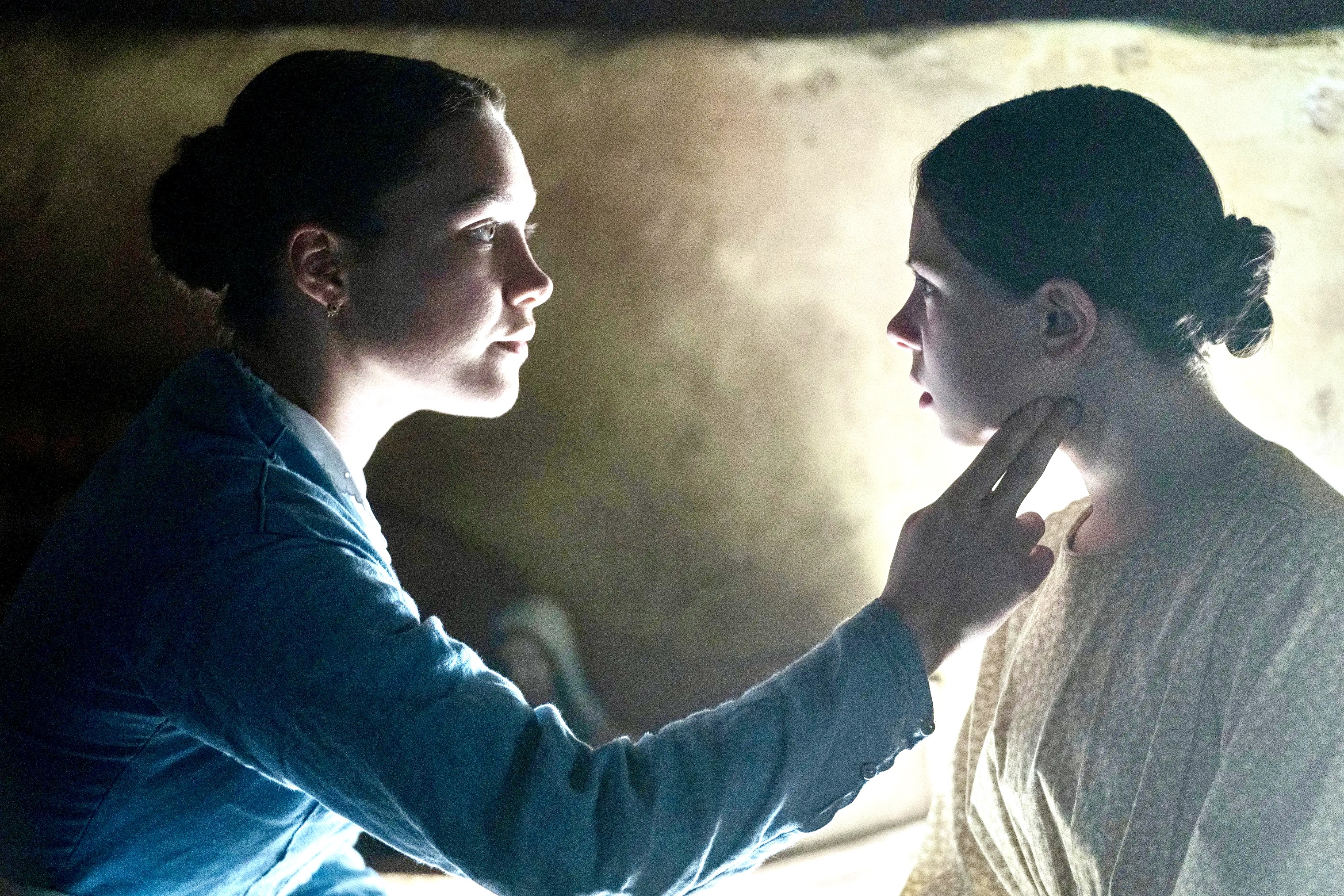
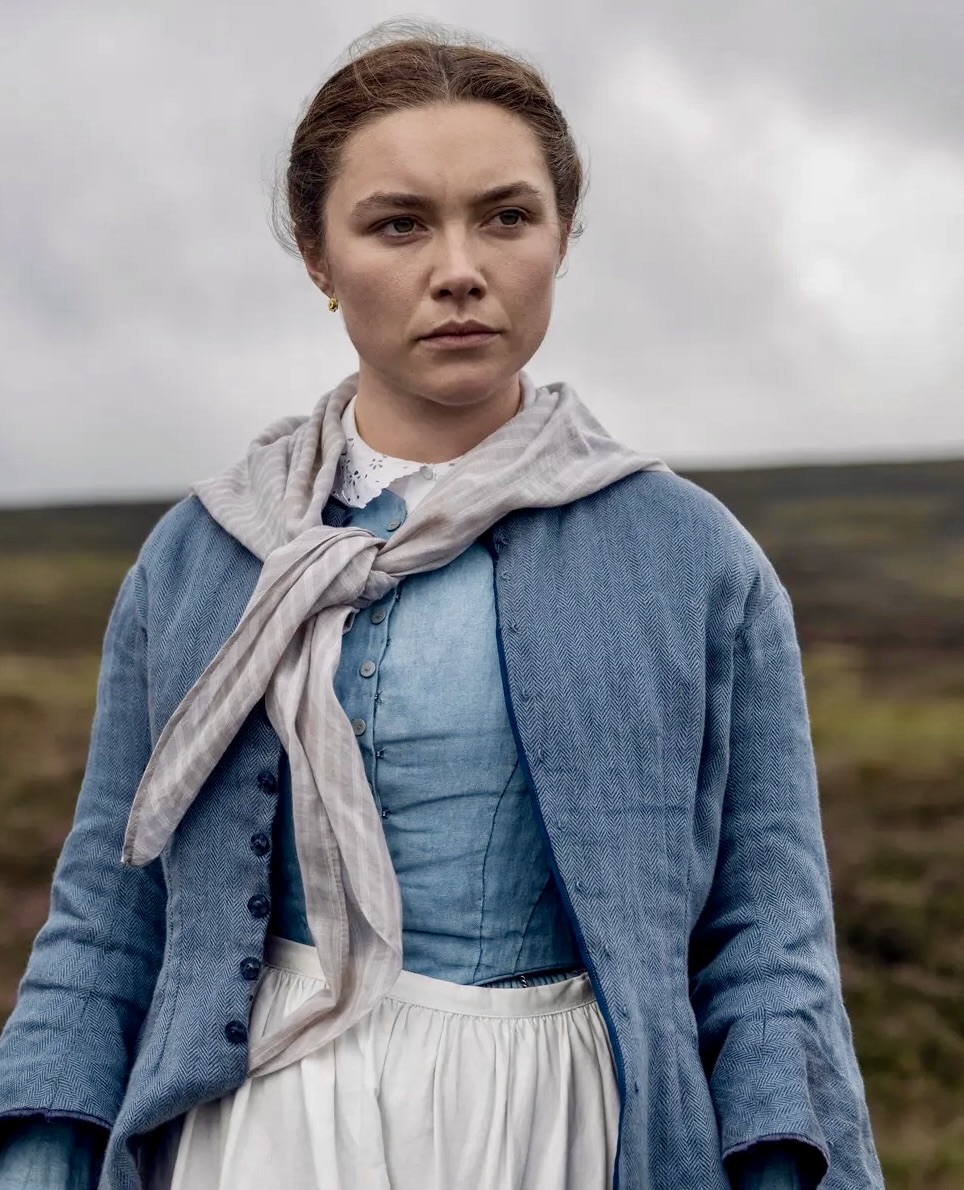
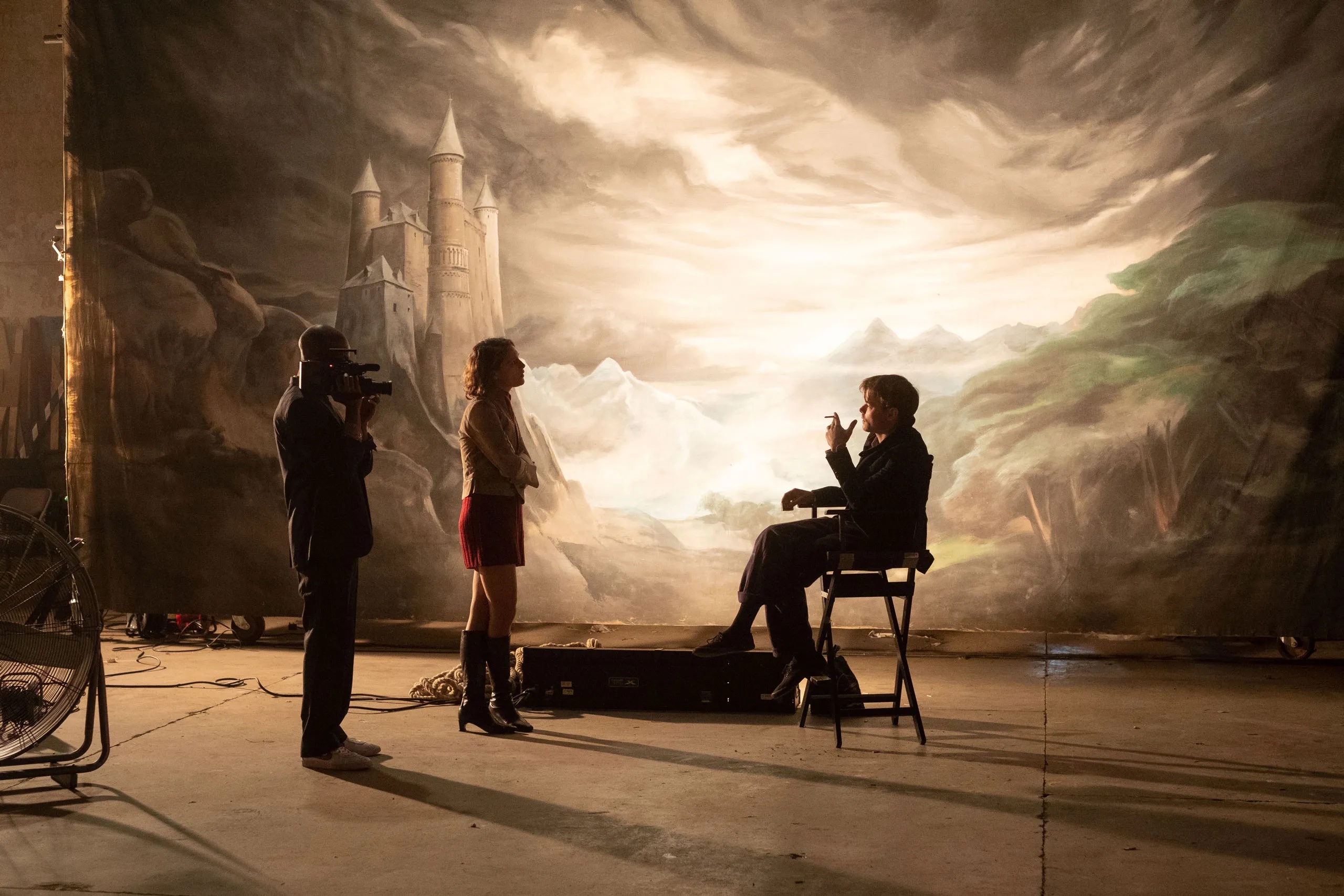
Emma Donoghue’s The Wonder is a little jewel of a novel, a bleak tale seen entirely through the eyes of its main protagonist, Lib. Because the original story is so insular, I wondered if it would be a suitable subject for a film, but director Sebastián Lelio (who co-write the screenplay with Alice Birch) has done a creditable job of opening up the original vision, even throwing in some post-modernist flourishes to accentuate the artifice of the situation. The opening scene depicts a contemporary film studio, complete with lighting rigs and other equipment before the camera pans right and zooms in to the hold of a nineteenth century sailing ship, where Lib (Florence Pugh) is eating a meal. From the very beginning, Leilio seems to be warning us not take everything we see on face value. The Wonder, after all, is also a story of deception.

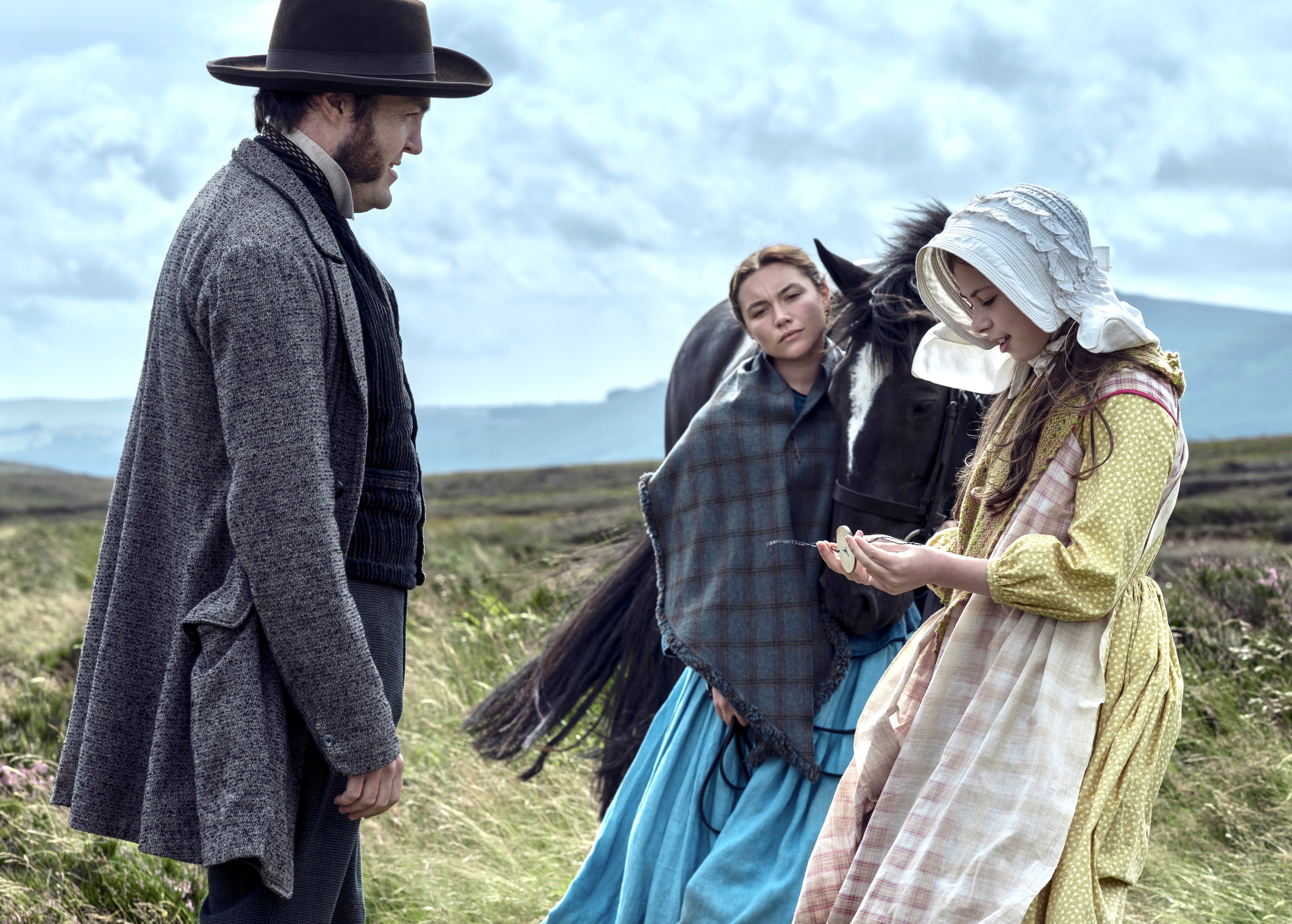
It’s 1862 and English nurse Lib Wright has been summoned to a remote Irish village to stand watch over the Wonder of the title – eleven year old old Anna O’ Donnell (Kila Lord Cassiday), who, it is claimed, has not eaten a morsel of food in four months and yet remains in apparently perfect health. Lib is understandably sceptical, but the local clergy, led by father Thaddeus (Ciarán Hinds), are keen to claim this as a bona fide miracle, a feather in the cap of the Catholic church. Dr McBrierty (Toby Jones), on the other hand, prefers to see Anna as some bizarre new mutation. Has she developed the ability to photsynthesise? Lib’s task will be to keep a close watch on Anna around the clock, alternating shifts with a nun, Sister Michael (Josie Walker), so that – if there is any secret feeding going on – it will soon come to light.

Lib’s suspicions are shared by newspaper journalist Will Byrne (Tom Burke), who has been despatched to his old stamping ground to investigate the claims, but the truth behind these ‘saintly’ events is well hidden and hard to root out…

The Wonder makes a successful transition from novel to film, largely because of Pugh’s sterling performance in the lead role, as well as through Ari Wegner’s moody cinematography, which somehow contrives to make every frame look like the work of a classic artist – Jan Vermeer perhaps, or Caravaggio. There are also a few moments where Anna’s older sister, Kitty (Niamh Algar), who also serves as the story’s narrator, breaks the fourth wall and addresses the viewer directly. Some may find these touches intrusive but, for me, they are so effective they have me wishing there were more of them and that Algar had a little more to do in the story – she’s a superb actor and this is little more than a supporting role.

Donoghue’s source novel, a scathing criticism of the Catholic faith and the gullibility of its followers, emerges intact – and those who anticipate a headlong plunge into despair should take heart. The film’s conclusion is more positive than you might expect.

4 Stars

Philip Caveney

Living

09/11/22

Cineworld, Edinburgh

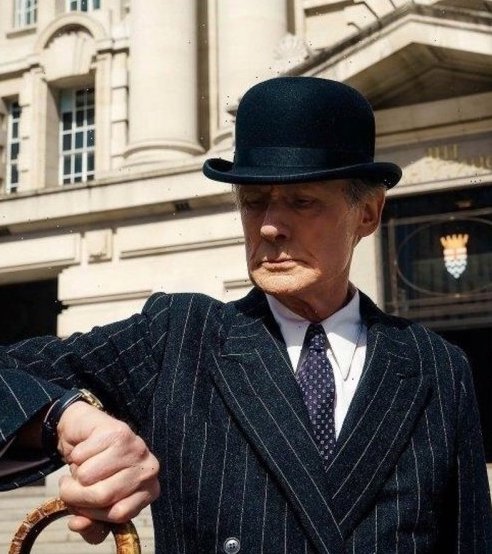
Scripted by novelist Kazuo Ishiguro and directed by Oliver Hermanus, Living is a remake of Akira Kurosawa’s celebrated film, Ikiru – the story of a man coming to the end of his life and desperately trying to right the wrongs of his wasted opportunities. Set in the same era as the original, the story is cleverly relocated to a city hall somewhere in London, where a battalion of bowler-hatted wage slaves put reams of printed paper into order. The office is presided over by Mr Williams (Bill Nighy) a man so grievously incapable of meaningful conversation, that the office’s sole female occupant, Miss Harris (Aimee Lou Wood), has secretly dubbed him ‘Mr Zombie.’

But when his doctor informs him that, courtesy of stomach cancer, he has only a few months left to live, Williams finds he is totally incapable of talking about it to his son and daughter-in-law, preferring instead to unload on a random stranger he meets in a cafe, louche ‘artist’, Sutherland (Tom Burke). Sutherland listens in bewilderment as Williams tells him that he’s never properly lived his life and his solution is to take Williams out on the lash, visiting a series of seedy bars and strip clubs. This offers Williams some momentary respite from his torture, but no real answers.

Next, he has a chance encounter with Miss Harris, and ultimately takes her into his confidence. These scenes could easily be creepy, but it’s clear that Williams is inspired not by lust, but by the young woman’s youth: her ability to take pleasure in the smallest things – like the knickerbocker glory she gleefully chooses when the two of them have lunch at Fortnum’s. It’s these scenes that are the film’s strongest suit and one lengthy monologue from Williams, as he recalls happier times, actually has me filling up with tears.

Ultimately, Living is all about the inability of people to communicate with each other and the point is eloquently made, but – given the film’s length and the fact that it moves with all the urgency of glacial erosion – it sometimes feels as though it makes it several times over. Williams’ elevation to a kind of sainthood, as his final moments are recalled by a passing police constable (Thomas Coombes), come dangerously close to mawkishness. Furthermore, there’s a part of me that feels there’s a kind of cheating going on here. Williams’ progressing illness is conveyed with little more than the occasional grimace and a discreet spot of blood on a handkerchief. Otherwise, he remains as perfectly attired and implacable as ever. None of the horrors of his cancer are ever shown and we all know, don’t we, that real life is never as convenient as that?

Still, there’s plenty to admire here. Nighy was doubtless put on this earth to play the role of Williams, his chiselled, impassive features somehow managing to convey the torment that lies beneath that calm exterior – and Wood is simply adorable as the ingenue who breezes briefly through the fusty atmosphere of the office, before moving on to better things. Kudos should also go to the sound department, for the lustrous music that underpins the films key moments, accentuating the poignancy and regret of the central premise. The era is convincingly evoked, right down to the opening and closing credits and Sandy Powell’s meticulous costume design is, as ever, spot on.

A final thought. I wonder if this – like the film that inspired it – would have looked even more sumptuous in black and white?

3. 8 stars

Philip Caveney

True Things

07/04/22

Cineworld, Edinburgh

Kate (Ruth Wilson) has reached a difficult point on life’s highway. 

She’s somewhere in her thirties and struggling to hold down a thankless job at a benefits office in Ramsgate, where her customers seem to specialise in hurling abuse at her. She has no significant other in her life, no real interests and spends much of her free time gazing wistfully at exotic locations on her computer screen. Her work colleague, Alison (Hayley Squires), is trying to hook her up with one of her male friends, telling her that she needs to start playing the field if she doesn’t want to be a spinster all her life – while Kate’s mum (Elizabeth Rider) criticises her daughter’s ‘difficult nature,’ which – apparently – makes her come across badly to others. Kate’s dad (Frank McCusker) just seems obsessed with giving her home-grown vegetables from his allotment.

It’s clear that Kate is badly in need of new horizons – and things change dramatically when she conducts an interview with ‘Blond’ (Tom Burke), a handsome stranger, who freely admits to having done time in prison and cheekily wants to know if she’s free for lunch later on.

Against all better judgement, Kate accepts the invitation and shortly thereafter finds herself engaged in frantic sex in a high rise car park. To say that she’s smitten by Blond would be something of an understatement. She becomes instantly obsessed with him, unable to function properly when he’s not there, constantly waiting for a call or a text or… something. 

The trouble is, Blond is in complete control of this dangerous liaison and careful to give nothing away about his situation or his intentions. As viewers, we learn as little about him as Kate does. He’s an enigma and a pretty toxic one at that. It’s crystal clear that, if Kate cannot break the powerful hold he has on her, she is destined for heartbreak.

Harry Wootliff’s powerful little film is a veritable powder keg of longing, a symphony of doomed ambition. It’s as much a meditation on the theme of loneliness as it is an examination of the powerful pull of sexuality. Wilson is terrific here, offering yet another of her bruised outsiders struggling to survive the vagaries of life. She takes Kate through a maelstrom of subjugation until she finally seizes agency on a Spanish dance floor, thrashing ecstatically around to the sound of PJ Harvey’s Rid of Me

Burke, meanwhile, makes me understand exactly why Kate is in Blond’s thrall, even when he’s being obnoxiously vague about his intentions or heartlessly exploiting her utter devotion to him. He is powerfully charismatic. The film is essentially a two-hander, with an underused Squires doing the best she can with the thankless role of Alison.

It could be argued that True Things is relentlessly one-note, but if that’s the case, then it’s a note played with utter perfection by skilled artists. The characters here feel absolutely genuine and the slow-burn, languorous atmosphere is further intensified by Ashley Connor’s woozy cinematography, which often depicts events in an out of focus haze. A scene where Kate reels drunkenly around at a house party almost has me reaching for the alka seltzer. Furthermore, there’s a delicious duality to what’s depicted onscreen. I’m not always certain that scenes I’ve just watched have actually happened or are simply imaginings plucked from within Kate’s troubled head-space 

This could easily be annoying but, in the case of True Things, it gives the film added depth.

4 stars

Philip Caveney

The Souvenir: Part Two

04/02/22

Cineword, Edinburgh

Joanna Hogg’s The Souvenir was a well deserved indie hit back in 2020. It relates the story of young film student, Julie (Honor Swinton Byrne), whose life becomes inextricably entangled with the mysterious Anthony (Tom Burke), a secretive alpha-male who claims to work for the foreign office. Julie quickly learns that Anthony cannot be trusted and that he has a propensity for selling off her treasured belongings in order to fuel an all-pervading drug addiction. It’s a powerful story, one with a heart-rendingly tragic conclusion.

It therefore came as something of a surprise to learn that a sequel had been commissioned. Shot last year, and newly arrived in the cinemas, it’s already been garlanded with high praise and five star reviews from many of the UK’s most prestigious critics. Like the previous film, it boasts Martin Scorcese as executive producer and takes up where the last film ended, with Julie trying to come to terms with Anthony’s suicide, whilst simultaneously attempting to continue her schooling, working alongside a bunch of fellow students to produce her graduation film.

Along the way, Julie experiences a disastrous one-night-stand with actor Jim (Charlie Hutton) and continues to kindle the scorn of the egomaniac fledgling director, Patrick (Richard Ayoade), who offers some of the film’s funniest lines. ‘You’re literally forcing me to have a tantrum!’ he screams at one point. It’s the late 80s, which probably explains why nearly every character we meet smokes continuously – on film sets, at the dinner table, even in the cinema. The film occasionally feels as though it should carry a government health warning.

As before, Hogg makes no attempt to disguise the fact that Julie is rampantly over-privileged. Here is a student with no side-job, who nevertheless lives alone in a swanky, central-London apartment, and is able to call upon her rich parents, Rosalind (Swinton-Byrne’s real life mother Tilda Swinton) and William (James Spencer), to further fund her filmmaking efforts to the tune of ten thousand pounds, which they are able to do without an eyebrow being raised.

The first half of the film works well, concentrating on Julie’s efforts to process her grief. She makes regular visits to a counsellor, visits Anthony’s parents and even drops in on some of his shadier acquaintances in her search for answers. The second half of the film takes us headlong into the filmmaking process, with Julie struggling to get her ideas across to the cast and crew who’ve been assigned to work on her vision. A decision to abandon her original project (a film about the working classes in Sunderland) is probably a wise move – anything she might have had to say about that subject would have smacked of appropriation.

Instead, she tries to capture the details of her doomed relationship with Anthony on film. This is meta to say the very least. Now we’re watching Julie watching actors playing her and Anthony, enacting scenes from her recent history – and then, when we see the finished film, it’s viewed through Julie’s gaze so she appears to be starring in a film about her own life titled… er… The Souvenir.

To my mind, this second half is both more ambitious and less cohesive than what’s gone before. Which is not to say that there isn’t plenty here to admire, just that it feels a bit scattershot – and the film’s final sequence would have impressed me a lot more if I hadn’t recently seen it done better – and more confidently – in TV series Landscapers.

But that’s hardly Hogg’s fault. She’s clearly a talented filmmaker, but I’m hoping now she’ll apply those talents to something entirely different, rather than The Souvenir: Part Three.

Only time will tell on that one.

3.8 stars

Philip Caveney

The Deep Blue Sea

15/07/20

National Theatre Live

Terence Rattigan’s 1952 play seems remarkably contemporary, despite the period details that flood both the script and director Carrie Cracknell’s interpretation of it. Boarding houses are prevalent; Freddie has turned to alcohol because of his awful experiences as a second world war pilot; suicide is illegal; Dr Miller (Nick Fletcher), the doctor-turned-bookie, has a German accent that makes him an outsider. But its central themes – of love, loss and alienation – endure, even if the specific context does not.

Helen McRory is an inspired choice for the lead role, imbuing Hester Collyer with an oxymoronic fierce fragility. She’s at once desperate and sprightly, confident and lost.

Hester too is an outsider: a vicar’s daughter, she has left a respectable marriage (to the paternalistic Sir William, a judge, played with eminent likeability by Peter Sullivan) in favour of a love affair with the dashing Freddie Page (Tom Burke). It’s to the play’s credit that neither of these men is easily dismissed: Sir William is kindly, but Hester wants more than the pleasant companionship he offers; Freddie is unreliable and unromantic, but he is no cad. Both men offer Hester what they have to give, but neither has enough.

And, unable to envisage a future without Freddie’s love, Hester attempts to kill herself.

It’s undoubtedly a tragic tale, brutal in its exposure of human sadness. Tom Scutt’s design, with its eerie reflectiveness and skeletal outlines of other apartments – other sorrows – underscores the universality of Hester’s unhappiness.

But there is hope here, and redemption. And a fried egg sandwich too!

4 stars

Susan Singfield


The Souvenir

06/01/20

Writer-director Joanna Hogg’s latest feature is as much a study of film-making as it is an intimate portrayal of a flawed relationship. Its the early 1980s and wannabe film-maker Julie (Honor Swinton Byrne) is trying to find her voice. She’s in her mid-twenties, and keen to explore a story that will take her out of her ‘bubble.’ And it is quite a rarefied bubble, with a Knightsbridge flat and a place at film school all funded by her parents, a set of privileges that both advantage her (giving her the space and opportunity to pursue her dreams) and infantilise her (‘Can I borrow some more money, Mummy? No, I promise, I’m not being extravagant…’). Julie is keenly aware that hers is a narrow worldview, but soon realises that appropriating someone else’s experiences isn’t going to work. And, when she meets Anthony (Tom Burke), it soon becomes apparent that even she is not impervious to drama and to strife.

Julie lacks confidence, and Anthony has lots of it. He’s ebullient, arrogant, charming and dismissive. He’s a bit older than her, works for the foreign office (or so he says), and has a taste for the finer things in life. Julie is swept off her feet but, at a dinner party, Anthony’s friend, Patrick (Richard Ayoade), reveals a disturbing secret. As time goes on, Anthony’s behaviour becomes ever more erratic and manipulative, and Julie’s fragile sense of self takes a real battering.

It’s beautifully acted by all involved, although – given the film’s preoccupation with privilege – it’s a little concerning to see the emergence of another acting dynasty, with Swinton Byrne’s real-life mother (Tilda Swinton) playing her fictional counterpart with consummate skill. Swinton Byrne has certainly inherited the family talent and is mesmerising on screen, but I’m still not sure I like a world where directors’ godchildren are cast as leads in their films. It speaks too loudly of closed doors.

Still, that aside, this is a clever, thought-provoking film. It moves slowly and leaves gaps, as much revealed by what is not said as by what is. Julie is often rendered mute by Anthony’s outbursts; her parents are models of politeness and restraint. But the relationships are vivid nevertheless, and Julie’s core determination to create something of her own shines through, despite her ongoing ordeal.

Burke is especially interesting as Anthony, ensuring we empathise with him even as we despise his actions. As he gradually exerts more and more control over Julie’s life, we begin to will her to break free from his clutches, but she seems incapable of shrugging off his malignant influence. Meanwhile, the era and lifestyle against which this toxic relationship plays out are evocatively portrayed, the cinematography’s washed out tones a subtle reminder of the historical setting.

This exquisite slow burner of a film is, most definitely, one to watch.

4.3 stars

Susan Singfield