The Studio

Common Tongue

03/10/25

The Studio at Festival Theatre, Edinburgh

Writer-director Fraser Scott explores the knotty relationship between language and identity in this searing polemic, which – despite the complexity of the subject – is both accessible and very funny.

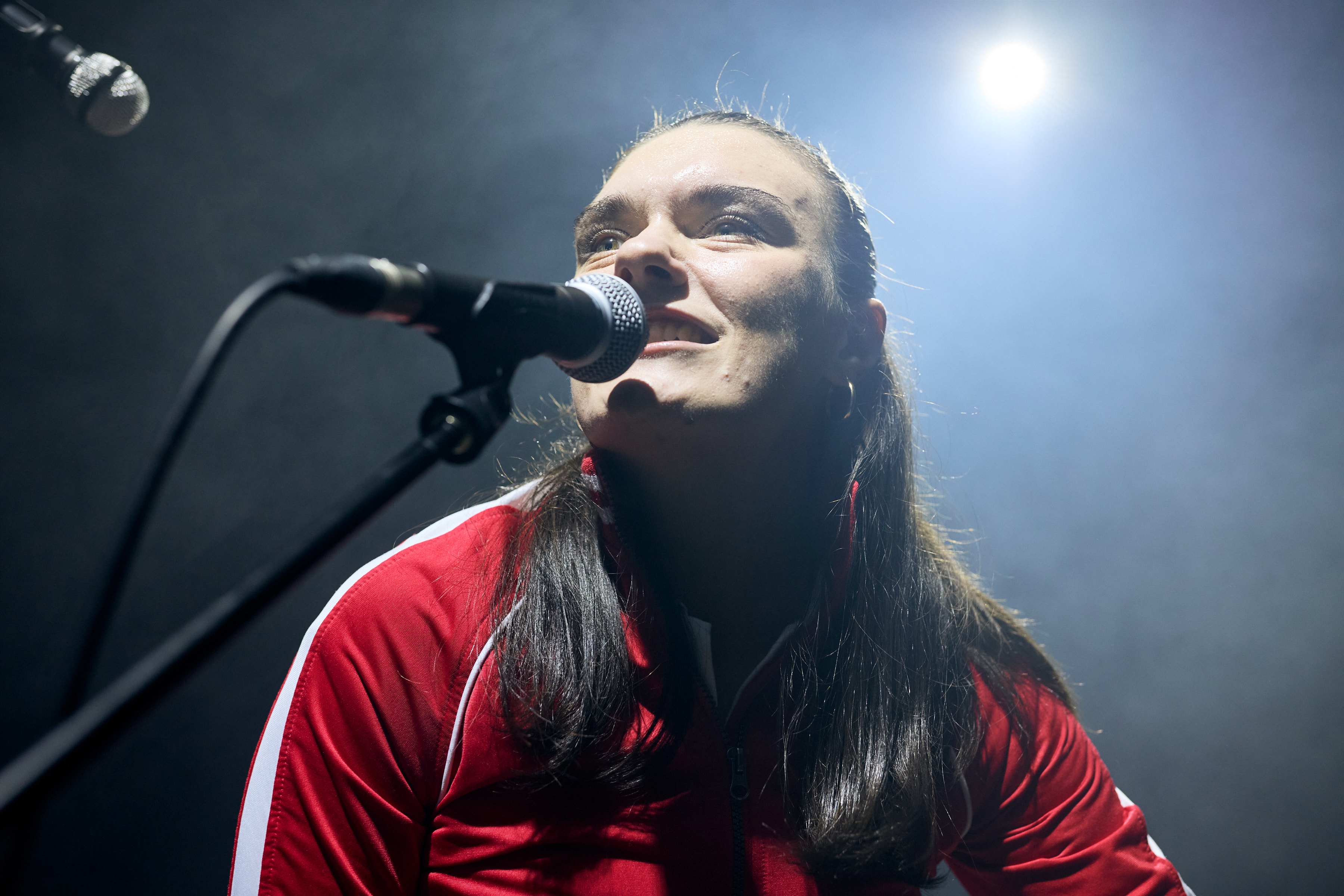
Bonnie (Olivia Caw) is fae Paisley, where she lives with her beloved Papa and speaks like him too. She’s sparky and clever and, as she grows up, keen to spread her wings and see the world.

Step one is St Andrew’s University, where her flatmates are all from England or Edinburgh – “aun a dinnae ken which is worse.” They tease Bonnie about the way she speaks, and she gives as good as she gets, mocking their accents in turn. But of course it’s not the same. The English girl who says, “You have to be okay with how we sound too,” is missing the point. The way she sounds isn’t always on the brink of being wiped out, has never been banned, will never disadvantage her. But Bonnie doesn’t yet have the words to articulate this point.

Step two is a year in the USA, where even those who enthusiastically claim their “Scotch” ancestry struggle to understand anything Bonnie says. She finds herself having to speak slowly and Anglicise her language, which seems harmless enough but it’s tiring. It takes its toll.

Back on home turf, a graduate now, killing time while she works out what she wants to do with her life, Bonnie is disconcerted by Papa telling her that she sounds different: “pure posh.” She realises she has to make a choice. Will she sacrifice her voice to achieve success in an unequal world, or will she roar at the injustice and fight to be heard on her own terms?

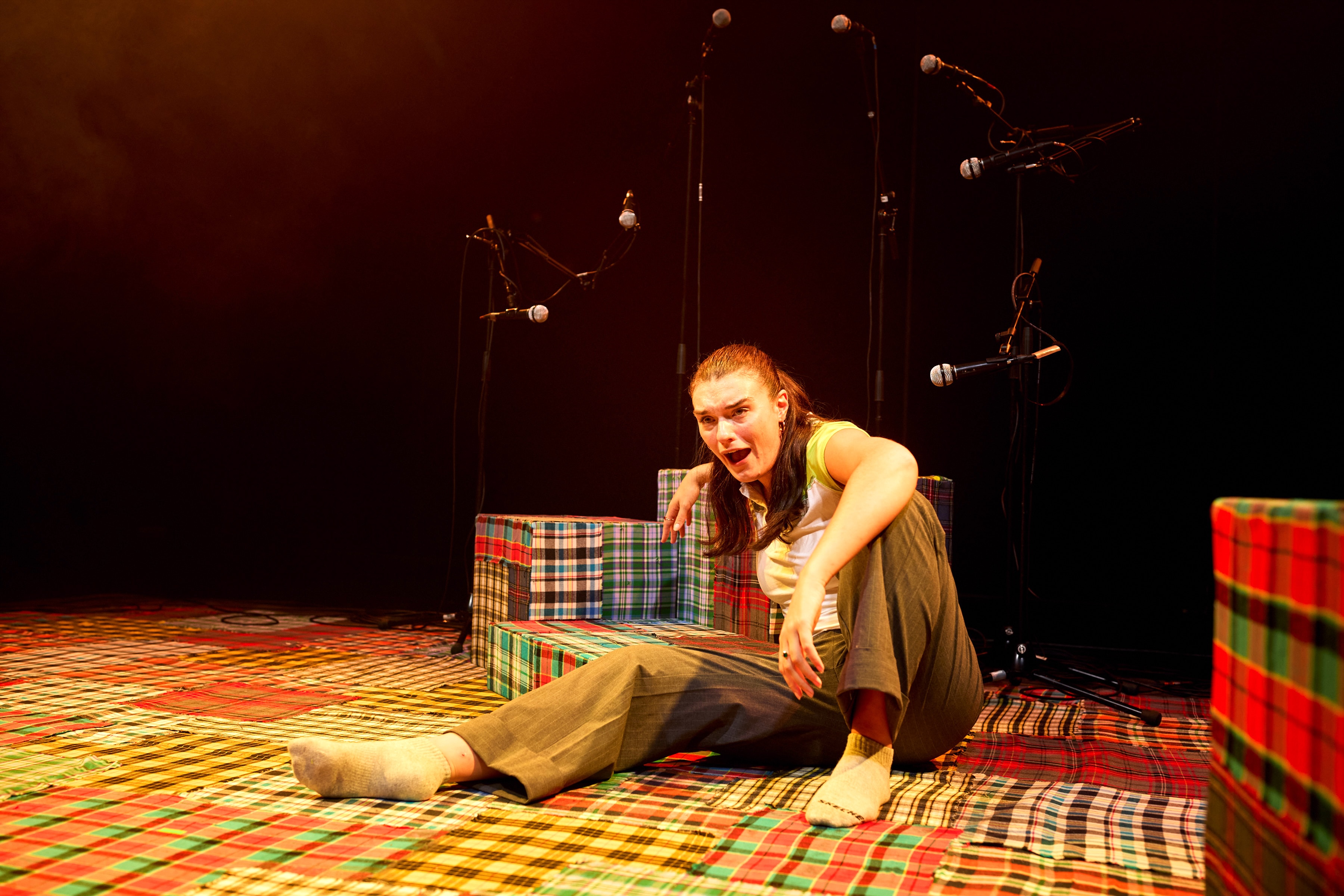
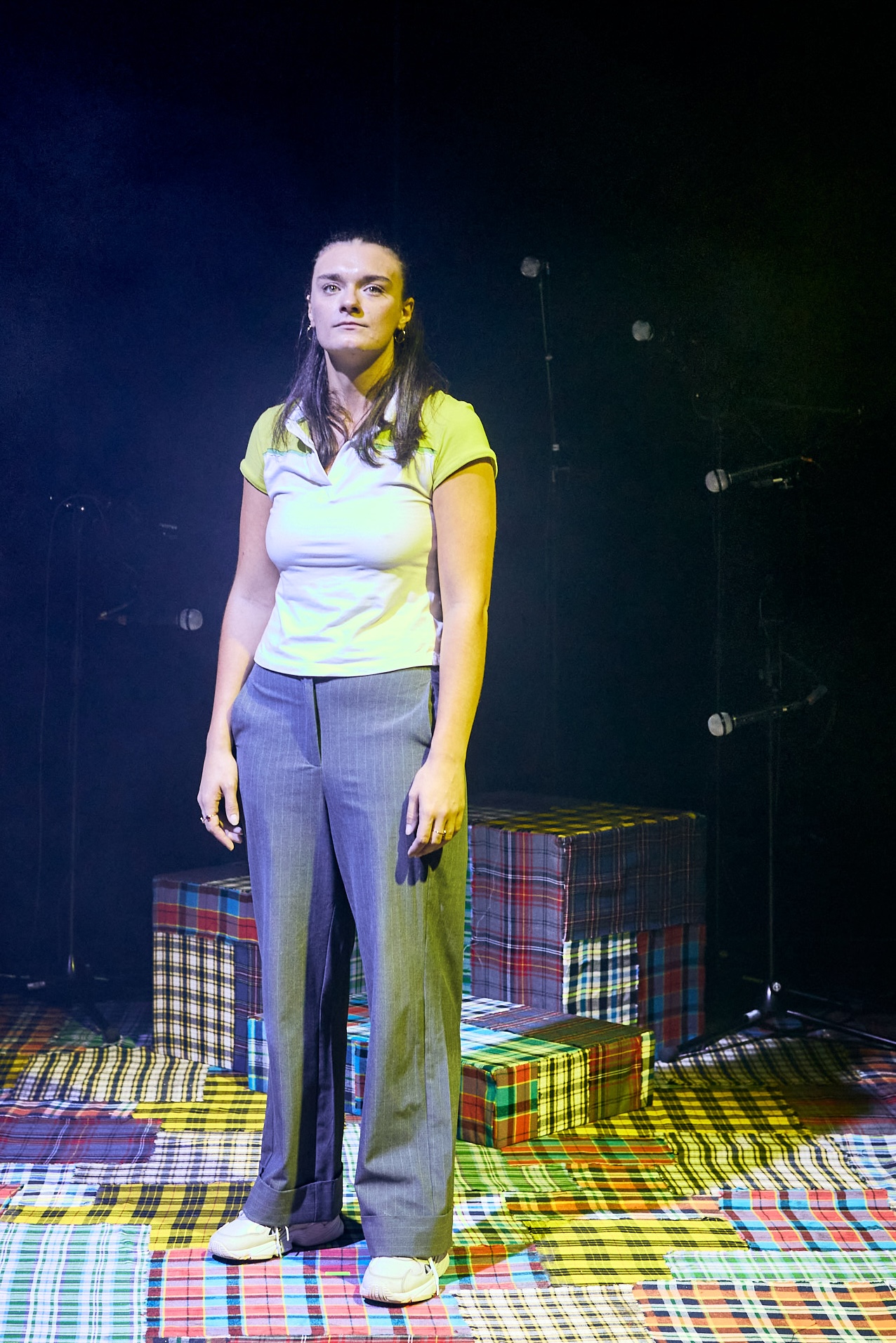
This is a demanding monologue and Caw’s performance is flawless, at once profound and bitingly funny: the jokes delivered with all the timing and precision of a top comedian; the emotional journey intense and heartfelt.

Patricia Panther’s sound design is integral to the production, and I especially like the use of multiple microphones, clustered to denote new places and people. Admittedly, there’s a lot of competition from Storm Amy raging outside and rattling the pipes, but it’s effective nonetheless.

Fraser makes his points cogently, probing both the Sapir-Whorf hypothesis (that the language we use shapes the way we think) and the repercussions of linguistic colonialism. As a Welsh woman, I’m familiar with historical tales of school-kids being punished for speaking Cymraeg, but the Scots issue is clearly ongoing. In fact, as I leave the theatre tonight, I bump into one of the teenagers who attends the drama club I teach. He tells me that he was sent out of class recently for saying, “I ken,” that his teacher deemed his language “cheeky.” I think his teacher needs to see this play.

Kinetic and engaging, Common Tongue has a lot to say and a braw way of saying it.

5 stars

Susan Singfield

When Mountains Meet

26/04/24

The Studio at Festival Theatre, Edinburgh

When Mountains Meet is a very personal piece of gig theatre, composed by musician Anne Wood, who stands centre stage throughout, playing her violin and seeming almost to conduct proceedings.

Directed by Kath Burlinson and Niloo-Far Khan, this is the nostalgic story of Wood’s first meeting with her father. Raised in the Highlands by her single Scottish mother, the twenty-something Anne (Iman Akhtar) is a bold and fearless woman, happily hopping on a plane to Pakistan to try to get to know the man whose DNA she has inherited – and to connect with a culture that is both alien and hers.

Told through a blend of music, spoken word, projection and audience interaction, the production is as complex and disorienting as Wood’s relationship with her dad. It’s a gentle, welcoming piece – there’s a pot of kahwa tea on our table and four little ladoo sweets – but it encompasses some thorny themes, including feminism, poverty and the devastating effects of Partition. Anne’s father (Jamie Zubairi) is a kind and courteous man – a doctor, well-respected by all for his selfless commitment to building hospitals and helping the poor – but he is also unwilling to publicly acknowledge Anne as his daughter, her illegitimacy and creative career both proving sticking points. She is ‘taboo’.

With its cabaret-style seating, the storytellers (Akhtar, Zubairi and Hassan Javed) occasionally wending their way through the tables, this is an inclusive piece, and we’re carried along by its deceptively light tone, smiling as we make paper aeroplanes and hold stones in our hands. Wood’s violin is accompanied by Rakae Jamil’s sitar, Mary Macmaster’s electric harp and Rick Wilson’s percussion, and the result is a seamless fusion of Scottish and Pakistani influences. It all adds up to something very life-affirming: about how big the world is and how small we are; about acceptance, endurance and love.

When Mountains Meet is on tour in Scotland until the end of May, so why not seize the chance to see it if it’s in your vicinity? It’s a foot-tapping, thought-provoking gem.

4 stars

Susan Singfield

Keepers of the Light

08/09/23

The Studio at Festival Theatre, Edinburgh

It’s not difficult to understand why the island is a popular symbol in literature. Separate by its very nature, an island always exists as a counterpoint to a known ‘main’ land, allowing a writer to remove their protagonists from their usual environs and – by means of a storm or a lost sea vessel – trap them in a mysterious and unfamiliar place. The dimensions help too: the island serves as both a microcosm and a pressure pot, illuminating and intensifying the characters’ concerns.

Little wonder then that the real-life mystery of three lighthouse keepers who went missing from the Flannan Isles in 1900 looms large in the public imagination. From Wilfred Wilson Gibson’s 1912 poem (still commonly taught in schools), to Kristoffer Nyholm’s 2018 film, The Vanishing, the story continues to intrigue – and Scottish playwright, Izzy Gray, is the latest to be thus inspired. Indeed, as an Orcadian, rooted in island culture, she has a special connection to the subject matter. Lighthouses are in her blood.

The Flannan Isles lighthouse had only been operational for a year when a terrible storm struck. The light went out, alerting the authorities to the fact that something was amiss, but – by the time a search party made it to the island – there was no trace of the three keepers.

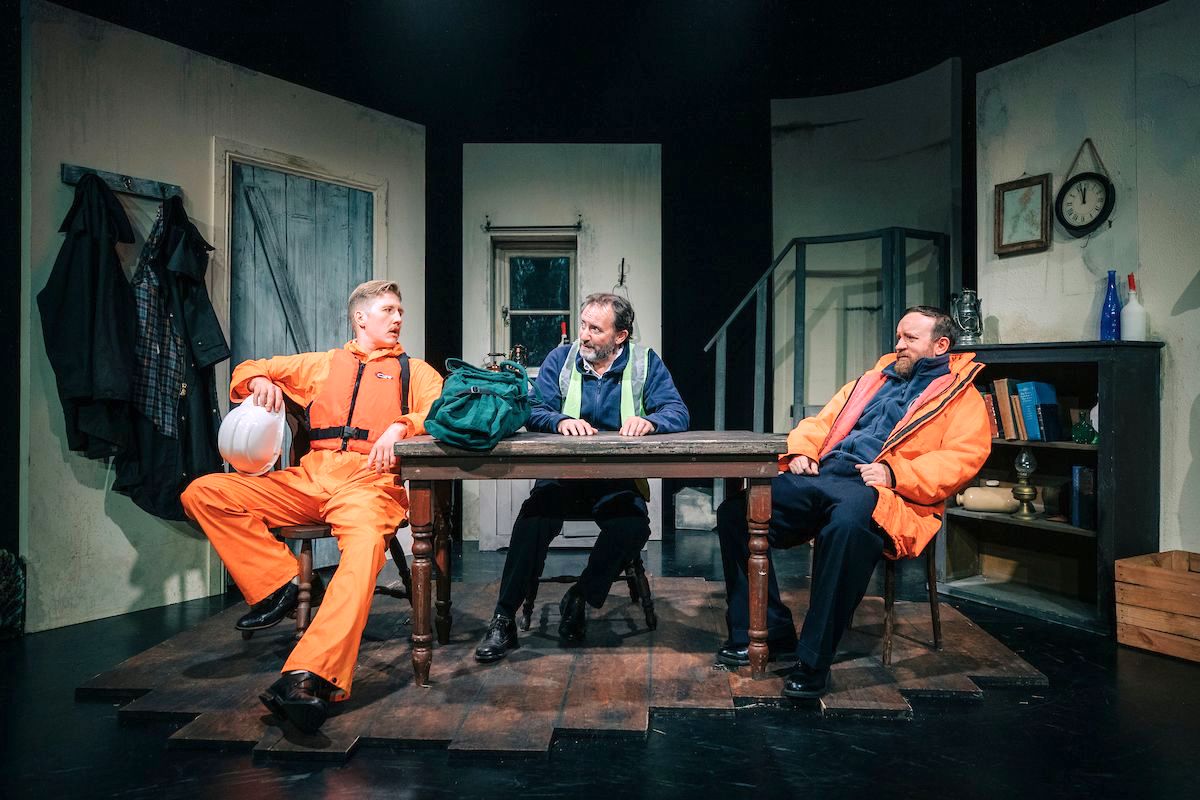
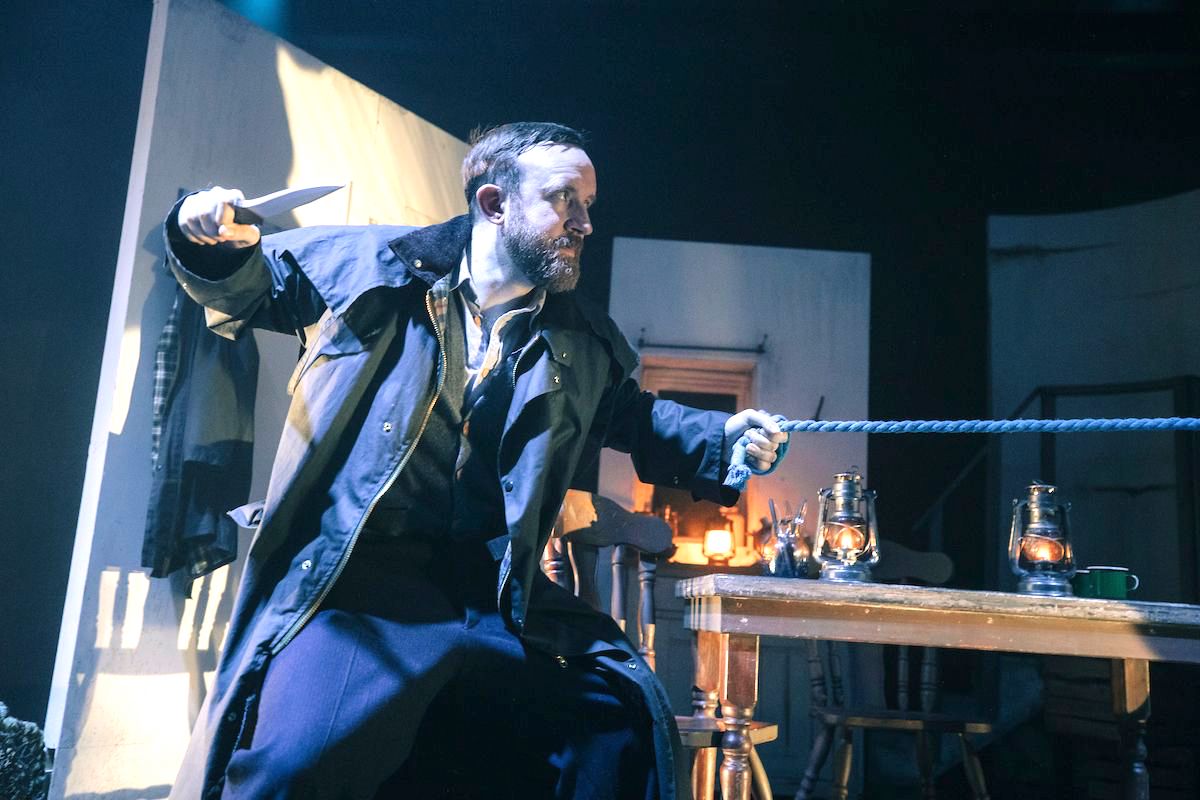
In Keepers of the Light, Gray intersperses the tale of the three lost men, Donald, Tam and Jim (Rhys Anderson, Fraser Sivewright and Garry Stewart respectively), with the parallel narrative of their modern-day counterparts, Mac, Alec and Davie. The lighthouse no longer requires keepers – it’s been automated for more than fifty years – but it does need maintenance, and the three engineers are helicoptered in for what is supposed to be a couple of hours for a routine job. But destiny has other ideas, and the men find themselves stranded overnight with nothing to do but consider the fates of their predecessors…

Gray explores the enduring nature of the mystery, pointing out that the reason the story is so compelling is that there is no answer: all we have is conjecture and gossip, supposition and fantasy. This meta-telling is made explicit by the decision to bookend the play with Alec’s musings, as he contemplates the idea that people are drawn to fill in the gaps. If something is unknown, we make up our own solutions.

It’s not all plain sailing. At times, the dialogue feels a little forced and unnatural, and some of the jokes and themes are hammered home (Davie’s Tic Tac error, for example, is clear; it gets a laugh: we don’t need Mac to add, “No, you mean TikTok!”). The piece would benefit from leaving more unsaid, trusting the audience to infer the meaning from the context.

Another minor niggle: I don’t think the actors need to leave the performance space every time they switch characters. After the first couple of metamorphoses, it’s clear what is happening, and the exiting and re-entering just slows things down. At one point, they do begin to transform on stage, taking off their fleeces and putting on their twentieth-century characters’ hats, which works well, but then they exit anyway, before returning a few seconds (and some minor costume changes) later.

Nonetheless, Keepers of the Light – ahem! – keeps the light shining on this fascinating tale, boldly straddling fact and fiction.

3 stars

Susan Singfield

Though This Be Madness

22/05/22

The Studio, Festival Theatre, Edinburgh

Though This Be Madness deals with both the micro and the macrocosm: a study of one woman’s mental health, and a record of her place in a long line of other women. She is daughter, sister, mother. She is Shakespeare’s heroines.

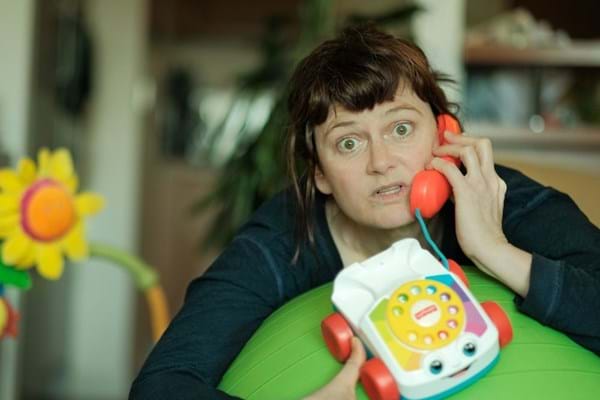
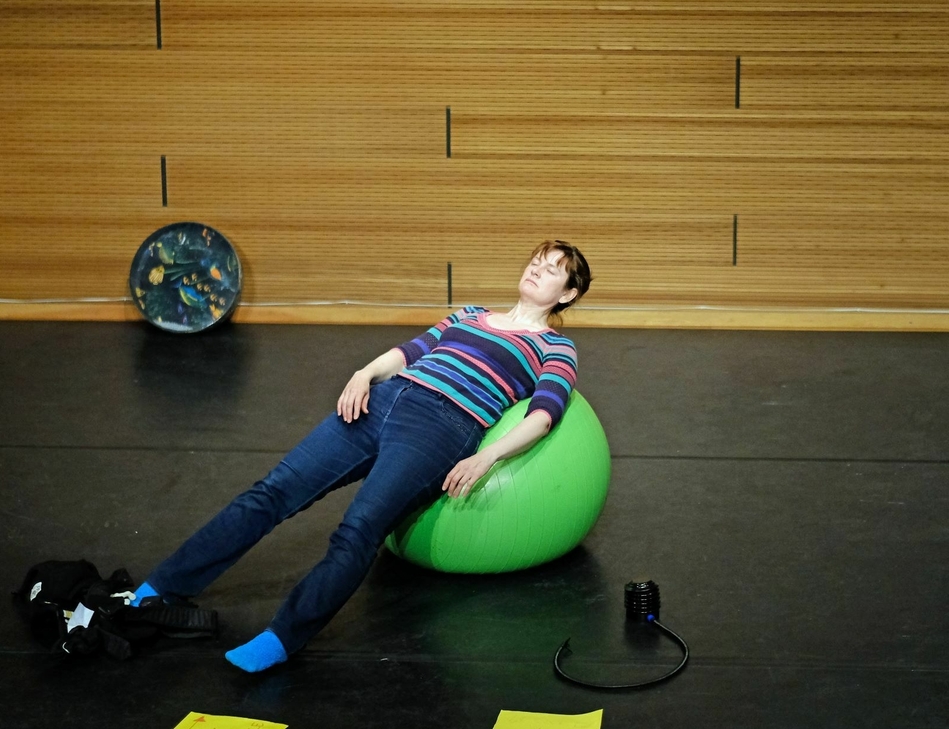
This is Skye Loneragan’s scattershot depiction of a new mother, struggling to finish a sentence without being interrupted by a baby’s cry, and it’s a haphazard, palpably stressful piece. ‘The Land of the Lounge Room’ is messy, with toys strewn everywhere, and our protagonist has given up trying to tidy them away. There’s no point, is there? Her body’s been ravaged; she doesn’t remember what sleep feels like; her doctor’s unsympathetic and her mother thinks she shares too much. Oh, and her sister’s schizophrenic.

There’s a lot to process here. The fragmented, unstructured narrative works well to convey a sense of disconnection and distraction, but it also means that not everything lands, and that some interesting ideas are lost in the chaos. The references to Shakespeare’s women, in particular, feel under-explored.

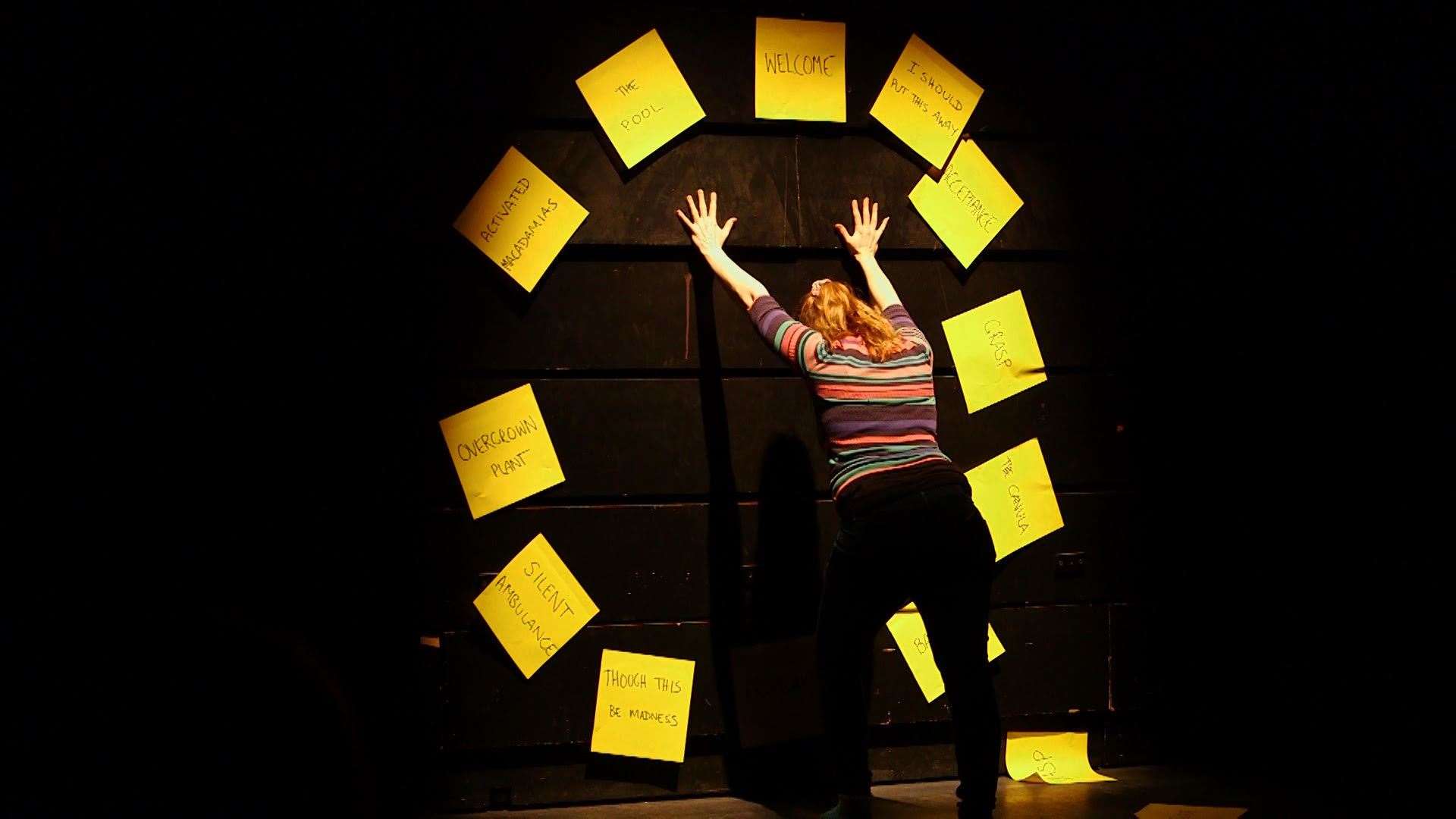
Loneragan is an engaging performer (with exemplary mime skills). I like the symbolism of the post-it notes and the overt circularity of the piece, and Mairi Campbell’s music lends it an eerie – almost hypnotic – air. In the end, however, I can’t help feeling this piece is both too much and too little: too many ideas for the short running time, and too little made of the best of them.

3 stars

Susan Singfield

The Tin Soldier


The Studio, Festival Theatre, Edinburgh

09/12/17

Bird of Paradise Theatre’s production of The Tin Soldier is an object lesson in the art of storytelling. It’s thoughtful and vibrant and beautifully done.

Jack (Robert Softley Gale) and his friends live in The Place. Based on the Internats, where non-ambulant disabled children were ‘dumped’ in Soviet Russia, The Place is cold, inhospitable and under-staffed. Left to their own devices, the children forge strong ties, creating their own family units. And, central to this bonding process, is the sharing and telling of stories.

The appeal of The Tin Soldier is obvious: the loyal, steadfast toy is one of very few positive depictions of a disabled character in children’s fiction. He might not have a happy ending, but he’s undoubtedly the hero of the tale: dogged, determined, loving and loveable.

But the real beauty of this piece is all in the telling. The multi-media, multi-format approach is beguiling: the story is told simultaneously through spoken word, sign language, subtitles, music and animation. If that sounds chaotic, it’s not. It’s all perfectly choreographed, each form complementing the next, adding subtle layers of meaning and complexity. Caroline Parker, as the aptly-named Dancer, is especially mesmerising, signing the songs centre-stage; it’s visually stunning, even though I don’t know sign language.

Bird of Paradise’s artistic vision is of “a culture where disabled artists are recognised for the excellence of their work” – and Softley Gale, Parker and Joseph Brown (Kipper) certainly merit accolades for these performances.

The music is provided by Novasound, aka Audrey Tait and Lauren Gilmour. It’s lovely: Gilmour’s voice has a plaintive quality that really suits the tale.

The Tin Soldier is playing until the 23rd December, so if you’re looking for a festive family show that goes beyond the obvious, then why not take a look at this? You won’t be disappointed.

4.4 stars

Susan Singfield