The Greatest Showman

Better Man

01/01/2025

Cineworld, Edinburgh

Our first cinema trip of 2025 is to see a film that actually came out last year – Boxing Day to be precise. A further complication is that this would certainly have made our list of the best films of 2024 had we managed to squeeze it in a day earlier. No matter. Better Man is brilliant and I have every reason to believe I’ll still feel as strongly about it when it comes time to compile this year’s selection.

Pop biopics can be tricky beasts. You can play it straight like Bohemian Rhapsody, you can evoke a multi-layered fantasia, as in Rocket Man – or you can go for a balls-out, head-scrambling slice of pure invention, which is what Michael Gracey (of Greatest Showman fame) has done with the life story of Robbie Williams. I should probably add here that I’m not a rabid fan of Williams and his music (though Angels has long been a go-to for me on the rare occasions when I get to do a bit of karaoke). Had I not picked up on early rumours of this film’s delights, I would probably have let it slip under my radar.

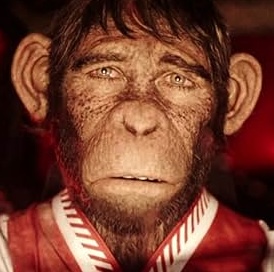
It’s hardly a spoiler to mention that Williams doesn’t even appear in his own biopic, apart from singing his best-known songs, but is instead portrayed by a CGI generated ape, mo-capped by Jonno Davies. This device is a stroke of genius, highlighting Williams’ sense of alienation, while also removing all worries of an actor not looking enough like the real man. Somehow, the metaphor renders many of the resulting scenes incredibly moving.

We first encounter our hero as a cheeky little monkey, living in a humble home with his mum, Janet (Kate Mulvany), his beloved gran, Betty (Alison Steadman), and his fame-obsessed dad, Peter (Steve Pemberton) – a pound shop Frank Sinatra, who heads off to seek his own fortune when Williams is just a boy. His son spends the rest of his life seeking his old man’s approval.

At the ripe old age of fifteen, fame unexpectedly beckons when Robbie auditions for a place in a new boy band being set up by would-be pop impresario Nigel Martin Smith (Damon Herriman). Against all the odds, he makes the cut – though it’s clear from early-on that he and the other band members are merely there to act as backup to Smith’s prodigy, Gary Barlow (Jake Simmance). As Take That embark on a punishing schedule of appearances around the UK’s gay clubs, it soon becomes clear that Robbie is having trouble handling the pressures of fame…

On paper, this may all sound straightforward enough but, as reimagined through Gracey’s mindset, the film is a collection of exhilarating, exuberant and occasionally devastating set pieces: there’s a wonderfully playful dance routine through the streets of London set to Rock DJ; a swooning waltz between Robbie and Nicole Appleton (Raechelle Banno) on the deck of a ship; and, best of all, a raucous rendition of Let Me Entertain You at Knebworth, which quickly escalates into an epic battle between Robbie and hordes of his inner demons. The film never flags but steps deftly into each successive interpretation with perfect timing. I keep having to stop myself from applauding.

Williams has been criticised for dishing the dirt on actual people, but it should be said that the person who comes in for most of the criticism is Robbie himself, often acting up like a spoiled brat with too much money in the bank. Viewers should be warned that the film is unflinching in its treatment of mental illness and self-harm. A funereal sequence set to the aforementioned Angels is particularly affecting and I don’t mind admitting that I view it through floods of tears.

One last thing: I know I say this far too often but, for the full effect, do see this one on the big screen. It’s a fabulous piece of filmmaking that effortlessly oversteps the relative simplicity of its subject to create something genuinely spectacular. And even if you don’t care one jot for Robbie Williams’ music, this one will still hit you in the feels.

5 stars

Philip Caveney

Bohemian Rhapsody

10/11/18

There seems to be a bit of a Greatest Showman buzz about this film. Most critics have been decidedly sniffy about it, accusing it of glossing over some of Freddie Mercury’s darker traits, as well as his bisexuality. Audiences, on the other hand, have eagerly embraced it, claiming it as a five star picture. The truth, of course, lies somewhere in between these extremes.

It’s a competent biopic, with a mesmerising central performance from Rami Malek that goes way beyond mere impersonation. He fully inhabits the character of Freddie Mercury and it’s interesting to conjecture how the film might have fared if it had stuck with its original lead, Sacha Baron Cohen. It’s hard to believe anyone could have done it more justice. Still, for all that, there are missteps in the mix and, just like The Greatest Showman, this so-called ‘true story’ takes some sizeable liberties.

We first meet Freddie in 1970, when he’s still Farrokh Bulsara, working as a baggage handler at Heathrow Airport and, in his spare time, virtually stalking local band, Smile, which features Brian May (Gwilym Lee) on lead guitar and Roger Taylor (Ben Hardy) on drums. When the band’s singer departs to join another outfit, the way is open for Freddie to offer his services as vocalist and songwriter. After a slightly shaky start, and the addition of bass player, John Deacon (Ray Mazello), the band soon have a record deal and are on the way to a brilliant career. Freddie, of course, woos and marries the ‘love of his life,’ Mary Austin (Lucy Boynton), something that proves rather awkward when he latterly arrives at the conclusion that he’s bisexual.

To give the screenwriters their due, they don’t exactly ignore Mercury’s darker side, particularly during the period where he leaves the band to embark on an ill-fated solo career (although, in reality, that break up never actually happened). He is shown to be a loose canon, indulging in the excessive lifestyle that ultimately led to his untimely death. Even here there are untruths. The film wants us to believe that Freddie had his HIV diagnosis before he appeared at Live Aid. He didn’t. Also, the gig, which took place in 1985, is depicted here as some kind of a reunion for the band, but actually they’d been recording their album The Works only the year before and had just toured it all over the world.

Of course, changing the truth for dramatic effect is not exactly a new phenomenon, but what about those missteps I mentioned? Well, for one thing, the other members of Queen seem incapable of speaking any of their lines without throwing in some exposition, just in case we’re unsure of what’s happening at any given time. For another, the clunky scenes where Freddie interacts with his Zoroastrian parents, Bomi and Ger, are decidedly mawkish. There’s also a cameo by Mike Myers as (fictional) EMI record executive ‘Ray Foster’, who denounces the titular single as ‘too long for the radio’ in a cod Northern accent that borders on caricature. This leads to the band walking out on their record label. (Again, this didn’t happen.) In the end, it’s these liberties that niggle me more than anything else. When you’ve got a story as amazing as this one, why muddy the waters by adding stuff that never actually occurred?

Of course, you can forgive a lot when you have the kind of soundtrack that’s offered here, featuring pretty much all of Queen’s biggest hits – and the decision to end the film with an uncanny twenty minute recreation of the band’s appearance at Live Aid is a clever mood, sending audiences out on a high. Rami Malek’s performance is the kind of flashy role that can attract Oscar attention, and I won’t be remotely surprised if he gets a nomination next year – but to my mind,  Bohemian Rhapsody represents a bit of a missed opportunity.

In the end, it’s a decent biopic, but not an entirely convincing one.

3.5 stars

Philip Caveney

The Greatest Showman

03/01/17

Okay, so we need to get one thing clear: The Greatest Showman is in no way a biopic. It may purport to tell the tale of PT Barnum, but it’s so far removed from the insalubrious truth that it’s more accurately filed under fiction. It borrows Barnum’s name, that’s all, and a few details from his life. Otherwise, it’s pure fantasy: a complete reimagining of the infamous freak show.

That’s not to say it doesn’t work; it’s a highly entertaining and lively piece of cinema, beautifully produced and performed with precision and wit. It’s bright and exhilarating, with catchy tunes. No doubt about it: this is fun.

In this version of events, PT Barnum (Hugh Jackman) is a striver: a poor tailor’s son with huge ambitions, who falls in love with Charity (Michelle Williams), a rich, upper-class girl, and is determined to provide her with the lifestyle he believes she deserves. He’s a risk taker and a charlatan, but he’s charming with a big heart, and disarms everyone he meets. When they fall on hard times, he decides to open a circus, showcasing such ‘freaks’ as a bearded lady, conjoined twins, a dwarf and a fat man. In his fictional incarnation, he’s not exploiting them, exactly, although he is making money from their efforts; he’s celebrating them, offering redemption to those society has rejected, helping them to forge a kind of family. And all progresses swimmingly, until he can’t resist the charms of opera singer, Jenny Lind (Rebecca Ferguson), who seems like a passport into the higher echelons of society. He risks everything to promote her, and it all comes crashing down.

It’s utterly enchanting, even if it isn’t true, and there are some excellent set pieces, such as the freaks’ defiant song of self-determination, This Is Me, led by bearded lady Lettie Lutz (Keala Settle), whose voice is just spectacular. Jackman is very good too, and Michelle Williams proves again that she’s a real chameleon, able to convince – it seems – in almost any role.

I was disappointed, though, to learn that Rebecca Ferguson doesn’t sing her own songs  (she is dubbed by Loren Allred); Ferguson is a fine actress with a face just made for the big screen, but was there really no one available who could deliver the whole deal? It seems a shame to give the part to someone who can’t play it, just because she is a ‘name’. There are enough stars in this film to carry it, surely?

Still, quibbles aside, this is eminently watchable, itself fulfilling (ironically perhaps) what it claims were Barnum’s aims: it’s rare indeed to see such a diverse range of performers given such prominent roles in a movie. It has the feelgood factor in bucketloads, and is eminently suitable for a family audience.

4.2 stars

Susan Singfield