Studio Ghibli

The Wild Robot

27/10/24

Cineworld, Ediburgh

In what will almost certainly be one of Dreamworks’ final in-house animations, The Wild Robot pulls out all the stops, making this one of the most visually stunning productions outside of Studio Ghibli. In its early sections, it also deploys some perfectly-timed slapstick sequences that are laugh-out-loud funny.

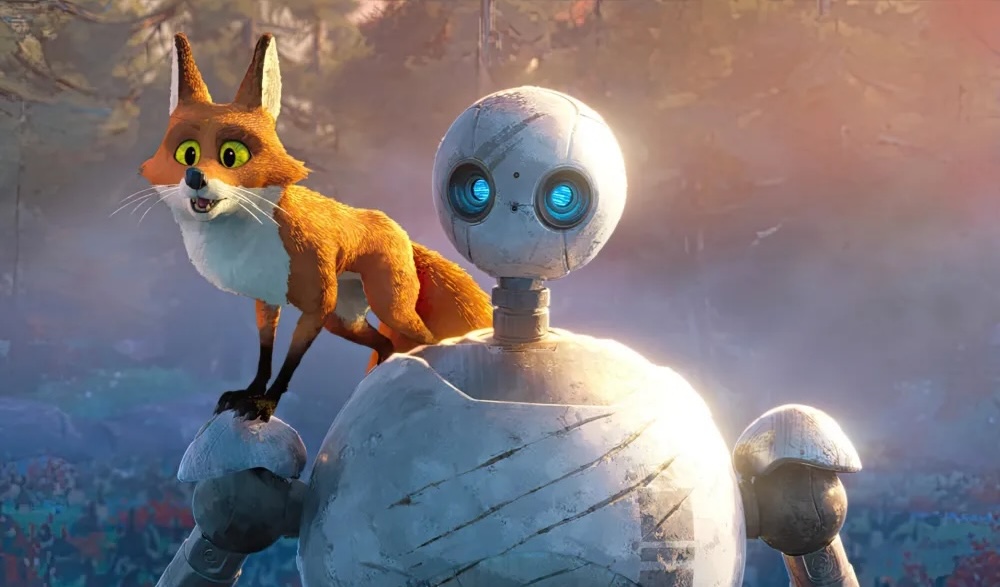
This is the story of Rozzum Unit 7134 (voiced by Lupita Nyong’o), an AI ‘household assistant’ accidentally deposited on a Pacific island and inadvertently switched on by an exploratory rodent looking for food. ‘Roz’ immediately starts wandering the unfamiliar landscape, frantically seeking out suitable tasks to accomplish, but there are no humans to be assisted and the island’s resident wildlife inevitability see the new arrival as something to be feared. Determined to make a success of this unexpected situation, Roz sets out to learn all the different creatures’ languages so that she can adapt to their individual needs.

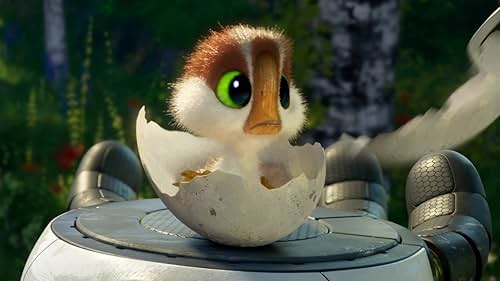
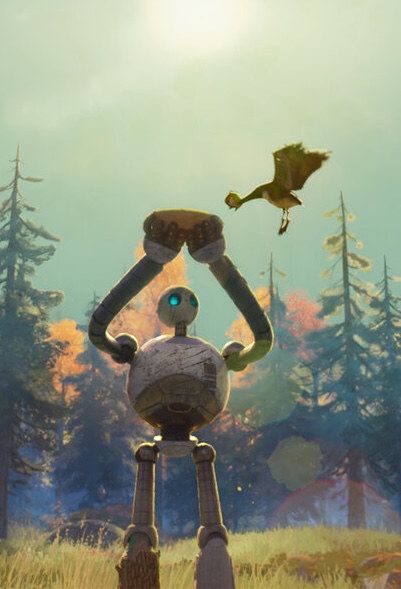
But things become complicated when she accidentally kills a nesting goose and crushes all but one of its eggs. She manages to save the surviving egg from the attentions of hungry fox, Fink (Pedro Pacal), and when it finally hatches, the chick – who Roz eventually names Brightbill (Kit Connor) – imprints on Roz, perceiving the robot as his mother. Roz now has some clearly designated tasks to accomplish. Brightbill needs to learn to eat, swim and then fly before he and the rest of the local goose population set out on their yearly migration. Assisted by Fink and a knowledgable possum(Catherine O’ Hara), Roz has to make some serious adjustments to her usual mode of practice…

As I said, The Wild Robot, based upon Peter Brown’s novel, is an impressive piece of animation, sometimes breathtaking in its depictions of the island’s landscape and its various inhabitants. Huge flocks of birds and butterflies are rendered in such detail that it sometimes feels like I’m watching a heightened David Attenborough documentary. Writer/director Chris Sanders also makes some canny observations about the nature of AI and its capacity for adaptation.

A shame then that in the final third, the script increasingly feels the need to have some of the characters making cringe-making fridge-magnet-style observations about the nature of love and understanding – Bill Nighy’s migration leader is a particular case in point. Those elements are already being shown in ways that even the youngest of audiences can comprehend, so such mawkish pronouncements feel like a mis-step. Also, the cynical part of my brain makes me wonder how, in the loving multi-species community that eventually evolves on the island, the carnivores will ever manage to survive.

But perhaps that’s just me.

Quibbles aside, this is a beautiful and genuinely moving film that explores some fascinating ideas. If it does prove to be Dreamworks’… ahem… swan song, then it’s an impressive note to end on.

4 stars

Philip Caveney
The Boy and the Heron

20/12/23

Cineworld, Edinburgh

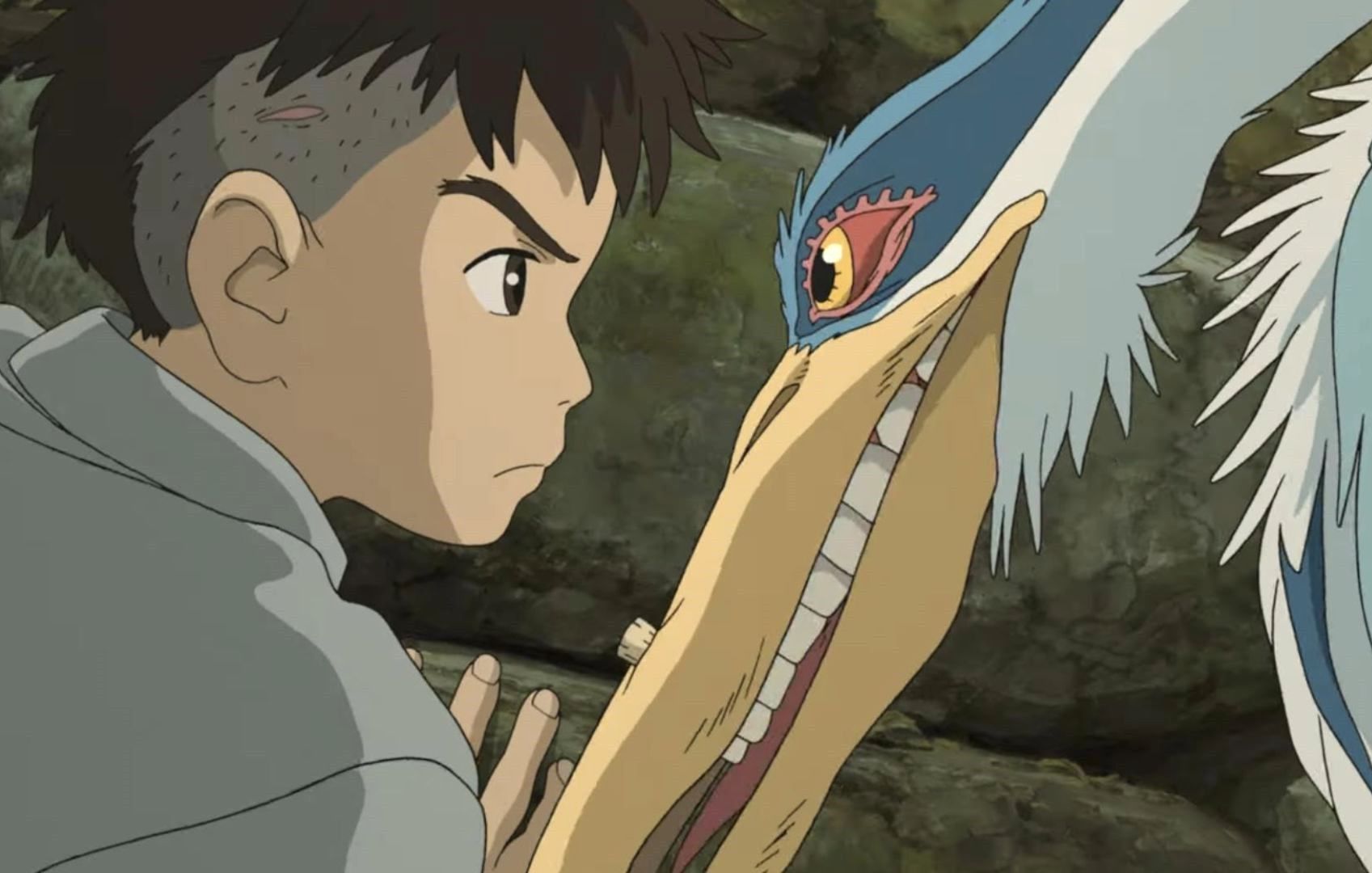
At eighty-two years of age, Hayao Miyazaki, the co-founder of Studio Ghibli, has had more comebacks than Frank Sinatra. He’s been talking about retirement ever since Princess Mononoke way back in 1997, but has managed three major releases since then, not to mention a whole bunch of shorts. And now here he is once again, director and writer of The Boy and the Heron, still reaching for those impossible heights on the big screen – and mostly achieving them.

It’s evident at a glance that Ghibli continues to exert a powerful hold on lovers of quality animation. This advance IMAX screening (the film will officially be released in the UK on Boxing Day) is completely sold out, despite being in Japanese with subtitles. (We don’t mind, we prefer it that way but apparently it puts a lot of viewers off.) We’ve managed to secure a couple of seats in the very front row, the giant screen looming above us, making the whole experience incredibly immersive.

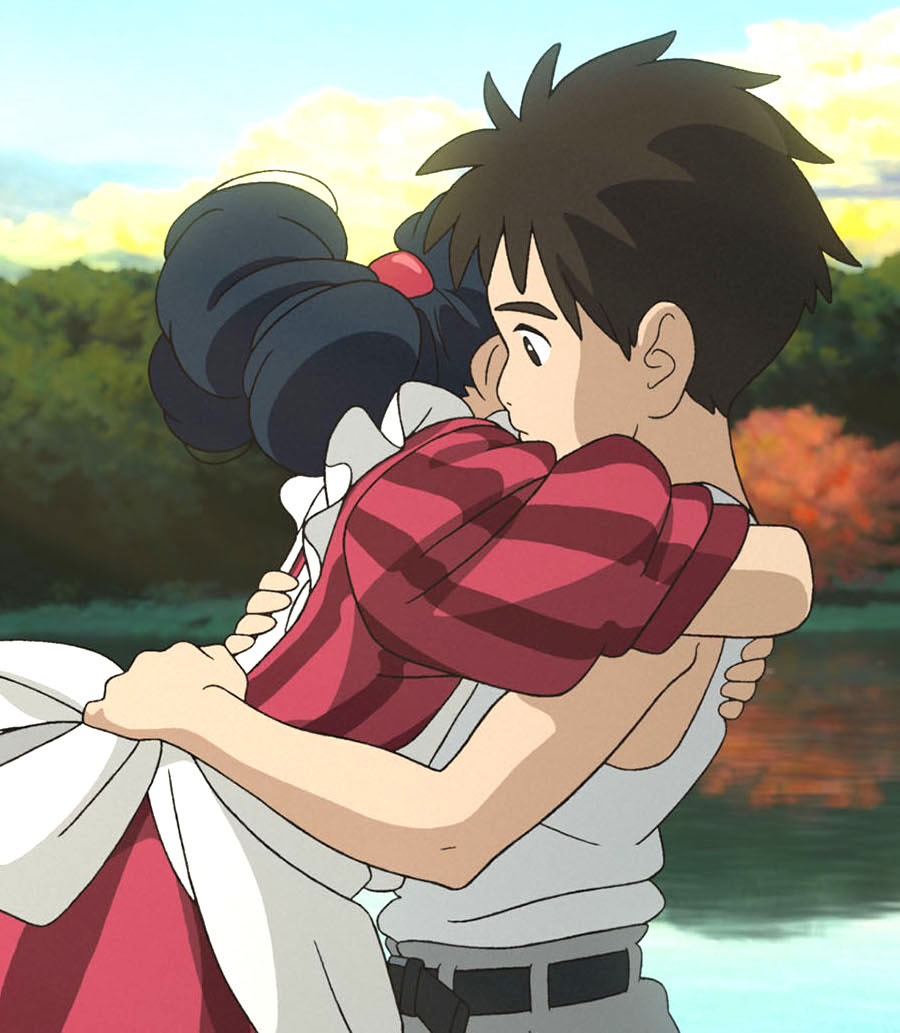
The story is loosely autobiographical, but I can only assume that this applies to the film’s almost hallucinatory opening scenes in World War 2 – otherwise I’m left to conjecture that Mizayaki had a very strange childhood! Tokyo teenager Mahito (Soma Santoni) awakes one night to the sound of an explosion and is told that the local hospital has been firebombed. He’s horrified, because he knows his mother is working there and, in a breathtaking action sequence, he dresses himself and runs frantically through the blazing city, in the desperate hope of rescuing her. But he’s too late.

A few years later, Mahito accompanies his father, Shoichi (Takuya Kimura), an aeroplane designer, out to the calm of the countryside. Shoichi is now married to his late wife’s sister, Natsuko (Yoshino Kimura), who is pregnant with what will be Mahito’s little brother or sister. Mahito soon discovers that his stepmother’s country house is a place of mystery and intrigue, serviced by a team of comical-looking… erm… grannies. But things take a darker turn when a sinister grey heron that hangs around the grounds starts talking, telling Mahito that his presence is required elsewhere…

All the hallmarks of Studio Ghibli are present and correct and they’ve arguably never looked more ravishing. There are beautiful shimmering landscapes, ancient mouldering buildings and a succession of weird, dreamlike environments that seem to virtually erupt from the screen. And there’s that brilliant technique they always employ of illustrating food so perfectly, you can actually taste it. (One scene features fish entrails, so this isn’t always a pleasure!)

Aside from the fact that this particular tale focuses on a teenage boy (Ghibli’s lead protagonists are nearly always female), it feels like classic Ghibli dialled up to 11.

If there are some shortcomings, they are in the plot. It’s not that Miyazaki’s screenplay lacks interesting ideas. On the contrary, it’s stuffed with them, so many that they virtually do battle with each other to establish authority. While it’s perfectly fine for a storyline to be complex, it shouldn’t feel over-complicated and, since some of the fantastical goings-on are opaque to say the least, I too often find myself bewildered by what Miyazaki is trying to say. The inevitable questions that arise are left unanswered and, eventually, I decide that this is deliberate.

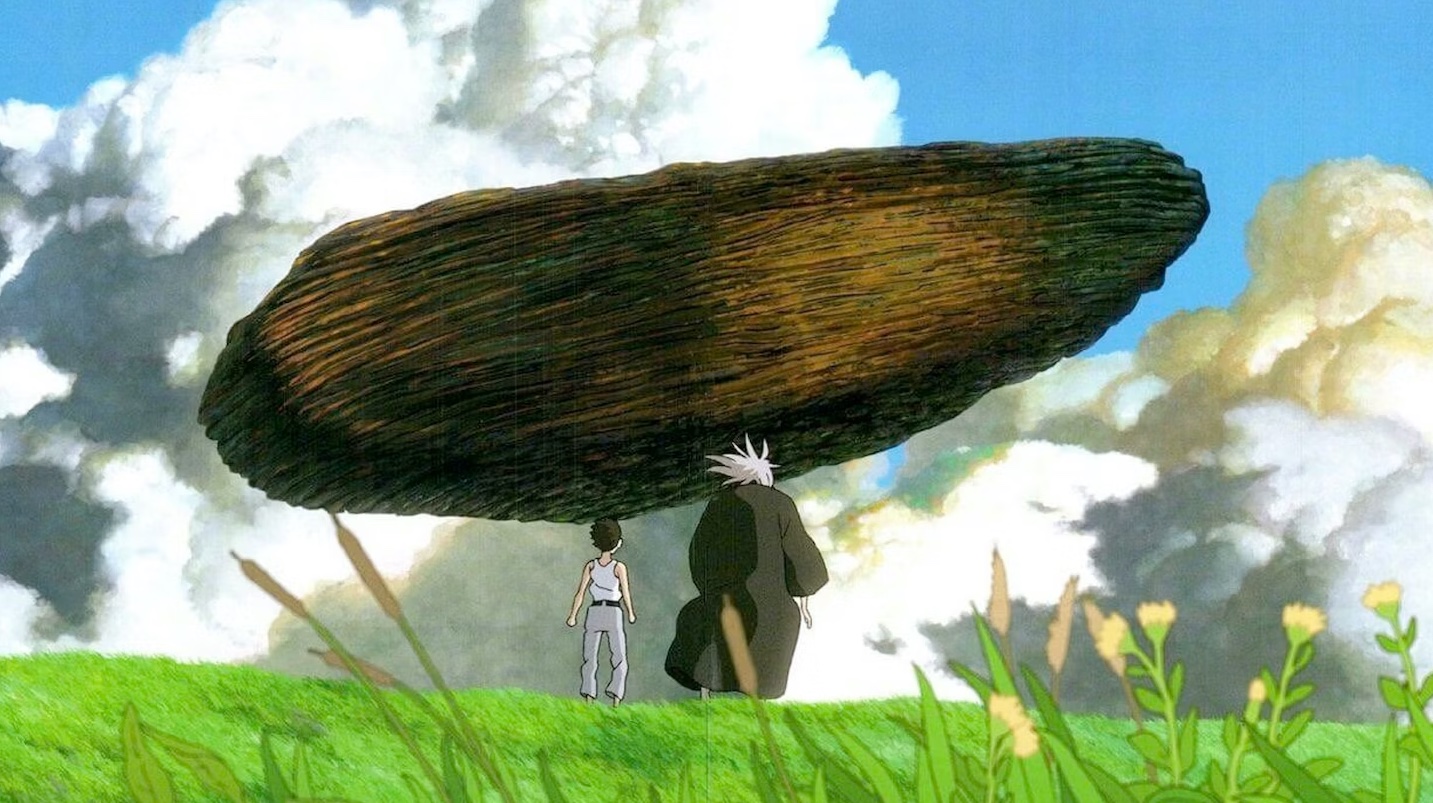
Perhaps it’s simply a case of an elderly man with a lifetime’s experience trying to cram all of it into a couple of hours. It’s hard not to see the mysterious wizard-like figure, obsessed with balancing various pieces of polished stone on top of each other in order to ‘make the world work’, as a version of the great director himself, trying to puzzle out the enormity of his own astonishing career.

As the credits roll, I find myself wondering if I might manage to slot this film in for a second viewing – maybe even the upcoming dubbed version with a host of Hollywood talent providing the voices. The Boy and the Heron is that kind of movie, the sort that has you pondering its various possibilities long after you’ve left the cinema. See it on the big screen, in IMAX if you can. You may be puzzled, but you won’t be disappointed.

4.2 stars

Philip Caveney

Turning Red

24/03/22

Disney +

The House of Mouse’s decision to release all new Pixar films directly to their in-house streaming service seems incredibly short-sighted – and not just because this is a time when cinemas are really struggling to tempt viewers back into seats. Mostly, it’s because the gorgeous animation that exemplifies Pixar is made to be shown on the biggest screens available. However, Disney seem not for turning, so it’s time to renew that monthly subscription.

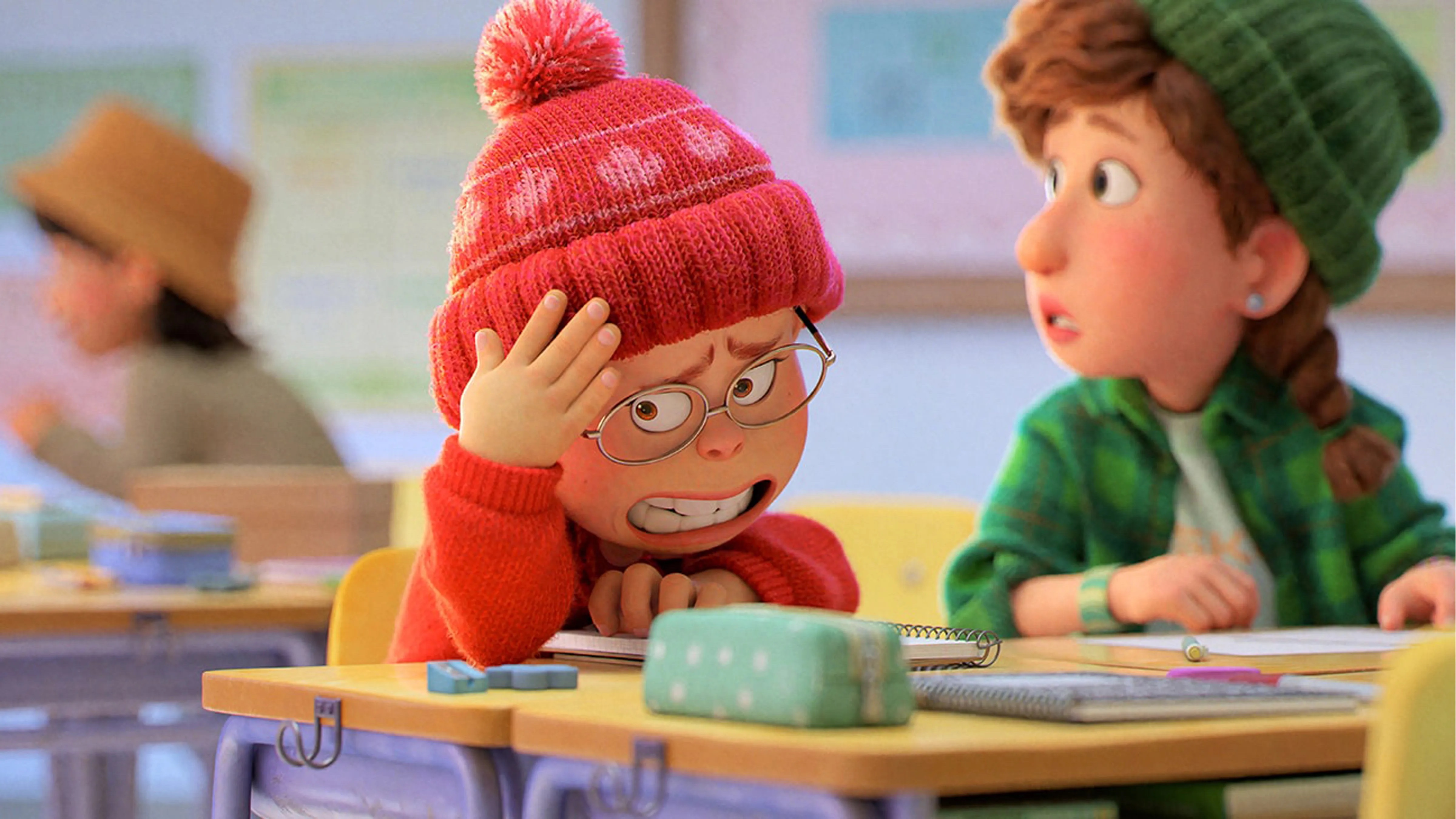
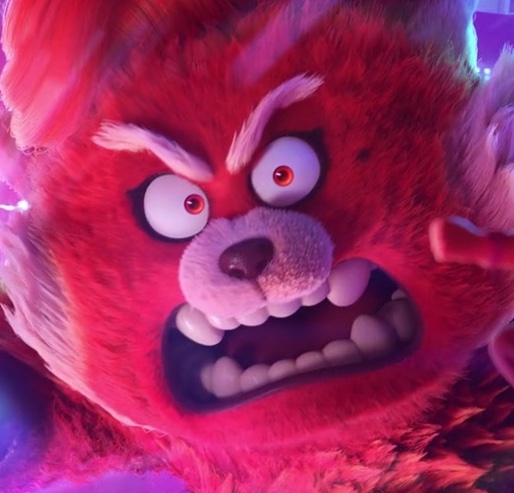
Turning Red is set in Toronto in 2002 . Meilin (Rosalie Chiang) is thirteen years old, a good girl who excels as a scholar and spends most of her spare time helping her domineering Mother, Ming (Sandra Oh), to run the family temple, a place dedicated to their illustrious ancestor, Sun Yee. Meanwhile, Meilin’s father, Jin (Orion Lee), cooks up some amazing food. In scenes that could have come straight from a Studio Ghibli feature, his dishes are enough to make this reviewer’s mouth water.

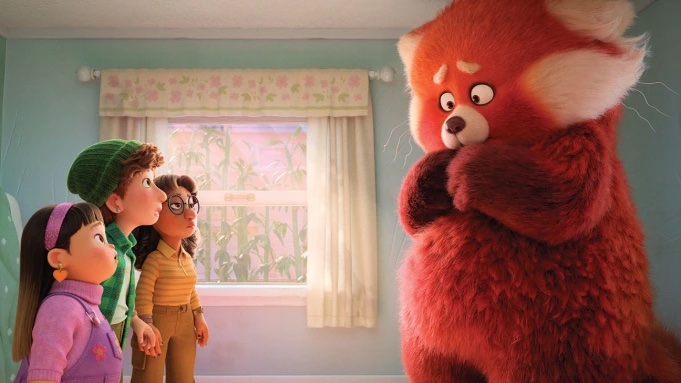
With her three bosom buddies, Miriam (Ava Morse), Priya (Maitreyi Remakrishnan) and Abby (Hyein Park), Meilin is a fan of the hot new boy band, 4*Town. She also discovers, to her dismay, that she’s developing a crush on handsome local store clerk, Tyler (Tristran Allerick Chen), who she has always professed to hate. She is hurtling headlong towards puberty and the resulting rush of hormones has an unfortunate effect on Meilin. She finds herself suddenly transforming into a giant red panda at the most inopportune moments (although I’m not sure when would be a good time). This is the result of an ancient transformation that every young woman of her family must undergo.

It can be cured, Ming assures her daughter, but not until a month has passed. Awkward.

And then news reaches Meilin that 4*Town are going to be performing at a huge concert in Toronto and she and her friends know that, whatever else comes or goes, they will have to be there in order to ‘become women.’ So how are they ever going to raise the hefty price of admission?

From the outset it’s clear that Pixar, already the most innovative of animation studios, is setting out to walk a path where no other cartoon makers have dared to venture. The Red Panda is clearly a metaphor, standing in for the turmoil and confusion of adolescence – the film even manages to cover the subject of menstruation without raising so much as an eyebrow. All credit to director Domee Shi, who has clearly used her own youth in Canada as inspiration for the story, co-writing the screenplay with Julia Cho and Sarah Streicher. Hats off also to songwriters Billie Eilish and Finneas, who manage to capture the vapid tosh that is 4*Town’s music with ease.

This is a gorgeous film, all about the power of womanhood and the healing properties of friendship. The fact that it’s wrapped up in a pretty parcel of jaw-dropping animation doesn’t dilute its message one jot – and the climactic showdown at the 4*Town arena concert – where events begin to feel a little like Pandazilla – brings everything to a suitably powerful conclusion.

Even on our modest screen at home this looks dazzling, so how it would have looked on IMAX can only be wistfully imagined.

4.4 stars

Philip Caveney

When Marnie Was There

09/04/20

Netflix

We’re continuing our Ghibli odyssey, courtesy of Netflix, and tonight’s selection is 2014’s whimsical When Marnie Was There. Adapted from Joan G Robinson’s 1967 Norfolk-based novel, Keiko Niwa’s script moves the action to a small Japanese coastal town, where asthmatic twelve-year-old Anna is sent for a summer of clean air and recuperation.

Anna (Sara Takatsuki) is a troubled kid: fostered because her parents are dead; socially awkward and unpopular at school; good at art but too self-conscious to let anyone see her work; habitually tongue-tied, but volatile – so that, when she does speak, it’s usually in anger. A holiday in the countryside with the kindly Oiwas (Susumu Terajima and Toshie Negishi) is just what she needs, for her mental as well as her physical health.

On a solitary walk in the marshland, Anna spots a derelict mansion, and feels strangely drawn to the place. There, she meets Marnie (Kasumi Arimura), a mysterious blonde girl, who lives in the house with her parents and servants. The friendship that develops is fierce, intense – and, at Marnie’s insistence, secret. Anna becomes obsessed; her feelings for Marnie are all-consuming. But not everything is as it seems…

When Marnie Was There is as beautifully crafted as you’d expect from this deservedly renowned studio: the drawings are delicate and sumptuous and full of emotion. The images of water and food are particularly lush, the latter almost making my mouth water.

And if the story is light and the revelations predictable, it’s nonetheless charming and very well told.

4 stars

Susan Singfield

The Cat Returns

16/03/20

Netflix

When the world goes mad, when cinemas across the UK close their doors, and when all major film releases are pushed back for months, what does a movie reviewer do for entertainment? Well, the recent rash of Studio Ghibli films, streamed on Netflix, seems a promising source to explore.

We’ve seen many of the big hitters, of course, but here’s something we missed on its first release in 2002. Directed by Hiroyuki Morita (who directed Akira and The Ghost in the Shell), The Cat Returns tells the story of Haru (Chizuru Ikewaki), a shy seventeen-year-old schoolgirl, whose life is completely upended when she saves a cat from being run over by a truck. It turns out that he’s no ordinary moggie, but Prince Lune (Takayuki Yamada), the heir to the magical Cat Kingdom. What’s more, he’s determined to reward Haru for her good deed, even though showering her with mice isn’t as well-received as he expects.

This features the usual enchanting hand-drawn animation and a storyline that owes more than a passing debt to Alice in Wonderland – indeed, there are whole sequences here that pay homage to Lewis Carroll’s most famous book and the similarities are too marked to be accidental. While Alice finds her way to Wonderland by following a white rabbit, Haru follows podgy white cat, Muta (Tetsu Watanabe), and ends up in an equally bewildering destination.

Much like that story, the plot here meanders into some very eccentric backwaters and doesn’t make very much sense, but that’s not really a problem. I love the character of Baron (Yoshihiko Hakamada), a super-cool cat who sports a sharp suit and bowler hat and has more than a dash of 007 about him – and Tetsurô Tanba’s Cat King is also entertaining, a clumsy buffoon, intent on marrying his son off to Haru (I know, weird, right?).

While The Cat Returns may not be top flight Ghibli, it’s nonetheless quirky and inventive enough to make an hour and fifteen minutes pass in the blink of a cat’s eye. And right now, that’s a bonus.

3.5 stars

Philip Caveney

Ponyo

16/08/18

During the month of August when the Edinburgh Fringe is in full swing, we don’t have a lot of time to visit the cinema – but when we saw that Ponyo was showing at the Cameo Cinema, we had to make an exception. We’ve only recently started to discover the joys of Studio Ghibli and this is, quite appropriately, the one that got away. This quirky ‘boy meets fish’ story has so much to recommend it – gorgeous visuals, a powerful ecological theme and an almost overwhelming cuteness that’s never allowed to tip over into full-blown mawkishness.

Scientist/magician Fujimoto (rather disturbingly voiced, in this version, by Liam Neeson) lives deep beneath the sea in a Nautilus-like submersible, where he conducts a series of mystical experiments. When one of those experiments, a little red-headed fish, goes exploring, she is swept up by a dredger net and carried far away. She eventually gets washed ashore where she hooks up with a boy called Sosuke (Frankie Jonas) and, when she licks a drop of blood from his hand, a weird transformation occurs…

There’s something of the selkie myth to this tale, but as ever it’s shot through with that unique Hayao Miyazake world view. Odd though the story is, it’s an absolute joy to watch. The animation of the water itself is a particular delight, at times recalling Hokusai’s famous watercolours and, while this might not be quite up there with the likes of Howl’s Moving Castle or Princess Mononoke, it’s nonetheless a charming and spellbinding film.

If the opportunity occurs to see this – particularly on the big screen – don’t miss your chance.

4.4 stars

Philip Caveney


Mary and the Witch’s Flower

06/05/18

Studio Ghibli may be defunct, but here’s the first release from its successor, Studio Ponoc, and it’s apparent pretty much from the word go that the resulting film couldn’t be more Ghilbli-esque if it tried. All the familiar tropes are here. A moody young girl with low self-esteem? Check! Stranded in an unfamiliar neighborhood while her parents are away? You’ve got it! A cheeky but handsome boy she at first hates but grows to care about? Oh, yes! Sumptuous representations of the countryside?  All present and correct!

Which might give the impression that Mary and the Witch’s Flower is nothing but a pale imitation of what has gone before and I certainly don’t mean to do that. Suffice to say that the film is very much in the great tradition of Japan’s leading animation studio and, of course, that should be no great surprise, because its director, Hiromasa Yonebayashi (of When Marnie Was There), was one of Ghibli’s most acclaimed animators.

MATWF is based on classic 70s novel The Little Broomstick by Mary Stewart, a book that was clearly a huge influence on  the work of a certain Ms Rowling, and tells the story of young Mary (Hana Sugisaki), who is currently living with her Great Aunt Charlotte (Shinobu Otake) and doing her best to fit in with a rather dull day-to-day existence in the countryside. A chance encounter in the woods leads her to discover the titular flower, said to be able to grant its possessor incredible powers and, shortly thereafter, she finds an ancient broomstick, which – once activated – takes her off to the mysterious Endor College, a school for witches…

As a calling card, Studio Ponoc really couldn’t have done much more to assure Ghibli fans that its towering reputation is in safe hands. There are the kind of gorgeously lush settings we’ve grown to expect, elements of adventure, comedy and suspense and, of course, that all-important atmosphere of magic that will entrance viewers of all ages. There’s also a choice of viewing. Those who, like me, prefer to watch it in the original language with subtitles, can choose to do so – but there is also a dubbed version on offer, voiced by Ruby Barnhill, Kate Winslet and Jim Broadbent.

Mary Stewart would, I’m sure, have been thrilled with this delightfully inventive adaptation of her classic book. It’s sure to captivate a legion of animation fans.

4.4 stars

Philip Caveney


Spirited Away


01/04/18

Spirited Away is the fifth – and, for us, the final – film of The Cameo’s Ghibli retrospective (they’re showing Howl’s Moving Castle next week, but we are otherwise engaged). And it doesn’t disappoint, demonstrating once again how animation can be deployed to tell a wide range of stories. Over the last few Sundays, we’ve been treated to tragedy, comedy, epic adventure and fairy tale – and now this, a delightful coming-of-age story, clearly targeting an older audience than either My Neighbour Totoro or Kiki’s Delivery Service, but nowhere near as violent and passionate as Princess Mononoke, nor as politically charged as Grave of the Fireflies. This is a ‘tween’ piece, I’d say, and very good it is too.

Chihiro (Rumi Hiiragi) is ten years old and, in the opening sequence, she’s moody and glum. She lies morosely in the back seat of her parents’ car, clutching onto a farewell card and bouquet, refusing to take an interest in the town they’re driving through, even when her mum (Yasuko Sawaguchi) points out her new school. They’re moving house, and Chihiro is not at all happy to leave her old life behind. When her dad (Takashi Naitô) takes what he’s sure will be a shortcut to their new house on the hill, they soon get lost, and things take a decidedly unexpected turn.

From hereon in, we’re in Alice in Wonderland or Wizard of Oz territory, as the family wanders innocently into what they think is an abandoned theme park. Though initially tentative, Chihiro’s parents – on sniffing out a tempting buffet – become emboldened by greed, and begin to gorge on the feast they find. Chihiro is more cautious and hangs back, nervous about the consequences. And she’s right to be, because – before her very eyes – her parents are transformed into pigs, and she runs, frightened, not knowing what to do.

It soon becomes apparent that she’s trapped in the spirit world, and that her only means of escape is to follow the advice of her newly-acquired friend, Haku (Miyu Irino), and work for the witch, Yubaba (Mari Natsuki), to earn her freedom and save her family. And, just like Alice and Dorothy before her, she encounters a series of strange and memorable characters as she tries to find her way back home; like theirs, too, her journey is more meandering than linear, her quest a secondary element of the narrative, far less prominent than the colourful details of a wondrous ‘other’ world.

It’s gorgeously animated, of course. There are interesting themes – greed and environmentalism being perhaps the most obvious – and some truly awesome imagery. It’s beautifully done. If I don’t like it quite as much as the others I’ve seen, it’s because of that winding plot: a series of sparkling vignettes loosely patched together, rather than a compelling story arc.

Still, I’m glad I’ve seen it. This retrospective has really opened my eyes. I’m a Ghibli convert, and I’ll be seeking out more of the studio’s back catalogue (any recommendations gratefully received). And we’ve already booked our tickets for its progeny, Studio Ponoc’s first feature film, Mary and the Witch’s Flower.

4 stars

Susan Singfield

Kiki’s Delivery Service

18/03/18

Our Studio Ghibli initiation continues apace, as we find ourselves – for the third week running – taking advantage of The Cameo’s most welcome retrospective. It’s snowing today, but that doesn’t appear to have deterred anyone from venturing out, and the audience figures seem very healthy for a Sunday afternoon. There’s a lovely atmosphere in the cinema, a sense of nostalgia and shared pleasure. It’s a delight to be here.

Based on the novel by Eiko Kadono, this screenplay by director Hayao Miyazaki is as delightful as even our brief acquaintance with Ghibli has led us to expect. Kiki (Minami Takayama) is a witch and, as she’s just turned thirteen, tradition has it that she must leave home and seek a town in which to complete her witch training. She’s sad to leave her family, of course, but keen to assert her independence, and she sets off in high spirits, determined to forge a new life in a big town near the sea. She strikes lucky, landing a job in a bakery in a bustling city, and accommodation with an ocean view. She and her sarcastic cat, Jiji (Rei Sakuma), settle in happily, and Kiki uses her broomstick skills to set up a speedy delivery service.

But this is a coming-of-age story, and adolescence – it turns out – is as tough for a witch as it is for anyone. Kiki is tongue-tied and embarrassed when Tombo (Kappei Yamaguchi) invites her to a party; she’s self-conscious about her clothes; she becomes withdrawn and depressed. Worse, she loses the ability to understand what Jiji says (although this may have more to do with Jiji’s own growing up, as he falls for local cat, Lily, and fathers kittens with her) and then finds she can no longer fly. Still, we’re not kept in the doldrums for long, as we learn – alongside Kiki – that if we’re patient, rest, take care of ourselves, and allow our friends to help us, that our spirits will revive and we’ll become ourselves again.

If that sounds saccharine, it shouldn’t. The story is smartly told, and not overly sentimental. Not everything is resolved. Madame’s ungrateful granddaughter, for example, remains just that: not a character in need of redemption, simply a selfish girl. But it’s utterly adorable, just heart-warming and beautiful and a perfect way to spend a Sunday.

4.1 stars

Susan Singfield

My Neighbor Totoro

11/03/18

After the harrowing Grave of the Fireflies, the next film in the Cameo Cinema’s Studio Ghibli season comes as a slice of light relief. My Neighbor Totoro is the enchanting story of two intrepid young girls from the city, Satsuki (voiced by Noriko Hadaka) and her little sister, Mei (Chika Sakamoto). In the opening scenes, we watch as the girls move with their father to a dilapidated house in the Japanese countryside in order to be closer to their mother, who is ill in hospital (with what, exactly, we are never told).

The old house harbours some fascinating secrets, including the little creatures called ‘Soot Spreaders’, who haunt the dark corners of each room and scatter away whenever humans approach; but Satsuki and Mei seem to greet such visitors with interest and delight, rather than dread. If there’s a central message here it seems to be ‘embrace the inexplicable’ and that’s exactly what the girls do, encouraged by the enthusiasm and positivity of their father. They soon make friends with Granny (Tania Kitabayashi), an old lady who lives nearby and even with Kanta (Toshiyuki Amagasa), a teenage boy who initially appears to be unfriendly but who proves to be a friend when push comes to shove. The girls also discover that the nearby forest is home to a collection of mystical creatures, not least the strange shambling clawed beast known as Totoro, who, unlike most monsters, turns out to friendly and helpful.

As in ‘Fireflies,’ this story perfectly captures the essence of a moody but resourceful  little girl (Mei) and her interplay with Totoro provides much of the humour here. Their antics are often laugh-out-loud funny. The storyline has strong echoes of Alice In Wonderland, particularly in Mei’s pursuit of a rabbit-like creature down an underground opening and in the form of a Cheshire Cat-headed magical ‘coach’, summoned by Totoro to take the girls off on fantastic adventures. Written and directed by Hayao Miyazaki, this is a delightful film that has genuine appeal for all ages. It’s also quite beautiful to look at – some of the gorgeous woodland vistas captured here would not look out of place on the walls of an art gallery.

Utterly beguiling. The Cameo’s season continues on Sunday 18th of March with Kiki’s Delivery Service. Get those tickets booked now!!

4.2 stars

Philip Caveney