Steve Coogan

The Penguin Lessons

16/04/25

Cineworld, Edinburgh

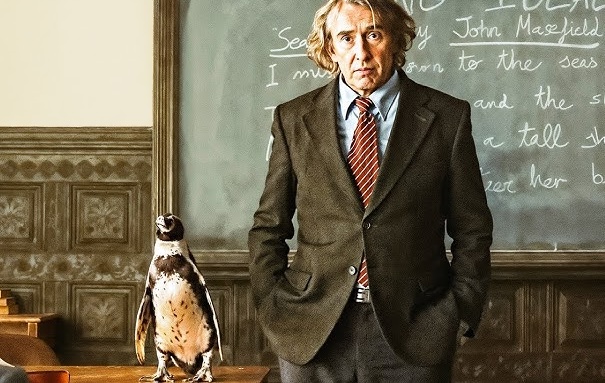
Adapted from Tom Michell’s memoir by the ever industrious Jeff Pope, The Penguin Lessons begins in 1976, when Michell (Steve Coogan) is a somewhat disaffected English teacher, beginning a new post in a private school in Argentina. He arrives in a country that has recently undergone a brutal coup and takes up his post under the watchful gaze of Headmaster Buckie (Jonathan Pryce), a man who prefers to put the needs of the school first and pretend that the current political upheaval is of no consequence. The only friend Tom makes on the staff is Tapio (Björn Gustafsson) a well-meaning but humourless Finlander, who seems to have the knack of saying the wrong thing every time he opens this mouth.

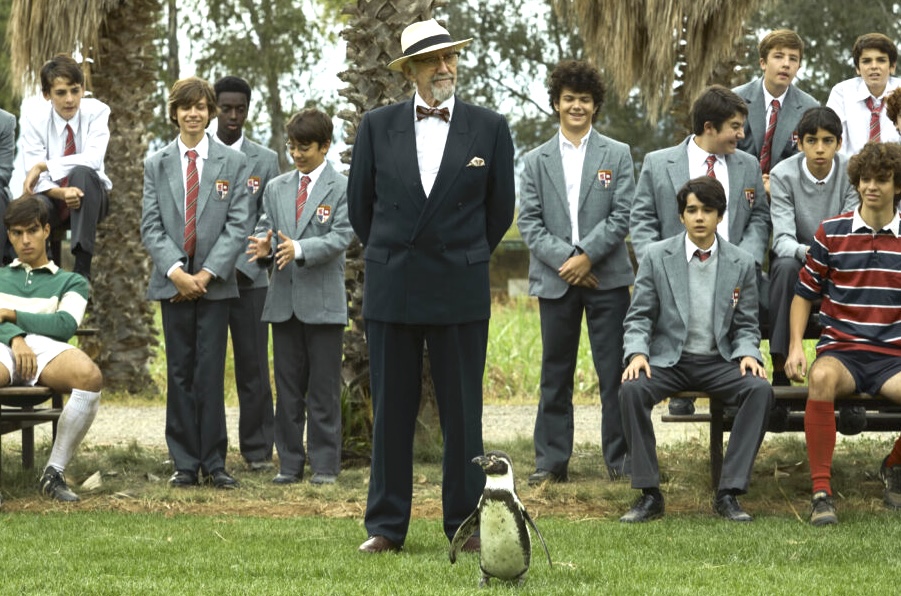
On a brief visit to Ecuador, Tom chances upon a group of oil-covered penguins washed up on a beach. One of them is still alive and – mainly because he’s trying to impress a young (married) woman he’s met in a dancehall – Tom takes the luckless bird back to his hotel room and cleans him up. Having acquired the penguin – Tom dubs him ‘Juan Salvador’ – he finds it impossible to get rid of it, the penguin following him hopefully everywhere he goes. Eventually, Tom has no option but to take Juan Salvador back to the school and keep him hidden in his room… until, in a moment of madness, fuelled by the indifference of his privileged pupils, Tom is prompted to bring the creature into the classroom…

The Penguin Lessons could so easily descend into a mawkish comedy at this point – and there’s no denying that Juan Salvador (or at least the penguin actor who portrays him) is impossibly cute, coaxing adoring sighs from the audience every time he waddles engagingly onto the screen. But Pope’s script skilfully touches on darker themes, dealing with the brutal regime of the Junta and the plight of the ‘disappeared,’ the thousands of people arrested by Perón’s forces. Tom manages to distance himself from the situation until Sofia (Alfonsina Carrocio), the daughter of the school’s housekeeper, Maria (Vivian El Jaber), is arrested on the street and taken away to be ‘interrogated.’

Coogan is on impressive form here, portraying Tom as a cynical, hardbitten loner with something lurking in his past. The short scene where we discover the reason for his remoteness is affecting because it is so understated and yet so utterly believable; likewise, the scene where Tom is prompted to confess to Maria that he could have tried to help Sofia as she was being arrested but was ‘too scared.’

Peter Cattaneo directs with a lightness of touch that effortlessly fuses the film’s disparate elements. There are many who will criticise its ambition but, to my mind it’s beautifully handled: a funny, touching story set against a tumultuous background.

And now, if you’ll excuse me, I’m off to p-p-p-pick up a penguin.

4 stars

Philip Caveney
Dr Strangelove: National Theatre Live

29/03/25

Cineworld, Edinburgh

In 1964, I watched Stanley Kubrick’s dark satire, Dr Strangelove, in an RAF cinema somewhere in darkest Lincolnshire. I was thirteen years old, arguably a bit too young to fully appreciate its biting satire, but I remember being absolutely terrified by the apocalyptic ending, which left me feeling decidedly nervous about the world’s future.

Fast forward to the early 1980s, where I attend a stand-up gig at the Old Grey Mare pub in Didsbury, Greater Manchester. Friends have encouraged me to go along and catch a gifted young impressionist called Steve Coogan, who they predict ‘has a promising future ahead of him.’ It costs me fifty pence to get in and the funniest routine is the one where Coogan adopts the persona of a BBC reporter, commentating on a live tragedy unfolding in… er… Camberwick Green.

What I could never have predicted is that in 2025, Coogan would be starring in an adaptation of Kubrick’s film, adapted by Armando Iannucci from the original screenplay co-written by Kubrick and Terry Southern – and, perhaps more pertinently, that a story that played like an outrageous spoof in the 1960s feels suspiciously like a cautionary warning in the present day.

Brigadier General Jack D Ripper (John Hopkins) has a paranoid breakdown and orders a B52 bomber, piloted by Major TJ ‘King’ Kong (Coogan, in one of four roles) to drop a nuclear device on a target in the Soviet Union. President Merkin Muffley (also Coogan), after being briefed by General Buck Turgidson (Giles Terrera), finds himself presented with the tricky task of contacting the Russian President to warn him of the incoming attack. The Russian premier is understandably not too happy about the situation, especially when he learns that the aircraft is maintaining complete radio silence, and that the attack can therefore not be called off.

A whole series of disastrous events ensue…

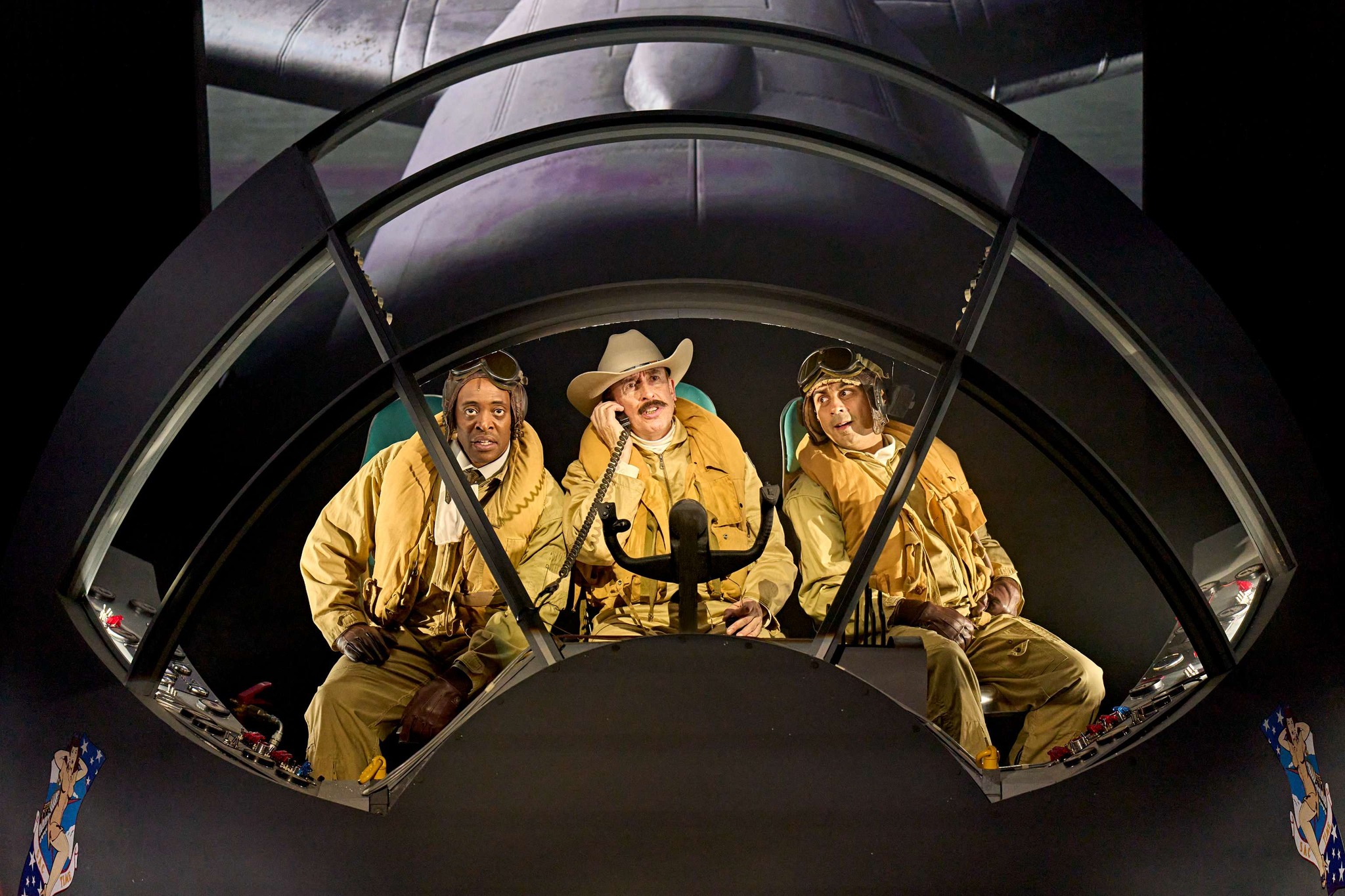
This brilliantly-staged production is a weird hybrid – part play, part film – and at times it is astonishing in its sheer invention. Coogan is extraordinary. Like Peter Sellars before him, he also takes on the role of RAF officer Group Captain Lionel Mandrake and, of course, the titular Dr S, a man who can’t seem to stop himself from making involuntary Nazi salutes… (Now where have I seen that recently?) Some of the lightning-fast costume changes he’s obliged to undergo are so slickly done that I’m left gasping.

But it’s not just Coogan who excels here. Hopkins plays the cigar-chomping, alpha male, Jack D Ripper with panache, while Terrera milks plenty of laughs as the scheming, self-serving Turgidson. There’s a huge cast at work here and every one of them is drilled to perfection.

Hildegard Bechtler’s set design is accomplished, opening and closing to disclose a wild variety of settings, even managing to convincingly place the audience in the cockpit of a B52 bomber, flying over mountainous terrain. Iannucci handles the adaptation with a light touch, capturing the original film perfectly and only occasionally tweaking the script to accommodate more recent references.

You don’t have to have seen the original to appreciate this superb production, but it might prompt many to investigate it on streaming. Kubrick made many great films over his long career and was famously pernickety about his work. But I have no doubt that he would be absolutely delighted by what director Sean Foley and his team have done with what could be the filmmaker’s greatest achievement.

5 stars

Philip Caveney

The Lost King

07/10/22

Cineworld, Edinburgh

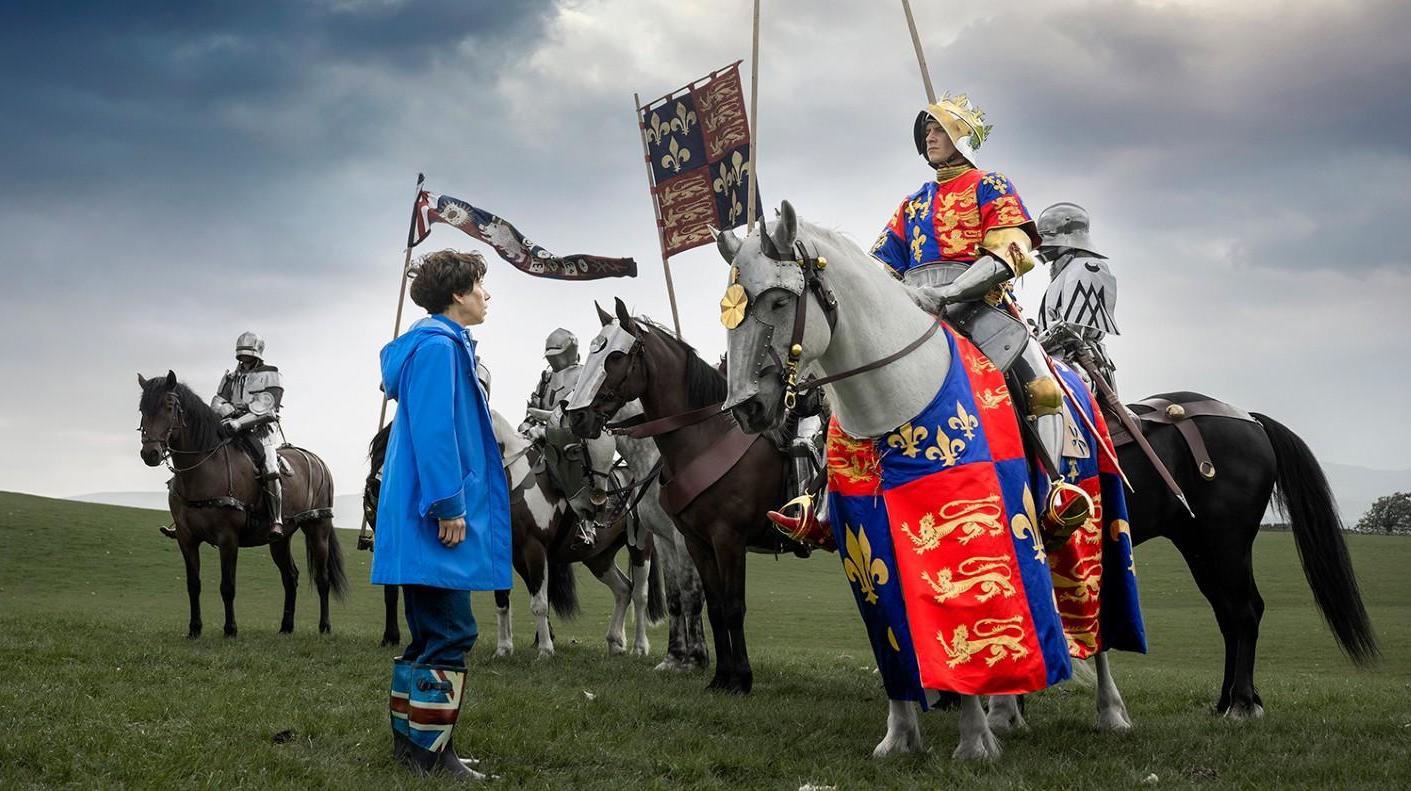
The Lost King is based on a true story – how a woman called Philippa Langley came to be the driving force behind the discovery of the remains of King Richard III… underneath a council car park in Leicester. Written by Steve Coogan and Jeff Pope and directed by Stephen Frears (the team behind the excellent Philomena), the film relates how Langley (Sally Hawkins), an ‘ordinary woman’ living in Edinburgh, first becomes interested in the last of the Plantagenet kings, while watching a performance of Shakespeare’s eponymous play. The titular role is performed by a young actor (Harry Lloyd) and thereafter, Langley experiences visions of ‘Richard’, who seems to be waiting for her to do something.

Much to the bemusement of her ex-husband, John (Coogan), and her two young sons, Langley’s interest quickly develops into a full-blown obsession. She reads everything she can find about Richard, she joins a group of local enthusiasts and, eventually , she finds herself in Leicester and that fateful car park. After making her way a spot helpfully marked by a large letter R, she becomes convinced that she’s standing on Richard’s grave.

I know. If this hadn’t actually happened it would be risible. But it did happen, so get over it.

Convinced she’s right, Langley approaches archeologist Richard Buckley (Mark Addy) at Leicester University, and persuades him to help her to organise an excavation of the car park. But where are the funds going to come from?

The film has stirred up some controversy by suggesting that, although Langley was undoubtedly the prime mover behind the campaign to find Richard – she actually raised most of the money via crowdfunding – she was latterly sidelined by Leicester University, who monopolised the subsequent discovery and dismissed her as an ‘amateur’. One man in particular, Richard Taylor (played here by Lee Ingleby), comes across as especially unpleasant and the real Taylor, former Vice Chancellor of the university, is currently threatening legal action. Surely it would have been kinder at least to give the character a different name? (This would also have avoided having yet another Richard in the story.)

Whatever the truth of the case, this is a fascinating story about self-belief and perseverance. I like the fact that Langley is not deified here, but presented as a far from perfect individual, selfishly devoting everything to her obsession, no matter what the cost to herself or her family. And I like the device of having Richard as part of the ongoing adventure, offering a little more depth to the proceedings.

While the whereabouts of a long-dead body is arguably low-stakes, recent events have shown how pageantry, pomp and circumstance really seem to matter to huge swathes of the population, and it’s always a delight to see Edinburgh (my home city) depicted onscreen in all its glory – even when, in certain scenes, it’s pretending to be Leicester!

3.8 stars

Philip Caveney

Greed

22/02/20

Steve Coogan’s regular collaborations with director Michael Winterbottom always yield interesting results. There’s the iconic 24 Hour Party People, the various iterations of The Trip, the splendidly labyrinthine A Cock and Bull Story – but none of these can quite prepare a viewer for the caustic evisceration of venture capitalism that is Greed. The film isn’t subtle in its approach; on the contrary, it goes in with all guns blazing and neatly obliterates its chosen targets.

Coogan plays Sir Richard ‘Greedy’ McCreadie, a man who has positioned himself as a major player in the fashion industry, mostly by virtue of being meaner and crueller than the competition. As he approaches his sixtieth birthday, he finds his image smeared by bad publicity, so he decides to throw a Gladiator-themed birthday bash on the Greek island of Mykonos. He invites his ex-wife – and titular head of his company – Samantha (Isla Fisher), his new partner (Shanina Shaik), his aged mother (Shirley Henderson), his son, Finn (Asa Butterfield), and a whole host of VIPs. The event will be staged as a gladitorial extravaganza, which naturally involves building a Roman ampitheatre and will even feature a lion called Clarence. What could go wrong?

Through the ensuing confusion wanders the hapless Nick (David Mitchell, pretty much playing himself). He’s Sir Richard’s chosen biographer, clearly struggling to put together a sympathetic portrait of an odious subject – though he does find some solace in his brief exchanges with personal assistant, Cathy (Pearl Mackie), who has her own reasons for hating her boss. McCreadie is a man who complains that the local beach is occupied by ‘unsightly’ Syrian refugees, a man who – instead of paying them to make themselves scarce (which would be bad enough) – tricks them into working as his waiters, complete with Roman slave costumes. With his slicked back grey hair and outlandishly capped teeth, McCreadie is quite clearly styled on Sir Philip Green, right down to the appropriation of his workers’ pension funds, the profits from which go straight into the purchase of yet another luxury yacht. If anybody on the planet had an ounce of sympathy left for Green, this film will neatly extinguish it.

Winterbottom (who also wrote the screenplay) makes no bones about his utter contempt for his subject. Though he examines McCreadie’s formative years, when he was card-sharping his way through boarding school, there’s never any attempt to create sympathy for the character. He is, quite simply, the product of privilege – an arrogant, hateful man addicted to the aquisition of more and more wealth, for no better reason than the fact that he has a natural ability for it. Though Coogan often has some amusing lines, its easier to laugh at McCreadie than with him.

Greed has been widely criticised for a scattershot approach to its central subject, but it’s fueled by an almost incandescent sense of anger, a disgust that creatures like McCready are allowed to exist and prosper in a world that ought to have the sense to depose them The closing credits offer a horrifying list of statistics about the world’s wealth, but they are hardly necessary. The film has already instilled a feeling of utter shame.

4.7 stars

Philip Caveney


Stan & Ollie

18/12/18

I’m no Laurel and Hardy aficionado, but of course I know who they were and the nature of their work; I haven’t spent my life under a stone! And I’m a fan of clowning, generally, and a sucker for a biopic. So, off I go to the local multiplex, to catch a preview screening of this much-talked-about movie.

It’s a gentle film, lovingly created, with two stellar performances at its heart. John C Reilly (Hardy) and Steve Coogan (Laurel) are note-perfect in their roles, embodying their real-life counterparts with obvious relish.

This is a bittersweet chronicle, detailing the latter years of the duo’s partnership. Their glory days behind them, they leave Hollywood to embark on a tour of Britain, hopeful that this will entice an eminent producer to get behind their latest movie idea: a comic retelling of Robin Hood. But audience figures are low, even in small, regional theatres, and the pair are left to face the fact that their careers are largely history.

It’s beautifully played, and the pathos is at times unbearable, but I can’t help feeling it’s all a little… subdued. I’d like everything dialled up a notch, and more focus on the emotional consequences of what happens to the pair. The script (by Jeff Pope) is terribly restrained; I’d prefer it if the leash were loosened just a tad.

Still, this is eminently watchable, with some cracking moments to relish. The interplay between the comics’ wives is particularly enjoyable: Lucille Hardy (Shirley Henderson) and Ida Kitaeva Laurel (Nina Arianda) were evidently as chalk and cheese as their husbands, and their reluctant friendship is a highlight of the film.

A good movie, then, but not a brilliant one, despite those fine impersonations of two comedy legends.

3.8 stars

Susan Singfield

Mindhorn

05/05/17

Here’s a bit of an oddity – a movie shot on the Isle of Man, that isn’t pretending to be Scotland or Ireland or Monte Carlo, but actually is, of all things, the Isle of Man. That’s because the location was the regular haunt of fictional 80s cop, Mindhorn (think a cross between Bergerac and the Six Million Dollar Man and you’re pretty much there). But time has moved on and actor Richard Thorncroft (Julian Baratt) has lost his hair, developed a beergut and is finding it increasingly difficult to land decent acting work, reduced now to advertising corsets and support stockings. This is doubly annoying considering his old co-star, Peter Eastman (Steve Coogan) has managed to string out his spin-off series, Windjammer for eight successful seasons and still lives on the island in unabashed luxury.

Thorncroft thinks he sees an opportunity to revitalise his own career, when a suspected serial killer, who calls himself ‘The Kestrel’ (Russell Tovey) announces to the police that he will talk to only one person – Mindhorn himself. Thorncroft heads back to his old stamping ground and begins to reconnect with people from his past – not least, his regular love interest on the series, Patricia Deville (Essie Davies) who now lives with Thorncroft’s old stunt stand in, Clive (Simon Farnaby). But as the events unfold, the former star is drawn into a bit of amateur sleuthing – and it becomes apparent that things may not be exactly what they seem…

Mindhorn may not be big on belly laughs, but it’s a decent comedy thriller with an appealing central premise and it’s shot through with a genuine sense of pathos. Thorncroft’s desperate need to rekindle his former star power verges on desperation only leads him, inevitably into deeper humiliation. The film boasts a starry cast, including Andrea Riseborough, Simon Callow, Harriet Walter and (in an uncredited cameo) Kenneth Branagh, who enjoys one of the film’s most outrageous scenes. Barrett makes a convincing transition to leading man and Essie Davies is also terrific as Mindhorn’s lost love. It’s clear from the outset that the two of them have some unfinished business.

So yes, enjoyably silly stuff. Make sure you stay till the end of the credits for a showing of Mindhorn’s wonderfully naff power ballad, You Can’t Handcuff the Wind, the dreadful lyrics of which may just be worth the price of admission alone.

4.2 stars

Philip Caveney