Simon Wilkinson

The Glass Menagerie

07/11/25

Royal Lyceum Theatre, Edinburgh

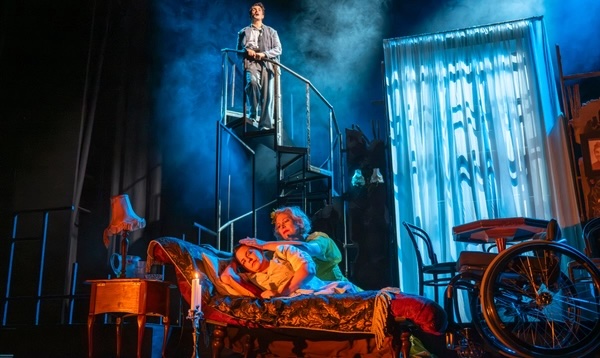
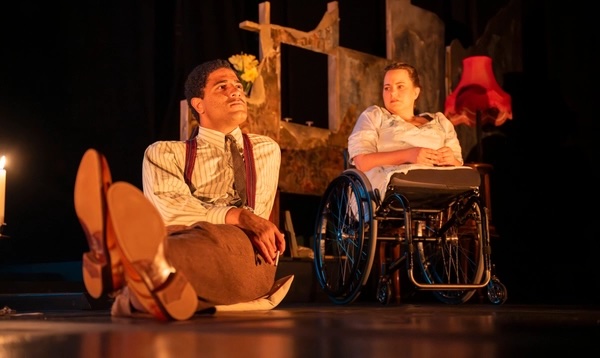
Directed by Andrew Panton, this production of The Glass Menagerie (from Dundee Rep, Citizens and the Royal Lyceum) is an altogether gentler and less histrionic affair than other interpretations I have seen – and all the more compelling for it. Emily James’ barely-there set echoes the characters’ fragility, underscoring the narrator’s opening assertion that the play “is not realistic.” The overt theatricality – the fourth-wall breaking; the exaggerated miming as the family eat a meal – paradoxically emphasises the underlying authenticity, the idea that this is “truth in the pleasant disguise of illusion”.

The time: 1937. The place: St Louis, Missouri. Our narrator is Tom Wingfield (Christopher Jordan-Marshall), and it’s no coincidence that he shares his initials with the playwright. The Glass Menagerie was described by Tennessee Williams as “a memory play,” a loosely autobiographical attempt to pin down his relationship with his emotional past – so it makes perfect sense that Tom should be an aspiring writer, desperate to escape the clutches of a dead-end job in a broken economy. He is consumed by the need for freedom in all its guises – creative, personal, sexual – bitterly resentful of his mother’s insistence that it is his duty to stay at home and provide for her and his sister.

His mother, Amanda (Sara Stewart), is the kind of fading Southern belle Williams is famous for, but – at least in this iteration – she’s less monstrous than Blanche DuBois or Maggie the Cat. This Amanda reminds me more of Austen’s Mrs Bennett: a woman made ridiculous by her desire to find a husband for her daughter, even though her zealotry makes perfect sense in a society where women are financially dependent on men. Stewart imbues Amanda with warmth and likability, while also making clear exactly why Tom finds her so intolerable.

Amy Conachan’s Laura is irresistible. She is Tom’s older sister, but a combination of shyness and disability means that she is far less worldly-wise than him. In fact, they are opposites in almost every respect. While Tom finds the city too small and claustrophobic, Laura is agoraphobic, too terrified even to open the front door, let alone build a life for herself outside the home. Tom rails against his situation but Laura has ruefully accepted her lot in life, successfully side-stepping Amanda’s attempts to set her up on dates and dedicating herself to the care of her collection of delicate glass ornaments. So it’s all the more heartbreaking to see her open up to Tom’s kindly friend, Jim (Declan Spaine), only to have her hopes dashed by his smiling comment that he’d love to have a sister just like her. Exquisitely acted, the extended duologue between this pair is a real highlight for me.

The dreamy nature of the play is further emphasised by the music, liltingly performed by Spaine as the story unfolds, and Simon Wilkinson’s light design perfectly complements the ethereal atmosphere, at times illuminating the characters’ faces in such a way as to almost create cinematic close-ups, so that we’re forced to focus on their pain and misery.

This beautifully-realised production of The Glass Menagerie has only one more showing at the Lyceum, so you’ll have to be quick if you want to get yourself a ticket for tonight’s performance.

4.6 stars

Susan Singfield
To Save the Sea

10/10/24

Traverse Theatre, Edinburgh

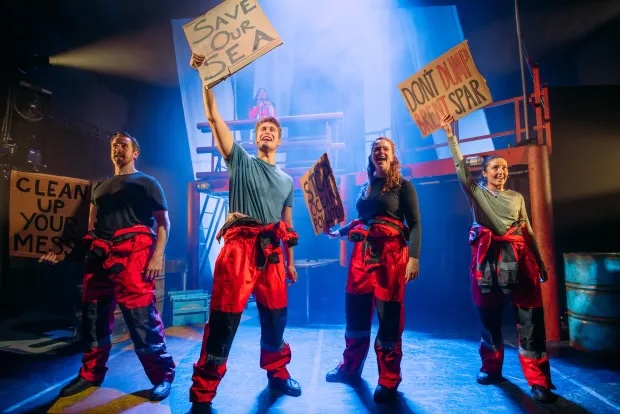
If ever I were asked to compile a list of ‘unlikely ideas for a musical,’ the story of the Brent Spar oil rig might well up there towards the top. How could such a tricky subject, set in such a obscure location, ever be convincingly staged? Well, this rousing production, written and directed by Isla Cowan and Andy McGregor is an object lesson in how to make such a venture work – a heartfelt polemic, for sure, but a supremely entertaining sung-through musical at the same time. And you don’t have to be a committed activist to appreciate the importance of what happened back in 1995 – and to realise that not enough has changed since then.

Many will remember the story of the decommissioned Brent Spar, which (largely as a cost-cutting exercise) was scheduled to be blown to bits by its owners, Shell, before being consigned to the depths of the North Atlantic, where it would cause untold damage to the ecosystem. But the company’s plans came to the attention of a team of Greenpeace activists, who sailed out from Shetland, climbed aboard the rig and steadfastly refused to leave, even after being repeatedly blasted by water cannon.

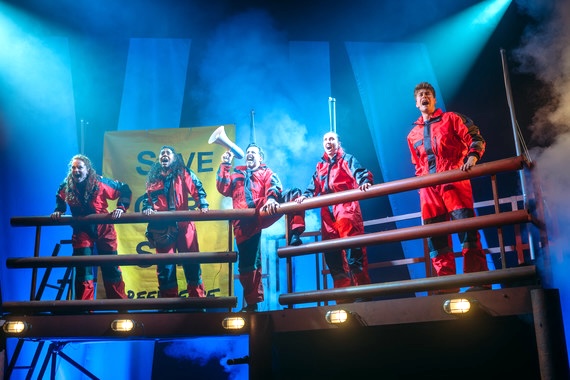
In this version of events, the names of the protagonists have been changed. Team leader Karl (Matthew McKenna) is driven by his desire to do the right thing for the environment. He’s backed up four others: feisty rich girl, Engel (Katie Weir), whose parents made a lot of money from fossil fuels; student, Colin (Nathan French), who has impulsively abandoned his University studies in order to go on this mission; journalist with a conscience, Brianna (Kaylah Copeland), who has promised to do everything she can to bring this matter to the public’s attention; and stay-at-home mum, Rachel (Kara Swinney), taking a break from her domestic duties to make a stand for ‘something that matters.’

Together the disparate team sail out to the rig and prepare to face the opposition.

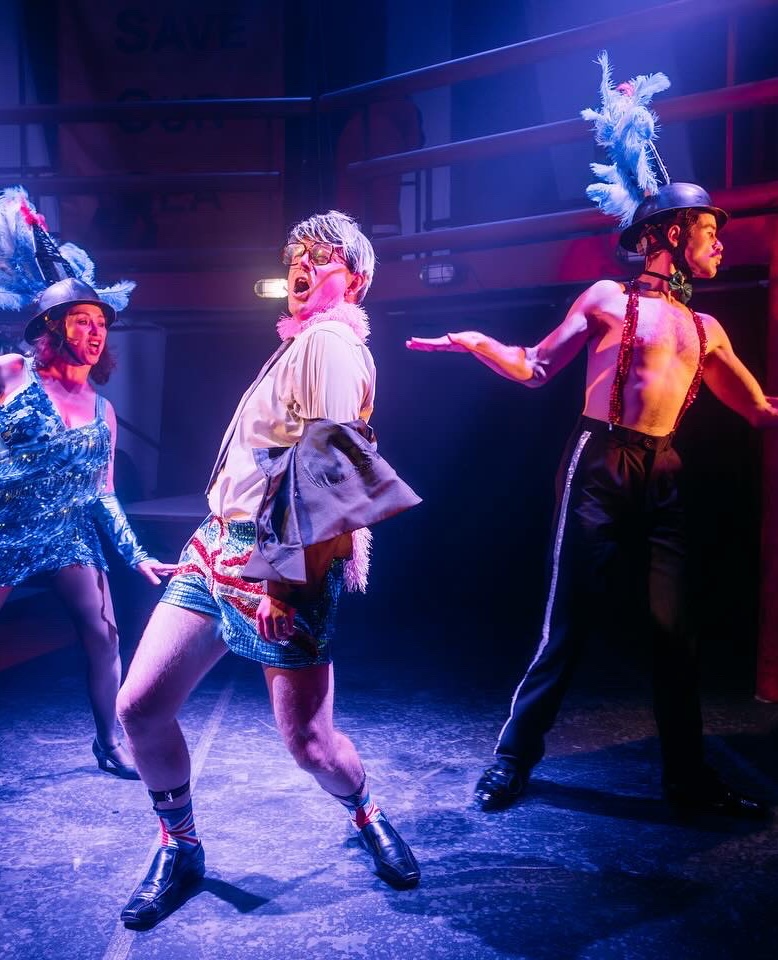
Meanwhile, a scheming triumvirate of Shell executives, Rupert (David Rankine), Karen (Helen Logan) and David (Ewan Somers), are determined to end the occupation as quickly as possible. This could cost them a lot of money! The trio are played as comic relief to the action, drawing up their dastardly plans almost in the style of Gilbert and Sullivan villains, romping around in a variety of costumes and occasionally breaking away to embody real life characters. Somers does a hilarious job of embodying John Major as (trust me) you’ve never seen him before, while Logan briefly dons a bald pate to impersonate German chancellor, Helmut Kohl.

Claire Halleran’s impressive set design convincingly evokes the rugged location and this is accentuated by Fraser Milroy’s sound and Simon Wilkinson’s lighting. The songs (also by Cowan and McGregor) are uniformly impressive, all majestic chords and soaring vocals. All the performers have impressive ranges and, when the five protestors join together in powerful harmony, the results are nothing short of spectacular. A scene where Rachel proudly proclaims the importance of her new-found role is particularly moving and I have to confess to having something in my eye by the time Swinney reaches the final chorus.

This is only at the Traverse for a couple more nights before moving on to tour a series of Scottish locations through October, finishing up in Inverness on November 2nd. If you can get seats, I urge you to make the effort. To Save the Sea is a deeply committed and ultimately moving piece of musical theatre with an important message to deliver.

4.6 stars

Philip Caveney

Group Portrait in a Summer Landscape

05/10/23

Lyceum Theatre, Edinburgh

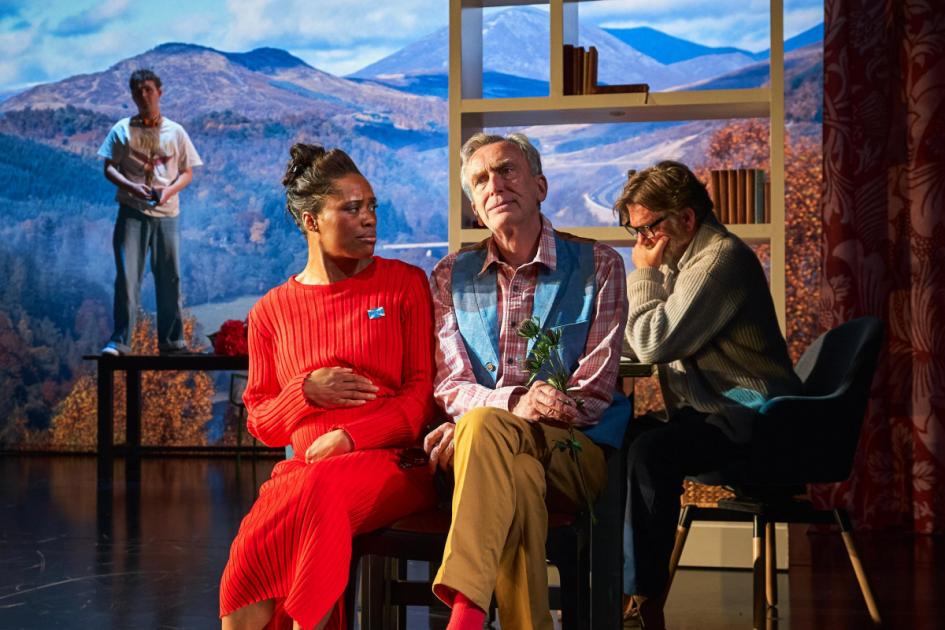
Patriarch Rennie (John Michie) has invited a disparate group of people to his retirement party. He’s had to keep the guest list secret from his wife, Edie (Deirdre Davis), because – with the exception of her old pal, film star Jimmy Moon (Benny Young) – there’s no way she’d agree to hosting the people he has in mind. En route to the couple’s country house in the Scottish Highlands is their daughter Emma’s ex-husband, for example – even though their wedding ended acrimoniously and Charlie (Matthew Trevannion) is renowned for wreaking havoc wherever he goes. Of course, he maximises the antagonism by bringing along his latest girlfriend, Jitka (Nalini Chetty), and why wouldn’t Rennie ask the newly-betrothed Frank (Keith Macpherson) and Kath (Patricia Panther) to join the party? It’s not as if Frank’s always been in love with Emma (Sally Reid) or anything, is it? Oops. There’s an uninvited presence too: the ghost of Rennie and Edie’s son, Will (Robbie Scott), who watches over the day’s proceedings with increasing horror…

Playwright Peter Arnott says he set out to to write a ‘Scottish Chekhov’ and to some extent he has succeeded. At first it seems as though, unlike Chekhov, Arnott is looking back at the political moment that nominally serves as the play’s pivot; he has the advantage of hindsight to create dramatic irony. After all, we know the outcome of the 2014 Scottish independence referendum, the divisive topic inflaming the characters. But we soon learn that this is just a distraction: as Charlie says, it’s mere tinkering around the edges while ignoring the real revolution that is on its way, and which only the rich and ruthless will be able to survive.

If Arnott’s script is retro, then David Greig’s direction is decidedly contemporary, a deliberate jarring of styles that helps to illuminate the sense that something is changing, mirroring the mismatch between parochial politics and apocalyptic predictions, Chekhovian naturalism and magical realism. I like the dissonance.

Jessica Worrall’s set also leans into the contrast, a hyper-realistic backdrop juxtaposed with a more figurative interior: a glorious photograph of a Highland glen and a sketched-in kitchen-diner, symbolised by oversized shelving units, enormous tables and vast floral curtains.

Both Simon Wilkinson’s lighting and Pippa Murphy’s sound are integral to the production: the former spotlighting the snippets of conversation that combine to drive the plot, the latter signalling the shifts to the ghost’s point of view, as the sound distorts and fragmented memories play through Will’s Walkman. This supernatural presence is one of my favourite things about the play: Scott physicalises the spirit’s pain and confusion with a beautiful awkwardness.

The first act is very strong, an interesting set-up that promises something the second doesn’t quite deliver. Although the characters are all cleverly depicted, the piece feels somehow unfinished, as if the story arc has been cut short. Rennie’s revelation, when it comes, is anticlimactic, and I don’t quite buy it as a reason for inviting these particular people to his home (why would anyone ever invite Charlie anywhere?). But, even if it’s a little opaque and doesn’t offer any real answers to the issues it grapples with, Group Portrait in a Summer Landscape is an intelligent and ambitious play, leaving us with a lot to think – and talk – about.

3.8 stars

Susan Singfield